
Influence of GMAW Process Parameters and
Selection Techniques on the Quality of a Welded
Joint
Er. Saurabh Gandhe1, Prof. V.S. Aher2, Prof. Dr. V. D. Wakchaure3 1
PG Scholar, 2Assistant Professor, 3Head of Department, Mechanical Engineering, Amrutvahini college of Engineering, Sangamner 422605, India
Abstract: Metal inert gas welding is one of the important joining processes in the industry. There is wide range of applications of MIG welding to join similar as well as dissimilar materials. This process is also employed for thickness of sheets from lower to higher thickness. It is essential to have an appropriate quality of welded joints for each application. The quality of joints is dependent on various factors such as tensile strength of the joint, microstructure, hardness and penetration of the joint. These factors are affected by different welding input process variables or their combinations such as welding voltage, welding current, wire feed rate, welding speed, etc. Higher quality of the joints is ensured by accurate combinations of these variables. This method to find out combination of variables such that the value of input is lower and output is higher is called an optimization. Various optimization techniques are available to finalize the parameters, which are Taguchi DOE, Taguchi Grey based, ANN network, surface response methodology, regression analysis, mathematical modeling, etc. In this paper weight age of input variables, output variables and optimization technique is discussed per literature. The study is limited for Carbon steel sheets having thickness up to 6mm. Based on the weight age the parameters and method of optimization is suggested. An overview of various techniques of optimization have been studied, effects of different parameters on the quality output parameters are discussed and appropriate range is suggested based on the literature review.
I. INTRODUCTION
MIG welding [8] can be used as a manual welding operation as well as automatic process. Main advantage of the MIG welding is automatic continuous feeding filler wire. It can also be used to join unalloyed steel, aluminum alloy and stainless steels. Robotic MIG welding is found to be a very effective tool to attain required quality, higher productivity, better working condition, and semiskilled operators can cooperate. MIG welding [35] can be operated manually as well as in automatic way. The use of robotic welding increases the productivity and the quality of the welded joints. Semiskilled operator can operate the machine. But operator should have a proper knowledge of programming of the machine. Specific design of work piece, equipment, shielding gas, electrode size and type of equipment are discussed in this study. Due to flexibility [6] and higher speed, the MIG welding is one of the widely used processes among all the welding processes. Input process parameters such as weld current, voltage and preheat temperature are optimized in order to attain output properties such as tensile strength and percentage elongation. Here grey based Taguchi analysis is used to optimize the parameters and mathematical equation is formed by using a Regression analysis. Results shows that preheat temperature are most affecting factors on the tensile strength.
properties are the important parameters of welding joint quality. Input parameters are affected on the quality of weld joint. Previously traditional methods were used to estimate the required input parameter of the welding process. This method was dependent on trial and error methods. So the new techniques such as Artificial Neural Networks (ANN), Design of Experiments (DOE) and Finite Element Modeling (FEM) are used for optimization of multiple variables.
[1] Optimization technique by using a Taguchi as well as Grey relational analysis in order to optimize the different process parameters to join the materials AISI1010 & AISI1018 with the MIG welding. After joining the output variables like hardness of metal and tensile strength are checked by varying the input parameters such as current, voltage, welding speed, and bevel angle. [3] MIG welding of the aluminum is very critical process. It is carried out to join the aluminum of grade AA219-T87 which is precisely used in aerospace applications. Optimization of different parameters such as welding current, Voltage and welding speed are carried out by using L9 orthogonal array in Taguchi method to improve its ultimate tensile strength and hardness. As there are two outcomes of the process, grey relational analysis was also used in addition with Taguchi. [4] Ultimate tensile strength, yield strength in tension and percentage elongation are taken as output parameters to judge the quality of MIG welded joints of material AISI 316L austenitic stainless steels. As here also there are three output variables so the grey relational analysis by Taguchi is used in order to optimize welding current, gas flow rate and nozzle to plate distance. Investigated [5] and used different optimization models such as ANN–Quasi Newton, ANN–GA, and ANN–SA in order to optimize the different process parameters of MIG welded joints of Aluminum alloy plates. In their study they observed that ANN GA model has given a best performance by giving minimum error and shows that most affecting factor on the welding strength was welding speed. Increase in welding speed will decrease in welding strength. Two stainless steel [7] plates of thickness 6mm are welding with MIG welding by mixing the fluxes as Sio2 and Cr2O3. Input parameters varied as weld current, voltage and welding speed in order to achieve the output parameters such as penetration depth, size of bead. Optimizations of parameters are carried out by using L9 orthogonal array using Minitab 16 software. All these parameters are used three times such as without flux, with Sio2 flux and with Cr2O3 flux.
New modified model [19] and equation is developed for MIG welding and regression analysis is used to formulate the model for lap joint. Total bead area is taken as a output parameters and current, time, speed, voltage are taken as input parameters. Welding speed [20] versus wire feed rate for MIG welding lap joints were tested for aluminum sheets of 1.6mm thickness. Weld bead, the bead width, back bead width, and bead cross-section area are the parameters taken for comparing different values of wire feed rate and welding speeds. Increase in the welding speed and wire feed rate have reduced the output parameter values. [22] MIG welding joints of AISI 316L (austenitic stainless steel) with AISI 409M (ferritic stainless steel) are prepared to optimize the notch angles and root gap in the welding process to improve ultimate tensile strength and yield strength of the welded joint. [23] MIG welding and Laser MIG welding is differentiated for various factors. Results show that welding time, consumption of filler material, stress and deformation of the material in MIG welding is more than that in laser-MIG welding. Studied the effects of welding speed versus wire feed rate for MIG welding of Aluminum alloy. It is seen that Increase in welding speed causes increase in the wire feed rate and decrease in required outcome value. Studied [24] the effects of welding speed versus wire feed rate for MIG welding of Aluminum alloy. It is seen that Increase in welding speed causes increase in the wire feed rate and decrease in required outcome value. AISI 1040 [25] sheets are welded by MIG welding. Input parameters like arc voltage, arc current, welding speed, nozzle to work distance and gas pressure are optimized for improving the quality of welded joints. L9 Taguchi method and regression analysis is adopted for optimization.
Flux core arc welding [26] of two steel sheets is carried out to optimize the input parameters such as welding current, arc voltage, and nozzle-to-plate distance, electrode-to - work angle and welding speed in order to achieve greater weld penetration. In this study the central composite rotatable design is used as a tool for optimization. [27] Taguchi and ANOVA methods of analysis to optimize the input process parameters of MIG welding for C20 mild steel such as weld current, voltage and welding speed in order to achieve higher values of penetration. [28] Taguchi L9 orthogonal array method of analysis to optimize the input process parameters of MIG welding for 5A06 Aluminum alloy such as weld current, voltage, wire feed rate and plasma current in order to achieve higher values of Tensile strength, % elongation and Macrostructure. [30] Used Taguchi orthogonal array method of analysis to optimize the input process parameters of MAG welding for stainless steel 304L and 308L such as feed rate, distance, welding speed, laser power and defocus laser in order to achieve higher values of penetration, bead cross section and macrostructure. [31] Used Taguchi L16 orthogonal array method of analysis to optimize the input process parameters of MAG welding for stainless steel 304L and 308L such as electrode size, voltage, current, shielded gas, travel speed in order to achieve higher values of hardness. [32] Used Grey based Taguchi method of analysis to optimize the input process parameters of MIG welding for steel plates such as feed rate, distance, welding speed, voltage and gas flow in order to achieve higher values of penetration, bead height and bead width.
[33] Grey comparative method of analysis to optimize the input process parameters of Laser MIG welding for magnesium alloy AZ31 such as laser power, weld current and welding speed in order to achieve higher values of microstructure, tensile strength and penetration. Grey comparative method [34] of analysis to optimize the input process parameters of MIG welding for AL 5083 and AL 5183 as filler wire such as weld current, welding speed, and feed rate in order to achieve higher values fatigue strength. Used mathematical modeling method [36] of analysis to optimize the input process parameters of MIG welding for AISI 416 and AISI 440 Fse such as lase power and welding speed in order to achieve higher values of weld bead size and penetration. [37] composite rotatable design of analysis to optimize the input process parameters of MIG welding for stainless steel 409M such as current, voltage, speed, nozzle to plate distance and work angle in order to achieve higher values of weld bead size and penetration. [38] Taguchi DOE of analysis to optimize the input process parameters of MIG welding for stainless steel 304L such as current, plate thickness, and gas flow rate and travel speed in order to improve microstructure and micro hardness. [40] Residual-stress field analysis to optimize the input process parameters of MIG welding for Al-2024 and Al-7150 aluminum alloy such as current, nozzle to plate distance in order to reduce the residual stresses.
the input process parameters of MIG welding of NV E690 steel joint such as weld current, laser power and voltage and distance in order to improve Tensile strength, microstructure and micro hardness. Numerical simulation analysis [47] to optimize the input process parameters of MIG welding of NV E690 steel joint such as weld current, laser power and voltage in order to improve microstructure and to reduce residual stresses. X ray biography analysis [48] to optimize the input process parameters of MIG welding of Aluminum alloy such as weld current and keyhole in order to improve microstructure. Optimized the input process parameters [49] of MIG welding of pure copper such as bevel angle, distance between torch & work piece, laser power, welding speed in order to improve microstructure, surface morphology, micro hardness and mechanical properties. Taguchi 27 orthogonal array analysis [50] to optimize the input process parameters of MIG welding of Fe36 Ni Invar alloy such as weld current, laser power, welding speed and wire feed rate in order to improve microstructure and hardness. Optimized the input process parameters [51] of MIG welding of 304 (stainless steel) such as current, gas flow rate and welding speed in order to improve microstructure and tensile strength. Compare joints of copper base metal [52] and HS201 welding wire under traditional MIG welding and laser MIG welding by varying the process parameters such as weld current, arc voltage, wire feed, welding speed and gap size in order to improve its microstructure, micro hardness and tensile strength. Optimized [53] the input process parameters of MIG welding of steel such as current, arc voltage and welding speed in order to improve microstructure and weld formation (bead dimension).
II. EFFECTS OF INPUT PARAMETERS
[image:4.612.88.531.333.483.2][1-77]In order to get a higher penetration and higher strength in the welded joints many factors are responsible which are discussed below. The contribution of each welding parameter is presented on the histogram. By referring the literature on optimization it can be said that most weight age is given for mainly three parameters which are welding current, welding speed and welding voltage.
Fig.1 Weight age of welding input parameters
A. Current
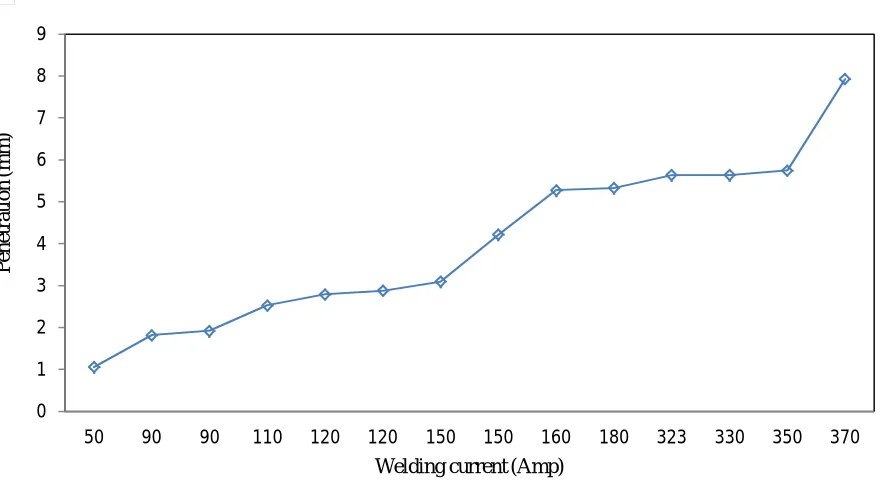
Welding current is the most important factor to achieve a high penetration. In the MIG welding process as wire speed increases, welding current also increases. But with increase in the wire feed rate, the speed at which torch is traveled should also be increased in order to cope up with wire speed and more penetration. When the torch travel speed is less, penetration will decrease
.
Fig. 2 MIG controller 0
5 10 15 20 25 30 35 40
Welding current
Welding speed
Welding voltage
Distance between torch
& w/p
[image:4.612.158.459.584.708.2]Fig.3 Variation of penetration with welding current
B. Voltage
Welding voltage is also dependent on the arc length. Voltage parameter directly affects on the heat input of the process. Very high
voltage causes excessive spatters and undercut. Similarly too low voltage also causes to increase the defects like porosity and overlapping of edges of weld joint.
Fig. 4 Variation of penetration with welding voltage
0 1 2 3 4 5 6 7 8 9
50 90 90 110 120 120 150 150 160 180 323 330 350 370
P
en
et
ra
ti
o
n
(m
m
)
Welding current (Amp)
0 1 2 3 4 5 6
20 21 22 22.5 22.5 24 25 26 26 30 35 40 42 47
P
en
e
tr
at
io
n
(m
m
)
C. Travel Speed
More torch travel speed reduces the heat input and fusion of the work piece and penetration increases with the decrease in travel speed. But too low speed also causes excessive heat inputs which also decreases the penetration.
Fig.5 Variation of penetration with travel speed
III. SELECTION OF OUTCOME VARIABLE
[1-77] Similar to the input parameters output parameters can also be selected by using histogram prepared by reviewing various literatures. As by observing histogram, the most important parameters are Tensile strength, Microstructure, Hardness and penetration. Let us discuss one by one.
Fig.6 Outcomes of the MIG welding
A. Tensile Strength
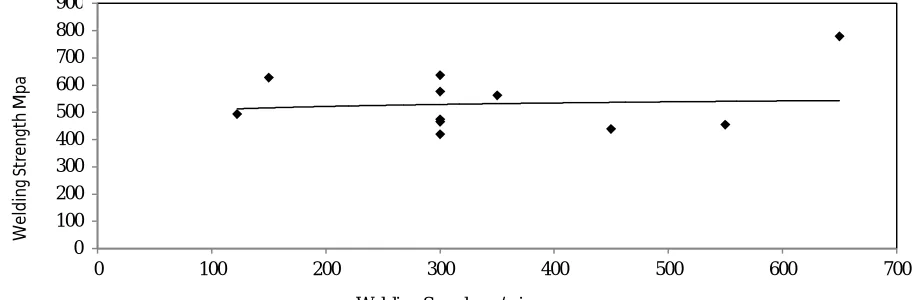
It is the measure of resistance of that joint towards the tensile force exerted during application. Most suitable term to describe the tensile strength is Ultimate tensile strength and yield strength. Ultimate tensile strength describes the stress value just before the failure where as yield strength describes indication of future failure. The yield strength is generally taken to design the welded joint. Generally, welded joints should have a higher strength than the base metal of the work piece. It can be increased by increasing the welding current generally up to 300 amps. However, best results for current are achieved at around 180amps to 240amps in terms of tensile strength.
0 5 10 15 20 25 0 1 2 3 4 5 6 7
60 90 120 150 180 210 240 270 300 330 360 390 420 450 480 510 540 570 600
P
en
et
ra
ti
o
n
(m
m
)
Fig. 7 Welding strength Vs welding current
[image:7.612.80.535.339.519.2]Tensile strength can also be increased by increased in the welding voltage up to 40 volts. Beyond this value an excessive heat will reduce the bonding and which reduces the tensile strength. A voltage from 25 Volts to 35 volts will give our required value.
Fig. 8 Welding strength Vs welding voltage
Next term which affects on the tensile strength is welding speed. Tensile strength decreases as welding speed increases. So, lower welding speed about 200 to 300mm/min will give us required value of output.
Fig. 9 Welding strength Vs welding speed 0 100 200 300 400 500 600 700 800 900
0 50 100 150 200 250 300 350
W el di ng S tr eng th M pa
Welding Current (Amp)
0 100 200 300 400 500 600 700 800 900
0 5 10 15 20 25 30 35 40 45
W el di ng S tr eng th M pa
Welding Voltage Volts
0 100 200 300 400 500 600 700 800 900
0 100 200 300 400 500 600 700
W el d in g St re n gt h M p a
[image:7.612.74.530.562.712.2]Wire feed rate is the one more factor which affects nearly same as that of welding current. For wire feed rate up to 4m/min strength increase and beyond this value strength decreases. Best results are obtained at 2 to 4 m/min.
Fig. 10 Welding strength Vs wire feed rate
B. Measurement of Tensile Strength
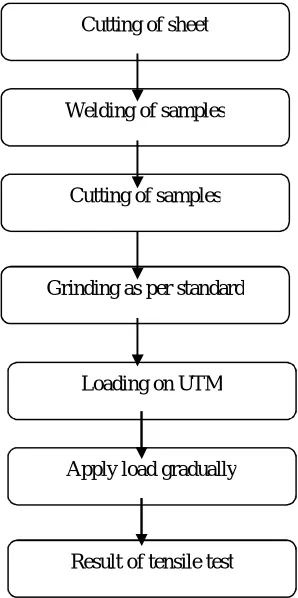
Tensile strength is measured on a equipment called as universal testing machine as shown in figure. Welded specimen is loaded between upper & middle crosshead and load applied gradually. Load cell attached to the machine records the changes in gradually applied load values.
Fig.11 Measurement of tensile strength 0
100 200 300 400 500 600 700
0 1 2 3 4 5 6 7
W
el
di
ng
S
tr
eng
th
M
pa
Wire Feed rate m/min
Cutting of sheet
Welding of samples
Cutting of samples
Grinding as per standard
Loading on UTM
Apply load gradually
[image:8.612.226.375.399.698.2]C. Microstructure
Microstructure of the material is study of metals by eyes or with the help of microscope having > 60 x magnification. This inspection is required to detect the non uniformity in the material as well as in the welded joint. It indicates the heat treatment process done on the metal. Specimen preparation and procedure is given as below.
Fig.12 Microstructure study of welded joints [75]
D. Result of Microstructure
Fig.13 a) Base metal (BM) b) Heat affected zone (HAZ) c) Fusion zone (FZ)
Microstructure of the specimen is taken at three different locations. First is the base metal as it will be compared with the other two locations. Second is heat affected zone that is exactly adjacent area of the base metal or area in between base metal welded joint. Finally third location is at welded joint location which is also called as fusion zone. Requirement for result of the microstructure shows that base metal of the steel shows a fine Pearlite, heat affected zone shows a fine Cementite while a fusion zone shows a fine tempered martensite. As martensite is harder than Cementite and Cementite is harder than Pearlite the fusion zone should be a stronger and harder than heat affected zone and base metal.
Cutting of sheet
Welding of samples
Grinding
Rough Polishing
Final Polishing
Etching
E. Hardness
[67] hardness of the metal is defined as the resistance to wear, scratches or indentation. A Brinell hardness test is suitable for MIG welded joints. Whatever the observations in microstructure test can be validated by a hardness test.
Fig.14 Hardness test of specimen.[74]
Effects of parameters on hardness: By observing the graphs below the average value of Brinell hardness number are 157 for base metal, 163 for heat affected zone and 211 for fusion zone. That means welded joint is harder than HAZ and the base metal. It is also seen that value of BHN is more up to 228 at 150amps to 220amps. Beyond this value, increase in hardness will cause increase in brittleness of a metal. So it should be restricted up to 220amps.
Fig.15Harness Vs welding current / voltage
Fig.16 Harness Vs welding speed
Similarly voltage of the welding source 22 Volts to 30 Volts and travel speed should be 150mm/min to 300mm/min in order to achieve better hardness and microstructure.
0 50 100 150 200 250
1 2 3 4 5 6 7
B
H
N
Samples with increase in value of current and voltage
HAZ BM FZ
0 50 100 150 200 250
0 50 100 150 200 250 300 350
B
H
N
Welding speed (mm/min)
Cutting of sheet
Welding of samples
Cutting of samples
Grinding as per standard
Polishing and leveling
Brinell hardness test
IV. SELECTION OF OPTIMIZATION TECHNIQUE [1-77]
Fig 17 Methods of optimization
A. Taguchi Design of Experiment
This method was founded by Dr. Genechi Taguchi. As so many experimentation is needed in trial and error method, so to avoid this delay and to reduce the cost of experimentation he suggested a DOE method. The process of selection of parameters and analysis is shown by flowchart.
`
Fig.18 Flowchart of Taguchi design of experiment
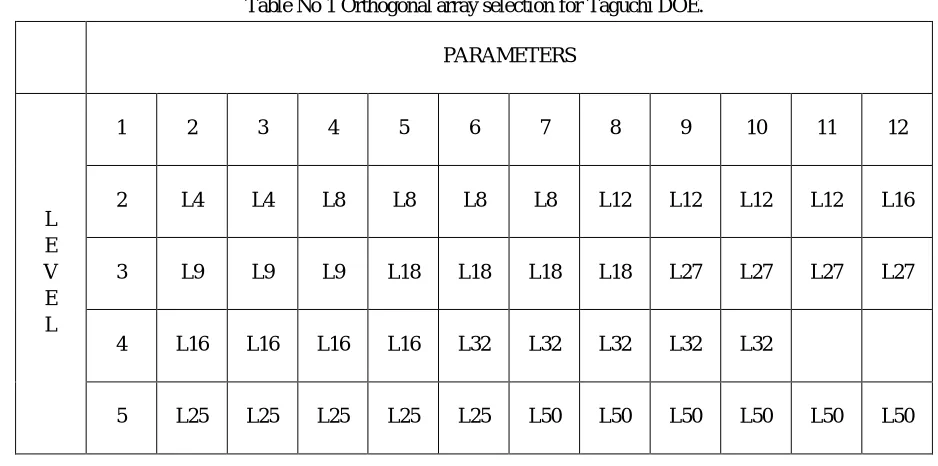
This method is suitable for single output factors and multiple input factors. According to number of input factors an orthogonal array is to be selected.
0 5 10 15 20 25
Set output factors (Quality)
Set input factors and their levels (process)
Select orthogonal array as per factors & their levels
Perform the experiments & observe change in output factors
Analysis of Signal to noise ratio
Identify optimum combination of input parameters based on S/N ratio.
END
Verify whether improvement in output parameters or not?
[image:11.612.167.429.355.694.2]Table No 1 Orthogonal array selection for Taguchi DOE.
PARAMETERS
L E V E L
1 2 3 4 5 6 7 8 9 10 11 12
2 L4 L4 L8 L8 L8 L8 L12 L12 L12 L12 L16
3 L9 L9 L9 L18 L18 L18 L18 L27 L27 L27 L27
4 L16 L16 L16 L16 L32 L32 L32 L32 L32
5 L25 L25 L25 L25 L25 L50 L50 L50 L50 L50 L50
B. Taguchi grey Relational Analysis
Taguchi design of experiment was insufficient for analysis as it can optimize only one parameter at a time. To optimize multiple outcomes variable in a single experiment the Grey relational analysis is used. It works by combining all the output variables into a single common factor. Procedure for Grey relational analysis is as shown below:
Fig. 19 Flowchart of Taguchi Grey based method Design of experiment &
execution
Estimate S/N ratio
Multiple outcomes variables
Single outcome factor
Estimation of optimized parameters
Generation of grey relation and prepare a sequence
Estimation of Grey relation coefficient
Estimation of Grey relation grade
[image:12.612.114.473.385.704.2]C. Factorial Design
[image:13.612.152.413.121.435.2]In thistype of design multiple factors are optimized having interrelation between each other. Multiple outcomes with multiple input process variables can be optimized.
Fig.20 Flowchart of factorial design of experiment
V. SUMMARY OF OPTIMIZATION TECHNIQUES
K.Y. Benyounis, A.G. Olabi (2008), “Optimization of different welding processes using statistical and numerical approaches – A reference guide” [29]
Table No 2 Difference between various optimization techniques
Comparison Taguchi design
Factorial design
Response surface methodology
Genetic algorithm
Artificial neural network
Regression
Principal component
analysis
Time for calculation Very Short Short Short Very
long Long Medium Long Level of
understanding Easy Easy Easy Difficult Moderate Easy Difficult
Accuracy of result Normal Very high Very high High High Normal High
Frequency of usage More More More Less More Less Very less
Availability of model No Yes Yes No Yes Yes Yes
Select input & output factors
Select factorial level (Input)
Create factorial design (No of input X No of levels)
Perform the experiments as per design
Analysis of output variables
Identify optimum input parameters based on percentage contribution
END
Verify whether improvement in output parameters or not?
[image:13.612.58.555.517.721.2]A. Summary Of Input / Output Parameters Relationship [77]
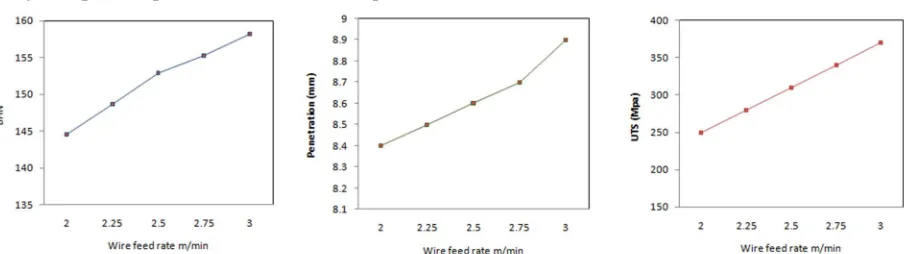
Fig.22 a) BHN Vs Wire feed rate b) Penetration Vs Wire feed rate c) UTS Vs Wire feed rate
Fig.23 a) BHN Vs Voltage b) Penetration Vs Voltage c) UTS Vs Voltage
Fig. 24a) BHN Vs Speed b) Penetration Vs Speed c) UTS Vs Speed
[image:14.612.81.533.88.215.2] [image:14.612.80.533.247.373.2] [image:14.612.77.536.406.534.2] [image:14.612.81.533.564.705.2]VI. DISCUSSION
Summarizing the techniques of optimization, for a very accurate result Factorial design or response surface methodology can be used as the time required for calculation is less and accuracy is very high. Whenever a requirement of accuracy is moderate or normal the Taguchi method is suitable as it is easy to understand, time required for calculation is very less, as per the literature review it has used very frequently more than any other method. Also it does not involve any mathematical model so quick result is possible. In case of multiple output variables, the Taguchi method is used with Grey analysis as discussed in Fig. So the recommendation is for quickest result Taguchi or Grey relational analysis and for accurate result where time is not a major concern ANN, Genetic algorithm, Principal component analysis can be a best solution.
[image:15.612.82.524.259.424.2]Summarizing an input & output variables relationship, wire feed rate is directly proportional to the output parameters of the joint which are Hardness, penetration and ultimate tensile strength. Voltage and current are also directly proportional to all the output variables while welding speed is inversely proportional to the output variables. The recommended values of input parameters are Gas Metal Arc Welding Guidelines (2014), Publication C4.200, Lincoln Global Inc, PP [29, 30 and 67] gives
Table No 3 Input parameters range for steel sheets having thickness 1 to 6mm [76]
Material Sheet thickness mm
Wire Feed m/min
Current (amp)
Travel speed (mm/min)
Voltage (volts)
Carbon steel sheets
1 2.5 80 330 18
1.5 3.8 120 500 19
2 3.8 130 450 20
3 4.4 160 500 21
4 5 175 450 22
5 5.7 200 380 21
6 6.4 220 350 22
VII. CONCLUSION
A review is carried out for welding output parameters, input parameters as most influencing parameters and most used parameters. Similar review has also carried out for optimization technique as most fast and most accurate technique by referring the literature. Among the output parameters selected parameters such as Tensile strength, Microstructure, hardness and penetration are the most important parameters to specify the quality of joint. The input parameters which affects mostly on above output parameters are identified as welding current, voltage, speed and wire feed rate. The effects of all above input parameters on output parameters is discussed and excluding welding speed rest all parameters are directly proportional to output. Welding speed is inversely proportional to the output. The study is limited for Carbon steel sheets having thickness up to 6mm so range for values of input parameters is also given as per literature review.
REFERENCES
[1] Prakash Babu Kanakavalli, B. Navaneeth Babu, Ch.P.N. Vishnu Sai (2019), “A hybrid methodology for optimizing MIG welding process parameters in joining of dissimilar metals”, proceeding in Materials Today, 15 July 2019. https://doi.org/10.1016/j.matpr.2019.05.396
[2] Bhagwan F. Jogi, A.S. Awale, S.R. Nirantar, H.S. Bhusare (2018), “Metal Inert Gas (MIG) Welding Process Optimization using Teaching-Learning Based Optimization (TLBO) Algorithm”, proceeding in Materials Today, Volume 5, Issue 2, Part 2, 2018, Pages 7086-7095.
https://doi.org/10.1016/j.matpr.2017.11.373
[3] Arunkumar Sivaraman, Sathiya Paulraj (2019), “Multi-Response Optimization of Process Parameters for MIG Welding of AA2219-T87 by Taguchi Grey Relational Analysis”, proceeding in Materials Today, Volume 4, Issue 8, 2017, Pages 8892-8900.
https://doi.org/10.1016/j.matpr.2017.07.240
[4] Nabendu Ghosh, Pradip Kumar Pal, Goutam Nandi (2016), “Parametric Optimization of MIG Welding on 316L Austenitic Stainless Steel by Grey-based Taguchi Method”, Global Colloquium in Recent Advancement and Effectual Researches in Engineering, Science and
Technology (RAEREST 2016), Volume 25, 2016, Pages 1038-1048.
https://doi.org/10.1016/j.protcy.2016.08.204
[5] Sudipto Chaki, B. Shanmugarajan, Sujit Ghosal, G. Padmanabham, “Application of integrated soft computing techniques for optimization of hybrid CO2 laser– MIG welding process, Applied Soft Computing, Volume 30, May 2015, Pages 365-374.
https://doi.org/10.1016/j.asoc.2015.01.045
https://doi.org/10.1016/j.measurement.2019.106924
[7] Pavan G. Chaudhari, Priyank B Patel, Jaksan D. Patel (2018), “Evaluation of MIG welding process parameters using activated flux on SS316L by AHP-MOORA method”, proceedings in Materials Today, Volume 5, Issue 2, Part1, PP 5208-5220.
https://doi.org/10.1016/j.matpr.2017.12.103
[8] R. Gudmundson (2006), “ 16- Optimizing the use of robotic MIG welding”, MIG welding guide, Woodhead publishing Series in Welding and Other joining Technologies, 2006, PP 263 – 275. https://doi.org/10.1533/9781845691479.263
[9] Detao Cai, Shanguo Han, Shida zheng, Ziyi Luo, Yupeng Zang, Kai Wang (2018), “ Microstructure and corrosion resistance of Al5083 alloy hybrid plasma MIG welds”, Journal of Materials Processing Technology, Volume 255, May 2018, PP 530-535.
https://doi.org/10.1016/j.jmatprotec.2017.12.033
[10] Rishav Sen, Amlana Panda (2018), “ A Comprehensive review on the feasibility study of Metal inert gas welding”, proceedings in Materials Today, Volume 5, Issue 9, Part3, PP 17792 -17801.
https://doi.org/10.1016/j.matpr.2018.06.104
[11] A. Balaram Naik, A. Chennakeshava Reddy (2018), “Optimization of tensile strength in TIG welding using the Taguchi method and analysis of variance (ANOVA)”, Thermal Science and Engineering Progress, Volume 8, December 2018, Pages 327-339.
https://doi.org/10.1016/j.tsep.2018.08.005
[12] Nabendu Ghosh, Pradip Kumar Pal, Goutam Nandi, Ramesh Rudrapati (2018), “Parametric Optimization of Gas metal arc welding process by PCA based Taguchi method on Austenitic Stainless Steel AISI 316L”, proceedings in Materials Today, Volume 5, Issue1, part 1, 2018, Pages 1620-1625.
https://doi.org/10.1016/j.matpr.2017.11.255
[13] Yang Yang, Cao Longchao, Wang Chaochao, Zhou Qi, Jiang Ping (2018), “Multi-objective process parameters optimization of hot-wire laser welding using ensemble of met models and NSGA-II”, Robotics and Computer-Integrated Manufacturing, Volume 53, October 2018, Pages 141-152.
https://doi.org/10.1016/j.rcim.2018.03.007
[14] V. Vairamani, N. Mohan, Venkatesh, S.K. Karthikeyan, M. Sakthivel (2019), “Optimization and microstructure analysis of Corten steel joint in MAG welding by post heat treatment”, proceedings in Materials Today, Volume 5, Accepted 30 June 2019
https://doi.org/10.1016/j.matpr.2019.06.737
[15] Peng Jingnana, Yang Lixina (2016), “The Mathematical Model Research on MIG Groove Welding Process”, IX International Conference on Computational Heat and Mass Transfer, ICCHMT2016, Procedia Engineering 157, PP 357 – 364.
https://doi.org/10.1016/j.proeng.2016.08.377
[16] Zhou Mingrong (2019), “Effect of laser-MIG hybrid welding on microstructure and properties of seismic steel plate for buildings”, Results in Physics, Accepted 11 December 2018, PP 840-845.
https://doi.org/10.1016/j.rinp.2018.12.054
[17] Arun Kumar Srirangan, Sathiya Paulraj (2016), “Multi-response optimization of process parameters for TIG welding of Incoloy 800HT by Taguchi grey relational analysis”, Engineering Science and Technology, an International Journal 19, PP 811–817.
http://dx.doi.org/10.1016/j.jestch.2015.10.003
[18] Nabendu Ghosh, Pradip Kumar Pal, Goutam Nandi (2017), “GMAW dissimilar welding of AISI 409 ferritic stainless steel to AISI 316L austenitic stainless steel by using AISI 308 filler wire”, Engineering Science and Technology, an International Journal 20 (2017) PP 1334–1341.
http://dx.doi.org/10.1016/j.jestch.2017.08.002
[19] Bo-Ram Lee, Tae-Jong Yun, Won-Bin Oh, Gang Zhang, Kyoung-Seo Ki, Ill-Soo Kim (2019), Global and Cluster-wise Regression Models for Total Bead Area as Welding Quality”, 14th Global Congress on Manufacturing and Management (GCMM-2018), Procedia Manufacturing 30 (2019), PP 26–33.
https://dx.doi.org/10.1016/j.promfg.2019.02.005
[20] H.J. Park, D.C. Kim, M.J. Kang, S. Rhee (2008), “Optimization of the wire feed rate during pulse MIG welding of Al sheets”, Journal of Achievements in Materials and Manufacturing Engineering, VOLUME 27, ISSUE 1, March 2008, PP 83-86.
[21] A. Balaram Naik, A. Chennakeshava Reddy (2018), “Optimization of Tensile Strength in TIG Welding Using Taguchi Method and Analysis of Variance (ANOVA), Thermal Science and Engineering Progress, PP 1-25.
https://doi.org/10.1016/j.tsep.2018.08.005
[22] S.K. Rajput, Abhishek Kumar, S.S. Tripathi, Ekansh Sachan (2019), “Investigation of micro structural behavior and mechanical properties of dissimilar weld joints of austenitic-ferritic stainless steel”, Materials Today: Proceedings, Accepted 3 September 2019.
https://doi.org/10.1016/j.matpr.2019.09.018
[23] Xiaohong Zhan, Yubo Li, Wenmin Ou, Fengyi Yu, Jie Chen, Yanhong Wei (2016), “Comparison between hybrid laser-MIG welding and MIG welding for the invar36 alloy, Optics & Laser Technology, 0030-3992, PP 75–84.
http://dx.doi.org/10.1016/j.optlastec.2016.06.001
[24] H.J. Park, D.C. Kim, M.J. Kan, S. Rhee (2008), “Optimization of the wire feed rate during pulse MIG welding of Al sheets”, Journal of Achievements in Materials and Manufacturing Engineering, VOLUME 27, ISSUE 1, PP 83-86.
[25] K. Kishore, P. V. Gopal Krishna, K. Veladri and Syed Qasim Ali (2010), “ANALYSIS OF DEFECTS IN GAS SHIELDED ARC WELDING OF AISI1040 STEEL USING TAGUCHI METHOD, ARPN Journal of Engineering and Applied Sciences, VOL. 5, NO. 1, JANUARY 2010, PP 37-41.
[26] N.B. Mostafa, M.N. Khajavi (2006), “Optimization of welding parameters for weld penetration in FCAW”, Journal of Achievements in Materials and Manufacturing Engineering, VOLUME 16, ISSUE 1, PP 132-138.
[27] S. V. Sapakal, M. T. Telsang (2012), “PARAMETRIC OPTIMIZATION OF MIG WELDING USING TAGUCHI DESIGN METHOD”, International Journal of Advanced Engineering Research and Studies, IJAERS, Vol. I, Issue IV, July-Sept., PP 28-30.
[28] BAI Yan, GAO Hong-ming, WU Lin, MA Zhao-hui, CAO Neng (2010), “Influence of plasma-MIG welding parameters on aluminum weld porosity by orthogonal test, accepted 28 October 2009, PP 1392-1396, DOI: 10.1016/S1003-6326(09)60310-1
[30] Lyes Bidi, Philippe Le Masson, Eugen Cicala, Christophe Primault (2017), “, Experimental design method to the weld bead geometry optimization for hybrid laser-MAG welding in a narrow chamfer configuration”, Optics & Laser Technology, PP 114-125. http://dx.doi.org/10.1016/j.optlastec.2016.09.046
[31] Sumit Das Lala, Ajay Biswas, John Debbarma, A.B. Deoghare (2017), “Study of hardness of the weld bead formed by partial hybrid welding by metal inert gas welding and submerged arc welding at three different heat inputs”, Materials Today: Proceedings 5 (2018) 13650–13657.
[32] J.P. Ganjigatti, Dilip Kumar Pratihar, A. Roy Choudhury (2007), “Global versus cluster-wise regression analyses for prediction of bead geometry in MIG welding process”, Journal of Materials Processing Technology 189 (2007) 352–366.
doi:10.1016/j.jmatprotec.2007.02.006
[33] Ming Gao, Shuwen Mei, Zemin Wang, Xiangyou Li, Xiaoyan Zeng (2012), “Process and joint characterizations of laser–MIG hybrid welding of AZ31magnesium alloy”, Journal of Materials Processing Technology 212 (2012) 1338–1346.
doi:10.1016/j.jmatprotec.2012.01.011
[34] Vidit Gaur, Manabu Enoki, Toshiya Okada, Syohei Yomogida (2018), “A study on fatigue behavior of MIG-welded Al-Mg alloy with different filler wire”, International Journal of Fatigue 107 (2018) 119–129.
https://doi.org/10.1016/j.ijfatigue.2017.11.001
[35] R G U D M U N D S O N , “Optimizing the use of robotic MIG welding”, MIG welding guide, Air Liquide Gas AB, Sweden, PP 263-275.
[36] M.M.A. Khan, L. Romoli, M. Fiaschi, G. Dini, F. Sarri (2011), “Experimental design approach to the process parameter optimization for laser welding of Martensitic stainless steels in a constrained overlap configuration”, Optics & Laser Technology 43 (2011) 158–172. doi:10.1016/j.optlastec.2010.06.006 [37] Pradeep Khanna, Sachin Maheshwari (2018), “Development of Mathematical Models for Prediction and Control of Weld Bead Dimensions in MIG Welding of
Stainless Steel 409M, Materials Today: Proceedings 5 (2018) 4475–4488.
[38] Shanti Lal Meenaa, Ravi Butola, Qasim Murtaza, Hardik Jayantilal, M.S Niranjan (2017), “Metallurgical Investigations of Microstructure and Micro hardness across the various zones in Synergic MIG Welding of Stainless steel”, Materials Today: Proceedings 4 (2017) 8240–8249.
[39] AG Olabi, A Alaswad and KY Benyounis (2014), “Mathematical Modeling of Weld Phenomena, Part 2: Design of Experiments and Optimization”, Comprehensive Materials Processing, Volume 6.
http://dx.doi.org/10.1016/B978-0-08-096532-1.00618-X
[40] S. Pratihar, V. Stelmukh, M.T. Hutchings, M.E. Fitzpatrick, U. Stuhr, L. Edwards (2006), “Measurement of the residual stress field in MIG-welded Al-2024 and Al-7150 aluminum alloy compact tension specimens”, Materials Science and Engineering A 437 (2006) 46–53. doi:10.1016/j.msea.2006.04.061
[41] K. S. Pujari, D. V. Patil, Gurunath. Mewundi (2017), “Selection of GTAW process parameter and optimizing the weld pool geometry for AA 7075-T6 Aluminum alloy”, Materials Today: Proceedings 5 (2018) 25045–25055.
[42] S.K. Rajput, Abhishek Kumar, S.S. Tripathi, Ekansh Sachan (2019), “Investigation of micro structural behavior and mechanical properties of dissimilar weld joints of austenitic-ferritic stainless steel”, Materials Today: Proceedings.
https://doi.org/10.1016/j.matpr.2019.09.018
[43] Saurav Datta, Asish Bandyopadhyay & Pradip Kumar Pal (2008), “Application of Taguchi philosophy for parametric optimization of bead geometry and HAZ width in submerged arc welding using a mixture of fresh flux and fused flux”, Int J Adv Manuf Technol (2008) 36:689–698. DOI 10.1007/s00170-006-0894-7 [44] Shih Jing-Shiang, Tzeng Yih-Fong, Yang Jin-Bin (2011), “Principal component analysis for multiple quality characteristics optimization of metal inert gas
welding aluminum foam plate”, Materials and Design 32 (2011) 1253–1261. doi:10.1016/j.matdes.2010.10.001
[45] Shekhar Srivastava, R.K. Garg (2017), “Process parameter optimization of gas metal arc welding on IS: 2062 mild steel using response surface methodology”, Journal of Manufacturing Processes 25 (2017) 296–305.
http://dx.doi.org/10.1016/j.jmapro.2016.12.016
[46] G.F. Sun, Z.D. Wang, Y. Lu, R. Zhou, Z.H. Ni (2017), “Investigation on microstructure and mechanical properties of NV E690 steel joint by laser-MIG hybrid welding”, Materials & Design, JMADE 2976, doi: 10.1016/j.matdes.2017.04.054
[47] G.F. Sun, Z.D. Wang, Y. Lu, R. Zhou, Z.H. Ni, X. Gu, Z.G. Wang (2018), “Numerical and experimental investigation of thermal field and residual stress in laser-MIG hybrid welded NV E690 steel plates”, Journal of Manufacturing Processes 34 (2018) 106–120.
https://doi.org/10.1016/j.jmapro.2018.05.023
[48] Guoxiang Xu, Lin Li, Houxiao Wang, Pengfei Li, Qinghu Guo, Qingxian Hu, Baoshuai Du (2019), “Simulation and experimental studies of keyhole induced porosity in laser MIG hybrid fillet welding of aluminum alloy in the horizontal position”, Optics and Laser Technology 119 (2019) 105667.
https://doi.org/10.1016/j.optlastec.2019.105667
[49] Jian-Nan Yang, Lin-Jie Zhang, Jie Ning, Qing-Lin Bai, Xian-Qing Yin, Jian Xun Zhang (2017), “Single pass laser-MIG hybrid welding of 8-mm thick pure copper (T2) without preheating: microstructure and properties”, Applied Thermal Engineering (2017), doi:
http://dx.doi.org/10.1016/j.applthermaleng.2017.07.210
[50] Xiaohong Zhan, Dan Zhang, Yanhong Wei, Yuhua Wang (2017), “Research on the microstructure and properties of laser-MIG hybrid welded joint of Invar alloy”, Optics and Laser Technology 97 (2017) 124–136.
http://dx.doi.org/10.1016/j.optlastec.2017.06.014
[51] Mingjun Zhang, Genyu Chen, Yu Zhou, Shenghui Liao (2014), “Optimization of deep penetration laser welding of thick stainless steel with a 10 kW fiber laser”, Materials and Design 53 (2014) 568–576.
http://dx.doi.org/10.1016/j.matdes.2013.06.066
[52] Lin-Jie Zhang, Qing-Lin Bai, Jie Ning, An Wang, Jian-Nan Yang, Xian Qing, Yin, Jian-Xun Zhan (2016), “ A comparative study on the microstructure and properties of copper joint between MIG welding and laser-MIG hybrid welding”, JMADE 2121.
Doi: 10.1016/j.matdes.2016.07.11
[53] Ran Zong, Ji Chen, Chuansong Wu (2019), “A comparison of TIG-MIG hybrid welding with conventional MIG welding in the behaviors of arc, droplet and weld pool”, Journal of Materials Processing Technology.
https://doi.org/10.1016/j.jmatprotec.2019.03.003
[55] Diganta Kalita, Parimal Bakul Barua (2015)"Taguchi Optimization of MIG Welding Parameters Affecting Tensile Strength of C20Welds", International Journal of Engineering Trends and Technology (IJETT), V26(1),43-49,ISSN: 2231-5381.
[56] Ravi Bharadwaj, M.K. Gaur, Saurabh Agrawal, Vedansh Chaturvedi (2018), “Simultaneous Optimization of Multiple Performance Characteristics in MIG Welding for MachiningAISI-304 Stainless Steel by Weighted Principle Component Analysis”, Journal of Experimental& Applied Mechanics, ISSN: 2230-9845.
[57] Nabendu Ghosh, Pradip Kumar and Goutam Nandi (2016), “PARAMETRICOPTIMIZATION OF GAS METAL ARCWELDING PROCESS BY USING GREYBASED TAGUCHI METHOD ON AISI 409FERRITIC STAINLESS STEEL”, TECHNOLOGICAL ENGINEERING, ISSN2451 – 3156, DOI: 10.2478/teen-2016-0003.
[58] M. D. Faseeulla Khan, D. K. Dwivedi, Satpa Sharma (2011), “Development of response surface model for tensile shear strength of weld bonds of aluminum alloy 6061 T651”, Materials and Design, DOI 10.1016/j.matdes.2011.05.025
[59] Amit Kohli and Hari Singh (2011), “Optimization of processing parameters in induction hardening using response surface methodology”, Sadhana-academy Proceedings in Engineering Sciences, DOI - 10.1007/s12046-011-0020-x.
[60] Satyaduttsinh P. Chavda, Jayesh V. Desai, Tushar M. Patel (2014), “A Review on Optimization of MIG Welding Parameters using Taguchi DOE Method”, International Journal of Engineering and Management Research,Volume-4, Issue-1, February-2014, ISSN No.:2250-0758.
[61] H.R. Ghazvinloo, A. Honarbakhsh Raouf and N. Shadfar (2010), “Effect of arc voltage, welding current and welding speed on fatigue life, impact energy and bead penetration of AA6061 joints produced by robotic MIG welding”, Indian Journal of Science and Technology, ISSN: 0974-5645.
[62] Labesh Kumar, T. Vanaja & M. Mahender Reddy (2018), “OPTIMIZATION OFPARAMETRES FOR WELDABILITYSTRENGTH – AN EXPERIMENTAL DESIGNAPPROACH”, International Journal of Mechanical and Production Engineering Research and Development (IJMPERD), ISSN (P): 2249-6890; ISSN (E): 2249-8001, Pg No241-248.
[63] Ramakrishna Koganti, Armando Joaquin, Matthew Zaluzec, Chris Karas (2009),“Influence of Metal Inert Gas (MIG) Welding Factors Wire Feed Rate and Weld Travel Speedon Aluminum Weld Joint Strength”, Paper No: MSEC_ICM & P2008-72127, pp. 133-136; 4pages,https://doi.org/10.1115/MSEC_ICMP2008-72127
[64] Tao Yang, Jun Xiong & Hui Chen (2016), “Effect of process parameters on tensile strength in plasma-MIG hybrid welding for 2219aluminum alloy”, Int J Adv Manuf Technol (2016) 84:2413–2421, DOI 10.1007/s00170-015-7901-9.
[65] Radha Raman Mishra, Vishnu Kumar Tiwari and Rajesha S (2014), “A STUDY OF TENSILESTRENGTH OF MIG AND TIG WELDEDDISSIMILAR JOINTS OF MILD STEEL ANDSTAINLESS STEEL”, International Journal of Advances in Materials Science and Engineering(IJAMSE) Vol.3, No.2. [66] K. Sivasakthivel, K. Janarthanan, R. Rajkumar(2015), “Optimization of Welding Parameter in MIG Welding by Taguchi Method”, International Journal of
Advanced Research in Mechanical Engineering & Technology(IJARMET), Vol. 1, Issue 1, ISSN : 2454-4736.
[67] Darshan A. Bhatt, Hardik R. Mehta (2015),“Analyzing Effects of Weld Parameters for Increasing the Strength of Welded Joint on Mild Steel Material by using the MIG Welding Process”, International Journal for Research in Applied Science & Engineering Technology(IJRASET), Volume 3 Issue I, January 2015,ISSN: 2321-9653
[68] Satyaduttsinh P. Chavda, Jayesh V.Desai, Tushar M. Patel (2014), “A Review on Optimization of MIG Welding Parameters using Taguchi DOE Method”, International Journal of Engineering and Management Research, Volume-4, Issue-1,Page Number: 16-21.
[69] P.K. Palani, N. Murugan (2006), “Selection of parameters of pulsed current gas metal arc welding”, Journal of Materials Processing Technology 172 (2006) 1– 10,doi:10.1016/j.jmatprotec.2005.07.013.
[70] BY M. SEN, M. MUKHERJEE, AND T. K.PAL (2015), “Evaluation of Correlations between DP-GMAW Process Parameters and Bead Geometry”, WELDING JOURNAL /AUGUST 2015, VOL. 94, Sponsored by the American Welding Society and the Welding Research Council.
[71] BY R. A. RIBEIRO, E. B. F. SANTOS, P. D. C.ASSUNÇÃO, R. R. MACIEL, AND E. M.BRAGA (2015), “Predicting Weld Bead Geometry in the Novel CWGMAW Process”, WELDING JOURNAL / SEPTEMBER 2015,VOL. 94, Sponsored by the American Welding Society and the Welding Research Council.
[72] Abhishek Prakash & Raju S. S et al, (2016)"Parametric optimization of metal inert gas welding by using Taguchi approach. “International Journal of Research in Engineering and Technology, volume: 05 Issue: 02, Feb- 2016).
[73] Singhmar et al, (2015) "Experimental study for welding aspects of austenitic stainless steel (AISI 304) on tensile strength by Taguchi technique”. International Journal of Mechanical Engineering and Robotics, Research 439.
[74] http://sm-nitk.vlabs.ac.in/exp10/index.html
[75] http://ukimguta.pw/universal-testing-machine-line-diagram.html
[76] Gas Metal Arc Welding Guidelines (2014), Publication C4.200, Lincoln Global Inc, PP [29,30 and 67]



![Table No 3 Input parameters range for steel sheets having thickness 1 to 6mm [76] Sheet thickness Wire Feed Current Travel speed](https://thumb-us.123doks.com/thumbv2/123dok_us/1231288.648388/15.612.82.524.259.424/table-parameters-sheets-having-thickness-thickness-current-travel.webp)
