On the Analysis and Design of
Genetic Fuzzy Controllers
An Application to Automatic Generation Control of Large Interconnected Power Systems
Using Genetic Fuzzy Rule Based Systems
Craig D. Boesack
A thesis submitted to the Faculty of Engineering and the Built Environment, University of the Witswaterand, Johannesburg, in fulllment
of the requirements for the degree of Doctor of Philosophy
School of Electrical and Information Engineering Johannesburg 2012
I declare that this thesis is my own unaided work. It is being submitted to the Degree of Doctor of Philosophy to the University of the Witwatersrand, Johannesburg. It has not been submitted before for any degree or examination
to any other University.
Signature :
Student : Craig D. Boesack
Date :
Supervisor : Prof. Tshilidzi Marwala
Co-Supervisor: Prof. Fulufhelo V. Nelwamondo
Dedicated to my father Charles and to the memory of my mother Eva for their love.
Abstract
Frequency Control of large interconnected power systems is governed by means of Automatic Generation Control (AGC), which regulates the system frequency and tie line power interchange at its nominal parameter set points. Conventional approaches to AGC controller design is centered around the Proportional, In-tegral and Derivative (PID) controller structures, which have found widespread application within industry.
However, the dynamic changes experienced throughout the life cycle of power systems have many contributing factors, in part attributed to unknown knowl-edge of system behavior, neglected process dynamics and a limited knowlknowl-edge of system interactions, which makes modeling for AGC systems particularly trying for conventional AGC controller design approaches.
Therefore, in this study, Genetic - Fuzzy controllers (GA - Fuzzy) are applied as plausible candidates for Automatic Generation Controller design and application. In GA - Fuzzy controllers, genetic algorithms which are based on the foundation of evolutionary heuristics are used as a global search method for FLC design. This is particularly motivated by the fact that Fuzzy controllers, especially where there are large data sets, unknown process knowledge and insucient expert data available, FLC controller design proves to be a daunting task.
Therefore, this thesis explores the automatic design of FLC controllers through evolutionary heuristics and applies the designed controller to the AGC problem of large interconnected power systems. The design methodology followed is to understand power system interactions through power plant modeling and the simulation power plant models for the basis for AGC controller design.
It is shown in this study that the performance of the GA - Fuzzy controller have favourable characteristics in terms of robust performance, robustness prop-erties and compares favorably with conventional AGC controller techniques. The analysis of the GA - Fuzzy controller shows that problem formulation and chro-mosome encoding of the problem search space forms an important prerequisite for controller design by evolutionary methods.
Therefore the study concludes by stating that GA - Fuzzy controllers are plau-sible for application within the power industry because of its desirable attributes and that future work would include extending this research into areas of renewable energy for study and application.
Contents
Declaration ii
Dedication iii
Abstract iv
List of Figures xvii
List of Tables xix
List of Abreviations xx
Acknowledgments xxi
1 Introduction 1
1.1 Background . . . 2
1.2 Motivation for GA-Fuzzy Controller Design Techniques . . . 4
1.3 Conventional AGC Control . . . 6
1.4 Summary of Contributions . . . 6
1.4.1 Application of GA-Fuzzy Controller Design to Automatic Generation Control . . . 6
1.4.2 A GA-Fuzzy Automatic Generation Controller for Inter-connected Power Systems . . . 7
1.4.3 On the application of Bezier Surfaces for GA - Fuzzy
con-troller design for use in Automatic Generation Control . . 7
1.4.4 Dynamic governor model development for grid code com-pliance in South Africa . . . 7
1.5 The Taxonomy of the Thesis . . . 8
1.6 Summary of Chapter 1 . . . 13
2 Literature Review 14 2.1 Frequency Control of Interconnected Power Systems . . . 14
2.1.1 Impact of Frequency on Synchronous Machines and Gener-ators . . . 16
2.1.2 Impact of Frequency Variations on System Load . . . 18
2.1.3 Impact on Time Correction . . . 18
2.2 Automatic Generation Control . . . 20
2.3 AGC Objectives . . . 21
2.3.1 AGC and Tie-Line Bias Control . . . 23
2.3.2 Generating Unit Governing and Control . . . 27
2.3.2.1 Conventional AGC Control . . . 27
2.3.2.2 AGC Controller Design Approaches . . . 29
2.3.3 Primary Governing Of Turbo-Generators . . . 30
2.3.4 Automatic Generation Control . . . 31
2.4 Modeling Of Interconnected Power Systems . . . 32
2.4.1 Model Validation Tests . . . 33
2.4.2 Governor Dead Band . . . 35
2.4.3 Governor Droop . . . 36
2.4.4 Generation Rate Constraints . . . 38
2.4.5 The Turbine Model . . . 38
2.4.5.1 Calculation of the Power Fractions . . . 41
2.4.5.2 Calculation of the Time Constants . . . 45 vii
2.5 Summary of Chapter 2 . . . 46
3 Power Plant Modeling and Control 47 3.1 Power Plant Modeling and Control . . . 48
3.2 The Need for System Modeling . . . 48
3.3 Boiler Dynamics and Control . . . 49
3.4 Modeling Methodology . . . 51
3.4.1 Turbine Model Parameter Estimation . . . 52
3.4.2 Main Steam Pressure Drop Modeling . . . 56
3.4.3 The Inuence of Boiler Controls on AGC Systems . . . 59
3.5 Modeling of Fuel Dynamics and Boiler Storage . . . 62
3.6 Summary of Chapter 3 . . . 66
4 Genetic Algorithms and Its Applications 67 4.1 An Overview of Genetic Algorithms . . . 69
4.1.1 Individual Selection . . . 71
4.1.2 Chromosome Reproduction and Crossover . . . 72
4.1.3 Chromosome Mutation and Adaptation . . . 75
4.1.4 Elitism . . . 78
4.2 Summary of Chapter 4 . . . 78
5 Fuzzy Logic Control 79 5.1 Basic Fuzzy Set Theory . . . 81
5.1.1 A Fuzzy Set . . . 82
5.1.2 A Few Fuzzy Set Operations . . . 83
5.1.2.1 The Complement of a Fuzzy Set . . . 83
5.1.2.2 Union of Two Fuzzy Sets (Disjunction) . . . 83
5.1.2.3 Intersection of Two Fuzzy Sets (Conjunction) . . 84
5.2 The Fuzzy Logic Controller . . . 85
5.2.1 Fuzzication . . . 86 viii
5.2.2 The Fuzzy Rule Base . . . 87
5.2.3 Defuzzication . . . 88
5.2.3.1 Center of Gravity (COG) . . . 89
5.2.3.2 Mean of Maximum (MOM) . . . 90
5.3 Summary of Chapter 5 . . . 90
6 Genetic Fuzzy Rule Based Systems 92 6.1 Soft Computing . . . 92
6.2 Heuristic Search Methods . . . 95
6.3 Genetic Fuzzy Systems . . . 97
6.3.1 The Michigan Approach . . . 98
6.3.1.1 Detectors . . . 99
6.3.1.2 Matching . . . 101
6.3.1.3 The Prediction Array . . . 102
6.3.1.4 Eectors . . . 102
6.3.2 The Pittsburgh Approach . . . 103
6.3.3 The Iterative Rule Learning Approach . . . 104
6.3.3.1 The Genetic Generation Stage . . . 105
6.3.3.2 The Post Processing Stage . . . 105
6.3.3.3 The Genetic Tuning Stage . . . 105
6.4 Summary of Chapter 6 . . . 105
7 On the Design and Analysis of a Genetic Fuzzy AGC Controller 107 7.1 Elements of GA - Fuzzy Control . . . 108
7.2 Evolution and Adaptation of Fuzzy Systems . . . 110
7.2.1 Genetic Tuning and Learning of Fuzzy Systems . . . 111
7.2.2 On Using the Genetic Algorithm for Tuning Fuzzy Systems 112 7.2.3 Membership Function Adjustment . . . 114
7.2.4 Fuzzy Rule Base Generation by Genetic Algorithms . . . . 118 ix
7.3 On the Selection of the Fitness Function for Controller Design . . 122
7.4 AGC Controller Design . . . 123
7.4.1 Conventional PI and PID AGC Control . . . 125
7.4.2 GA Fuzzy Controller Design . . . 128
7.4.2.1 Chromosome Encoding and Problem Formulation 130 7.4.2.2 Genetic Parameters for Optimization . . . 131
7.4.3 Discussion . . . 132
7.4.3.1 GA Tuning and Optimization for AGC Systems . 134 7.4.3.2 AGC Simulation of GA Fuzzy Controller . . . 135
7.4.3.3 GA - Fuzzy Controller Robustness and Paramet-ric Model Variation . . . 141
7.4.3.4 Exploration versus Exploitation of Search Space . 143 7.5 On Using Bezier Surface Encoding for GFRBS . . . 144
7.5.1 Chromosome Encoding by means of the Bezier Surface . . 145
7.6 Summary of Chapter 7 . . . 148
8 Conclusions and Future Work 150 8.1 General Discussion on GFRBS . . . 151
8.1.1 Genetic Algorithms . . . 152
8.1.2 Strengths and Weaknesses of GFRBS . . . 153
8.1.3 GA - Fuzzy AGC Controller Design . . . 154
8.2 Summary of Contributions . . . 155
8.2.1 Application of GA-Fuzzy Controller Design to Automatic Generation Control . . . 156
8.2.2 A GA-Fuzzy Automatic Generation Controller for Inter-connected Power Systems . . . 156
8.2.3 On the application of Bezier Surfaces for GA - Fuzzy con-troller design for use in Automatic Generation Control . . 156
8.2.4 Dynamic governor model development for grid code com-pliance in South Africa . . . 157 8.3 Future Work . . . 157 8.3.1 Exploring Alternative Methods of Chromosome Encoding . 157 8.3.2 Evaluate Alternative Heuristic Search Methods . . . 158 8.3.3 Inuences of Renewable Energy Sources on AGC Performance158
Appendices 159
A Previously Published Work 160
A.1 Application of GA-Fuzzy Controller Design to Automatic Genera-tion Control . . . 160 A.2 A GA-Fuzzy Automatic Generation Controller for Interconnected
Power Systems . . . 167 A.3 On the application of Bezier Surfaces for GA - Fuzzy controller
design for use in Automatic Generation Control . . . 173 A.4 Dynamic governor model development for grid code compliance in
South Africa . . . 180
B The TGOV05 Unit Model 184
C Matlab Source Code for GA - Fuzzy 186
References 196
Index 217
List of Figures
1.1 A Conventional Feedback Control Loop . . . 4
1.2 Flow chart of the structure of the thesis . . . 8
2.1 Illustration of frequency response due to load disturbance of 0.01 p.u. MW and mandatory governor response and AGC action. . . 15
2.2 Illustration of the Voltage and Frequency Limits of Synchronous Machines (source, IEC 60034-1 Eleventh Edition 2004-04) . . . 17
2.3 Conventional Tie - Line Bias Control for Automatic Generation Control . . . 26
2.4 Governor Deadband Model . . . 35
2.5 Graphical Illustration of Governor Deadband with Response Limits 36 2.6 Droop Characteristic of Interconnected Power Systems . . . 37
2.7 Illustration of Governor Droop Characteristic . . . 37
2.8 Illustration of Generation Rate Constraint . . . 38
2.9 A Vessel Under Pressure . . . 39
2.10 A Typical Small Tandem Compound Turbine Model . . . 41
3.1 Typical Optimization Flow for Model Parameter Estimation of a typical Generating Unit . . . 51
3.2 Methodology for Turbine Model Parameter Estimation, illustrat-ing the concept of step and ramp test procedures . . . 53
3.3 Turbine Power Response for 5% Governor Valve Step Test with Boiler on Automatic Control . . . 54
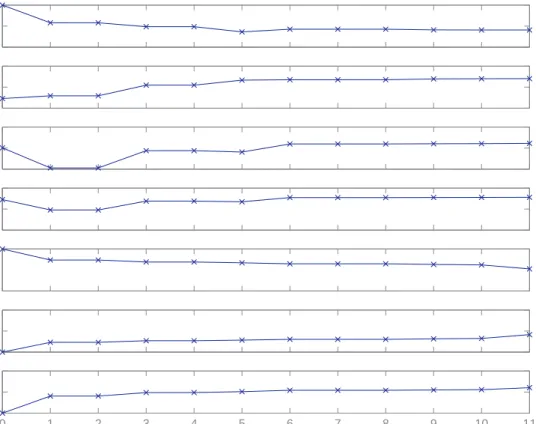
3.4 Trajectory of Turbine Parameters towards convergence of solution 55
3.5 Main Steam Pressure Drop Modeling, (a) Typical load ramp, (b) Typical boiler outlet pressure PD(t) and turbine inlet pressure PT(t) and (c) Parameter Estimation of Pressure Drop Model. . . . 58 3.6 Governor valve step response of 2.5% showing megawatt response
with Boiler Control on manual, (a) 2.5% Step in Valve position with trend of turbine inlet pressure, (b) Experimental megawatt response and simulated megawatt response . . . 61 3.7 Boiler Controller Response to Setpoint Step Change, (a) Boiler
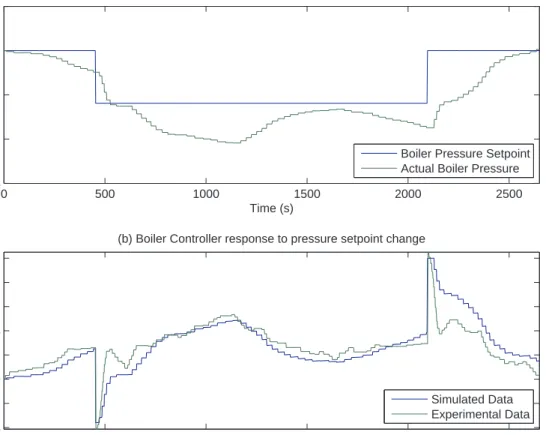
pressure setpoint step change with the boiler controller on auto-matic, (b) Boiler controller response to pressure setpoint change. . 62 3.8 Fuel Dynamics Model . . . 63 3.9 Calculation of fuel delay TD by manual observation of transient
response data . . . 65 3.10 Boiler pressure response due to fuel demand step change. . . 66 4.1 Flow chart of the Simple Genetic Algorithm (SGA), showing
Ge-netic Operators for reproduction and the Elitist strategy for the survival of the ttest individuals. . . 70 4.2 Illustration of Roulette Wheel Selection . . . 72 4.3 The Functioning Of Genetic Operators, (a) Genetic Crossover and
(b) Genetic Mutation . . . 73 4.4 Inuence of Crossover Probability (Pc) during Genetic Operations 74 4.5 Transient Comparison of Dierent Types of Crossover Techniques,
illustrating performance on Tie - Line Power . . . 75 4.6 Inuence of Mutation Probability (Pm) during Genetic Operations 76
5.1 A Comparison between a Crisp relation and a Fuzzy Relation . . 80
5.2 Illustration of a Fuzzy Set . . . 82
5.3 Basic Fuzzy Set Operations . . . 84
5.4 Basic Architecture of a Fuzzy Logic Controller . . . 86
5.5 Typical Triangular Membership Functions . . . 87
5.6 Illustration of Dierent Methods of Defuzzication . . . 89
6.1 Soft Computing Models and Hybridization . . . 94
6.2 Illustration of a Genetic - Fuzzy Rule Base System (GFRBS). . . 98
6.3 Illustration of the Michigan Type Classier (Source, Casillas et al. (2007)) . . . 100
6.4 Illustration of the Pittsburgh Approach to Fuzzy Rule Based Systems104 7.1 Illustration of Biologically inspired Cognitive Systems as applied to Soft Computing. . . 109
7.2 Illustration of Expert Tuning of the Knowledge Base . . . 112
7.3 Illustration of Genetic Algorithm Tuning of the Knowledge Base . 113 7.4 Chromosome Encoding of the Membership Function . . . 116
7.5 Inuence of Tunable Parameter Variation of Membership Func-tions on Rule Surface(a= 0.1, b = 0.2) . . . 117
7.6 Inuence of Tunable Parameter Variation of Membership Func-tions on Rule Surface(a= 0.8, b = 0.9) . . . 118
7.7 Genetic Tuning of the Rule Base and the Knowledge Base . . . . 120
7.8 Symmetrical Load Disturbances for Initial Load Conditions . . . . 123
7.9 A Simplied Illustration of Primary Frequency Control and Rela-tion to Secondary Frequency Control . . . 124 7.10 PI/PID Controller Response For Various Performance Indices With
Nonlinearities, such as Deadband and Generation Rate Constraint 127
7.11 Two Area Interconnected Power System, with GA Fuzzy Controller and Non Linear Components such as Deadband and Generation Rate Constraints . . . 133 7.12 Typical Genetic Comparison of Performance Indices . . . 136 7.13 A comparison of a number of GA - Fuzzy Controllers showing the
frequency response characteristic due to a load disturbance in Area 1 without DB and GRC. . . 137 7.14 A comparison of a number of GA Fuzzy Controller showing the
frequency response characteristic due to a load disturbance in Area 1, and considering governor deadband. . . 138 7.15 A comparison of a number of GA Fuzzy controller showing the
frequency response characteristic due to a load disturbance in Area 1, and considering Generation Rate Constraint. . . 140 7.16 Nominal performance due to Model Parametric Variation for
var-ious uncertainty values, (a) GA - Fuzzy Controller response, (b) Conventional PI Controller response. . . 142 7.17 Frequency response comparison due to Model Parametric
Varia-tion for various uncertainty values considering deadband, (a) GA - Fuzzy Controller response, (b) Conventional PI Controller re-sponse. . . 142 7.18 Frequency response comparison due to Model Parametric
Varia-tion for various uncertainty values considering GeneraVaria-tion Rate Constraint, (a) GA Fuzzy Controller response, (b) Conventional PI Controller response. . . 143 7.19 Illustration of the Chromosome Encoding of the Bezier Polynomial
Coecients, Control Points and Scaling Gains . . . 146
7.20 Transient Response Curves for Optimized GA-Fuzzy Controller with Encoding by a Bezier Surface, showing Area frequency re-sponse to load disturbance. . . 147 7.21 Area Control Error response to load disturbance using Bezier
Sur-face Encoding . . . 148 B.1 A Simplied Unit Model (P SS/E⃝c), showing steam turbine
con-gurations and associated boiler model and controls, the TGOV05 model (PSS/E (2004)) . . . 185
List of Tables
2.1 The Eects of Frequency Variations on Dierent Types of Loads . 19 2.2 Model Validation Test Procedures . . . 34 2.3 Table of Conversion Factors . . . 42 2.4 Typical Heat Balance Data for 200MW HP Turbine (Original Units) 42 2.5 Converted Data To Metric Units of HP Turbine Heat Balance Data
(Metric Units) . . . 43 2.6 Typical Heat Balance Data for 200MW LP Turbine (Original Units) 43 2.7 Converted Data To Metric Units of LP Turbine Heat Balance Data
(Metric Units) . . . 43 2.8 Calculation of HP Turbine Power Fractions . . . 44 2.9 Calculation of LP Turbine Power Fractions . . . 44 2.10 Calculation of the Turbine Time Constants TSCor and TCO . . . . 45 3.1 Optimal Turbine Parameters, showing the normalization parameters 56 3.2 Table showing calculation of K9 and C1 parameters for the main
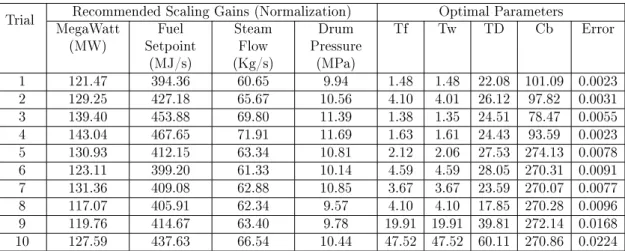
steam pressure drop . . . 58 3.3 Optimization of the Fuel Dynamics Model, using Matlab / Simulink
(using the fminimax optimization routine) . . . 64 6.1 Various Examples of Hard and Soft Computing . . . 95 6.2 Typical Encoding of the Detectors for use in Fuzzy XCS Systems 101
7.1 Linguistic term encoding and representation within the chromosome117
7.2 Encoding of the Rule Base as a Genetic Chromosome . . . 121
7.3 Nominal PI Controller Gains Optimized by GA . . . 126
7.4 Nominal PID Controller Gains Optimized by GA . . . 126
7.5 Performance Indices for PI and PID type Control Laws . . . 127
7.6 GA-Fuzzy Controller Encoding as applied to AGC Design . . . 131
7.7 Genetic Optimization Parameters for GA-Fuzzy Controller Design as applied to AGC . . . 132
7.8 Optimized GA Fuzzy Rules Table (GA - Fuzzy # 5) . . . 139
List of Abreviations
∆f(t) Change in System Frequency ACE Area Control Error
ACO Ant Colony Optimization AGC Automatic Generation Control ANN Articial Neural Networks
ECS Evoluationary Computational Systems
ED Economic Dispatch
FC Frequency Control
FLC Fuzzy Logic Control
GA Genetic Algorithms
GFRBS Genetic - Fuzzy Rule Based Systems
HC Hard Computing
IPS Interconnected Power Systems IRL Iterative Rule Learning
KB Knowledge Base
LFC Load Frequency Control
NF Neural Fuzzy
PI Proportional and Integral Controller
PID Proportional, Integral & Derivative PSO Particle Swarm Optimization
RB Rule Base
SA Simulated Anealing
TEC Time Error Correction UoD Universe of Discourse VSD Variable Speed Drives
Acknowledgments
Completing this doctoral work has been a wonderful, rewarding and often an over-whelming experience. It is indeed a humbling experience, not only to appreciate the theory, in writing an academic paper, in presenting a coherent discussion but also to be part of various working parties dedicated to completing the task set before them.
It has been a pleasure to work with my adviser, Prof. Tshilidzi Marwala, who has guided me into the right direction, for his intuitive approach to prob-lem solving and he has greatly contributed to the completion of this work. His contribution to this work is appreciated.
Appreciation and thanks is also extended to my co-adviser, Prof. Fulufhelo V. Nelwanondo, who provided valuable insight and comment. His contribution and assistance is greatly appreciated and acknowledged.
Appreciation and thanks to Dr. Graeme Chown and Mr. Mike Coker, for their guidance and valuable comments, especially during the testing of generating units and on the model parameter estimation of the units. Their expertise and insight is highly appreciated and valued.
To Eskom and their team for nancial support during project execution and xxi
for their guidance, willingness and expert knowledge for providing the means through which unit testing and evaluation can be performed.
Acknowledgment and thanks to my father Charles and brothers, Arnold, Wal-ter and Lenrick for their support and love. Their continual encouragement and also lending a helping hand during times when most needed.
Chapter 1
Introduction
Automatic Generation Control (AGC) plays an important role in the control of frequency within Interconnected Power Systems (IPS) and has been employed as an energy regulator since the inception of power generation. For this reason, AGC has found widespread application as a secondary frequency control regulator to rstly control the frequency following random load disturbances and secondly to modulate inter area power exchanges.
One of the network conditions which makes the AGC control problem challeng-ing is that the electrical network is constantly changchalleng-ing, loads are connected and disconnected at will, the size and complexity of the national grid is continuously increasing thereby changing the dynamic behavior of the electrical network over time. Therefore, from an AGC perspective these conditions place strict perfor-mance demands upon the AGC controller to yield good controller robustness in the presence of unknown and unmodeled dynamics.
In this regard, conventional PI controller strategies as applied to the AGC con-trol problem has been predominately implemented within modern power utilities
1.1. Background 2
today and have found widespread industrial success. However, as the network grows in size and complexity, routine controller retuning is often required. This ensures that the control performance is maintained within the stated control ob-jectives and it also guarantees the integrity of the electrical grid.
Therefore the premise of this work is to show that network frequency control performance can be improved by the application of more advanced controller de-sign techniques, with attributes which inherently consider unknown and unmod-eled dynamics. Furthermore, advances in hardware technology and soft comput-ing techniques has made it possible for the application of more advanced control design methodologies to be implemented for use within AGC. In particular, the proposed AGC controller is based on the principles of Genetic - Fuzzy Rule Based Systems (GFRBS).
Characteristically GFRBS compensates for imprecision and vagueness where there is limited knowledge of the process under control and it provides for a mech-anism by which systems can learn and adapt its inherent control characteristics with the explicit objective of improving on closed loop performance.
1.1 Background
The Automatic Generation Control problem of large Interconnected Power Plants have a long history and date back to the inception of power systems, where the control of frequency have been achieved through mechanical means such as the ywheel governor of the synchronous machine (Kumar and Kothari, 2005).
Although the ywheel governor has been proven to be a very practical means of regulating speed, it suers from its inability to regulate frequency after a disturbance without supplementary control action. This is also true of modern
1.1. Background 3
digital governing systems where supplementary control action is required for good disturbance rejection properties following a frequency incident. This has lead to a eld of study known as Automatic Generation Control, which emphatically deals with Frequency Control and power regulation on electrical networks and the control of their respective generating units.
Traditionally, power utilities have been structured around Control Areas, where each control area is responsible for the regulation of frequency within it's own area, and also to maintain Tie-Line power ows within prescribed specications. Because each Control Area operates as an independent business unit, there exists an economic objective within AGC control and thus strict regulation of generat-ing units are required to obtain this objective. It is also noted that in order to meet this objective, a compromise between strict and tight regulation and long term equipment life cycle management needs to be achieved. This function is typically granted to the judgment of the power utility.
In order to meet this objective within a changing power industry, and as net-work complexity grows, new control methods and new techniques for frequency regulation are required to maintain the integrity of supply and to ensure supply quality, reliability and security amidst an unknown dynamic system.
It is for this reason that extensive AGC research is needed, to validate control techniques, to analyze system behavior within a changing power system environ-ment, and to study the impact of alternative forms of energy such as renewable energy on AGC performance, which has fast become a topic of note.
In this research, we focus specically on AGC controller design, to dene a control system to meet the objective, of a robust AGC design via GA-Fuzzy and soft computing techniques. It is shown that this will contribute to the plight of AGC controller design rationale, to meet the challenges of a world in an energy
1.2. Motivation for GA-Fuzzy Controller Design Techniques 4
crisis and to contribute to the body of knowledge at large.
1.2 Motivation for GA-Fuzzy Controller Design
Techniques
The design and optimization of feedback controllers consist of the parametric selection of control variables to enhance the performance of the closed loop control system. By so doing, the inherent characteristics of the closed loop control system are manipulated in favor of the desired performance objectives. Therefore, with this in mind, classical control theory describes a plethora of design tools and methods specically tailored for the purpose of controller design, Figure 1.1.
. . Feedback . Controller . K(s) .. Controlled . Plant . G(s) . Feedback . F(s) . Output . Y(s) . Reference . R(s)
Figure 1.1: A Conventional Feedback Control Loop
This process can be broadly described by two fundamental procedures for con-troller design. Firstly, concon-troller selection in terms of structure and specication and secondly controller optimization to achieve the stated specication criteria. The former process is concerned with the merits of controller design, its structure and its interactions to best achieve the control objective. The latter process of controller optimization tends to be an acquired skill, requiring careful analysis, assessment of performance and controller redesign.
The next question is, how far should we go in the design analysis to obtain optimal or near optimal control? This is a frequently asked question within
1.2. Motivation for GA-Fuzzy Controller Design Techniques 5
control system design circles, and with no all round best application, but the designed solution is specically dedicated to the problem at hand (Cordón et al., 1996; Tavakoli et al., 2007). Therefore, we would use a performance measure either intuitively in manual design to indicate the success with which the designed controller adheres to the specied control objectives.
This in a Soft Computing context is known as a Performance Index, or Fitness Function within an Evolutionary Computational context (De Jong, 1988). In Genetic Fuzzy control systems, one of the main functions in its application is the selection of an appropriate performance measure and the translation of the control problem into an encoded representation for Genetic application. This in some cases may be a non-trivial function, but it has to suciently encapsulate all possible performance regimes.
When all these aspects are put together, a mechanism exists for automatic controller design by Computational Intelligence methods. This is especially ad-vantageous in instances where there are limited information, unknown or unmod-eled system dynamics and also the lack of a complete process model. In a similar manner to cognitive design of control systems, Computational Intelligence meth-ods such as GA-Fuzzy design applies heuristic techniques for design, emulating human intelligence.
One added advantage of using GA-Fuzzy approaches to design is that stability of the control systems are inherently considered by the selection of the tness function, when appropriately chosen. Although, a specic stability criterion can be incorporated into the tness function, this would inherently penalize weaker solutions and encourage stronger individuals.
It is with this in mind that we explore GA-Fuzzy techniques of AGC controller design, with the expectation that plausible control of the network can be achieved
1.3. Conventional AGC Control 6
through its application.
1.3 Conventional AGC Control
The methods for designing Automatic Generation Controller for large intercon-nected power systems have traditionally followed the Proportional Integral (PI) and Proportional, Integral and Derivative (PID) control law strategies.
However, these controllers do not perform adequately in the presence of uncertainty and suers from poor transient performance in the presence of non -linearity. It is because of this inherent weakness in conventional methods that GA - Fuzzy controller design is explored as an AGC solution.
1.4 Summary of Contributions
This section briey highlights certain contributions made to the international literary community of papers accepted for publication.
1.4.1 Application of GA-Fuzzy Controller Design to Automatic Generation Control
Portions of Chapters 1, 2, 4, 5, 6 and 7 have appeared in the following paper: Application of GA-Fuzzy Controller Design to Automatic Generation Control, Craig D. Boesack, Tshilidzi Marwala and Fulufhelo V. Nelwa-mondo, Third International Workshop On Advanced Computational Intelligence (IWACI2010).
1.4. Summary of Contributions 7
1.4.2 A GA-Fuzzy Automatic Generation Controller for Interconnected Power Systems
Large portions of Chapters 2, 6 and 7 have appeared in the following paper: A GA-Fuzzy Automatic Generation Controller for Interconnected Power Systems, Craig D. Boesack, Tshilidzi Marwala and Fulufh-elo V. Nelwamondo, Fourth International Workshop On Advanced Computational Intelligence (IWACI2011).
1.4.3 On the application of Bezier Surfaces for GA - Fuzzy controller design for use in Automatic Generation Control
Large portions of Chapters 2, 6 and 7 have appeared in the following paper: On the application of Bezier Surfaces for GA - Fuzzy controller design for use in Automatic Generation Control, Craig D. Boesack, Tshilidzi Marwala and Fulufhelo V. Nelwamondo, 2nd International Conference on Advances in Energy Engineering (ICAEE2011).
1.4.4 Dynamic governor model development for grid code compliance in South Africa
Portions of Chapter 3 is found in the following paper:
Dynamic governor model development for grid code compliance in South Africa, Graeme Chown, Craig Lucas, Mike Coker and Rahul Desai - PPA Energy, Jean vd Merwe and Christelle - MTech, Bunty Kiremire, Craig Boesack, Preshen Moodley and Albert Smit - Eskom.
1.5. The Taxonomy of the Thesis 8
To be submitted to Energize 2012.
1.5 The Taxonomy of the Thesis
This section discusses the taxonomy of the thesis and provides a description of the content of each section, its peculiar attributes and its main points of discussion.
. . Chapter 1 . Introduction . Chapter 2 .
Literature Review on AGC Systems
.
Chapter 6
.
Genetic Fuzzy
.
Rule Based Systems
.
Chapter 7
.
On the Design and Analysis
.
of a Genetic Fuzzy AGC Controller
. Chapter 8 . Conclusions and . Future Work . Appendix A .
Previously Published Work
.
Appendix C
.
C Matlab Code of a
.
Simple Genetic Algorithm (SGA)
.
& GA - Fuzzy Controller
.
Appendix B
.
The TGOV05 Unit Model
.
Chapter 3
.
Modeling of Power Plant Processes
.
Chapter 4
.
Heuristic Search
.
and Genetic Algorithms
.
Chapter 5
.
Fuzzy Logic Control
.
and Rule Based Systems
1.5. The Taxonomy of the Thesis 9
Chapter 1, Introduction
The Introduction provides an overview of the thesis by describing the relevant background of this work. It focuses on giving a general introduction to Automatic Generation Control, it expounds on a few limitations within existing structures of control and proposes the application of GA-Fuzzy Rule Based System design as a plausible AGC controller to meet stated multi-objective criteria.
It continues by summarizing literary contributions of this work, and concludes be describing the taxonomy of the thesis.
Chapter 2, Literature Review
In this chapter a review of current literature is performed. It presents a foundation for the rest of the thesis and gives a detailed overview of Automatic Generation Control and associated modeling of interconnected power systems. It starts by giving and exposition of Tie-Line Bias control and how it is applied to the AGC control problem of modern power utilities.
Further, it reviews AGC controller design approaches, culminating in discus-sion on the modeling of interconnected power plants.
Chapter 3, Power Plant Modeling and Control
Chapter 3 addresses aspects of power plant modeling and control, especially from a model parameter estimation perspective, highlighting techniques for obtain-ing power plant mechanical characteristics through dedicated power plant tests. This section is aimed at providing a comprehensive understanding of power plant control, its processes and how the behavior of both boiler and turbine control systems play a role in appreciating its inuence on network frequency incidents
1.5. The Taxonomy of the Thesis 10
and analysis.
This chapter also illustrates that fairly accurate results for turbine and boiler systems can be obtained from experimental testing of power plants. In particular it illustrates that the boiler plant and its control system play a signicant role in frequency response dynamics of interconnected power systems, for eective load disturbance rejection properties and sustained responses.
Chapter 4, Genetic Algorithms and Its Applications
The chapter on Genetic Algorithms and Its Applications present an introduction to Heuristic search and expounds on the rudiments of Genetic Algorithms. It establishes that GA's are good global search methods, which can be accurately applied to many industrial optimization and learning problems.
It further reviews the fact that GA's are rather sensitive to tness function selection and care should be taken in its appropriate selection for the problem at hand. This chapter forms the foundation of how the amalgamation of GA's and Fuzzy systems can be combined to produce GA-Fuzzy Rule Base Systems. Chapter 5, Fuzzy Logic Control
This chapter is a fundamental review of Fuzzy Logic Control Systems and Rule Base Systems. Its particular application in GA-Fuzzy design is to establish the tunable parameters, control structure and rule base mechanisms for heuristic learning.
In addition, this chapter shows that FLC design is intuitive, however it could be a challenging task to design an optimal FLC controller when limited knowledge is available.
1.5. The Taxonomy of the Thesis 11
Chapter 6, Genetic Fuzzy Rule Based Systems
This section combines Chapters 4 and 5 to form a discussion on Genetic Fuzzy Rule Based Systems. In particular it studies various approaches to Genetic Fuzzy Design. In particular, mention is made of the Michigan and Pittsburgh ap-proaches to Genetic Fuzzy Rule Base design (GFRBS).
It establishes that the two GFRBS's methods are fundamentally dierent in it encoding of the chromosome, and on the application of the GA population. In the Michigan approach, the entire population represents a prospective solu-tion whereas in the Pittsburgh approach, each chromosome represents an entire solution to the problem.
It concludes by stating that the Michigan approach is best suited for online adaptation and learning, and the Pittsburgh for oine approaches, each with their peculiar attributes for control.
Chapter 7, On the Design and Analysis of a Genetic Fuzzy AGC Controller
In chapter 7 AGC controllers are designed and weighed upon how well they meet the stated performance measures. It illustrates GA-Fuzzy genetic tuning of the Knowledge Bases and Rule Bases and contrast AGC performance with conventional design approaches.
Key contributions illustrate that the encoding of the search space parame-ters plays an important role in nal controller performance. It also shows that favourable characteristics are obtained of the nal GA-Fuzzy controller.
It further continues by discussing the performance of the GA, and that under certain circumstances dynamic GA parameter updates are required to improve
1.5. The Taxonomy of the Thesis 12
algorithm performance and convergence properties. Chapter 8, Conclusions and Future Work
In this section a conclusion is presented and a few recommendations are made. It also discusses future work and highlights potential improvements in the GA -Fuzzy design methodology. It is concluded that evolutionary methods for con-troller design is a plausible method of learning and adapting concon-troller behavior to meet the demands and objectives of the stated design problem, provided that suitable chromosome representation is made.
Chapter A, Previously Published Work
This chapter details published work and the contribution made to the body of engineering knowledge. Large portions of the chapters contained within this thesis have formed the foundations of the published work.
The rst paper provides a very general introduction to the concepts of Ge-netic - Fuzzy Control and its application to the Automatic Generation Control problem.
The second paper is an extension of the rst highlighting additional aspects of chromosome encoding and its inuence on the evolved AGC controller.
The third paper looks at how Bezier Surfaces can be used an a mechanism by which encoding can be realized and shows that any appropriate encoding method of the problem search space can be used for GA - Fuzzy design.
Lastly, the fourth paper presents topics of power plant modeling and experi-ences.
1.6. Summary of Chapter 1 13
1.6 Summary of Chapter 1
The Introduction presented the motivation and overview of the thesis. Its chief aim is to introduce GA-Fuzzy AGC control as a viable approach to control system design, especially where system information is uncertain. It also highlights the literary contributions of the thesis and its value added.
The next chapter (Literature Review) presents a detailed review of current techniques used within AGC controller design.
Chapter 2
Literature Review
This literature review discusses the importance of Frequency Control (FC) and the function of Automatic Generation Control (AGC) within large Interconnected Power Systems (IPS). In addition, it establishes the importance of dynamic fre-quency control and its role within the control of active power by maintaining a balance between load demand and generated power.
It is paramount that strict control of the network frequency is maintained amidst system disturbances and that the frequency is returned to its nominal value within certain boundary conditions. The manner by which this function is achieved is through Automatic Generation Control (AGC), also commonly known as Load Frequency Control (LFC) .
2.1 Frequency Control of Interconnected Power Systems
Frequency Control of large Interconnected Power Systems form an important function for modern power utilities and thus the quality of frequency forms a
2.1. Frequency Control of Interconnected Power Systems 15
basic performance measure. In order to achieve satisfactory FC performance, closed loop control of all power generators forming part of AGC is warranted, but not only to maintain performance, FC ensures that synchronous machines operate eciently within operational boundaries.
In addition, frequency also indicates the health of the electrical network in terms of over generation and under generation. Any excess of frequency above its nominal value would indicate a surplus of energy and likewise any deciency of frequency below is nominal value would indicate a decit of energy. Therefore, to minimize frequency deviations, AGC control is needed.
However, at rst during a frequency incident, mandatory turbine governor responses (Primary Frequency Control) take eect and thereafter, the integral component of AGC (or Secondary Frequency Control) ramps each generating unit according to the magnitude of the frequency deviation. This is graphically illustrated in Figure 2.1 below.
0 10 20 30 40 50 60 70 80 90 100 -0.025 -0.02 -0.015 -0.01 -0.005 0 Grid Frequency Time (s) Frequency Deviation (Hz) 0 10 20 30 40 50 60 70 80 90 100 0 0.002 0.004 0.006 0.008 0.01 Increase in Generation Time (s)
Increase in Generation (p.u. MW)
Primary Frequency Response (Governor Action)
Secondary Frequency Response (AGC Action)
Increase In Generation (To Restore Frequency)
Figure 2.1: Illustration of frequency response due to load disturbance of 0.01 p.u. MW and mandatory governor response and AGC action.
2.1. Frequency Control of Interconnected Power Systems 16
As seen from Figure 2.1 AGC provides an eective mechanism for regulating total power generation in order to minimize the system frequency deviation△f(t). In addition, AGC also regulates the total Tie - Line ∑N
i=1
∆PT iei(t)power ows. In
practice, AGC sends raise or lower commands to each generating unit for the control of real power.
The dynamic behavior of large interconnected power systems is dependent upon system disturbances, uncertainties due to loading requirements and upon the need to supply electricity of good quality in terms frequency control (Kumar and Kothari, 2005).
Therefore, within an interconnected power system, the network frequency is an important indication of the power mismatch between energy demand and supply. This inherently places strict performance demands upon the AGC controller, not only to maintain good disturbance rejection properties, but also to be robust in terms of controller design and also to exhibit good regulatory performance (Tan and Xu, 2009).
2.1.1 Impact of Frequency on Synchronous Machines and Generators This section highlights the need for FC and the impact of frequency variations on synchronous machines and generating units. A permanent deviation in frequency has a direct inuence on the operation of the power system. It not only aects the quality of control on the frequency but it also inuences the performance and eciency of synchronous machines.
Operating synchronous machines beyond its frequency and voltage boundaries shorten the life of the equipment and can lead to equipment failure. For this rea-son most equipment manufactures of synchronous machines design equipment,
2.1. Frequency Control of Interconnected Power Systems 17
including both motors and generators, to operate within certain boundary con-ditions. Exceeding these boundary conditions would result in thermal stress to the electrical windings, overheating of windings and consequential failure of the synchronous machine.
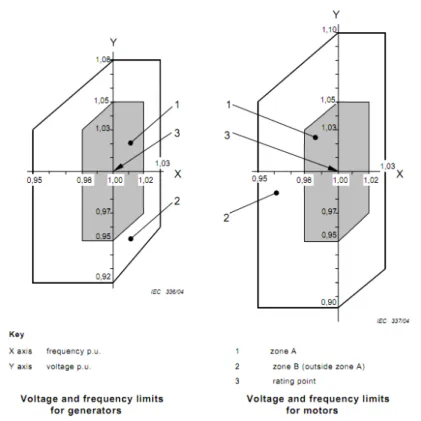
According to the International Standard IEC 60034-1, rotating electrical ma-chines should operate at its nominal value (see Figure 2.2, rating point) and should allow for continuous operation in Zone A. Exceeding both frequency and voltage limits (Zone B) is not recommended, however the synchronous machine should be able operate within this area for a limited period of time. This inadvertently places strict frequency and voltage demands upon the electrical grid.
Figure 2.2: Illustration of the Voltage and Frequency Limits of Synchronous Ma-chines (source, IEC 60034-1 Eleventh Edition 2004-04)
In addition to aecting synchronous machines and generators, frequency vari-ation on the electrical grid could also have a substantial impact on steam
tur-2.1. Frequency Control of Interconnected Power Systems 18
bine blades. Operating the frequency outside its boundary conditions could lead to turbine blade failures, increased blade resonance, and causing fatigue of the blades.
In addition, blades could also be susceptible to resonance near the operational speed of the turbine such as when system run-up and shut-down procedures are initiated. This is also true in situations of low and high grid frequency. Thus it is critical to operate the grid frequency fairly tightly to minimize such eects. In summary the operational characteristics of the grid should enable the turbo-generator to function eectively within its performance prole.
2.1.2 Impact of Frequency Variations on System Load
Electrical load can either be resistive, capacitive or inductive. Pure resistive loads are insensitive to frequency variations, while capacitive and inductive loads are frequency dependent. Within industry a large amount of inductive loads are synchronous machines fed directly from the electrical grid. In certain instances use is made of Variable Speed Drives (VSD) which can tolerate a certain amount of frequency variation, however, if the frequency deviation is extreme, deteriorating performance and eciency of the synchronous machine would result. Table 2.1 highlights the implications of frequency variations on system load.
2.1.3 Impact on Time Correction
Time Error Correction (TEC) forms one of the functions of the Automatic Gen-eration Controller. During the opGen-eration of AGC, there are periods of time when there is either over or under generation. This tends to cause the average frequency
2.1. Frequency Control of Interconnected Power Systems 19
Table 2.1: The Eects of Frequency Variations on Dierent Types of Loads
Load Type Examples FrequencyEects of
Variations Discussion
Resistive
Loads Heaters, Lamps insensitive.Frequency
Although resistive loads are insensitive to frequency
variations, a large load disturbance results in a proportionally equivalent frequency deviations. Inductive Loads Generating Sets, Motors, Transformers Loss of perfor-mance and overheat-ing
In generating sets, over uxing is a condition which
is aggravated by system frequency variations, which
could have detrimental eects on the synchronous
machine. In all cases overheating due to frequency aects operates the machines close to their
respective physical limits.
Capacitive
Loads Capacitor Banks
Loss of perfor-mance
Capacitor banks play a vital role in the control of
reactive power on the electrical grid and as such frequency variations would
negatively impact on reactive power control. to either be high or low and consequently leading to a time error.
The time error on average needs to be corrected over time. If the time error is positive it indicates that in the past there has been over generation and similarly, when the time error is negative it indicates that there has been a period of time in the past when the system was under generating.
In order to correct this, TEC compensates by adjusting the Area Control Error (ACE) over time in such a manner as to bring the time error to zero. This TEC controller is a slow acting controller.
2.2. Automatic Generation Control 20
The network frequency of interconnected power systems is a primary indication of the health of the electrical grid. It's not only a measure of network stability, but also provides a mechanism by which the generating supply and demand energy balance is assessed. An increase in frequency indicates an energy surplus while a decrease in frequency is indicative of under generation. Therefore, control of network frequency by means of increasing or decreasing generation is known as Automatic Generation Control (AGC).
2.2 Automatic Generation Control
Conventional Proportional and Integral (PI) Controllers as applied to Automatic Generation Control (AGC) have been studied extensively as contained within the literature and have been successfully applied to many large scale interconnected power systems (Kumar and Kothari, 2005; Bevrani and Hiyama, 2007).
In this section, the design of Automatic Generation Controllers are studied and evaluated, in particular the control methodology employed is that of Genetic - Fuzzy Control as contained within this research. The reliability and availability of large interconnected power systems are crucial to national infrastructure, both in terms of meeting quality of supply demands and on ensuring that the load demand balance is maintained at all times.
Especially when considering that quality of electrical supply, which is viewed primarily by the stability of system frequency and by maintaining electrical power, it is paramount, that power utilities achieve good control of their generating units. Although network stability is also viewed from a voltage perspective, the relationship between network frequency and voltage is closely related. This multi-objective control function is achieved by AGC, which forms a supervisory
2.3. AGC Objectives 21
controller on all generating units contained within the power utility, and volt-age control is achieved by the Automatic Voltvolt-age Regulator (AVR) (Kumar and Kothari, 2005).
In this research, we take a deeper look into AGC and the application of Genetic - Fuzzy Control system technology as a viable control strategy for large intercon-nected power systems. The attraction of Genetic - Fuzzy Control technology for this application stems from the fact that Genetic based adaptation and robust-ness properties, which is an inherent characteristic of this method, may prove benecial for generation control purposes.
2.3 AGC Objectives
Modern power systems are typically controlled by a proportional and integral type control law, which aims at minimizing the Area Control Error (ACE) of the power system, thereby maintaining system frequency and tie - line power exchanges. Recent research eort have focused on the application of fuzzy logic control (Talaq and Al-Basri, 1999; Du and Li, 2006; Anower et al., 2006; Shayeghi et al., 2009; Anand and Jeyakumar, 2009a), hybrid articial neural network (Liu and Zhang, 2009; Panda et al., 2009a,b) control strategies for the application of AGC, in which, improvements in control strategy and control system performance is reported.
Therefore, the present study focuses on applying GA-Fuzzy controller design techniques as applied to modern AGC of large interconnected power systems. The main contribution of this work is to review current literature and to analyze the performance of the designed controller by means of simulation.
2.3. AGC Objectives 22
primarily on AGC and the application of Genetic - Fuzzy Controller design tech-niques as contained within the literature. The primary research methodology employed is that of answering the following questions which forms part of the key design objectives for the design rationale.
• What is AGC and why is it an important function for large interconnected power systems?
• What are the key associated problems with AGC as found within industry?
• What are the design objectives for AGC?
• In terms of controller design, it is proposed to apply Genetic - Fuzzy con-troller design methodologies as a proposed solution to the AGC problem.
• Fundamental questions are as follows.
How are Genetic - Fuzzy controllers designed and what are the key design considerations?
Since Genetic Algorithms are based on random selection and proba-bilistic search methods, how is the stability of the system guaranteed especially when Genetic - Fuzzy controllers are applied?
How does Genetic Fuzzy controllers compare with conventional con-troller techniques in terms of performance and robustness, what is its advantages and limitations when applied to AGC?
These questions forms the basis of the literature review section and is aimed at establishing the required theoretical and practical knowledge for applying Genetic - Fuzzy controllers to AGC. Therefore, the discussion begins by describing AGC, followed by an account of fuzzy logic controllers and the operation of Genetic
2.3. AGC Objectives 23
Algorithms.
2.3.1 AGC and Tie-Line Bias Control
Conventional approaches to the AGC control problem have been based on Tie-Line Bias control, where a proportional and integral type control strategy is em-ployed (Skaar and Nilssen, 2004; Alrifai and Zribi, 2005; Shayeghi et al., 2009). Since during normal electrical load variations, AGC provides a convenient means by which frequency deviations are returned to nominal parameters. This main-tains frequency deviations and tie line power exchanges at zero steady state error values.
However, Tie-Line Bias control does not lead to optimal closed loop control performance, which tend to be more oscillatory in nature, especially when consid-ering modeling uncertainties, unknown non-linear plant characteristics and the complex behavioral interactions of large interconnected power systems (Ha, 2000; Venkat et al., 2008) and inter area oscillating modes.
For this reason, much research eect have been focused on the development of AGC controller design methodologies for good robustness performance objectives as well as maintaining good load disturbance rejection properties (Bevrani et al., 2004; Shayeghi and Shayanfar, 2005; Bevrani and Hiyama, 2007; Shayeghi et al., 2007; Taher et al., 2008; Venkata Prasanth and Jayaram Kumar, 2008; Khod-abakhshian and Edrisi, 2008; Taher and Hematti, 2008; Tan and Xu, 2009), to produce robust AGC controllers.
Contained within the literature, various AGC controller design methodologies have been proposed in response to unknown process dynamics, with improvements in performance being cited when compared to established AGC techniques. These
2.3. AGC Objectives 24
can be summarized as follows. Conventional PID approaches are considered in (Malik and Kumar, 1988; Khodabakhshian and Edrisi, 2008; Sinha et al., 2008; Tan, 2009), where a new design approach to PID tuning is detailed based on maximum peak resonance specication (MPRS), citing improvements in control system performance and improved robustness properties (Tan, 2009). MPRS is a frequency domain loop shaping controller design method.
In addition to conventional I, PI and PID controller design strategies (Nanda et al., 2006), the application of optimal control (Yuksel et al., 2008), variable structure control, model predictive control (Venkat et al., 2008) and the applica-tion of linear matrix inequalities (Rerkpreedapong and Hasanovic, 2003; Bevrani et al., 2004; Raj and Raja, 2009) to the AGC control problem of interconnected power systems have found widespread research interest and application (Shayeghi and Ali, 2004; Shayeghi and Shayanfar, 2005; Shayeghi et al., 2007, 2009).
This is particularly motivated by the fact that the aforementioned controller design strategies are inherently robust to model uncertainty, and when applied to AGC yield desirable closed loop characteristics. This would include robust-ness against network growth and complexity, unknown non-linear dynamics and complicated network interactions.
However, the former controller design techniques are model dependent and may prove to be a challenge to obtain especially when dynamics are not well known nor accurately modeled or when system identication is not readily available, limiting the performance of the controller.
This inadvertently led to the application of more intelligent design methods, including fuzzy logic control (Anand and Jeyakumar, 2008; Cam, 2007), fuzzy gain scheduling (Talaq and Al-Basri, 1999; Jianhong et al., 2002; Juang and Lu, 2005; Anower et al., 2006), articial neural networks (Shayeghi and Ali, 2004)
2.3. AGC Objectives 25
and fuzzy neural networks (Liu and Zhang, 2009) to name but a few. These techniques are founded upon expert knowledge and human reasoning, taking into account system unknowns from a linguistic perspective.
In view of this, one of the main aspects which makes intelligent control methods such as fuzzy logic control (FLC) and articial neural networks (ANN) a non-trivial task is that of rationalization and neural network training. Fuzzy systems depend upon expert knowledge, however, an expert may not always be available (Castro and Camargo, 2004), making the fuzzy logic controller design and rule base generation non trivial.
In addition, when considering multiple input and multiple output systems and their respective interactions, large numbers of fuzzy rules are involved and the parametrization of the membership functions including its scaling gains, FLC design can become overwhelming. In the case of ANN, especially large networks, training and optimization can become an issue. For this reason, it is proposed to use genetic algorithms for the optimization of fuzzy controllers.
With application to control systems and power systems, genetic algorithms have found universal application (Chang et al., 1996; Cordón et al., 1996; Wang and Spronck, 2003; Dalci et al., 2004; Ghoshal, 2005; Du and Li, 2006). Their heuristic search characteristics makes genetic algorithms suitable for nding ap-propriate solutions to complex control problems via optimization methods. In this research, we apply genetic algorithms to the optimization of a fuzzy logic controller, applying them to the Automatic Generation Control problem of inter-connected power systems.
Automatic Generation Control (AGC) can be considered as a supervisory con-trol strategy for large interconnected power systems, with the express aim to regulate system frequency and tie-line interchange power (Kumar and Kothari,
2.3. AGC Objectives 26
2005). This forms an important function within modern power utilities and forms a primary business objective, especially when viewed from a power regulatory perspective.
Interconnected power systems can be divided in sections known as control areas which represents a coherent group of electrical Generating Units operating under synchronized frequency conditions.
In each control area, the AGC controller strives to meet its scheduled demand by regulating each Generating Unit up or down (controlled by raise or lower pulses) according to its scheduled load demand. The load demand depends upon the system frequency ∆f(t)and its relative power exchange deviations ∆PT ie(t) with its neighboring control areas (Rerkpreedapong and Hasanovic, 2003).
This is graphically illustrated in Figure 2.3.
f
0 -−ef
i ?+∆
f
i-β
i -+eP
T ie0-−e+P
T iei 6∆
P
T iei +-ACE
iAGC
-∆
P
CiFigure 2.3: Conventional Tie - Line Bias Control for Automatic Generation Control
The dynamic behavior of large interconnected power systems is dependent upon system disturbances, uncertainties due to loading requirements and upon the need to supply electricity of good quality in terms frequency control (Kumar and Kothari, 2005).
Therefore, within an interconnected power system, the network frequency is an important indication of the power mismatch between energy demand and supply.
2.3. AGC Objectives 27
This inherently places strict performance demands upon the AGC controller, not only to maintain good disturbance rejection properties, but also to be robust in terms of controller design and also to exhibit good regulatory performance (Tan and Xu, 2009).
2.3.2 Generating Unit Governing and Control
By considering typical Generating Units which are controlled by turbine governing systems upon load disturbances does not yield a zero steady state error for system frequency. In fact, as the loading on the electrical network increases, the frequency tends to decrease, due to the increased energy demand and vice versa (as the loading decreases the frequency tends to increase)(Shayeghi et al., 2009). This implies that there needs to be a continuous energy balance in terms electrical demand and supply.
Therefore, due to governor action there is an immediate governing response to frequency deviations, however, this does not return the system frequency to its nominal value. This is known as primary frequency control. However, in order to return the frequency to its nominal value, secondary frequency control is required or AGC.
2.3.2.1 Conventional AGC Control
Conventional control approaches to solving the AGC problem has been based on tie-line bias control (Kumar and Kothari, 2005) and by making use of the classical PI controller strategy. In this approach, corrections due to frequency deviations ∆f are made via the area frequency response characteristic β. This is in turn used to form the the Area Control Error (ACE) as described by the equation 2.1
2.3. AGC Objectives 28
below, where ∆PT ie represents the tie-line interchange power. The subscript i denotes the ith control area within the interconnected power system.
The equation (2.1),
ACEi = ∆PT iei+βi∗∆fi (2.1)
is the Area Control Error (ACE), where i is the ith control area with i ∈
(1· · ·N) and N representative of the total number of control areas, ∆PT iei =
PT iei −PT ie0 is the inadvertent Tie-Line power exchange deviation and ∆fi =
fi−f0 is the frequency deviation from its nominal value.
Eectively the ACE manages the power frequency balance in order to maintain system frequency by manipulating system power. The Frequency Bias factor
−10B depends upon the system capacity and size of the generating electrical network, and is synonymous to the area frequency response characteristic β.
In conventional Tie-Line Bias Control it is recommended that −10B = β
(Bakken and Grande, 1998; Egido et al., 2004; Kumar and Kothari, 2005), in that it would tend to reject internal area disturbances more eectively. This is an important criteria for system stability as well.
The term ∆PCi represents the power demand required by all Generating Units
participating within AGC control. This signal is proportioned accordingly by means of the capabilities of the Units in terms of power generation limits and are proportioned by means of participation factors.
2.3. AGC Objectives 29
2.3.2.2 AGC Controller Design Approaches
Contained within the literature there are many controller design methodologies which have been applied to the Automatic Generation Control problem (Kumar and Kothari, 2005). The studies presented have focused on classical approaches such as the PI controller design methods to the application of more robust con-troller design theories, such as H∞ Optimal Control. The present study will therefore highlight a few of these design methods and will expound on their ap-plication to AGC.
The conventional AGC controller is based on the classical Proportional and Integral (PI) controller structure. This can be written as follows, where KP and KI represent the Proportional and Integral controller gains respectively (Kumar and Kothari, 2005; Khodabakhshian and Edrisi, 2008; Tan, 2009).
∆PCi =KP ∗ACEi+KI∗
ˆ
ACEidt (2.2)
Typically, the controller parameters (KP and KI) are designed conservatively to meet the stated performance objectives in terms of robustness and system stability. This is of importance to the interconnected power system since it ensures good quality of frequency and power supply to the grid.
More recently, fuzzy logic controller design techniques have been applied (Du and Li, 2006; Cam, 2007; Anand and Jeyakumar, 2008, 2009a,b) and various hybrid approaches (Ferrari-Trecate et al., 2004; Khan and Iravani, 2007; Panda et al., 2009b,a). These techniques provides superior performance as stated within the literature in terms of robust performance, particularly because the nature of these techniques considers design uncertainty.
2.3. AGC Objectives 30
Moreover, robust controller design techniques have also been applied to the AGC control problem. These include Variable Structure Control (Ha, 2000; Al-Hamouz et al., 2005, 2007; Huddar and Kulkarni, 2008), Genetic Fuzzy Gain Scheduling (Talaq and Al-Basri, 1999; Jianhong et al., 2002; Juang and Lu, 2005; Anower et al., 2006) , techniques based on evolutionary optimization and hybrid approaches (Grantner and Fodor, 2002; Ting and Rao, 2006; Xianbo and Jingqi, 2007; Kim et al., 2008a; Panda et al., 2009b,a).
Apart from the conventional controller design criteria (such as robust perfor-mance and stability), the AGC controller design aims at maintaining adequate load rejection regulation, as well as minimizing the Generating Units movement to the control demand. This minimizes production costs, by optimally control-ling the unit for regulating performance . In addition, the importance of this to power utilities is that it guarantees substantial production cost savings, reducing routine maintenance due to wear and tear (caused by Unit cycling) but more importantly it aims at meeting the business objectives of the power utility.
In general, frequency control of power systems are governed by what is known as primary speed (or frequency) governing, secondary frequency control (or Auto-matic Generation Control) and should the frequency continue to deviate beyond operational limits, tertiary control (or load shedding) becomes eective. Each of these control mechanisms has a stabilizing eect on the frequency.
2.3.3 Primary Governing Of Turbo-Generators
Turbine Governing control systems forms a critical component for modern rotat-ing machinery, such as turbo-generatrotat-ing systems. This is necessary to perform fast turbine speed regulation and once the turbo-generator is synchronized to the national electrical grid, it provides a means by which the loading on the generator
2.3. AGC Objectives 31
is varied. Opening or closing of the main steam admission control valves to the turbine (water gate valves in the case of a hydro turbine), leads to an increase in generated energy. However, it should be noted that primary governing on its own does not lead to zero steady state error.
2.3.4 Automatic Generation Control
Electrical power systems fullls a vital role within society today, amid national growth in electrical demand and the need for reliable electrical networks have placed strict demands upon Power Utilities to provide sustainable energy as well as to adhere to the performance standards of the National Grid.
In order to achieve this, Power Utilities have implemented various controlling strategies aimed at providing network stability, assurance in terms of meeting energy demand versus energy supply and on enabling that systems are in place for the recovery of system frequency upon any external network disturbances. This regulatory process is known as Automatic Generation Control.
Therefore, to drive the network frequency to zero steady state error, AGC is employed. It forms a load reference input to the turbine governor control system of generating units. Its primary objectives are to (Bakken and Grande, 1998; Egido et al., 2004; Shayeghi et al., 2009),
• Maintain frequency deviations ∆f(t) at zero in the presence of electrical load disturbances.
2.4. Modeling Of Interconnected Power Systems 32
neighboring control areas contracted for AGC.
• Maintain the Area Control Error (ACE) ACE(t) at zero. Both the fre-quency and the ACE can be considered as a health measure for the inter-connected power system.
2.4 Modeling Of Interconnected Power Systems
Modeling of systems and subsystems are fundamental to control system design and analysis (Changliang et al., 2001; Cordero-Cruz et al., 2002; Egido et al., 2004; Ferrari-Trecate et al., 2004; Barbieri and Lastra, 2007). This is particularly true in power plant design for controller development, where a good knowledge of the process is required for eective control operations.
This section therefore introduces modeling of interconnected power systems, especially from a dynamic frequency response perspective, and describes the im-portance of understanding the dynamic behavior of power systems, its dynamic interactions and paves the way for eective control system design.
The presence of a good validated model enables system analysts, electrical network operators and utility engineers to perform eective network planning, fault analysis and system diagnostic exercises (Egido et al., 2004). This forms an important function for Systems Operations and National Control Dispatch, where the planning for ecient energy regulation is performed on a day by day basis. In addition, eective model development ensures that sucient conditions are met to ensure the robustness of the controller design.
2.4. Modeling Of Interconnected Power Systems 33
large complex interacting systems (Peet and Leung, 1995; Flynn and O'Malley, 1999; Hain et al., 2000). The only way to compensate for this is to divide the modeling task into manageable sections representing the major system dynamics of the power plant.
This is well achieved within the TGOV series of power plant models, for single and multi-area interconnected networks (see Appendix B), which is a simplied turbine governor model and can also model the eects of boiler dynamics and associated control systems for use within dynamic power plant frequency studies (Hain et al., 2000; Barbieri and Lastra, 2007; Aºubalis et al., 2009).
Developed as part of an international working group, the TGOV model is a representative unit model used to model various unit control modes of opera-tion when enabled by appropriate parameter selecopera-tion (Hannett and Khan, 1993; Flynn and O'Malley, 1999; Hain et al., 2000). However, nding appropriate parameters may prove to be a demanding task, since a large portion of these parameters represents the dynamic physical behavior of the turbine and boiler respectively.
2.4.1 Model Validation Tests
Model validation tests are aimed at establishing good input output correlations of model response to test data characteristics. In this process, tests are based on the normal mode of operation of the Generating Unit and coincide with daily unit operational practices. Table 2.2 describes a selection of model validation tests which can be performed on a generating unit.
As an example, where the unit is controlled in Coordinated Boiler follow Mode, the model will be parametrized for this case, and tests will be aligned for this