Immersive Learning environments in the context of Knowledge Creation Li Shang Ly
A Thesis In
The John Molson School of Business
Presented in Partial Fulfillment of the Requirements For the Degree of
Doctor of Philosophy (Business Administration) at Concordia University
Montreal, Quebec, Canada
March 2018
CONCORDIA UNIVERSITY School of Graduate Studies This is to certify that the thesis prepared
By: Li Shang Ly
Entitled: Immersive Learning environments in the context of Knowledge Creation and submitted in partial fulfillment of the requirements for the degree of
Doctor of Philosophy (Business Administration)
Complies with the regulations of the University and meets the accepted standards with respect to originality and quality.
Signed by the final Examining Committee:
_________________________________________ Chair Dr. Mehdi Farashashi _________________________________________ External Examiner Dr. Lynn Jeffrey _________________________________________ External to Program Dr. Robert Cassidy _________________________________________ Examiner Dr. Dennis Kira _________________________________________ Examiner Dr. Mark-Alexandre Tomiuk _________________________________________ Thesis Supervisor Dr. Raafat George Saade
Approved by______________________________________________________ Dr. Kathleen Boies, Graduate Program Director
March 26th, 2018 ___________________________
iii ABSTRACT
Immersive Learning environments in the context of Knowledge Creation Li Shang Ly, PhD
Concordia University, 2018
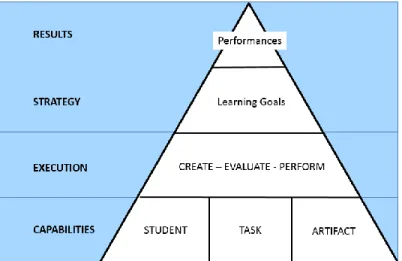
This dissertation redefines an immersive environment as a place where students become fully engaged and experience the state of flow. We argue that current research in immersive learning lacks focus on knowledge acquisition. Therefore, across 4 exploration papers, 9 experiments in a spectrum of university courses, we developed the Integrated Knowledge Acquisition Model (IKAM), a toolset allowing researchers to create learning tools with immersive elements. IKAM builds on 4 levels of pedagogical strategy starting with the capabilities of the tool (student-artefact-task) inspired by PAT, executed in a 3 phase form (create-evaluate-perform, with the mechanism of Nonaka’s SECI Model), addressed with learning goals and measured by traditional performance scores.
Furthermore, we combined TAM, UTAUT, Cognitive Absorption model to build an immersive environment appropriate measurement model called the Technology Immersive Model (TIM). This scale was reduced through Exploratory Factory Analysis and Confirmatory Factor Analysis to a 15 items measuring the levels of enjoyment, immersion and timelessness of a student’s experience in our immersive platform. Through Structural Equation Modeling we were able to determine and confirm that tool design (functionality and cognitive expectancy) engages students with intrinsic
motivation which leads to immersion and timelessness. Overall, we contribute to the field of business technology management by providing a starting point to identifying
immersion learning tool with a focus on knowledge acquisition in today’s changing world embedded in technology and data.
iv DEDICATIONS
v ACKNOWLEDGMENTS
I would like to thank Dr. Fassil Nebebe, Dr. Tak Mak, Dr. Danielle Morin, Dr. Raafat Saade, Ms. Eva Ferrera, Ms. Christabell Moyo, Prof. Mahesh Sharma, Dr. Dennis Kira for their continuous support in my career in the SCBTM department since the very beginning when I worked as a Teaching Assistant in 2010.
A very special thank you to my supervisor Dr. Raafat Saade, you protected me, mentored me through every step of the way and taught me many lessons that will shape me into a researcher and an academic.
A special thank you to my committee members and examiners Dr. Robert
Cassidy, Dr. Lynn Jeffrey, Dr. Dennis Kira, Dr. Mark Alexandre Tomiuk who dedicated their time to review my dissertation and provide me feedback to improve my research.
I would like to thank my family, my mother Lam Tieu Binh, my brother Ka Vinh Ly, my fiancé Stephen Athanasoulias and our close family Barbara Papakostas, Dino Athanasoulias, Tina Athanasoulias, Richard Tang for their continuous support and investment in me. Thank you for taking care of me through very stressful times.
I would like to thank my colleagues in the Ph.D Program (Sonal Kumar, Megan Pepe, Pedram Fardnia, Moayad Tanash, Chun Zhang, Brad Aeon, Arka Mukherjee) for their genuine support and encouragements throughout the program.
I would like to thank all of my amazing friends from different places and my growing family for their support and encouragements in everything I do.
vi CONTRIBUTION OF AUTHORS
Dr Raafat Saade as my supervisor and co-author Dr. Marc Alexandre Tomiuk
Dr. Danielle Morin Dr Denis Kira
vii TABLE OF CONTENTS
LISTOFTABLES ... X
LISTOFFIGURES ... XII
CHAPTER ONE: INTRODUCTION ... 1
1.1RESEARCH IN THE PAST 10 YEARS ... 2
1.2THE FUTURE OF EDUCATION AND ITS HURDLES WITH TECHNOLOGY ... 9
1.3CONTRIBUTIONS ... 17
1.4STRUCTURE OF DISSERTATION ... 19
CHAPTER TWO: LITERATURE REVIEW ... 21
2.1KNOWLEDGE MANAGEMENT ... 21
2.2IMMERSIVE LEARNING ... 25
2.3FLOW AND ENGAGEMENT ... 33
2.4CONCLUSION ... 36
CHAPTER THREE: THEORETICAL FRAMEWORK ... 38
3.1RECENT STUDIES ... 38
3.2FLOW ... 43
3.3KNOWLEDGE PROCESSING:THE SOCIALIZATION-EXTERNALIZATION-COLLABORATION -INTERNALIZATION MODEL ... 44
3.4INTEGRATED KNOWLEDGE ACQUISITION MODEL ... 46
3.5RESEARCH QUESTIONS ... 48
CHAPTER FOUR: METHODOLOGY ... 50
4.1CONTEXT ... 50
viii
4.3THE INSTRUMENT ... 67
CHAPTER FIVE: EXPLORATORY RESEARCH ... 70
PAPER 1–IMMERSIVE LEARNING EXPERIENCE ... 72
PAPER 2–UNDERSTANDING OF PEER TO PEER LEARNING USING ITEM RESPONSE THEORY ... 74
PAPER 3–EVIDENCE BASED MANAGEMENT FOR LEARNING:AN EXPERIMENT ... 76
PAPER 4–KNOWLEDGE MANAGEMENT ITTOOL: AN INVESTIGATION WITHIN A MARKETING INTRODUCTORY COURSE ... 78
CHAPTER SIX: RESULTS & ANALYSIS ... 80
6.1PSYCHOMETRIC PROPERTIES ... 81
6.2DESCRIPTIVE STATISTICS ... 81
6.3STATISTICAL ANALYSIS (EFA,CFA,SEM) ... 85
PART 1–EXPLORING OUR DATA THROUGH EXPLORATORY FACTOR ANALYSIS (EFA) ... 86
PART 2–CONFIRMATORY FACTOR ANALYSIS (CFA) ... 100
PART 3–STRUCTURAL EQUATION MODELING (SEM)–MODEL TESTING ... 107
CHAPTER SEVEN: CONCLUSION ... 112
7.1KEY FINDINGS ... 112
7.2OVERVIEW OF OUR STUDY ... 113
7.3PUTTING IT ALL TOGETHER (A RESEARCH ROADMAP) ... 115
7.4LIMITATIONS ... 117
7.5FUTURE RESEARCH ... 118
7.6IMPLICATIONS ... 119
ix
REFERENCES ... 122
APPENDIXA CONSENT FORM ... 143
APPENDIXB QUESTIONNAIRE ... 144
APPENDIXC ETHICS CERTIFICATE... 146
APPENDIXDPAPER 1 ... 147
APPENDIXEPAPER 2 ... 180
APPENDIXFPAPER 3 ... 224
APPENDIXGPAPER 4 ... 251
APPENDIXHCHAPTER 6PART 1EFA ... 272
APPENDIXICHAPTER 6PART 2CFA ... 273
x LIST OF TABLES
TABLE 1.1RESEARCH FIELDS OF INTEREST (NUMBER OF ARTICLES PER YEAR) ... 4
TABLE 1.2WORD COUNT SUMMARY TABLE OF 251 ARTICLES IN 2016 ... 7
TABLE 3.1INTERSECTION BETWEEN STUDENT AND TASK- ARTIFACT INTERSECTION... 42
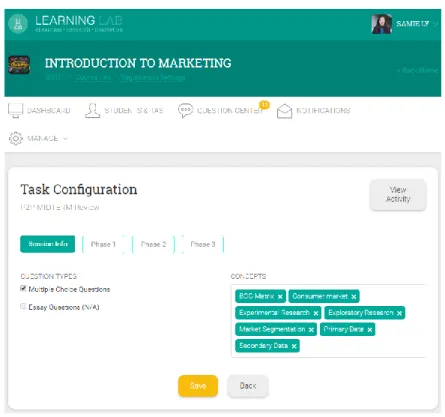
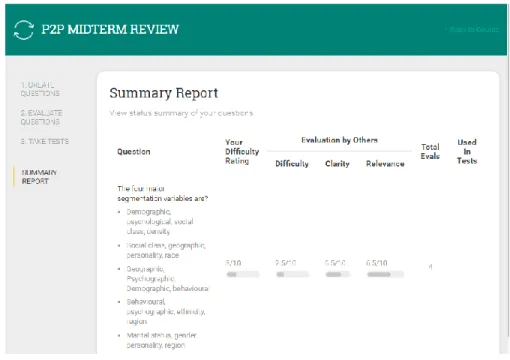
TABLE 4.1LIST OF FEATURES WITHIN THE P2PSYSTEM ... 53
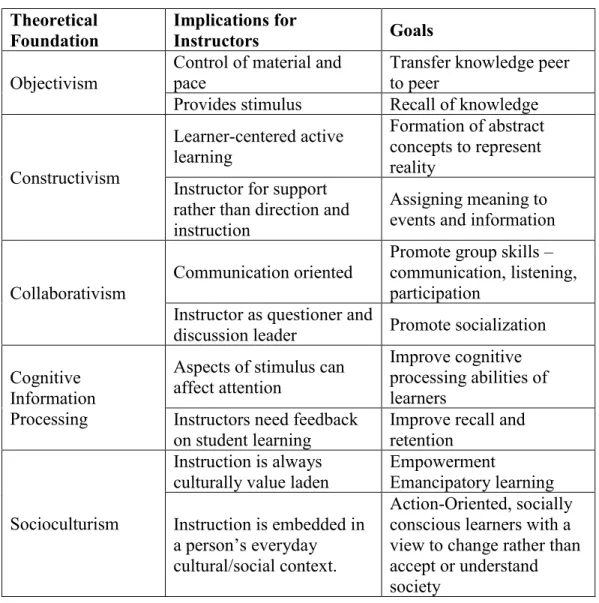
TABLE 4.2SUMMARY OF THEORETICAL LEARNING METHODS WITH TRADITION IMPLICATIONS AND GOALS ... 54
TABLE 4.3SUMMARY OF THE P2P PLATFORM INTEGRATION ... 60
TABLE 4.4INSTRUMENT WITH SOURCES OF ITEMS... 67
TABLE 4.5MAIN AUTHORS AND THEIR CONTRIBUTIONS IN THE MODEL ... 69
TABLE 6.1LIST OF COURSES FROM OUR SAMPLE OF 288 PARTICIPANTS ... 82
TABLE 6.2REPRESENTATION OF THE GENDER SPLIT FEMALE (1),MALE (2) ... 83
TABLE 6.3FREQUENCY TABLE FOR EACH EDUCATION LEVEL. ... 84
TABLE 6.4THREE-PART ANALYSIS PROCESS OF THE SCALE ... 86
TABLE 6.5DESCRIPTION OF SCALE ITEMS USED IN THE STUDY AND THEIR SOURCES ... 86
TABLE 6.6FIRST ITERATION OF EFA ... 90
TABLE 6.7JUSTIFICATION OF ITEM REDUCTIONS. ... 92
TABLE 6.8PARTIAL ITEMS ... 93
TABLE 6.9FINAL FACTOR LOADING ... 94
TABLE 6.10FINAL FACTOR LOADING - PARTIAL CORRELATIONS ... 95
TABLE 6.11FACTOR CORRELATION MATRIX ... 95
TABLE 6.12PARTIAL SCALE ... 97
xi
TABLE 6.14SUMMARY OF COVARIANCES BETWEEN CONSTRUCTS ... 101
TABLE 6.15SUMMARY OF CORRELATIONS BETWEEN CONSTRUCTS ... 102
TABLE 6.16SUMMARY OF HYPOTHESES RESULTS OF OUR ANALYSIS ... 110
xii LIST OF FIGURES
FIGURE 1.1OVERALL TREND OF RESEARCH PUBLICATIONS (ALL) ... 5
FIGURE 1.2OVERALL TREND OF RESEARCH PUBLICATIONS (CPAL,IM,CPALKM,IMKM) ... 5
FIGURE 1.3OVERALL TREND OF RESEARCH PUBLICATIONS (IM,CPALKM,IMKM) ... 6
FIGURE 1.4WORD CLOUD REPRESENTATION OF 251 ARTICLES IN 2016. ... 8
FIGURE 3.1STAGES OF FLOW AND THE PERSON-ARTEFACT-TASK MODEL OF FLOW ANTECEDENTS FROM FINNERAN &ZHANG (2003) ... 41
FIGURE 3.2MODIFIED TO STUDENT-TASK-ARTIFACT WITH EMBEDDED THEORIES ... 41
FIGURE 3.3CSIKSZENTMIHALYI (1990)’S FLOW DIAGRAM ... 43
FIGURE 3.4MODIFIED FLOW GRAPH WITH DIFFICULTY AND KNOWLEDGE ... 44
FIGURE 3.5SECIMODEL PROPOSED BY NONAKA ET AL.(2000) ... 45
FIGURE 3.6ENHANCED SECI MODEL INCLUDING 3PHASES ... 46
FIGURE 3.7IKAMINTEGRATED KNOWLEDGE ACQUISITION MODEL ... 47
FIGURE 6.1GRAPH REPRESENTING THE DIVERSITY IN ETHNICITY OF OUR SAMPLE ... 83
FIGURE 6.3BAR CHART REPRESENTING THE LEVEL OF EDUCATION OF EACH COURSE. ... 84
FIGURE 6.4CFAMODEL OF 5 CONSTRUCTS ... 101
FIGURE 6.5FLOW OF CONSTRUCTS BASED ON THEORY ... 104
FIGURE 6.6TECHNOLOGY IMMERSIVE MODEL (TIM) WITH HYPOTHESES TO BE TESTED . 105 FIGURE 6.7FINAL MODEL AMOSOUTPUT ... 108
FIGURE 6.8TECHNOLOGY IMMERSIVE MODEL (TIM) WITH RESULTS ... 108
1
CHAPTER ONE: Introduction
The advent of Information Technology (IT) and its exponential use impacts education around the world at all levels. More specifically, students’ learning styles are continuously changing therefore affecting traditional teaching and establishing
pedagogical models by evolving the basic unidirectional teacher-to-student instruction into a highly dynamic IT-supported and elaborated learning environment.
New learning environments entail three-dimensional graphics, computer games, animations and a full range of wide spread mobile devices of variable sizes fitting all demographics and contexts. The world of education has innovated throughout the globe to facilitate learning in multiple forms (Herrera, Guerrero, & Urbano, 2018; Ştefan, 2012b; Villagrasa, Fonseca, Redondo, & Duran, 2014).
Rooted in the traditional classroom style(s), educators are expected and
encouraged to continuously seek teaching and learning improvements to engage students. Especially at the university level today, non-interactive learning seems to dominate students’ classroom experiences despite the relevance in preparing a generation of future leaders to hop onto a heavily IT focused industry.
Given IT’s potential to enhance learning through various innovative methods, we respond by centering this dissertation’s scope around the concept of immersive learning and it’s fundamental elements contributing to cognitive absorption.
Immersive learning environments have been a popular domain of exploration in the literature. However, there are debates around the notion that not all immersive environments are created for learning (Algarawi, Alslamah, Alhabib, Alfehaid, &
2
Ibrahim, 2018; Christopoulos, Conrad, & Shukla, 2018; Pena-Rios, Callaghan, & Gardner, 2018; Quintana & Aranguiz, 2018).
Researches are focusing on the improvements of tactile skills and virtual reality graphics, while there is a lack of focus on the topics of knowledge acquisition and processing to which we believe is an essential variable to improve learning. With this in mind, we emphasize and investigate on existing knowledge management and knowledge acquisition models in combination to what is deemed as a justified immersive
environment conducive to learning (Anderson, Spiro, & Montague, 2017; Bolisani & Bratianu, 2018; Finneran & Zhang, 2003; Jackson & Marsh, 1996; R. Saadé & Bahli, 2004; Sein-Echaluce, Fidalgo-Blanco, & García-Peñalvo, 2017; Van Schaik, Martin, & Vallance, 2012).
We propose a three-fold theoretical framework consisting of student-artefact-mechanism, a model tying together qualitative and quantitative analyses through eight experiments and four written papers as well as an in-house immersive learning tool. 1.1 Research in the past 10 years
In the present chapter, we will highlight the current field of research in the past 10 years and examine the popularity and fluctuations of academic publications in the
domains of computer-assisted learning (CPAL), immersive learning (IM), and knowledge management (KM). We then further a discussion on the current hurdles in technology and the shift of society in education from a teacher, students and administrators’ perspective.
Through a web search, we present an aggregation of publications of five key words such as computer assisted learning (CPAL), immersive learning (IM), knowledge management (KM), as well as the combination of two domains such as computer assisted
3
learning – knowledge management (CPALKM), immersive learning – knowledge management (IMKM).
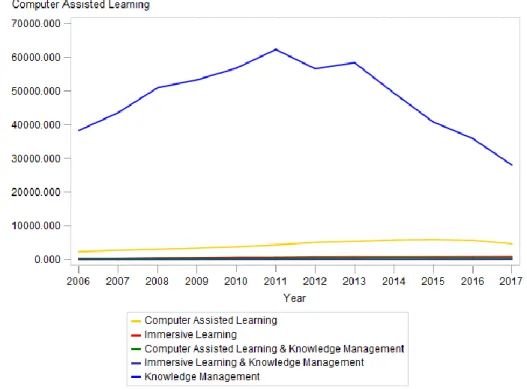
The topic of knowledge management has been highly popular in academic research, especially from 2007-2014. In the last 10 years, experiments and empirical research on this topic has grown, then plateaued in 2011. We noticed a rising peak followed by a quick run to maturity. It seems that researchers studied the area of
knowledge management in the world of business and organization in the hopes to manage the knowledge of employees and staff members. The topic became popular due to the practice of reassessing techniques and methods for better management of knowledge and knowledge transfer within an organization, especially when it came to succession
planning, noting that at that time there was a large increase in retirements (See Table 1.1). Interestingly, a dip brought down the interest of this discipline reaching a high of 62300 articles to 35900 articles in 2016.
4
Table 1. 1 Research Fields of interest (Number of articles per year)
Year Computer Assisted Learning (CPAL) Immersive Learning (IML) Computer Assisted Learning & Knowledge Management Immersive Learning & Knowledge Management Knowledge Management 2006 2270 105 144 6 38300 2007 2680 185 165 14 43600 2008 2970 330 208 23 51000 2009 3350 398 230 28 53300 2010 3760 535 278 45 56800 2011 4330 556 307 45 62300 2012 5070 708 397 52 56600 2013 5330 720 398 58 58400 2014 5740 709 443 50 49400 2015 5880 731 409 55 40800 2016 5640 756 414 55 35900 2017 4650 792 393 65 28000 APY 4306 544 316 41 47867 ∆5 -146.000 -0.051 -0.366 -0.250 -1087.459 ∆10 280.242 0.138 0.506 0.136 -374.064
APY: Average Per Year
D5: Change in last 5 years (Slope) D10: Change in last 10 years (Slope)
5
Figure 1. 1 Overall trend of research publications (All)
6
Figure 1. 3 Overall trend of research publications (IM, CPALKM, IMKM) On the other hand, the topic of computer-assisted learning has been on the rise in the past 10 years and has not yet reached a plateau of interest. The first interest in CPAL started with Randall & Ruddell (1946) studying adult literacy and further raised to 5 papers in 1948 on topics in computer assisted teaching and learning.
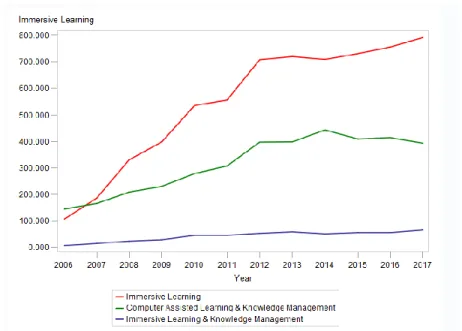
When we combine the search of articles in both fields (CPALKM), we see a rise in interest in the relevance of technology input and the need to reorganize larger formats of information such as data, statistics and archives. The combination of both domains generated an increase in scholarly publications from 144 articles in 2006 to 414 in 2016, and it continues to rise up to today.
As for the topic of immersive learning (reaching an average publication of 741.6 articles in the last 5 years), although the body of knowledge and research output is not as strong as CPAL (5448 average articles in the last 5 years) is gaining momentum and popularity over the past decade. The number of publications grew 7-fold in the last 10 years from 105 articles in 2006 to 756 articles in 2016. Upon an investigation of the 756
7
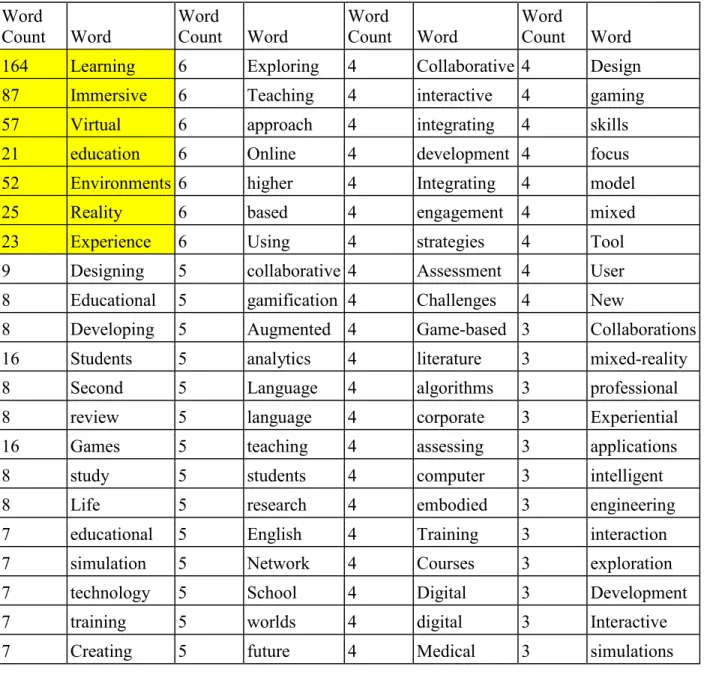
articles, we observed the majority of research in immersive learning take primarily an educational and instructional perspective through virtual reality, whereas the key word “Knowledge” and “Cognitive Absorption” was only mentioned 1 time. See Figure 1.4 for the word cloud representation of the articles as well as their word count in Table 1.2. However, articles with the combination of both immersive learning and knowledge management (IMKM) are scarce.
Table 1. 2 Word count summary table of 251 articles in 2016 Word Count Word Word Count Word Word Count Word Word Count Word
164 Learning 6 Exploring 4 Collaborative 4 Design
87 Immersive 6 Teaching 4 interactive 4 gaming
57 Virtual 6 approach 4 integrating 4 skills
21 education 6 Online 4 development 4 focus
52 Environments 6 higher 4 Integrating 4 model
25 Reality 6 based 4 engagement 4 mixed
23 Experience 6 Using 4 strategies 4 Tool
9 Designing 5 collaborative 4 Assessment 4 User
8 Educational 5 gamification 4 Challenges 4 New
8 Developing 5 Augmented 4 Game-based 3 Collaborations
16 Students 5 analytics 4 literature 3 mixed-reality
8 Second 5 Language 4 algorithms 3 professional
8 review 5 language 4 corporate 3 Experiential
16 Games 5 teaching 4 assessing 3 applications
8 study 5 students 4 computer 3 intelligent
8 Life 5 research 4 embodied 3 engineering
7 educational 5 English 4 Training 3 interaction
7 simulation 5 Network 4 Courses 3 exploration
7 technology 5 School 4 Digital 3 Development
7 training 5 worlds 4 digital 3 Interactive
8
7 Research 5 world 4 teacher 3 Exploratory
7 science 5 case 4 Impact 3 systematic
7 systems 5 STEM 4 System 3 e-learning
7 online 5 data 4 Skills 3 experiment
Figure 1. 4 Word Cloud representation of 251 articles in 2016.
In year 2000, the combination of IMKM did not exist in scholarly peer reviewed journals, they only appeared in 2006 with 6 articles rising to 55 articles in 2016. This begs the question on whether interest and subsequently research in the area of knowledge processing in immersive environments will rise? We strongly believe that we are at the onset of a paradigm shift where the foundations of immersive learning and of knowledge management will be fused within IT-based environments toward the betterment of
9
measurable learning objectives. We advocate in this dissertation the strong need for research in this domain.
The concept of utilizing computer assisted learning systems as a complement to the creation of immersive learning with designs of structural strategies to manage information and knowledge flows seems to be uninvestigated. Overall, there are many hurdles in adapting information technologies for learning. In the next section, we will discuss the factors that create resistance to technology and how we are on the road to overcome some of them. We will also mention how technology has taken a role in education and we foresee it to stay an important medium for the future.
1.2 The future of education and its hurdles with technology
Overall Resistance to technology
Originally, technology adoption has been strongly resisted by the school
environment in general and higher education due to uncertainties in assessing the success and cost/benefit of the investment and commitment it requires. The value to the learning process was not clear or evident. Since 2001, according to Maslowski (2001) decisions to integrate and adopt IT into the education environment followed the school’s culture, vision, norms and values that are shared with faculty members, staff members and students. As technology integration mediates teachers’ actions, beliefs and attitudes mentions Chai, Hong, & Teo, (2009). In recent years, there seems to be a major shift in higher education towards the inclusion of IT in education, however the value proposition with regards to learning is still not clear, evident or established since the introduction of TAM (technology accepted model, a concept still investigated today (Schmitt & Saadé, 2017 (June); Teo & Zhou, 2017).
10
Doering, Hughes, and Huffman (2003) conducted a study where teachers were doubtful and very hesitant to using technology. Surprisingly after their completion of an initiation course, their doubts transformed into positive sentiments due to their better understanding of the support network available to them and the advantages of implementing a technology system. As a result, to this experiment, the school’s pedagogical knowledge increased. This situation has been shown by multiple authors such as Choy, Wong, and Gao (2009), Fu (2013) in most recent years.
Doering, et al. (2003)’s study still applies today (although to a lesser extent) since senior faculty are still teaching today – a group whose majority is still resistant to the use of today’s technologies. To ease adoption, Doering, et al. (2003)’s experiment shows teachers and students need to be exposed and trained to a new learning management system before they can see positives in a novelty. These activities, held to introduce the potential of modern information technologies in the classroom seem to have just started in higher education and are face with the challenge of sustainability and integration within the university culture.
The future in education and its opportunities
Mentioned in 2001 and evident today, Niederman and Rollier (2001) expressed the future may hold where universities offer multi-disciplinary programs with the partnership of other schools (Sincak et al., 2017). Institutions are brokers who provide facilities to their buyers and sellers in education services. Although organizations seem to be moving towards this direction, higher education seem to remain in their training model of program offering (Newman & Scurry, 2015).
11
Thus, institutions that do not initiate a change in their vision in adapting to an information technology, their future will cease to exist mentioned Reddy and PS Goodman (2002).
Glenn and D’Agostino (2008), noted that technology will change skill-sets required for the future workforce, while corporations and organizations have to consider the opportunities and threats in order to remain competitive in the market. This also applies to higher education institutions.
We stress the notion that IT is a major contributor to learning whereby knowledge (or subject matter) is processed in ways transcending traditional instructional methods and such that the role of the educator changes into a facilitator of this knowledge processing activity. The ultimate goal is to enhance the learners’ engagement with the subject matter conducive to enhance efficiency and effectiveness.
In order to answer whether learners work more efficiently and effectively, we analyzed current research on IT in learning and explain which aspects of IT are advantageous (increases their effectiveness and efficiencies) and disadvantageous (decreases or does not change their performance) for learners. Along with this analysis, we can further investigate whether technology should be used in the educational and training context and if so, in which cases it would be most appropriate.
Going back to basics
In a study of information communication technology (ICT) in Uganda,
researchers mentioned not to underestimate the power of local knowledge even if it does not happen between four walls in a school mentions Andena, Norton, and Kendrick (2010). In developing countries where technology is scarce, it allows people to reflect on
12
what is the most important when implementing technology. Andena, et al (2010) noted for technology to be effective for learning, the basics need to be met. Such basics entail an effort to understand and integrate local knowledge and local literacy practices, having interventions and focusing on allowing participants to be productive in their capabilities to develop skills and contribute to local knowledge and global discourses. In addition, for the programs to be culturally and ideologically sensitive to the local situation of each country. Mentioned in 2010, as well as in a series of articles in year 2017, Henderson, Selwyn, and Aston (2017) suggest that technology doesn’t transform the nature of teaching and learning, but instead enabled diversity of provision, equal access and increased efficiency of delivery as well as the personalization of an individual’s learning process.
Technology has the potential to transform the economies in the world including various educational systems available. It is important to emphasize on building
participants ‘capacity to generate knowledge rather than emphasizing on the mere
transfer of digital literacy skills and tools available. Andena et al., (2010); Angus, Snyder, & Sutherland-Smith, (2004); Meyers, Erickson, & Small, (2013) mentioned the emphasis on the true reasons of a digital divide, which is the differences in culture, education, literacy, opportunity and social power.
Moreover, the access to technology is much more complex as it is a multi-level social goal and enriches those who get the benefits associated to these resources,
therefore efforts should be made to explore ways through which technology can become a medium to transport communicate resources (such as stories and skills) to the
13
classroom and make such learning engaging and accessible to all (Comber and Green 1999; Burbules and Callister 2000; Andena, Norton, and Kendrick 2010).
Access to technology, a shift in society
Facer, Furlong, and Furlong 2010 mentioned the possibility of two future societies, either a modern information society or an underdeveloped society that did not bite the information bullet. Thus, children of the digital generation must be given access to information in order to become future working in the knowledge economy. In addition, authors Furneaux, (200) and Her, (2017) mentions technology will continue to gain a significant impact on higher education where technology will become the core
differentiator in academic institutions. A statement mentioned by Glenn and D’Agostino (2008) still applies even more rapidly today whereby university research and
development departments were once the primary arena for testing new tools and theories, while a shift has occurred where corporations are now the edge in adopting new
innovations.
The convenience of technology
What can information technology offer? Information technology allows access to learning material 24 hours a day, 7 days a week. It created opportunities for asynchronous learning allowing students to learn at their own pace and style. (Hjørland, 2008;
Mukherjee & Bleakney, 2017). Students with greater access to a wealth of information can refer to material, submit homework out of class anywhere with an internet access. An increased access influences the way students learn course material (Furneaux, 2004), on the flip side, technology can be disruptive to encourage cases of plagiarism, cheating,
14
distractions and confusions due to the amount of information available to them (Glenn & D’Agostino, 2008).
15 years ago, we witnessed the use of futuristic tools such as video podcasts, RFID sensor networks, mobile broadband, Wikis and Blogs. A few years later in 2008, online courses, text messaging, document management became popular tools (Glenn & D’Agostino, 2008). The variety year after year keeps growing such that today ipads, tablets have now become the new trends (Nguyen, Barton, & Nguyen, 2015). However, the same issue persists, people are still not readily prepared to be critical and evaluate the amount of information available unless they are the producers and consumers of the knowledge (Andena, et al. 2010).
Where does technology lead us to?
Academia in general accepts the opportunities associated with online courses, a key to advancing the institutions mission and giving access to advanced education
(Scoppio & Luyt, 2017). Moreover, corporate academic partnerships increasingly become part of the university experience. To that effect, institutions have to demonstrate a
commitment to advanced technologies in order to attract corporate partners. University faculty and staff view information technology as having a positive impact, however they acknowledge that there can be challenges such as tenure, promotions and other
organizational practices that will need adjustments in order to encourage members to adopt new technologies. Institutions can allow their knowledge to be transferred to foreign locations, where distance education becomes increasingly global and the ability to reach more individuals around the world – a clearly attractive proposition. As Cornell University Ms. Mclure mentions “Today’s students are used to getting what they need
15
instantly and universities have to respond to remain competitive, yet these innovations
often cost millions of dollars.”, it is an issue of money (Glenn and D’Agostino 2008, p.6). Many faculty and staff mentioned that tenure and promotion requirements may need to be re-worked as they should include technology based teaching criteria (Glenn &
D’Agostino, 2008).
Barriers to the use of IT in learning
Innovative practices in higher education such as the use of technology has created many barriers for students, teachers and administration. Soden (2017) argues, it is often not about the technology but the method of communication and feedback used. There needs to be a level of summary and formative engaged feedback. In his article he elaborates on the use of screen captures as a form of support to teach users how to use technologies, the author argues that the low priority and limited time given to educators to receive formative rather than summative assessment on the use of technology has an impact on university teachers’ motivation to innovate (Soden, 2017 p. 14).
Students’ perspective
From the students’ perspective, Frederick, Schweizer, & Lowe (2006) indicated technology creates a few challenges for students, especially those with mobility, special needs and anxiety issues when faced with standardized tests. Students in general
experience a need to have technical skills, a reduction of peers and instructors interactions (Fu, 2013; Whelan, 2008). In addition, technology is disruptive and pervasive creating distractions to students’ attention. At the University of Illinois, Dr. Johnson from (Economist, 2008) noticed an increase in discourteous behavior such as plagiarism and cheating in courses that leverages the online environment.
16
“Perhaps due to the relative anonymity of that forum, students appear to take more liberties online than they would in class.”
Solidified by the argument of Glenn & D’Agostino (2008). The easy access to online reference material causes the greatest risk to education by new technologies. Mainly the access to online facts and research increases the risk that students are graduating without foundational knowledge in some subjects.
Teachers’ perspective
On the teachers’ perspective, Jo Shan Fu’s article (2013) as well as many authors have mention technology brings a lack of clear vision (Al-Bataineh, Anderson, Toledo, & Wellinski, 2008), Lack of assistance and knowledge support (Ertmer &
Ottenbreit-Leftwich, 2010; Hutchison & Reinking, 2011; Tezci, 2011; Yildirim, 2007), lack of allocated time for the mastery (Almekhlafi & Almeqdadi, 2010; Tezci, 2011), lack of focus on the content of the course (Lim, 2007), pressure to increase performance (Liu & Szabo, 2009), insufficient skills for managing teaching materials (Frederick et al., 2006; Goktas, Yildirim, & Yildirim, 2009; Honan, 2008; Yildirim, 2007), lack of financial support (Liu & Szabo, 2009).
In turn authors suggest a few strategies to deal with these challenges such as providing training and developing activities that related technologies: Create support groups to encourage teachers to share their effective technology practices and
experiences (Ertmer & Ottenbreit-Leftwich, 2010); offer opportunities for students to live through what it is like to use technology efficiently (Frederick et al., 2006); and integrate course curricula with technology-enhanced material.
17
Our motivation in this dissertation to explore the IT potential to enhance learning centering on the concept of immersive learning and its fundamental elements contributing to cognitive absorption also take into observations on current and past studies and hurdles on education and technology. In the next sections, we would like to present existing knowledge management models, mainly Nonaka, Toyama, and Konno (2000)’s work within an immersive learning context and the foundational concepts cognitive absorption such as the state of flow – full engagement.
1.3 Contributions
This dissertation contributes to the body of knowledge and the advancement of research at the intersection of several fields of interest namely, in knowledge
management, computer assisted learning – e-learning/e-pedagogy, design, collaboration and immersive learning. We present the design of an e-tool, methodology and results of a study using this e-tool within the context of higher education students’ level of e-learning technology adaption and their learning experiences (specifically the experience of flow) in classrooms at multiple levels (undergraduate, masters, doctoral).
We also contribute to a niche of interest in the integration of information
technology in collaborative e-learning within a knowledge management framework and perspective as we look at structures and designs of knowledge created by people who assess their knowledge acquisition and processing level through the medium of the e-learning information technology.
Moreover, this dissertation contributes to computer assisted learning and information technology in education body of knowledge by showcasing a web-based information system that addresses the multi-disciplinary nature embodied by the
18
mechanics of learning. Even though it is one example of an information technology, our contribution allows educators and researchers to categorize types of ITs, designs and information and knowledge models in order to achieve a higher engagement level of learning.
With the rise of interest in immersive learning, this study puts into perspective immersive learning in today’s highly interactive internet environments and the classroom thereby providing ideas and sharing information and guidance to researchers who
develop information systems/technologies for learning with a focus on knowledge processing.
In specific, the present research elaborated in this dissertation contributes to the body of knowledge in the following ways:
1. Proposes a theoretical framework for collaborative e-learning;
2. Integrates knowledge management, flow, and collaboration theories into the conceptual model;
3. Maps and explores the elements of the theoretical framework in an e-collaboration tool across
4. Different educational levels
a. Undergraduate new entrants b. Undergraduate at graduation c. Masters
d. PhD
5. Different majors and subject matters
6. Studied Evidence-based versus non evidence-based
7. Utilized different statistical methods to understand learning (EFA, CFA, SEM, IRT)
Based on the contribution 3, the present study looks at the generalizability of the application within the theoretical framework; Testing of the theoretical framework based on validated survey items and performing further validation within the present context;
19
Reduces the theoretical constructs and re-interprets them in to the present context; Develop a theoretical model: Technology Immersive Model (TIM).
1.4 Structure of Dissertation
This dissertation stems from the Person-Artifact-Technology (PAT) by Finneran & Zhang, (2003), which was used by a recent author Van Schaik et al., (2012) who argued when using technology, if a person achieved the state of flow, they are therefore immersed. Led by this thought, we began looking into the literature for identify further the relationships between immersion and attaining flow related to learning environments using technology. We looked into the literature review of three core topics in Chapter 2 mainly knowledge management such that a tool or process allow knowledge to be organized and knowledge to be transformed and acquired, immersive learning
environment which has been a relatively popular topic of research, however we question to what level immersive learning truly deals with knowledge. And finally, flow of engagement, which is our measurement of higher learning engagement levels.
We follow by introducing in Chapter 3 our theoretical framework with which we center our research around by defining three elements:
1. Students’ experience and knowledge gain, complemented by a task designed with Nonaka, Toyama, and Konno (2000)’s SECI model and the artefact , a new technology platform allowing all components to function.
2. Artefact, a peer to peer in house developed tool with which the pedagogical design and functionalities strategically followed the SECI model allowing students to process their knowledge and achieving an environment that is engaging to the flow state.
20
3. Task, a process allows students to transform their knowledge in a 3 steps process of creating, evaluating and performing, while allowing collaboration and the measurement of their engagement level through flow.
These three elements translate into an Integrative Knowledge Acquisition Model (IKAM) defines as the components necessary to develop an immersive e-learning tool. In Chapter 4, we break down the details of our methodology and measurement scales
inspired by multiple authors and theoretical models such as Flow (Csikszentmihalyi & Csikszentmihalyi, 1992), Technology Acceptance Model (TAM) (F. D. Davis, 1989), Unified Theory of Acceptance and Use of Technology (UTAUT) (Venkatesh, Morris, Davis, & Davis, 2003), Motivational Model (MM) (F. D. Davis, Bagozzi, & Warshaw, 1992), Cognitive Absorption by (R. Saadé & Bahli, 2004). We also take the opportunity to showcase the peer-to-peer platform. In Chapter 5, we summarize and showcase 4 exploration papers from which we tailored our research design. These papers were presented in multiple conferences, proceedings and journals allowing us to receive feedback and comments to improve our research. To bring it all together, in Chapter 6, we take on an overview by exploring factors within our aggregated sample, confirm factors and investigate on relationships between constructs and propose the Technology Immersion Model (TIM) as a measurement of flow within an immersive learning environment. We then conclude in Chapter 7 our final thoughts on our research limitations, future research, contribution and applications.
21
CHAPTER TWO: Literature Review
The research work presented in this study is based on three theoretical
foundations mainly knowledge management, immersive learning and the state of flow, to that effect, the literature review will follow as per the respective theoretical areas.We now review the body of knowledge of these three topics.
2.1 Knowledge Management
Current research (Chaves, Scornavacca, & Fowler, 2018; Foote & Halawi, 2018; Moen, Benum, & Gjærum, 2018; Winkler & Wagner, 2018) in knowledge management have revised Nonaka’s SECI model and suggested modifications as well as
improvements. There has been an apparent shift towards more dynamic knowledge management models where 3 overarching themes have appeared in the literature.
(Gourlay, 2006; Heisig, 2009; I. Nonaka, Toyama, & Hirata, 2008) mentioned in order to achieve high quality knowledge management, it is important to understand human factors and behaviors at the micro level of interactions. On the other hand Cook & Brown, (1999), P. Sun, 2010; Tsoukas (2000) ,Von Krogh, Ichijo, & Nonaka, (2000), Zboralski, (2009) focused on the need to look at enabling factors within a context, more specifically within a community to understand how knowledge is created. As the third theme,
building on Nonaka and Konnoo (2000)’s identification of a “ba” environment for knowledge creation, Stacey (2001) questioned transformational changes in knowledge creation while Bernier & Bowen (2004), experimented on creating an environment and testing its control and agility of knowledge development in a virtual setting (Arbabi et al., 2017; Harsh, 2009; J. Sun et al., 2017).
22
Researchers Jakubik, (2011); Nonaka et al., (2008); Serenko, Bontis, Booker, Sadeddin, & Hardie, (2010) acknowledge that the field of knowledge management has shifted from its core of quantifiable and measurable information towards knowledge creation, interactions and social practices with individuals in the community.
The knowledge acquisitions concepts need to be human-focused, mainly on people, culture and leadership. To support their claim, Jakubik (2011) defined the micro-level perspective of human behavior and engagement by mentioning the topic of
immersion centered interaction based on psychologist Csikszentmihalyi (1990, pp. 88-89)’s flow theory. Based on Csikszentmihalyi (1990)’s interpretation of flow experience, individuals share common clear goals towards their experience to which, with
interactions allow them to create feelings and these feelings gives them a sense of control on the possibilities of choices. Within the process of knowledge creation at the human level, individuals have an intrinsic motivation, such as a commitment to the learning process and view mistakes and challenges as a way to push their limits and learn. Similarly, (Senge & Scharmer, 2001, p.24) believes knowledge creation is an
“intensely human, messy process of imagination, invention and learning from
mistakes, embedded in a web of human relationships. The more firms try to protect their knowledge, the more they risk destroying the conditions that lead to its generation. Organizing for knowledge creation may be very different from organizing traditional competitive advantage.”.
On the practical end, Hardaker & Smith (2002), Li, Lai, & Luo (2016) argued with the increase in information, organizations cannot continue to ignore innovation and knowledge transfer. Very often they seek too much control on the learning process
23
without giving enough freedom to their employees. When building products, initiatives, they should focus on the needs of their staff members. In the same line, Grant & Baden-Fuller (2000) Jakubik (2008), Wenger & Snyder (2000), mentioned knowledge creation is shifting from a firm oriented to a network and community oriented knowledge process where knowledge is created through peer to peer interactions, commentaries, dialogues and reconceptualization.
“The focus on human is not enough”, mentioned Jakubik (2008), not only does the focus need to be at a micro-level, the scope should be contextual. Wenger (2000), Jakubik, (2008) quotes
“. . . groups of people informally bound together by shared expertise and passion for joint enterprise [. . .]”
People in communities of practice share their experiences and knowledge in free-flowing, creative ways that foster new approaches to problems. Researchers mentioned multiple characteristics of communities such that guidance is needed at the beginning, but they can become self-sustained (Cook and Brown, 1999; Tsoukas, 2000; Zboralski, 2009; Sun, 2010), collaborative learning approaches enhance critical thinking (Hardaker and Smith, 2002), individuals become responsible of their own learning where they follow a process of questioning the existence of solutions and assumptions while seeking new possibilities (Fagerholm & Helelä, 2003; Jakubik, 2008).
Von Krogh et al. (2000) interpreted Nonaka and Takeuchi’s SECI model
differently when describing the transformation in the focus of content such as capturing, locating, transferring, sharing existing knowledge to contexts of knowledge creation taking into account enabling conditions (instill a vision, manage conversations, mobilize
24
activists, create the right context, globalize local knowledge) that result in increased new innovations. This is in line with Hardaker, Smith (2002)’s thoughts on a missed
opportunity from learners to participate in an exchange of ideas where the appropriate level of interactivity is meaningful. This problem can now be answered via social communities enabled by the advancement of Information Technology (IT) which they could not in the past.
With an understanding of human factors, contexts of knowledge creation, researchers Gourlay (2006), Senge & Scharmer (2001), Stacey (2001) believe that the notion of transformative change is largely unexplored. Gourlay (2006) and Harsh (2009) criticized on how explicit knowledge is not always externalized tacit knowledge, but it is the representation of ongoing practices and the ability to exercise control over knowledge (over a period of time).
Control of an environment, includes the challenge of working with limited information as a survival technique to information overload. Hence the ability of an individual to detect value added information through a learning driven process (Cross, 1976) allows knowledge to be useful and reusable which consequently can increase the efficiency of knowledge creation (Hardaker, Smith, 2002; Harsh, 2009).
As an example, Bernier and Bowen (2004) have applied text-based online
discussion forums as an attempt to control an environment and gain an ability to measure knowledge in virtual social context. Although it is only the start of understanding
knowledge management within organization, (Arling & Chun, 2011, p. 231) mentioned that organizations still need to understand how to manage knowledge in order to achieve their goals.
25
Based on this literature review, researchers’ suggestions and criteria, we seek to build on the environment defined by Nonaka et al. (2000)’s 3 key elements such as the SECI model, a mechanism used in exploring knowledge transformation from tacit to explicit (artifact). Ba, a platform to advance collaboration and knowledge sharing (task) and the initiative, motivation of individuals within this marketing course to lead creative ideas (person).
2.2 Immersive Learning
As we have seen in the introduction, the body of research on immersive learning has just recently (in the past 5 years) increased primarily due to advances in IT for gaming. In that regard, a literature review on immersive learning was conducted to understand the various learning approaches that can be used to construct immersive learning activities such as experiential, constructivist and collaborative, to provide interesting and effective opportunities for IT to create and engage students. We examine various literature introducing advanced technological inventions of virtual reality used in an immersive learning experience to then blend the importance of learning methods with technology and suggest future research ideas to contribute to the theory.
Previous research indicates active learning strategies are more effective than traditional passive learning styles (Inks & Avila, 2008; R. G. Saadé, Tan, & Kira, 2008). As education is relevant for institutions such as elementary, secondary, university and higher education, education is also relevant in training within the professional world (such as professional selling, manufacturing services, entrepreneurship) where new course delivery methods (such as hybrid, web-based courses) are used based on cost, time effectiveness, quality of the learning experience and individual learning styles and needs.
26
As authors Auster and Wylie (2006) developed a systematic approach to active learning, they include four interrelated dimensions of the teaching process such as context setting, class preparation, class delivery and continuous improvement.
Immersive learning, which can be considered as an active learning strategy, is complemented by various learning styles. Auster and Wylie’s (2006) context setting involves the establishment of an atmosphere for learning that facilitates student
interaction and engagement. Referring to Inks & Avila (2008), engagement relates to the quality and effectiveness of the learning experience where people learn better when they are fully engaged. It requires students to participate in discussions, reflect on their thoughts, solve problems, and be present in activities by which the learner is required to go through a cognitive process of new information presented. An effective, high quality context atmosphere requires a lot of monetary investment, by which researchers use technologies such as virtual realities with gamification and strategies to create an enticing environment for students to immerse in and learn. Not only should the environment be attractive but accessible to all those who wish to learn at low cost, otherwise true
experiential learning may incur a high cost such as travelling expenses, extended time for readiness to experience, or investment in risky efforts which may not result in the
experience intended.
In terms of class delivery, from PowerPoint to blackboard and chalk, the world has evolved into greater graphical delivery content such as 3 dimensional virtual realities which provoke a higher interaction of the content with the student using behavioral elements such as tactile, vision and auditory senses.
27
With respect to learning styles, it is worth noting that passive traditional learning styles create hurdles in customizing learning content for each student as their behaviors differ and their retention of the information vary from one person to another. With the start of web-based interactive content, allowing students to learn at their own pace, students and teachers can receive feedback and act in seeking continuous improvement such as coming back to a lecture, reviewing unclear content. Many learning management systems today monitor improvements on a regular basis.
Considering the above discussion, defining “immersive learning” can be
problematic as it attaches itself to experiential, constructivist, and collaborative elements found in various activities designed to engage the participant. The literature always refers to “immersive learning” as it relates to a specific context and in the presence and
facilitation of some form of information technology. In this research study, our literature review revealed that there are three primary perspectives at which “immersive learning” is utilized: In an experiential environment; through a constructivist method; and via active collaboration.
Experiential Immersive Learning (EIL) is represented by activities that allow students to immerse themselves in an artificially constructed world (virtual world) that may resemble reality. As Johnson and Levine (2008) describe, virtual worlds such as Second Life allow students to become part of a constructed world, interact with the virtual environment and learn from simulated experiences automatically created or arising based on a specific series of interactions (Milgram et al., 1994 ; Ştefan, 2012). Students’ interactions in EIL with people, activities, quests, tasks, objects and other simulated artifacts present an opportunity that may be hard to create in the real world due
28
to expenses and/or risks (Inks & Avila 2008). For example, students can visit a Nano scale environment in 3 dimensions to examine a photon and travel through a lesson in particles of physics delivered by an avatar of Einstein (Johnson & Levine, 2008). This experience provides students with a different view of the subject matter, both memorable and illuminating that the traditional classroom was not able to offer. It is also an
environment where students can manipulate the parameters of their studies by creating visual effects in real time. EIL is very rewarding and engaging as immerging
technologies including virtual reality and collaborative/social systems are now giving students and institutions access to a cost effective customized learning platform solutions (North, 2014).
Using the constructivist learning method, students are provided with opportunities to learn at their own pace. A constructivist online experience can be created today by customizing an environment designed by difficulty levels taking into consideration a student’s prior knowledge and questioning these students on their unique misconceptions of a subject matter. To that effect, constructivism entails an interesting reflective and introspective element to learning, which entails the processing of knowledge that needs to be gained and assimilated. In an environment where instructors are able to create a
personal connection, they can engage students in the reflective activities by observation and test them on abstract conceptualization of a specific subject matter, whereby
knowledge contained within the activity may be guided or scaffolded. As a method of customization, information technologies allow educators to manage student’s opinions, contributions, behavior, motion etc…, which may then update the environment in real time (Biocca & Delaney 1995). In constructivist-based online learning tools, teachers can
29
monitor the learning process of their students. Students can be allowed to be autonomous in their learning such that they can freely travel in the environment, interact with other students, and acquire information of interest while teachers can receive feedback on their students conscious and unconscious learning progress (Fernandes, Raja, & Eyre 2003).
Social or Collaborative learning (an activity that is very popular today with all the social networking websites) allows students to capitalize on the opportunity to share and learn from each other. Interactivity plays a crucial role in the world of immersive learning, as Kalay (2004) expressed, virtual surroundings allow group learning, similar to a class physical experience, where they are aware of the social process of learning and are affected by the presence and behavior of their peers. Technologies facilitate spatial and process visualization, which allows students to discover time sensitive and cultural backgrounds through graphical reconstructions (Ştefan, 2012).
To that effect, collaborative online learning tools become an asset for individuals to create working spaces for distant learners where they can meet, network, exchange experiences and knowledge (Ştefan, 2012a). A few examples of collaborative learning tools include using Mobile Augmented Reality models in architectural heritage through 3D visualization of media, (Kassim, Abdullah, Denan, & Arafat, 2017), Interactive distance learning delivery via blackboard which offers discussion boards and virtual classrooms Macfarlane & Robson (2017) as well as societies with the objective to use computer-supported collaborative learning (Ludvigsen & Arnseth, 2017).
The promised network is from student to student but also student to teacher as well as teacher-to-teacher in a global setting (North, 2014). Immersive learning that draws on IT support, social networking and gamification rely heavily on technological
30
and process-driven advances that are rich in user interfaces, represent realistic situations, represent complex pedagogical processes and the creation of an environment where students can engage and immerse themselves into experiences that fosters learning.
Collaborative learning focuses on the students as a group. Activities are created to foster a learning environment where students interact with each other, get insight in each other’s thinking processes, discuss subject matter aiming to refine their knowledge and, in the process, enhance their overall cognitive abilities and skills. Collaborative learning is very common in a face to face classroom environment. However, with the recent advances in IT, new opportunities arise that increases the breadth of possibilities for IT-assisted collaborative methods that can be done in the classroom or online.
Student collaboration towards a learning goal draws on elements of discovery, sharing and negotiating knowledge (Kristensen, 1999). Considering those elements, discovery is an exploratory activity of an active learning form where students should construct their own knowledge from material provided by their instructor. Sharing, is a requirement for successful collaboration that requires effectively structured cooperation of students. Negotiation is a form of active participation which allows the student to practice their present knowledge and refine it through discussion, evaluation, and reflection (Pirker, Kultima, & Gütl, 2016)). These learning collaboration elements provide significant benefits and opportunities for deeper understanding of learning material via student self-discovery and autonomy resulting in an increase in motivation and engagement (Kersh, 1962; Saade, Nebebe, & Mak, 2011).We summarize below the conditions that foster a collaborative learning environment:
31
• Entails activities that allow students to immerse themselves in a process that may resemble reality.
• Students interact with elements such as other students, tasks, objects and knowledge artifacts.
• Students have the flexibility to learn at their own pace.
• Provide an environment that considers a student’s prior knowledge. • Allow students to question subject matter.
• Include reflective and introspective elements into the learning tasks. • Allow the instructor to create a personal connection with the students.
• After reflective activities allow students to peer-test on subject matter at hand. • Allow possibility where knowledge at hand may be guided or scafolded within the
activity.
• Monitor student learning progress updating the environment in real time providing opportunities for instructor to interact during the process.
• Allows students to capitalize on the opportunity to share and learn from each other, via feedback mechanisms. Provide an interactive environment giving students opportunities to explore and share in real time. Student should be aware of the collaborative process of learning.
• Have an environment affected by the presence and behavior of their peers. With various learning approaches, such as discovering, sharing and negotiating, we believe that integrating them together in some form and function can provide effective learning environments whereby computer assisted opportunities can be exploited to engage students in a collaborative learning environment.
Previous research indicates that active learning strategies are more effective than traditional passive learning methods (Inks, and Avila 2008). Engagement, as a critical element for a successful collaborative learning activity, relates to the quality and
effectiveness of the learning experience and observed when students are immersed in the process. More explicitly, this is measured with the level of interaction occurring during
32
the collaborative activity, i.e. high noise level of student’s discussions, not rushed to leave classroom, and in an online setting, the number of clicks and time duration spent using the collaborative tool. Collaborative learning requires students to participate in discussions, reflect on their thoughts, solve problems, and be present in activities by which they are required to go through a cognitive process of new information presented (Inks and Avila 2008).
Defining “Collaborative Learning” can be difficult as it involves many interrelated learning elements. In this article, we borrow from Johnson and Johnson (1991) “the first requirement for an effectively structured cooperative lesson is that students believe that they sink or swim together.” and “While the essence of cooperative learning is positive interdependence, other essential components include individual
accountability … and group skills.”, to formulate our own definition as follows: “Collaborative learning engages instructor (as facilitator) and student (as learner) in a learning partnership whereby both are equally responsible for the learning
outcomes for enhanced interdependence, knowledge, and skills.”
In an online setting, collaborative learning heavily draws on IT support for the creation of an environment where students can immerse themselves into knowledge discover, sharing and negotiation. To that effect, this study presents the design of an online collaborative learning tool and results.
33 2.3 Flow and Engagement
Students engagement is one of the most important aspect of implementing
immersive learning technologies. Achieving flow in the learning process, is described by Csikszentmihalyi, (1990) as a state of full engagement. In a flow state, a person’s level of concentration upon an activity increases; the person has the ability to block thoughts, concerns and worries unrelated to the project from their consciousness. The individual feels a sense of control toward the project and feels the self to be in a flow state.
In our dissertation, we look at the engagement level of each person during their use of our tool. To be more precise we look at the state of flow within the realm of e-learning and identify the most important aspects related to IT. Motivated by the need for more concrete and accurate ways to evaluate the state of flow, we identify important factors that may be used to better understand students’ behavior and attitudes towards IT.
The literature on flow considers the necessity for an individual to be fully
attentive to is environment Csikszentmihalyi (1975). Therefore research in flow considers the relationship between focus, concentration and flow (Esteban-Millat, Martínez-López, Huertas-García, Meseguer, & Rodríguez-Ardura, 2014). Davis & Wiedenbeck (2001) sees the mental process of an individual to be centered around their perception of a certain stimulus, as a result, attention is one of the most researched topics in psychology.
Research on flow in e-learning environments support the significant effect that focused attention help determine students’ flow level (e.g. Kiili, 2005; Ryoo et al., 2008). Having a sense of control which is described as a feeling that arises when an individual are in control of their own actions and interactions with the environment (Koufaris, 2002; Rodríguez-Ardura & Meseguer-Artola, 2017). In an online environment, the perception
34
of control over the medium also helps to explain individuals’ flow experiences. Multiple students such as (Chang & Wang, 2008; Koufaris, 2002) point out the relationship between the perception of control and the flow of the process. On the other hand, research studies mention the state of flow in virtual learning environments with their perception of control. (e.g. Inal & Cagiltay, 2007; Pearce, Ainley, & Howard, 2005; Rossin, Ro, Klein, & Guo, 2009; Ryoo et al., 2008).
Concentration is defined as the degree to which attention is totally focused when using a system (Dearman, 2015; Sánchez-Franco & Roldán, 2005). Csikszentmihalyi, 1990 had mentioned having clear goals and receiving immediate feedback were characteristics that facilitate an individual’s concentration.
Several studies such as Meyer & Jones (2013) have reported the effects of time distortion on concentration. In addition, (R. Saadé & Bahli, 2004) mentioned the use of technology along with full attention to the virtual environment, give the individual the feeling of being transported through time and space. As Leong (2011) mentioned, the individual perceives time to pass quickly and often is surprised how quickly time passes.
As for curiosity, which is defined as a form of intrinsic motivation is key to fostering active learning and spontaneous exploration. Authors from the literature of flow have tried to define curiosity, however have not reached a consensus (Gottlieb, Hayhoe, Hikosaka, & Rangel, 2014; Kidd & Hayden, 2015; Oudeyer, Kaplan, & Hafner, 2007). Some state curiosity is often associated to a psychological interest for novel, complex activities, while others argue there is a knowledge gap or errors in prediction and have quantified curiosity mathematically (Barto, 2013; Oudeyer et al., 2007).
35
In an effective e-learning courses, the learner’s enjoyment acts as a catalyst to encourage his/her learning initiative. Factors that could affect enjoyment are clear goals, including overall course as well as intermediate goals, autonomy (student feels a sense of control over their action) and feedback (student receive appropriate feedback at proper time). Csikszentmihalyi in 1990 even defined Enjoyment the closest characteristic to describe what flow is all about, meaning Enjoyment is a core for successful on-line activity.
Playfulness is the interactive component of hedonics, and has been described as a situational characteristic of a Website (Lin, Wu, & Tsai, 2005). Moon & Kim (2001) developed a measure they termed “perceived playfulness” and defined it as “the strength of one's belief that interacting with a WWW will fulfill his or her intrinsic motives.” Similarly, Lavie & Tractinsky (2004) defined playfulness as “a state characterized by perceptions of pleasure and involvement,” and developed a scale based on the work of Martocchio (1994), who had found a link between playfulness and satisfaction. In the context of software product design, Hassenzahl, Platz, Burmester, & Lehner (2000) that the ergonomic and hedonic qualities contributed almost equally to judgments of
perceived fun of working with their website prototypes. Lin et al. (2005) evaluated models of Website usage and found that playfulness was related to satisfaction, and that intent to use a Website was affected by playfulness and perceived usefulness. In addition to being tied to satisfaction, playfulness has also been linked with aesthetics (Chung & Tan, 2003).
36
Researchers also studied motivational perspectives to understand behavior. Davis, Bagozzi, Davis, & Warshaw (1992) have advanced this motivational perspective to understand behavioral intention and to predict the acceptance of technology. They found intrinsic and extrinsic motivation to be key drivers of behavioral intention to use
(Vallerand, 1997; Venkatesh, 1999; Wlodkowski & Westover, 1999) defined intrinsic motivation as an evocation, an energy called forth by circumstances that connect with what is culturally significant to the person. Intrinsic motivation is grounded in learning theories and is now being used as a construct to measure user perceptions of
game/multimedia technologies (Venkatesh, 1999; Venkatesh et al., 2003; Venkatesh, Speier, & Morris, 2002).
2.4 Conclusion
In 2018, today, we are embedded within a world of information overload which has become the best opportunity to explore different facets of knowledge management unlike before when information was limited. Technology has brought us data that we could not find or imagine 20 years ago. Our theories in knowledge management, immersive learning, and flow have been the same as the past, but our perspectives have changed.
The ideas that knowledge management should be human focused, immersion centered, contextual and community oriented are not new, however the implementation and the complexity of technology acting as a catalyst to information allows us, as
researchers to explore a much bigger, faster and complex world. We can now take a step back from the foundations and explore not only knowledge management, knowledge
37
acquisition at a large scale, we can also look into the emotions of a person, and their interactions with every other person within the community.
When we speak about immersive learning, we refer to new innovative platforms with immersion features such as games. On the other hand, the education world has shifted to adapt online learning and continue to confirm three learning methods such as experiential, constructivist and collaborative. In our dissertation, we would like to take this foundation and explore beyond modes of learning, or modes of platforms but rather a high level integration of all platforms and learning methods that generates the state of flow. Although some research work has been done joining these areas, to our knowledge, none include a unified investigation on knowledge management, flow, collaboration in e-learning therefore this will be the focus in this dissertation.
38
CHAPTER THREE: Theoretical Framework The central theme of this study revolves around knowledge creation and
knowledge processing in a state of flow, attained through the process of using an online learning tool designed for collaboration. Being in a state of flow suggests that the environment under which learning is to occur is immersive in some way. While most studies on immersive learning and immersive environments evolve around studies in relation to playing games, only a handful have investigated computer assisted immersive activities, and we have found none that is focused on knowledge acquisition and
processing. Some of the latest publications include gamification in knowledge management initiatives (Ahmed & Sutton, 2017), mediating experiential learning in interactive immersive environments(Mostafa, 2018), however all center around virtual realities and less on learning.
The end result of this section is to present an integrated knowledge acquisition framework based on a formulated research model: The Technology Immersive Model - TIM. We will take the opportunity to introduce the works of Van Schaik et al., (2012), Finneran & Zhang (2003), Jackson & Marsh (1996), R. Saadé & Bahli (2004) Saade, Nebebe, & Mak (2011) which we integrate and adapt to the present context. Their research model validated constructs and items were adapted and applied to our study and used to formulate our theoretical model leading to TIM.
3.1 Recent Studies
Schaik, et al. (2012) was the only research we found that discussed immersive environments differently as compared