Set Expansion using Sibling Relations between Semantic Categories
Sho Takase Naoaki Okazaki Kentaro Inui
Graduate School of Information Sciences Tohoku University, Japan
{takase, okazaki, inui}@ecei.tohoku.ac.jp
Abstract
Most set expansion algorithms assume to acquire new instances of different seman-tic categories independently even when we have seed instances of multiple semantic cat-egories. However, in the setting of set ex-pansion with multiple semantic categories, we might leverage other types of prior knowl-edge about semantic categories. In this paper, we present a method of set expansion when ontological information related to target se-mantic categories is available. More specifi-cally, the proposed method makes use of sib-ling relations between semantic categories as an additional type of prior knowledge. We demonstrate the effectiveness of sibling rela-tions in set expansion on the dataset in which instances and sibling relations are extracted from Wikipedia in a semi-automatic manner.
1 Introduction
Set expansion is the task of expanding a list of named entities from a few named entities (seed in-stances). For example, given a few instances of car vehicles “Prius”, “Lexus” and “Insight”, the task outputs new car instances such as “Corolla”, “Civic”, and “Fit”. Set expansion has many ap-plications in NLP including named entity recogni-tion (Collins and Singer, 1999), word sense disam-biguation (Pantel and Lin, 2002), document cate-gorization (Pantel et al., 2009), and query sugges-tion (Cao et al., 2008).
Set expansion is often implemented as bootstrap-ping algorithms (Hearst, 1992; Yarowsky, 1995; Ab-ney, 2004; Pantel and Ravichandran, 2004; Pantel
and Pennacchiotti, 2006). A bootstrapping algo-rithm iteratively acquires new instances of the tar-get category using seed instances. First, a bootstrap-ping algorithm mines phrasal patterns that co-occur frequently with seed instances in a corpus. Given the words “Prius” and “Lexus” as seed instances of the car category, the algorithm finds patterns such as “Toyota produce X” and “X is a hybrid car” (X is a variable filled with a noun phrase). Next, the bootstrapping algorithm acquires instances that co-occur with patterns, i.e., noun phrases that appear frequently in the variable slots in the patterns. For example, the pattern “Toyota produce X” might re-trieve vehicles manufactured by Toyota. Bootstrap-ping algorithms repeat these steps, expanding pat-terns using newly acquired instances.
However, bootstrapping algorithms often suffer from patterns that retrieve instances not only of the target category but also of other categories. For example, given the seed instances “Prius” and “Lexus”, a bootstrapping algorithm might choose the pattern “new type of X”, which might extract un-related instances such as “iPhone” and “ThinkPad”. Thesemantic driftproblem (Curran et al., 2007), the phenomenon by which a bootstrapping algorithm deviates from the target category, has persisted as the major impediment of bootstrapping algorithms.
Bootstrapping algorithms assume prior knowl-edge about a semantic category in the form of seed instances. Recently, researchers have been more interested in self-supervised learning of every se-mantic category in the world from massive text corpora, as exemplified by the Machine Reading
ex-pansion with multiple semantic categories, we might leverage prior knowledge of other types that were unexplored in previous studies. For example, a per-son cannot belong to both actor and actress cate-gories simultaneously. Additionally, we know that two distinct categories of car and motorcycle prod-ucts share similar properties (e.g., vehicle, gasoline-powered, overland), but have some crucial differ-ences (e.g., with two or four wheels, with or without windows).
In this paper, we present a method of set expan-sion when ontological information related to target semantic categories is available. More specifically, the proposed method makes use of sibling relations between semantic categories as an additional type of prior knowledge. We demonstrate the effectiveness of sibling relations on the dataset (seed and test in-stances) extracted from Wikipedia.
This paper is organized as follows. Section 2 re-views the Espresso algorithm as the baseline algo-rithm of this study. The section also describes the problem of semantic drift and previous approaches to the problem. Section 3 presents the proposed method, which uses sibling relations of semantic categories as an additional source of prior knowl-edge. Section 4 demonstrates the effectiveness of the proposed method and discusses the experimen-tal results. In section 5, we conclude this paper.
2 Related Work
2.1 Espresso algorithm
Pantel and Pennacchiotti (2006) proposed the Espresso algorithm, which fundamentally iterates two steps: candidate extraction and ranking. In can-didate extraction, the algorithm collects patterns that are co-occurring with seed instances and instances acquired in the previous iteration. The algorithm also finds candidates of new instances using patterns extracted in the previous iteration.
In the ranking step, the algorithm finds the topN candidates of patterns and instances based on their scores. The espresso algorithm defines scorerπ(p)
for candidate patternpand scorerι(i)for the
candi-date instanceias
rπ(p) = 1 |I|
i∈I
pmi(i, p)
max pmirι(i), (1)
rι(i) = 1 |P|
p∈P
pmi(i, p)
max pmirπ(p), (2)
pmi(i, p) = log2 |i, p|
|i,∗||∗, p|. (3) In these equations,P andIare sets of patterns and instances of each category.|P|and|I|are the num-bers of patterns and instances in the sets. |i,∗|and |∗, p| are the frequencies of instance i and pattern pin a given corpus. |i, p|presents the frequency by which instanceico-occurs with patternp. Also, max pmi is the maximum of pmi values in all instances and patterns.
First, the Espresso algorithm extracts patterns that co-occur with seed instances. Next, the algorithm ranks the patterns based on their score calculated us-ing equation (1) and acquires the top N patterns. The more a pattern co-occurs with reliable instances, the higher the score the pattern obtains. In this way, the algorithm acquires patterns that correspond to the target semantic category.
2.2 Semantic Drift
The major obstacle of bootstrapping algorithms is semantic drift (Curran et al., 2007). Semantic drift is the phenomenon by which a bootstrapping algo-rithm deviates from the target categories. For ex-ample, one can consider the car category, which in-cludes “Prius” and “Lexus” as seed instances. The Espresso algorithm might extract patterns that co-occur with many categories such as “new type of X” and “performance of X” after some iterations. These generic patterns might gather unrelated in-stances such as “iPhone” and “ThinkPad”. These instances obscure the characteristics of the target se-mantic category. Therefore, the patterns extracted in the next iteration might not represent at the semantic category of the seed instances.
2.3 Approaches to semantic drift
Many researchers have presented various ap-proaches to reduce the effects of semantic drift. The approaches range from refinement of the seed set (Vyas et al., 2009), applying classifier (Bellare et al., 2007; Sadamitsu et al., 2011; Pennacchiotti and Pantel, 2011), using human judges (Vyas and Pantel, 2009), to using relationships between semantic cat-egories (Curran et al., 2007; Carlson et al., 2010).
Vyas et al. (2009) investigated the influence of seed instances on bootstrapping algorithms. They reported that seed instances selected by human who are not specialists sometimes yield worse results than those selected randomly. They proposed a method that refines seed sets generated by humans to improve the set expansion performance.
Bellare et al. (2007) proposed a method using a classifier instead of scoring functions in the ranking step of bootstrapping algorithms. The classifier ap-proach can use multiple features to select instances. Sadamitsu et al. (2011) extended the method of Bel-lare et al. (2007) to use topic information estimated using Latent Dirichlet Allocation (LDA). They use not only contexts but also topic information as fea-tures of the classifier. Pennacchiotti and Pantel (2011) proposed a method for the automatic con-struction of training data for the classification ap-proach. However, these researchers did not target set expansion for multiple semantic categories.
Vyas and Pantel (2009) proposed an algorithm that finds and removes the causes of semantic drift. The algorithm employs a human judge to prevent se-mantic drift in the iterative process of a bootstrap-ping algorithm. When a human judge detects an in-correct instance, the algorithm removes the patterns that acquired the incorrect instance. The algorithm also removes instances having a similar context vec-tor to that of the incorrect instance to avoid a similar error. Although they used human judges, they ig-nored ontological information such as relations be-tween categories.
Curran et al. (2007) proposed Mutual Exclu-sion Bootstrapping, which incorporates exclusive-ness constraint between categories into the boot-strapping algorithm. Mutual Exclusion Bootstrap-ping uses the restriction that an instance and a pat-tern must belong to only one category. Instances
or patterns appearing in multiple categories are am-biguous. Therefore, they are likely to cause seman-tic drift. By removing ambiguous instances and pat-terns, Curran et al. (2007) achieved high precision.
Carlson et al. (2010) proposed the Coupled Pat-tern Learner (CPL) algorithm which also uses mu-tual exclusiveness. The CPL algorithm acquires en-tity instances (e.g., instances of the car category) and relation instances (e.g., CEO-of-Company (Larry Page, Google) and Company-acquired-Company (Google, Youtube)) simultaneously. To acquire those instances, the algorithm requires knowledge about exclusiveness constraint between categories and links between categories (e.g., an instance of the CEO category must be CEO of some instance of the company category). However the algorithm uses only the exclusiveness constraint as prior knowledge related to multiple semantic categories.
Curran et al. (2007) and Carlson et al. (2010) use not only seed instances but also exclusiveness con-straint between semantic categories as a prior knowl-edge. However, we have more prior knowledge about semantic categories at hand. For example, we can obtain ontological information between seman-tic categories easily from existing resources such as Wikipedia. Ontological information provides sib-ling relations between semantic categories, i.e., cat-egories that should have common properties. In this study, we explore the usefulness of sibling relations between semantic categories in set expansion.
At last, we mention the relationship between this study and ontology learning. Ontology learn-ing (Maedche and Staab, 2001; Navigli et al., 2003) is the task of constructing hierarchical structure of ontology by extracting terms and ontological rela-tions between terms. In contrast, this study utilizes an existing resource as a hierarchical structure of on-tology, and expands the list of instances of semantic categories on the hierarchical structure.
3 Proposed method
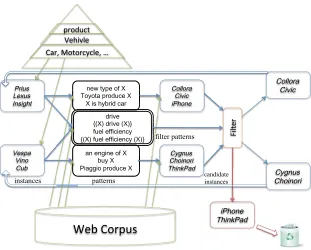
instances patterns candidate instances
instances i t
patterns candidatecinstances
e s
filter patterns
Figure 2: Set expansion using sibling relations.
Algorithm 1The proposed method.
Input: C: a set of categories,S1, S2, ..., ST: sibling groups (subset
of C),Ic: seed instances of eachc∈C,L: the number of
itera-tions
Output: Ic: instances for eachc∈C 1: forj= 1,2, ..., Tdo
2: FSj←pattern-extraction(Sj)
3: end for
4: forl= 1,2,3..., Ldo
5: forj= 1,2, ..., Tdo
6: I=[]
7: for allc∈Sjdo 8: R←ESPRESSO(Ic) 9: R←FILTER(R, FS
j)
10: I+=R
11: end for
12: for(i, c, s)inIin descending order of scoredo
13: if|Ic| ≤N∗landi /∈Icfor allc∈S\cthen 14: insertiintoIc
15: end if
16: end for
17: end for
18: end for
19: functionFILTER(R, F)
20: R= []
21: for(i, c, s)in Rdo
22: ifico-occur with∀f∈Fthen
23: insert(i, c, s)intoR
24: end if
25: end for
26: returnR
27: end function
Figure 1: Example of syntactic dependencies.
pect that instances including the same sibling group hold common properties. We assume the common property to be represented by patterns of the sibling group. These patterns, which can check the common property of the sibling group, are denoted as filter patterns. Our proposed method obtains filter pat-terns using the sibling group and ascertains whether an instance co-occurs with the filter patterns.
each candidate instance co-occurs with the filter pat-terns before the final decision of acquiring instances. The method approves instances that co-occur with the filter patterns (e.g., “Corolla”).
The detail of the method is described in Algo-rithm 1. The method is given a set of target cat-egoriesC, sibling groups (S1, S2, ..., ST), seed
in-stancesIcof each categoryc∈Cand the number of
iterationsL. Each sibling group is a subset ofC, and disjoint from each other. The method chooses filter patternsFSj of each sibling group Sj from lines 1 to 3. In line 8, the method extracts instances of each categorycof the sibling groupSjusing the function
ESPRESSO. ESPRESSO requires an instance setIc
of categoryc. ESPRESSOreturnsR, the list of the tuples each of which consists of instancei, category
cand scores(i.e., (i, c, s)), using the Espresso algo-rithm described in Section 2.1.
In the experiments, using a Japanese large-scale corpus, we employ a phrase-like unit (bunsetsu)
having dependency with an instance as a pattern. Figure 1 shows an example of Japanese sentence and its English translation1. Consider the instance
“Toyota Motor Corporation” in the sentence shown in Figure 1. The algorithm extracts the pattern:
• X←− (X←−announced)
In line 9, the method checks whether each can-didate instanceiinRhas a common property of a
sibling group using FILTERfunction (lines 19 to 27). FILTERexamines that eachiinRco-occurs with a
filter pattern f inF. The function returns the list of instances and their scores which co-occur with the filter patterns. In short, this function filters out an instance which lacks the common property of the sibling group captured by the filter patternsF.
The method uses the exclusiveness constraint be-tween categories of the sibling group to prevent drift within the group. If a pattern or an instance appears in multiple categories of the sibling group, then the method decides a single category that suits the best to the pattern or the instance. The method makes this decision based on a ranking. For example, consider a pattern “muffler of X”, in which a pattern appeared
1The words in the English sentence are ordered as they
ap-pear in the Japanese sentence. For this reason, the word order and dependency edges in the English sentence look strange, but these are correct in the Japanese original sentence.
(a). Coverage
(b). Dispersion
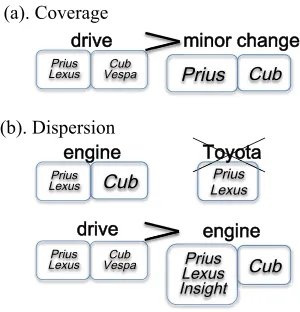
Figure 3: Two desirable properties for filter patterns.
in car and motorcycle categories. If the pattern is ranked 13th in the car category and fourth in the mo-torcycle category, then the pattern belongs only to the motorcycle category. In algorithm 1, function Espresso incorporates an exclusiveness constraint for patterns. The exclusiveness constraint for in-stances is implemented from lines 12 to 16.
The method acquires topN instances in order of
scoreswhile applying the exclusiveness constraint
from lines 12 to 16. After the method secures new instances of each category, the method proceeds to the next iteration.
3.2 Acquisition of filter patterns
As described above, using filter patterns, our pro-posed method checks whether an instance has a common property of the sibling group. We describe how to extract and score the filter patterns.
Acquisition of filter patterns has two phases: can-didate extraction and ranking. In cancan-didate extrac-tion, our method collects patterns that co-occur with seed instances of the sibling group. For example, given a sibling group consisting of car and mo-torcycle categories, the method finds patterns co-occurring with seed instances of car or motorcycle categories.
tree.Please refer tofilter patterns (top 3)column of Table 2 as an example of filter patterns.
After extracting candidates, the method selects the most suitable filter patterns in the candidates. The method selects filter patterns based on the two factors: CoverageandDispersion. Coverageis the number of instances with which a filter pattern co-occurs. Dispersionis the degree of scattering cate-gories in which the pattern appears. Figure 3 shows example of suitable filter patterns based on these fac-tors. In Figure 3, a caption in bold font presents a filter pattern, and a caption in italic font presents an instance supported by the corresponding filter pat-tern.
The filter pattern is expected to cover all correct instances of the sibling group. Therefore, a pattern co-occurring with many seed instances is desirable. For example, in Figure 3 (a), the pattern “drive” is more suitable than “minor change” because “drive” supports more correct instances. This factor, Cover-age, is modeled by recall. Recall of the patternfof the sibling groupSjis calculated using equation (4).
Recall(Sj, f) =
c∈Sj
i∈Iccooccur(f, i)
c∈Sj|Ic|
(4)
cooccur(f, i) =
1 ifico-occurs withf
0 otherwise (5)
Ic is the set of seed instances of category c. |Ic|
is the number of seed instances of category c. cooccur(f, i)indicates whether the seed instancei co-occurs with the patternf.i∈Iccooccur(f, i)is
the number of seed instances co-occurring with pat-ternf.
A filter pattern co-occurring with specific in-stances of the sibling group is inappropriate because filter patterns must ascertain whether candidate in-stances have a common property among categories. Therefore the method applies the restriction that the patterns must appear in two or more categories of the sibling group2. In Figure 3 (b), the pattern “engine”
2We found that the number of candidate patterns was too
small when we adopted the restriction that filter patterns must appear in all categories of the sibling group. Therefore, we in-troduced the restriction that filter patterns must appear in two or more categories of the sibling group. Furthermore, we measure
Coverageto obtain filter patterns that appear many categories of the sibling group.
co-occurs with seed instances of both car and mo-torcycle categories but “Toyota” appears only in the car category. The method removes the latter in this example. Furthermore, we should respect a pattern which co-occurs with seed instances in each cate-gory in a sibling group equally. For example, Fig-ure 3 (b) shows that the filter pattern “drive” is more suitable than “engine” because “drive” co-occurs with seed instances of car and motorcycle categories equally. This factor,Dispersion, is modeled by en-tropy. Entropy of the patternf of the sibling group Sjis calculated using equation (6).
Entropy(Sj, f) =−
c∈Sj
Pc(f) log|C|Pc(f) (6)
Pc(f) =
i∈Iccooccur(f, i)
c∈Sj
i∈Iccooccur(f, i)
(7)
|C| is the number of categories in which the pattern f appears. If the pattern f co-occurs with seed instances of each category equally, then Entropy(Sj, f)obtains the highest score.
To prioritize patterns with consideration of Cov-erageandDispersion, we score the patternf:
Score(Sj, f) =Entropy(Sj, f)∗Recall(Sj, f)
(8) CalculatingScore(Sj, f)for candidate patternfof
each sibling groupSj, the method acquires the top
15 patterns of each sibling group. We presume that a sibling group is exclusive to the other sibling groups. Therefore if a pattern is considered as candidates in multiple sibling groups, then the method decides that the pattern belongs to only the sibling group in which the pattern appears most frequently.
4 Experiments
4.1 Experimental setting
Precision
the number of instances Espresso
Espresso + exclusiveness constraint
Our proposed method
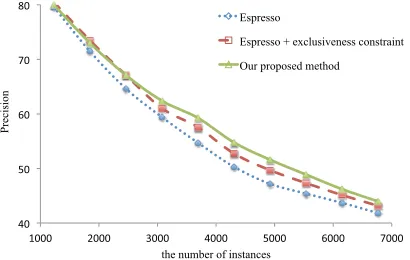
Figure 4: Precision of each method in accordance with the number of acquired instances.
instances, it is difficult to measure recall. Therefore, we compare the precision of each method when each method acquires fixed quantities of instances. We asked three human annotators to judge the correct-ness of acquired instances. We conducted the ex-periments in Japanese. The results described herein have been translated into English for presentation.
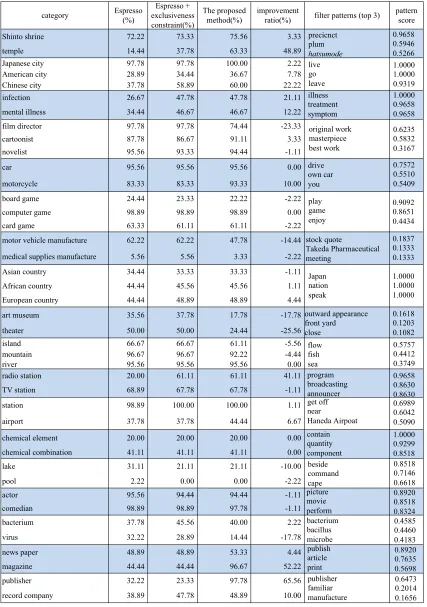
Table 2 reports all categories used for the exper-iments. Each category belongs to only one sibling group. Each sibling group consists of two or more categories. We prepared sibling groups by manu-ally based on Wikipedia. Each category starts with 15 seed instances extracted from Wikipedia in a semi-automatic manner (Sumida et al., 2008). Be-cause the automatic method yields incorrect seed in-stances, we removed errors manually.
We used 110 million Japanese web pages from which patterns and instances are extracted. We parsed sentences in the web pages using KNP, a Japanese dependency parser (Kurohashi et al., 1994). To reduce the computational time for the Espresso algorithm, we removed patterns and in-stances occurring fewer than three times.
4.2 Results
Figure 4 shows the precision of each method in accordance with the number of acquired instances. The dotted line depicts the precision curve of the Espresso algorithm. Espresso + exclusiveness con-straint (depicted in dash line) improved the precision of extracted instances by 2.4 percents (with 4305 in-stances) and 1.3 percents (with 6765 inin-stances). The
proposed method (in solid line) with exclusive and sibling relations outperformed other baselines. In particular, the proposed method improved the pre-cision from Espresso by 4.4 percents (with 4305 instances) and 2.1 percents (with 6765 instances). This result demonstrates that prior knowledge about sibling relations improves the performance of set ex-pansion.
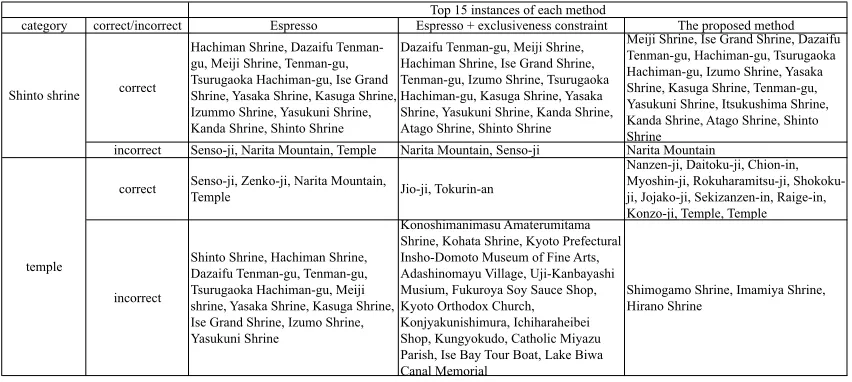
Table 1 shows the top 15 instances with high scores of Shinto shrine and temple categories, which belong to the same sibling group, acquired by each method in the 5th iteration. In Table 1, we divided instances into correct or incorrect ones. In Table 1, Espresso and Espresso + exclusiveness constraint obtained many incorrect instances, but each method acquired different instances. In Espresso, some instances (e.g., “Hachiman Shrine” and “Dazaifu Tenman-gu”) were identified as instances of both Shinto shrine and temple categories. In contrast, Espresso + exclusiveness constraint prohibits an in-stance from belonging to multiple categories and tries to choose the best category for the instance. This example suggests that mutual exclusivity mit-igates semantic drift. However, in the temple cat-egory, Espresso + exclusiveness constraint obtains many unrelated instances such as “Fukuroya Soy Sauce Shop” and “Adashinomayu Village”. The proposed method removed these incorrect instances with knowledge about commonality of the sibling group. These results suggest that sibling relations are useful additional knowledge for set expansion.
Table 1: Top 15 instances of the Shinto shrine and temple categories obtained by each method.
category correct/incorrect Espresso Espresso + exclusiveness constraint The proposed method
correct
Hachiman Shrine, Dazaifu Tenman-gu, Meiji Shrine, Tenman-Tenman-gu, Tsurugaoka Hachiman-gu, Ise Grand Shrine, Yasaka Shrine, Kasuga Shrine, Izummo Shrine, Yasukuni Shrine, Kanda Shrine, Shinto Shrine
Dazaifu Tenman-gu, Meiji Shrine, Hachiman Shrine, Ise Grand Shrine, Tenman-gu, Izumo Shrine, Tsurugaoka Hachiman-gu, Kasuga Shrine, Yasaka Shrine, Yasukuni Shrine, Kanda Shrine, Atago Shrine, Shinto Shrine
Meiji Shrine, Ise Grand Shrine, Dazaifu Tenman-gu, Hachiman-gu, Tsurugaoka Hachiman-gu, Izumo Shrine, Yasaka Shrine, Kasuga Shrine, Tenman-gu, Yasukuni Shrine, Itsukushima Shrine, Kanda Shrine, Atago Shrine, Shinto Shrine
incorrect Senso-ji, Narita Mountain, Temple Narita Mountain, Senso-ji Narita Mountain
correct Senso-ji, Zenko-ji, Narita Mountain,
Temple Jio-ji, Tokurin-an
Nanzen-ji, Daitoku-ji, Chion-in, Myoshin-ji, Rokuharamitsu-ji, Shokoku-ji, Jojako-Shokoku-ji, Sekizanzen-in, Raige-in, Konzo-ji, Temple, Temple
incorrect
Shinto Shrine, Hachiman Shrine, Dazaifu Tenman-gu, Tenman-gu, Tsurugaoka Hachiman-gu, Meiji shrine, Yasaka Shrine, Kasuga Shrine, Ise Grand Shrine, Izumo Shrine, Yasukuni Shrine
Konoshimanimasu Amaterumitama Shrine, Kohata Shrine, Kyoto Prefectural Insho-Domoto Museum of Fine Arts, Adashinomayu Village, Uji-Kanbayashi Musium, Fukuroya Soy Sauce Shop, Kyoto Orthodox Church, Konjyakunishimura, Ichiharaheibei Shop, Kungyokudo, Catholic Miyazu Parish, Ise Bay Tour Boat, Lake Biwa Canal Memorial
Shimogamo Shrine, Imamiya Shrine, Hirano Shrine
Top 15 instances of each method
Shinto shrine
temple
1. Low score of filter patterns 2. High precision in the baseline
In cause 1, precision drops in categories (e.g., motor vehicle manufacture, medical supplies man-ufacture, art museum, and theater categories) of some sibling groups. For example, in motor vehicle manufacture and medical supplies manufacture cat-egories, improvement ratios are -14.44 percent and -2.22 percent, respectively. In this sibling group, the highest score of filter patterns is as low as 0.1837. Recall that scores of filter patterns are computed for a small number of seed instances in a sibling group. Low scores of filter patterns imply that the proposed method could not find patterns with ofCoverageand
Dispersion. We suspect that the lack of common-ality of categories in the sibling group (e.g., motor vehicle manufacture and medical supplies manufac-ture) does not fit well to the assumption of using fil-ter patfil-terns. Therefore, investigating the impact of choosing sibling groups would be an interesting fu-ture direction of this research.
The film director and the comedian categories are affected by cause 2. In cause 2, although seman-tic drift does not occur in Espresso, the proposed method filtered out some positive instances. In other words, the proposed method removed correct in-stances more than incorrect ones. The proposed method forces instances to co-occur with filter pat-terns but the constraint may be too strong.
More-over, because filter patterns are determined only by seed instances, filter patterns may not cover the com-mon property of newly-acquired instances as the method iterates the bootstrapping process. In order to remedy this effect, it might be necessary to update filter patterns in the middle of iterations.
5 Conclusion
In this paper, we demonstrated that sibling relations between semantic categories provide useful knowl-edge for set expansion. We proposed the method that uses sibling relations as prior knowledge. In the experiments, we reported that the proposed method gained 4.4 percent improvements (with 4305 in-stances) from the baseline Espresso algorithm.
However, as explained in Section 4.2, the pro-posed method suffers from some side effects. We suspect that the causes of the side effects derive from the design of sibling groups and the constant use of filter patterns. Addressing these issues is left for fu-ture work. We also plan to extend this approach for extracting relation instances where each relation has semantic constraints on arguments (entity instances) and where pairwise relations (e.g., is-president-of
Acknowledgments
This research was partly supported by JST, PRESTO. This research was partly supported by JSPS KAKENHI Grant Numbers 23240018 and 23700159.
References
Steven Abney. 2004. Understanding the yarowsky algo-rithm.Comput. Linguist., 30(3):365–395.
Kedar Bellare, Partha Pratim Talukdar, Giridhar Ku-maran, O Pereira, Mark Liberman, Andrew Mccallum, and Mark Dredze. 2007. Lightlysupervised attribute extraction for web search. InProceedings of Machine Learning for Web Search Workshop, NIPS 2007. Huanhuan Cao, Daxin Jiang, Jian Pei, Qi He, Zhen Liao,
Enhong Chen, and Hang Li. 2008. Context-aware query suggestion by mining click-through and session data. InProceedings of the 14th ACM SIGKDD inter-national conference on Knowledge discovery and data mining, pages 875–883.
Andrew Carlson, Justin Betteridge, Richard C. Wang, Es-tevam R. Hruschka Jr., and Tom M. Mitchell. 2010. Coupled semi-supervised learning for information ex-traction. InProceedings of the Third ACM Interna-tional Conference on Web Search and Data Mining. Michael Collins and Yoram Singer. 1999.
Unsuper-vised models for named entity classification. In In Proceedings of the Joint SIGDAT Conference on Em-pirical Methods in Natural Language Processing and Very Large Corpora, pages 100–110.
James R. Curran, Tara Murphy, and Bernhard Scholz. 2007. Minimising semantic drift with mutual exclu-sion bootstrapping. InPacific Association for Compu-tational Linguistics, pages 172–180.
Marti A. Hearst. 1992. Automatic acquisition of hy-ponyms from large text corpora. InProceedings of the 14th conference on Computational linguistics, pages 539–545.
Sadao Kurohashi, Sadao Kurohashi, and Makoto Nagao. 1994. Kn parser : Japanese dependency/case struc-ture analyzer. InIn Proceedings of the Workshop on Sharable Natural Language Resources, pages 48–55. Alexander Maedche and Steffen Staab. 2001. Ontology
learning for the semantic web. IEEE Intelligent Sys-tems, 16(2):72–79.
Roberto Navigli, Paola Velardi, Universit Roma, and La Sapienza. 2003. Ontology learning and its ap-plication to automated terminology translation. IEEE Intelligent Systems, 18(1):22–31.
Etzioni Oren, Banko Michele, and Cafarella Michael J. 2006. Machine reading. InProceedings of The
Twenty-First National Conference on Artificial Intel-ligence and the Eighteenth Innovative Applications of Artificial Intelligence Conference.
Patrick Pantel and Dekang Lin. 2002. Discovering word senses from text. In Proceedings of the eighth ACM SIGKDD international conference on Knowledge dis-covery and data mining, pages 613–619.
Patrick Pantel and Marco Pennacchiotti. 2006. Espresso: Leveraging generic patterns for automatically harvest-ing semantic relations. InProceedings of the 21st In-ternational Conference on Computational Linguistics and 44th Annual Meeting of the Association for Com-putational Linguistics, pages 113–120.
Patrick Pantel and Deepak Ravichandran. 2004. Auto-matically labeling semantic classes. InProceedings of Human Language Technology/North American chap-ter of the Association for Computational Linguistics, pages 321–328.
Patrick Pantel, Eric Crestan, Arkady Borkovsky, Ana-Maria Popescu, and Vishnu Vyas. 2009. Web-scale distributional similarity and entity set expansion. In
Proceedings of the 2009 Conference on Empirical Methods in Natural Language Processing, pages 938– 947.
Marco Pennacchiotti and Patrick Pantel. 2011. Automat-ically building training examples for entity extraction. InProceedings of the Fifteenth Conference on Compu-tational Natural Language Learning, pages 163–171. Kugatsu Sadamitsu, Kuniko Saito, Kenji Imamura, and
Genichiro Kikui. 2011. Entity set expansion using topic information. InProceedings of the 49th Annual Meeting of the Association for Computational Linguis-tics: Human Language Technologies: short papers, pages 726–731.
Asuka Sumida, Naoki Yoshinaga, and Kentaro Torisawa. 2008. Boosting precision and recall of hyponymy rela-tion acquisirela-tion from hierarchical layouts in wikipedia. InProceedings of the Sixth International Conference on Language Resources and Evaluation.
Vishnu Vyas and Patrick Pantel. 2009. Semi-automatic entity set refinement. InProceedings of Human Lan-guage Technologies: The 2009 Annual Conference of the North American Chapter of the Association for Computational Linguistics, pages 290–298.
Vishnu Vyas, Patrick Pantel, and Eric Crestan. 2009. Helping editors choose better seed sets for entity set expansion. In Proceedings of the 18th ACM con-ference on Information and knowledge management, pages 225–234.