DOI : https://doi.org/10.32628/CSEIT195278
Data Mining Techniques Based Stock Record Management
N. Vijayalakshmi, A. Baviya
Department of Computer Science, Bon Secours College for Women, Thanjavur. Thanjavur, TamilNadu, India
ABSTRACT
Our targets are to show signs of improvement basic leadership for enhancing deal, administrations and quality, which is helpful instrument for business support, speculation and reconnaissance. A methodology is actualized for mining examples of gigantic stock information to foresee factors influencing the clearance of items. For this gap the stock information in three distinct groups based on sold amounts Dead-Stock, Slow-Moving and Fast-Moving utilizing K- implies calculation or Hierarchical agglomerative calculation. After that Most Frequent Pattern calculation is executed to discover frequencies of property estimations of the relating things. Most Frequent Pattern gives visit examples of thing characteristics and furthermore gives deals incline in a minimal shape. Grouping and Most Frequent Pattern calculation can create increasingly valuable example from expansive stock information which is useful to get thing data for stock. Opportune recognizable proof of recently developing patterns is required in business process. Information mining procedures are most appropriate for the characterization, valuable examples extraction and predications which are vital for business support and basic leadership. Examples from stock information show advertise inclines and can be utilized in determining which has incredible potential for basic leadership, vital arranging.
Keywords : Data Mining, Leadership, Business Process, Information Mining, Market Basket Analysis, Particle Swarm Optimization
I. INTRODUCTION
Data mining methods like bunching and affiliations can be utilized to discover significant examples for future forecasts. Bunching is utilized to produce gatherings of related examples, while affiliation gives an approach to get summed up standards of ward factors. Examples from a colossal stock data based on these standards can be acquired. Deal data grouping has diverse market trends. A few bunches or sections of offer might develop, while others are declining. The data created is exceptionally valuable for business basic leadership. It is anything but difficult to transform money into stock, yet the test is to transform stock into money. Successful stock administration empowers an association to meet or
concern is discovering the moving intensity of the items in the market. This is a valuable way to deal with recognize the moving recurrence of things based on the known traits, here we have essential property identified with this precedent, for example shading, type, season, and Design. So it tends to be anticipate that what results of specific properties have what kind of offer trends in various areas. Subsequently based on this situation it can foresee the reason of dead-stock, moderate moving and quick moving things. Data mining strategies are most appropriate for the examination of such sort of grouping, helpful examples extraction and forecasts.
II. BACKGROUND
This data accumulation can be utilized by them to anticipate the client conduct and their interests thought about the execution of numerical and symbolic representation of utilizing data in term of comparable inquiry. Considered a model for stock choice emotionally supportive network [IDSS] in which requesting amount, requesting cost, wellbeing factor, lead time and backorder limits are choice factors, the algorithm is connected to fine the ideal answer for the situation where the lead time requests to pursue a general conveyance. He proposed a technique based trading data mining approach for intra-stock mining which ordinarily perform focuses on finding most showing up things for the stock time arrangement data and entomb trading mining which used to find the distinctive solid relationship among the several stocks.] created a rundown of stocks which are persuasive to Kuala Lumpur Composite Index (KLCI), and after that deliver order rules, which he indicates the between connections among the stocks as far as their trading execution as for KLCI. Specialists in the field of data mining dependably endeavor to discover imaginative techniques in order to enhance the execution of the extraction strategies utilized in data mining as they
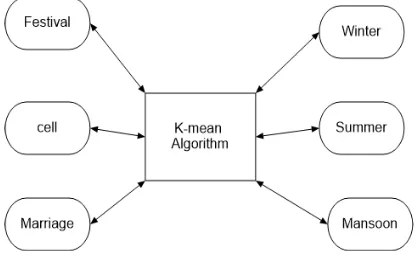
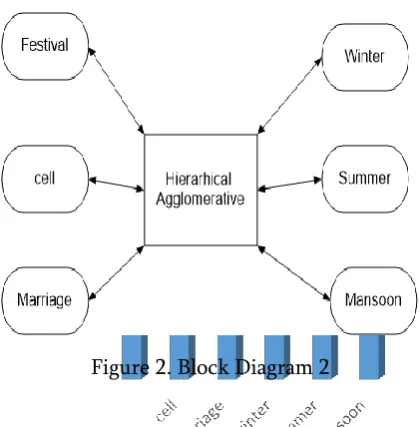
normally use history of the diverse exchanges done in finding the data as it will be helpful for some time later. In the present long stretches of advancement in the field of data mining, it is viewed as that the parceled clustering technique is appropriate for clustering an expansive archive dataset because of their moderately low computational prerequisites and increment in the steady execution of the framework. The time factor multifaceted nature of the partitioning technique is practically direct, in light of which it is generally utilized. The best known partitioning clustering algorithm is the K-means algorithm and its variations. As this algorithm is basic, clear and is based on the firm establishment of examination of differences. Notwithstanding the K-means algorithm, several algorithms, other algorithms, for example, Particle Swarm Optimization (PSO) are another computational knowledge strategy that has just been connected to picture clustering and other low dimensional datasets. In the main stage, it partitions the stock information in three unique bunches based on sold amounts for example Dead Stock (DS), Small Growth (SG) and Fast-Growth (FG) using K-means algorithm or Hierarchical Agglomerative. In the second stage Most Frequent Pattern (MFP) algorithm is utilized to discover frequencies of property estimations of the corresponding things. In this work an algorithm utilized for mining examples of enormous stock information to anticipate factors influencing the clearance of items.
Figure 2. Block Diagram 2
In the initial step of clustering, the calculation will search for the two most comparable information indicates and consolidate them make another "pseudo- data point", which speaks to the normal of the two combined information focuses. Every iterative advance takes the following two nearest data points (or pseduo-datapoints) and combines them. This procedure is commonly proceeded until there is one substantial bunch containing all the first data points. Hierarchical clustering results in a "tree", demonstrating the relationship of the majority of the first points. Hierarchical clustering is an agglomerative (top down) clustering technique. As its name recommends, the possibility of this technique is to manufacture a chain of command of bunches, appearing between the individual individuals and consolidating groups of information dependent on similitude.
Association rule mining is a standout amongst the most imperative and well characterizes procedure for concentrate relationships, visit examples, associations or causal structures among sets of things in the exchange databases or different vaults. Association rules are broadly utilized in different territories, for example, risk management, telecomm, market analysis, inventory control, and stock information. Apriori calculation for solid association among the examples is very prescribed. Another calculation MFP that is all the more productively creates visit designs
and solid association between them. For this reason a property grid containing checked benefits of comparing properties of every item has been utilized.
III.IMPLEMENTATION
Here volume trait is chosen and missing qualities are supplanted by worldwide consistent zero. Aggregation will here gather information via season shrewd trait. Select the trait on which aggregation needs to do. Select suitable characteristic on which preprocessing going needs to done.
IV.CONCLUSION
The issue of example disclosure from stock information mining is tended to in this undertaking. Half and half bunching affiliation mining approach is actualized to group stock information and discover reduced type of related patterns of offer. After usage on current database it is demonstrated that grouping and most continuous Pattern calculation is extremely proficient for mining patterns of colossal stock information and predicting the variables influencing the clearance of items. It plan most successive
example of items utilizing their realized properties in stock framework. It recognized the patterns of moving items through their known traits.
V. REFERENCES
[1]. A Khan, B. Baharudin, K. A. Khan, “Mining
Customer Data for Decision Making using new
Hybrid Classification algorithm” in journal of
theoretical and applied Information Technology Vol 27 no.1 ,15th May 2011.
[2]. Dattatray Gandhmal, Ranjeetsingh Parihar and
Rajesh Argiddi ,“An Optimized Approach to
Analyze Stock market using Data Mining
Technique” in International Conference on
Emerging Technology Trends (ICETT) 2011. [3]. Mrs. Tejaswini Hilage and R. V. Kulkarni,
“Review of Literature on Data Mining” IJRRAS
10 (1), January 2012.
[4]. Chidanad Apte, Bing Liu,Edwin P.D, Pednault
and Padhraic Smyth “Business Application of Data Mining ” ,Communication of the ACM
August 2002/Vol. 45, No. 8. [5].http://nccur.lib.nccu.edu.tw/bitstream/140.11 9/35 231/8/35603108.pdf
[5]. Abubakar, Felix, “Customer satisfaction with
supermarket retail shopping”, 2002.
[6]. Sung-Ju Kim, Dong-Sik Yun and Byung-Soo
chang, “Association Analysis of Customer
Services from the Enterprise Customer
Management System” ,ICDM-2006.
[7]. Jiawan Han, Micheline Kamber “Data Mining
Concepts and Techniques” 2nd edition 2004.
[8]. Neelamadhab Padhy, Dr. Pragnyaban Mishra ,
and Rasmita Panigrahi, “The Survey of Data Mining Applications And Feature Scope”,
International Journal of Computer Science, Engineering and Information Technology (IJCSEIT), Vol.2, No.3, June 2012.
[9]. L.K. Soon and Sang Ho Lee, “Explorative Data
Findings”, pringer- ADMA 2007, LNAI 4632, pp. 562–569, 2007.
[10].Darken, C. Moody, J. Yale Comput. Sci., New
Haven, “Fast adaptive k-means clustering” IEEE-
2002.
[11]. Berry and Linoff, “data mining techniques: for
marketing, sales and customer support”, John
Eilry #Sons, inc, 1997.
[12].Usama Fayyad, Gregory Piatetsky-Shapiro, and
Padhraic Smyth, “From Data Mining to Knowledge Discovery in Databases”, AI
Magazine Volume 17 , Number 3, 1996.
Cite this article as :