A Soft Decision-Directed Blind
Equalization AlgorithDl
Jeyhan Karaoguz
Center for Communications and Signal Processing
Department of Electrical and Computer Engineering
North Carolina State University
A SOFT DECISION-DIRECTED BLIND EQUALIZATION ALGORITHM
by
JEYHAN K ARAOGUZ
North Carolina State University,
Center for Communications and Signal Processing,
Department of Electrical and Computer Engineering,
P.O.Box 7914, Raleigh, NC, 27695.
(919) 515-5348.
Abstract
A new approach to decision-directed (DD) blind equalization is introduced based on a neural
network classification technique. The new ~D algorithm, termed soft decision-directed equalization
algorithm, is most effective for reconstructing PSK and QPSK signals. It can also be extended to
higher order QAM signals at the expense of computational complexity. We show that previously
published DD type equalization algorithms reduce to the standard DD equalization algorithm when
PSK or QPSK type signals are used. It is known that the standard DD algorithm does not guarantee
convergence for closed eye situations. Therefore, the new soft DD algorithm becomes an attractive
solution for reconstructing low order QAM signals such as PSK and QPSK. In the simulations,
the performance of the soft DD algorithm is illustrated by applying it to a two-dimensional digital
mobile communication systems. A time-varying multipath fading channel model is used as the
transmission medium. The performance of the soft DD blind equalization algorlthrn is compared
to the standard DD algorithm, the maximum-level-error (MLE) algorithm, the fast recursive least
squares decision-feedback equalization (FRLS-DFE) algorithm and Godard's blind equalization
algorithm. Tile comparisons illustrate the improvement in performance achievable with the new
soft DD equaliaation algorithm.
This work was supported by the Center Cor Communications and Signal Processing, North Carolina State
Uni-veraity, Raleigh,Net 27695-1911.
!<araoguz -I. : A Soft Decision-Directed Blind Equalization Algoritlim
I. INTRODUCTION
2
The adaptive equalizat.ion technique in which the training sequence is replaced by the quantized
values of the equalizer output is known as "decision-directed" (DD) equalization
[1].
The complexweight vector update equation for a complex DD equalizer, shown in Fig. 1, is given by
w(n
+
1)
=
w(n) - a[y(n) - y(n)]r·(n)(1)
where a is the step size, y(n) and y(n) denote the adaptive filter output and the estimate of the
decision unit respectively, and r"
(n)
is the complex conjugate of the input data vector stored inthe equalizer at time n. The DD blind equalization algorithm has found a wide variety of
appli-cations especially in digital radio systems due to its simplicity. However there are two important
disadvantages of the DD equalizer:
(1)
tile convergence is slow;(2)
the convergence of the DDalgorithm can be assured only if the equalizer starts with an "open eye"
[2].
These two limitationsmotivated further research in DD equalization. Sato [3] introduced a new DD blind equalizer based
on a coarser quantization scheme. This approach performed better than the standard DD
equal-ization for the "closed eye" situations because the standard algorithm quantizes the output of the
equalizer to the nearest data symbol which most likely results in an incorrect decision for channels
with severe distortions. Benveniste and Goursat (4] introduced a generalization of Sato's algorithm
for complex data symbols. The generalized algorithm had the following update equation:
w(n
+
1)=
w(n) - a [y(n) - 1 c-'ign(y(n))]r·(n).(2)
Note that y(n) is replaced by1 c-,ign[y(n))where the complex sign function is defined by c~ign(Yr+
jYi)
=
.9gn(Yr)+
jJJgn(Yi). Instead of using the estimate y(n), the update relation (2) utilizes theequalizer output quantized to
1
c.9ign[y(n)]. The scalar1
is given by[4]
(3)
where
ar(n)
andai(n)
are, respectively, the real and imaginary components of the data symbola(n).
Next, Picchi and Prati [5] introduced a "Stop-and-Go" DD blind equalizer which uses astop-and-go adaptation rule. This algorithm updates the filter taps according to the standard
DD update equation (1)
if
both the standard DD error"y(
n) -y(
n)" and the Sato-like [5] errorKereoguz : A Soft Decision-Directed Blind Equalization AlgoritJlm
3
also converged for closed eye situations. Another practical DD blind equalizer was introduced as the Maximum-Level-Error (MLE) algorithm[6]. This algorithm also uses a stop-and-go adapt.ation rule. The data constellation plane is divided into two regions by a threshold boundary determined by the outermost symbols in the constellation. The adaptation is stopped if the equalizer output is in the interior of the threshold boundary and continued if it is in the exterior of the threshold boundary. For the latter case the sign of the decision directed error is always correct. Therefore the MLE algorithm always updates the filter taps in the correct direction but its disadvantage is that the frequency of updates is small because most of the equalizer outputs fall into the region interior to the threshold boundary. Ross and Taylor
[7J
slightly modified the MLE algorithm by scaling the magnitude of the update constant instead of stopping the adaptation when the output of the equalizer is in the interior of the threshold boundary.An interesting and least-mentioned point common to all previously mentioned modified DD algorithms except the MLE algorithm is that they can only be applied to high order constellations such as 16-QAM and 64-QAM. This is because for low order constellations such as PSK and QPSK, Sato's algorithm reduces to the standard DD algorithm. This can be verified if the scalar'1in
(3)
is calculated for a PSK or QPSK constellation (symmetric around the origin). Then, one can find out that the Sato's estimate"y(
n) -1 c-,ign[y(n)J"
becomes exactly equal to the standard DD estimateKereoguz .. : A Soft Decision-Directed Blind Equalization Algorithm 4
so, a neural network technique is employed where the transmitted data sequence is reconstructed at the receiver as accurately as possible. The final result of this approach is shown to be a
decision-directed equalizer. The new algorithm will be referred to as "soft decision-directed equalizer". The previous modifications
(3,4,5]
to the standardDD
algorithm has been introduced primarily by ad-hoc means. In this paper a theoretical justification is provided in deriving the softDD
equalization algorithm.II. DERIVATION OF SOFT DECISION-DIRECTED EQUALIZATION ALGORITHM
In the equations the following definitions hold. The received complex input vector stored in the equalizer taps at time n is represented by r and defined as
r=xi+iYi=[r(k)
r(k-l) ... r(k-N+l)]t.
(4)
The blind equalizer is composed of an arbitrary Nth order complex FIR filter whose taps are adaptively adjustable. The complex weight vector is given by
(5)
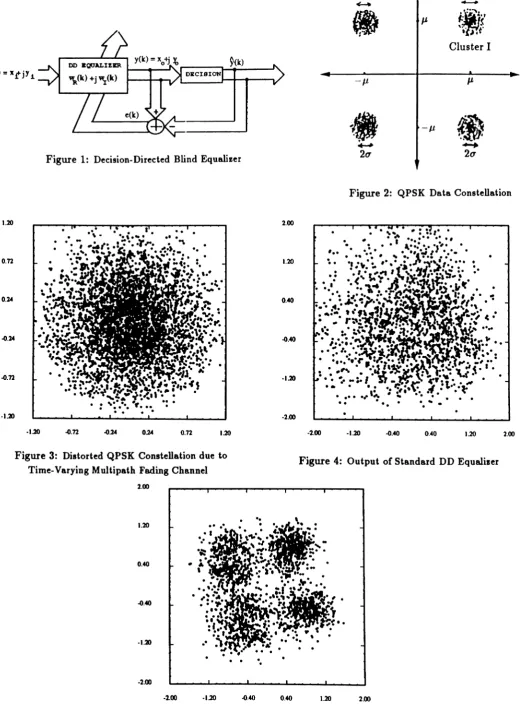
The soft decision-directed blind equalizer for 2-D communication systems is shown in Fig. 1. The blind equalizer output is
(6)
All boldface variables denote vectors.
When digital data is transmitted through an ideal channel, the reconstructed constellation at the receiver will be composed of single points corresponding to each complex symbol in the alphabet. Ilowever, for practical dispersive channels, the detected data sequence forms a constellation with clusters instead of single points as depicted in Fig. 2 for a QPSK scheme. The variances of the clusters depend on the distortion introduced by the channel. Our neural network technique employs the Gaussian cluster formation algorithm [9] which models each cluster by a Gaussian distribution with apriori known mean and variance, and classifies the incoming data as belonging to one of
Karaoguz °1: A Soft Decision-Directed Blind Equalization Algorithm 5
the distribution of the summation of random variables approaches a Gaussian distribution as the
number of the paths increases.
Let us consider one of the clusters (for example "Cluster I") in the constellation diagram (Fig.
2). The transmitted complex symbol corresponding to "Cluster I" is composed of two random
components
(x,
y).
Therefore the joint Gaussian distributionf(
e ,y)
which models "Cluster I"takes on the following form
( ) I l t _1
f
:t:,y = 21rIKI1/2exp(-ir
Kr)
(7)
where r
=
((x -llz),(Y-lLy)]t. The Ilz and ILv specify the mean values of "ClusterI" with respectto x-axis and y-axis respectively. The covariance matrix K is defined as
(8)
In 2-D conununication systems the random symbol components z and y are statistically
indepen-dent, therefore
K
becomesand the determinant of
K
becomesK
=
[(7~
o
(72
0I
v
(9)
(10)
lienee assuming independent real and imaginary components [z ,
y)
for each symbol, the jointGaussian distribution takes on the following form
(11)
where
(/lz,
u~) and (lLy,u~) are the mean and variance pairs for the real and imaginary parts of thetransmitted symbol corresponding to "Cluster In.
We now extend (11) to define a general performance function which models the entire data
constellation encompassing all the clusters (assuming there are n of them, for example for QPSK
n=4, for 64-QAM n=64).
(12)
where the index n goes through all the clusters. The log operation is performed to make q;have a
Kereogur . ' . : A Soft Decision-Directed Blind Equaliza.tion Algorithm 6
complex output of the blind equalizer as shown in Fig. 1. Substituting (4) and (5) in (6), the real and imaginary parts of the equalizer output X o and Yo respectively, can be found as
Xo = X~WR - Y!Wl
Yo
=
Y~WR-t-
X~Wl'(13)
Notice that if (13) is substituted in (12) \II becomes a function of the real and imaginary parts of the equalizer filter weight vector W R, WI respectively. The algorithm modifies the complex weights
of the FIR filter to maximize the log likelihood of generating the observed output values from the mixture of Gaussian distributions in (12). If we view the output of the blind equalizer as a data point, the algorithm maximizes
'1i(
W R'wJ)
by moving the data point toward the center of the nearest cluster. The Pnin (12) is the proportion of the nth cluster in the mixture. For practical 2-Ddata communication systems the Pn's can be taken as equal since the symbols are chosen equally likely from an alphabet. In addition, we can impose the same variance (1'2 for each cluster. After
making these assumptions (12) reduces to
(14)
where each cluster has a mean value defined by the pair
(Il:r:n'
llYn) and a variance specified by (1'2.To maximize (14) with respect to the complex FIR weight vector, we compute the gradient ascent in
q,(
1'1R' 1'1I)' An LMS-like stochastic gradient update algorithm is employed because of its stability, robustness and ease of implementation. After applying it to the complex FIR weights [10], one obtains(15)
(16)
where a is the learning rate. The W
R(
k)and 'Wl(
k)are the real and imaginary parts of the complexFIR weight vector at time k, Notice that all complex linear unit weights are updated simultaneously after each iteration proportional to gradient ascen t in '1'
(w
R' WJ)
with respect to weights. The vector partial derivatives can be written as(11)
Karaoguz "
where
: A Soft Decision-Directed Blind Equalization Algorithm 7
(19)
Assuming a QPSK constellation as illustrated in Fig. 2,four symbols are located symmetrically
around the origin. Using (13), after some algebraic manipulations, the partial derivatives can be
written as
(20)
(21 )
and
(22)
where Iln
=
(-I)nIl and Il is the symmetric mean, and E~=1E~=1flm ft(%0' Yo)=
1. The real andimaginary components of the weight vector are initialized to zero except for the real component of
the first tap which is initialized to 1. The update equations (15,16) continuously adjust tile complex
weight vector so that the output of the blind equalizer forms four clusters where the clusters have
mean and variance values specified by (Jlm, Jln :m, n
=
1,2) and (1"2 respectively.Before elaborating on the final result (20,21,22) of the soft DD algorithm, we will show that
the standard DD update equation (1) is a special case of the soft DD algorithm's update equations
(20,21). Again consider the QPSK data constellation as shown in Fig. 2, and assume that the
real and imaginary parts of the equalizer output :Co, Yo are each greater than zero. Accordingly,
the four exponentials in equation (14) (for QPSK
n=4)
take different values. For the momentignore the smaller exponentials and keep the largest one corresponding to the positive mean values
Ilz
=
JLy=
JL. This is equivalent to ignoring the probability that the particular output value canbe from the clusters farther away. Therefore (14) reduces to
(23)
Furthermore, the partial derivatives can be written as
(24)
Karaoguz : A Soft Decision-Directed Blind Equalization Algoritllm 8
ThE' updates (20,21) for the real and imaginary parts of the weight vector reduce to the standard
I)D updates (24,25) where the mean values of the real and imaginary parts of the equalizer output
are used as the estimates in (1). If you substitute(24,25)in (15,16)the result becomes equivalent to
the standard DD equation (1)except for a norrnalizat ion factora2. Therefore the soft DD algorithm
is equivalent to the standard DD algorithm if we ignore the probability that the equalizer output
can be from the clusters farther away. With this assumption, we place full confidence in the blind
equalizer output estimate as does the standard DD equalizer. However the estimates for the
"closed-eye" situations ar~ most likely incorrect. Therefore as proved in
(2],
the standard DD algorithmmay not converge since the incorrect decisions move the weight vector in the wrong direction.
The final result of the proposed algorithm is the set of the equations (20,21,22). Recall that
these equations were derived from (14) by taking into account the fact that any given equalizer
output value can be from anyone of the clusters in the constellation. Therefore, the update
equations (20,21) are the sum of 4 decision-directed updates corresponding to 4 clusters in the
QPSK constellation. TIle probability that an output belongs to a certain cluster is determined
by the joint sigmoid function O""ft(zo,
Yo)
in (22) which can take values between 0 and 1. Thisdecision procedure is analogous to the Bayes decision rule used in [11]. The probability that a
given equalizer output can be from the clusters farther away is taken into account however the
clusters that are farther away from the given equalizer output have relatively less effect than
the ones closer in updating the filter weights. Therefore, the joint sigmoid function
n
"''1(:1:0' lie,)
introduces a soft-decision as to which cluster a given output most likely belongs to, rather than an
unreliable hard-decision made by the standard DD algorithm. Now let us see what improvement is
achieved by the soft-decision capability of the new algorithm instead of the hard-decision employed
by the standard DD algorithm. Consider the case when the equalizer output is near zero. For the
QPSK constellation described above, the standard DD algorithm most likely makes an incorrect
decision because the output value can be from anyone of the four clusters. The disadvantage of
the standard DD algorithm is that the weights are changed by (24,25) the most for these highly
ambiguous estimates. Consequently, most of the time the filter taps are updated in the wrong
direction by a large amount. This phenomenon causes the standard DD equalizer to diverge for
closed eye situations where there are many ambiguous decisions to make. On the other hand, the
soft DD algorithm makes very small changes in the weight vector for the cases when the equalizer
Kereogus: .r~l( " .. A Soft Decision-Directed Blind Equelisetion Algorithm 9
approximately cancel out since each update in (20,21) (corresponding to each cluster) changes the
filter weights by the same magnitude but in opposite directions. Inother words, when the estimates
are found to be unreliable the weight update is virtually stopped. The simulation results in the
next section support the line of reasoning presented above. The simulations demonstrate that for
closed eye situations where there are many ambiguous decisions to make, the soft DD algorithm
successfully converges whereas the standard DD algorithm fails to converge.
III. SIMULATIONS AND RESULTS
In the simulations we investigated the capabilities of the soft DD blind equalizer and compared
it to the standard DD algorithm, the MLE algorithm, the fast recursive least mean squares decision
feedback (FRLS-DFE) [12] algorithm and the conventional constant modulus algorithm (CMA) (13]
which is a special case of Godard's blind equalizer
[14].
The fading channel is composed of fourmultipath channels with delays up to four times the symbol duration. The received signal at each
multipath is composed of forty different scattered signals with random, and mutually statistically
independent amplitudes, phases and angles of arrival. Finally, a vehicle speed of 45 rni/hr is applied
which results in 60 Hz peak Doppler shift and about 16 ms channel coherence time. This small
coherence time causes rapid time-varying fading [15]. The number of taps are 8 for the standard
DD, MLE, CMA and soft DD algorithms. For the FRLS-DFE, the number of taps is 30 and 4 for
the forward and feedback filters, respectively. Fig. 3 shows the distorted QPSK constellation due to
the time-varying fading channel. Evidently, the eye pattern is closed. Fig. 4illustrates the output
of the standard DD algorithm which failed to reconstruct the desired constellation. Fig. 5 is the
output of the MLE algorithm where it performed better than the standard DD algorithm but the
quality of the equalized constellation is still poor and also the convergence duration is considerably
long. Fig. 6 is the output of the FRLS-DFE where the bit-error-rate is still quite high. These
results are as expected. Due to the closed eye situation there are many ambiguous cases (symbols
mapped around origin in Fig. 3) to decide and any incorrect decision made by the standard DD
equalizer moves the equalizer weight vector in the wrong direction and finally causes it to diverge.
For the FRLS-DFE algorithm, the incorrect decisions not only moves the weight vector in the
wrong direction but also causes error propagation in the feedback filter [8] which results in the poor
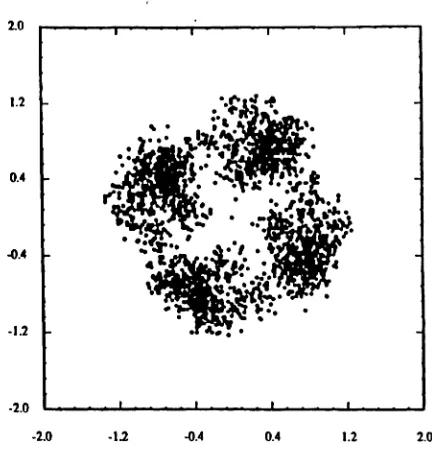
performance as shown in Fig 6. The output of the CMA is illustrated in Fig. 1. Evidently, the
: A Soft Decision-Directed Blind Equa.lization Algorithm 10
fading channel as the resulting constellation is not well-defined. Fig. 8 presents the output of the
new soft
DD
blind equalization algorithm for the same channel. While the other algorithms failed,the soft
DD
equalization algorithm successfully reconstructed theQPSK
data constellation becauseof the soft-decision sigmoid function
(22)
which enables the algorithm to handle the ambiguous andreliable estimates more efficiently. The convergence rate of the soft DD algorithm is compared to
other algorithms and illustrated in Fig. 9. A moderate distortion multipath fading channel is used
in these simulations in order to ensure the convergence of the standard DD algorithm and the MLE
algorithm. Fig. 9 is determined by taking an average of 36 individual runs with different seeds
for the random complex binary input. Due to the known training sequence FRLS-DFE converges
faster than the other algorithms. The soft DD blind equalization algorithm follows the FRLS-DFE
in terms of convergence speed. The standardDD algorithm and the MLE algorithm are the slowest.
The convergence rate of the standard DD is slow because wrong decisions delay convergence. The
convergence rate of the MLE algorithm is the slowest because it waits for a reliable data to update
the filter taps.
IV. CONCLUSION
A soft decision-directed blind equalization algorithm has been presented. Unlike other DD
algo-rithms (4,5] which reduce to standard
DD
algorithm for low orderQAM
applications (such as PSKand QPSK), the new algorithm is most effective for reconstructing PSK and QPSK signals. The
proposed algorithm can also reconstruct higher order
QAM
signals but the computationalcom-plexity increases. Simulation results demonstrated that the soft DD blind equalization algorithm
performed significantly better than the existing algorithms such as the standard DD algorithm, the
MLE algorithm, the FRLS-DFE algorithm and the CMA.
REFERENCES
[1]
J.E. Mazo, "Analysis of Decision-Directed Equalizer Convergence", The Bell System Journal,Vol. 59, No. 10, December 1980, pp. 1857-1876.
[2]
O. Macchi and E. Eweda, "Convergence Analysis of Self-Adaptive Equalizers", IEEE Trans.on Inform. Theory, Vol. 30, 1984, pp. 161-176.
[3] Y.
Sato,uA
Method of Self-Recovering Equalization for Multilevel Amplitude-ModulationSchemes", IEEE Trans. on Commun., Vol. 23, 1975, pp. 679-682.
[4]
A. Benveniste and M. Goursat, uBlind Equalizers", IEEE Trans. on Commun., Vol. 32, No.Karaoguz , . r . • • r : A Soft Decision-Directed Blind Equalization Algorithm 11
(5] G. Picchi and G. Prati, "Blind Equalization and Carrier Recovery Using a "Stop-ann-Go" Decision-Directed Algorithm ", IEEE Trans. on Communications, Vol. 35, 1987, pp. 877-887.
[6] R. Yatsuboshi, N. Sata, and K. Aoki, "A Convergence of Automat.ic Equalizer by Maximum
Level Error Control," Nat. Conv. Rec., IEeE Japan, No. 2192, 1974
[7] F.J. Ross, D.P. Taylor, "An Enhancement to Blind Equalization Algorithms," IEEE Transac-tions on CommunicaTransac-tions, Vol. 39, No.5, 1991, pp. 636-639
(8] B. Gudmundson, "Adaptive Equalizers with Application to Mobile Radio", Ph.D Dissertation, September 1988, Electrical Engineering, Royal Institute of Technology, Sweden.
(9] G.E. Hinton, S.J. Nowlan, "The Bootstrap Widrow-Hoff Rule as a Cluster-Formation Algo-rithm", Neural Computation, No.2, 1990, pp. 355-362.
(10] B. Widrow et.al., " The Complex LMS Algorithm", Proc. of the IEEE, April 1975, pp. 719-720.
[11] S. Chen, G.J. Gibson, C.F.N. Cowan, "Adaptive Channel Equalisation Using a
Polynomial-Perceptron Structure",
lEE
Proc., Pt. I, Vol. 137, No.5, October 1990, pp. 257-264.[12] T. Adali, S.H. Ardalan, "Multi-Channel General Order Fast Transversal Filter Applied to Rapid Equalization of Fading Mobile Channels", Submitted to ICA SSP '92.
[13] J. Karaoguz, S.H. Ardalan, "Use of Blind Equalization for Teletext Broadcast Systems", IEEE
Transactions on Broadcasting, Vol. 37, No.2, June 1991, pp. 44·54.
[14] D. N. Godard, "Self-Recovering Equalization and Carrier Tracking in Two-Dimensional Date Communication Systems," IEEE Transactions on Communications, Vol. COM-28, No. 11, November 1980, pp. 1867-1875.
(15]
J.
G.
Proakis, "Adaptive Equalization for TDMA Digital Mobile Radio", IEEE Trans. on.
.
~~-:
:.,
..
• • I ••• : . . .: •I-
.
.:...
,':.
..
I..
..
. .],'..,
I • •·
.
~:...: I·.... .
• • .,.~. I •
.a.
~'.:
I... .
z» . . . , f· •,.J.",.~.. ••
•: ..I.:
~~. ~~~"I,...,.,..
~.
• I • ( . . •A ...~ ••
loot
• •• _ . •• --'1• • •.(.''Air"~~.,.~ I'~.II'~._ • •_-. ·fI- .., ..
-.!~. _.. " . ' . -:- • .,;.. -:1"••• .. ..
I~ • '1-..
r~_,
_••
,...~••
_~':: :.. :.,..-..I,,·
;t:;~~\'\\S:' ....
• •• ••.-L'
I·... ••~'r;,
~~~~
' , ...
•• -.~
..~:A: •..:~•
•• • I •• •~ 1.;..~
-
~t-...J;~ ~.-Gf ; •..
• : •• : ••• ,. f :1:, ••• •~..·~~l,..·
.:,
i··
• -".
• - .··eJ~'.~~· • . . . . .•
~.,:...
' - I~5· ·
•••
.• ·
~• .. ;.1,
. " ' "1':-.,..
"'''·t· ." ·
-I: ··•.
L"
~.~-.
.
.
.
...
"
--.
.
...
..
..
.
Yo
20-
.20-~ ~
"
p. f:'I
~.,''t. ,J.t"
Cluster I
Xo
-p
'.
-JlI)
-.
...
~20-
20-Figure 2: QPSK Data Constellation
2.00 1.20 -0.40 -2.00 -1.20 0.40
Figure 1: Decision-Directed Blind Equalizer
1.20 0.72 -o.2A -0.72 0.2A -1.20
-1.20 -o.n 0.204 0.72 1.20 -2.00 -1.20 -0.40 0.40 1.20 2.00
Figure 3: Distorted QPSK Constellation due to Time-Varying Multipath Fading Channel
2.00
Figure 4: Output of Standard DD Equalizer
1.20
0.40
.0.40
-1.20
.~
• • ... .. . 14 • . •
-
,
I-..
..
.
.
.
-2.00
-2.00 -1.20 -0.40 0.40 1.20 2.00
2.00 1.20 0.40 -0.40 -1.20 -2.00
-1.20 -0.40 0.40 1.20 2.00 -2.0 -1.2 .().4 0.4 1.2 2.0
Figure 6: Output of FRLS-DFE Figure 7: Output of CMA
-0.4
-.
-
••
-1.2 ~
.-,
.
..
.--.
• I.
-2.0
.2.0 ·1.2 -0.4 0.4 1.2 2.0
Figure 8:
Output of Soft DD Bqualiser2500 2000
ISOO
UQ)
NumberorIterations o
!
I - FRLS-DFEEquaBlerI I : • :
...+
i
II ', Soft DDEq~aliler ..I ! III _ Standard DDEqualJael
I : . .
...~~:
i
IV : MLEEqu~ler• : z
i
·
!
·..···..
·i··
·..· ..
: : : : ~ 14 -90 -]8 ... -12
Figure 9: Convergence Rate of Soft DD Equaliaer Compared to Other Equalisers
Mean SquareError(dB)
40
-W
...
·· ,.
.
..