A Novel Method for Image Retrieving System
With The Technique of ROI & SIFT
Mrs. Dipti U.Chavan¹, Prof. P.B.Ghewari²
P.G. Student, Department of Electronics & Tele. Comm. Engineering, Ashokrao Mane Group of Institutions, Vathar, Kolhapur, Maharashtra, India1
Assistant Professor, Department of Electronics & Tele. Comm. Engineering, Ashokrao Mane Group of Institutions, Vathar, Kolhapur, Maharashtra, India2
ABSTRACT- In this paper focuses on a probabilistic generative model that concurrently tackles the problems of image retrieval and region-of-interest (ROI) segmentation. The proposed model takes into account several properties of the matching process between two objects in different images. Our approach improves the reliability of detected true matches between any pair of images. Furthermore, by taking advantage of the links to the ROI provided by the true matches, the proposed method is able to perform a suitable ROI segmentation. Finally, the proposed method is able to work when there is more than one ROI in the query image. Our approach clearly outperforms the most prevalent approach for geometrically constrained matching. The proposed technique concurrently provided very good segmentations of the ROI. Furthermore, the capability of the proposed method to take into account several objects-of-interest was also tested on three experiments: two of them concerning image segmentation and object detection in multi-object image retrieval tasks, and another concerning multiview image retrieval. These experiments proved the ability of our approach to handle scenarios in which more than one object of interest is present in the query. In this paper matching process carried out with the help of Scale Invariant Feature Transform (SIFT) between ROI image and different images in Data base.
KEYWORDS: Image retrieval, Object segmentation, ROI, Object segmentation, Image Databases, SIFT.
I.INTRODUCTION
The system represents a geometric-aware matching that relies on a probabilistic mixture model to concurrently solve both image retrieval and ROI segmentation problems. Our proposal provides a unified framework that takes into account three kinds of constraints: spatial coherency between points belonging to the same object, underlying geometric transformations between matched objects, and visual similarity between matched points. As a result, the proposed method naturally provides segmentation mask identifying the ROI in the query image. Our method focuses on the matching process between a query image and a set of reference images. For matching process, Scale Invariant Feature Transform (SIFT) is used between ROI image and different images in Data base. Our method models the transformation between objects appearing in two images.
II.PREVIOUS WORK
(1)Prototype-based image search reranking ( L. Yang and A. Hanjalic, IEEE, Jun. 2012):- This paper focuses on Image Search Re-ranking Based on Prototype a prototype based method to learn reranking function from human labeled samples. Based on images obtained in initial search result, visual prototype will be generated. Each prototype is used to construct a Meta reranker to produce a reranking score for any other image from initial set. Finally all scores from all metarerankers are aggregated. For visual reranking author used SVM algorithm.
(2)Large-scale image retrieval with compressed fisher vectors (F. Perronnin, Y. Liu, J. Sanchez, and H. Poirier IEEE) :-This paper implementation primarily focuses to use the Fisher kernel framework. Author compress Fisher vectors to reduce their memory footprint and speed-up the retrieval & shown on two publicly available datasets that compressed Fisher vectors perform very well using as little as a few hundreds of bits per image, and significantly better than a very recent compressed BOV approach.
Based on the above literature review there are several properties of matching process between two objects in different images, like objects undergoing a geometrical transformation, typical spatial location of region of interest and visual similarity. From our point of view, the proposed method provides three main benefits with respect to traditional retrieval approaches: first, the segmentation of the ROI may be useful in many applications (e.g. video editing); second, it improves the retrieval process by enforcing the matches to fulfill a set of geometric constraints; and, third, using a mixture model to represent the matching process allows us to consider more than one image region being matched in a reference image. It successfully addresses several problems of interest in computer vision, such as multi-object retrieval, detection and segmentation, or multiview retrieval. The above mentioned system inspired me to make an attempt to provide a comprehensive assessment of the method in new scenarios of application.
III.PROPOSED METHOD
Flow chart-1. Block diagram of the proposed method
As shown in Flow chart-1 – First input (query) image is selected and using Median filter noise is eliminated. Harris corner detection method is used for edge detection, selected seed points are located. ANFIS (Adaptive Neuro Fuzzy Interference System) is used For ROI segmentation. Segmented output is available which is further used as a query image to find its match in the database.
1) Filtering: - Using Median filter the RGB three colors of the image pixels are filtered. Hence we get the filtered RGB image.
2) ROI: - The Harris corner detector is a popular interest point detector due to its strong invariance to: rotation, scale, illumination variation and image noise. The Harris corner detector is based on the local auto-correlation function of a signal; where the local auto-correlation function measures the local changes of the signal with patches shifted by a small amount in different directions. A discrete predecessor of the Harris detector was presented by Moravec; where the discreteness refers to the shifting of the patches.
Change of intensity for the shift [u,v]: as per formula (1) given below :
(1) Input Image
Obtain ROI
Pixel Matching in Database
Object retrieval from Database
Display
Retrieved Object
2,
( , )
( , ) (
,
)
( , )
x y
advantage of the self adaptability and learning capability of the neural network and the capability of the fuzzy system to take into account of the prevailing uncertainty and imprecision of real systems with the help of the fuzzy if-then rules, an integrated forecasting approach comprising of both the fuzzy logic and the neural network has been considered. This hybrid system is called the Adaptive network based fuzzy inference system.
A neuro-fuzzy technique called Adaptive network based fuzzy inference system (ANFIS) has been used as a prime tool in the present work. ANFIS is a neuro fuzzy technique where the fusion is made between the neural network and the fuzzy inference system. In ANFIS the parameters can be estimated in such a way that both the Sugeno and Tsukamoto fuzzy models are represented by the ANFIS architecture. The fuzzy logic takes into account the imprecision and uncertainty of the system that is being modeled while the neural network gives it a sense of adaptability. Using this hybrid method, at first an initial fuzzy model along with its input variables are derived with the help of the rules extracted from the input output data of the system that is being modeled. Next the neural network is used to fine tune the rules of the initial fuzzy model to produce the final ANFIS model of the system. In this proposed work ANFIS is used as the backbone for the identification of real world systems.
B) ANFIS structure:-
For simplicity, it is assumed that the fuzzy inference system under consideration has two inputs and one output. The rule base contains the fuzzy if-then rules of Takagi and Sugeno’s type as follows:
If x is A and y is B then z is f(x, y)
Where A and B are the fuzzy sets in the antecedents and z=f(x, y) is a crisp function in the consequent. Usually f(x, y) is a polynomial for the input variables x and y. But it can also be any other function that can approximately describe the output of the system within the fuzzy region as specified by the antecedent. When f(x, y) is a constant, a zero order Sugeno fuzzy model is formed which may be considered to be a special case of Mamdani fuzzy inference system [144] where each rule consequents specified by a fuzzy singleton. If f(x, y) is taken to be a first order polynomial a first order Sugeno fuzzy model is formed. For a first order two rule Sugeno fuzzy Inference system, the two rules may be stated as Rule 1: If x is A1 and y is B1 then f1=p1x+q1y+r1
Rule 2: If x is A2 and y is B2 then f2=p2x+q2y+r2
Here type-3 fuzzy inference system proposed by Takagi and Sugeno is used. In this inference system the output of each rule is a linear combination of the Input variables added by a constant term. The final output is the weighted average of each rule’s output.
4)SIFT(Scale Invariant Feature Transform): For matching process Scale Invariant Feature Transform technique is used between ROI image and different images in Data base. A SIFT feature is a selected image region (also called key point) with an associated descriptor. Key points are extracted by the SIFT detector and their descriptors are computed by the SIFT descriptor. It is also common to use independently the SIFT detector (i.e. computing the key points without descriptors) or the SIFT descriptor (i.e. computing descriptors of custom key points). SIFT key points of objects are first extracted from a set of reference imagesand stored in a database. An object is recognized in a new image by individually comparing each feature from the new image to this database and finding candidate matching features based on Euclidean distance of their feature vectors. From the full set of matches, subsets of key points that agree on the object and its location, scale, and orientation in the new image are identified to filter out good matches. The determination of consistent clusters is performed rapidly by using an efficient hash table implementation of the generalized Hough transform. Each cluster of 3 or more features that agree on an object and its pose is then subject to further detailed model verification and subsequently outliers are discarded. Finally the probability that a particular set of features indicates the presence of an object is computed, given the accuracy of fit and number of probable false matches. Object matches that pass all these tests can be identified as correct with high confidence.
Comparative method:
IMAGE
RGB to HSV
And wavelet
decomposition
Texture
Classification based
on color
1
st& 2
ndorder
Statistical moment
Gabour Transform
3. Statistical moments and Gabour transform
The statistical moments of the classified texture are calculated to obtain varying range of textures. For this 1st and 2nd order statistical moments are calculated. Gabour filter is applied to extract selective key regions along with their texture information in terms of color which are used to match the contents with dataset image features and matching image is displayed.
IV.RESULTS AND ANALYSIS 4.1 Implementation
The proposed work is implemented in MATLAB and experimentation is done. The figure 4.1 shows the screen shot of GUI of implemented work.
Figure 4.1 GUI of implemented work in MATLAB
Figure 4.1 indicates the implemented algorithm output in GUI with different processing buttons in it. Button 1 is for setting up the dataset for experimentation. Button 2 is for selecting test image for matching process. Button 3 provides noise removal process. Button 4 is for extracting features using SIFT of the test image. Button 5 is for training neural network with selected test image. Button 6 gives final matching result of the test image with that of database.
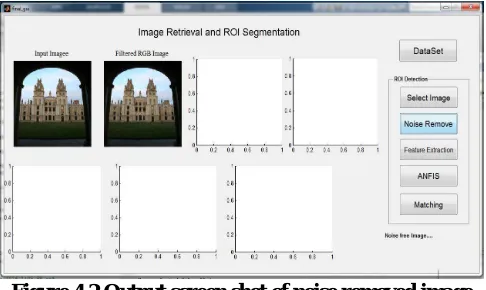
4.2 Noise removal result
Figure 4.2 Output screen shot of noise removed image
Figure 4.3 Laplace scale norm operator.
Figure 4.3 shows the laplace scale norm operator is run on image.
4.3 Selected seed points result
Figure 4.4. Selected seed points output screenshot
As shown in figure 4.4 laplacian operator, auto scaling is done and key points are selected which are
Figure 4.6: Result of matched images from database
Figure 4.6 shows then most matching images as result of matching.
After training from neural network, the results of segmented ROI are compared with the hidden points and most matching results are selected. It may happen that more than one images may match from the database, from which second most matching result is shown in the image window.
4.6 Annotations
The system gives a generative probabilistic Model that concurrently tackles image retrieval and ROI segmentation problems. By jointly modeling several properties of true matches, namely : objects undergoing a geometric transformation, typical spatial location of the region of interest, and visual similarity, our approach improves the reliability of detected true matches between any pair of images.
4.7 Comparative analysis:
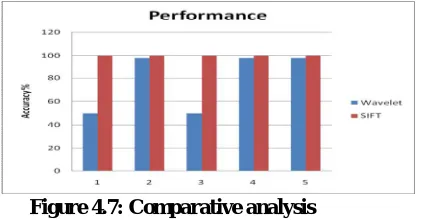
Figure 4.7: Comparative analysis
We compared the results in terms of accuracy. SIFT based results are almost 100 percent in terms of retrieving the most matching image. As shown in figure 4.7, Wavelet based image retrieval shows less accuracy as compared with proposed method using SIFT
V. CONCLUSION AND ANALYSIS
5.1 Conclusion
This project focuses on reliability of detected true matches between any pair of images. Furthermore, the proposed method associates the true matches with any of the considered foreground components in the image and assigns the rest of the matches to a background region, to perform a suitable ROI segmentation.
The fuzzy based neural network system has shown significantly successful results for matching the correct image and mostly matching image of same object but with different angles and perspective. The results obtained are satisfactory with great success ratio.
5.2 Future scope
REFERENCES
[1]Ivan Gonzalez Diaz, “A Generative Model for Concurrent Image Retrieval and ROI Segmentation” IEEE Trans. Multimedia, vol. 16, no. 1, January 2014.
[2] L. Yang and A. Hanjalic, “Prototype-based image search reranking,” IEEE Trans. Multimedia, vol. 14, no. 3, pp. 871–882, Jun. 2012.
[3]F. Perronnin, Y. Liu, J. Sanchez, and H. Poirier, “Large-scale image retrieval with compressed fisher vectors,” in Proc. 2010 IEEE Conf. Computer Vision and Pattern Recognition (CVPR), pp. 3384–3391, Jun. 2010.
[4]O. Chum, M. Perdoch, and J.Matas, “Geometric min-hashing: Finding a (thick) needle in a haystack,” in Proc. IEEE Conf. Computer Vision and Pattern Recognition, 2009(CVPR 2009), pp. 17–24, Jun. 2009.
[5] J. Philbin, O. Chum, M. Isard, J. Sivic, and A. Zisserman, “Lost in quantization: Improving particular object retrieval in large scale image databases,” in Proc. IEEE Conf. Computer Vision and Pattern Recognition, pp. 1–8, Jun. 2008.
[6] J. Philbin, O. Chum, M. Isard, J. Sivic, and A. Zisserman, “Object retrieval with large vocabularies and fast spatial matching,” in Proc. IEEE Conf. Computer Vision and Pattern Recognition, pp. 1–8, 2007.
[7] O. Chum, J. Philbin, J. Sivic, M. Isard, and A. Zisserman, “Total recall: Automatic query expansion with a generative feature model for object retrieval,” in Proc. 11th Int. Conf. Computer Vision, Rio de Janeiro, Brazil, 2007.
[8]D.G. Lowe, “Distinctive image features from scale invariant key points,” IJCV, vol. 60, no. 2, pp. 91–110, 2004.
[9]X. Shen, Z. Lin, J. Brandt, S. Avidan, and Y. Wu, “Object retrieval and localization with spatially-constrained similarity measure and k-nn re-ranking,” in Proc. 2012 IEEE Conf. Computer Vision and Pattern Recognition (CVPR), pp 3013–3020,2012.