PV Solar Controller with 100 Watt Module as
a STATCOM for Distribution Utility
Rajkumar Chougale 1, Devidas Mahadik 2
Assistant Professor, Department of Electrical Engineering, Bharati Vidyapith's Engineering College, Kolhapur,
Maharashtra, India 1
Principal, Department of Electrical Engineering, Adarsh Institute of Technology (Polytechnic), Vita, Sangli,
Maharashtra, India 2
ABSTRACT: PHOTOVOLTAIC (PV) solar energy produces real power during day. But during night time solar system remains completely idle. This paper deals with utilization of PV solar controller as a STATCOM in the night for reactive power compensation and voltage control. This feature will also be available to some extent in daytime with the inverter capacity remaining after real power production. In the night, when the solar system is completely idle, this new control technique makes the solar farm controller (PIC Controller with inverter) behaves like a STATCOM. During the day also, when solar farm is producing real power, this new control approach makes the solar farm controller acting as a voltage control device with the remaining inverter KVA capacity and thereby increases power transfer limits substantially by compensating the reactive power, which improves power factor.
KEYWORDS: PV, Reactive power compensation, Static Synchronous Compensator (STATCOM), PV solar controller as a STATCOM, MATLAB Simulation.
I. INTRODUCTION
Electrical energy is one of the essential and basic inputs necessary for the financial development of a country. Today, in India, out of the total electrical energy generated, about 20-25% is lost, often during peak load the voltage profile goes below the accepted level. One main cause for high transmission and distribution loss is the high percentage of reactive load. The presence of highly inductive loads is harmful to the power system and an increase of such loads leads to an increase in reactive power demand thus decreases power factor of the system resulting in higher losses. Thus supply of additional of surplus reactive power, as in the case of vastly inductive loads, like arc furnace etc. has to be done at the cost of useful power, which not only is too expensive but also results in the system instability, because of limited capability of generators to supply reactive power. Therefore needs to compensate the reactive power need, which automatically improves system power factor.
In PV solar system, PV solar plant can be used as source of reactive power in night without any extra expenses. This provides a novel night-time application of a PV solar farm by which the solar along with inverter is employed as a STATCOM for voltage control. During day time also, the PV solar system, while supplying real power output is still made to work as a STATCOM and provide voltage control using its remaining inverter KVA capacity [1-6].
II. RELATED WORK
incremental benefits. During the day time also, when PV solar system is producing real power, this new control technique makes the solar farm inverter provide voltage control with the remaining inverter VA capacity (after meeting the requirements of real power generation) and thereby increases power transfer limits considerably. This avoids expensive additional equipment such as, series / shunt capacitors, or separate Flexible AC Transmission System (FACTS) devices like STATCOM.
III. CONVENTIONAL STATCOM
STATCOM is a voltage-source converter based device, which converts a DC input voltage into an AC output voltage in order to compensate the active and reactive needs of the system [10].STATCOM is one of FACTS devices that can be used for compensation and control of power factor. The fig.1 shows such a simple STATCOM structure. In all of FACTS devices, it is important that the control strategy be suitable to have better and speedily control over power factor compensation. Many control strategies for STATCOM were researched and each of them can improve reactive power and power factor problems.
Fig.1:STATCOM Structure
IV. CONVENTIONAL PV SOLAR SYSTEM
A conventional PV Solar system collects radiation energy from Sun during day time. In other words, it produces real power during day and is fed to the grid through inverter. But during night time solar system with inverter controller remains completely idle.
Drawbacks of Conventional PV Solar System
• Reduced power handling capability of Grid system, as there is no provision of reactive power compensation. • Separate Power factor correction equipment is required to improve overall system power factor.
• Poor voltage regulation, due to low lagging power factor.
• Increased overall cost, due to additional cost on power factor correction equipment.
V. PV SOLAR CONTROLLER AS STATCOM
Benefits of PV Solar controller as STATCOM
This new control technique of PV Solar controller as STATCOM has many advantages over a conventional PV Solar system. The detailed benefits are illustrated below.
• Increased power handling capability of Grid system. • Improves overall system power factor.
• Improves voltage regulation.
• Cost of PV Solar Controller is lower than a conventional STATCOM.
PWM for MOSFET firing
In the basic PWM method (fig 2) a sinusoidal, fundamental frequency signal is compared against a high frequency triangular signal; producing a square wave signal, which controls the firing of the converter valves. Which then drives the capacitor & inductor for the reactive power compensation.
Fig.2: PWM for firing of converter valves
VI. EXPERIMENTAL RESULTS (HARDWARE)
Hardware results of 100W solar module
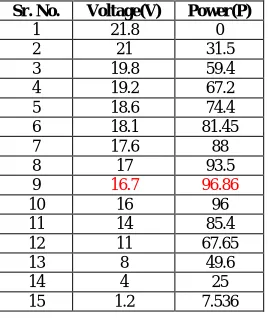
With the help of Power -Voltage Curve, PV Module maximum loading capability can be traced. A 100W solar module is tested under a sunny day condition with a variable rheostat as a load. Voltmeter and Ammeter is used for voltage and current measurements respectively.
Table 1: Voltage, Power measurements of 100 W Solar module
Sr. No. Voltage(V) Power(P)
1 21.8 0
2 21 31.5
3 19.8 59.4
4 19.2 67.2
5 18.6 74.4
6 18.1 81.45
7 17.6 88
8 17 93.5
9 16.7 96.86
10 16 96
11 14 85.4
12 11 67.65
13 8 49.6
14 4 25
As per the measurements, the maximum power rating of PV Solar Module is calculated and found 96.86 Watt, which is calculated by - Power (P) = Voltage (V) × Current (I) ...(1)
Table 1 shows Voltage - Power values from open circuit to short circuit of 100W solar module. The characteristics of P-V curve has been plotted from Voltage - Power measurements as shown in fig.3.
Fig.3: Power-Voltage characteristics of PV Solar system
Power-Time Curve for real power generation
A 100 Watt PV Solar module is connected to grid (Between line and neutral 230Volt, 50Hz AC) through voltage source inverter in sunny day. The real power absorbed by different load conditions with reference to time is illustrated below.
Table 2: Real Power measurement with respect to time of 100 W Solar module
Sr. No. Time(Hrs) Power(P) Sr. No. Time(Hrs) Power(P)
1 1 0 13 13 98.4
2 2 0 14 14 97.8
3 3 0 15 15 96.2
4 4 0 16 16 86.2
5 5 0 17 17 60.7
6 6 0 18 18 25.1
7 7 21.2 19 19 0
8 8 40.8 20 20 0
9 9 58.9 21 21 0
10 10 79.5 22 22 0
11 11 90.1 23 23 0
12 12 95.7 24 24 0
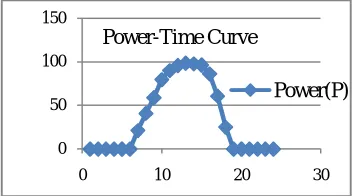
The real power is measured and analysed on Power Analyser at the inverter output. It is to be found that, from 7.00 AM to 6.00 PM sun radiation generates real power, which is then converted to alternating current by an inverter. The measurements are shown in table 2. During the rest of time, their is no real power generation is made. Fig.4 shows the Power - Time curve with respect to the time.
Fig.4: Power-Time characteristics of PV Solar system 0
50 100 150
0 10 20 30
Power-Time Curve
Power-Time Curve for real and reactive power exchange
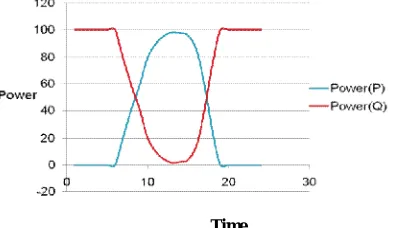
The real and reactive power exchange by 100Watt PV Solar controller as STATCOM with respect to time is illustrated below, which is obtained by the power analyser.
Table 3: Real and Reactive Power exchange with respect to time of 100 W Solar module
Sr. No. Time(Hrs) Power(P) Power(Q) Sr. No. Time(Hrs) Power(P) Power(Q)
1 1 0 100 13 13 98.4 1.6
2 2 0 100 14 14 97.8 2.2
3 3 0 100 15 15 96.2 3.8
4 4 0 100 16 16 86.2 13.8
5 5 0 100 17 17 60.7 39.3
6 6 0 100 18 18 25.1 74.9
7 7 21.2 78.8 19 19 0 100
8 8 40.8 59.2 20 20 0 100
9 9 58.9 41.2 21 21 0 100
10 10 79.5 20.5 22 22 0 100
11 11 90.1 9.9 23 23 0 100
12 12 95.7 4.3 24 24 0 100
During night-time, when PV Solar system is completely idle, the controller as STATCOM injects reactive power to the grid. On the other side, under sunny day condition, real power generation is made by the PV Solar system which is fed to the grid by controller. The Power - Time curve (Fig.5) shows the real and reactive power exchange by PV Solar controller as STATCOM.
Time
Fig.5: Real and Reactive power exchange characteristics of PV Solar system
VII. EXPERIMENTAL RESULTS (MATLAB)
Fig. 6: MATLAB simulation with PV solar controller as a STATCOM
Voltage, Current waveforms by MATLAB simulation
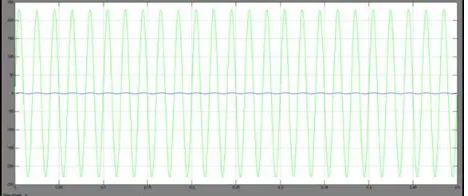
The voltage and current waveforms without and with compensation are obtained from scope by MATLAB Simulink as shown in figure 7 and 8. And it is clear that, With PV solar controller as a STATCOM fundamental sine wave is retrieved by minimizing harmonic and ripple.
Fig.7: Voltage current waveform without PV solar controller as a STATCOM
Fig.8: Voltage current waveform with PV solar controller as a STATCOM
Active, Reactive power waveforms by MATLAB simulation
Fig.9: Active Reactive power without PV solar controller as a STATCOM
Fig.10: Active Reactive power with PV solar controller as a STATCOM
VIII. CONCLUSION
It has been observed that, in conventional PV Solar system the overall asset remains idle during night time. Also it requires additional STATCOM for reactive power compensation. With this new control strategy, PV Solar system is utilized for 24 hours. Out of which 12 hours for real power generation during daytime and 12 hours for reactive power compensation during nighttime, that avoids additional cost of conventional STATCOM.
The reactive power observed without compensation is 105 VAR, with an power factor of 0.65 lagging. On the other hand, with PV solar controller as a STATCOM the reactive power is minimized and the net reactive power is measured as 15 VAR, with an power factor of 0.98, which is comparatively a improved power factor.
REFFERENCES
[1] Rajiv K. Varma, Vinod Khadkikar, and Ravi Seethapathy, "Nighttime application of PV solar farm as a STATCOM to regulate grid voltage", IEEE Trans. On Energy Conversion, vol. 24, no.4, pp.983-985, Dec. 2009.
[2] K.R. Padiyar and R.K. Varma, "Damping Torque Analysis of Static Var System Controllers", IEEETransactions on Power Systems, Vol. 6, No. 2, pp. 458-465, May 1991.
[3] Rajiv K. Varma, Shriram S. Rangarajan, Iurie Axente and Vinay Sharma, “Novel application of a PV Solar Plant as a STATCOM during Night and Day in a distribution Utility Network”, Power system conference and Exposition(PSCE), 2011 IEEE.
[4] Rajiv K. Varma and Vinod Khadkikar, “Utilization Of Solar Farm Inverter As STATCOM” US Provisional Patent application filed 15 Sept. 2009.
[5] Rajiv K. Varma, Shah Arifur Rahman and Ravi Seethapathy, "Novel Control of Grid connected Photovoltaic Solar Farm for improving transient stability and transmission limits both during Night and Day".
[6] R. M. Mathur and R. K. Varma Thyristor Based FACTS controllers for electrical transmission system, New York: Wiley-IEEE press, 2001 [7] L. Gyugyi, "Reactive Power Generation and Control by Thyristor Circuits." IEEE Trans. Ind.Appl., vol. IA-15, no. 5, pp.521-532, Sept./Oct., 1979.
[8] P. Kundur, Power System Stability and Control, EPRI Power System Engineering Series (McGraw-Hill, New York, 1994).
[9] Kishore .A, Hill. E.F., 1971. Static optimization of reactive power sources by use of sensitivity parameters, IEEE Transactions on power apparatus and systems: 1166-1173
[10] Narain G. Hingorani and Laszlo Gyugyi, Understanding FACTS, Concept and Technology ofFlexible AC Transmission Systems, IEEE Power Engineering Society, Sponsor, IEEE Press, Standard Publishers Distributors, Delhi,First Indian edition, 2001.
[12] Hadi Saadat, Power System Analysis, Tata McGraw - Hill Series in Electrical and Computer Engineering Edition.
BIOGRAPHY
Rajkumar Chougale was born in Kolhapur, Maharashtra, India on 22nd May 1985. He received his B.E. and M.E. degree in Electrical Engineering from Government College of Engineering, Karad (Satara), Maharashtra, India in 2006 and 2015 respectively, under Shivaji University, Kolhapur. He is currently working as an Assistant Professor in Electrical Engineering at Bharati Vidyapeeth's College of Engineering, Kolhapur, since 2008. He is a life member of ISTE since 2010. His area of interests are FACTS and Renewable energy.
[1]