Proceedings of Recent Advances in Natural Language Processing, pages 803–812,
A Weakly Supervised Approach to Train Temporal Relation Classifiers
and Acquire Regular Event Pairs Simultaneously
Wenlin Yao, Saipravallika Nettyam, Ruihong Huang Department of Computer Science and Engineering
Texas A&M University
{wenlinyao, n1005120, huangrh}@tamu.edu
Abstract
Capabilities of detecting temporal rela-tions between two events can benefit many applications. Most of existing temporal relation classifiers were trained in a su-pervised manner. Instead, we explore the observation that regular event pairs show a consistent temporal relation de-spite of their various contexts, and these rich contexts can be used to train a con-textual temporal relation classifier, which can further recognize new temporal re-lation contexts and identify new regular event pairs. We focus on detecting after
andbeforetemporal relations and design a weakly supervised learning approach that extracts thousands of regular event pairs and learns a contextual temporal rela-tion classifier simultaneously. Evaluarela-tion shows that the acquired regular event pairs are of high quality and contain rich com-monsense knowledge and domain specific knowledge. In addition, the weakly super-vised trained temporal relation classifier achieves comparable performance with the state-of-the-art supervised systems.
1 Introduction
Capabilities to recognize temporal relations be-tween two events can benefit many Natural Lan-guage Processing applications, including event timeline generation, script knowledge extraction, text summarization and event prediction.
This is a challenging task because temporal relations can be described in dramatically dif-ferent contexts depending on domains and pairs of events, signifying different semantic mean-ings. In order to capture various contexts, large amounts of labeled data are needed to train a
high-coverage temporal relation classifier. However, al-most all existing datasets that contain event-event temporal relation annotations are limited in size and domains, such as Automatic Context Extrac-tion (ACE) (Strassel et al.,2008) and TimeBank (Pustejovsky et al., 2003), which generally con-tain several hundred documents. Most of the ex-isting temporal relation classifiers were trained us-ing these small manually annotated datasets, rely-ing on sophisticated lexical, grammatical, lrely-inguis- linguis-tic (e.g., tenses and aspects of events), semanlinguis-tic (e.g., semantic roles and lexicon derived features) and discourse (e.g., temporal discourse connec-tives (Mirza and Tonelli,2014b) ) features.
We observed that event pairs presenting regular-ities tend to show the same temporal relation de-spite of various contexts they may occur in. For instance,arrestevents tend to happen afterattack
events, and the following sentential contexts all in-dicate the same temporal relation:
Under pressure following suicide attacks, police arrested scores of activists on Monday.
Two men were arrested on suspicion of carrying out the Mumbai attacks.
Carlos was arrested in Sudan in August in connec-tion with two bomb attacks in France in 1982. Mamdouh Habib was arrested in Pakistan three weeks after the Sept.11 attacks.
Leveraging this key observation, we propose a bootstrapping approach that focuses on recog-nizingafterorbeforetemporal relations and sub-stantially reduces the reliance on human annotated data. We start by identifying regular event pairs that have occurred enough times with an explicit temporal pattern, i.e., EV_A after (before) EV_B. We then populate these seed event pairs in a large unlabeled corpus to quickly collect hundreds of thousands of sentences that contain a regular event pair, which are then used as training instances to
obtain an initial contextual temporal relation clas-sifier. Next, the classifier is applied back to the text corpus and label new sentential contexts that indicate a specific after orbefore temporal rela-tion between events. Then new regular event pairs can be identified, which are event pairs that have a majority of their sentences labeled as describing a particular temporal relation. The newly identi-fied regular event pairs will be used to augment seed event pairs and identify more temporal re-lation sentential contexts in the unlabeled corpus. The bootstrapping learning process iterates.
In summary, this paper makes the following contributions: (1) Through this weakly super-vised learning method, we obtain both a contex-tual temporal relation classifier and a list of regu-lar event pairs that usually show a particuregu-lar "af-ter/before" temporal relation; (2) Our experiments show that the weakly supervised trained contex-tual temporal relation classifier achieves compa-rable performance with state-of-the-art supervised models using benchmark evaluation data provided by TempEval-3; (3) We obtained around 4,400 regular event pairs with the overall accuracy of 69%. The learned regular event pairs demonstrate rich common sense knowledge, furthermore, our evaluation shows that about 90% of temporally related regular event pairs are causally related as well.
2 Related Work
Most of existing temporal relation classifiers were learned in a supervised manner and depend on human annotated data. In the TempEval cam-paigns (Verhagen et al., 2007, 2010; UzZaman et al.,2013), various classification models and lin-guistic features (Bethard, 2013; Chambers et al.,
2014;Llorens et al.,2010;D’Souza and Ng,2013;
Mirza and Tonelli, 2014b) have been applied to identify temporal relations between two events. For example, a recent study by (D’Souza and Ng,
2013) applied sophisticated linguistic, semantic and discourse features to classify temporal rela-tions between events. They also included 437 hand-coded rules in building a hybrid classifica-tion model. CAEVO, a CAscading EVent Order-ing architecture byChambers et al.(2014), applied a sieve-based architecture for event temporal or-dering. CAEVO is essentially a hybrid model as well. While the first few sieves are rule based and deterministic, the latter ones are machine learned
using human annotated data.
In contrast, we present a weakly supervised ap-proach that requires minimal human supervision (i.e., several patterns), and simultaneously learns a contextual temporal relation classifier and a col-lection of regular event pairs. In particular, our approach has a co-training (Blum and Mitchell,
1998) flavor, and the contextual temporal relation classifier learning and the regular event pair acqui-sition process collaborate and dependent on each other.
Pattern based methods have been applied to ac-quire event pairs in a specific semantic relation. Specifically, VerbOcean (Chklovski and Pantel,
2004) extracted fine-gained semantic relations be-tween verbs including the happens-before relation using lexico-syntactic patterns. It turns out that the temporal relation patterns used in VerbOcean (e.g., “to X and then Y”) are too specific and not capable of identifying many event pairs that are rarely seen in one of the specified patterns. Eval-uation shows that our approach induces very dif-ferent event pairs from VerbOcean, by using the weakly supervised trained temporal relation clas-sifier to recognize diverse contexts that describe a particular temporal relation. Our work is also related to previous research on generating narra-tive event chains (Chambers and Jurafsky, 2008,
2009), however, as indicated by the authors, their focus is not to detect temporal orders between events and the generated event chains are only par-tially ordered.
Detecting causality between events is challeng-ing and has been addressed by several pilot stud-ies (Girju, 2003;Bethard and Martin,2008;Riaz and Girju, 2010;Do et al.,2011;Riaz and Girju,
2013). Recently, Mirza and Tonelli(2014a) pre-sented annotation guidelines and annotated ex-plicit causality between events in Timebank. With the resulted corpus, called Causal-TimeBank, they built supervised models to identify causal rela-tions. ThenMirza and Tonelli(2016) proposed a sieve-based method to perform joint temporal and causal relation extraction, exploiting interactions between temporal and causal relations.
3 Event Representations
or more than one type of events, and therefore has varied meanings depending on contexts. To make individual events expressive and self-contained, we find and attach arguments to each event word and form event phrases. Specifically, we consider both verb event phrases (Section 3.1) and noun event phrases (Section 3.2). We further require that at least one argument is included in an event pair which may be attached to the first or the sec-ond event. In other words, we do not consider event pairs in which neither event has an argument.
3.1 Verb Event Phrases
To ensure a good coverage of regular event pairs, we consider all verbs1 as event words except re-porting verbs2. The thematic patient of a verb refers to the object being acted upon and is essen-tially part of an event, therefore, we first include the patient of a verb in forming an event phrase. We use Stanford dependency relations (Manning et al.,2014) to identify the direct object of an ac-tive verb or the subject of a passive verb. The agent is also useful to specify a event especially for a intransitive verb event, which does not have a patient. Therefore, we include the agent of a verb event in an event phrase if its patient was not found. Agents are usually the syntactic subject of an active verb orbyprepositional object of a pas-sive verb.
For instance, in the sentence“They win the lot-tery.”, the verbwincan refer to variouswinevents, but with its direct object, win lottery refers to a specific type of event. For another instance, “Wa-ter evaporates when it’s hot.”, the verbevaporates
itself is not very meaningful without contexts, but after including its subject, the eventwater evapo-ratesbecomes self-contained. If neither a patient nor an agent was found, we include a prepositional direct object of a verb in the event representation to form an event phrase.
3.2 Noun Event Phrases
We include a prepositional object of a noun event in forming an noun event phrase. We first consider an object headed by the prepositionof, then an ob-ject headed by the prepositionby, lastly an object headed by any other preposition.
1We used POS tags to detect verb events.
2Reporting verbs, such as “said”, “told” and “added”, are commonly seen in news articles. We determined that most of event pairs containing a reporting verb are not very interest-ing and informative and we therefore discarded these event pairs.
Note that many noun words do not refer to an event. In order to compile a list of noun event words, we use two intuitive textual patterns par-ticipate in EVENT and involve in EVENT. By the semantics of these two patterns, their prepositional direct objects refer to events. However, due to lan-guage vagueness and dependency analysis errors, non-event words were seen in theEVENTposition too. Therefore, we only consider words that have occurred with one of the two patterns at least 20 times as potential noun event words. To further remove noise, we quickly went through the list of nouns and manually removed non-event words. Finally, we obtained 721 noun event words.
3.3 Generalizing Event Arguments Using Named Entity Types
Including arguments into event representations generates specific event phrases though. In order to obtain generalized event phrase forms, we re-place specific name arguments with their named entity types (Manning et al.,2014). We also sider replacing pronouns with their types, but con-cerned with poor quality of full coreference res-olution, we only replace personal pronouns with their typePERSON. We observed that this strategy greatly improves generality of event phrases and facilitates the bootstrapping learning process. In section5.1.2, we compare bootstrapping learning performance using generalized event representa-tions v.s. using non-generalized event represen-tations.
3.4 Regular Event Pair Candidates
Considering that it is not feasible to test all pos-sible pairs of events in Gigaword and often two events that co-occur in a sentence have no tempo-ral relation. In order to narrow down the search space, we identify candidate event pairs which are likely to have temporal relations.
Figure 1: Overview of the Bootstrapping System
regular pair if it occurs three or more times with one of the patterns in the text corpus. The assump-tion is that if a pair of events shows a particular temporal relation regularly, it is likely to be seen in the above textual patterns as well. Specifically, we extract the governor and dependent word of the de-pendency relationprep_after (prep_before)in the annotated English Gigaword (Napoles et al.,2012) and check whether each word is an event3. If yes, we form an event phrase for each event and obtain an event pair. In addition, we expect regular event pairs to occur mostly in a single temporal order, eitherbeforeorafter, and discard event pairs that have showed mixed temporal orders. Specifically, a regular event pair is required to occur in a partic-ular temporal relation more than 90% of times.
Overall by applying the two strategies, we ob-tained a candidate event pair pool that consists of 40,278 event pairs.
4 Bootstrapping both Regular Event Pairs and a Temporal Relation Classifier
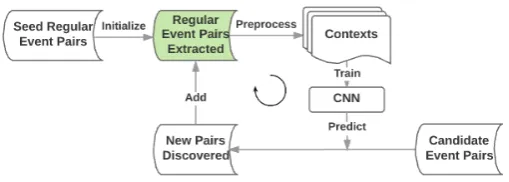
Figure1illustrates how the bootstrapping system works. We first populate seed regular event pairs in the text corpus and identify sentences that con-tain a regular event pair as training instances. We train a contextual temporal relation classifier, us-ing Convolutional Neural Nets (CNNs), to identify specific contexts describing a temporal after (be-fore)relation. We then apply the classifier to the corpus to identify new sentences that describe a particular temporal relation, from which new reg-ular event pairs can be extracted. Note that the classifier is only applied to sentences that contain a candidate regular event pair. The bootstrapping process repeats until the number of newly identi-fied regular event pairs is less than 100.
While we used the whole Gigaword (Napoles
3Note we consider any verb and a noun that is in our noun event list as an event.
et al.,2012) to identify regular event pairs, we only use the New York Times section of Gigaword for bootstrapping learning.
4.1 Regular Event Pair Seeds
In order to ensure high quality of seed pairs, we only consider event pairs that have occurred in ex-plicit temporal relation patterns, EV_A after
(be-fore)EV_B, as seed event pairs. Furthermore, we require each seed regular event pair to have oc-curred in a temporal relation pattern for at least ten times. Specifically, we identified 2,110 seed regular event pairs using the Gigaword corpus4.
4.2 Contextual Temporal Relation Classification
We use a neural net classifier to capture compo-sitional meanings of sentential contexts and avoid tedious feature engineering. Specifically, we used a Convolutional Neural Net (CNN) as our classi-fier, inspired by recent successes of CNN models in various NLP tasks and applications, such as sen-timent analysis (Kalchbrenner et al., 2014;Kim,
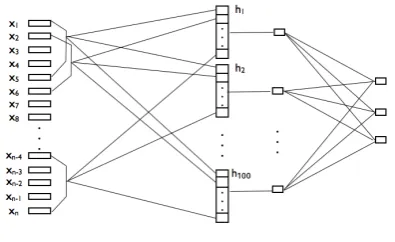
2014), sequence labeling (Collobert et al., 2011) and semantic parsing (Yih et al.,2014). As shown in figure2, our CNN architecture is a slight varia-tion of the previous models as described in (Kim,
2014;Collobert et al.,2011). It has one convolu-tional layer with 100 hidden nodes, one pooling layer and one fully connected softmax layer.
Figure 2: CNN Model Architecture
distributions over three classes (AFTER, BEFORE and OTHER) indicating the temporal relation be-tween a pair of events in a sentence. Specifically, the temporal relations are defined with respect to the textual order the two events are presented in a sentence. If the first event is temporallyBEFORE the second event as described in a sentence, this in-stance will be labeled asBEFORE. Otherwise if the first event is temporally AFTER the second event as described in a sentence, the instance will be la-beled asAFTER. The classOTHERis to capture all the rest contexts that may describe a temporal re-lation other thanafter (before)or do not describe a temporal relation.
In our experiments, we use pre-trained 300-dimention word2vec word embeddings (Mikolov et al.,2013) that are trained on 100 billion words of Google News and we use a filter window size of 5. In training, we used stochastic gradient descent with Adadelta update rule (Zeiler, 2012) and mini-batch size of 100, in addition, we applied dropout (Hinton et al., 2012) with rate p = 0.5 to avoid overfitting of the CNN model. We also randomly selected 10% of the training data as the validation set and chose the classifier with the highest valida-tion performance within the first 10 epochs.
4.2.1 Sentential Contexts: Local Windows v.s. Dependency Paths
We explore two types of contexts, local windows v.s. dependency paths, in order to identify con-texts that effectively describe temporal relations between two events.
First, the local window based context for an event pair includes five words before the first event, five words after the second event and all the words between the two events. Note that two event phrases can be arbitrarily far from each other and long contexts are extremely challenging for a
classifier to capture. In our experiments, we only consider sentences where two event mentions are at most 10 words away.
Second, we observed that not every word be-tween two events is useful to predict their temporal relation. In order to concentrate on relevant con-text words, we further construct dependency path5 based context representation. Specifically, consid-ering a dependency tree as an undirected graph, we use breadth-first-search to extract a sequence of words connecting the first event word to the sec-ond event word. In addition, to capture important information in certain syntactic structures such as conjunctions, we extract children nodes for each word in the path. Finally, we sort extracted words according to their textual order in the original sen-tence and the sorted sequence of words is provided as an input to the CNN classifier.
4.2.2 Negative Training Instances
Reasonably, most sentences in a corpus do not contain an event pair that is in a temporal “be-fore/after” relation. Therefore, we use negative instances that are 10 times of the total number of positive training instances (i.e., sentences that contain an event pair in a after (before)relation). Specifically, we require a negative instance to con-tain an event pair that does not appear in seed pairs nor the candidate event pair set. We randomly sampled negative instances satisfying the condi-tion. Then these deemed negative instances were labeled as the class OTHER, a class that compete with the two temporal relation classes, BEFORE andAFTER.
4.3 New Regular Event Pair Selection Criteria
Recall that regular event pairs are event pairs that tend to show a particular temporal relation despite of their various contexts. Therefore, we identify a candidate event pair as a new regular event pair if majority of its sentential contexts, specifically 60% of contexts, were consistently labeled as a particular temporal relation (afterorbefore) by the CNN classifier. In addition, we require that at least 15 instances of a regular event pair have been la-beled as the majority temporal relation. In order to control semantic drift (McIntosh and Curran,
2009) in bootstrapping learning, we increase the threshold by 5 after each iteration.
Systems 0 (Seeds) 1 2 3 4 5 Total
Basic System 1057 213 102 48 – – 1420
+ Arg Generalization 2110 638 323 81 – – 3152
+ Dependency Path Contexts (Full System) 2110 1230 555 288 156 62 4401
Table 1: Number of New Regular Event Pairs Generated after Each Bootstrapping Iteration
Furthermore, in order to filter out ambiguous event pairs that can be in eitherbeforeorafter tem-poral order depending on concrete contexts, we re-quire the absolute difference between number of instances labeled asAFTERand labeled asBEFORE to be greater than a ratio of the total number of instances, specifically, we set the ratio to be 40%.
5 Evaluation
Our bootstrapping system learned regular event pairs as well as a contextual temporal relation clas-sifier. We evaluate each of the two learning out-comes separately.
5.1 Regular Event Pair Acquisition 5.1.1 System Variations
We compare three variations of our system:
Basic System: in the basic system, we did not apply event argument generalization as described in section3.3. In addition, we use local window based sentential contexts as input for the classifier.
+ Arg Generalization: on top of the basic sys-tem, we apply event argument generalization.
+ Dependency Path Contexts (Full System): in the full system, we apply event argument general-ization and use dependency path based sentential contexts as input for the classifier.
Table1shows the number of regular new pairs that were generated after each bootstrapping it-eration by each of the three systems. First, we can see that event argument generalization is use-ful in obtaining roughly two times of seed regu-lar event pairs. Second, event argument general-ization is useful in recognizing additional regu-lar event pairs in bootstrapping learning as well. Third, dependency path based sentential contexts are effective in capturing relevant sentential con-texts for temporal relation classification, which en-ables the bootstrapping system to maintain a learn-ing momentum and learn more regular event pairs.
5.1.2 Accuracy of Regular Event Pairs
For each of the three system variations, we ran-domly selected 50 pairs from seed regular event
Systems Seed Pairs New Pairs
Basic System 0.73 0.55
+ Arg Generalization 0.71 0.63 + Dependency Path Contexts 0.67 Table 2: Accuracy of 100 Randomly Selected Event Pairs
pairs and 50 from bootstrapped event pairs6 and asked two human annotators to judge the correct-ness of these acquired regular event pairs.
Specifically, for each selected event pair, we ask two annotators to label whether a temporalAFTER orBEFORErelation exists between the two events. In addition to the two temporal relation labels, we provide the third category OTHER as well. We instruct annotators to assign the label OTHER to an event pair if the two events (i) generally have no temporal relation, (ii) have a temporal relation other than AFTERorBEFORE, or (iii) one or both mentions do not refer to an event at all.7 For each event pair, only one label is allowed. Before the official annotation, we trained the two annotators with system generated event pairs for several iter-ations. The event pairs we used in training annota-tors are different from the final event pairs we used for evaluation purposes.
Table 2 shows the accuracy of regular event pairs learned by each system variation. We de-termine that an event pair is correctly predicted by a system if the system predicted temporal re-lation is the same as the label that has been as-signed by both of the two annotators. The over-all kappa inter-agreement between the two anno-tators is 72%. We can see that with event argu-ment generalization, the quality of acquired seed regular event pairs is roughly equal to that using specific name arguments. Furthermore, because we obtained two times of seed event pairs after us-ing event argument generalization, the second and third bootstrapping systems received more guid-ance and continued to learn regular event pairs 6The seed pairs for the second and the third system are the same, so we evaluate the same 50 randomly selected seed pairs for the two systems.
Common Sense
PERSONworked←graduation career→announcedretirement
washhands→eating
PERSONreturned←visit
Politics
government beformed←elections fledmainland←losingwar
imposedsanctions←invasionof LOCATION
LOCATIONsplit←war
Business reachedhostedbanquetagreement←meeting←negotiations trading→stockclosed
Health
causeof death←cancer
PERSON behospitalized←sufferingstroke PERSONdied←admittedto hospital
Sports
games→endedseason
PERSON besidelined←undergoingsurgery PERSON besuspended←testingfor cocaine PERSONreturned←recoveringfrom injury
Crime
shooting→PERSON bearrested
spendingin jail→PERSON bereleased
PERSON bearrested←bombings
driverfled←accident
Table 3: Examples of Learned Regular Event pairs. →represents beforerelation and← repre-sentsafterrelation.
with a high quality. In addition, using depen-dency path based sentential contexts enables the classifier to further improve the accuracy of boot-strapped regular event pairs.
5.1.3 Examples and Constructed Knowledge Graphs
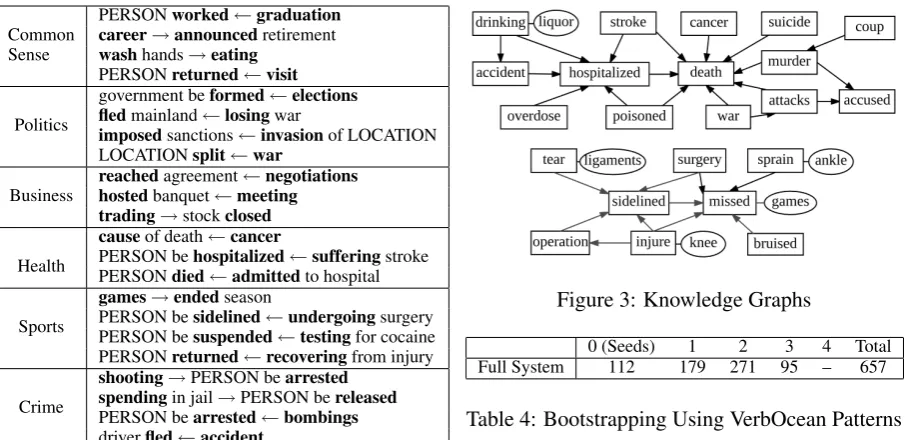
We have learned around 4,400 regular event pairs that are rich in commonsense knowledge and do-main specific knowledge for dodo-mains including politics, business, health, sports and crime. Table
3shows several examples in each category. In addition, related event pairs form knowledge graphs, figure 3 shows two examples. The first one describes various scenarios that cause deaths while the second one describes contingent rela-tions among events specific in sports.
5.1.4 Causally Related Events
We observed that a large portion of the learned regular event pairs are both temporally and causally related. We adopt the force dynamics the-ory and determine that two events are causally re-lated if one event causes, enables or prevents the other event to happen. Then we asked two anno-tators 8 to annotate causal relations for the same set of 100 randomly selected regular event pairs
8 We used the same two annotators that have conducted temporal relation annotations. For this task, the annotator inter-agreement is0.82in kappa.
Figure 3: Knowledge Graphs
0 (Seeds) 1 2 3 4 Total Full System 112 179 271 95 – 657
Table 4: Bootstrapping Using VerbOcean Patterns
generated by the full bootstrapping system. Sur-prisingly, out of 69 event pairs that have been as-signed with the same temporal relation by both an-notators, 61 event pairs were deemed as causally related. This shows that most of our temporally related regular event pairs are causally related as well.
5.1.5 Using VerbOcean Patterns
VerbOcean Chklovski and Pantel (2004) created lexico-syntactic patterns in order to extract event pairs with various semantic relations from the Web. Specifically, for the temporal relation
happens-before, VerbOcean used ten patterns such as “to X and then Y”, “to X and later Y” and acquired 4,205 event pairs with a temporal “be-fore/after” relation from the Web.
Therefore, we replace our two straightforward temporal relation patterns, EV_A after (before)
by using VerbOcean patterns. Note that the Giga-word corpus we used is much smaller in volume than the Web. Therefore, we hypothesize that Ver-bOcean patterns are too specific to be productive in identifying regular event pairs from a limited text corpus.
In addition, we compared our learned 4,401 reg-ular event pairs with the 4,205 verb pairs in the
happens-beforerelation acquired by VerbOcean9. Interestingly, among these two sets, only eight event pairs are the same. This shows that our boot-strapping learning approach recognizes diverse sentential contexts and learns a dramatically dif-ferent set of temporally related event pairs, com-pared with VerbOcean which mainly uses specific lexico-syntactic patterns to query the giant Web.
5.2 Weakly Supervised Contextual Temporal Relation Classifier
5.2.1 Accuracy of the Classifier
Recall that the contextual temporal relation clas-sifier was trained on the New York Times sec-tion of Gigaword. In order to evaluate the accu-racy of the classifier, we applied the weakly su-pervised learned classifier (the full system) to sen-tential contexts between pairs of events extracted from the Associated Press Worldstream section of Gigaword. We randomly sampled 100 instances from the ones that were labeled by the classifier as indicating aafterorbeforerelation and with a con-fidence score greater than 0.8. Then for each in-stance and its pair of events, we asked our two an-notators to judge whether the sentence indeed de-scribes aafter (before)temporal relation between the two events. According to the annotations10, the classifier predicted the correct temporal rela-tion 74% of time.
5.2.2 Evaluation Using a Benchmark Dataset
To facilitate direct comparisons, we evaluate both our weakly supervised trained classifier and two supervised trained systems using a benchmark evaluation dataset, the TempEval-3-platinum cor-pus, which contains 20 news articles annotated with several temporal relations between events. We only evaluate system performance on identi-fying temporal “before/after” relations.
9Because event pairs in VerbOcean do not contain argu-ments, we removed event arguments from our event pairs for direct comparisons.
10The two annotators achieved a Kappa inter-agreement score of0.71.
Approaches F1 P R
1 ClearTK (Bethard,2013) 0.27 0.36 0.22 2 Mirza and Tonelli(2014b) 0.29 0.24 0.38 3 Our classifier 0.28 0.35 0.24
Table 5: Performance on TempEval-3 Test Data
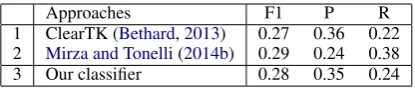
We compare with two feature-rich supervised trained systems. ClearTK (Bethard, 2013) uses event attributes such as tense, aspect and class, de-pendency paths and words between two events as features in identifying temporal relations between events. More recently, (Mirza and Tonelli,2014b) proposes even more sophisticated features includ-ing various lexical, grammatical and syntactic fea-tures, event durations, temporal signals and tem-poral discourse connectives etc. In contrast, our neural net based temporal relation classifier is sim-pler and does not require feature engineering.
Table 5shows the comparison results between these three systems. Note that we ran the orig-inal ClearTK system and we re-implemented the system described in (Mirza and Tonelli, 2014b). In addition, both supervised systems were trained using TimeBank v1.2 (Pustejovsky et al.,2006). The performance across the three systems is over-all low, one reason is that the pairs of events that are in a temporal relation were not provided to the classifiers. Therefore, the classifiers had to identify temporally related event pairs as well as classify their temporal relations. We can see that the weakly supervised classifier achieved roughly equal performance as ClearTK, while the other su-pervised system presents a a different precision-recall tradeoff. Overall, without using any anno-tated data or sophisticated hand crafted features, our weakly supervised system achieved a F1-score comparable to both supervised trained systems.
6 Conclusion
James Pustejovsky, Patrick Hanks, Roser Sauri, An-drew See, Robert Gaizauskas, Andrea Setzer, Dragomir Radev, Beth Sundheim, David Day, Lisa Ferro, et al. 2003. The timebank corpus. InCorpus linguistics. volume 2003, page 40.
James Pustejovsky, Marc Verhagen, Roser Saurí, Jes-sica Littman, Robert Gaizauskas, Graham Katz, In-derjeet Mani, Robert Knippen, and Andrea Setzer. 2006. Timebank 1.2. Linguistic Data Consortium
40.
Mehwish Riaz and Roxana Girju. 2010. Another look at causality: Discovering scenario-specific contin-gency relationships with no supervision. In Seman-tic Computing (ICSC), 2010 IEEE Fourth Interna-tional Conference on. IEEE, pages 361–368. Mehwish Riaz and Roxana Girju. 2013. Toward a
better understanding of causality between verbal events: Extraction and analysis of the causal power of verb-verb associations. InProceedings of the an-nual SIGdial Meeting on Discourse and Dialogue (SIGDIAL). Citeseer.
Stephanie Strassel, Mark A Przybocki, Kay Peter-son, Zhiyi Song, and Kazuaki Maeda. 2008. Lin-guistic Resources and Evaluation Techniques for Evaluation of Cross-Document Automatic Content Extraction. In Proceedings of the Sixth Interna-tional Language Resources and Evaluation
Confer-ence (LREC-08).
Naushad UzZaman, Hector Llorens, James Allen, Leon Derczynski, Marc Verhagen, and James Pustejovsky. 2013. SemEval-2013 task 1: TempEval-3 evaluating time expressions, events, and temporal relations. In
Proceedings of the 7th International Workshop on
Semantic Evaluation (SemEval 2013).
Marc Verhagen, Robert Gaizauskas, Frank Schilder, Mark Hepple, Graham Katz, and James Pustejovsky. 2007. Semeval-2007 task 15: Tempeval temporal relation identification. InProceedings of the 4th
In-ternational Workshop on Semantic Evaluations.
As-sociation for Computational Linguistics, pages 75– 80.
Marc Verhagen, Roser Sauri, Tommaso Caselli, and James Pustejovsky. 2010. Semeval-2010 task 13: Tempeval-2. InProceedings of the 5th international
workshop on semantic evaluation. Association for
Computational Linguistics, pages 57–62.