Cost Estimation
Techniques for
Web Projects
Emla Mendes
Acquisition Editor: Kristin Klinger Senior Managing Editor: Jennifer Neidig Managing Editor: Sara Reed Development Editor: Kristin Roth Typesetter: Amanda Appicello Cover Design: Lisa Tosheff Printed at: Yurchak Printing Inc.
Published in the United States of America by IGI Publishing (an imprint of IGI Global) 701 E. Chocolate Avenue
Hershey PA 17033 Tel: 717-533-8845 Fax: 717-533-8661 E-mail: [email protected] Web site: http://www.igi-pub.com and in the United Kingdom by
IGI Publishing (an imprint of IGI Global) 3 Henrietta Street
Covent Garden London WC2E 8LU Tel: 44 20 7240 0856 Fax: 44 20 7379 0609
Web site: http://www.eurospanonline.com
Copyright © 2008 by IGI Global. All rights reserved. No part of this book may be reproduced in any form or by any means, electronic or mechanical, including photocopying, without written permission from the publisher. Product or company names used in this book are for identification purposes only. Inclusion of the names of the products or companies does not indicate a claim of ownership by IGI Global of the trademark or registered trademark.
Library of Congress Cataloging-in-Publication Data Mendes, Emilia.
Estimation techniques for web projects / Emilia Mendes. p. cm.
Summary: “This book provides a step-by-step methodology to improving cost estimation practices for Web projects. Utilizing such techniques as stepwise regression modeling, case-base reasoning, classification and regression trees, and expert opinion, it is a powerful tool for scholars, researchers, and practitioners in the areas of Web development, Web engineering, project management, and software engineering”--Provided by publisher. Includes bibliographical references and index.
ISBN 978-1-59904-135-3 (hardcover) -- ISBN 978-1-59904-137-7 (ebook)
1. Web site development industry--Costs. 2. Web site development--Costs. 3. Web site development--Man-agement. I. Title.
HD9696.82.A2M46 2008 006.7068’1--dc22
2007022426 British Cataloguing in Publication Data
A Cataloguing in Publication record for this book is available from the British Library.
All work contributed to this book is new, previously-unpublished material. The views expressed in this book are those of the authors, but not necessarily of the publisher.
Cost Estimation Techniques
for Web Projects
Table of Contents
Preface... vi Section.I:. Web.Cost.Estimation.Principles Chapter.I What.is.Different.about.Web.and.Software.Projects?... 1 Introduction... 1 . Differences.between.Web.Applications.and.Conventional.Software... 4 . What.Differentiates.Web.Effort.Estimation.from.Software.Effort.Estimation?... 16 . Conclusion... 20 . References... 22 Chapter.II Introduction.to.Web.Cost.Estimation... 25 Introduction... 25 . Overview.of.Effort.Estimation.Techniques... 26 . Expert-Based.Effort.Estimation... 28 . Algorithmic.Techniques... 30 Artificial-Intelligence Techniques... 37 . Which.Technique.to.Use?... 46 . Web.Effort.Estimation.Survey... 48 . Conclusion... 57 . References... 58 Chapter.III How.Accurate.is.an.Effort.Model?... 62 Introduction... 63. Cross-Validation... 69 . Detailed.Example... 70 . Conclusion... 76 . References... 76 Chapter.IV Sizing.Web.Applications... 78 Introduction... 78 . Size.Measures.Taxonomy... 82 . Literature.Review.of.Hypermedia.and.Web.Size.Measures... 89 . Application.of.Taxonomy.to.Surveyed.Size.Measures... 103 . Change.in.Trends... 114
Defining Your Own Size Measure... 115
. Conclusion... 116 . References... 116 Section.II:. Techniques.for.Building.Web.Cost.Models Chapter.V Web.Effort.Estimation.Using.Regression.Analysis... 120 Case.Study... 120. . . Conclusion... 154 . References... 156 Chapter.VI Web.Effort.Estimation.Using.Case-Based.Reasoning... 158 Introduction... 159 . Previous.Studies.that.Used.CBR.for.Web.Cost.Estimation... 164 . Case.Study... 170 . Model.Validation... 196 . Conclusion... 200 . References... 201 Chapter.VII Web Effort Estimation Using Classification and Regression Trees... 203
Introduction... 204. . Previous.Study.that.Used.CART.for.Web.Effort.Estimation... 206 . Case.Study... 208 . Model.Validation... 234 . Conclusion... 238 . References... 239 Chapter.VIII What.is.the.Best.Technique?... 240 Introduction... 241
. Survey.of.Web.Effort.Estimation.Studies.that.Compared.Different. . ...Techniques... 241 . Comparing.Effort.Estimation.Techniques... 246 . Detailed.Example... 254 . Management.Implications... 268 . Conclusion... 273 . References... 273 Chapter.IX How.to.Improve.Your.Company’s.Effort.Estimation.Practices... 275 Introduction... 276 . The.Value.of.Cross-Company.Data.Sets... 290 . How.to.Start?... 294 . Conclusion... 299 . References... 299 Section.III:. An.Introduction.to.Statistics Chapter.X Understanding.Project.Data... 303 Introduction... 303 . Measurement.Scales... 304
How Good are Your Data?... 310
. Visualising.Variables.and.Relationships... 315 . How.to.Identify.Relationships.between.Variables... 321 . How.to.Compare.Distributions.between.Two.or.More.Variables... 351 . Conclusion... 373 . References... 373 Chapter.XI The.Need.for.Empirical.Web.Engineering:.An.Introduction... 375 Introduction... 376 . Implementing.Successful.Measurement... 381 . Overview.of.Empirical.Assessments... 387 . Issues.to.Consider.with.Empirical.Assessments... 391 . Detailing.Formal.Experiments... 396 . Detailing.Case.Studies... 401 . Detailing.Surveys... 403 . Conclusion... 404 . References... 404 About.the.Author... 406
Preface
A cornerstone of Web project management is sound effort estimation, which is the process by which a person, group of people, tool, model, or a combination of these predicts the amount of effort needed to accomplish a given task. The importance of having realistic effort estimates at an early stage in a project’s life cycle is widely recognised by Web project managers and developers since accurate estimates are paramount to manage resources effectively, and to considerably increase the
prob-ability that projects will be finished on time and within budget.
However, recent findings showed that numerous Web projects worldwide are still not finished within time and budget, and one of the main reasons for that is the
use of poor project management practices, which includes poor effort estimation (Ginige, 2002).
Given that the field of Web effort estimation is relatively new, with its first paper
published only in 2000 (Mendes, Counsell, & Mosley, 2000), it would not be
sur-prising that research findings in this field may not have reached industry widely.
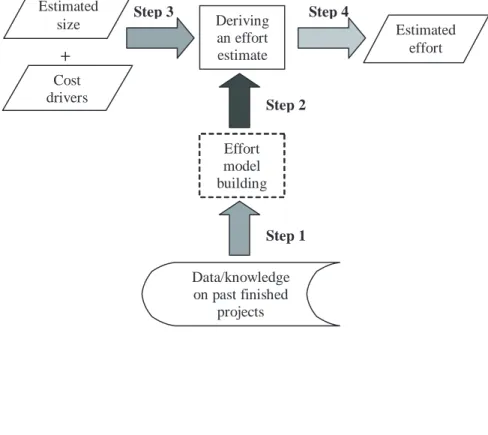
Effort estimation, also known as cost estimation, is a necessary part of an effective process, whether this process is Web authoring, design, testing, or development as a whole. An effort estimation process involves the following steps (Fenton &
Pfleeger, 1987).
1. The identification of factors perceived to influence effort (e.g., size measures,
cost drivers) and the type of relationship they have with effort
volve the use of large cross-company data sets with data on numerous diverse projects.
3. The use of one or several effort estimation techniques to be applied to estimate effort for new projects. The effort estimates generated by these techniques can also be adjusted using expert opinion.
4. The assessment of how effective the prediction technique is
It is important that all these steps are followed; otherwise, the effort estimates ob-tained may not be as useful as they should.
Another important point is that effort prediction is generally based on the follow-ing.
• Knowledge of previous similar projects and applications managed by an or-ganisation. This means that data from past projects may be essential in helping organisations estimate effort for new projects.
• Other project and application characteristics that are believed to be related to effort. Examples of project characteristics are the size of the development team, its experience with working on similar projects, and the number of different programming languages being used in a project. An example of an application characteristic is the size of the problem to be developed, which may encompass different attributes such as the total number of new Web pages, total number of images, number of features that were reused, and so forth.
The objective of this book is therefore to provide Web companies, researchers, and students with the necessary knowledge on Web effort and cost estimation. It includes step-by-step guidelines on how to use and compare several effort estimation techniques, which may considerably help companies improve their current effort estimation practices, and help researchers and students understand the process that needs to be carried out to estimate development effort.
The effort estimation techniques that are detailed in this book are those that have been to date the three mostly used effort estimation techniques in the Web effort estimation literature, namely, stepwise regression, case-based reasoning, and
clas-sification and regression trees (CART).
Throughout this book, we take the view that the use of past data on finished Web
projects can be extremely useful and necessary to help obtain accurate effort esti-mates for new Web projects and also to help Web companies understand how they currently estimate effort for their new projects.
All chapters are self-contained, and whenever applicable, the chapters present a lit-erature review of previous studies on the topic being explained in order to ensure that
We also present detailed chapters on principles of statistics and empirical studies to provide readers with additional knowledge not only useful for Web effort and cost estimation, but also useful within the context of Web engineering.
It is important to note that despite Web effort estimation being one of the main com-ponents of project management, there are at least two other comcom-ponents also related
to effort estimation that can indirectly benefit from the use of more sound estimating
processes. These two other components are project productivity and development
processes. Once a Web company identifies important factors that have a bearing
on effort and gathers data on past projects, it is also possible to identify current productivity trends between projects and also between developers, and to assess if differences in development processes have any effect on the effort estimates proposed and learn how to improve processes. Therefore, a change to a more systematic way of estimating effort can also drive a company to improve its productivity and current development processes, which is always a positive outcome.
Purpose.
The purpose of this book is to introduce practitioners, lecturers, researchers, and students to Web effort estimation concepts and detailed case studies. Our objective is to provide detailed knowledge on Web effort estimation, step-by-step guidelines on how to use particular effort estimation techniques to estimate effort for new projects, and lessons on how to compare the effort estimates provided by these techniques, which may also include comparison with other benchmarking effort estimates. The motivation for this book was threefold. First, our experience in dealing with Web companies to improve their effort estimates showed that companies would like to know how to use different effort estimation techniques and how to compare these techniques; however, the literature available was either too brief or unavailable. Sec-ond, our experience teaching Web effort estimation to postgraduate students showed that the books that were completely devoted to the topic of effort estimation were all applied to conventional software development projects, which are very different from Web projects (see Chapter 1 for a detailed discussion). Third, our experience in giving tutorials on Web effort estimation to Web engineering researchers also showed the need for a single place where all the necessary information was avail-able. There are several papers on Web effort estimation available, and also a book chapter; however, none details the processes that are used by different techniques to obtain effort estimates. Papers may compare different techniques, however each
technique is presented very briefly and readers have to look for complementary
Target.Audience
The target audience of this book comprises Web project managers and develop-ers, Web engineering and software engineering students, and Web and software researchers. This book does not assume readers are familiar with either effort esti-mation concepts or any of the effort estiesti-mation techniques described, or statistical principles.
Outline
The book is organised into 11 chapters, each briefly described as follows.
Chapter I introduces terminology related to hypertext, since this is the model the Web is based upon, then provides an overview of differences between Web and software development with respect to their development processes, technologies, quality factors, and measures. Finally it discusses the differences between Web cost estimation and software cost estimation.
Chapter II introduces the concepts related to Web effort estimation and effort esti-mation techniques. These concepts are later used in further chapters.
Chapter III describes the process to be used to assess the accuracy of an effort tech-nique or model. This process is called cross-validation. In parallel with conducting a cross-validation, prediction accuracy measures are also obtained and aggregated. Examples of accuracy measures are the mean magnitude of relative error (MMRE), the median magnitude of relative error (MdMRE), the magnitude of relative error (MRE), and the prediction at Level.l.(Pred[25]).
Chapter IV presents a literature survey of size measures (attributes) that have been
published within the last 14 years and classifies the surveyed measures according
to a proposed taxonomy. In addition, this chapter also discusses ways in which Web companies can devise their own size measures.
Chapter V presents a case study where a real effort prediction model based on data from completed industrial Web projects is constructed step by step using a statistical technique called regression analysis.
Chapter VI presents a case study that details step by step how to obtain effort es-timations using real data from completed industrial Web projects using a machine learning technique called case-based reasoning.
Chapter VII presents a case study where a real effort prediction model based on data from completed industrial Web projects is constructed step by step using a machine learning technique called CART.
Chapter VIII details the use of statistical significance tests to compare different
effort estimation techniques and models.
Chapter IX provides suggestions believed to help improve effort estimation
prac-tices that can be of benefit to Web companies, in particular, small Web development
companies. The discussion also includes suggestions on how to improve project management practices as means to improving effort estimates.
Chapter X provides an introduction to parts of statistics that are frequently used when dealing with data for effort estimation. The concepts presented here are in no way exhaustive since statistics comprises a very large body of knowledge where entire
books are devoted to specific topics. The parts that are the focus of this chapter are
those that are necessary to use when building effort estimation models, and also when comparing different effort estimation techniques.
Chapter XI discusses the need for empirical investigations in Web engineering, which
is motivated by the very definition of engineering. It describes the three main types
of empirical investigations: surveys, case studies, and formal experiments. Although all three types of empirical investigations are presented, formal experiments are
detailed further since they are the most difficult type of investigation to plan.
References
Fenton, N. E., & Pfleeger, S. L. (1997). Software.metrics:.A.rigorous.and.practical. approach (2nd ed.). Boston: PWS Publishing Company.
Ginige, A. (2002, July). Workshop on Web engineering. Web engineering: Managing the complexity of Web systems development. Proceedings.of.the.14th
.Inter-national.Conference.on.Software.Engineering.and.Knowledge.Engineering (pp. 72-729).
Mendes, E., Counsell, S., & Mosley, N. (2000, June). Measurement and effort prediction of Web applications. Proceedings.of.2nd.ICSE.Workshop.on.Web.
Acknowledgments
I would like to take this opportunity to thank all those who directly or indirectly
have influenced my career as an academic and by doing so have contributed to the
creation of this book.
First, I thank Wendy Hall, who was the first to suggest that software measurement
was a topic she believed I would be enthusiastic about.
I also thank Steve Counsell, a great friend with whom I had the great opportunity to collaborate with, and who gave me one of his own books on statistics.
I thank Barbara Kitchenham, who has been a remarkable mentor and a role model, from whom I always have learned so much and to whom I will be forever in-debted.
I would also like to thank all the colleagues and friends with whom I had the op-portunity to collaborate on publications on the topic of software or Web effort estimation, namely, Steve Counsell, Rachel Fewster, Chris Lokan, Chris Triggs, and Ian Watson.
Finally, my deepest gratitude goes to my husband for his constant help and infinite
support, and for bringing light into my life.
Emilia.Mendes May.2007
Section.I
Web Cost Estimation
Principles
This.section.provides.the.motivation.for.Web.cost.estimation,.introduces.principles. and.techniques.that.can.be.used.to.estimate.costs,.and.discusses.how.to.size.a.Web. application.
Chapter I
What is Different
about Web and
Software Projects?
Abstract
The objective of this chapter is threefold. First is to introduce new terminology that relates specifically to hypertext, the model the Web is based upon. Second, it provides an overview of differences between Web and software development with respect to their development processes, technologies, quality factors, and measures.
Third, it discusses the differences between Web effort estimation and software effort
estimation.
Introduction
The Web was originally conceived in 1989 as an environment for the sharing of information (e.g., research reports, databases, user manuals) with geographically
dispersed individuals. The information itself was stored on different remote servers and was retrieved by means of a single user interface (Web browser). The informa-tion consisted primarily of text documents interlinked using a hypertext metaphor (Offutt, 2002).
Since its inception, the Web has morphed into an environment used as a carrier for the deployment of many different types of applications. Such applications range from small-scale information-dissemination-like applications, typically developed by writers and artists, to large-scale commercial, enterprise-planning and -scheduling, collaborative-work applications, developed by multidisciplinary teams of people with diverse skills and backgrounds using cutting-edge technologies (Gellersen & Gaedke, 1997; Ginige & Murugesan, 2001; Offutt, 2002). Many of the Web applica-tions currently in use are fully functional systems that provide business-to-customer and business-to-business e-commerce, and numerous services to numerous users (Offutt).
The massive increased use of the Web to provide a carrier platform for commercial applications has been motivated by several key factors, such as the following:
• The possible increase of an organisation’s competitive position
• The opportunity for small organisations to project a corporate presence in
the same way as larger organisations (Taylor, McWilliam, Forsyth, & Wade, 2002)
• Industries such as travel and hospitality, manufacturing, banking, education,
and government utilising Web-based applications to improve and increase their operations (Ginige & Murugesan, 2001)
• The development of corporate intranet Web applications for use within the
boundaries an organisation
The seemingly insatiable appetite for Web applications reaching into areas of com-munication and commerce makes it one of the leading and most important branches of the software industry to date (Offutt, 2002).
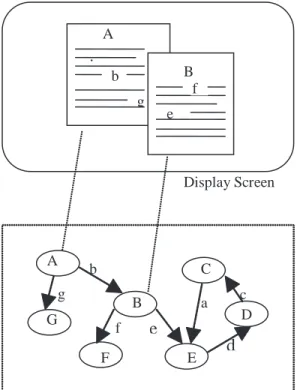
The World Wide Web (or simply Web) is the best known example of hypertext. The concept of hypertext was described by Conklin (1987, p. 1) as follows (see Figure 1): “windows on the screen are associated with objects in a database, and links are provided between these objects, both graphically (as labelled tokens) and in the database (as pointers).”
A collection of objects stored in a database is typically called a hyperdocument. When the objects are pure text, the hyperdocument is called hypertext; otherwise, objects that also include graphics, digitised speech, audio recordings, pictures,
ani-mation, film clips, and so forth are generally referred to as hypermedia, though these
Figure 1. The concept of hypertext (Adapted from Conklin, 1987) HypertextDatabase A b g B e f Display Screen d A c G F E f C D B e b a g
chunked information interrelated by hyperlinks. The origin or destination of a link is an anchor. Anchors can be words, sentences, areas of an image, and so on. To date, the development of Web applications is in general ad hoc, resulting in
poor-quality applications that are difficult to maintain (Murugesan & Deshpande, 2002) and projects that are not finished on time or within budget. The main reasons for
such problems can be attested to an unsuitable design and development process, as well as poor project management practices (Ginige, 2002).
A survey on Web-based projects, published by the Cutter Consortium in 2000, revealed a number of problems with large outsourced Web-based projects (Ginige, 2002):
• 84% of surveyed delivered projects did not meet business needs
• 53% of surveyed delivered projects did not provide the required
• 79% of surveyed projects presented schedule delays
• 63% of surveyed projects exceeded their budget
As both our reliance and requirements for larger and more complex Web applica-tions increase, so too does the need for methodologies, standards, and best-practice guidelines to help organisations develop applications that are delivered on time and within budget, and are high quality and easy to maintain (Lee & Shirani, 2004; Ricca & Tonella, 2001; Taylor et al., 2002). To develop such applications, Web development teams need to use sound methodologies, systematic techniques, quality assurance, rigorous disciplined and repeatable processes, better tools, and baselines.
Web engineering aims to meet such needs head on (Ginige & Murugesan, 2001).
The term Web engineering was first published in 1996 in a conference paper by
Gellersen, Wicke, and Gaedke (1997). Since then, this term has been cited in numer-ous publications, and activities devoted to discussing Web engineering are constantly taking place (e.g., workshops, conference tracks, entire conferences).
Murugesan and Deshpande (2001) describe Web engineering as “the use of scien
-tific, engineering, and management principles and systematic approaches with the
aim of successfully developing, deploying and maintaining high quality Web-based systems and applications.”
It should be noted that this is a similar definition used to describe software engi
-neering; however, these disciplines differ in many ways, and the differences will be explored in more depth in the next section.
Differences between Web Applications and
Conventional Software
The main focus of this section is to discuss and highlight the differences between
Web and conventional software applications. However, it is first important to define
what exactly we mean by a Web application.
Web Hypermedia, Web Software, and Web Application
The Web literature uses numerous synonyms for a Web application, such as Web site, Web system, and Internet application. The Institute of Electrical and
Electron-ics Engineers (IEEE, 2003) defines the term Web site as a “collection of logically
However, using the terms Web site and Web application interchangeably does not allow one to distinguish between a Web pages’ physical storage and a live business application. For this reason, we consider that they are not similar.
In addition, we can distinguish Web applications into three different categories as
first suggested by Christodoulou, Zafiris, and Papatheodorou (2000).
• Web hypermedia application: An application characterised by the authoring
of information using nodes (chunks of information), links (relations between nodes), anchors, access structures (for navigation), and delivery over the Web.
These applications are often called static Web applicationsas Web pages and
links are not generated on the fly. Technologies commonly used for developing
such applications are HTML (hypertext markup language), XML (extensible markup language), JavaScript, and multimedia. In addition, typical developers are writers, artists, and organisations who wish to publish information on the
Web and/or CD-ROMs without the need to know programming languages such
as Java. These applications have unlimited potential in areas such as software engineering, literature, education, and training.
• Web software application: An application that often implements a conventional
business domain and uses the Web’s infrastructure for execution. Typical applications include legacy information systems such as databases, booking systems, knowledge bases, and so forth. Many e-commerce applications fall into this category. Typically they employ development technologies (e.g.,
DCOM, ActiveX, etc.), database systems, and development solutions (e.g., J2EE). Developers are in general young programmers fresh from a computer
science or software engineering degree course, managed by a few more senior staff.
• Web application: An application delivered over the Web that combines
char-acteristics of both Web hypermedia and Web software applications
Differences between Web and Software Development
Web and software development differ in a number of areas, more of which will be discussed later. However, of these, three key areas provide the greatest differences and affect the entire Web-software development and maintenance processes. These areas encompass the people involved in the development of these applications, the intrinsic characteristics of the applications, and the audience for which they are developed.
The development of conventional software remains largely dominated by IT pro-fessionals as a sound knowledge of programming, database design, and project
management is necessary. In contrast, Web development encompasses a much wider variety of developers, such as amateurs with no programming skills, graph-ics designers, writers, database experts, and IT professionals, to name but a few. This is possible as Web pages can be created by anyone without the necessity for programming knowledge (Brereton, Budgen, & Hamilton, 1998).
Web applications by default use communications technology and have multiplatform accessibility. In addition, since they employ a hypermedia paradigm, they are nonse-quential by nature, using hyperlinks to interrelate Web pages and other documents. Therefore, navigation and pluralistic design become important aspects to take into account when developing Web applications in general. Finally, the multitude of technologies available for developing Web applications means that developers can build a full spectrum of applications, from a static simple Web application using
HTML to a fully fledged distributed e-commerce application (Taylor et al., 2002).
Conventional software can be developed using several programming languages
running on a specific platform, components off the shelf (COTS), and so forth. It
can also use communications technology to connect to and use a database system. However, the speed of implementing new technology is faster for Web development relative to conventional software development.
Web applications are aimed at wide-ranging groups of users. Such groups may be known ahead of time (e.g., applications available within the boundaries of an intranet). However, it is more often the case that Web applications are devised for an unknown group of users, making the development of aesthetically pleasing
ap-plications more challenging (Deshpande & Hansen, 2001). In contrast, conventional
software applications are generally developed for a known user group (e.g.,
depart-ment, organisation, clients), making the explicit identification of target users and specific functional and nonfunctional requirements an easier task.
For the purpose of discussion, we have grouped the differences between Web and software development into seven areas, which are as follows:
1. Application characteristics and availability 2. Technology and architecture
3. Quality drivers
4. Information structuring, design, and maintenance
5. Disciplines and people involved in development
6. Stakeholders
Application Characteristics and Availability
Web Creation: Web applications are created by integrating numerous distinct
elements, such as fine-grained components (e.g., DCOM, OLE, ActiveX);
interpreted scripting languages; COTS (e.g. customised applications, library
components, third-party products); multimedia files (e.g., audio, video, 3-D
objects); HTML, SGML (standard generalized markup language), and XML
files; graphical images; and databases (Deshpande & Hansen, 2001; Offutt,
2002; Reifer, 2000).
Components may be integrated in many different ways and present different quality attributes. In addition, their source code may be proprietary or unavailable, and may reside on and/or be executed from different remote computers (Offutt, 2002).
Conventional software creation: In contrast, conventional software applications can also be developed using a wide palate of components (e.g., COTS) and are generally developed using conventional programming languages such as C++,
Java, Visual Basic, and Delphi. These applications may also use multimedia files, graphical images, and databases.
Web platforms: Web applications are in general platform independent (although there are exceptions, e.g., OLE, ActiveX), and Web browsers in general pro-vide a similar user interface and functionality, freeing users from the chore of
having to relearn (Deshpande & Hansen, 2001).
Conventional software platforms: Unlike Web applications, modern software products are mainly still highly monolithic and platform dependant: limited
in use by the underlying hardware configuration and the operating system
used on the target platform (Deshpande & Hansen, 2001). There are in addi
-tion programming languages on the market (e.g., Java, cross compilers) that are intentionally cross-platform or allow the conversion of one application
to run on one or more different platforms (e.g., Borland CBuilder/Delphi for
Windows and Linux).
Web navigation: Uniquely different from conventional software, Web applications employ the navigation of navigational structures with the use of a hypermedia paradigm, where content is structured and presented using anchors and hyper-links. Navigational structures may also be customised, providing a dynamic adaptation of content structure that may include atomic hypermedia components
and different presentation styles (Fraternali & Paolini, 2000).
Conventional software navigation: Despite numerous attempts by the hypermedia
interface, the majority of conventional software applications do not use this paradigm.
Web availability: Stakeholders use the Web with an expectation that all applica-tions will be fully operational throughout the year (24/7, 365 days a year), suggesting that any downtime, no matter how short, can be detrimental (Offutt, 2002) to both the user and the organisation that owns and runs the application (e.g., online banking).
Conventional software availability: Except in a relatively few application domains (e.g., security, safety critical, military, and banking), clients using conventional software applications do not expect their applications to be available 24/7, 365 days a year.
Technology and Architecture
Web development technology: Web applications are developed using a wide range
of diverse technologies such as the many-flavoured Java solutions available
(Java servlets, Enterprise JavaBeans, applets, and JavaServer pages), HTML, JavaScript, XML, UML, databases, and much more. In addition, there is an ever increasing use of third-party components and middleware, saving an organisation’s valuable resources in that it does not have to reinvent the wheel. Since Web technology is a dynamic area that changes quickly, some authors
suggest it may be difficult for developers and organisations to keep in step
with the technology currently available and to decide on the best choice of technology for a given type of application (Offutt, 2002).
Conventional software technology: The principle technology used to develop conventional software applications are mostly object-oriented-based languages, relational databases, and CASE tools (Reifer, 2000). The speed with which new programming technologies are proposed is considerably slower than that for Web applications. For example, one of the most recent developments in
software development might be the use of on-the-fly compilers. In this instance, productivity is reduced by the removal of the need to first make and then link
an application. However, there is still a requirement for a person to write the code. This comes with the advent of the WYSIWYG (“what you see is what you get”) HTML editor used to build Web applications, which removed the need for any HTML programming experience at all.
Web architecture: Web applications can utilise a whole stream of diverse
con-figurations, ranging from typical solutions developed using a simple
client-server architecture (two tier), represented by Web browsers on the client’s computer connecting to a remote Web server hosting the Web application, to
(Offutt, 2002). The servers and clients embodied within these more complex architectures are representative of computers that may have different operating
systems, and software and hardware configurations, and may be connected to
each other using different network settings and bandwidth.
The introduction of multitier architecture was motivated by limitations of the two-tier model (e.g., implementation of an application’s business logic on the client machine and an increased network load as data processing is only executed on the client machine). For multitier architectures, the business logic is moved to a sepa-rate server (middle tier), which is now used to service client requests for data and functionality. The middle tier then requests and sends data to and from a (usually) separate database server (data tier). In addition, the type of networks used by the various stakeholders may also be unknown, so assumptions have to be made while
developing these applications (Deshpande & Hansen, 2001).
Finally, the infrastructure used to deliver Web applications means these applications are inherently distributed as their content pages can reside on any number of Web servers distributed across the Internet.
Conventional software architecture: Conventional software applications run either in isolation on a client’s machine (a centralised system), or in general use a two-tier architecture whenever applications intend to use data from database systems running on a separate server (distributed). In addition, the type of networks used by the stakeholders is usually known in advance since most
conventional software applications are limited to specific places and organisa
-tions (Deshpande & Hansen, 2001).
Quality Drivers
Web applications: Web companies that operate their businesses using the Web rely heavily on providing applications and services of high quality so that customers return to do repeat business. As such, these companies only see
a return on investment if customers’ needs have been satisfied. In addition,
customers who use the Web for obtaining services have little or no loyalty to the company with which they do business with (for example, a client
wish-ing to purchase socks online, on findwish-ing the cheapest e-store for his or her purchase, may not necessarily return to that store if the Web site is difficult to
navigate or the price is no longer competitive with other e-stores, found with only a few simple keystrokes and clicks through a search engine). This also suggests that new companies providing Web applications of an even higher quality will most likely displace customers from previously established
busi-nesses. Furthermore, it can be asserted that quality is a principal factor that will bring repeated business, and for this reason, quality is often considered higher in priority than getting delivery on time to market, with the mantra “later and better” as the mission statement for Web companies who wish to remain competitive (Offutt, 2002).
The dominant quality criteria for Web companies are as follows (Offutt, 2002).
Reliability: Applications that work well, do not crash, and provide the correct data and data processing
Usability: A characteristic of applications that are simple to use. If a customer wants to use a Web application to purchase a product online, the application should be as simple to use as the process of physically purchasing that product in a real shop. Many existing Web applications present poor usability despite an extensive range of Web usability guidelines that have been published to date. An application with poor usability will be quickly replaced by another more usable application as soon as its existence becomes known to the target audi-ence (Offutt, 2002).
Security: A characteristic of applications where the handling of customer data and
other information is done securely such that problems (e.g., financial loss, legal
consequences, loss of credibility) can be avoided (Offutt, 2002)
Conventional software: Within the context of conventional software development, software contractors are often paid for their delivered applications regardless of their quality. Return on investment is immediate. Ironically, they are also
often paid for fixing defects in the delivered application, where these failures
principally exist because of a lack of thorough testing. This knock-on effect suggests that the customer paying for the development may end up paying at least twice the initial bid before the application is fully functional. For conventional software, time to market takes priority over quality as it can be more lucrative to deliver applications with hidden defects sooner than go for the high-quality applications to be delivered later. For these companies, the “sooner but worse” rule applies (Offutt, 2002).
Another popular mechanism employed by software companies is to fix defects and
make the updated version into a new release, which is then resold to customers, bringing in additional revenue.
Information Structuring, Design, and Maintenance
Web applications structuring: Web applications present structured and unstructured content, which may be distributed over multiple sites and use many different
systems (e.g., database systems, file systems, multimedia storage devices; Fraternali & Paolini, 2000). In addition, the design of a Web application,
unlike that of conventional software applications, includes the organisation of content into navigational structures by means of anchors and hyperlinks. These structures are created to provide users with easily navigable Web ap-plications. Well-designed applications should allow for suitable navigation
structures (Deshpande et al., 2002) as well as the structuring of content, which should take into account efficiency and reliable management (Deshpande &
Hansen, 2001).
Conventional software structuring: Conventional software presents structured
content (although help files many times also have unstructured content), which
may also be distributed generally using a two-tier architecture when a data-base system is used to store the data. In addition, the design of a conventional
software application generally uses a conventional methodology of a specific
paradigm (e.g., object orientation, aspect orientation), and does not include the organisation of content into navigational structures by means of anchors and hyperlinks.
Application file formats: Another difference between Web and conventional
appli-cations is that Web appliappli-cations often contain a variety of specific file formats for multimedia content (e.g., graphics, sound, and animation). These files must be thoroughly integrated into the configuration management system, and their
maintenance routines also need to be organised as it is likely these will also differ from the maintenance routine used for simple text-based documents (Brereton et al., 1998).
Conventional software formats: Conventional software applications present
structured content that use flat file or database systems. The structuring of
such content has been addressed over the years by software engineering, so the methods employed within this discipline for information structuring and
design are well known by IT professionals (Deshpande & Hansen, 2001). Web application maintenance: For the maintenance cycle of applications, Web
applications are updated frequently and without the need for specific releases,
updates, and patches, and have maintenance cycles of days or even hours (Offutt, 2002). In addition, their content and functionality may also change
significantly from one moment to another, and so the concept of project
completion may seem unsuitable in such circumstances. Some organisations also allow non-information-systems experts to develop and modify Web
ap-plications. In environments such as these, it is often necessary to provide an
overall management structure for the delivery and modification of applications
to avoid confusion (Standing, 2002).
Conventional software maintenance: The maintenance cycle for conventional software applications adheres to a more rigorous process. Upon a product’s release, software organisations usually initiate a cycle whereby a list of requested changes, adjustments, or improvements (either from customers or from its own development team) is prepared over a set period of time, and later incorporated
as a specific version or release for distribution to all customers simultaneously.
This cycle can be as short as a week and as long as several years. It requires more planning as it often entails other, possibly expensive, activities such as marketing, sales, product shipping, and occasionally personal installation at a customer’s site (Ginige & Murugesan, 2001; Offutt, 2002). This cycle has become more transparent over the years as online automated updates using Web technology come into play.
Disciplines and People Involved in Development
Web application development teams: To develop large and complex Web applica-tions, a team of people with a wide range of skills and expertise in different
areas is required. These areas reflect distinct disciplines such as software
engineering (development methodologies, project management, tools), hyper-media engineering (linking, navigation), requirements engineering, usability engineering, information engineering, graphics design, and network
manage-ment (performance measuremanage-ment and tuning; Deshpande et al., 2002; Ginige,
2002; Ginige & Murugesan, 2001).
Conventional software development teams: Building a conventional software application involves contributions from a smaller number of disciplines than those used for developing Web applications. These may include software engineering, requirements engineering, and usability engineering.
Web application people: For the people involved in development, the Web pro-vides a broad spectrum of different types of Web applications, varying in quality, size, complexity, and technology. This variation is also applicable to the range of skills presented by those involved in Web development projects. Web applications can be created by artists and writers using simple HTML code or more likely one of the many commercially available Web authoring
tools (e.g., Macromedia Dreamweaver, Microsoft Frontpage), making the
authoring process transparent to those with no prior programming experi-ence (Standing, 2002). However, Web applications can also be very large and complex, requiring teams of people with diverse skills and experience. Such
teams consist of Web designers and programmers, graphic designers, librarians, database designers, project managers, network security experts, and usability experts (Offutt, 2002).
Again for large and complex sites, Web designers and programmers are necessary to implement the application’s functionality using the necessary programming languages and technology. In particular, they must decide on the application’s architecture and the choice of technologies applicable for their goal, and must also design the
ap-plication taking into account its documents and links (Deshpande & Hansen, 2001).
Graphic designers, usability experts, and librarians provide applications pleasing to the eye, easy to navigate, and that provide good search mechanisms to obtain the required information. It is often the case that where this type of expertise is required, it is outsourced on a project-by-project basis.
In addition, large Web applications most likely use database systems for data stor-age, making it important to have a team member with expertise in database design and with the use of a suitable query language, such as structured query language (SQL), to build the necessary query scripts required for data manipulation.
Project managers are responsible for managing the project in a timely manner and
allocating resources such that applications are developed on time, within budget, and with high quality. Finally, network security experts provide solutions for vari-ous security aspects (Ginige, 2002).
Conventional software people: For the development of conventional software
applications, the field remains dominated by IT professionals, where a sound
knowledge of programming, database design, and project management is fundamental.
Stakeholders
Web applications: Web applications can be developed for use within the boundaries of a single organisation (intranet) or a number of participating organisations (extranets), or for use by any person anywhere in the world. This implies that stakeholders may come from a wide range of intersecting groups, some clearly
identified (e.g., employees within an organisation) while others remain unknown (Deshpande & Hansen, 2001; Deshpande et al., 2002; Offutt, 2002; Standing,
2002). As a direct consequence, Web developers are regularly faced with the challenge of developing applications for unknown users, whose expectations (requirements) and behaviour patterns are also unknown at development time
devised to better understand prospective needs of these clients such that qual-ity requirements can be determined beforehand and as a prelude to delivering
high-quality applications (Deshpande et al.).
Another issue is that whenever the target client group is unknown, it also becomes
more difficult to provide aesthetically pleasing user interfaces, an important factor
necessary to enable a Web company to successfully stand out from the competition
(Deshpande & Hansen, 2001). In addition, some stakeholders may reside locally,
or in another state, province, or country. Those who reside overseas may present different social and linguistic backgrounds as well different cultural demands and sensitivity. The challenge, therefore, of developing successful applications increases
as a consequence of an increase in the number of factors that can influence the suc
-cess of an application (Deshpande & Hansen; Standing, 2002).
Finally, whenever the stakeholders are unknown, it becomes difficult to estimate the
number of users that will use the service, so applications should ideally be developed so they can grow to meet demand, and as such should be scalable (Offutt, 2002).
Conventional software: For conventional software applications, it is usual for
stakeholders to be explicitly identified prior to development. These stakehold
-ers often represent groups confined within the boundaries of departments, divisions, or organisations (Deshpande & Hansen, 2001).
Legal, Social, and Ethical Issues
Web applications: As a distributed environment, the Web enables a vast amount of structured (e.g., database records) and unstructured (e.g., text, images, audio) content to be readily available to a multitude of users worldwide, and this is often cited as one of the best advantages of using the Web. However, this envi-ronment is open to abuse for the purpose of dishonest actions, such as copying content from Web applications without acknowledging the source, distributing information about customers without their consent, infringing copyright and intellectual property rights, and even, in some instances, stealing a person’s
identity (Deshpande & Hansen, 2001). The consequences that follow from the
unlawful use of the Web are that Web companies, customers, entities (e.g., the World Wide Web Consortium, W3C), and government agencies must apply a similar paradigm to the Web as those applied to publishing, where legal, social,
Table 1. Web-based vs. traditional approaches to development
Web-Based Approach Conventional Software Approach
Application Characteristics and Availability
Integration of numerous distinct
components (e.g., fine-grained, interpreted scripting languages; COTS; multimedia files; HTML, SGML, and XML files; databases; graphical images) and distributed, cross-platform applications, and structuring of content using navigational structures with hyperlinks. Availability throughout the whole year (24/7/365).
Integration of distinct components (e.g., COTS, databases, graphical images) and monolithic single-platform applications Except for a few application domains, no need for availability 24/7/365.
Technology and
Architecture Variety of Java solutions (Java servlets, Enterprise JavaBeans, applets, and JavaServer Pages), HTML, JavaScript, XML, UML, databases, third-party components and middleware, and so forth. Architecture comprises two-tier to n-tier clients and servers with different network settings and bandwidth, sometimes unknown.
Object-oriented languages, relational databases, and CASE tools.
One- to two-tier architecture with network settings and bandwidth that are likely to be known in advance.
Quality Drivers Quality is considered of higher priority than time to market.
Main quality drivers are reliability, usability, and security.
Time to market takes priority over quality. Main quality driver is time to market.
Information Structuring, Design, and Maintenance
Structured and unstructured content, use of hyperlinks to build navigational structures. Maintenance cycles are frequent without specific releases.
Maintenance cycles of days or even hours.
Structured content, with seldom use of hyperlinks.
Maintenance cycles are done via specific releases.
Maintenance cycles ranging from a week to several years.
Disciplines and People Involved in Development
Disciplines are software engineering, hypermedia engineering, requirements engineering, usability engineering, information engineering, graphics design, and network management.
People are Web designers and programmers, graphic designers, librarians, database designers, project managers, network security experts, usability experts, artists, and writers.
Disciplines are software engineering, requirements engineering, and usability engineering. People are IT professionals with knowledge of programming, database design, and project management.
Stakeholders Wide range of groups, known and
unknown, residing locally or overseas. Generally groups confined within the boundaries of departments, divisions, or organizations. Legal, Social,
and Ethical Issues
Content can be easily copied and distributed without permission or acknowledgement of copyright and intellectual property rights. Applications should take into account all groups of users including disabled people.
Content can also be copied infringing privacy, copyright, and IP (Internet protocol) issues, albeit to a smaller extent.
Issues referring to the accessibility offered by Web applications should also take
into account user groups such as that of disabled people (Deshpande & Hansen,
2001).
Conventional software: Conventional software applications also share a similar fate as that of Web applications although to a smaller extent since these applications are not so readily available for such a large community of users.
Table 1 summarises the differences between Web-based and conventional develop-ment contexts.
As we have seen, there are a number of differences between Web and
conven-tional software application development. However, these two engineering fields
also share a number of similarities that become more self-evident when we focus on the development of large-scale complex applications. Both need quality assur-ance mechanisms, development methodologies, tools, processes, techniques for requirements elicitation, and effective testing and maintenance methods and tools
(Deshpande et al., 2002).
What Differentiates Web Effort Estimation from
Software Effort Estimation?
Within the context of software and Web development, effort estimation, also known as cost estimation (or “costimation”), represents the attainment of an estimated ef-fort for a new project to be developed. Such an efef-fort estimate can be obtained via expert opinion and/or the use of explicit models (e.g., generic equations generated using statistical regression analysis and machine-learning algorithms), built from past project data. The challenge here is to obtain realistic effort estimates, that is, estimates that are close in value to the actual effort it will take to complete the new project.
Currently, there are numerous factors as to why effort estimates lack accuracy. However, within the context of Web development, those that seem to occur the most are highlighted as the following.
• Project managers who lack suitable or relevant experience with projects us
-ing the in-house development environment, technologies, and programm-ing languages
• Development teams that lack suitable or relevant experience with projects us -ing the in-house development environment, technologies, and programm-ing languages
• Unclear user requirements (fluidic scope; Pressman, 1998)
• Users who frequently request changes
• Pressure for on-time deliverables despite the need to deliver quality applica
-tions, which often leads to the development of applications without a full and complete understanding of the application’s requirements (Reifer, 2000)
• Company’s poor process maturity
• Hype associated with a new technology, and the lack of a careful consideration
of the merits of using the technology (e.g., Java)
A reliable effort estimate is fundamental to the successful management of both soft-ware and Web projects. Having realistic estimates at an early stage in a project’s life cycle allows project managers and development organisations to manage resources effectively, and to prepare realistic project bids that are sensible and more likely to be successful.
For example, an effort estimate will help a project manager determine who to al-locate to the project and when. Therefore, effort estimation (effort prediction) is a necessary part of an effective process, no matter if the process represents require-ments gathering, design, or testing.
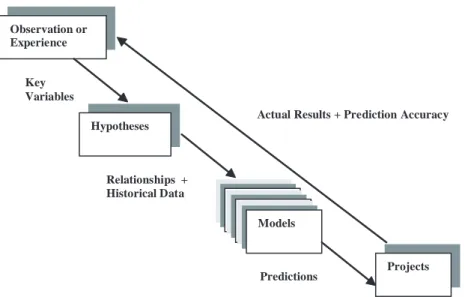
An objective effort estimation process (see Figure 2) involves the following steps.
• The use of empirical observation and/or experience to identify variables
(measures) that are believed to influence the effort required to develop a new
application. Examples of variables are the total number of new Web pages, total number of new images, developer’s experience within the development environment, and maximum number of developers on a project. Note that the size of an application is a variable (set of variables) that is always considered important due to its strong relationship with effort.
• The formulation of hypotheses about the relationship between the selected
variables and effort. Examples of hypotheses are the following statements: It seems that the greater the number of new static Web pages, the greater the amount of effort to develop a new application; it seems that larger teams will spend more time on developing an application compared to smaller teams.
• The gathering of data about past finished projects or even past development
believed to influence effort and effort itself. Note that if a company only uses
past data from very successful projects, the effort estimate obtained for a new project may provide an estimated effort that is not typical of the company’s situation. Here it may be useful (if there is enough available data) to compare predictions obtained using a subset of successful projects, a subset of less suc-cessful projects, and a subset containing both types of projects (each subset should have data on at least 12 projects, as per previous work in this area).
• The use of historical data to build effort estimation models for use in
predict-ing effort for new projects
• The assessment of how effective (accurate) those effort estimation models are,
that is, the assessment of their prediction accuracy
The prediction process illustrated in Figure 2 remains unchanged when applied to either Web or software effort estimation. However, despite sharing similar prediction processes, Web effort estimation differs from its software cousin for the following reasons:
• There is no standard for sizing Web applications as Web companies vary
widely with regard to the types of applications they develop and the tech-nologies employed as part of this process. For example, some companies focus on the development of small, multimedia-rich, static Web applications,
Figure 2. General prediction process (Adapted from Fenton & Pfleeger, 1996)
Key Variables Observation or Experience Hypotheses Models Projects Actual Results + Prediction Accuracy
Predictions Relationships +
where the development teams may argue it reasonable to measure application size as the total number of new Web pages and total number of new images. However, for those applications that will incorporate fewer static Web pages but will in addition incorporate a large number of complex scripts, databases, and conventional programming languages such as Java or C#, it becomes
more difficult to determine which variable(s) should represent application
size. Suggestions on how to size Web applications have been made by both practitioners and researchers, and will be detailed in Chapter 4. In relation to conventional software, size is often measured using function points (e.g.,
IFPUG, COSMIC-FFP), and less often using lines of code.
• Numerous Web companies are too small to provide a stable environment from
which they can develop and maintain their applications. Successful projects rely entirely on having experienced individuals, and the general lack of overall structure and control lead to the production of similar projects that can vary widely in their productivity and the application’s quality. In such instances, success cannot be repeated as there is no understanding of the factors involved, and as such, effort estimate is tantamount to a guesstimate. This scenario is also common to software companies; however, software companies have at their disposal a range of literature in effort estimation and project management that has been accumulated over the past 20 to 30 years, a stark contrast to the
development of Web applications in such a new field.
• Small Web companies may use technologies that differ widely from project
to project due to frequently bidding for contracts in domains where they have little or no previous experience, and for which they require the use of a differ-ent set of technologies. In this instance, the added learning curve to implemdiffer-ent
the required technology makes it difficult to utilise data on past projects in an
attempt to estimate effort for new Web projects.
• Except for the Tukutuku database (Mendes, Mosley, & Counsell, 2003), there
are practically no existing benchmark databases that can be used to obtain and then compare Web effort estimates and to benchmark Web projects’ productiv-ity. This contrasts directly with conventional software development, for which there are several known benchmark databases available (e.g., ISBSG, Laturi)
to which software companies regularly contribute data on finished projects
and from which they are able to calculate productivity baselines and effort estimates.
• Web development differs substantially from traditional software development
approaches. As such, variables (e.g., size variables) and effort models that have been proposed for software cannot be readily reused for Web projects.
• Despite the proposal of numerous Web development methodologies, there is
no single, unifying methodology that entirely captures all the intricacies of Web development projects and project management. Most of the
methodolo-gies proposed have not been readily assimilated by practitioners as they lack simplicity and appear to be too academic (Barry & Lang, 2001). Without the full understanding of what characterises Web development projects, it is
dif-ficult to determine factors that are influential upon developing projects within
time and budget.
One of the aims of researchers in the field of Web engineering is to provide the means
for practitioners to objectively estimate effort for their projects and to improve their current practices. Even though there are no standard size measures or development methodologies, currently it is not impossible for Web companies to measure effort objectively. The chapters that follow aim to help companies pursue this objective.
Conclusion
This chapter outlines the distinctions between Web and software applications, and discusses differences between Web and conventional software development. These have been summarised below:
Application Characteristics and Availability
• Web applications are distributed, are cross-platform, integrate numerous
distinct components, and contain content that is structured using navigational structures with hyperlinks. In addition, they are expected to be always avail-able (24/7/365) to the client.
• Traditional software applications are generally monolithic and single platform,
and can integrate distinct components. Except for a few application domains, these applications are not required to be available 24/7/365.
Technology and Architecture
• Web applications use a variety of Java solutions, HTML, JavaScript, XML,
UML, databases, third-party components and middleware, and so forth. In
terms of their architecture, they use anything from a two-tier to an n-tier
so-lution, with different network settings and bandwidth. Network settings and bandwidth are unknown in advance.
• Traditional software applications use object-oriented languages, relational databases, and CASE tools. In terms of their architecture, they typically use a one- or two-tier architecture, and network settings and bandwidth are likely to be known in advance.
Quality Drivers
• Web companies in general take the view that the delivery of a quality product
should be given a higher priority than time to market. In addition, the main quality drivers for these companies are reliability, usability, and security.
• Traditional software applications take the view that time to market should take
priority over the delivery of a quality product, and as such, this becomes their core quality driver.
Information Structuring, Design, and Maintenance
• Web applications use content that is both structured and unstructured, in
ad-dition to navigational structures built using hyperlinks. Maintenance cycles
are frequent and without specific releases, with updates ranging from an hour
to several months.
• Traditional software applications use content that is structured and seldom
employ hyperlinks (except on help pages). Their maintenance cycles are
car-ried out via specific releases and can range from a week to several years.
Disciplines and People Involved in Development
• The disciplines related to Web development are software engineering,
hyper-media engineering, requirements engineering, usability engineering, informa-tion engineering, graphics design, and network management. In addiinforma-tion, the people involved in Web development are Web designers and programmers, graphic designers, librarians, database designers, project managers, network security experts, usability experts, artists, and writers.
• The disciplines related to traditional software development are software
engi-neering, requirements engiengi-neering, and usability engineering. Generally, the people involved in software development are IT professionals with knowledge of programming, database design, and project management.
Stakeholders
• Within the context of Web development, stakeholders represent a wide range
of groups, known and unknown, residing locally or overseas.
• Conversely, within the context of traditional software development,
stake-holders are generally groups confined within the boundaries of departments,
divisions, or organisations.
Legal, Social, and Ethical Issues
• Within the context of Web development, content can be easily copied and
distributed without permission or acknowledgement of copyright and intel-lectual property rights. In addition, applications should take into account all groups of users including the disabled.
• Within the context of traditional software development, content can be copied
and in so doing infringe privacy, copyright, and IP issues, albeit to a smaller
extent when compared to Web-based environments.
Finally, this chapter also discussed the differences between Web and software effort estimation. These are due to the nonexistence of standard size measures to be used to size any type of Web application; many development companies are too small to look into the use of organised development processes, measures, and measure-ment. This suggests that their effort estimates are no better than an educated guess. The diversity of new technologies and languages used to develop Web applications may sometimes make it prohibitive to learn from the experience of past projects, and there are no existing benchmarking databases of Web projects (except for the Tukutuku database) for the creation of effort models and for benchmarking produc-tivity within and across companies.
References
Barry, C., & Lang, M. (2001). A survey of multimedia and Web development
tech-niques and methodology usage.IEEE Multimedia, 8(2), 52-60.
Brereton, P., Budgen, D., & Hamilton, G. (1998). Hypertext: The next maintenance
Christodoulou, S. P., Zafiris, P. A., & Papatheodorou, T. S. (2000). WWW2000: The
developer’s view and a practitioner’s approach to Web engineering.
Proceed-ings of the 2nd ICSE Workshop on Web Engineering (pp. 75-92).
Conklin, J. (1987). Hypertext: An introduction and survey. Computer, 20(9),
17-41.
Deshpande, Y., & Hansen, S. (2001). Web engineering: Creating a discipline among
disciplines. IEEE Multimedia, 8(2), 82-87.
Deshpande, Y., Murugesan, S., Ginige, A., Hansen, S., Schwabe, D., Gaedke, M.,
et al. (2002). Web engineering. Journal of Web Engineering, 1(1), 3-17.
Fenton, N. E., & Pfleeger, S. L. (1997). Software metrics: A rigorous and practical
approach (2nd ed.). Boston: PWS Publishing Company.
Fraternali, P., & Paolini, P. (2000). Model-driven development of Web applications:
The AutoWeb system. ACM Transactions on Information Systems, 18(4),
1-35.
Gellersen, H., & Gaedke, M. (1999). Object-oriented Web application development.
IEEE Internet Computing, 3(1), 60-68.
Gellersen, H., Wicke, R., & Gaedke, M. (1997). WebComposition: An
object-ori-ented support system for the Web engineering lifecycle. Journal of Computer
Networks and ISDN Systems, 29(8-13), 865-1553.
Ginige, A. (2002, July). Workshop on Web engineering. Web engineering: Managing
the complexity of Web systems development. Proceedings of the 14th
Inter-national Conference on Software Engineering and Knowledge Engineering
(pp. 72-729).
Ginige, A., & Murugesan, S. (2001). Web engineering: An introduction. IEEE
Multimedia, 8(1), 14-18.
Institute of Electrical and Electronics Engineers (IEEE). (2003). Recommended
practice for the Internet Web site engineering, Web site management, and
Web site life cycle. Author.
Lee,