NTHU at the CoNLL-2014 Shared Task
Jian-Cheng Wu*, Tzu-Hsi Yen*, Jim Chang*, Guan-Cheng Huang*, Jimmy Chang*, Hsiang-Ling Hsu+, Yu-Wei Chang+, Jason S. Chang*
* Department of Computer Science
+ Institute of Information Systems and Applications
National Tsing Hua University HsinChu, Taiwan, R.O.C. 30013
{wujc86, joseph.yen, cwebb.tw, a2961353,
rocmewtwo, ilovecat6717, teer1990, jason.jschang}@gmail.com
Abstract
In this paper, we describe a system for cor-recting grammatical errors in texts written by non-native learners. In our approach, a given sentence with syntactic features are sent to a number of modules, each focuses on a specific error type. A main program integrates corrections from these modules and outputs the corrected sentence. We evaluated our system on the official test data of the CoNLL-2014 shared task and obtained 0.30 in F-measure.
1 Introduction
Millions of non-native learners are using English as their second language (ESL) or foreign lan-guage (EFL). These learners often make different kinds of grammatical errors and are not aware of it. With a grammatical error corrector applies rules or statistical learning methods, learners can use the system to improve the quality of writing, and be-come more aware of the common errors. It may also help learners improve their writing skills.
The CoNLL-2014 shared task is aimed at pro-moting research on correcting grammatical errors. Types of errors handled in the shared task are ex-tended from the five types in the previous shared task to include all common errors present in an es-say.
In this paper, we focus on the following errors made by ESL writers:
• Spelling and comma
• Article and determiner • Preposition
• Preposition + verb (interactive) • Noun number
• Word form
• Subject-verb-agreement
For each error type, we developed and tuned a module based on the official development data. A main program combines the correction hypotheses from these modules and produces the final correc-tion. If multiple modules propose different cor-rections to the same word/phrase, the correction proposed by the module with the highest precision will be chosen.
2 Method
2.1 Spelling and Comma module
In this section, we correct comma errors and spelling errors, including missing/extraneous hy-phens. For simplicity, we adopt Aspell1 and
GingerIt2 to detect spelling errors and generate
possible replacements, considered as confusable words, which might contain the word with cor-rect spelling. Then, we replace the word being checked with confusable words to generate sen-tences. Language models trained on well-formed texts are used to measure the probability of these
1http://aspell.net/
2https://pypi.python.org/pypi/gingerit We use GingerIt only for correcting missing/extraneous hyphens
candidates. Candidate with the highest probability is chosen as correction.
Omitted commas form a large proportion of punctuation errors. We apply the CRF model pro-posed by Israel, et. al. (2012) with some mod-ification. We replace distance features with syn-tactic features. More specifically, we do not use features such as distances to the start of sentence or last comma. And we add two features, one in-dicates whether a word is at the end of a clause, and the other indicates whether the current clause starts with a prepositional phrase.
2.2 Subject-verb-agreement module
This module corrects subject-verb-agreement er-rors in a given sentence. Consider the sentence ”The boy in blue pants are my brother”. The cor-rect sentence should be ”The boy in blue pants is my brother”. Since a verb could be far from it’s subject, using ngram counts may fail to detect and correct such an error.
We use a rule-based method in this module. In the first stage, we identify the subject of each clause by using information from the parser. Both the dependency relation and syntactic structure are used in this stage. Dependency relations such as
nsubj and rcmod indicate subjects of subject-verb relation. If there is a subject-verb that has not been assigned a subject via dependency relations, head of noun phrase in the same clause will be used in-stead. And in the second stage, we check whether subject and verbs agree, for each clause in the sen-tence.
Here we explain our correction process in more detail. For each clause, the singular and plural forms of verbs in the clause must be consistent with the subject of the clause unless the subject is a quantifier. Consider the following sentences:
The number of catsisten. A number of catsareplaying.
Since our judgment only depends on the subject number, it’s hard to tell whether should we use a plural verb or not in this case. The quantifiers we do not handle are listed as follow:number, lot, quantity, variety, type, amount, neither.
2.3 Number module and Forms module
We correct noun number error in two stages. In the first stage, we generate a confusion set for each
word. While constructing confusion set for noun number, both of the singular form and plural form are included in the set. While constructing con-fusion set for word forms, we use the word fam-ilies in Academic Word List (AWL)3 and British
National Corpus (BNC4000) 4. Given a content
word, all the words in the same family except antonyms are entered into the confusion set. How-ever, comparative form and superlative form of an adjective are eliminated from the confusion set, since replacing an adjective with these forms is a semantic rather than syntactic decision. The fol-lowing examples illustrate what kinds of alterna-tives are eliminated:
antonyms:misleadingfor the wordlead semantics:higherfor the wordhigh
Additionally, in the forms module, a correc-tion is ignored, if it is actually correcting a verb tense, subject-verb-agreement, or noun number er-ror. We use part-of-speech (POS) tag to check this. More specifically, any corrections that changes a word with a VBZ tag to a word with a VBP or VBDtag is ignored, and vice versa. And any cor-rections that switches a noun between it’s singular form and plural form is also ignored.
With the confusion sets, we proceed to the second stage. In this stage, we use words in the confusion set to attempt to replace potential errors. Language models trained on well-formed text are used to validate the replacement decisions. Given a wordw, If there is an alternativew’ that fits in the context better, wis flagged as an error andw’is returned as a correction.
Here is our formula for correcting errors
P(O) = Pngram(O) +2 Prnn(O)
P(R) = Pngram(R) +Prnn(R) 2
P romotion= P(R)|O|−P(O)
While checking a content word w, we replace win the original sentenceOwith alternatives and generate candidatesC. We then generate the can-didate R with the highest probability among all
3http://www.victoria.ac.nz/lals/ resources/academicwordlist/sublists
candidates. We use an interpolated probability5of
ngram language modelPngram and recurrent
neu-ral network language modelPrnn. Promotion
in-dicates the increase in probability per word after we replace sentence Owith the candidate R. We use word number to normalizePromotion follow-ing Dahlmeier, et al. (2012). Corrections are made only ifPromotionis higher than a empirically de-termined threshold.6
2.4 Article and Determiner module
In this subsection, we describe how we correct er-rors of omitting a determiner or adding a spuri-ous determiner. The language models mentioned in the last subsection are also used in this module. We tune our thresholds for making corrections on development data7, and found that deleting a
de-terminer should have a lower threshold while in-serting one should have a higher one, so we set different thresholds accordingly.8
To cope with the situation where a deter-miner/article is far ahead of the head of the noun phrase, we apply another constraint while making correction decision.
First, we calculate statistics on the head of noun phrases. We extract the most frequent 100,000 terms in Web-1T 5-gram corpus. These terms are used to search their definitions in Wikipedia (usu-ally at the first paragraph). The characteristic of a definition is that it has no prior context and most of the noun phrases with a determiner are unique or known to the general public. Heads of these nouns phrases are likely to always appear with a determiner.
Heads that tend to appear with a determiner
thehelp us to decide whether a determiner should be added to a noun phrase. We add a determiner using two constraints. We only insert a determiner or an article, if the statistics indicate that head of a noun phrase tends to have a determiner, or the promotion of log probability is much higher than the threshold. A similar constraint is also applied, for deleting a determiner or an article.
5the probabilities present in the formula are log probabil-ities
6the threshold for noun number module is 0.035 and 0.050 for word form module. These threshold were set empirically after testing on development data
7test data of the CoNLL-2013 shared task
8the threshold for insertion is 0.035 and 0.040 for deletion
2.5 Preposition module
For preposition errors, we focus on handling two types of errors: REPLACE and DELETE. A preposition, which should be deleted from the given sentence, is regarded as a DELETE error, whereas for a preposition, which should be placed with a more appropriate alternative, is re-garded as a REPLACE error. In this work, we correct the two types of errors based on the as-sumption that the usage of preposition often de-pends on the collocation relations with a verb or noun. Therefore, we use the dependency relations such as dobj and pobj, and prep to identify the related words, and then we validate the usage of prepositions, and correct the preposition errors. A dependency-based model is proposed in this paper to handle the preposition errors. The model consists of two stages: detecting the possible preposition errors and correcting the errors.
In the first stage, we use the Stanford depen-dency parser (Klein and Manning, 2003) to extract the dependency relations for each preposition. The relation tuples, which contain the preposition, verb or noun, and prepositional object. For example, the tuple of verb-prep-object (listen, to, music), or the tuple of noun-prep-object (point, of, view) are extracted for validation. We identify a preposi-tion containing as an error, if the tuple containing the preposition does not occur in a reference list built using a reference corpus. In order to resolve the data sparseness and false alarm problems, we need a sufficiently large list of validated tuples. In this study, the reference tuple lists are gener-ated from the Google Books Syntactic N-grams (Goldberg and Orwant, 2013)9. For example, we
can find (come, to, end, 236864) and (lead, to, re-sult, 57632) in the verb-preposition-object refer-ence list. We have generated 21,773,752 different dependency tuples for our purpose.
deletes the preposition, is also taken into consid-eration. All candidates are ranked according to the frequency provided by the reference lists. The preposition in the tuple with the highest frequency is returned as the correction suggestion.
Figure 1: Sample annotated trigrams
Figure 2: Sample trigram group
Figure 3: Sample phrase translation for a trigram group
2.6 Interactive errors module
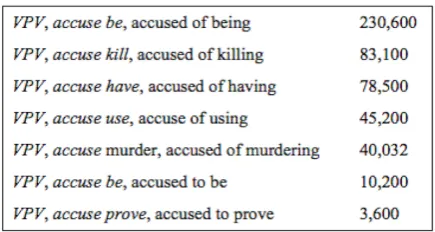
This module uses a new method for correcting serial grammatical errors in a given sentence in learners writing. A statistical translation model is generated to attempt to translate the input with se-rial and interactive errors into a grammatical sen-tence. The method involves automatically learing translation models based on Web-scale n-gram. The model corrects trigrams containing
se-rial preposition-verb errors via translation. Eval-uation on a set of sentences in a learner corpus shows that the method corrects serial errors rea-sonably well.
Consider an error sentence”I have difficulty to understand English.”The correct sentence for this should be”I have difficulty in understanding En-glish.”It is hard to correct these two errors one by one, since the errors are dependent on each other. Intuitively, by identifyingdifficulty to understand as containing serial errors and correct it to diffi-culty in understanding, we can handle this kind of problem more effectively.
[image:4.595.78.294.313.443.2]First, we generate translation phrase table as follows. We begin by selecting trigrams related to serial errors and correction from Web 1T 5-gram. Figure 1 shows some sample annotation trigrams. Then, we group the selected trigrams by the first and last word in the trigrams. See Figure 2 for a sample VPV group of trigrams. Finally, we gener-ate translation phrase table for each group. Figure 3 shows a sample translation phrase table.
At run time, we tag the input sentence with part of speech information in order to find trigrams that fit the type of serial errors. Then, we search phrase table and generate translations for the input phrases in a machine translation decoder to produce a corrected sentence.
3 Experiment
Two types of trigram language models, ngram model and recurrent neural network (RNN) model, are used in correcting spelling, noun number, word form, and determiner errors. We trained the ngram language model on English Gigaword and BNC corpus, using the SRILM tool (Stolcke, 2002). We train the RNN model with RNNLM toolkit (Mikolov et al., 2011). Complexity of training the RNN language model is much higher, so we train it on a smaller corpus, the British National Corpus (BNC).
(Gold-berg and Orwant, 2013) were also used to develop our dendepency-based model in the preposition module.
To assess the effectiveness of the proposed method, we used the official training, develop-ment, and test data of the CoNLL-2014 shared task. On the test data, our system obtained the pre-cision, recall andF0.5 score of 0.351, 0.189, and 0.299. The following table shows the performance breakdown by module.
Figure 4: The performance breakdown by module. (Displayed in %)
In the spelling and hyphen module, candidates from Aspell include words that only differ from the original word in one character, s. Language models are then used to choose the candidate with highest probability as our correction. The module therefore gives some corrections about noun num-bers or subject-verb-agreement. As a result, some corrections made by this module overlap with cor-rections made by the noun numbers module and the subject-verb-agreement module, which makes the recall of correcting spelling and hyphen errors, 4.11%, overestimated.
4 Conclusion
In this work, we have built several modules for er-ror detection and correction. For different types of errors, we developed modules independently using different features and thresholds. If mul-tiple modules propose different corrections to a word/phrase, the one proposed by the module with higher precision will be chosen. Many avenues for future work present themselves. We plan to integrate modules in a more flexible way. When faced with different corrections made by different modules, the decision would better be based on the confidence of each correction with a uniform standard, but not on the confidence of modules.
Acknowledgments
We would like to acknowledge the funding sup-ports from Delta Electronic Corp and National Science Council (contract no: NSC 100-2511-S-007-005-MY3), Taiwan. We are also thankful to anonymous reviewers and the organizers of the shared task.
References
Daniel Dahlmeier, Hwee Tou Ng, and Eric Jun Feng Ng 2012. NUS at the HOO 2012 Shared Task. In Pro-ceedings of the Seventh Workshop on Building Ed-ucational Applications Using NLP, Association for Computational Linguistics, June 7.
Daniel Dahlmeier and Hwee Tou Ng, 2012. Better Evaluation for Grammatical Error Correction. In Proceedings of the 2012 Conference of the North American Chapter of the Association for Computa-tional Linguistics (NAACL 2012).,568-672
Daniel Dahlmeier, Hwee Tou Ng, Siew Mei Wu. 2013. Building a Large Annotated Corpus of Learner En-glish: The NUS Corpus of Learner English. In Proceedings of the 8th Workshop on Innovative Use of NLP for Building Educational Applications(BEA 2013)
Yoav Goldberg and Jon Orwant 2013. A dataset of syntactic-ngrams over time from a very large cor-pus of English books. InProceedings of the Second Joint Conference on Lexical and Computational Se-mantics, Atlanta, GA, 2013.
Ross Israel, Joel Tetreault, and Martin Chodorow 2012. Correcting Comma Errors in Learner Essays, and Restoring Commas in Newswire Text. In Pro-ceeding of the 2012 Conference of the North Amer-ica Chapter of the Association for Computational Linguistics: Human Language Technologies ,284-294, Montreal Canada, June. Association for Com-putational Linguistics
Dan Klein and Christopher D. Manning. 2003. Ac-curate unlexicalized parsing. InProceedings of the 41st Meeting of the Association for Computational Linguistics, 423-430.
Tomas Mikolov, Anoop Deoras, Dan Povey, Lukar Burget, and Jan Honza Cernocky 2011. Strategies for Training Large Scale Neural Network Language ModelsProceedings of ASRU 2011