R E S E A R C H
Open Access
Localization using iterative angle of arrival
method sharing snapshots of coherent subarrays
Shun Kawakami
*and Tomoaki Ohtsuki
Abstract
In this paper, we propose a localization method using iterative angle of arrival (AOA) method sharing snapshots of coherent subarrays. The conventional AOA method is restricted in some applications because array antenna used for receivers requires many antennas to improve localization accuracy. The proposed method improves localization accuracy without increasing elements of antenna arrays, and thus the lower costs and smaller devices are
expected. First, we estimate rough location of source with each subarray-small number of antennas-in initial estimation. Then, we configurate virtual arrays by sharing snapshots based on the initial AOAs, estimate again with virtual arrays-large number of antennas-in update estimation, and update the location iteratively. Simulation results show that the localization accuracy of the proposed method is better than that of the conventional method using the same number of antennas if the appropriate virtual arrays are configurated and the phase synchronization error between two subarrays is smaller than 0.14 of a wavelength.
Keywords:localization, angle of arrival, antenna array, virtual array
Introduction
Localization of sources is attracting a great deal of inter-est in mobile communications and other many applica-tions. Global positioning system (GPS) is used in various applications, such as location information ser-vice of cellular phone and car navigation system. How-ever, nodes require to equip with exclusive receivers that are expensive. More importantly, GPS is unavailable indoor or underground. Accurate indoor localization plays an important role in home safety, public services, and other commercial or military applications [1]. In commercial applications, there is an increasing demand of indoor localization systems for tracking persons with special needs, such as elders and children, who may be away from visual supervision. Other applications need the solutions to trace mobile devices in sensor networks. Therefore, various localization techniques alternative to GPS have been researched. They are classified to two categories: lateration using distance information by more than two receivers and angulation using direction information by more than one.
Time difference of arrival (TDOA) method estimates the distance from propagation times through different receivers [2]. Received signal strength (RSS) method uses the knowledge of the transmitter power, the path loss model, and the power of the received signal to determine the distance of the receiver from the trans-mitter [3]. For lateration, a node estimates the distances from three or more beacons to compute its location. Angle of arrival (AOA) method uses array antenna to estimate direction of arrival and at least two receivers, called subarray, are required to localize sources [4]. Localization accuracy of this method is higher than that of TDOA and RSS in theory, but it is restricted in some applications, because array antenna used in receivers is large. The accuracy of AOA depends on the number of antennas, thus it requires more antennas to improve the accuracy.
Some schemes are proposed to solve the problems as mentioned above. Cooperative AOA uses only one set of acoustic modules and radio transceiver for each, if meet with certain conditions (e.g. distances between each other within a certain range) [5]. However, this scheme previously requires the distances obtained by TDOA or RSS, and its localization performance is low if the errors of the distances are large.
* Correspondence: [email protected]
Graduate School of Science and Technology, Keio University, Yokohama, Japan
In this paper, we propose an iterative localization method based on AOA. This method requires at least two subarrays each configurated of some antennas like the general AOA method. The objective of the proposed method is to improve localization accuracy without increasing antennas. First, we estimate rough location of source with each subarray-small number of antennas-in initial estimation. Then, we configurate virtual arrays by sharing snapshots based on initial AOAs, estimate again with virtual arrays-large number of antennas-in update estimation, and update the location iteratively.
Simulation results show that the performance of loca-lization accuracy of the proposed method is better than that of conventional method using the same number of antennas if the appropriate virtual arrays are configu-rated and the phase synchronization error between two subarrays is smaller than 0.14 of a wavelength. The loca-lization accuracy of the proposed method is almost identical to that of conventional method using the large number of antennas.
Related works
General localization method using AOA
AOA method uses array antenna to estimate direction of arrival and more than two subarrays are required to localize sources. Assume that there is a sufficient dis-tance between sources and each subarray, called far field model, formulated by r ≥ 2D2/l [6], wherer is a dis-tance between source and subarray,Dis array aperture, andlis wavelength.
We consider that there are two subarrays and one source in the field. Each subarray estimates signal direc-tionsθˆ1, θˆ2. Let (xk, yk) be the phase center location of subarraykand(xˆ,ˆy)be the estimated location of source, then two lines are respectively written by,
ˆ
y−y1= (xˆ−x1) tanθˆ1, (1)
ˆ
y−y2= (xˆ−x2) tanθˆ2. (2)
From Equations 1 and 2,(xˆ,yˆ)can be solved as ⎧
⎪ ⎪ ⎪ ⎨ ⎪ ⎪ ⎪ ⎩ ˆ
x= x1tanθˆ1−x2tanθˆ2+y2−y1 tanθˆ1−tanθˆ2
ˆ
y= (x1−x2) tanθˆ1tanθ2+y2tanθˆ1−tanθˆ2 tanθˆ1−y1tanθˆ2
. (3)
Two non-parallel lines are sufficient to locate a posi-tion on a plane. How accurate the posiposi-tion is depends on the estimation accuracies of θˆ1and θˆ2. With more than three subarrays, multiple intersection points are available, and one point is selected by some methods [4], for example, mean aggregation. AOA is estimated
by MUSIC [7], ESPRIT [8], and so on. In this paper, we choose MUSIC for its simplicity.
Array model for separated subarrays
In [9], the environment that the AOA of a single signal impinges on two subarrays is considered. If two subar-rays are assumed ideal and identical, each geometry is uniform linear array (ULA), configurated of Melements and interelements spacing isd, steering vectors are writ-ten as
a1(θ) =a2(θ)
= [1,ej(2π/λ)dsinθ,. . .,ej(2π/λ)(M−1)dsinθ]T, (4)
where [·]T represents the transpose operation.
Then, a steering vector for the whole array is given by
a(θ) =
a1(θ)
ej(2π/λ)Rsinθ a2(θ)
, (5)
whereRis a distance between the two subarrays.
The virtual array technique
The virtual, or interpolated, array technique is researched in order to estimate the AOAs of coherent sources [10] and reduce the elements of array [11]. In this technique, the real array manifold is linearly trans-formed onto a preliminary specified virtual array mani-fold over a given angular sector. That is, an interpolation matrixBis designed to satisfy
¯
a(θ) =BHa(θ), (6)
wherea(θ) anda¯(θ)are the steering vectors of the real and virtual array, respectively, and [·]H represents the Hermitian transpose operation. However, this technique requires to divide the field of array into some sectors and compute the interpolation matrixB, preliminary.
Proposed method
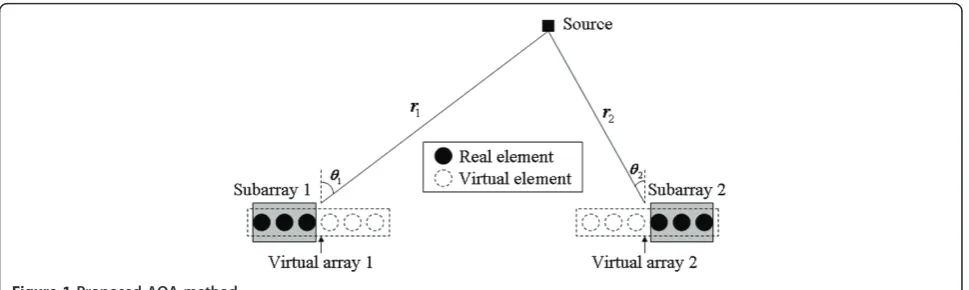
We propose a new localization method sharing snap-shots of coherent subarrays and estimating AOA itera-tively. This method estimates the source location roughly in initial estimation and updates that iteratively in update estimation. The objective of the proposed method is to improve the localization accuracy without increasing elements of antenna arrays. In this section, we present the proposed algorithm based on AOA.
Assumption
ofMelements at timetcan be modeled as
x1(t) =a1(θ)s(t) +n1(t), (7)
x2(t) =a2(θ)s(t) +n2(t), (8)
wherexk(t),ak(θ),nk(t) are the snapshots, steering vec-tor, white sensor noise of subarray k, and s(t) is the complex amplitude of the source, respectively.
Like Equation 5, when the reference point of each subarray is source location, array response in VAkcan be written as
vkm(θ) =akm(θ)bk, (9)
where
akm(θ) = 1
rke
j(2π/λ)(m−1)dsinθ, (10)
bk=ej(2π/λ)rk, (11)
(1/rk) is inverse of the distance between a source and subarray k that means signal fading coefficient. Note thatakm(θ)corresponds to array response in VAk and
bkcorresponds to phase shift from a source to VA k. Cooperative systems, such as virtual multiple-input multiple-output and distributed array antennas achieve high performance for capacity or location accuracy by sharing received signals, but need symbol synchroniza-tion among receivers [12,13]. Symbol synchronizasynchroniza-tion can be achieved by transmitting pilot symbols. However, this is an unnecessary waste of bandwidth; particularly, in broadcast systems. Symbol synchronization problem is often featured in orthogonal frequency division multi-plexing system, and various schemes have been pro-posed [14-16]. The propro-posed method is a kind of cooperative system and then requires the symbol syn-chronization. The source and each receiver is also line of sight.
Initial estimation
First, each subarray uses own correlation matrix to esti-mate AOA given by
ˆ R1= 1
N N
t=1
x1(t)xH1(t), (12)
ˆ R2= 1
N N
t=1
x2(t)xH2(t). (13)
Directionsθˆ1(1),θˆ2(1)are obtained by MUSIC as follows, individually.
When the received correlation matrix is R, the eigen-deconfiguration ofRis computed as
R=ESSEHS +ENNEHN, (14)
where ΛS andΛNare the diagonal matrices that con-tain the signal- and noise-subspace eigenvalues of R, respectively, whereasES andEN are the corresponding orthonormal matrices of signal- and noise-subspace eigenvectors ofR, respectively. Once the noise-subspace is obtained, the directions can be estimated by searching for peaks in the MUSIC spectrum given by
PMUSIC(θ) =
aH(θ)a(θ)
aH(θ)E
NEHNa(θ)
. (15)
Then, source location is computed as Equation 3. This is the initial estimation.
Update estimation
We have, now, rough directions and distances by com-puting from estimated source location and known each subarray location. Next, we share the array snapshots and synchronize those as
xv1(t) =
x1(t) x2(t)∗δ1
,xv2(t) =
x1(t)∗δ2 x2(t).
δ1,δ2are phase corrective functions as follows
δ1=ej(2π/λ){(rˆ1−ˆr2)+Mdsinθˆ2}, (17)
δ2=ej(2π/λ){(rˆ2−ˆr1)+Mdsinθˆ1}, (18) whereˆr1, ˆr2are distances andθˆ1,θˆ2are directions esti-mated by subarrays 1 and 2, respectively.
This means that the dimension of each subarray snap-shots increases fromM × 1 to 2M × 1. Each subarray uses extended correlation matrix to estimate AOA.
In case of subarray 1, a new AOA is estimated by the virtual correlation matrix
ˆ Rv1=
1
N N
t=1
xv1(t)xHv1(t), (19)
and the array response of VA 1 in the nth iteration is given by
vn1,m(θ) =
⎧ ⎪ ⎨ ⎪ ⎩
1 ˆ
r1
ej(2π/λ)(m−1)dsinθ (1≤m≤M) 1
ˆ
r2
ej(2π/λ)(m−1)dsinθˆ2(n−1)((M+ 1)≤m≤2M)
. (20)
Note that θis the variable and θˆ2(n−1)is the constant estimated in previous iteration. This virtual steering vec-tor does not need the interpolation matrix as Equation 6. Assume that UˆN1is the noise-subspace of Rˆv1and vn1(θ) = [vn1,1(θ),v1,2n (θ),. . .,vn1,2M(θ)]is the steering vec-tor, MUSIC spectrum in VA 1 is given by
PMUSIC1 (θ) = v
n
1(θ)
H
vn1(θ)
vn1(θ)HUˆN1Uˆ
H N1vn1(θ)
. (21)
Similary, MUSIC spectrum in VA 2 whose steering vector isvn2(θ), is given by
PMUSIC2 (θ) = v
n
2(θ)
H
vn2(θ)
vn
2(θ)
HUˆ N2Uˆ
H N2vn2(θ)
. (22)
From Equations 21 and 22 we get new directionsθˆ1(n) andθˆ2(n)in thenth iteration, and thus estimate the new source location. The proposed method iteratively updates the estimates of the directions and source locations.
Virtual array configuration
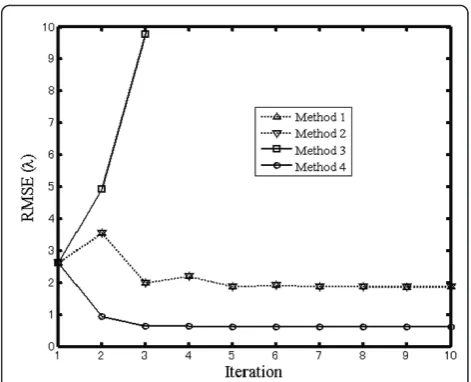
We can consider four methods about virtual array con-figuration as shown in Figure 2 for two subarrays. Each virtual array has the different steering vector because the elements have different order. In Figure 2, the refer-ence point means the phase referrefer-ence for each element of array antenna. The steering vector includes the
distance between the reference point and each element of array antenna. Then, the reference point is needed to compute the distance to compose the steering vector.
Figure 3 shows root mean square errors (RMSEs) comparison of four methods. Assume that the positions of subarrays 1 and 2, (M = 4), are (0, 0), (100l, 0), and a source is at (50l, 50l). From Figure 3, localization accuracy is high when a reference point of virtual array is a real element. This is because elements of steering vector of virtual array correspond to elements of virtual correlation matrix. Method 4 indicates the best perfor-mance because both VA 1 and VA 2 in method 4 use the real element, the element of self-subarray, as the reference point. Note that, VA 2 in method 1 and VA 1 in method 2 also use the real element as the reference point. Figure 3 also indicates the iteration countn = 5 of method 4 is enough to improve the localization accuracy.
Figure 2Virtual array configuration.
When virtual array configuration is based on method 4, steering vectors of VA 1 and VA 2 in thenth itera-tion can be represented, respectively, as
vn1,m(θ) =
⎧ ⎪ ⎨ ⎪ ⎩
1 ˆ
r2
ej(2π/λ)(m−1)dsinθˆ2(n−1)(1≤m≤3)
1 ˆ
r1
ej(2π/λ)(m−1)dsinθ (4≤m≤6), (23)
vn2,m(θ) =
⎧ ⎪ ⎨ ⎪ ⎩
1 ˆ
r1
ej(2π/λ)(m−1)dsinθˆ1(n−1)(1≤m≤3)
1 ˆ
r2
ej(2π/λ)(m−1)dsinθ (4≤m≤6). (24)
Simulation results
In this section, we examine the localization performance of our proposed method. We use common simulation parameters over all simulations as Table 1. The location of a source and each subarray is as Figure 4. A source is generated in random to show the proposed method does not depend on the source location.
First, the phase synchronization between two subar-rays is assumed as perfect. In other words, δ1, δ2 in
Equations 17 and 18 are exact. We compare the pro-posed method to three conventional methods. Conv. (M
×K) means the conventional method that usesK subar-rays each configurated ofMelements.
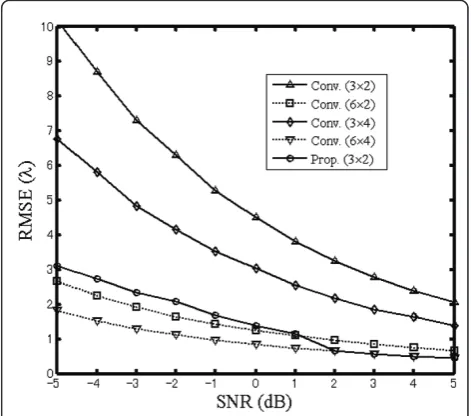
Prop. is the proposed method that uses two subarrays each configurated of three elements, the virtual array configuration of Prop. is based on method 4, and the iteration count n = 5. The purpose of our proposed method is to improve the localization accuracy without increasing the number of antennas.
In Figure 5, the RMSEs of the location estimates for all the methods versus signal-to-noise ratio (SNR) are shown. Prop. performs asymptotically close to Conv. (6 × 2) and Conv. (6 × 4), and outperforms Conv. (3 × 2). This is because Prop. can use more snapshots than Conv. (3 × 2). Prop. shows the more robustness, parti-cularly in low SNR. We stress that Conv. (6 × 2) and Conv. (6 × 4) use more antennas than Prop.
In Figure 6, the cumulative distribution function (CDFs) of location RMSEs at SNR = 0 dB versus the error distance, 0.5lintervals, are shown. The probability of Prop. in the small errors, less than 1l, is higher than that of Conv. (6 × 2), whereas in the large errors, is also higher. In Prop., AOA is estimated using the parameters (directions and distances) estimated in the previous iteration. Thus, the estimation errors in the (n - 1)th iteration are larger, the localization accuracy of Prop. in thenth iteration is also larger.
Figures 7 and 8 show the MUSIC spectrum of the conventional method (n= 1) and the proposed method (n = 5). The maximum spectrum of the proposed method is closer to true AOA than that of the conven-tional method. At the same time, MUSIC spectra of the
Table 1 Simulation parameters
Number of sources 1
Geometry of subarray ULA
Interelement spacing l/2
Number of snapshots 128
Noise model AWGN
AOA estimation method MUSIC
Spectral resolution 0.1°
Simulation runs 10000
proposed method have spurious peaks because the pro-posed method in update estimation uses the snapshots of the other subarray. However, these spurious peaks are much lower than the maximum spectra, true peaks, then we can distinguish these peaks.
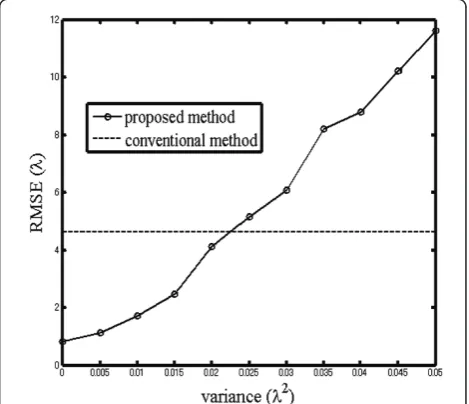
Next, we evaluate the effect of the phase synchroniza-tion error between two subarrays. Note that the phase synchronization error is defined as the error arising among different separated receivers. We assume that two subarrays are located in the different far field, then those are not connected by cable cannot be synchro-nized perfectly. Figure 9 shows location RMSE of the proposed method versus the synchronization error between two subarrays, where method 4 is used for
virtual array configuration and iteration time is 5. The synchronization error is added toδ1,δ2, and its variance is defined as Gaussian distribution.
We can see that phase synchronization between two subarrays is important for the proposed method because RMSE becomes larger as error variance increases. The proposed method can achieve smaller RMSE the con-ventional one when the error variance is smaller than 0.02l2.
Conclusion
In this paper, we proposed a new localization method based on AOA. The objective of the proposed method is to improve localization accuracy without increasing Figure 6CDFs of location RMSEs versus the error distance.
Figure 7AOA estimated by subarray 1.
Figure 8AOA estimated by subarray 2.
antennas. This method estimates rough source location by initial estimation, share snapshots of coherent subar-rays, and iteratively update source location by update estimation. We showed that the proposed method loca-lizes a source more accurately than the conventional method when the reference point of virtual array is a real element and the phase synchronization error between two subarrays is smaller than 0.14 of a wavelength.
Abbreviations
AOA: angle of arrival; CDFs: cumulative distribution function; GPS: global positioning system; RMSEs: root mean square errors; RSS: received signal strength; TDOA: time difference of arrival; ULA: uniform linear array.
Acknowledgements
This work was supported by Ohtsuki Laboratory, the Department of Computer and Information Science, Keio University. Part of this paper was presented at the Asia-Pacific Signal and Information Processing Asso- ciation (APSIPA ASC 2009) and at the IEEE International Conference on Wireless Information Technology and Systems (ICWITS 2010).
Competing interests
The authors declare that they have no competing interests.
Received: 14 November 2010 Accepted: 24 August 2011 Published: 24 August 2011
References
1. K Pahlavan, P Krishnamurthy, J Beneat, Wideband radio channel modeling for indoor geolocation applications. IEEE Commun Mag.36(4), 60–65 (1998). doi:10.1109/35.667414
2. L Jun, C Qimei, T Xiaofeng, Z Ping, A method to enhance the accuracy of location systems based on TOA-location algorithms. inITS Telec Proc
Conference, 979–982 (2006)
3. F Reichenbach, D Timmermann, Indoor localization with low complexity in wireless sensor networks. IEEE Ind Info, 1018–1023 (2006)
4. S Zhilong, PYT Shing, Precise localization with smart antennas in Ad-Hoc networks, inIEEE Globecom Conference, pp. 1053–1057 (2007)
5. T Hui, W Shuang, X Huaiyao, Localization using cooperative AOA approach. Wicom Networking and Mobile Computing, 2416–2419 (2007)
6. S Kuldip, Antenna near field intensity predection, inProceedings of the International conference on Electromagnetic Interference and Compatibility, pp. 109–114 (1999)
7. H Krim, M Viberg, Two decades of array signal processing research. IEEE Signal Process Mag.13(4), 67–94 (1996). doi:10.1109/79.526899 8. B Friedlander, AJ Weiss, Direction finding using spatial smoothing with
interpolated arrays. IEEE Trans Aerosp Electron Syst.28, 574–587 (1992). doi:10.1109/7.144583
9. F Athley, C Engdahl, Direction-of-arrival estimation using separated subarrays, inProceedings 34th Asilomar Conference Signals, Systems,
Computation1, 585–589 (2000)
10. B Friedlander, Direction finding using an interpolated array. IEEE Signal Process Lett.5, 2951–2954 (1990)
11. AB Gershman, JF Bohme, A note on most favorable array geometries for DOA estimation and array interpolation. IEEE Signal Process Lett.4, 232–235 (1997). doi:10.1109/97.611287
12. M Seo, M Rodwell, M Madhow, A feedback-based distributed phased array technique and its application to 60-GHz wireless sensor network, inIEEE
MTT-S International Microwave Symposium Digest, pp. 683–686 (2008)
13. Y Hua, Q Zhang, Z Niu, A cooperative MAC protocol with virtual-antenna array support in a multi-AP WLAN system. IEEE Trans Wirel Commun.8(9), 4806–4814 (2009)
14. J Beek, M Sandell, PO Borjesson, ML estimation of time and frequency offset in OFDM systems. IEEE Trans Signal Process.45, 1800–1805 (1997). doi:10.1109/78.599949
15. D Lee, K Cheun, A new symbol timing recovery algorithm for OFDM systems. IEEE Trans Consumer Electron.43, 767–775 (1997). doi:10.1109/ 30.628706
16. A Armada, M Ramon, Rapid prototyping of a test modem for terrestrial broadcasting of digital television. IEEE Trans Consumer Electron.43, 1100–1109 (1997). doi:10.1109/30.642377
doi:10.1186/1687-6180-2011-46
Cite this article as:Kawakami and Ohtsuki:Localization using iterative angle of arrival method sharing snapshots of coherent subarrays. EURASIP Journal on Advances in Signal Processing20112011:46.
Submit your manuscript to a
journal and benefi t from:
7 Convenient online submission
7 Rigorous peer review
7 Immediate publication on acceptance
7 Open access: articles freely available online
7 High visibility within the fi eld
7 Retaining the copyright to your article