R E S E A R C H
Open Access
Integrating energy efficiency analysis of
massive MIMO-based C-RAN
Di Zhang
1*, Muhammad Tariq
2, Shahid Mumtaz
3, Jonathan Rodriguez
3and Takuro Sato
1Abstract
Besides the prior study of energy efficiency (EE) that focuses on single component (antenna, radio frequency (RF) chain, circuit, etc.), or limited to one base station (BS) area, in this paper, EE is integrated, investigated with various components (antenna, RF chain, circuit, coverage area) considering in, based on an optimized system model. That is, one optimized multi-BS system model is introduced beforehand with the cloud radio access network (C-RAN) for easier deployment of the selecting/sleeping mechanism. In addition, the system EE is described by an optimization problem while taking more component factors into consideration. While solving, this integrated optimization problem in all time intervals of all BS areas is proved to be equal to an optimization problem of each single BS area within each single time interval. After that, the integrated optimization solution is obtained while adding up the single-BS-single-interval optimization solutions, whereas the later solution is addressed by an offline decision method plus a convex optimization strategy. Observation from the numerical results demonstrates that the antenna power consumption is the dominant factor of the power consumption, which therefore, the dominant factor of EE performance.
Keywords: Energy efficiency, Cloud Radio Access Network, Massive MIMO, 5G, Convex optimization
1 Introduction
Energy efficiency (EE) issue receives various attentions in wireless communications nowadays apart from the pre-vious spectrum efficiency (SE) [1, 2]. In EE study, the energy harvesting (EH) technology is proposed and widely studied recently [3, 4], for the EE optimization [3], simul-taneous wireless information and power transfer (SWIPT) [4] and other issues. In addition, the authors of [5] pro-pose one cellular zooming scheme, to divide the cellular coverage area into different ring sections with respect to the distance from the base station (BS) to the user termi-nal and to select the needed area(s) for zooming in (with users) or out (without users) while cooperating with the cooperative multi-point (CoMP) technology [6]. To step further, a cooperative transmission with BS and antenna selecting/sleeping is investigated in [7, 8], and the authors in [9] introduce this selecting/sleeping method into RF chain study. Additionally, in [10], selecting/sleeping mech-anism is further investigated in a multi-antenna relay networks. Similarly, in the study of [11], a cellular partition
*Correspondence: [email protected]
1GITS/GITI, Waseda University, Okubo, 3-14-8, 169-0074 Tokyo, Japan
Full list of author information is available at the end of the article
zooming scheme is presented to further optimize the cel-lular zooming scheme of [5]. Compared with [5], the prior study of us in [11] further divides the ring area in [5] into fan sections for zooming in and out, which the system EE performance is progressively boosted up via this method. Although various literature can be found in this regard, yet most of them are limited to one or two components selecting/sleeping cases. Lately, an integrated study has been done in [12] while taking more component power consumptions into consideration for both uplink and downlink analysis. But this work is focused on one BS area scenario.
By contrast, estimation from [13] indicates that while gathering several BSs together for integrated optimiza-tion, i.e., machine room sharing, more energy could be saved. Intuitionistic experience also has that while holis-tically adopting the selecting/sleeping, i.e., taking more components into consideration, EE performance can be further enhanced. Thus while studying EE, an integrated multi-BS multi-component perspective will be better than the previous signal BS or less component ones. One should also note that while taking more elements into
consideration, although it will be much closer to the real-ity, but it turns out to be an concave optimization problem while directly solving will cost more resources and time period. In this case, a tradeoff strategy is given in this study.
Additionally, cloud radio access network (C-RAN) pro-vides a platform for the integrated architecture for opti-mizing [13, 14]. But due to the one antenna in one remote radio head (RRHs) area configuration, numerous RRHs are needed while deploying. In addition, due to the one antenna RRHs with its small coverage area, zooming scheme and the antenna selecting/sleeping scheme are not considered in prior literature [13].
Therefore, to optimize the system EE, C-RAN is bor-rowed in this study while introducing massive MIMO antenna arrays to replace the existing LTE antennas in the outdoor environment, and uniformly sched-uled several BS resources together to form a “C-RAN.” The benefits have been stated in [2]. In addition, other than the previous work that focus on the sin-gle component (antenna, radio frequency (RF) chain, etc.) selecting/sleeping scheme, the EE problem within all time intervals is modeled from a comprehensive per-spective with more components taking into consideration (machine room, electron circuits, etc.). It is found that the problem is an concave one. To solve it, it is first proved that the global EE optimization problem can be achieved by summing up every optimization solution of each time interval within each single BS area. In addition, the single-time-interval-single-BS-area EE optimization problem can be solved by a linear convex optimization problem plus an offline decision method. Additionally, observation from the results demonstrates that antenna power consumption is the dominant factor of EE in this system.
The structure of this paper was organized as follows: Section 2 described the proposed system structure. The system model was investigated in detail, including the analysis of its sum rate and energy consumption with regards to the EE definition. In Section 3, the EE problem was modeled into a non-convex preparative optimization problem, and its solution was given. The proposal was verified and compared by the comprehensive computer-based simulation results in Section 4. Finally, the paper was concluded in Section 5.
NOTATIONS: In this paper, the uppercase boldface let-ters were used to denote the matrix, lowercase boldface letters were the vectors, and normal letters were the scalar quantities, respectively. In addition,AH denoted the Her-mitian transposition of a matrixA;ATdenoted the trans-pose of a matrixA;Aij was the(i,j) entry of a matrixA withith raw andjth column;||A||2F was the Frobenius 2-norm of a matrixA;Ewas the expectation operation; and
a.s.
−→denoted the almost sure convergence, respectively.
2 Proposed system model and analysis of the
transmission rate and energy consumption
As the definition of EE [15, 16], in order to investigate the EE, achievable sum rate and consumed energy expression should be achieved beforehand. Thus in the following sub-sections, the optimized system model, the sum rate, and its consumed energy investigation based on this model were addressed beforehand.
2.1 The proposed system model
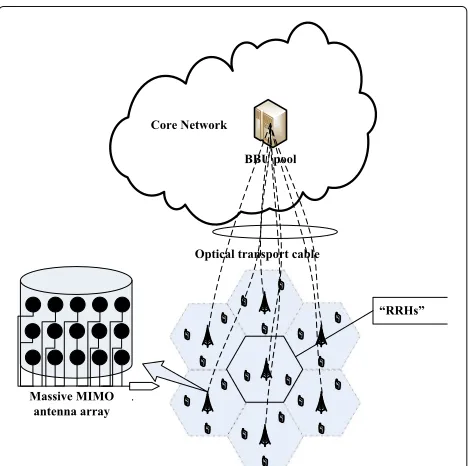
Typically, C-RAN consists of baseband unit (BBU), RRHs, and high bandwidth low latency connections between the RRHs and BBU [13]. The benefits of C-RAN reside in its joint information processing and resource scheduling, which can be executed via the virtual base station (VBS) that connects with a general purpose platform (GPP) server.
Consequently, an example of the proposed system model can be shown in Fig. 1. In addition, while uni-formly scheduling several BSs’ resources, the “BBU” sections are separated into two parts: plant and control center, switcher connected to the core network. Fur-thermore, unlike several BBUs within one C-RAN clus-ter, here the system is further modified by connecting all of its connecting BSs to one “BBU” for uniformly resource scheduling purpose. The benefit of this strat-egy is stated by [2]. Here, the latency issue is left for further study while adopting the CoMP-JP with cooper-ating cellular in line with the majority work of this, such as [17].
BBU pool
Optical transport cable
Massive MIMO antenna array
Core Network
“RRHs”
2.2 The transmission rate analysis
Take the hypothesis that there areKactive UEs that each of them associating withbactive antennas for its trans-mission. Suppose that all of the UE’s requests are routed back to the uniform “BBU” through backhaul links with CoMP-JP. Moreover, power of each antenna is equally assumed to be Pa. By ignoring the cluster inter-ferences from the neighboring BS area [2, 11], further take hk, a 1 × M complex-Gaussian vector with zero-mean-complex-Gaussian entries, and variance12 for each dimension, as the channel from BS to UE k[18]. While assuming component carrier (CC) bandwidth assigned to each UE isBCCswhere CC is sufficient enough forKUEs.
In line with study in [2, 11, 18], withK,Mgrowing large with a constant ratioM/K, by an equal power allocation, achievable rate of UEkcan be given by [2]
Rk=E
BCCslog2
1+ ρ
tr(HHH)−1
≥BCCslog2
⎛
⎝1+ ρ
EtrHHH−1
⎞ ⎠
a.s.
−→BCCslog2
1+ρM−K K
,
(1)
where ρ = Pk/Pnk, with Pnk the noise power for each
user k. Here the second step is obtained by employing the Jensen’s inequality, whereas the approximate equation by the third step is obtained in line with prior studies of [2, 10]. This is the “channel hardening” effect in mas-sive MIMO, which means that withK,Mgrowing large, the off-diagonalHHHeffects become increasing weaker compared with the diagonal matrix of H [19, 20]. The sum rate within each C-RAN under this assumption turns out to be the total transmission rate of the overall BS areas. In addition, for the sake of compactness, it is fur-ther assumed that the UE number is equal among different cellular areas. Thus, the sum rate, while denotingBas the total cellular number of this system, turns out to be
Rsum= B
i=1 K
j=1
Rki,j, (2)
whereRki,jis equal toRk. With this sum rate in hand, the left work is the power consumption analysis, which was addressed by the following sections.
2.3 The energy consumption analysis
Energy consumption of C-RAN, typically, can be sum-marized into the dynamic energy consumption plus the constant energy consumption parts. The dynamic energy consumption mainly comes from the transmission (for instance, antenna, RF chain, and circuit to serve the trans-mission) and coverage area maintaining [2]. In contrast,
the constant energy consumption mainly results from the machine room and other equipments, which seldom light is casted on in prior studies. Under this circumstance, total energy consumption follows [21]
Pclu(t)= B
i=1
pdyn,BSi +pfix,BSi , (3)
wherepdyn,BSb ,pfix,BSb yield the dynamic energy consump-tion of each BS area (to serve the UEs and maintain the BS coverage area) and constant energy consumption of each BS area. Additionally, the dynamic energy consumption can be further elaborated by
pdyn,BSb =
K
j=1
1
ηPkj +Pcj +PjRF+Pccj
. (4)
Here, Pkj is the transmission rate energy consump-tion (equal toPk, the allocated antenna energy power of UE k with rateRki,j). In addition,PRFj ,Pcj,Pjcc are the RF chain, circuit, and the allocated coverage area maintaining energy consumption, respectively. Furthermore,ηdenotes the power amplifier (PA) efficiency with value 0< η <1.
As discussed before, the goal of this paper is to explore the EE merits of this proposal while taking more compo-nents into consideration. In order to describe this com-prehensive EE with mathematics model, two lemmas are given beforehand.
Lemma.(lemma 3.1in [22]) only consider the downlink transmission while setting the power of uplink transmis-sion period to be zero1, the optimal power allocation for
an epocht isPkj > 0 for power on time period τon ⊆
(t(i−1),t(i)] (downlink), andPkj = 0 for the remaining time periodsτoff ⊆ (t(i−1),t(i)] (uplink). The follow-ing identities also hold: τon ∩τoff = φ, τon ∪τoff = (t(i−1),t(i)].
Proof.SeeLemma 3.1in [22].
Lemma.By assuming the arrive of UE request obeys a Poisson point process (PPP) distribution with meanμ
varianceσ2of all epoch time, andT = T
t=1(
ti−1,ti].
Opti-mal power allocation can be obtained while adding the optimal power allocation in all time intervals, and the per-formance of UEs obeys a PPP distribution with meanμ, variance σ2. In this case, UEs’ performance within the total time intervals obeys a PPP distribution with mean Tμ, varianceTσ2.
3 The energy efficiency model and its solution
The EE optimization model and its solution of this study are addressed in this section. As discussed before, EE is defined as the achievable sum rate divided by the con-sumed energy. Hence, in line with prior study [20], the global EE optimization problem of this modified sys-tem (within all time intervals of all BS areas), while integrated taking the antenna, RF chain, circuit, and dynamic and constant power into consideration, can be described as
transmission power, total BS power, the number of CC, the number of antenna, and the number of RF chain, respectively. Further,Nia,j,NiUE,j ,Nbsrf,totaldenote the number of antenna allocated to each UE, number of UE indica-tor, and the total number of RF chain within one clus-ter, respectively. Note that here C1, C2 specify that in one cluster, the total transmission power should be no greater than the allocated power, and the total cellular power consumption should be no greater than the total BS power, respectively. In addition, C3, C4, C6 denote that in one cluster, the number constraints of CC, antenna, as well as the power constraints, should be satisfied.
Whereas C5 yields the UE number cannot exceed the RF chain number. This is because of the assumption that one active RF chain could only serve one active UE, in line with the prior MIMO structure, for the sake of compactness.
The EE optimization problem, although, has been addressed so far and can be solved by the concave opti-mization method, but it will cost more resources and calculation time due to the constraint C3 comparing with the linear searching method. Thus, another purpose of this paper is to find an alternative method to sim-plify the processing. Fortunately, in line with prior study [21], it is noted that if Ck was taken as the used CCs of the previous UEs, a minimum CC selection method can be obtained beforehand, whereas Im(t) is defined as of CCs. For the left optimization problem, we dig more and find the followingCorollaryexisting.
Corollary. According toLemma 2, the binary value of power allocation Pki,j and its time distributionτon both obey the identically Poisson distribution in every time interval(t(i−1),t(i)]. While linearly adding every indi-vidual power allocation within each time interval, it turns out to be the optimal solution of the total time intervals. This can be proved as follows.
Proof. In τon time period, whenever there is a trans-mission request, power allocation is triggered with a constant value of Pki,j (proof of Lemma 1 in [22]). Oth-erwise, in τoff period, no power is allocated. This is
because τon andPik,j display the same performances like the active UEs’ existences with their on–off binary val-ues. Thus, it is clear that the binary values of τ,Pki,j are of the same distribution performances just like UEs.
this case, while removing the integration to the total time intervals, the problem can be further described as follows
Note that the purpose of C3 is to find the optimal CC solution under CC number constraint, which has less rela-tionship with the power allocation. In this case, it can be solved via an offline method. That is, whenever request coming, select the least CC number for its transmission under CC constraint in (7). The remaining part after this selection turns out to be a component selection and power allocation problem with respect to the achievable trans-mission rate. In addition, without loss of generality, it is further assumed that each antenna consumes the same power once activated, as well as the circuit, RF chain.
In addition, similar to Lemma 2, while adding up all users’ location performances within every BS areas, it is the UEs’ location performances of the whole cluster. Moreover, the PPP distribution of UE within one cluster, with large time range, can be taken as a sum of sepa-rate PPP distribution of each BS area. Whereas in each area, the UE displays the same PPP distribution but with a smaller range. Thus, the optimal solution can be obtained by optimizing the EE problem of one BS area within one time interval. Which is, the remaining problem can be decomposed as a optimization problem with
max
whereas the global optimization solution is the summa-rization of each of this single-time-interval-single-BS-area optimization problem. To this optimization problem, it is proved by Theorem 1 in [23] that, if we define a max-imum weighted solution with S∗ = max(Pkj,PRFj ) = K
k=1Rkj∗/(PkJ + PRFj )∗, and further suppose the prob-lem has an optimal solutionS∗. Optimal solution of the EE problem in (10), if any, should satisfy the following constraint toS∗if any. Note that RF chain power consumption has nothing to do with the achievable sum rate although it is needed for the transmission. Under this circumstance, while searching for the optimal solution, it will converge to zero. To avoid this, in line with [24], we assume that in each search step, the number of RF chain is equal to the number of antenna in order to satisfy the transmission requirement.
After this, the extreme point existence is verified by the Lagrange method as shown in (13) and (14). As we can see, it always has an extreme point on condition that (13) is equal to zero and (14) lower than zero. Thus, at least one optimal solution of our EE optimization problem exists. In addition, this optimal solution can be straightforward obtained while comparing all of those extreme points and keeping the one with best EE performance.
∂2maxPk j,PRFj
∂(Pjk)2 = ∂2K
j=1 Rk
j Pkj+PRFj
∂(Pkj)2 =
− K
j=1 BCCs
(M−K)2
ln2[KN0+Pkj(M−K)]2 +
M−K
ln2[KN0+Pjk(M−K)]
(Pkj +PRFj )2
− K
j=1
2BCCs
M−K
ln2[KN0+Pjk(M−K)]−
log2KN0+P
k j(M−K) KN0
Pjk+PjRF3
.
(14)
As all constraints are in linear functions now, one can use the linear searching method to obtain the opti-mal solution of (10) with constraints (11) plus an offline searching method of CC. That is, in each step, search the optimal solution with every possible combination of the constraints, compare them, and only keep the best one. As the linear constraints, one can obtain the optimal solution within a much shorter time. Whereas the searching can be achieved by IBM Cplex (refer to IBM ILOG CPLEX Opti-mization Studio V12.60 documents) or MATLAB-based linear programming (LP) [25].
4 Numerical analysis and results
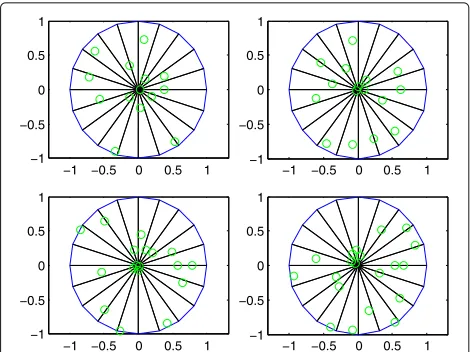
Here in the numerical analyses and simulation setups of this paper, the simulation parameters in line with [9, 26] are employed, which is shown in Table 1. In addition, in each BS area, it is assumed that the active UE number is 20 in one BS area. In this case, achievable sum rate of each cellular within one time interval is the active UE’s sum rate. In addition, the sum rate of the system clus-ter is the amount rate of each BS area within the total time intervals. Another, parts of the UE’s location distri-bution performance is shown in Fig. 2. Note that due to the limit space and tedious generation, here we only gave one figure to show this distribution as an example of our
Table 1Simulation components
Parameters Value
Antenna number per RRH 100
RRH number 10
Machine room 480 W
Number of UE per BS area 20
Mean transmission rate per UE 200 MHz
Circuit power of per RF chainPRF
j 160 mW
Constant circuit powerPc
j 160.8 W
PA efficiencyη 35%
Power of antennaPk
j 37 dBm
−1 −0.5 0 0.5 1 −1
−0.5 0 0.5 1
−1 −0.5 0 0.5 1 −1
−0.5 0 0.5 1
−1 −0.5 0 0.5 1 −1
−0.5 0 0.5 1
−1 −0.5 0 0.5 1 −1
−0.5 0 0.5 1
Fig. 2Location distribution of active UE in one cellular coverage area
simulation, whereas the number of active UEs is growing from 14 to 20. As shown in this figure, the green bubble yields the location of one active UE whereas the blue cir-cle is the coverage area edge. Thexandycoordinate axes denote the normalized range of the cellular area. Note that for easy discrimination, here one cell coverage circle area is divided into 20 parts for better display of the active UE’s position in this simulation. The reason to adopt the PPP distribution is that the location of active UEs ran-domly disperses in cluster area, which is similar to the UE performance in the real world.
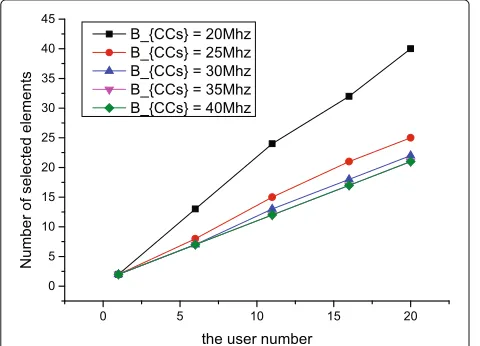
Additionally, we further randomly generate the trans-mission rate. In the simulation here, we evaluate the performance of component selection and EE performance in one cellular area. The randomly generated transmis-sion rate can be found in Table 2 with its simulation results in Figs. 3 and 4. Here, Fig. 3 yields the number of selected components and Fig. 4 is the EE performance. As the PPP distribution of the UE’s position within each cell and randomly generated transmission rate, the curve of EE performance in Fig. 4 goes up and down. That is because in each step, the randomly generated transmis-sion rate results in the up and down curves of the energy consumption, which in turn, the up and down curves of EE performance.
One can figure out from Fig. 3 that at first, the number of selected components decreases while CC increasing. Afterwards, CC has less effect to the component selection performance while arriving at the optimal one;Ckhere in this simulation. Thus on the condition that each pair of components consumes an equal power,Ckwill be the one with the least component number and CC value, 35 MHz here. This can be further confirmed in Fig. 4, whereBCCs
Table 2Value of transmission rate request
Number of UE Value (M/s) Number of UE Value (M/s)
1 64.873 11 180.217
2 317.714 12 33.529
3 124.486 13 91.591
4 211.413 14 365.335
5 66.260 15 60.951
6 240.793 16 330.327
7 105.189 17 215.337
8 261.632 18 398.454
9 275.686 19 31.270
10 299.261 20 177.071
increases whileBCCsincreases. Yet whenBCCsarrived at
Ck, simply increasing the CC has little effect to the EE per-formance. The bestBCCsisCkand the optimal solution of EE optimization problem is obtained while solving (10), by takingCkwith the value of 35 MHz.
By assuming one cluster consisting of 10 massive MIMO BSs, Figs. 5 and 6 are the component selection and EE performance of the optimized system model within one cluster. As shown, similar to Figs. 3 and 4, because of the random transmission rates, EE curves here go up and down. One can further confirm from these two figures that the optimalBCCsis 35 MHz.
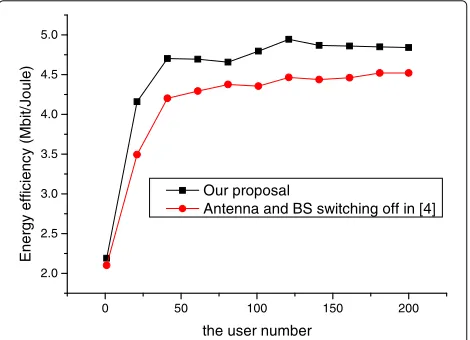
To further verify the validity of our proposal, EE per-formance of this proposal and the prior state-of-the-art proposal in [7] with BS and antenna selecting and switch-ing off scheme are further compared. The result can be found in Fig. 7. It is clear that our proposal can enhance the EE performance while taking more elements into con-sideration. That is, by the integrated proposal, one can
Fig. 3Component selection performance of our scheme, one cellular area
0 5 10 15 20
1.0 1.5 2.0 2.5 3.0 3.5 4.0 4.5 5.0
EE
per
for
mance
(Mbi
t/
J
oul
e)
the user number
B_{CCs} = 20Mhz B_{CCs} = 25Mhz B_{CCs} = 30Mhz B_{CCs} = 35Mhz B_{CCs} = 40Mhz
Fig. 4Energy efficiency performance of our scheme, one cellular area
select the optimal number of components for the trans-mission while switching off the unwanted ones. But in [7], the unwanted power consumptions of other components (for instance, RF chain, circuit) are still needed for the transmission. One can see from Fig. 7 that, although the EE performance is enhanced by our proposal, the other components (RF chain, electrons, etc.) have less effect to the EE performance comparing with the antennas because of the close gap between the two. Thus, the antenna power consumption is the dominating factor of the power con-sumptions, which in turn, the dominating factor of system EE performance.
5 Conclusions
In this paper, an optimized system model is proposed for economical deployment in outdoor environment and bet-ter adoption of the selecting/sleeping mechanism. Afbet-ter- After-wards, the system EE performance is modeled into a
0 50 100 150 200
0 100 200 300 400
Number
of
sel
ect
ed
el
ement
s
the user number B_{CCs} = 20Mhz B_{CCs} = 25Mhz B_{CCs} = 30Mhz B_{CCs} = 35Mhz B_{CCs} = 40Mhz
Fig. 6Energy efficiency performance of our proposal in one cluster
global optimization problem. Solution of this problem is obtained while summing up the solution of each BS cov-erage area within a single-time-interval-single-BS-area optimization problem. In addition, the single-time-interval-single-BS-area optimization problem is solved by a linear convex optimization problem plus an offline selection method. Numerical results manifest that the proposal here displays better EE performance compar-ing with the previous proposal, by further reduccompar-ing the reminder component power consumptions other than the antenna, RF chain, or other component alone. In addition, CC has great effect to the performance before reaching the optimal one and little influence after this. The numer-ical results further indicate that among the component power consumptions, antenna power consumption is the dominant one.
Antenna and BS switching off in [4]
Ener
Fig. 7Energy efficiency comparison between our proposal and proposal in [7]
Endnote
1In this paper, we try to solve the EE optimization
prob-lem in downlink, the uplink EE optimization although not considered here, but can be also obtained while setting the downlink power as zero, as discussed in the following sections.
Appendix
It is difficult to prove the lemma directly, but the proof could be done by some division and summarization meth-ods, i.e., to prove that the sum distribution Tt=1UEt of independent identically distributed Poisson distribu-tion of each time period UEt was a Poisson distribution. Whereas this can be confirmed by some linear operations. Which is, according to the basic property of expectation value and variance in statistics, expectation calculation of the independent identically distributed Poisson distribu-tion is a linear operadistribu-tion, and the variance is independent. Thus, it has
In addition, according to the deduction ofLemma 1, in each time period, the optimal power, if any, should be allo-cated with a constant value. Suppose this constant value isPk, wherePk > 0,t∈ (t(i−1),t(i)]. By assuming “EE” as the optimal solution operator, according to Jensen’s inequality, it follows
where lt denotes a time interval length. Furthermore, assume a suboptimal solution with value Pˆt existing, which of course, a constant value withPˆt > 0,t ∈(t(i−
As we can see, this resulted in a paradox. Thus,Pˆk must be equal toPk in order to get one and only one integral optimal result. In this case, the global optimal result of EE can be obtained by the sum optimal power in each independent time period. This completes the proof.
Acknowledgements
This work is supported by the EU-JAPAN co-funded project 5G Pagoda (European Commission H2020 program under grant agreement no. 723172); research and development on fundamental and utilization technologies for social big data, NICT, Japan; research on big data dynamic parallel cooperative processing function using autonomous distributed M2M network (MIC Scope Type II, Phase I, 2015).
This paper is based on the paper accepted by IEEE ICC 2016 with title “Integrating Energy Efficiency Mechanism with Components Selection for Massive MIMO Based C-RAN.”
Competing interests
The authors declare that they have no competing interests.
Author details
1GITS/GITI, Waseda University, Okubo, 3-14-8, 169-0074 Tokyo, Japan. 2Department of Electrical Engineering, Princeton University, Princeton 08540,
NJ, USA.3Instituto de Telecomunicações, 3810-193 Aveiro, Portugal.
Received: 22 April 2016 Accepted: 22 November 2016
References
1. Q Wu, M Tao, WK Ng, W Chen, R Schober, Energy-efficient resource allocation for wireless powered communication networks. IEEE Trans. Wireless Commun.15(3), 2312–2327 (2016)
2. D Zhang, S Mumtaz, Z Zhou, T Sato, inIEEE ICC. Integrating energy efficiency mechanism with components selection for massive MIMO based C-RAN, (Kuara Lumpur, Malaysia, 2016)
3. J Gong, S Zhou, Z Niu, Optimal power allocation for energy harvesting and power grid coexisting wireless communication systems. EEE Trans. Commun.61(7), 3040–3049 (2013)
4. Z Chang, J Gong, Y Li, Z Zhou, T Ristaniemi, G Shi, Z Han, Z Niu, Energy Efficient Resource Allocation for Wireless Power Transfer Enabled Collaborative Mobile Clouds. IEEE Journal on Selected Areas in Communications.PP(99) (2016)
5. Z Niu, Y Wu, J Gong, Z Yang, Cell zooming for cost efficient green cellular networks. IEEE Commun. Mag.48(11), 74–79 (2010)
6. L Thiele, T Wirth, M Schellmann, Y Hadisusanto, V Jungnickel, inIEEE ICC Workshops. Mu-mimo with localized downlink base station cooperation and downtilted antennas, (2009), pp. 1–5
7. Z Zhou, M Dong, K Ota, C Xu, Energy-efficient matching for resource allocation in D2D enabled cellular networks. IEEE Trans. Veh. Tech.PP(99), 1–12 (2016)
8. S ZHANG, Y WU, S Zhou, Z Niu, Traffic-aware network planning and green operation with bs sleeping and cell zooming. IEICE Trans. Commun. E97-B(11), 2118–2126 (2014)
9. X Zhang, S Zhou, Z Niu, X Lin, inIEEE WCNC. An energy-efficient user scheduling scheme for multiuser MIMO systems with RF chain sleeping, (2013), pp. 169–174
10. M Ju, HK Song, IM Kim, Joint relay-and-antenna selection in multi-antenna relay networks. IEEE Trans. Commun.58(12), 3417–3422 (2010)
11. D Zhang, K Yu, Z Zhou, T Sato, inIEEE ISADS. Energy efficiency scheme with cellular partition zooming for massive MIMO systems, (2015), pp. 266–271 12. E Bjornson, L Sanguinetti, J Hoydis, M Debbah, Optimal design of
energy-efficient multi-user mimo systems: is massive MIMO the answer? IEEE Trans.Wireless Commun.14(6), 3059–3075 (2015)
13. China Mobile, C-RAN, The Road Towards Green RAN. (2014). http://labs. chinamobile.com/cran/wp-content/uploads/CRAN_white_paper_v2_5_ EN.pdf
14. I Alyafawi, E Schiller, T Braun, D Dimitrova, A Gomes, N Nikaein, inIEEE ICC. Critical issues of centralized and cloudified LTE-FDD radio access networks, (2015), pp. 5523–5528
15. KM Saidul Huq, S Mumtaz, J Bachmatiuk, J Rodriguez, X Wang, RL Aguiar, Green HetNet comp: energy efficiency analysis and optimization. IEEE Trans. Veh. Technol.64(10), 4670–4683 (2015)
16. S Zhou, T Zhao, Z Niu, Software-defined hyper-cellular architecture for green and elastic wireless access. IEEE Commun. Mag.54(1), 12–19 (2016) 17. J Xu, L Duan, R Zhang, Cost-aware green cellular networks with energy
and communication cooperation. IEEE Commun. Mag.53(5), 257–263 (2015)
18. M Jung, T Kim, K Min, Y Kim, J Lee, S Choi, inIEEE VTC. Asymptotic distribution of system capacity in multiuser MIMO systems with large number of antennas, (2013), pp. 1–5
19. F Rusek, D Persson, BK Lau, EG Larsson, TL Marzetta, O Edfors, F Tufvesson, Scaling up MIMO: opportunities and challenges with very large arrays. IEEE Signal Processing Mag.30(1), 40–60 (2013)
20. TL Narasimhan, A Chockalingam, Channel hardening-exploiting message passing (CHEMP) receiver in large-scale MIMO systems. IEEE J. Sel. Topics Signal Process.8(5), 847–860 (2014)
21. H Chen, Y Jiang, J Xu, H Hu, Energy-efficient coordinated scheduling mechanism for cellular communication systems with multiple component carriers. IEEE J. Sel. Areas Commun.31(5), 959–968 (2013) 22. J Xu, R Zhang, Throughput optimal policies for energy harvesting wireless
transmitters with non-ideal circuit power. IEEE J. Sel. Areas Commun. 32(2), 322–332 (2014)
23. Z Zhou, S Zhou, J Gong, Z Niu, inIEEE GLOBECOM. Energy-efficient antenna selection and power allocation for large-scale multiple antenna systems with hybrid energy supply, (2014), pp. 2574–2579
24. X Chen, X Wang, X Chen, Energy-efficient optimization for wireless information and power transfer in large-scale MIMO systems employing energy beamforming. IEEE Wireless Commun. Lett.2(6), 667–670 (2013) 25. OLM MC Ferris, SJ Wright. Linear Programming with MATLAB (SIAM,
Philadelphia, 2007)
26. D Zhu, M Lei, inCHINACOM. Traffic adaptation and energy saving potential of centralized radio access networks with coordinated resource allocation and consolidation, (2013), pp. 587–593
Submit your manuscript to a
journal and benefi t from:
7Convenient online submission
7 Rigorous peer review
7Immediate publication on acceptance
7 Open access: articles freely available online
7High visibility within the fi eld
7 Retaining the copyright to your article