Joint Inference for Event Coreference Resolution
Jing Lu1 and Deepak Venugopal2 and Vibhav Gogate1 and Vincent Ng1
1Department of Computer Science, The University of Texas at Dallas, Richardson, TX 75080 2Department of Computer Science, The University of Memphis, Memphis, TN 38152
[email protected],[email protected], {vgogate,vince}@hlt.utdallas.edu
Abstract
Event coreference resolution is a challenging problem since it relies on several components of the information extraction pipeline that typically yield noisy outputs. We hypothesize that exploiting the inter-dependencies between these components can significantly improve the performance of an event coreference resolver, and subsequently propose a novel joint inference based event coreference resolver using Markov Logic Networks (MLNs). However, the rich features that are important for this task are typically very hard to explicitly encode as MLN formulas since they significantly increase the size of the MLN, thereby making joint inference and learning infeasible. To address this problem, we propose a novel solution where we implicitly encode rich features into our model by augmenting the MLN distribution with low dimensional unit clauses. Our approach achieves state-of-the-art results on two standard evaluation corpora.
1 Introduction
Within-document event coreference resolution is the task of determining which event mentions in a text refer to the same real-world event. Event coreference is arguably more challenging and less studied than entity coreference. The challenge stems in part from the fact that an event coreference resolver typically lies towards the end of the standard information extraction (IE) pipeline, assuming as input the noisy outputs of its upstream components. Specifically, a standard event coreference resolver takes as input the extracted event triggers, their arguments, and the entity coreference information, and aggregates this information through rules to resolve coreferent event mentions. Each component of this pipeline can introduce errors that naturally propagate to the event coreference resolver, thereby significantly affecting its performance. Further, the aforementioned pipeline architecture also fails to exploit inter-dependencies between the various components that can provide valuable insights to the resolver.
In light of these weaknesses, we propose a novel approach to within-document event coreference resolution based on Markov Logic Networks (MLNs) (Domingos and Lowd, 2009). In our approach, we jointly perform four key tasks in the IE pipeline: trigger identification and subtyping, argument identification and role determination, entity coreference resolution, and event coreference resolution. To our knowledge, this is the first attempt to design an MLN for event coreference resolution. MLNs are particularly well-suited for modelingjoint inferencetasks in natural language processing (NLP) due to the inherent relational structure and uncertainty typically associated with challenging NLP problems.
A major obstacle to the successful application of MLNs to NLP tasks is the high computational complexity of probabilistic inference and learning algorithms. The MLNs used in NLP are so large that even linear time inference algorithms are computationally infeasible. For instance, the rich sets of features that are typically used to solve the four tasks in the IE pipeline for event coreference, are ill-suited for modeling as explicit MLN formulas, since they will yield a large MLN having millions of features. Therefore, a major contribution of our work lies in the proposal of a novel hybrid approach where we embed such features as weighted unit clauses in a low-dimensional space, and then integrate these clauses with the rest of the MLN formulas during inference. Since this idea is generally applicable to modeling NLP tasks using MLNs, we believe that our work will be of interest to other NLP researchers as well.
This work is licensed under a Creative Commons Attribution 4.0 International License. License details: http://
Georges Cipriani[P erson], a former militant of the French far-left group Action Directe, {left}ev1 the prison[Origin]
in Ensisheim in northern France on parole on Wednesday[T ime]. He[P erson] {left}ev2 Ensisheim[Origin] in a
police vehicle[Instrument]bound for an open prison near Strasbourg.
Table 1: Event coreference resolution example.
We evaluate our approach on corpora involving two languages, the new KBP 2015 English corpus and the Chinese portion of the ACE 2005 corpus. On both corpora, our approach performs significantly better than the baseline pipeline-based resolver. In particular, on the KBP corpus, we achieve the best result reported to date surpassing the previous best result by around 0.43 percentage points in average F1-score.
2 Definitions and Corpora 2.1 Definitions
We employ the following definitions in our discussion of event extraction and coreference:
• Anevent mentionis an explicit occurrence of an event consisting of a textual trigger, arguments or participants (if any), and the event type/subtype.
• Anevent triggeris a string of text that most clearly expresses the occurrence of event, usually a word or a multi-word phrase
• Anevent argumentis an argument filler that plays a certain role in an event.
• Anevent coreference chain(a.k.a. anevent hopper) is a group of event mentions that refer to the same real-world event. They must have the same event (sub)type.
To understand these definitions, consider first the example shown in Table 1, which contains two event mentions,ev1andev2. Here,leftis the trigger for bothev1andev2with subtype Movement.Transport-Person.ev1has three arguments,Georges Cipriani,prison, andWednesdaywith rolesPerson,Origin, andTimerespectively. ev2also has three arguments,HeandEnsisheim, andpolice vehiclewith roles Person,Origin, andInstrumentrespectively.
2.2 Corpora
We employ two text corpora in two languages for evaluation. TheEnglishcorpus was used in the Event Nugget Detection and Coreference task in the TAC KBP 2015 Event Track (henceforth the KBP 2015 corpus). This corpus is composed of two types of documents, newswire documents and discussion forum documents. The training set consists of 158 documents with 6538 event mentions distributed over 3335 event coreference chains, and the test set consists of 202 documents with 6438 event mentions distributed over 4125 event coreference chains. TheChinesecorpus is the Chinese portion of the ACE 2005 training corpus. This corpus is composed of documents taken from six sources, and consists of 633 documents with 3333 event mentions distributed over 2521 event coreference chains. Note that ACE and KBP employ slightly different event ontologies: ACE defines 33 event subtypes and KBP defines 38 event subtypes, among which 31 subtypes are shared by both ontologies.
2.3 Key Differences between ACE and KBP
While both ACE and KBP rely on the aforementioned definitions, the guidelines they employ when annotating triggers and event coreference chains are slightly different. Below we highlight the differences that are relevant to our discussion.1
First, there are slight differences w.r.t. the annotation of triggers. ACE only allows single-word triggers, whereas KBP additionally allows multi-word triggers (e.g.,laid off). Also, each word in ACE may trigger at most one event mention, whereas each (multi-)word in KBP may trigger multiple event mentions (e.g., murdercan trigger two event mentions with subtypes Life.Die and Conflict.Attack).
creativecommons.org/licenses/by/4.0/
1For detailed definitions, seehttp://cairo.lti.cs.cmu.edu/kbp/2015/event/annotationandhttp:
Second, KBP adopts a more relaxed definition of event coreference than ACE. Specifically, KBP requires that two event mentions be coreferent as long as theyintuitivelyrefer to the same real-world event. In our running example,ev1andev2are coreferent according to KBP because they both refer to the same event of Cipriani leaving the prison. ACE, on the other hand,additionallyrequires that the correspondingargumentsin the two event mentions be coreferent. In the example,ev1andev2arenot coreferent according to ACE because theirOriginarguments are not coreferent (one Origin argument involves a prison and the other involves the city Ensisheim). Note that determining whether two entity mentions are coreferent is the task of entity coreference. Like event mentions, entity mentions have corpus-specificentity types.
3 Background
In this section, we give a brief overview of MLNs and discuss related work in event coreference resolution. 3.1 Markov Logic Networks
Formally, an MLNMis a set of pairs(fi, θi)wherefiis a formula in first-order logic andθiis a real number. Given a set of constants, an MLN represents a ground Markov network, in which we have one binary random variable for each possible ground atom and one propositional feature for each possible grounding of each first-order formula. The weight associated with the feature is the weight attached to the corresponding formula. The ground Markov network represents the following probability distribution:
PM(ω) = Z1 exp
X
fi
θiNfi(ω)
(1)
whereNfi(ω)is the number of groundings offi that evaluate to True given a worldω(an assignment
of{0,1}to all ground atoms). The use of first-order logic enables the user to succinctly represent prior, relational knowledge about the application domain, while the weights help model uncertainty in the truth of the first-order logic sentences.
3.2 Related Work
Existing within-document English event coreference resolvers have been evaluated on different corpora, such as MUC (e.g., Humphreys et al. (1997)), ACE (e.g., Ahn (2006), McConky et al. (2012), Chen and Ji (2009), S. and Arock (2012)), OntoNotes (e.g., Chen et al. (2011)) the (not publicly-available) Intelligence Community (IC) corpus (e.g., Cybulska and Vossen (2012), Araki et al. (2014)); the ECB corpus (e.g., Bejan and Harabagiu (2010; 2014), Lee et al. (2012)) and its extension, ECB+ (e.g.,Yang et al. (2015)); and ProcessBank (e.g., Araki and Mitamura (2015)). The newest event coreference corpus is the one used in the KBP 2015 Event Nugget Detection and Coreference shared task, in which the best performers are RPI’s system (Hong et al., 2015), LCC’s system (Monahan et al., 2015), and UI-CCG’s system (Sammons et al., 2015). Among these corpora, ACE is the only one that is additionally composed of event coreference-annotated Chinese documents. It has been used to train SinoCoreferencer (Chen and Ng, 2014), a publicly-available Chinese event coreference resolver. Not all such corpora were carefully annotated: as Liu et al. (2014) pointed out, OntoNotes and ECB have only been partially annotated with event coreference links, for instance.
4 Baseline System
Our pipeline-based baseline system has five steps:
Step 1: Entity extraction. Our entity extraction model jointly identifies the entity mentions and their entity types. We train this model using CRF++2, treating each sentence as a word sequence. Specifically,
we create one instance for each wordwand assign it a class label that indicates whether it begins an entity mention with type tj (B-tj), is inside an entity mention with type tj(I-tj), or is outside an entity mention
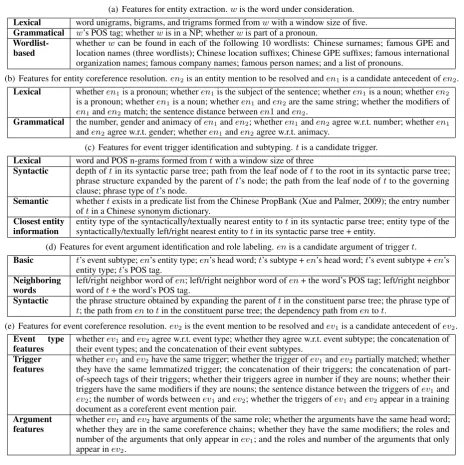
(O). The features used to represent each instance for training the English CRF and the Chinese CRF are shown in Tables 2(a) and 3(a), respectively.
Step 2: Entity coreference resolution. Our entity coreference classifier is a pairwise classifier that determines whether two entity mentions are coreferent or not. To train this classifier, we employ SVMlight
(Joachims, 1999), creating training instances using Soon et al.’s (2001) training instance creation method. Each training instance represents two entity mentions in each training document. The class value of a training instance is either positive or negative, depending on whether the two entity mentions are coreferent in the associated text. The features used to represent each instance for training the entity coreference classifiers for English and Chinese are shown in Tables 2(b) and 3(b), respectively.
After training, the resulting classifier can be used to classify each pair of entity mentions extracted in Step 1 as coreferent or not. We select as the antecedent of an entity mentionemthe closest preceding mention that is classified as coreferent withem.
Step 3: Trigger identification and subtyping. Since ACE allows only single-word triggers, our SVM-based Chinese trigger classifier takes as input a candidate triggerword(i.e., a word that survives Li et al.’s (2012) filtering rules) and outputs its event subtype (if it is a true trigger) orNone(if it is not a trigger). In essence, it jointly (1) identifies event trigger words and (2) assigns a subtype to each identified trigger. To train this classifier, we create one training instance for each wordwiin each training document. If the word does not correspond to a trigger, the class label of the corresponding instance isNone. Otherwise, the class label is the subtype of the trigger. The features used to represent each instance for training this classifier are shown in Table 3(c).
Because KBP additionally allows multi-word triggers, we recast the task of identifying English triggers as a sequence labeling task, where we train models using CRF++. Recall that since each (multi-)word may trigger multiple event mentions having different (sub)types, we train one CRF for each type. Specifically, to train the CRF for type tj, we create one instance for each word wi, assigning it a class label that
indicates whether it begins a trigger with subtype sjk (B-sjk), is inside a trigger with subtype sjk (I-sjk),
begins a trigger with other types (B-tm6=j), is inside a trigger with other types (I-tm6=j) or is outside a
trigger (O). The features used to represent each instance for training this CRF are shown in Table 2(c). To improve the recall of event trigger detection, we augment the CRF output with heuristically extracted triggers. Specifically, we first construct a wordlist containing triggers that appear infrequently (less than 10 times) in the training data and do not belong more than one subtype according to the training data. Then, we extract any word as a trigger with the corresponding subtype as long as it appears in the wordlist. Step 4: Argument identification and role labeling. Our argument identifier and role labeler is a classifier trained using SVMlightthat jointly learns the tasks of (1) identifying the true arguments of an
event mention and (2) assigning a role to each of its true arguments. To train this classifier, we create the training instances by pairing each true event mentionem(i.e., event mention consisting of a true trigger) with each ofem’s candidate event arguments, considering an entity mention extracted in Step 1 a candidate argument ofemif it appears in the same sentence asem. If the candidate argument is indeed a true argument ofem, the class label of the training instance is the argument’s role. Otherwise, its class label isNone. The features used to represent each instance for training the English classifier and the Chinese classifier are shown in Tables 2(d) and 3(d), respectively.
After training, we can apply this classifier to classify test instances. To create test instances, we pair eachcandidatetrigger (extracted in Step 3) with each of its candidate event arguments.
Step 5: Event coreference resolution. The event coreference classifier is a pairwise classifier that determines whether two event mentions are coreferent. To train this classifier, we use SVMlight, creating
training instances using Soon et al.’s (2001) training instance creation method. The features used to represent each instance for training the event coreference classifier for English and Chinese are shown in Tables 2(e) and 3(e), respectively.
(a) Features for entity extraction.wis the word under consideration. Lexical word unigrams, bigrams, and trigrams formed fromwwith a window size of five.
Grammatical w’s part-of-speech (POS) tag; whetherwis part of a NP; whetherwis part of a pronoun, whetherwis capitalized.
Semantic the WordNet synset id ofw; the WordNet synset ids ofw’s hypernym, its parent, and its grandparent. (b) Features for entity coreference resolution.en2is the entity mention to be resolved anden1is a candidate antecedent ofen2.
Lexical whetheren1is a pronoun; whetheren1is the subject of the sentence; whetheren1is a noun; whetheren2
is a pronoun; whetheren1is a noun; whetheren1anden2have the exactly the same string; whether the
modifiers ofen1anden2match; the sentence distance between the strings ofen1anden2.
Grammatical the number, gender and animacy ofen1anden2; whetheren1anden2agree w.r.t. number; whetheren1
anden2agree w.r.t. gender; whetheren1anden2agree w.r.t. animacy.
(c) Features for event trigger identification and subtyping.tis the candidate trigger.
Lexical t’s POS tag, lemmatized and unlemmatized word unigrams, word bigrams, and word trigrams formed fromtwith a window size of five.
Syntactic depth oftin its syntactic parse tree; path from the leaf node oftto the root in its syntactic parse tree; phrase structure expanded by the parent oft’s node; phrase type oft’s node.
Semantic WordNet synset id oft; WordNet synset ids oft’s hypernym, its parent, and its grandparent. (d) Features for event argument identification and role labeling.enis a candidate argument of triggert. Basic t’s event subtype;en’s entity type;en’s head word; event subtype + head word; event subtype + entity
type;t’s POS tag. Neighboring
words left/right neighbor word ofofen+ the word’s POS. en; left/right neighbor word ofen+ the word’s POS; left/right neighbor word Syntactic the phrase structure obtained by expanding the parent oftin the constituent parse tree; the phrase type of
t; the path fromentotin the constituent parse tree; the dependency path fromentot.
(e) Features for event coreference resolution.ev2is the event mention to be resolved andev1is a candidate antecedent ofev2.
Event type
features whethertheir event types; and the concatenation of their event subtypes.ev1andev2agree w.r.t. event type; whether they agree w.r.t. event subtype; the concatenation of Trigger
features whetherthe triggers ofev1andevev1 2andhave the same trigger; whether they have the same lemmatized trigger; whetherev2 or the hypernyms of these triggers are in the same WordNet synset; the
concatenation of their triggers; the concatenation of POS tags of their triggers; whether their triggers agree in number if they are nouns; whether their triggers have the same modifiers and they are in the same entity coreference chain if they are nouns; the sentence distance between the triggers ofev1andev2; whether
the triggers ofev1andev2appear in a training document as a coreferent event mention pair; whether the
triggers ofev1andev2appear in the first sentence and headline if this is a newswire document; whether
the sentence containing the the triggers ofev1andev2are identical if this is a discussion forum document.
Argument
features whetherwhether they are in the same coreference chains; whether they have the same modifiers; the roles andev1andev2have arguments with the same role; whether the arguments have the same head word; number of the arguments that only appear inev1; and the roles and number of the arguments that only
appear inev2.
Table 2: Features used in the English baseline system. POS tags, constituent parses and dependency parses are provided by CoreNLP (Manning et al., 2014). For all uses of WordNet (Fellbaum, 1998), only the first synset is used.
5 Joint Model
In this section, we describe our MLN-based joint model for event coreference resolution.
5.1 MLN Structure
Figure 1 shows our proposed MLN for event coreference resolution. It has five predicates subdivided into three categories: query, hidden and evidence.
ThequerypredicateEventCoref(d,t1,t2) is true when two event mentionst1 andt2 in document
dare coreferent. The hidden predicates are those that cannot be directly observed in the data. Our model contains three hidden predicates: (1)Trigger(d,t,p) is true when mentiontin documentdhas event/trigger subtypep. A special type called “None” indicates thattdoes not contain a trigger. (2) Argument(d,t,a,r) asserts that entity mentionais an argument of event mentiontin documentdand its role isr. Again, we include a special role called “None”, which indicates that the entity mention is not an argument of the event mention. The!symbol in the predicate definition indicates that every entity mention must take one and only one argument role. (3)EntityCoref(d,a1,a2) is true when entity mentions
(a) Features for entity extraction.wis the word under consideration. Lexical word unigrams, bigrams, and trigrams formed fromwwith a window size of five. Grammatical w’s POS tag; whetherwis in a NP; whetherwis part of a pronoun.
Wordlist-based whetherlocation names (three wordlists); Chinese location suffixes; Chinese GPE suffixes; famous internationalwcan be found in each of the following 10 wordlists: Chinese surnames; famous GPE and organization names; famous company names; famous person names; and a list of pronouns.
(b) Features for entity coreference resolution.en2is an entity mention to be resolved anden1is a candidate antecedent ofen2.
Lexical whetheren1is a pronoun; whetheren1is the subject of the sentence; whetheren1is a noun; whetheren2
is a pronoun; whetheren1is a noun; whetheren1anden2are the same string; whether the modifiers of
en1anden2match; the sentence distance betweenen1anden2.
Grammatical the number, gender and animacy ofen1anden2; whetheren1anden2agree w.r.t. number; whetheren1
anden2agree w.r.t. gender; whetheren1anden2agree w.r.t. animacy.
(c) Features for event trigger identification and subtyping.tis a candidate trigger. Lexical word and POS n-grams formed fromtwith a window size of three
Syntactic depth oftin its syntactic parse tree; path from the leaf node oftto the root in its syntactic parse tree; phrase structure expanded by the parent oft’s node; the path from the leaf node oftto the governing clause; phrase type oft’s node.
Semantic whethertexists in a predicate list from the Chinese PropBank (Xue and Palmer, 2009); the entry number oftin a Chinese synonym dictionary.
Closest entity
information entity type of the syntactically/textually nearest entity tosyntactically/textually left/right nearest entity totin its syntactic parse tree + entity.tin its syntactic parse tree; entity type of the (d) Features for event argument identification and role labeling.enis a candidate argument of triggert. Basic t’s event subtype;en’s entity type;en’s head word;t’s subtype +en’s head word;t’s event subtype +en’s
entity type;t’s POS tag. Neighboring
words word ofleft/right neighbor word oft+ the word’s POS tag.en; left/right neighbor word ofen+ the word’s POS tag; left/right neighbor Syntactic the phrase structure obtained by expanding the parent oftin the constituent parse tree; the phrase type of
t; the path fromentotin the constituent parse tree; the dependency path fromentot.
(e) Features for event coreference resolution.ev2is the event mention to be resolved andev1is a candidate antecedent ofev2.
Event type
features whethertheir event types; and the concatenation of their event subtypes.ev1andev2agree w.r.t. event type; whether they agree w.r.t. event subtype; the concatenation of Trigger
features whetherthey have the same lemmatized trigger; the concatenation of their triggers; the concatenation of part-ev1andev2have the same trigger; whether the trigger ofev1andev2partially matched; whether of-speech tags of their triggers; whether their triggers agree in number if they are nouns; whether their triggers have the same modifiers if they are nouns; the sentence distance between the triggers ofev1and
ev2; the number of words betweenev1andev2; whether the triggers ofev1andev2appear in a training
document as a coreferent event mention pair. Argument
features whetherwhether they are in the same coreference chains; whether they have the same modifiers; the roles andev1andev2have arguments of the same role; whether the arguments have the same head word; number of the arguments that only appear inev1; and the roles and number of the arguments that only
[image:6.595.67.532.57.523.2]appear inev2.
Table 3: Features used in the Chinese baseline system. POS tags, constituent parses, and dependency parses are provided by CoreNLP (Manning et al., 2014). A detailed description of the wordlists used in the wordlist-based features can be found in Chen and Ng (2016). The Chinese synonym dictionary is HIT-SCIR’s Tongyici cilin (extended).3
that can be directly observed in the data. In our MLN, we assume that we only observe the words; the predicateWord(d,t,w) is true when mentiontin documentdequals wordw.
The MLN formulas are of two types. The first six formulas have infinite weight, which means that they are hard formulas and must always be satisfied. The last two formulas are soft, and their weights will be learned from the data. All logical variables in our formulas are universally quantified and therefore for brevity, we do not use them in the formulas. Formula 1 encodes the hard constraint that if two event mentions are coreferent, then they should share the same trigger subtype. Formula 2 specifies the hard constraint that if event mentions are coreferent, then their triggers subtypes cannot be “None.” Formulas 3−6, all of which are hard formulas, specify the commutative and transitive properties of coreferent event and entity mentions. Formula 7, which is a soft formula, specifies the following dependency between coreferent entity mentions and coreferent event mentions: for two event mentionst1
andt2having the same trigger subtype, if there exists an argument rolerthat is filled by argumenta1int1
EventCoref(d,t1,t2) (a) Query
EntityCoref(d,a1,a2) Trigger(d,t,type!) Argument(d,t,a,role!)
(b) Hidden
Word(d,t,word) (c) Evidence
1. Trigger(d,t1,p)∧EventCoref(d,t1,t2)∧p6=None⇒ Trigger(d,t2,p) 2. EventCoref(d,t1,t2)⇒(¬Trigger(d,t1,None)∧ ¬Trigger(d,t1,None)) 3. EventCoref(d,t1,t2)⇒EventCoref(d,t2,t1)
4. EventCoref(d,t1,t2)∧EventCoref(d,t2,t3)⇒EventCoref(d,t3,t1) 5. EntityCoref(d,a1,a2)⇒EntityCoref(d,a2,a1)
6. EntityCoref(d,a1,a2)∧EntityCoref(d,a2,a3)⇒EntityCoref(d,a3,a1)
7. Trigger(d,t1,p)∧Trigger(d,t2,p)∧Argument(d,t1,a1,r)∧Argument(d,t2,a2,r)∧
¬EntityCoref(d,a1,a2)∧p6=None ∧r6=None ⇒ ¬EventCoref(d,t1,t2) 8. Word(d,t1,+w1) ∧ Word(d,t2,+w2) ∧ Trigger(d,t1,+p1) ∧ Trigger(d,t2,+p2) ⇒
EventCoref(d,t1,t2)
[image:7.595.109.498.63.331.2](d) Joint Formulas
Figure 1: MLN structure.
and bya2int2, thent1andt2are not event coreferent ifa1 anda2are not entity coreferent.4 Formula 8,
which is also a soft formula, encodes the dependency between words in the text, trigger subtypes and event coreference. The+sign in this formula indicates that for every grounding of the variables marked by the+sign, we use a different weight for the soft formula.
5.2 Augmenting the MLN Distribution
Notice that the MLN shown in Figure 1 does not model the features used in the baseline systems. These features typically have high dimensionality and encoding them directly in the MLN is quite inefficient. For example, describing a trigram as an MLN formula results ind3ground formulas, wheredis the number
of words in our vocabulary. Therefore, the ground Markov network of an MLN that explicitly models all such high dimensional features would be extremely large and infeasible for inference. To address this issue, we implicitly encode the high-dimensional features by embedding them as weighted unit clauses, one for each grounding of the hidden and query predicates. Specifically, for each hidden/query ground atomXi, we derive a weightφ(Xi)using the baseline system. This weight is computed as the distance from the hyperplane for the SVM-based classifiers and as a probability value for the CRF-based classifiers in the baseline system. We normalize each weight between the interval [−1,1]. The modified MLN distribution incorporating the new unit clauses is given by
PM0(ω)∝exp
X
fi
θiNfi(ω)
Φ(ω) (2)
whereωis a world (assignment on every ground atom) andΦ(ω)acts as a prior on the set of hidden (H) and query (Y) ground atoms in the original MLN and is given by,
Φ(ω) = exp X
X∈H∪Y
IX(ω)φ(X)
!
whereIX(ω)is an indicator function that is equal to 1 ifXis true inωand 0 otherwise.
5.3 Setting the Soft Formula Weights
During inference time, we dynamically set the weights for the soft formulas (Formulas 7 and 8 in Figure 1) as follows. For each ground soft formula where its evidence atoms do not make it false, we set its weight to be the sum of the (normalized) SVM weights or CRF probabilities corresponding to its hidden and query atoms. We then multiply the soft weights with hyper-parametersη1andη2for Formulas 7 and 8
respectively and tuneη1andη2using a grid search over the values{0.1, 0.25, 0.5, 0.75, 1.0}to optimize
the F1-score of event coreference resolution on the development set. 5.4 Inference
Given the prior-augmented MLN,M0, the key task we are interested in is finding a truth assignment to all
ground atoms of EventCorefthat has the maximum probability given evidence on all ground atoms of Word. The following standard MAP inference task, which computes a joint assignment to all hidden and query variables given evidence, can be used to find the desired truth assignment.
arg max
ω
exp
X
fi
θiNfi(ω)
Φ(ω)
(3)
Unfortunately, the optimization problem given above is NP-hard in general. Moreover, the number of possible worlds inM0 is extremely large and as a result naively searching over this large space (in order
to solve the optimization problem) is computationally infeasible. As a concrete example, for the KBP 15 training dataset, we have 50 million ground atoms.
Fortunately, we can exploit the structure of the MLN given in Figure 1 in order to scale up MAP infer-ence. In particular, the subset of ground atoms corresponding to two distinct documents are independent of each other. More formally, letXi andXjbe the subset of ground atoms corresponding to two documents,
sayDiandDjrespectively, thenXiis conditionally independent ofXj given evidence. Thus, givenD
documents in our corpus, the joint distribution represented by our MLN can be expressed as a product ofDdistributions. We can then perform inference independently over each such distribution, which greatly reduces the complexity of inference. Our inference procedure therefore follows an efficient, lazy, semi-lifted grounding strategy (Gogate and Domingos, 2011) that grounds the MLN for each document independently and solves Eq. (3) for each document separately using Gurobi (2013), a state-of-the-art integer linear programming solver.
6 Evaluation
6.1 Experimental Setup
We perform our evaluation on two corpora, the KBP 2015 English corpus and the Chinese portion of the ACE 2005 training corpus. For English, we train models on 128 of the training documents, tune parameters (the regularization parameters in SVM classifiers and the weights of the soft MLN formulas) on the remaining 30 training documents, and report results on the official test set.5 For Chinese, since
the ACE 2005 test set is not publicly available, we report five-fold cross validation results on the ACE 2005 training corpus. For each fold experiment, we employ three folds for classifier training, one fold for development (parameter tuning), and one fold for testing.
To evaluate event coreference performance on KBP, we follow the official KBP evaluation and employ four commonly-used scoring measures as implemented in version 1.7 of the official scorer provided by the KBP 2015 organizers, namely MUC (Vilain et al., 1995),B3(Bagga and Baldwin, 1998), CEAFe(Luo,
2005) and BLANC (Recasens and Hovy, 2011), as well as the unweighted average of their F-scores.6
5Since the KBP 2015 corpus was not annotated with event arguments and entity coreference links, we train our entity mention extractor, our entity coreference resolver, and our event argument identification and role classification model on two LDC corpora provided by the TAC KBP 2015 task organizers (LDC2015E29 and LDC2015E68), as permitted by the rules of the shared task.
Metric English/KBP 2015 Chinese/ACE 2005
Baseline MLNs Baseline MLNs
Prec Rec F1 Prec Rec F1 Prec Rec F1 Prec Rec F1
B3 53.48 39.21 45.20 50.27 41.63 45.54 38.21 37.93 37.66 36.87 42.54 39.50
CEAFe 42.33 38.54 40.35 47.53 33.48 39.29 40.28 37.76 38.98 41.02 41.19 41.10
MUC 50.52 29.13 36.96 47.07 38.21 42.18 40.02 40.27 40.14 39.37 44.70 41.86 BLANC 41.16 26.17 32.00 40.61 28.96 33.30 24.75 25.67 25.20 22.41 29.07 25.29
[image:9.595.77.524.61.147.2]Average = 38.64 Average = 40.08 CoNLL = 39.02 CoNLL = 40.82
Table 4: Results for event coreference resolution on KBP 2015 and ACE 2005.
English/KBP 2015 Chinese/ACE 2005
Baseline MLNs Baseline MLNs
Prec Rec F1 Prec Rec F1 Prec Rec F1 Prec Rec F1
65.05 51.43 57.45 67.97 50.51 57.95 67.08 56.44 61.30 66.39 57.37 61.55 Table 5: Results for event trigger identification and subtyping on KBP 2015 and ACE 2005.
To evaluate event coreference performance on ACE, we follow previous work on event coreference (e.g., Yang et al. (2015)) and employ the aforementioned four scoring measures as implemented in the latest version (v8) of the CoNLL scorer (Pradhan et al., 2014), as well as the CoNLL score, which is the unweighted average of the MUC,B3, and CEAF
eF-scores.7 To our knowledge, there is only one
difference between the implementations of the four scoring measures in the two scorers: while the CoNLL scorer considers an event mention correctly detected as long as it has an exact match with a gold event mention in terms of its left and right boundaries, the KBP 2015 scorer is stricter in that it considers an event mention correctly detected by additionally requiring that its event subtype be correctly determined.
6.2 Results and Discussion
The left half of Table 4 shows the results for English event coreference resolution on the KBP 2015 dataset. As can be seen, MLNs outperform the baseline system when evaluated on all but the CEAFemetrics.
W.r.t. the Average metric, MLNs achieve an F-score of 40.08, outperforming the baseline significantly by 1.44 points (pairedt-tests, p < 0.05). To our knowledge, this is the best result reported to date on this corpus, with the top system in the KBP 2015 shared task achieving an Average F-score of 39.65. In general, the MLN could detect more event coreference chains than the baseline system, as seen from its higher recall in all but the CEAFemetrics.8
The right half of Table 4 shows the results for event coreference resolution on the ACE 2005 Chinese corpus. As can be seen, MLNs outperform the baseline significantly by 1.8 points w.r.t. the CoNLL metric. In fact, MLNs achieve a higher score than the baseline w.r.t. each of the four scoring measures. Similar to what we observed on the KBP corpus, the consistently superior performance achieved by the MLN-based resolver can be attributed to its substantially higher recall accompanied by a slightly lower precision. In particular, since MUC is a link-based metric, the fact that the MLNs achieve a higher MUC recall on both datasets suggest that the MLNs are better at discovering event coreference links than the baseline.
One may argue that the MLNs maynotbe better than the baseline at discovering event coreference links: it may simply be the case that the joint inference process has allowed additional triggers to be extracted, which in turn allowed additional event coreference links to be established. To understand whether this is indeed the case, we compute the results for trigger identification and subtyping in Table 5. As can be seen, fewer English triggers are extracted after joint inference, whereas the reverse is true for Chinese. These results suggest that at least for English, the higher event coreference recall achieved by the MLNs is not attributable to better trigger identification and subtyping.
A closer examination of the outputs reveals that our resolver is comparatively better at extracting two types of coreference links that are traditionally considered difficult to extract. The first type involves triggers that are lexically different. For example, in the text segment “The former mayor of Detroit,
7The CoNLL scorer is available athttps://github.com/conll/reference-coreference-scorers. 8As is commonly known, CEAF
esometimes produces unintuitive scores. Specifically, the CEAFeF-score may drop as more
[image:9.595.97.493.181.225.2]Michigan was sentenced to 28 years in prison. . . Prosecutors asked for a minimum of 28 years for Kilpatrick, who resigned from the mayor’s office in 2008. . .”, the link between event mentions triggered byformerandresigned, both of which have type Personnel.End-position, is discovered by our resolver but not the baseline. The second type involves links between event mentions that are far from each other. 6.3 Error Analysis
To better understand how to improve our MLN-based resolver and to provide directions for future work, we conduct a qualitative analysis of its major sources of error in this subsection.
6.3.1 Two Major Types of Precision Error
Erroneous triggers. For both languages, our trigger classifier had difficulties with correctly classifying certain frequently-occurring words that are sometimes used as triggers and sometimes not. Specifically, the classifier misclassified many non-trigger instances of these words as triggers, which were subsequently used to establish coreference links by our resolver. A particularly interesting and challenging example involves the word “violent”. Consider two sentences that appear in the same document: “The violent arrest of Ahmed al-Alwani is likely to inflame tensions in Sunni-dominated Anbar” and “Iraq troops arrest leading Sunni MP in violent raid”. The first sentence contains two event mentions, one triggered byviolentwith type Conflict.Attack and the other triggered byarrestwith type Justice.Arrestjail. The second sentence, contains only one event mention: it is triggered byraidwith type Conflict.Attack and is coreferent withviolent. While our system successfully detects all three triggers, it also erroneously detectsviolentin the second sentence as a trigger. This error gets propagated to our event coreference resolver, which posits the two occurrences ofviolentas coreferent.
Failure to extract arguments. Recall that our argument classifier does not extract any argument of an event mention that does not appear in the same sentence as its trigger. This severely limits its ability to extract arguments and has caused many spurious event coreference links to be established. For instance, our resolver erroneously posits twoviolenceevents as coreferent: it does not know that the two events took place in different countries, as the argument classifier failed to extract their location arguments (one isHondurasand the other isVenezuela).
6.3.2 Two Major Types of Recall Error
Missing triggers. For both languages, the trigger classifier failed to identify trigger words/phrases that are unseen or rarely-occurring in the training data. As a result, many links cannot be established. Insufficient knowledge. Recall that our MLN-based resolver has achieved a higher recall than the baseline by doing a better job at establishing links between event mentions containing lexically different triggers. However, there are still many links between event mentions with lexically different triggers that our resolver fails to discover owing to the insufficient knowledge made available to it. This type of error is especially prominent on the Chinese corpus.
7 Conclusion
We proposed a novel joint inference based event coreference resolver using MLNs. Since encoding rich NLP features in MLNs is a challenging task, we encoded these features implicitly by adding weighted unit clauses to the MLN distribution. Results on an English corpus (KBP 2015) and a Chinese corpus (ACE 2005) show that our MLN based system achieved statistically significantly better performance than a pipeline-based resolver. Future work includes transferring our approach to other NLP tasks and exploring the possibility of incorporating active learning into our approach.
Acknowledgments
References
David Ahn. 2006. The stages of event extraction. InProceedings of the Workshop on Annotating and Reasoning
about Time and Events, pages 1–8.
Jun Araki and Teruko Mitamura. 2015. Joint event trigger identification and event coreference resolution with structured perceptron. In Proceedings of the 2015 Conference on Empirical Methods in Natural Language
Processing, pages 2074–2080.
Jun Araki, Zhengzhong Liu, Eduard Hovy, and Teruko Mitamura. 2014. Detecting subevent structure for event coreference resolution. In Proceedings of the Ninth International Conference on Language Resources and
Evaluation, pages 4553–4558.
Amit Bagga and Breck Baldwin. 1998. Algorithms for scoring coreference chains. InProceedings of the
Linguis-tic Coreference Workshop at The First International Conference on Language Resources and Evaluation, pages
563–566.
Cosmin Bejan and Sanda Harabagiu. 2010. Unsupervised event coreference resolution with rich linguistic features.
InProceedings of the 48th Annual Meeting of the Association for Computational Linguistics, pages 1412–1422.
Cosmin Adrian Bejan and Sanda Harabagiu. 2014. Unsupervised event coreference resolution. Computational
Linguistics, 40(2):311–347.
Zheng Chen and Heng Ji. 2009. Graph-based event coreference resolution. InProceedings of the 2009 Workshop
on Graph-based Methods for Natural Language Processing (TextGraphs-4), pages 54–57.
Chen Chen and Vincent Ng. 2014. SinoCoreferencer: An end-to-end Chinese event coreference resolver. In
Proceedings of the Ninth International Conference on Language Resources and Evaluation, pages 4532–4538.
Chen Chen and Vincent Ng. 2016. Joint inference over a lightly supervised information extraction pipeline: To-wards event coreference resolution for resource-scarce languages. InProceedings of the 30th AAAI Conference
on Artificial Intelligence, pages 2913–2920.
Bin Chen, Jian Su, Sinno Jialin Pan, and Chew Lim Tan. 2011. A unified event coreference resolution by in-tegrating multiple resolvers. InProceedings of the 4th International Joint Conference on Natural Language
Processing, pages 102–110.
Agata Cybulska and Piek Vossen. 2012. Using semantic relations to solve event coreference in text. In
Proceed-ings of the LREC Workshop on Semantic Relations-II Enhancing Resources and Applications (SemRel 2012),
pages 60–67.
Pedro Domingos and Daniel Lowd. 2009. Markov Logic: An Interface Layer for Artificial Intelligence. Morgan & Claypool, San Rafael, CA.
Christiane Fellbaum. 1998. WordNet: An Electronic Lexical Database. MIT Press, Cambridge, MA.
Vibhav Gogate and Pedro Domingos. 2011. Probabilistic theorem proving. InProceedings of the 27th Conference
on Uncertainty in Artificial Intelligence, pages 256–265.
Gurobi. 2013.Gurobi Optimizer Reference Manual. Gurobi Inc.
Yu Hong, Di Lu, Dian Yu, Xiaoman Pan, Xiaobin Wang, Yadong Chen, Lifu Huang, and Heng Ji. 2015. RPI BLENDER TAC-KBP2015 system description. InProceedings of the Eighth Text Analysis Conference (TAC
2015).
Kevin Humphreys, Robert Gaizauskas, and Saliha Azzam. 1997. Event coreference for information extraction. In
Proceedings of the Workshop on Operational Factors in Practical, Robust Anaphora Resolution for Unrestricted
Texts, pages 75–81.
Thorsten Joachims. 1999. Making large-scale SVM learning practical. In Bernhard Scholkopf and Alexander Smola, editors,Advances in Kernel Methods - Support Vector Learning, pages 44–56. MIT Press.
Heeyoung Lee, Marta Recasens, Angel Chang, Mihai Surdeanu, and Dan Jurafsky. 2012. Joint entity and event coreference resolution across documents. InProceedings of the 2012 Joint Conference on Empirical Methods
in Natural Language Processing and Computational Natural Language Learning, pages 489–500.
Peifeng Li, Guodong Zhou, Qiaoming Zhu, and Libin Hou. 2012. Employing compositional semantics and discourse consistency in chinese event extraction. InProceedings of the 2012 Joint Conference on Empirical
Zhengzhong Liu, Jun Araki, Eduard Hovy, and Teruko Mitamura. 2014. Supervised within-document event coreference using information propagation. InProceedings of the Ninth International Conference on Language
Resources and Evaluation, pages 4539–4544.
Xiaoqiang Luo. 2005. On coreference resolution performance metrics. InProceedings of Human Language
Technology Conference and Conference on Empirical Methods in Natural Language Processing, pages 25–32.
Christopher Manning, Mihai Surdeanu, John Bauer, Jenny Finkel, Steven Bethard, and David McClosky. 2014. The Stanford CoreNLP natural language processing toolkit. In Proceedings of 52nd Annual Meeting of the
Association for Computational Linguistics: System Demonstrations, pages 55–60.
Katie McConky, Rakesh Nagi, Moises Sudit, and William Hughes. 2012. Improving event co-reference by context extraction and dynamic feature weighting. InProceedings of the 2012 IEEE International Multi-Disciplinary
Conference on Cognitive Methods in Situation Awareness and Decision Support, pages 38–43.
Sean Monahan, Michael Mohler, Marc Tomlinson, Amy Book, Maxim Gorelkin, Kevin Crosby, and Mary Brunson. 2015. Populating a knowledge base with information about events. InProceedings of the Eighth Text Analysis
Conference (TAC 2015).
Nafise Sadat Moosavi and Michael Strube. 2016. Which coreference evaluation metric do you trust? a proposal for a link-based entity aware metric. InProceedings of the 54th Annual Meeting of the Association for
Compu-tational Linguistics (Volume 1: Long Papers), pages 632–642.
Sameer Pradhan, Xiaoqiang Luo, Marta Recasens, Eduard Hovy, Vincent Ng, and Michael Strube. 2014. Scoring coreference partitions of predicted mentions: A reference implementation. InProceedings of the 52nd Annual
Meeting of the Association for Computational Linguistics (Volume 2: Short Papers), pages 30–35.
Marta Recasens and Eduard Hovy. 2011. BLANC: Implementing the Rand Index for coreference evaluation.
Natural Language Engineering, 17(4):485–510.
Sangeetha S. and Michael Arock. 2012. Event coreference resolution using mincut based graph clustering.
Inter-national Journal of Computing and Information Sciences, pages 253–260.
Mark Sammons, Haoruo Peng, Yangqiu Song, Shyam Upadhyay, Chen-Tse Tsai, Pavankumar Reddyand, Subhro Roy, and Dan Roth. 2015. Illinois CCG TAC 2015 event nugget, entity discovery and linking, and slot filler validation systems. InProceedings of the Eighth Text Analysis Conference (TAC 2015).
Wee Meng Soon, Hwee Tou Ng, and Daniel Chung Yong Lim. 2001. A machine learning approach to coreference resolution of noun phrases. Computational Linguistics, 27(4):521–544.
Marc Vilain, John Burger, John Aberdeen, Dennis Connolly, and Lynette Hirschman. 1995. A model-theoretic coreference scoring scheme. InProceedings of the Sixth Message Understanding Conference, pages 45–52. Nianwen Xue and Martha Palmer. 2009. Adding semantic roles to the Chinese Treebank. Natural Language
Engineering, 15(1):143–172.