STABILITY INDICATING ASSAY METHOD DEVELOPMENT AND
VALIDATION FOR RASAGILINE IN ITS PHARMACEUTICAL
DOSAGE FORM
Mona Christian1,3* and Dr. B. N. Suhagia2
1
Arihant School of Pharmacy & Bri, Adalaj, Gandhinagar, Gujarat.
2
Institute of Pharmacy, Dharmasinh Desai University, Nadiad, Gujarat.
3
Hemachandracharaya North Gujarat University, Patan, Gujarat.
ABSTRACT
A new simple, rapid and sensitive stability indicating RP-HPLC
method has been developed for the determination of Rasagaline in its
pharmaceutical dosage form. The method employs Zorbax Extend C18,
150x4.6mm, 5µ(Agilent) column for the chromatographic separation
and phosphate buffer: ACN (40:60, v/v) was used as a mobile phase.
Separation was completed within 10 min with a flow rate of 1 ml/min
and detection was at 264 nm. The retention time of Rasagaline was
found to be 4.65 min. The proposed method was found to have the
linearity in the concentration range of range of 10-30 µg/ml. Linearty
regression coefficient was not less than 0.999. The values of % RSD are less than 2%
indicating accuracy and precision of the method. The percentage recovery varies from 99.02
– 102.30% of Rasagaline mesaylate. LOD and LOQ were found to be within limit. The
results obtained on the validation parameters met ICH Guidelines. The method was found to
have suitable application in routine laboratory analysis with high degree of accuracy and
precision.
KEYWORDS: Rasagaline, RP-HPLC Estimation, Analytical Method Validation.
1. INTRODUCTION
Parkinson’s disease (PD) is a neurodegenerative disorder manifested by a combination of
motor and non-motor symptoms. It involves multiple neurotransmitter systems, including
dopaminergic, cholinergic, noradrenergic, serotoninergic, GABAergic and glutamatergic
Volume 7, Issue 5, 405-414. Research Article ISSN 2277– 7105
Article Received on 04 Jan. 2018,
Revised on 24 Jan. 2018, Accepted on 14 Feb. 2018
DOI: 10.20959/wjpr20185-11242
*Corresponding Author
Mona Christian
Arihant School of Pharmacy
& Bri, Adalaj, Gandhinagar,
include a triad of resting tremor, rigidity and bradykinesia. Postural instability usually occurs
later in the course of the disease. A second-generation MAO-B inhibitor, rasagiline, was
developed in 1987 and was approved by the European Medicines Agency (EMEA) and the
Israeli Ministry of Health in 2005 and by the US FDA and Health Canada in 2006.
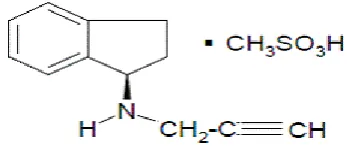
Chemically it is (1H-Inden-1-amine-2,3-dihydro-N-2-propynyl-(1R)-methanesulfonate (fig.
1).
Various analytical methods including UV Spectroscopy, HPLC– MS/MS methods,
RP-HPLC, HPTLC are available for the estimation of Rasagaline mesyalate in pharmaceutical
dosage forms. We tried to develop a simple stability indicating assay RP-HPLC method for
the estimation of Rasagaline mesalyate. The proposed method was optimized and validated as
[image:2.595.207.381.332.405.2]per the International Conference of Harmonization (ICH) guidelines.
Figure 1: Structure of Rasagaline mesaylate.
2. MATERIAL AND METHOD
Instruments and Apparatus
HPLC (LC-2010 HT) equipped with UV-visible detector and photodiode array detector with
vial tracks for automatic sampling, Shimadzu; Double beam UV spectrophotometer,
Shimadzu, Sonicator, Branson ultrasonic corporation; Analytical weight balance, Mettler
Toledo, Schwerzenbach, Switzerland; Water bath, Metalab scientific industries Ltd; Oven,
Lab line, India; pH meter, Lab line, India; 0.45 micron nylon filters; Glasswares and Syringe.
Chemical, Material & Reagents
Standard Rasagaline was procured from Emcure Pharmaceuticals Ltd., Adalaj, Gandhinagar;
marketed formulation named Relgin manufactured by INTAS Laboratories Pvt. Ltd. with
label claim 1mg Rasagiline was procured from local market. Methanol & water (Milli-Q) of
HPLC grade; Potassium dihydrogen orthophosphate, Triethylamine, Orthophosphoric acid,
Hydrochloric Acid, Hydrogen Peroxide, Sodium hydroxide of AR grade (Merck) were used
Preparation of standard stock solution of Rasagiline (100 µg/ml)
Weighed accurately 25mg of Rasagalline WS and transferred in to 25 ml volumetric flask
(V.F.), about 10ml of methanol was added and sonicated to dissolve. Cooled to RT, and
Volume was made up with methanol up to the mark and mixed. From this 10ml of solution
was transferred to 100ml V.F and volume was made up with methanol (100 µg/ml).
Sample preparation of Rasagiline in tablets (20 µg/ml)
About 10 tablets(Label claim = 1mg) were accurately weighed and transferred into a 100 ml
volumetric flask, about 50 ml of methanol was added, the solution was sonicated for 15 min
with intermittent shaking. The sample was allowed to cooled to RT and diluted up to the
mark with methanol and mixed well (100 µg/ml). Sample was centrifuged at 3000 rpm for 15
min. 2ml of this solution was pipette out in 10 ml V.F. and volume was made up with mobile
phase upto the mark which gave final concentration of 20 µg/ml. It was filtered through
0.45µ nylon filter.
Method Validation
The method was validated according to the International Conference on Harmonization
guidelines for validation of analytical procedures Q2 (R1) (ICH, 1996).
Specificity
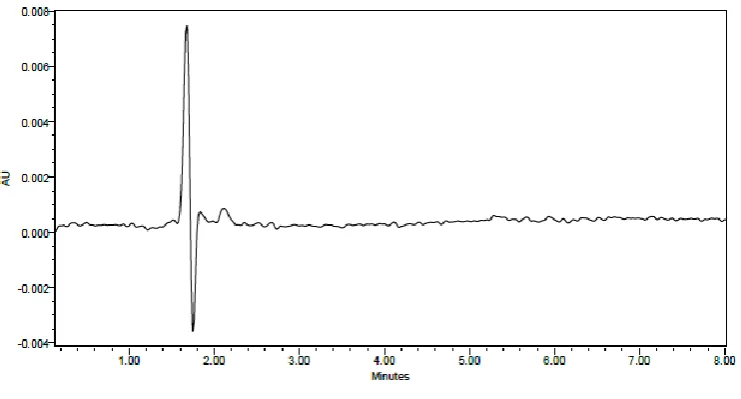
Specificity of the method was determined by checking the interference from blank and by
[image:3.595.113.484.521.720.2]performing force degradation in acid, base, peroxide and thermal condition.
Fig. 3: Chromatogram of Rasagiline Standard at 264nm.
[image:4.595.105.493.78.466.2]Fig. 4: Chromatogram of Rasagiline Sample at 264nm.
Table 1: Degradation profile of Rasagiline.
Stress condition % Degradation of Rasagiline
Acidic 20.25
Alkaline 15.27
Oxidative 9.13
Thermal 6.18
Linearity and Range (n=5)
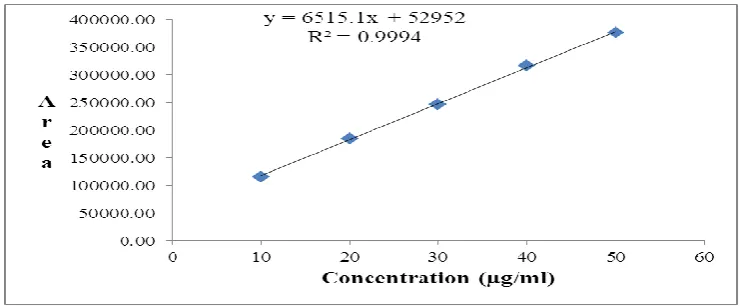
It was found that Lambert-Beer’s law was followed in the concentration ranges of 10 - 50
µg/ml (10, 20, 30, 40, 50 µg/ml) for Rasagiline. The straight line equation and correlation
[image:4.595.104.495.304.503.2]Fig. 5: Linearity graph of Rasagiline.
Table 2: Data of regression analysis of Rasagiline.
Drug Straight line equation of calibration curve R2 Correlation coefficient (r)
Rasagiline y = 6515.1x + 52952 0.9994 0.9997
Accuracy (% Recovery, n = 3)
The accuracy of the method was determined by calculating recovery of Rasagiline by using
standard addition method at 80, 100, 120% level. Percentage recovery was calculated by
injecting of each solution three times and % recovery was calculated with help of regression
equation. Recovery for Rasagaline was obtained in the range of 99.03 – 102.30% which
indicates accuracy of the method, as shown in table 3.
Table 3: Accuracy Study Data for Rasagiline. %
Level
Conc. Added (µg/mL)
Total Amount (µg/mL)
Total Amount
Recovered (µg/mL) Mean Area ± SD
% Recovery
% CV
80 16 36 36.83 185146.00 ± 902.76 102.30 0.933
100 20 40 39.61 296563.67 ± 2766.07 99.03 1.161
120 24 44 44.34 346237.00 ± 3149.65 100.76 0.910
Precision
The repeatability of method was checked by analyzing (n = 6) Rasagaline solutions and
response was recorded.
The intra-day (3 times on the same day) and inter-day (3 different days over a period of 1
week) a precision of the proposed method was checked by measuring the responses for 3
different concentration of Rasagaline. The result of precesion for Rasagiline is as shown in
Table 4. The % CV for repeatability of Rasagiline was found to be 0.592. The % CV for
intra-day precision was found to be in the range of 0.593 – 0.770% while inter-day precision
Table 4: Precesion (n = 7).
Precision (% CV)
Parameters Result
Repeatability (n = 6) 0.592 Interday (n = 3) 0.671 – 0.793 Intraday (n = 3) 0.593 – 0.770
LOD and LOQ
The Limit of detection (LOD) and Limit of quantitation (LOQ) were calculated by the
equation,
LOD = 3.3 x (SD/Slope)
LOQ = 10 x (SD/Slope)
Where,
SD = Standard deviation of the Y- intercepts of the calibration curve.
Slope = Mean slope of the calibration curve.
The limit of detection (LOD) & limit of quantification (LOQ) was calculated by using its
[image:6.595.76.521.617.733.2]equation and it is shown below, which indicate that the method is sensitive.
Table 5: LOD & LOQ Data for Rasagiline.
Drug LOD LOQ
Concentration (µg/ml)
Rasagiline 0.550 1.667
Robustness
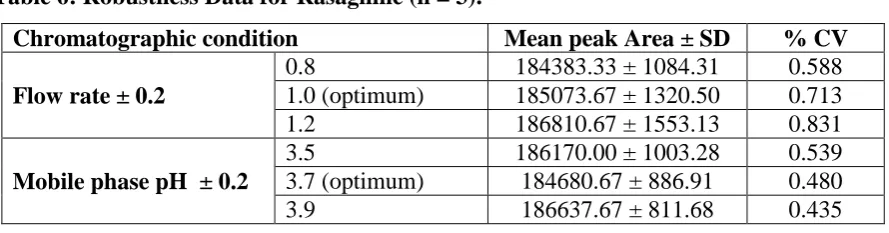
Results of robustness studies of RP – HPLC method are shown in table 6. The method was
found to be in term of variation in composition and flow rate, pH of the mobile phase and
column temperature. As % CV for all parameter was found to be less than 2%, which
indicates robustness of method.
Table 6: Robustness Data for Rasagiline (n = 3).
Chromatographic condition Mean peak Area ± SD % CV
Flow rate ± 0.2
0.8 184383.33 ± 1084.31 0.588
1.0 (optimum) 185073.67 ± 1320.50 0.713
1.2 186810.67 ± 1553.13 0.831
Mobile phase pH ± 0.2
3.5 186170.00 ± 1003.28 0.539
3.7 (optimum) 184680.67 ± 886.91 0.480
System suitability parameters
The results of system suitability test parameters are listed in table 7 and % CV for all
[image:7.595.152.444.401.633.2]parameter was found to be less than 2%.
Table 7: System suitability parameters Data for Rasagiline (n = 6).
Sr. No. Retention time, min Asymmetery Theoretical Plates
1 4.66 1.18 3247
2 4.70 1.17 3236
3 4.65 1.16 3251
4 4.70 1.17 3209
5 4.64 1.19 3244
6 4.66 1.18 3269
Mean 4.67 1.18 3242.67
SD 0.03 0.010 19.81
% CV 0.549 0.893 0.611
Summary of Validation And System Suitability Parameters
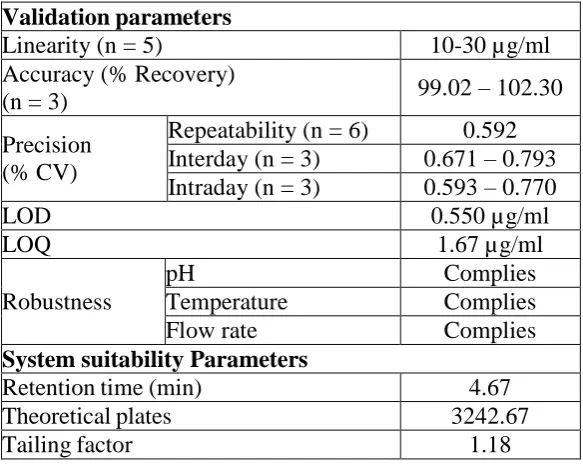
[image:7.595.154.444.401.634.2]All the validation and system suitability parameters are shown in Table 8.
Table 8: Summary of validation parameters & System suitability Parameters.
Validation parameters
Linearity (n = 5) 10-30 µg/ml
Accuracy (% Recovery)
(n = 3) 99.02 – 102.30
Precision (% CV)
Repeatability (n = 6) 0.592 Interday (n = 3) 0.671 – 0.793 Intraday (n = 3) 0.593 – 0.770
LOD 0.550 µg/ml
LOQ 1.67 µg/ml
Robustness
pH Complies
Temperature Complies
Flow rate Complies
System suitability Parameters
Retention time (min) 4.67
Theoretical plates 3242.67
Tailing factor 1.18
Estimation of Rasagaline in the marketed formulation by proposed RP-HPLC method:
(n=5)
10 tablets were accurately weighed and transferred into a 100ml volumetric flask, about 50ml
of methanol was added, and sonicated for 15 min with intermittent shaking to disperse the
tablet completely, The sample was allowed to cooled RT and diluted up to the mark with
2ml of this solution in 10 ml V.F. volume was made up with mobile phase. Filtered through
0.45µ nylon filter. The sample was injected into the chromatographic system and the %
labeled claim was calculated. Label claim of Rasagiline was 1 mg and average weight of 10
tablets was found to be 195 mg.
Table 9: Data of sample preparation for assay (n=5).
Sr. No. Area of Rasagaline
1 187385
2 185786
3 186465
4 184976
5 185095
Mean Area ± SD 185941.40 ± 1003.83
% CV 0.540
% Mean Assay ± SD 100.52 ± 0.759
3. CONCLUSION
Based on the results of the above studies, it is concluded that the method for determination of
assay of Rasagaline is precise, linear over the concentration range, stability indicating and
robust. The method is specific for the quantization of assay of Rasagaline in pharmaceutical
formulation. So the developed method can be easily applied for routine analysis of
Rasagaline in its bulk form and dosage form.
The method was found to be simple accurate economical and rapid and it can be applied for
routine analysis in laboratories and suitable for the quality control of bulk and pharmaceutical
formulations.
4. REFERENCES
1. H. V. Schapira, “The use of rasagiline in Parkinson’s disease”, J Neural Transm, 2006;
71: 157–161.
2. F. Stocchia and J. M. Rabeyb, “Effect of rasagiline as adjunct therapy to levodopa on severity of OFF in Parkinsons disease”, European Journal of Neurology, 2011; 18:
1373–1378.
3. Khashayar Dashtipour, Jack J Chen & Mark F Lew, “Rasagiline for the management of Parkinson’s disease”, Therapy, 2008; 5(2): 203–214.
4. Azilect; http://www.rxlist.com/azilect-drug.htm (accessed September 15, 2011).
5. ICH Q1B; Photostability testing on new drug substances and products. International
6. ICH Q1A (R2); Stability testing of new drug substances and products. International
Conference on Harmonization, Geneva, Switzerland, (2003).
7. ICH Q2 (R1); Validation of analytical procedures: Text and methodology. International
Conference on Harmonization, Geneva, Switzerland, (2005).
8. Lakshmi, M.V., Rao, J.V.L.N.S., Rao, A.L.; Development and validation of RP-HPLC
method for the estimation of rasagiline tablet dosage forms; Rasayan Journal of
Chemistry, 2010; 3: 621–624.
9. Jayavarapu, K.R., Murugeasn, J., Mantada, P.K.; Validated RP-HPLC method for the
estimation of rasagiline in pure and tablet dosage form; Journal of Pharmacy Research,
2011; 4: 1376–1377.
10. Kumar, R.N., Rao, G.N., Naidu, P.Y.; Stability indicating RP-HPLC method for
determination of rasagiline mesylate in bulk and pharmaceutical dosage forms;
International Journal Applied Biology and Pharmaceutical Technology, 2010; 1:
247–259.
11. Ma, J., Chen, X., Duan, X., Deng, P., Wang, H., Zhong, D.; Validated LC-MS/MS
method for quantitative determination of rasagiline in human plasma and its application to
a pharmacokinetic study; Journal of Chromatography B, 2008; 873: 203–208.
12. Song, M., Wang, L., Zhao, H., Hang, T., Wen, A., Yang, L., et al.; Rapid and sensitive
liquid chromatography-tandem mass spectrometry: Assay development, validation and
application to a human pharmacokinetic study; Journal of Chromatography B, 2008; 875:
515–521.
13. P Sunil Reddy; K Sudhakar Babu; Navneet Kumar. A Validated Normal Phase LC
Method for Enantiomeric Separation of Rasagiline Mesylate and Its (S)-Enantiomer on
Cellulose Derivative-Based Chiral Stationary Phase, Chirality, (2013).
14. Ravi Kumar Konda, Babu Rao Chandu, B.R. Challa,. Bio-analytical method development
and validation of Rasagiline by high performance liquid chromatography tandem mass
spectrometry detection and its application to pharmacokinetic study, Journal of
Pharmaceutical Analysis, 2012; 2(5): 342-349.
15. P Sunil Reddy; K Sudhakar Babu; Navneet Kumar. Development and Validation of a
Stability-Indicating RP-HPLC Method for the Simultaneous Estimation of Process
Related Impurities and Degradation Products of Rasagiline Mesylate in Pharmaceutical
16. K Vanitha Prakash, Ravi Pratap Pulla and Y Kranthi Kumar, Development and Validation
of Rasagiline Tartrate in Tablets by using Liquid Chromatography Research and
Reviews: Journal of Pharmaceutical Analysis, 2014; 3(2): 12-15.
17. Rama R, Preeti K. UV spectrophotometric method for the determination of Rasagiline
mesylate in bulk and pharmaceutical formulations. Int J Pharma Sci Rev Res., 2010; 5:
5-7.
18. Devala Rao G, Kathirvel S, Satyanarayana SV. Simple spectrophotometric methods for
the determination of Rasagiline mesylate in pharmaceutical dosage form. J Pharm Res.,
2011; 4: 61-62.
19. Chennaiah M, Veeraiah T, Charan Singh T, Venkateshwarlu G. Extractive
spectrophotometry methods for determination of Rasagiline mesylate in pharmaceutical
formulations using acidic Triphenyl methane dyes. J Chi Che Soc., 2011; 56: 926-929.
20. Sundara Murthy P, Balaji V, Rajasekhara R, Raju I. Validated and stability indicating
dissolution test with RP-HPLC analysis for Rasagiline Mesylate in tablet dosage form. Int
J Pharm Sci Rev Res., 2011; 10: 18-23.
21. Kumar RJ, Jeyabaskaran M, Kumari PM. Validated RP –HPLC method for the estimation
of Rasagiline in pure and tablet dosage form. J Pharm Res., 2011; 5: 1376-1377.
22. Reddy KU, Sriramulu J, Reddy UM, Reddy YP. Stability indicating RP-HPLC method
for the determination of Rasagiline in pharmaceutical products. Int J Sci Inn Disc., 2011;
1: 19-32.
23. R. Narendra Kumar, G.Nageswara Rao, P.Y. Naidu. Stability indicating RP-LC method
for determination of rasagiline mesylate in bulk and pharmaceutical dosage forms,
International Journal of Applied Biology and Pharmaceutical Technology, 2010; 1(2):