
R E S E A R C H
Open Access
Distributed joint source-channel code design
for GMAC using irregular LDPC codes
Iqbal Shahid and Pradeepa Yahampath
*Abstract
Separate source and channel coding is known to be sub-optimal for communicating correlated sources over a Gaussian multiple access channel (GMAC). This paper presents an approach to designing distributed joint
source-channel (DJSC) codes for encoding correlated binary sources over a two-user GMAC, using systematic irregular low-density parity check (LDPC) codes. The degree profile defining the LDPC code is optimized for the joint source probabilities using extrinsic information transfer (EXIT) analysis and linear programming. A key issue addressed is the Gaussian modeling of log-likelihood ratios (LLRs) generated by nodes representing the joint source probabilities in the combined factor graph of the two LDPC codes, referred to as source-channel factor (SCF) nodes. It is shown that the analytical expressions based on additive combining of incoming LLRs, as done in variable nodes and parity check nodes of the graph of a single LDPC code, cannot be used with SCF nodes. To this end, we propose a numerical approach based on Monte-Carlo simulations to fit a Gaussian density to outgoing LLRs from the SCF nodes, which makes the EXIT analysis of the joint decoder tractable. Experimental results are presented which show that LDPC codes designed with the proposed approach outperforms previously reported DJSC codes for GMAC. Furthermore, they demonstrate that when the sources are strongly dependent, the proposed DJSC codes can achieve code rates higher than the theoretical upper-bound for separate source and channel coding.
Keywords: Gaussian multiple-access channels; Distributed joint source-channel coding; LDPC codes; EXIT analysis
1 Introduction
Wireless communication of multiple correlated informa-tion sources to a common receiver has become an impor-tant research problem due to potential applications in emerging information gathering systems such as wireless sensor networks (WSNs) [1]. Most of the recent work on this problem has been focused on approaches based on the separation of source and channel coding, which rely on using distributed source coding (DSC) [2] to first generate independent bit streams from two sources and then to use a multiple-access method (such as TDMA, FDMA, or CDMA) [3] to convert a multiple-access chan-nel (MAC) into a set of orthogonal chanchan-nels. While it is known that for communication of correlated sources over orthogonal channels, the source-channel separation is optimal [3-5], the same does not hold true for a MAC [6-8]. Hence, there can be a loss of performance when
*Correspondence: [email protected]
Department of Electrical and Computer Engineering, University of Manitoba, 75, Chancellor’s circle, Winnipeg, R3T 5V6, Canada
separate source and channel coding is used to transmit correlated sources over a MAC. This is because when the sources are correlated, even if the transmitters cannot communicate with each other, it is possible to generate correlated inputs to a MAC by using a DJSC code and thereby improve the performance relative to a system with independent channel inputs. In contrast, with separate source and channel coding, distributed source coding of correlated sources yields independent bit streams, and hence, the MAC inputs cannot be made dependent unless the transmitters are allowed to collaborate in channel coding. Therefore, DJSC coding can be expected to out-perform separate source and channel coding in systems such as WSNs which are equipped with low-complexity, narrow-band sensors designed to communicate only with a common information gathering receiver.
DJSC coding of correlated sources for a GMAC has been studied sparsely in the literature. While there is no known tractable way to optimize a DJSC code for a given set of correlated sources and a MAC, a sub-optimal but effective and tractable framework is to encode each source using
an independent channel code in such a manner that the resulting dependence between the MAC input codewords can be exploited by a joint decoder [9,10]. In particu-lar, the use of a systematic channel code for each source preserves the dependence between the information bits of the MAC input codewords. For example, [9] presents an approach in which much of the correlation between the sources is preserved in MAC input codewords by encoding each source using a systematic low-density gen-erator matrix (LDGM) code. However, as LDGM codes exhibit a high error floor due to their poor distance prop-erties, this approach requires the use of two concatenated LDGM codes for each source to achieve good perfor-mance which increases the delay and complexity. Further-more, no known method exists for designing the LDGM codes to ensure that the codes are in some sense matched to the inter-source correlation and the channel noise level. An improved system design based on LDGM codes is presented in [10], which however requires an additional channel between each source and the common receiver. In another closely related work, Roumy et al. [11] consider the joint design of LDPC codes for independent sources transmitted over a two-input GMAC. The design of LDPC codes for correlated sources transmitted over orthogonal channels appears in [12].
In contrast to a previous work, in this paper, we present a DJSC code design approach for a pair of correlated binary sources, in which the degree profile of a system-atic irregular LDPC (SI-LDPC) code is optimized for the joint distribution of the two sources and the signal-to-noise ratio (SNR) of the GMAC. Our motivations for using SI-LDPC codes are the following: (1) systematic codes can be used to exploit inter-source correlation in joint decod-ing of the two codes, (2) LDPC codes can be optimized by linear programming, in conjunction with the EXIT analy-sis of the belief propagation (BP)-based joint decoder, and (3) LDPC codes are known to be capacity achieving for a single-user case [13] and hence will exhibit very good performance in coding correlated sources as well. One of the key issues addressed here is the mutual information computation (as required for EXIT analysis) for messages passed from factor nodes in the joint factor graph of the two LDPC codes, referred to as source channel fac-tor (SCF) nodes, which represent the joint probabilities of the two sources and the output conditional probabil-ity densprobabil-ity function (pdf ) of the GMAC. It is shown that the analytical computation of mutual information based on additive combining of incoming LLRs in variable nodes and parity check nodes of a factor graph as done in sin-gle LDPC codes does not apply to SCF nodes. In order to make the mutual information computation in EXIT anal-ysis, tractable using a Gaussian approximation [14], we propose a simple numerical approach based on Monte-Carlo simulations to fit a Gaussian pdf to outgoing LLRs
from the SCF nodes. Simulation results show that codes designed based on this method can not only outperform previously reported GMAC codes for both independent and correlated sources [9,11], but can also achieve code rates higher than the theoretical upper-bound for inde-pendent sources over the same GMAC, when the sources are strongly dependent.
This paper is organized as follows: Section 2 formulates the DJSC code design problem addressed in this paper and the code optimization procedure is presented in Section 3. Section 4 studies the problem of modeling the pdf of out-going LLRs from SCF nodes and presents a numerical method for computing the mutual information of these messages in the EXIT analysis. Section 5 presents and discusses the simulation results. Conclusions are given in Section 6.
2 Problem setup
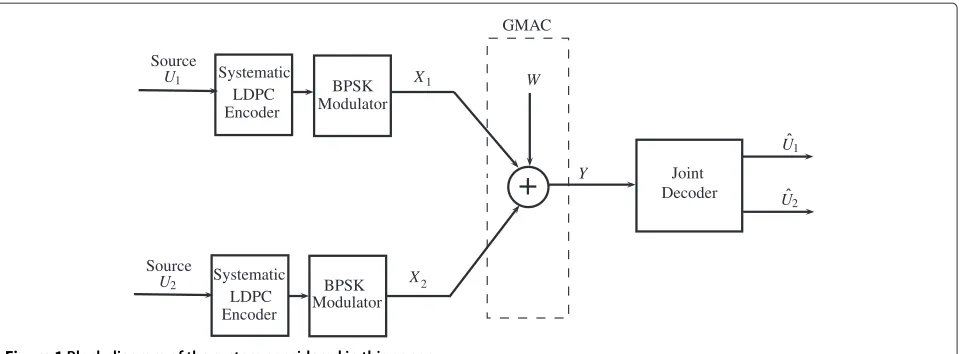
A block diagram of the system under consideration is shown in Figure 1. Let U1 and U2 be two dependent, uniform binary sources. Let the dependence between the two sources be described by theinter-source correlation parameter α ∈[ 0, 0.5], where P(U1 = U2) = α. A sequence of source bits from Uk, k = 1, 2, is encoded by a source channel code to produce a channel codeword whose bits are modulated to produce the GMAC input Xk ∈ {+1,−1} in equivalent base-band representation. The output of the GMACY∈Rcan is given by
Y=X1+X2+W, (1)
Systematic
Figure 1Block diagram of the system considered in this paper.
channel input codewords (the parity bits of each source are related to information bit as given by parity-check equations of the code [15]). The two channel codes are decoded by a joint decoder which observes the channel output Y. This approach essentially exploits the inter-source correlation to enhance the performance of channel codes. In particular, if two sources are independent, then each channel code requires a sufficient number of parity bits to correct the errors due to channel noise and the mutual interference between the the two independent bit streams. However, when the two sources are dependent,
the joint distributionP(X1,X2)of the information bits of the two channel input codewords provide an additional joint decoding gain and hence the number of parity bits required for encoding each source is reduced, or equiv-alently the achievable sum rate is higher. With practical (finite length) channel codes, this implies that the same decoding error probability can be achieved at a higher sum rate. Note that by construction, the aforementioned DJSC coding scheme requires that the code lengthnand the number of systematic information bits m (and the code rateRc = m/n) be identical for both sources, and
therefore, the resulting designs correspond to symmet-ricrates. Achieving asymmetric rates will possibly require some form rate splitting [16] and will not be considered in this paper.
The code design approach presented in this paper is based on systematic irregular LDPC (SI-LDPC) codes. First, consider an n-bit SI-LDPC code [17] whose par-ity check matrixHcan be represented by a factor graph with code bit variable (CBV) nodes x(1),. . .,x(n) and parity check factor (PCF) nodes (representing parity check equations), channel output variable (COV) nodes y(1),. . .,y(n), and thechannel factor(CF) nodes. In the case of a Gaussian channel, a COV node represents the conditional pdf p(y(n)|x(n)). The channel outputs are decoded by applying the BP algorithm to the factor graph [17]. For the purpose of code design, a length n SI-LDPC code can be completely specified by the parameters (n,λ(x),ρ(x)), whereλ(x) = dvmax
i=1 λixi−1and ρ(x) = dcmax
i=1 ρixi−1 are theedge-perspective degree polynomi-als of variable nodes and parity check nodes, respectively, and λi (resp. ρi) is the fraction of edges connected to CBV (resp. PCF) nodes of degreei(a degree of a node is the number of edges connected to it), satisfying the con-straints iλi = 1 andiρi = 1 [17]. The parameters dcmaxanddvmaxare typically chosen in such a manner that the sparsity of the corresponding factor graph is main-tained (i.e., the edges in the factor graph grow linearly with the codeword length [17]). It is known that a concentrated degree polynomial of the formρ(x)= ρxs−2+(1−ρ)xs for somes≥ 2 and 0< ρ ≤ 1 is sufficient for achieving near optimal performance ([13], Theorem 2).
Now consider, a two-input GMAC with an SI-LDPC code applied to each input. Since (1) is symmetric with respect toX1 andX2and the same rate is used for both sources, the same channel code can be used for both sources. While the parity check matrixHof each SI-LDPC
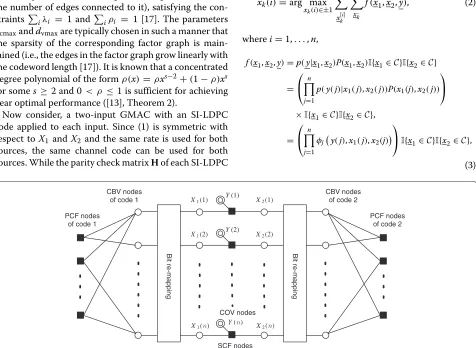
code whose code bits arexk(1),. . .,xk(n) can be repre-sented by a factor graph, for the joint decoding of the two codes, the combined factor graph as shown in Figure 3 has to be used, where the COV nodes y(1),. . .,y(n)are linked to factor nodes φ (y(i),x1(i),x2(i)), i = 1,. . .,n which represent (combined) SCF nodes. As described later in this paper, the message passing to and from these nodes in BP decoding is also crucial to the design of the codes as well. To determine theφ (·), consider the maxi-mum a posteriori (MAP) decoding of the codewordxk = (xk(1),. . .,xk(n))transmitted on GMAC inputk = 1, 2,
Then, it is easy to verify that the MAP decoded value of theith bit of the input codeword of GMAC inputkis given by
Cdenotes the set of all codewords of the code,I{·}denotes the indicator function, and
φjy(j),x1(j),x2(j)=p(y(j)|x1(j),x2(j))P(x1(j),x2(j)). (4)
In the factor graph, representation of (3), each factor node represents a term in the product [17]. As usual, the factors I{x1 ∈ C} and I{x2 ∈ C} are represented by the PCF nodes of the two codes, respectively. On the other hand, each term φi(·), i = 1,. . .,n, which is a function of the code bits x1(i) andx2(i), and the chan-nel outputy(i)is represented by a SCF node as shown in Figure 3. As the codes are systematic, for information bits P(x1(i),x2(i))is identical to the joint distributionP(u1,u2) of the source bits. For parity bits of an LDPC code (which has a dense generator check matrix), it can be assumed thatP(x1(i),x2(i)) = P((x1(i))P((x2(i))with P(x1(i)) = P(x2(i))=0.5 [18].
Sparse parity check matrices obtained through the EXIT analysis design procedure does not necessarily correspond to systematic generator matrices. As usual, the codes can be converted to systematic form by using Gaussian elimination. However, the resulting codes have dense parity-check matrices which makes the computational complexity of BP decoding impractically high. In order to get around this problem, abit re-mappingoperation is used in the joint decoder to rearrange the systematic code-bits, so that the codewords correspond to sparse matrices, as shown in Figure 3.
3 Code optimization
A well-known simple method for constructing a near-capacity achieving SI-LDPC code for a single-input AWGN channel with noise variance σ2 and some fixed ρ(x), is to determine the coefficients λi which maxi-mize the rate of the code under BP decoding, subject to Gaussian approximation (GA) for the messages passed in the decoder [13]. The code design in this case is a linear programming problem of the form ([17], Ch. 4): maximizeλi inequality to ensure the convergence of the BP algorithm ([13], Sec. 3) (decoder convergence constraint).
In optimization of an SI-LDPC code for two correlated sources to be transmitted over a GMAC, the objective is to determine the degree distributionλ(x)which maximizes the code rate Rc, given the source correlation param-eter α, the GMAC noise variance σ2, and some fixed ρ(x). Clearly, the objective function and the constraints (1) and (2) remain the same as for single channel code design. However, since the two sources are decoded jointly using a combined factor-graph, the third constraint has to be re-established. Specifically, let the mutual information between the code bitsXk and the LLRs passed from the
corresponding CBV nodes to the PCF nodes beIv(k→)p(l), wherelis the iteration in EXIT analysis. Then, for the con-vergence of BP decoding of the codes on the combined factor graph, it is required that
Iv(k→)p(l+1)≥Iv(k→)p(l),l=1,. . .,∞, (5)
fork=1, 2. In the following,Iv(k→)pwill be shown to be lin-ear inλi. Since the objective function and the constraints are all linear in the code parametersλi, we can use a lin-ear program to solve the problem. The rest of this section is devoted to EXIT analysis of BP decoding on the joint factor graph and the iterative computation ofIv(→k)p(l).
The details of BP decoding algorithm and the EXIT analysis for single-user LDPC codes can be found in [17,19]. In EXIT analysis, the analytical computation of mutual information is feasible only if the outgoing LLRs from the nodes in the factor graph have a Gaussian (or Gaussian-mixture) distribution [19]. When the channel is binary-input AWGN (BiAWGN) channel, the outgo-ing LLR values are Gaussian distributed [14]. For other types of channels, the Gaussian approximation of LLRs is known to be a good approximation, due to the univer-sality of the LDPC codes (a code designed for one type of channel performs well on a another type of a channel) [15]. The analytical expressions for iterative mutual infor-mation updates through CBV nodes and PCF nodes in EXIT analysis is well known [17]. In particular, the mutual information update through a CBV node stems from the message update through that variable node and the cen-tral limit theorem. That is, since an outgoing message of a given node has the mean equal to the sum of means of incoming messages to that node, given a reasonably high node degree, the outgoing message is approximately Gaussian. The mutual information update for a PCF node on the other hand relies on the deterministic relationship between the PCF node and the CBV nodes connected to it, as defined by the parity check equations. As a result, the mutual information update for a PCF node can be com-puted by simply using duality relationship that it has with a CBV node [20].
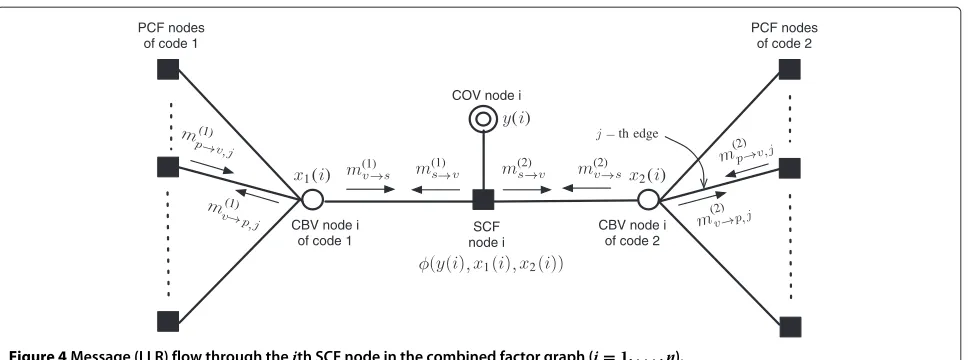
In the case of LDPC codes applied to two correlated sources transmitted over a GMAC and decoded by using a combined factor graph, the mutual information updates through CBV nodes and PCF nodes can be analytically computed as in the case of single-user LDPC codes. Denote the messages passed between various nodes in the factor graph as in Figure 4. Accordingly, the message passed from a degreedvCBV node of the codek∈ {1, 2}, along itsjth edge to a PCF node is given by
m(vk→)p,j= dv−1
i=1 i=j
( )
and the message passed from a PCF node of degreedcon itsjth edge to a CBV node is given by
see ([17], Ch. 2). Similarly, the LLR passed from a CBV node to a SCF node can be formed by the summation of incoming LLRs from the PCF nodes, i.e.,
m(vk→)s= dv−1
i=1
m(pk→)v,i. (8)
Note however that the LLRs computed by an SCF node cannot be formed as the sum of incoming LLRs, but are determined by (4). In the Appendix, it is shown that when sources are uniformly distributed
Let the mutual information between two random vari-ablesrandsbeI(r;s)and define the following: I(vk→)p
I(Xk;m(vk→)p),Ip(k→)v I(Xk;mp(k→)v), I(vk→)s I(Xk;m(vk→)s), andIs(→k)v I(Xk;m(s→k)v). In thel+1th iteration of EXIT analysis, givenIv(→k)p(l)andIv(k→)s(l),Ip(k→)v(l+1)andIs(→k)v(l+ 1)are first updated, followed byIv(k→)p(l+1)andIv(→k)s(l+1). The convergence of the degree polynomialλ(x)to a valid code is then verified by (5).
Let μ(vk→,dp) = E{m(vk→)p,j}, where v represents degree d CBV nodes in the factor graph,d = 2,. . .,dvmax. Given that all incoming messages to a CBV node are indepen-dent, the outgoing message is given by
μv(k→,dp) =(d−2)μp(k→)v+μ(s→k)v, (11)
Under the assumption that LLRs generated by a CBV node are Gaussian with meanμand variance 2μ, the mutual information I between the code bit represented by the CBV node and the LLR is given by
I=J(μ) (12)
whereJ(·)is given by Equation twenty four of [21]. Thus, the mutual information between degreedCBV nodes and the messages passed to PCF nodes is
I(vk→,dp)=J
Then, from the duality approximation ([17], pp. 236), it
Furthermore, the average mutual information between CBV nodes and the messages passed to SCF nodes is given by
Next consider the computation of mutual information Is(→1)vandIs(→2)vbetween the CBV nodes and the messages m(s1→)v and m(s2→)v as given by (9) and (10), respectively, passed from SCF nodes. Unfortunately, it is not straight-forward to compute these quantities, as the mean values ofm(sk→)v,k=1, 2 cannot be computed using an analytical relation as in (11). In this case,μ(sk→)vis a function ofμ(vk→¯)s, α, andσ2. As will be demonstrated below,m(sk→)vis in gen-eral not Gaussian-distributed, even ifm(vk→)s is Gaussian. However, in order to be able to apply EXIT analysis based on (12) suppose that, by using a suitable approach, we model the pdfm(sk→)vby a Gaussian function with variance equal to twice the mean. Then, we can obtain the required mutual information simply as
Next, we present an approach to numerically estimate the mean valuesμ(sk→)v. In order to get an idea about the pdf through Monte-Carlo simulations for several values ofα andμ(v2→)s, suggesting that the pdf ofm(s1→)vcan be highly skewed or even bi-modal depending on the values of α andμ(v2→)s. Similar observations hold form(s2→)v. Therefore, the problem at hand is to find a suitable method to fit a Gaussian pdf tom(sk→)v, which is effective for range values ofαandσ2.
For approximating an arbitrary distribution by a Gaussian, the transformation-based methods are widely used, see [22,23]. These methods are essentially para-metric where the parameter estimation is usually done through methods such as maximum likelihood (ML) or Bayesian inference. They also require performing the inverse transformoperation once the required processing is done on the Gaussian density. For our problem, both parameter estimation and inverse operation can make the LDPC code optimization algorithm intractable. Since our code optimization procedure is based on mutual infor-mation transfer through SCF nodes as computed in (17), we seek a computationally simple Gaussian approxima-tion which yields the maximum mutual informaapproxima-tionIs(→1)v for the messagesm(s1→)v, for givenμv(2→)s,α, andσ2. To this end, we consider the following three approaches.
• Mean-matched Gaussian approximation - The mean
μis estimated from observations and variance set to
2μ.
• Mode-matched Gaussian approximation - The mode m of the pdf is estimated from observations and we set the meanμ=mand variance2μ. The fitting of a Gaussian distribution at the mode of an arbitrary distribution is closely related to the Laplace approximation [24].
• Twocomponent Gaussian mixture approximation -The density is approximated by fitting a two component Gaussian mixture
a1N(μ1,σ12)+a2N(μ2,σ22), whereμ1,μ2,σ12,σ22,a1,
anda2are estimated from the observations.
Figure 5Histograms of outgoing messagesm(s1→)vfrom SCF nodes for different values of incoming message meanμ(v2→)sfor different valuesα(σ2=5).
other values ofα,μ(v2→)s andσ2. Furthermore, as will be shown (see Figure 8), the joint codes designed by using this approximation also yield the lowest decoding bit error probability compared to the other two approaches.
With all three approximation methods the mean value μ(sk→)v of the pdf ofm(s→k)vcan be estimated using Monte-Carlo simulation. For example, μ(sk→)v can be estimated
using mean-matched or mode-matched approximations as follows:
Step 1:Given the mean valueμ(vk¯→)sgenerate a sufficiently large number ofNsamples ofm(vk¯→)s∼N(μv(→k¯)s, 2μ(vk¯→)s).
Step 2:GivenP(X1,X2)andσ2, generateNsamples from the pdf of the GMAC outputy.
0 0.1 0.2 0.3 0.4 0.5 0.6 0.7 0.8 0.9 1
0.35 0.4 0.45 0.5 0.55 0.6 0.65 0.7
Input mutual information
Output mutual information
Mode matched Mean matched
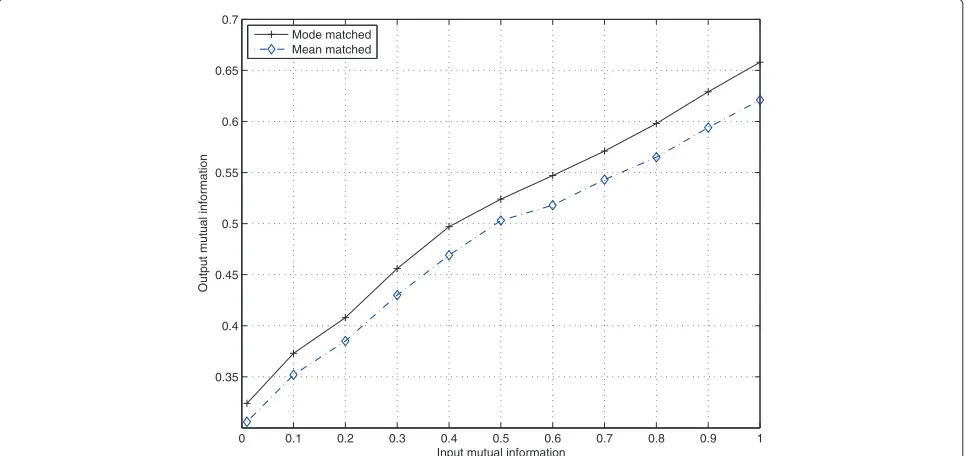
Figure 7Mutual information update through SCF nodes.I(s1→)v(output mutual information) as a function ofI(v2→)s(input mutual information) for μ(v2→)s= 3.24 andα= 0.01. Note the corresponding bi-modal histogram in Figure 5.
Step 3:Use (9) (ifk=1) or (10) (ifk=2) to compute the correspondingNsamples ofm(sk→)v. Estimate the meanm of the pdf ofm(sk→)vusing either mean-matched or mode-matched approximations described above. Setμ(s→k)v= m and var(m(sk→)v)=2m.
In the case of Gaussian mixture approximation, mean val-uesμ1,μ2and the weightsa1,a2can be estimated from the sample set ofm(sk→)v[25].
5 Simulation results
In this section, we present simulation results obtained by designing DJSC codes for a pair of uniformly distributed binary sources (whose statistical dependence is given by α) and a GMAC with noise varianceσ2.
First, we investigate the impact of the three message density approximation considered in Section 4. As evi-denced by Figures 6 and 7, codes designed by using the mode-matchedapproximation gives the maximum output
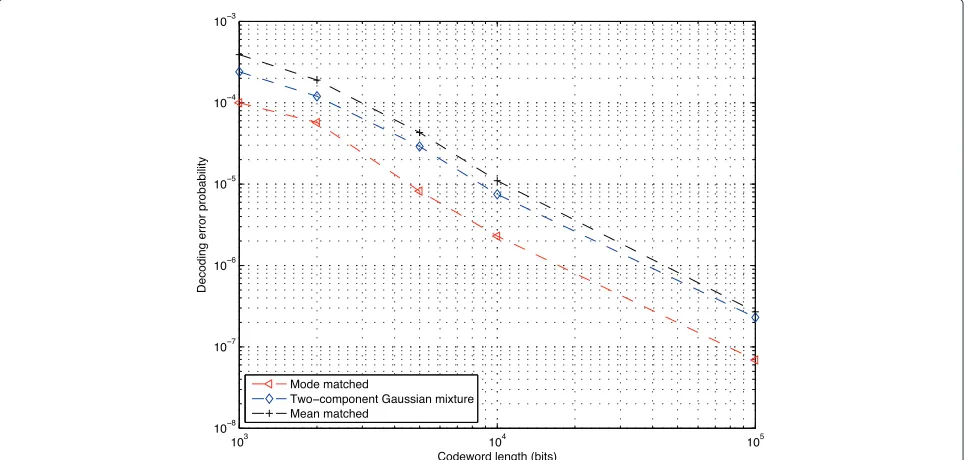
mutual information from a SCF node. In order to compare the three approximation methods on the basis of code per-formance, in Figure 8, we present the probability of decod-ing error of codes designed usdecod-ing each of these methods. Here, the correlation parameterα and the channel noise variance σ2 are identical to those used in Figure 7 (for which the density of outgoing messages from SCF nodes is bi-modal). These results confirm that the mode-matched approximation tends to yield the best codes, owing to the skewed nature of the pdf of the output messages from SCF nodes. For example, at the error probability of 10−6, the codeword length required with mode-matched approxi-mation is approximately 1.7× 104 bits, while that with mean-matched approximation is approximately 3.8×104 bits. In obtaining simulation results in the rest of this section, we have used the mode-matched approximation.
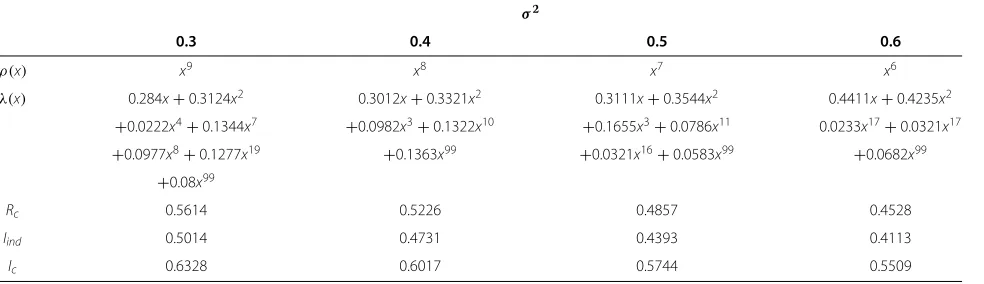
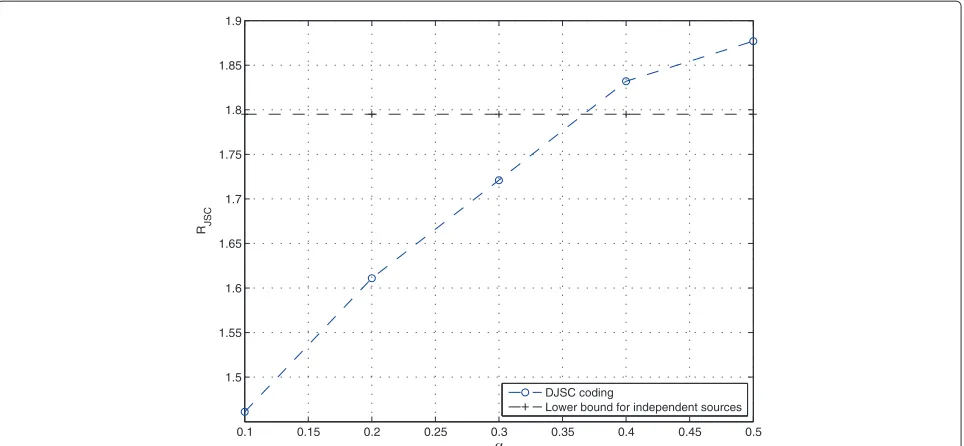
As discussed in Section 2, the capacity of a GMAC can be higher for dependent sources as compared to indepen-dent sources. Table 1 presents examples of several DJSC code designs together with their code ratesRcfor sources with a correlation level ofα=0.1. The table also indicates the maximum code rate achievable (channel capacity) with independent sources 12I(X1,X2,Y|α = 0.5)over the same channel (noise level), as well as the actual value of the joint mutual information 12I(X1,X2;Y|α = 0.1) of the DJSC code. In particular, note that the DJSC codes can actually achieve code rates (bits/channel-use) higher than the capacity of the GMAC for independent sources. While the capacity of GMAC for correlated sources remains unknown, these results clearly demonstrate that the proposed codes are able to outperform separate source and channel coding for GMAC (with separate source and channel coding, a good DSC would render the two sources nearly independent). In Figure 9, we compare the joint source-channel coding (JSC) rates in channel-uses/source-bit RJSC, achieved by the proposed DJSC codes as a function of α, at a codeword length of 106 bits and a decoding error probability of 10−6. The
rate lower-bound for independent sources [3] over the same GMAC is also shown. Note that forα ≤0.36, DJSC codes can achieve JSC rates below the theoretical lower-bound for independent sources with the same marginal probabilities.
In order to further demonstrate the advantage of the proposed DJSC codes compared to separate source and channel coding, we next compare three different system designs which differ in terms of the use of prior infor-mation about the inter-source correlation parameterα, as follows:
Scheme 1: Regardless of the actual inter-source corre-lationα, the two sources are assumed to be independent (α=0.5) in code design as well as in decoding. Essentially, these codes at best can only achieve a channel capacity of I(X1,X2;Y|α=0.5). We denote this scheme by (αdesign= 0.5,αdecode=0.5).
Scheme 2: Independent sources are assumed for code design (αdesign = 0.5), but the actual value of α is used in joint decoding. We denote this scheme by (αdesign = 0.5,αdecode=αactual).
Scheme 3: The actual value ofα is used for both code design and in joint decoding. We denote the scheme by (αdesign=αdecode=αactual).
Figure 10 shows the code rates (measured in bits per channel use) achieved byscheme 2andscheme 3for dif-ferent values of correlation parameter α, for σ2 = 1 and a decoding error probability of 10−6. While the rate achieved by both schemes increases as the inter-source correlation increases (αdecreases) as expected, note that
for α = 0.1 and α = 0.2, Scheme 3 can actually
achieve code rates higher than the theoretical upper-bound for independent sources over the same channel, which demonstrates the advantage of optimizing the code for the joint distribution of the sources. Figure 11 shows the decoding error probability of the three schemes, as a function of α. As expected, the codes optimized for the joint distribution of the sources yields the best
Table 1 Degree profiles for LDPC codes generated by the proposed design algorithm
σ2
Rc 0.5614 0.5226 0.4857 0.4528
Iind 0.5014 0.4731 0.4393 0.4113
Ic 0.6328 0.6017 0.5744 0.5509
For binary sources withα=0.1and different channel noise levelsσ2.R
cis the code rate,Iind=12I(X1,X2;Y|α=0.5)is the maximum code rate achievable (channel
0.1 0.15 0.2 0.25 0.3 0.35 0.4 0.45 0.5 1.5
1.55 1.6 1.65 1.7 1.75 1.8 1.85 1.9
RJSC
DJSC coding
Lower bound for independent sources
Figure 9JSC rateRJSC(channel uses per source bit) of proposed DJSC codes.σ2=0.5 and codeword length is 106bits. The theoretical lower-bound for independent sources over the same GMAC is also shown.
performance. It can also be seen that even the codes designed for independent sources can achieve a signifi-cant performance improvement if the actual value of joint probabilities of the sources are used in joint decoding. Note that with (αdesign=0.5,αdecode=0.5) and (αdesign= 0.5,αdecode = αactual), the same pair of codes have been
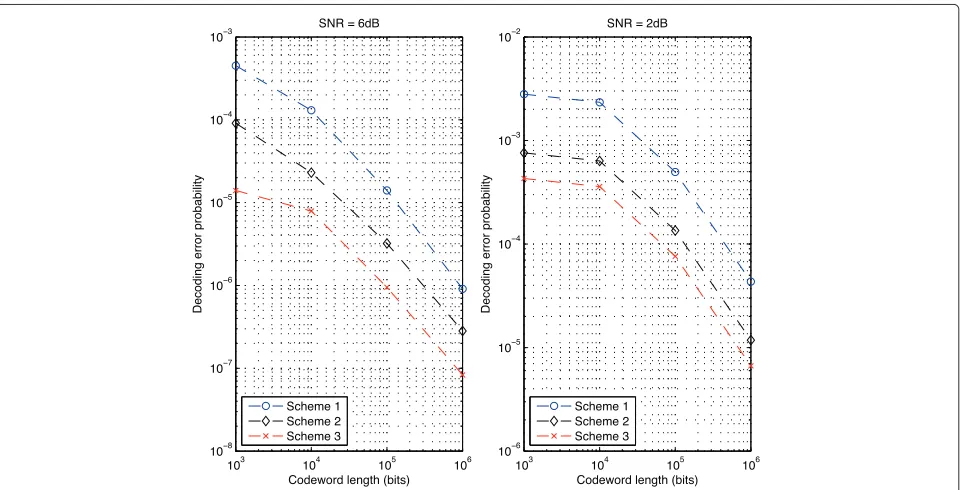
used for all values of α. As α decreases, the improve-ment achieved by incorporating the joint source statistics for both code optimization and joint decoding becomes more pronounced. Figure 12 shows the probability of decoding error of the three schemes as a function of code-word lengthnfor several values of SNR of the GMAC (for
0.2 0.25 0.3 0.35 0.4 0.45 0.5 0.55 0.6
0.2 0.25 0.3 0.35 0.4 0.45 0.5 0.55
Rate of source 1
Rate of source 2
Upper bound for independent sources Scheme 3
Scheme 2
Figure 11Comparison of three code-design/decoding schemes at different values of inter-source correlation (codeword length is106bits).
a given value of SNR, the JSC rates are kept the same for all three schemes).
It is of interest to compare the performance of the pro-posed LDPC code constructions with the concatenated LDGM codes reported in [9]. The use of LDGM codes has the advantage that all bits of two GMAC input code-words are correlated, whereas in the proposed scheme with systematic LDPC codes, only the information bits
are correlated. However, LDGM codes have an inherent disadvantage that they typically have a high error floor [17]. To get around this problem, the authors in [9] have used serial, parallel, and hybrid concatenation of LDGM codes with interleavers, but this also increases the encod-ing complexity. This problem is not present in the LDPC codes. Additionally, unlike LDGM codes in [9], the degree polynomials of the LDPC codes can be optimized to
Figure 13Comparison of the proposed LDPC codes with LDGM codes in (Figure eight of [9]);α=0.1).The SNR gap refers to the difference between the SNR of the actual channel for which the code is designed and the SNR corresponding to the theoretical limit for independent sources.
correlated sources, as proposed in this paper. While the theoretical limit of SNR required to achieve a given decod-ing error probability is not known for correlated sources, Figure eight of [9] shows the SNR gain of LDGM codes compared to the theoretical limit for independent sources. In Figure 13, we compare SNR gain of proposed LDPC codes and LDGM codes in Figure eight of [9]. The SNR gap (in decibels) in this figure is the difference between
the channel SNR for which the code is designed and the theoretical limit of SNR for independent sources.
While the proposed LDPC code design is aimed at DJSC coding of correlated sources over a GMAC, they can also be applied to channel coding of independent sources over a GMAC, similar to [11]. Specifically, recall that DJSC codes designed for α = 0.5 yields a channel code for independent sources. Figure 14 compares performance
Table 2 Degree profiles for LDPC codes used in Figure 14
of channel code designed in this manner with that of the codes reported in (Figure 3 of [11]). The degree profiles of the LDPC codes are given in Table 2. For example, the proposed code designs achieve a coding gain of≈0.2 dB at a decoding error probability of 10−3for all coding rates considered here. While the approach in [11] is also based on a combined factor graph for two codes, the improved performance of the codes proposed in this paper is due to more accurate approximation of the density functions of the outgoing messages from SCF nodes as discussed in Section 4.
6 Conclusions
An approach to designing a DJSC code with symmetric rates for a pair of correlated binary sources transmitted over a GMAC, based on SI-LDPC codes has been devel-oped. For EXIT analysis of the joint BP decoder for two sources, the accurate modeling of the density function of the outgoing LLRs from factor nodes in the com-bined factor graph of two LDPC codes, which represent the joint source probabilities and GMAC output condi-tional density (SCF nodes), has been investigated. While a tractable analytical expression appears difficult to obtain, a numerical method appropriate for EXIT analysis has been proposed for fitting a Gaussian or Gaussian mixture to model the density function of outgoing LLRs from SCF nodes. Experimental results are presented which show that SI-LDPC codes designed with this approach outper-form previously reported DJSC codes. Furthermore, these results demonstrate that, for strongly dependent sources, the proposed DJSC code can achieve code rates higher than the theoretical upper-bound for independent sources over the same GMAC.
Similarly, it can be shown that
p(x(i1)= −1|yi)= q−1,1(yi)P−1,1+q−1,−1(yi)P−1,−1
The authors declare that they have no competing interests.
Acknowledgements
This work has been supported by the National Science and Engineering Research Council (NSERC) of Canada.
Received: 3 September 2013 Accepted: 23 December 2013 Published: 9 January 2014
References
1. D Culler, D Estrin, M Srivastava, Overview of sensor networks. IEEE Comput.37(8), 41–49 (2004)
2. D Slepian, JK Wolf, Noiseless coding of correlated information sources. IEEE Trans. Inf. Theory.19(4), 471–480 (1973)
4. SS Shamai, S Verdu, Capacity of channels with uncoded-message side-information, inProceedings of the International Symposium on
Information Theory,Whistler, 17-22 September, (1995), p. 7
5. J Barros, SD Servetto, Network information flow with correlated sources. IEEE Trans. Inf. Theory.52(1), 155–170 (2006)
6. T Cover, A El Gamal, M Salehi, Multiple-access channel with arbitrarily correlated sources. IEEE Trans. Inf. Theory.IT-26(6), 648–657 (1980) 7. S Ray, M Medard, M Effros, R Koetter, On separation for multiple access
channels, inProceedings of the IEEE Inf. Theory Workshop,Chengdu, 22-26 October, (2006), pp. 399–403
8. SS Pradhan, S Choi, K Ramachandran, A graph-based framework for transmission of correlated sources over multiple-access channels. IEEE Trans. Inf. Theory.53(12), 4583–4604 (2007)
9. J Garcia-Frias, Y Zhao, W Zhong, Turbo-like codes for transmission of correlated sources over noisy channels. IEEE Signal Process. Mag.
24, 58–66 (2007)
10. AD Murugan, PK Gopala, H El Gamal, Correlated sources over wireless channels: cooperative source-channel coding. IEEE J. Selected Areas Commun.22(6), 988–998 (2004)
11. A Roumy, D Declercq, Characterization and optimization of LDPC codes for the 2-user Gaussian multiple access channel. EURASIP J. Wireless Commun. Netw Article ID 74890 (2007)
12. I Shahid, P Yahampath, Distributed joint source-channel coding using unequal error protection LDPC codes. IEEE Trans. Commun.
61(8), 3472–3482 (2013)
13. SY Chung, GD Forney, TJ Richardson, R Urbanke, On the design of low-density parity-check codes within 0.0045 dB of the Shannon limit. IEEE Commun. Lett.5(2), 58–60 (2001)
14. SY Chung, T Richardson, R Urbanke, Analysis of sum-product decoding of LDPC codes using a Gaussian approximation. IEEE Trans. Inf. Theory.
47(2), 657–670 (2001)
15. WE Ryan, S Lin,Channel Codes : Classical and Modern(Cambridge University Press, Cambridge, 2009)
16. B Rimoldi, R Urbanke, A rate-splitting approach to the Gaussian multiple-acccess channel. IEEE Trans. Inf. Theory.42(2), 364–375 (1996) 17. T Richardson, R Urbanke,Modern Coding Theory(Cambridge University
Press, Cambridge, 2008)
18. M Sartipi, F Fekri, Distributed source coding using short to moderate length rate-compatible LDPC codes: the entire Slepian-Wolf region. IEEE Trans. Commun.56(3), 400–411 (2008)
19. T Richardson, A Shokrollahi, R Urbanke, Design of capacity-approaching irregular low-density-parity-check codes. IEEE Trans. Inf. Theory.
47(2), 619–637 (2001)
20. S ten Brink, G Kramer, A Ashikhmin, Design of low-density-parity-check codes for modulation and detection. IEEE Trans. Communi.
52(4), 670–678 (2004)
21. S ten Brink, Convergence behavior of iteratively decoded parallel concatenated codes. IEEE Trans. Commun.49, 1727–1737 (2001) 22. GEP Box, DR Cox, An analysis of transformations. J. R. Stat. Soc. B.
26, 211–252 (1964)
23. T Gasser, P Bacher, J Mocks, Transformations towards the normal distribution of broad band spectral parameters of the EEG. Electroencephalogr. Clin. Neurophysiol.53, 119–124 (1982) 24. A Azevedo-Filho, RD Shachter, Laplace’s method approximations for
probabilistic interference in belief networks with continuous variables, in 10th Conference on Uncertainty Artif. Intell,Seattle, 29-31 July, (1994), pp. 28–36
25. AC Cohen, Estimation in mixtures of two Gaussian distributions. Technometrics.9(1), 15–28 (1967)
doi:10.1186/1687-1499-2014-3
Cite this article as:Shahid and Yahampath:Distributed joint source-channel code design for GMAC using irregular LDPC codes.EURASIP Journal on Wireless Communications and Networking20142014:3.
Submit your manuscript to a
journal and benefi t from:
7Convenient online submission
7Rigorous peer review
7Immediate publication on acceptance
7Open access: articles freely available online
7High visibility within the fi eld
7Retaining the copyright to your article
![Figure 13 Comparison of the proposed LDPC codes with LDGM codes in (Figure eight of [9]); α = 0.1)](https://thumb-us.123doks.com/thumbv2/123dok_us/961631.1117897/13.595.57.541.88.316/figure-comparison-proposed-ldpc-codes-ldgm-codes-figure.webp)

