R E S E A R C H
Open Access
Iterative joint frequency offset and channel
estimation for OFDM systems using first and
second order approximation algorithms
Rainfield Y Yen
1, Hong-Yu Liu
2and Chia-Sheng Tsai
3*Abstract
To implement an algorithm for joint estimation of carrier frequency offset (CFO) and channel impulse response (CIR) in orthogonal frequency division multiplexing (OFDM) systems, the maximum-likelihood criterion is commonly adopted. A major difficulty arises from the highly nonlinear nature of the log-likelihood function which renders local extrema or multiple solutions for the CFO and CIR estimators. Use of an approximation method coupled with an adaptive iteration algorithm has been a popular approach to ease problem solving. The approximation used in those existing methods is usually of the first order level. Here, in addition to a new first order approximation method, we also propose a second order approximation method. Further, for the part of the adaptive iteration algorithm, we adopt a new technique which will enable performance improvement. Our first order approximation method is found to outperform the existing ones in terms of estimation accuracies, tracking range, computation complexity, and convergence speed. As expected, our second order approximation method provides an even further improvement at the expense of higher computation complication.
Keywords:Carrier frequency offset, Orthogonal Frequency Division Multiplexing (OFDM), Synchronization, Channel estimation, Maximum-likelihood estimation
1. Introduction
For orthogonal frequency division multiplexing (OFDM) communications over mobile wireless channels, after an initial acquisition is completed for time and frequency synchronization [1,2], residual or fine carrier frequency offset (CFO) and time variation of the channel impulse response (CIR) will continue to exist due to Doppler shift, multipath fading, and/or local oscillator instability [3]. Therefore, fine CFO and CIR variation must be fre-quently tracked [3]. A majority of the methods proposed in the literature for CFO and CIR estimation either sin-gly addresses CFO or CIR estimation. That is, either per-fect CFO synchronization is assumed in deriving CIR estimations [4-14] or perfect CIR estimation is assumed in deriving CFO synchronization algorithms [15-17]. A more practical implementation is to jointly track CFO and CIR simultaneously. The commonly adopted
scheme for tracking CFO and/or CIR is to use a max-imum likelihood (ML) estimation algorithm coupled with the aid of an alternate and adaptive iteration algo-rithm [3,18-20]. But there exists a major difficulty, namely, the local extrema or multiple solution complica-tion arising from the highly nonlinear nature of the log-likelihood function. A most direct and straightforward approach is the use of the steepest descent or the gradi-ent method as given in [18]. Two hurdles in the gradigradi-ent method are the starting point and the adaptive step size for the adaptive iteration process. For the algorithm to work well so that the adaptive process will converge to the global solutions, proper or careful choice must be made of the starting point as well as the value or range of the step size. Often when the environment or the channel is changed, these choices will become different and hence must be re-established by a new search. Usually, the search is by trial and error and can be a nuisance. Therefore, theoretically the gradient method may be perfectly workable, but practically it may not be so conveniently implementable. An alternative is to use * Correspondence:[email protected]
3
Department of Computer Science and Engineering, Tatung University, No.40, Sec. 3, Zhongshan N. Rd., Taipei City 104, Taiwan
Full list of author information is available at the end of the article
mathematical approximations. For example, for what is called the joint maximum likelihood channel and fre-quency estimation (JML-CFE) algorithm given in [19], the authors used the frequency-domain expression of the discrete Fourier transform (DFT) output at the OFDM receiver where two terms containing CFO are approximated by truncating Taylor series expansions beyond the second order terms, one being the desired carrier term and the other the inter-carrier interference (ICI) term. The resultant approximate output expres-sion was used to form an approximate log-likelihood function. They then took partial differentiations of this approximate log-likelihood function respectively with respect to CIR and CFO to obtain a set of gradients and set them to equal zeros thus establishing a system of simultaneous equations in terms of CIR and CFO (Note that, for frequency-selective channels, the CIR is actually a multi-dimensional vector whose dimension equals the channel length). Solving the simultaneous equations leads to approximate solutions for the CFO and the CIR estimators. The log-likelihood function is a second order polynomial in CFO after the Taylor series truncation. Therefore, partial differentiation with respect to CFO will result in a first order polynomial in CFO. So the approximation is eventually of the first order level. Based on the estimator solutions as obtained above, adaptive iterations can then be performed alternately to jointly estimate data, CFO, and CIR in a decision-directed fashion. However, their solutions are very lengthy and cumbersome making the whole algorithmic process extremely tedious and complex. Another example of joint CFO and CIR estimation technique for OFDM based on iterative approximation is the expectation-maximization (EM) algorithm given in [20]. There, for what is called the expectation step, a minimum-mean-square error (MMSE) estimate of CIR conditioned on CFO was first derived from the log-likelihood function for the time-domain received signal. Then, for what is called the maximization step, conditioned on the MMSE channel estimate, an approximate expression was obtained for the log-likelihood function by truncating the Taylor series expansion of a term involving CFO be-yond the second order term. Setting to zero the partial differentiation of this approximate log-likelihood func-tion with respect to CFO yielded the CFO estimate. For the same reason as argued above, this approximation is also of the first order level. Adaptive iterations were then performed alternately between the expectation and maximization steps to produce the final CFO and CIR estimators. There are some shortcomings in the above EM-based approach. First, the MMSE channel estimate in the expectation step requires the knowledge of noise power and the channel covariance information. Second, the MMSE criterion for estimating the channel is not
geared to maximizing the log-likelihood function. Thus, it is expected that the MMSE channel estimator will not perform as well as an ML channel estimator.
In this paper, we shall propose a new first order approximation method as well as a second order approximation method for joint CFO and CIR estima-tion in OFDM systems. As will be seen, our first order approximation method is much succinct and easily com-prehensible. Additionally, with an ingenious design of the adaptive iteration algorithm, we are able to obtain extremely fast and excellent convergence results. In terms of estimation accuracies as well as tracking range, our algorithm offers comparatively more satisfactory performance than those of existing algorithms. Indubit-ably and expectedly, our second order approximation algorithm provides an even further improvement in fre-quency tracking and channel estimation performance over the first order counterpart.
2. Signal and system model
Define X=diag{X0,X1,. . .,XN−1} as the diagonal matrix
with {Xk, k= 0, 1. . .,N−1} as the set of transmitted baseband frequency-domain data symbols over an OFDM symbol block of length N(in symbol units);r= [r0,r1,⋯,rN−1]Tas the time-domain baseband received
signal vector; and w= [w0,w1,⋯,wN−1]T as the
time-domain baseband noise vector where {wn} are independ-ent, identically distributed (i.i.d.) complex Gaussian ran-dom variables with zero mean and variance σ2w and can usually be denoted bywn∼N(0,σ2w) for convenience. For a frequency-selective channel of dispersion length v, let h= [h0,h1,⋯,hv−1]T be the channel impulse response
(CIR) vector with {hm, m= 0, 1,. . .v−1} being spatially uncorrelated andH= [H0,H1,⋯,HN−1]Tbe the channel
frequency response (CFR) vector. Assuming the fre-quency offset normalized to subcarrier spacing is δ. Then, at the receiver, upon demodulation and discarding the cyclic prefix, the baseband sample at the nth time slot in the received time-domain OFDM block can be expressed as [3]
rn¼ej2πnδ=Nynþwn; n¼0;1;. . .N1 ð1Þ
where
yn¼ 1
ffiffiffiffi
N p XN
1
k¼0
HkXkej2πnk=N: ð2Þ
Here we have adopted unitary discrete Fourier trans-form (DFT) for signal data. We can readily combine (1) and (2) into a vector form as [18]
r¼ 1ffiffiffiffi
N
p DδFHNXHþw¼ 1
ffiffiffiffi
N
where
From (3), a log-likelihood function can be derived as
lnΛ¼ Nlnπσ2w 1
Constant modulus training sequence has been proven optimal for channel estimation [21]. Chu sequence [22], for example, falls onto this category. We shall use a Chu sequence given by {Xk¼ejπmk
2=N
, m being any integer relatively prime to N}. This results in XHX=IN. Then, (7) can be simplified to
^
Since (8) is now channel independent, we have decoupled δ from h and (10) can thus be solved for δ alone. However, (10) is highly nonlinear in δ and con-tains infinite number of solutions. We only desire the one solution that yields the global maximum of lnΛat a given h. The task is not possible by analytical means. The most direct and straightforward approach is the steepest descent or the gradient method which has been treated in [18]. But the problem with the gradient method lies in the proper selection of the starting point and the adaptive step size of the adaptive iteration process. An improper selection of the starting point or the step size or both may either lead to an undesired solution (a local extremum) or result in process diver-gence. Moreover, when the environment or the channel is changed, these choices will also be changed and must be reestablished by a new search. Often such a search is by trial and error and can be a nuisance. For the above reasons, the joint frequency tracking and channel esti-mation using the gradient method may not be practically implementable. An alternative is to simplify (10) by approximation so that (11) can be reduced to an
analytically solvable form. We shall present two approxi-mation methods.
2.1 First order approximation
Assumingδis small, we can approximateej2π(m−n)δ/Nby 1 +j2π(m−n)δ/N. We call this the first order approxi-mation since we have retained only the terms up to the first order. Then, (10) becomes
X lution and hence is not very accurate. We can improve the accuracy by iterative corrections as follows. Start with iteration 1 by labeling ^δ andrin (13) as ^δ1 andr1.
We then make the correction r2¼DHδ1r1. After this
correction, a residual CFO is assumed to remain and is estimated by using (13) again. Label this estimate as ^ ued until eventually the residual CFO approaches zero. The final CFO estimator is obtained by summing all the residual CFO estimates.
When noise is large or when signal-to-noise ratio (SNR) is small, it is found that the above iterative process may become divergent. To remedy, we may introduce a step size to avoid large corrective steps. The algorithm can therefore be summarized as follows:
i¼1;2;⋯;L
(for a total ofLiterations)
^
Some remarks of interest are in order.
1) Unlike the gradient method where the step size needs be carefully searched and usually varies with changing environment, hereλis easily picked. Under moderate conditions when the initial CFO is small, we can simply chooseλ= 1. For stringent conditions, e.g., when initial CFO is large, we can chooseλ= 0.5 orλ= 0.2.
2) We wish to point out that it is the corrective action of (14b) that makes our algorithm better. Normally, one would substitute the new CFO estimate obtained from (13) in each iteration into (8) to find a new^h without the corrective action of (14b). This newh^ is substituted into (9) to obtained a renewed gradient of (10) and then a renewed solution of CFO estimate given by (13) is obtained, and on and on. This latter approach is also what is used in [19] and [20] for their adaptive iteration algorithms. Computer simulations have been performed and results show that the algorithm given by (14a) ~ (14d) indeed performs much better than the latter approach. 3) Equation (8) or (14d) is an ML channel estimator
which is optimal in the sense that it will yield a maximum likelihood function for a given CFO. As noted earlier, we expect the ML channel estimator will outperform the MMSE channel estimator adopted in [20]. Simulation results indeed confirm this fact.
2.2 Second order approximation
By retaining terms up to the second order, we get the second order approximation given as ej2π(m−n)δ/N≈1 +
Solving (15), we get
δ¼B
As before, the approximate solution of (16) can attain better accuracy by iterative corrections. We summarize the adaptive iteration algorithm below.
i¼1;2;⋯;L
(for a total ofLiterations)
^ larger log-likelihood function, or equivalently,
^
For this second order approximation algorithm, no step size is needed as no divergence problem will occur in the small SNR region.
Simulation results show that both the above first order and second order approximation algorithms have faster convergence rate as well as better estimation accuracies than other existing algorithms including the gradient algorithm. Detailed performance comparisons will later be presented between prevalent existing algorithms and our algorithms.
3. Cramer-Rao bounds
Then the CRBs can be obtained from the diagonal ele-ments of J-1. Note that the CRBs obtained here are for the ML estimates of CIRhand CFOδ(i.e.,h^ and^δLC).
4. Simulation results
We shall first use a static channel model. That is to assume channel fading remains unchanged over a great many OFDM blocks (slow quasi-static fading). This implies that the maximum Doppler frequency must satisfyfM=υfc/c< < 1/Tcorresponding to a mobile speed υ< <c/(fcT), where c is the speed of light, T is one OFDM block length in seconds, and fc is the carrier frequency in Hz. Taking an 802.11a standard with
fc=5 GHz andΔf= 1/T= 312.5 kHz, this requiresυ≪67, 500 km/hr. Apparently, this requirement for slow quasi-static fading is easily met in practice. For example, ifυ= 60 km/hr, then fM≈10−3/T, it is thus reasonable to assume fading to remain unchanged over several hundred OFDM blocks.
Consider a frequency-selective channel of length v=9 having an exponential power profile with unit energy. Taking N=64 for the OFDM system and assuming an CFO of δ= 0.02, then for several algorithms, Figures 1 and 2 respectively show plots of CFO and CIR estimator variance or mean square error (MSE) vs. SNR. The CFO
estimator MSE is defined as E δ^δ
2
with E[ ]
denoting expectation, while the CIR estimator MSE is defined byE h^h2
h i
=v. Since both the Chu sequence and the channel are of unit power, the SNR is simply given by 1=σ2
w. Under the moderate condition ofδ= 0.02, we can simply use a step size ofλ=1 (the value ofλwill not be explicitly indicated in plots whenever it is unity) for our first order approximation algorithm, mean-while we find that L=1 will suffice. Note that L=1 means that results are obtained in a single iteration. On the other hand, the gradient method requires about 15 to 20 iterations using the starting point at the origin and a step size which is found to be 10-6. The EM-based algorithm is found to require about 20 to 25 iterations. For performance evaluations, we have incor-porated corresponding CRB vs. SNR curves in both figures.
Apparently from the figures, the gradient method and our second order method have the best performance. Our first order method and JML-CFE come second with the former slightly better in that it outperforms the lat-ter in channel estimation. However, if we had used L=3 for the former, the performance would be much improved to almost equal those of the gradient method and the second order algorithm. The EM-based algo-rithm shows the worst performance in CFO estimation among all, but it performs better than JML-CFE in CIR estimation. The reason that our approximation algo-rithms can outperform the EM-based and the JML-CFE algorithms is mainly because of the iterative correction action of (14b) or (18c). The iterative corrections greatly help refine the solution to better accuracy. The refining improvement of (18c) gets more pronounced with the second order approximation process as a second order approximation is certainly a better approximation than the first order approximation. The gradient method of [18] performs comparably to our approximation algo-rithms. However, as stated earlier, the gradient method
has the shortcoming that the starting point and step size are not easily searched hence making practical imple-mentation difficult.
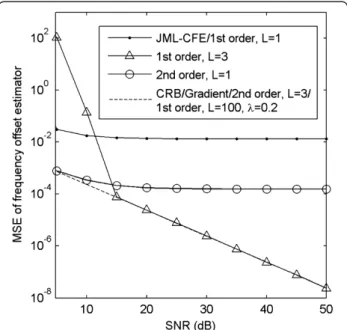
We next increase the CFO toδ= 0.2. Figures 3 and 4 show the corresponding performance curves for the same various algorithms. Here, the gradient method is found to work fine as well. Now with the increased CFO, the first order algorithms begin to perform poorly. As shown in the figures, the JML-CFE algorithm and
our first order method withL=1 andλ=1 yield unaccept-able performance results. The EM-based algorithm totally fails to perform and therefore is out of the pic-ture. However, it is to be noted that, for a givenδ, three parameters can affect or determine our algorithm per-formance. They are: 1) approximation order, 2) number of process iterations L, and 3) adjustment step size λ. Therefore, by increasing the number of iterations and adjusting the step size, our first order algorithm can be made to work with acceptable results. For instance, if usingλ= 0.2 with 100 iterations, the first order method can give a performance comparable to the second order algorithm with L=3 as well as to the gradient algorithm. For our second order algorithm, no adjustment step size needs be introduced as mentioned earlier (i.e.,λ= 1), but the number of iterations must be at least L=3. An explanation is warranted for the first order performance in the low SNR region. As can be observed in Figure 3, the first order algorithm with L=1 is seen to do better than L=3 at low SNR. The reason for this odd phenomenon is because, when noise is high, the initial estimate given by (14a) may be in error. Therefore, fur-ther iterations from this erroneous point will direct the search to a wrong direction and lead to even worse esti-mates. Nonetheless, a remedy can be made by use of the adjustment step size of λ. As can be seen in Figure 3, when using a λ= 0.2 along with sufficient iterations
L=100, the first order algorithm can achieve a compar-able performance as that of a second order withL=3.
For the gradient method, we have used the origin as the starting point which works fine thus far. However, Figure 3CFO estimator MSE performance withδ= 0.2 for
various algorithms.
Figure 4CIR estimator MSE performance withδ= 0.2 for various algorithms.
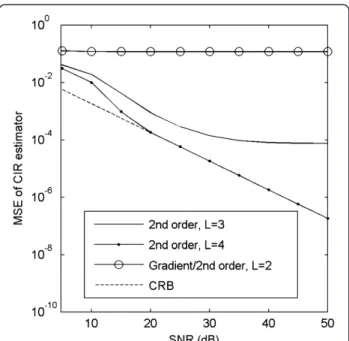
when the CFO exceeds half the subcarrier spacing, the difficulty of choosing the starting point as mentioned earlier starts to show up. Using the origin as the starting point at large CFO values will not work so fine anymore and, in fact, the gradient method will usually fail to con-verge to the global solution. In Figures 5 and 6, perform-ance curves of the gradient method and our 2nd order approximation method are given forδ= 1. Here, the gra-dient method fails to deliver acceptable performance, nor the second order algorithm with L=2 and 3. But when increasing the iteration number toL=4, the second order algorithm can perform satisfactorily if SNR exceeds 20dB. Again, the same odd phenomenon for the first order case at low SNR also occurs to the second order case due to a poor initial estimate given by (18b). We note here that, for fine frequency synchronization, CFO is usually smaller than 0.5 [18-20]. Nonethe-less, occasional large CFO that exceeds 0.5 does occur. This is when our proposed method becomes advanta-geous and useful. Furthermore, besides its major short-coming on the choice of starting point and step size, the gradient method has a slower convergence rate than our second order algorithm which needs only a single digit iteration number (L≤4 in all cases of simulations given
above) as against a two digit iteration number for the gradient method.
Numerous simulation tests indicate that, roughly, the EM-based algorithm has a tracking range less than ±0.05 of the subcarrier spacing and both the JML-CFE algo-rithm and our first order algoalgo-rithm with L=1 have a tracking range about ±0.1 of the subcarrier spacing. Our
first order algorithm with L=3 can achieve a tracking range about ±0.2 of the subcarrier spacing and it is found that further increasing Lwill not help the matter better. The gradient method can cover the range of half the subcarrier spacing. For our second order algorithm, when usingL=4, the tracking range can go up to [-1, 1] of the subcarrier spacing.
Figure 5CFO estimator MSE performance withδ= 1 for second order approximation and gradient method.
Figure 6CIR estimator MSE performance withδ= 1 for second order approximation and gradient method.
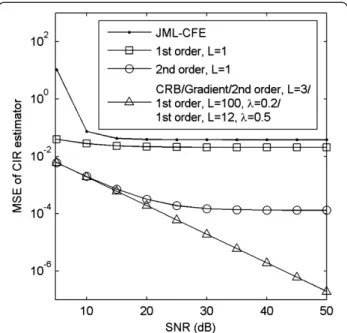
Over a long term period when fading is to be consid-ered, simulations for a frequency-selective Rayleigh fad-ing channel show more or less similar performance behaviors as for the static channel case. The impact of fading on the estimate performance for our first and sec-ond order algorithms includes reduced tracking range and the need for more iterations. Figures 7 and 8 present the performances of various algorithms under Rayleigh fading withδ= 0.2. Here again, the EM-based algorithm is found to yield unsatisfactory results and hence its per-formance is not shown in the figure. In view of Figures 7 and 8, we see that, for the same value L=1, the second order algorithm outperforms the first order algorithm as it should. However, when the iteration number is increased sufficiently with the aid of an adjustment step size, the first order algorithm can be enhanced to out-perform a second order algorithm with a low iteration number. This can be observed in the figures for the cases of first order algorithm with L=12, λ= 0.5 and
L=100,λ= 0.2 as both these first order cases outperform
the second order with L=1. However, as shown in the figures, the powerful second order algorithm with only
L=3 can easily compete with the above two cases of first order algorithm.
Finally, computation complexity is compared for vari-ous algorithms. Table 1 displays the arithmetic opera-tions needed in terms of real multiplication, addition, division, and square roots. One complex multiplication is equivalent to four real multiplications. One complex addition is equivalent to two real additions. Some com-posite data matrixes can be calculated in advanced and stored in memory before performing estimation algo-rithm. Gin (11), for example, can be pre-computed and stored in memory for later use in adaptive iterations. The needed arithmetic operations displayed in Table 1 exclude such situations. Moreover, L represents the number of iterative adaption needed.
As an example, we take L=3 for both the 1st and the 2nd order approximations, L=20 for the EM algorithm,
L=15 for the gradient algorithm, and v=N/4. Then, the EM algorithm requires 40N2+ 260N−20 real multiplica-tions, the JML-CFE needs 27N2+ 16N real multiplica-tions, and the gradient method takes 61N2+ 80N+ 1 real multiplications. In comparisons, the 1st order approxi-mation requires the least computational complexity of 25N2+ 39N−3 real multiplications, while the 2nd order approximation needs the most computation complica-tion of 85N2+ 78N+ 6 real multiplications.
5. Conclusion
We show that, for ML-based joint CFO and CIR estima-tion in OFDM systems, a proper approximaestima-tion simplifi-cation of the log-likelihood function coupled with the aid of a good iterative correction algorithm can result in satisfactory estimation performance. We first present a first order approximation algorithm and compare it with prevalent existing algorithms (also of first order). Our first order algorithm is found to be superior to others with faster convergence, wider tracking range, least com-putation requirement, and estimation accuracies. Then a second order approximation algorithm is presented with further performance improvement with higher computa-tional cost.
Figure 8CIR estimator MSE performance withδ= 0.2 for various algorithms under Rayleigh fading.
Table 1 Computation complexity
Real multiplication Real addition Real division
Square roots
EM L(8vN+ 13N−1) 2L(2vN+N−v−2) L 0
JML-CFE 2N(13N+ 2v+ 8) 12N2+ 2vN−3N−2v−6 1 0
Gradient LN(4N+ 5) +N(4v+ 5)−1 L(2N2
−1) + 2v(N−1) 0 0
The 1st order algorithm L(8N2+ 13N−1) + 4vN L(4N2−3) + 2v(N−1)−1 L 0
Abbreviations
CFO: Carrier frequency offset; CIR: Channel impulse response;
OFDM: Orthogonal frequency division multiplexing; DFT: Discrete Fourier transform; ICI: Inter-carrier interference; EM: Expectation-maximization; MMSE: Minimum-mean-square error; i.i.d.: Identically distributed; RVs: Random variables; CFR: Channel frequency response; SNR: Signal-to-noise ratio.
Competing interests
The authors declare that they have no competing interests.
Author details
1Department of Electrical Engineering, Tamkang University, No.151,
Yingzhuan Rd., Tamsui Dist., New Taipei City 25137, Taiwan.2Department of Electrical Engineering, Fu Jen Catholic University, No.510, Zhongzheng Rd., Xinzhuang Dist., New Taipei City 24205, Taiwan.3Department of Computer Science and Engineering, Tatung University, No.40, Sec. 3, Zhongshan N. Rd., Taipei City 104, Taiwan.
Received: 9 June 2012 Accepted: 29 October 2012 Published: 16 November 2012
References
1. TM Schmidl, DC Cox, Robust frequency and timing synchronization for OFDM. IEEE Trans. Commun.45(12), 1613–1621 (1997)
2. JJ van de Beek, M Sandell, PO Borjesson, ML estimation of time and frequency offset in OFDM systems. IEEE Trans. Signal Process.45(7), 1800–1805 (1997)
3. HY Liu, RY Yen, Effective adaptive iteration algorithm for frequency tracking and channel estimation in OFDM systems. IEEE Trans. Veh. Technol.59(4), 2093–2097 (2010)
4. JJ van de Beek, O Edfors, M Sandell, SK Wilson, PO Borjesson, On channel estimation in OFDM systems, inProceedings of the IEEE 45th Vehicular Technology Conference, Chicago, IL, vol. 2, 1995, pp. 815–819 5. O Edfors, M Sandell, JJ van de Beek, SK Wilson, PO Borjesson, OFDM
channel estimation by singular value decomposition. IEEE Trans. Commun.
46(7), 931–939 (1998)
6. Y Li, N Seshadri, S Ariyavisitakul, Channel estimation for OFDM systems with transmitter diversity in mobile wireless channels. IEEE J. Sel. Areas Commun.
17(3), 461–471 (1999)
7. Y Li, Pilot-symbol-aided channel estimation for OFDM in wireless systems. IEEE Trans. Veh. Technol.49(4), 1207–1215 (2000)
8. TL Tung, K Yao, RE Hudson, Channel estimation and adaptive power allocation for performance and capacity improvement of multiple-antenna OFDM systems, inProceedings of the IEEE SPAWC’01, Taoyuan, Taiwan, 2001, pp. 82–85
9. Y Li, Simplified channel estimation for OFDM systems with multiple transmit antennas. IEEE Trans. Wireless Commun.1(1), 67–75 (2002)
10. Z Cheng, D Dahlhaus, Time versus frequency domain channel estimation for OFDM systems with antenna arrays, inProceedings of the IEEE 6th International Conference on Signal Processing, Beijing, China, vol. 2, 2002, pp. 1340–1343
11. Y Li, JH Winters, NR Sollenberger, MIMO-OFDM for wireless
communications: signal detection with enhanced channel estimation. IEEE Trans. Commun.50(9), 1471–1477 (2002)
12. S Coleri, M Ergen, A Puri, A Bahai, Channel estimation techniques based on pilot arrangement in OFDM systems. IEEE Trans. Broadcast.48(3), 223–229 (2002)
13. X Wang, Y Wu, JY Chouinard, Modified channel estimation algorithms for OFDM systems with reduced complexity, inProceedings of the IEEE 7th International Conference on Signal Processing, Beijing, China, vol. 2, 2004, pp. 1747–1751
14. MZA Khan, Low-complexity ML channel estimation schemes for OFDM, in Proceedings of the IEEE 13th International Conference on Network, Kuala Lumpur, Malaysia, vol. 2, 2005, pp. 607–612
15. KW Kang, J Ann, HS Lee, Decision-directed maximum-likelihood estimation of frame synchronisation offset. Electron. Lett.30(25), 2153–2154 (1994) 16. PH Moose, A technique for orthogonal frequency division multiplexing
frequency offset correction. IEEE Trans. Commun.42(10), 2908–2914 (1994) 17. T Keller, L Piazzo, P Mandarini, L Hanzo, Orthogonal frequency division
multiplex synchronization techniques for frequency-selective fading channels. IEEE J. Sel. Areas Commun.19(6), 999–1008 (2001)
18. X Ma, H Kobayashi, SC Schwartz, Joint frequency offset and channel estimation for OFDM, inProceedings of the IEEE GLOBECOM 2003, San Francisco, USA, vol. 1, 2003, pp. 15–19
19. FZ Merli, GM Vitetta, Iterative ML-based estimation of carrier frequency offset, channel impulse response and data in OFDM transmissions. IEEE Trans. Commun.56(3), 497–506 (2008)
20. JH Lee, JC Han, SC Kim, Joint carrier frequency synchronization and channel estimation for OFDM systems via the EM algorithm. IEEE Trans.
Veh. Technol.55(1), 167–172 (2006)
21. P Stoica, O Besson, Training sequence design for frequency offset and frequency-selective channel estimation. IEEE Trans. Commun.51(11), 1910–1917 (2003)
22. DC Chu, Polyphase codes with good periodic correlation properties. IEEE Trans. Inform. Theory.18(4), 531–532 (1972)
doi:10.1186/1687-1499-2012-341
Cite this article as:Yenet al.:Iterative joint frequency offset and channel estimation for OFDM systems using first and second order approximation algorithms.EURASIP Journal on Wireless Communications
and Networking20122012:341.
Submit your manuscript to a
journal and benefi t from:
7Convenient online submission
7Rigorous peer review
7Immediate publication on acceptance
7Open access: articles freely available online
7High visibility within the fi eld
7Retaining the copyright to your article