Emotion Classification Using Massive Examples Extracted from the Web
Ryoko TOKUHISA†‡ †Toyota Central R&D Labs., INC.
Nagakute Aichi JAPAN
Kentaro INUI‡
‡Nara Institute of Science and Technology
Ikoma Nara JAPAN
{ryoko-t,inui,matsu}@is.naist.jp
Yuji MATSUMOTO‡
Abstract
In this paper, we propose a data-oriented method for inferring the emotion of a speaker conversing with a dialog system from the semantic content of an utterance. We first fully automatically obtain a huge collection of emotion-provoking event in-stances from the Web. With Japanese cho-sen as a target language, about 1.3 million emotion provoking event instances are ex-tracted using an emotion lexicon and lexi-cal patterns. We then decompose the emo-tion classificaemo-tion task into two sub-steps: sentiment polarity classification (coarse-grained emotion classification), and emo-tion classificaemo-tion (fine-grained emoemo-tion classification). For each subtask, the collection of emotion-proviking event in-stances is used as labelled examples to train a classifier. The results of our ex-periments indicate that our method signif-icantly outperforms the baseline method. We also find that compared with the single-step model, which applies the emotion classifier directly to inputs, our two-step model significantly reduces sentiment po-larity errors, which are considered fatal er-rors in real dialog applications.
1 Introduction
Previous research into human-computer interac-tion has mostly focused on task-oriented dialogs, where the goal is considered to be to achieve a
c
2008. Licensed under the Creative Commons
Attribution-Noncommercial-Share Alike 3.0 Unported
li-cense (http://creativecommons.org/licenses/by-nc-sa/3.0/). Some rights reserved.
given task as precisely and efficiently as possi-ble by exchanging information required for the task through dialog (Allen et al., 1994, etc.). More recent research (Foster, 2007; Tokuhisa and Terashima, 2006, etc.), on the other hand, has been providing evidence for the importance of the af-fective or emotional aspect in a wider range of di-alogic contexts, which has been largely neglected in the context of task-oriented dialogs.
A dialog system may be expected to serve, for example, as an active listening1 partner of an el-derly user living alone who sometimes wishes to have a chat. In such a context, the dialog system is expected to understand the user’s emotions and sympathize with the user. For example, given an utterence I traveled far to get to the shop, but it
was closed from the user, if the system could infer
the user’s emotion behind it, it would know that it would be appropriate to say That’s too bad or
That’s really disappointing. It can be easily
imag-ined that such affective behaviors of a dialog sys-tem would be beneficial not only for active listen-ing but also for a wide variety of dialog purposes including even task-oriented dialogs.
To be capable of generating sympathetic re-sponses, a dialog system needs a computational model that can infer the user’s emotion behind his/her utterence. There have been a range of stud-ies for building a model for classifying a user’s emotions based on acoustic-prosodic features and facial expressions (Pantic and Rothkrantz, 2004, etc.). Such methods are, however, severely lim-ited in that they tend to work well only when the user expresses his/her emotions by “exaggerated”
1
Active listening is a specific communication skill, based on the work of psychologist Carl Rogers, which involves giv-ing free and undivided attention to the speaker (Robertson, 2005).
The restaurant was very far but it was closed
Input Emotion
classification using EP Corpus
(section 3.4)
<disappointment> Output
I was disappointed because the shop was closed and I d traveled a long way to get there I was disappointed that it started raining I am happy since the book store was open when I got back home
Web Text
Sentiment polarity classification
(section 3.3)
Emotion-provoking event corpus (EP corpus)
the shop was closed and I d traveled a long way to get there it started raining
I am alone on Christmas the book store was open when I got back home
Emotion-provoking event Emotion(polarity) disappointment
(negative)
happiness (positive)
Emotion classification
Building emotion-provoking
event corpus (section 3.2) OFFLINE
ONLINE
loneliness (negative) disappointment
(negative)
Figure 1: Overview of our approach to emotion classification
prosodic or facial expressions. Furthermore, what is required in generating sympathetic responses is the identification of the user’s emotion in a finer grain-size. For example, in contrast to the above example of disappointing, one may expect the re-sponse to My pet parrot died yesterday should be
That’s really sad, wheras the response to I may have forgotten to lock my house should be You’re worried about that.
In this paper, we address the above issue of emotion classification in the context of human-computer dialog, and demonstrate that massive amples of emotion-provoking events can be ex-tracted from the Web with a reasonable accuracy and those examples can be used to build a seman-tic content-based model for fine-grained emotion classification.
2 Related Work
Recently, several studies have reported about di-alog systems that are capable of classifying emo-tions in a human-computer dialog (Batliner et al., 2004; Ang et al., 2002; Litman and Forbes-Riley, 2004; Rotaru et al., 2005). ITSPOKE is a tutoring dialog system, that can recognize the user’s emo-tion using acoustic-prosodic features and lexical features. However, the emotion classes are limited to Uncertain and Non-Uncertain because the pur-pose of ITSPOKE is to recognize the user’s prob-lem or discomfort in a tutoring dialog. Our goal, on the other hand, is to classify the user’s emotions into more fine-grained emotion classes.
In a more general research context, while quite a few studies have been presented about opinion mining and sentiment analysis (Liu, 2006), re-search into fine-grained emotion classification has emerged only recently. There are two approaches
commonly used in emotion classification: a rule-based approach and a statistical approach. Ma-sum et al. (2007) and Chaumartin (2007) pro-pose a rule-based approach to emotion classifica-tion. Chaumartin has developed a linguistic rule-based system, which classifies the emotions engen-dered by news headlines using the WordNet, Sen-tiWordNet, and WordNet-Affect lexical resources. The system detects the sentiment polarity for each word in a news headline based on linguistic re-sources, and then attempts emotion classification by using rules based on its knowledge of sen-tence structures. The recall of this system is low, however, because of the limited coverage of the lexical resources. Regarding the statistical ap-proach, Kozareva et al. (2007) apply the theory of (Hatzivassiloglou and McKeown, 1997) and (Tur-ney, 2002) to emotion classification and propose a method based on the co-occurrence distribution over content words and six emotion words (e.g. joy, fear). For example, birthday appears more of-ten with joy, while war appears more ofof-ten with
fear. However, the accuracy achieved by their
method is not practical in applications assumed in this paper. As we demonstrate in Section 4, our method significantly outperforms Kozareva’s method.
3 Emotion Classification
3.1 The basic idea
vari-Table 1: Distribution of the emotion expressions and examples Sentiment 10 Emotion Emotion lexicon (349 Japanese emotion words)
Polarity Classes Total Examples
happiness 90 (happy) (joyful) (glad) (glad)
Positive pleasantness 7 (pleasant) (enjoy) (can enjoy)
relief 5 (relief) (relief)
fear 22 (fear) (fear) (frightening)
sadness 21 (sad) (sad) (feel sad)
disappointment 15 (lose heart) (drop one’s head)
Negative unpleasantness 109 (disgust) (dislike) (dislike)
loneliness 15 (lonely) (lonely) (lonely)
anxiety 17 (anxiety) (anxiety) (worry)
anger 48 (angry) (get angry) (angry)
ety of machine learning-based methods if a suffi-cient number of labelled examples were available. Our basic idea is to learn what emotion is typically provoked in what situation, from massive exam-ples that can be collected from the Web. The devel-opment of this approach and its subsequent imple-mentation has forced us to consider the following two issues.
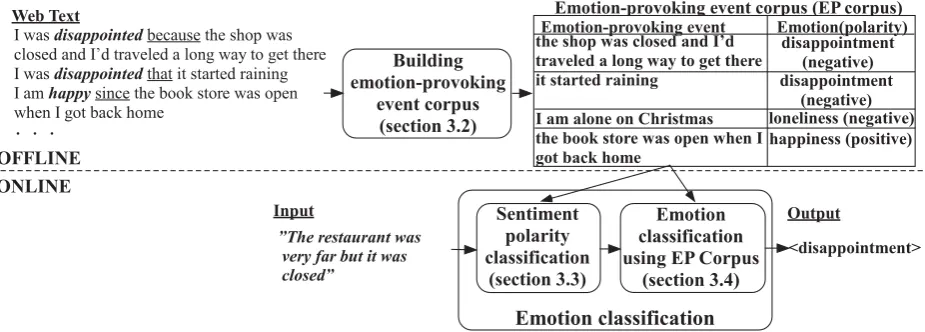
First, we have to consider the quantity and ac-curacy of emotion-provoking examples to be col-lected. The process we use to collect emotion-provoking examples is illustrated in the upper half of Figure 1. For example, from the sentence I was
disappointed because the shop was closed and I’d I traveled a long way to get there, pulled from the
Web, we learn that the clause the shop was closed
and I’d traveled a long way to get there is an
ex-ample of an event that provokesdisappointment. In this paper, we refer to such an example as an
emotion-provoking event and a collection of
event-provoking events as an emotion-event-provoking event
corpus (an EP corpus). Details are described in
Section 3.2.
Second, assuming that an EP corpus can be ob-tained, the next issue is how to use it for our emotion classification task. We propose a method whereby an input utterance (sentence) is classi-fied in two steps, sentiment polarity classification followed by fine-grained emotion classification as shown in the lower half of Figure 1. Details are given in Sections 3.3 and 3.4.
3.2 Building an EP corpus
We used ten emotions happiness, pleasantness,
relief, fear, sadness, disappointment, unpleasant-ness, loneliunpleasant-ness, anxiety, anger in our emotion
classification experiment. First, we built a hand-crafted lexicon of emotion words classified into the ten emotions. From the Japanese Evaluation Expression Dictionary created by Kobayashi et al. (2005), we identified 349 emotion words based
subordinate clause
emotion provoking event connective emotion lexicon
Figure 2: An example of a lexico-syntactic pattern
Table 2: Number of emotion-provoking events 10 Emotions EP event 10 Emotions EP event
happiness 387,275 disappoint- 106,284
ment
pleasantness 209,682 unpleasantness 396,002
relief 46,228 loneliness 26,493
fear 49,516 anxiety 45,018
sadness 31,369 anger 8,478
on the definition of emotion words proposed by Teramura (1982). The distribution is shown in Ta-ble 1 with major examples.
We then went on to find sentences in the Web corpus that possibly contain emotion-provoking events. A subordinate clause was extracted as an emotion-provoking event instance if (a) it was sub-ordinated to a matrix clause headed by an emo-tion word and (b) the relaemo-tion between the sub-ordinate and matrix clauses is marked by one of the following eight connectives: , , ,
, , , , . An example is given
in Figure 2. In the sentence “
(I was disappointed that it suddenly started raining)”, the subordinate clause “
(it suddenly started raining)”
mod-ifies “ (I was disappointed)” with the
connective “ (that)”. In this case, therefore,
the event mention “ (it suddenly
started raining)” is learned as an event instance
that provokesdisappointment.
Applying the emotion lexicon and the lexical patterns to the Japanese Web corpus (Kawahara and Kurohashi, 2006), which contains 500 million sentences, we were able to collect about 1.3 mil-lion events as causes of emotion. The distribution is shown in Table 2.
evalua-Table 4: Examples from in the EP corpus
EP-Corpus Result of evaluation
Emotion-provoking Event Emotion word 10 Emotions (P/N) Polarity Emotion
(A flower died quickly) (diappointed) disappointment(N) Correct Correct (There are a lot of enemies) (lose interest) unpleasantness(N) Correct Context-dep.
(There is a lot of Chinese cabbage)
(happy) happiness(P) Context-dep. Context-dep.
(I would like to drink orange juice)
(terrible) unpleasantness(N) Error Error
Table 3: Correctness of samples from the EP cor-pus
Polarity Emotion
Correct 1140 (57.0%) 988 (49.4%) Context-dep. 678 (33.9%) 489 (24.5%)
Error 182 (9.1%) 523 (26.2%)
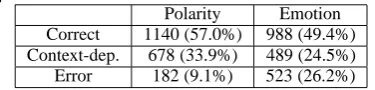
tion for the resultant EP corpus. One annotator, who was not the developer of the EP corpus, eval-uated 2000 randomly chosen events. The “Polar-ity” column in Table 3 shows the results of evaluat-ing whether the sentiment polarity of each event is correctly labelled, whereas the“Emotion” column shows the correctness at the level of the 10 emo-tion classes. The correctness of each example was evaluated as exemplified in Table 4. Correct indi-cates a correct example, Contex-dep. indiindi-cates a context-dependent example, and Error is an error example. For example, in the case of There are a
lot of enemies in Table 4, the “Polarity” is Correct
because it represents a negative emotion. How-ever, its emotion classunpleasantness is judged
Context-dep.
As Table 3 shows, the Sentiment Polarity is cor-rect in 57.0% of cases and partially corcor-rect (Cor-rect + Context-dep.) in 90.9% of cases. On the other hand, the Emotion is correct in only 49.4% of cases and partially correct in 73.9% of cases. These figures may not seem very impressive. As far as its impact on the emotion classification accu-racy is concerned, however, the use of our EP cor-pus, which requires no supervision, makes remark-able improvements upon Kozareva et al. (2007)’s unsupervised method as we show later.
3.3 Sentiment Polarity Classification
Given the large collection of emotion-labelled ex-amples, it may seem straightforward to develop a trainable model for emotion classification. Before moving on to emotion classification, however, it should be noted that a user’s input utterance may not involve any emotion. For example, if the user gives an utterance I have a lunch at the school
cafe-teria every day, it is not appropriate for the system
to make any sympathetic response. In such a case, the user’s input should be classified asneutral.
The classification between emotion-involved and neutral is not necessarily a simple problem, however, because we have not found yet any prac-tical method for collecting training examples of the classneutral. We cannot rely on the analogy to the pattern-based method we have adopted to col-lect emotion-provoking events — there seems no reliable lexico-syntactic pattern for extracting neu-tral examples. Alternatively, if the majority of the sentences on the Web were neutral, one would sim-ply use a set of randomly sampled sentences as la-belled data for neutral. This strategy, however, does not work because neutral sentences are not the majority in real Web texts. As an attempt, we collected 1000 sentences randomly from the Web and investigated their distribution of sentiment po-larity. The results, shown in Table 5, revealed that the ratio of neutral events was unexpectedly low. These results indicate the difficulty of collecting neutral events from Web documents.
Taking this problem into account, we adopt a two-step approach, where we first classify a given input into three sentiment polarity classes, either positive, negative or neutral, and then classify only those judged positive or negative into our 10 fine-grained emotion classes. In the first step, i.e. sen-timent polarity classification, we use only the pos-itive and negative examples stored in the EP cor-pus and assume sentence to be neutral if the out-put of the classification model is near the deci-sion boundary. There are additional advantages in this approach. First, it is generally known that performing fine-grained classification after coarse classification often provides good results particu-larly when the number of the classes is large. Sec-ond, in the context of dialog, a misunderstanding the user’s emotion at the sentiment polarity level would be a disaster. Imagine that the system says
You must be happy when the user in fact feels sad.
Table 5: Distribution of the Sentiment polarity of sentences randomly sampled from the Web
Sentiment Polarity Number Ratio
positive 650 65.0%
Figure 3: An example of a word-polarity lattice
Various methods have already been proposed for sentiment polarity classification, ranging from the use of co-occurrence with typical positive and neg-ative words (Turney, 2002) to bag of words (Pang et al., 2002) and dependency structure (Kudo and Matsumoto, 2004). Our sentiment polarity clas-sification model is trained with SVMs (Vapnik, 1995), and the features are {1-gram, 2-gram, 3-gram} of words and the sentiment polarity of the words themselves. Figure 3 illustrates how the
sen-tence “ (The cost of
educat-ing my child increases)” is encoded to a feature
vector. Here we assume the sentiment polarity of the “ (child)” and “ (education)” are
pos-itive, while the “ (cost)” is negative. These
polarity values are represented in parallel with the corresponding words, as shown in Figure 3. By expanding {1-gram, 2-gram, 3-gram} in this lat-tice representation, the following list of features are extracted: (child), Positive,
(child)-(of), Positive- (of), (child)- (of)-
(ed-ucation), etc.. The polarity value of each word is
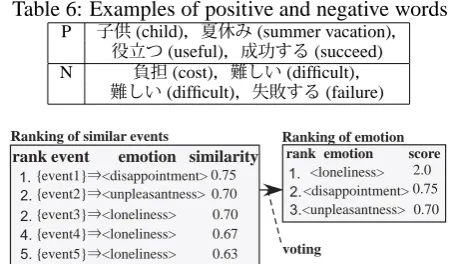
defined in our sentiment polarity dictionary, which includes 1880 positive words and 2490 negative words. To create this dictionary, one annotator identified positive and negative words from the 50 thousand most frequent words sampled from the Web. Table 6 shows some examples.
3.4 Emotion Classification
For fine-grained emotion classification, we pro-pose a k-nearest-neighbor approach (kNN) using the EP corpus.
Given an input utterance, the kNN model re-trieves k-most similar labelled examples from the EP corpus. Given the input The restaurant was
very far but it was closed as Figure 1, for
ple, the kNN model finds similar labelled exam-ples, say, labelled example{the shop was closed and I’d traveled far to get there}in the EP corpus.
Table 6: Examples of positive and negative words
P (child) (summer vacation)
(useful) (succeed)
N (cost) (difficult)
(difficult) (failure)
Ranking of similar events
rank event emotion similarity 1.
Figure 4: Emotion Classification by kNN (k=5)
For the similarity measure, we use cosine similar-ity between bag-of-words vectors;sim(I, EP) =
I·EP
|I||EP| for input sentence I and an emotion-provoking eventEPin the EP corpus. The score of each class is given by the sum of its similarity scores.
An example is presented in Figure 4. The emo-tion of the most similar event isdisappointment, that of the second-most similar event is unpleasantness tied with loneliness. Af-ter calculating the sum for each emotion, the system outputslonelinessas the emotion for the input I because the score for loneliness is the highest.
4 Experiments
4.1 Sentiment polarity classification
We conducted experiments on sentiment polarity classification using the following two test sets:
TestSet1: The first test set was a set of utterances which 6 subject speakers produced interact-ing with our prototype dialog system. This data include 31 positive utterances, 34 nega-tive utterances, and 25 neutral utterances.
TestSet2: For the second test set, we used the 1140 samples that were judged Correct with respect to sentiment polarity in Table 3. 491 samples (43.1%) were positive and 649 (56.9%) were negative. We then added 501 neutral sentences newly sampled from the Web. These samples are disjoint from the EP corpus used for training classifiers.
Table 7: F-values of sentiment polarity classifica-tion (positive/negative)
TestSet1 TestSet2
Pos Neg Pos Neg
Word 0.839 0.853 0.794 0.842
Word + Polarity 0.833 0.857 0.793 0.841
Table 8: F-values of sentiment polarity classifica-tion (positive/negative/neutral)
TestSet1 TestSet2
Pos Neg Pos Neg
Word 0.743 0.758 0.610 0.742
Word + Polarity 0.758 0.769 0.610 0.742
Table 7 shows the results for the two-class setting, whereas Table 8 shows the results for the three-class. “Word” denotes the model trained with only word n-gram features, whereas “Word+Polarity” denotes the model trained with n-gram features extracted from a word-polarity lat-tice (see Figure 3).
The results shown in Table 7 indicate that both the “Word” and “Word+Polarity” models are ca-pable of separating positive samples from negative ones at a high level of accuracy. This is an im-portant finding, given the degree of the correctness of our EP corpus. As we have shown in Table 3, only 57% of samples in our EP corpus are “ex-actly” correct in terms of sentiment polarity. The figures in Table 7 indicate that context-dependent samples are also useful for training a classifier. Ta-ble 7 also indicates that no significant difference is found between the “Word” and “Word+Polarity” models. In fact, we also examined another model which used dependency-structure information as well; however, no significant gain was achieved. From these results, we speculate that, as far as the two-class sentiment polarity problem is concerned, word n-gram features might be sufficient if a very large set of labelled data are available.
On the other hand, Table 8 indicates that the three-class problem is much harder than the two-class problem. Specifically, positive sentences tend to be classified as neutral. This method has to be improved in future models.
4.2 Emotion classification
For fine-grained emotion classification, we used the following three test sets:
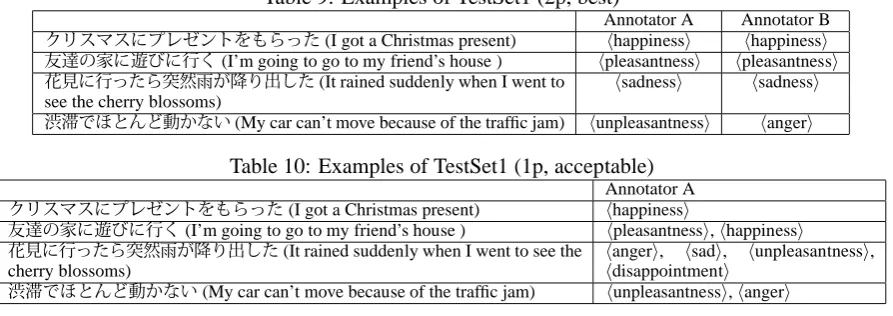
TestSet1 (2p, best): Two annotators were asked to annotate each positive or negative sen-tence in TestSet1 with one of the 10 emotion classess. The annotators chose only one tion class even if they thought several
emo-tions would fit a sentence. Some examples are shown in Table 9. The inter-annotator agree-ment isκ=0.76 in the kappa statistic (Cohen, 1960). For sentences annotated with two dif-ferent labels (i.e. in the cases where the two annotators disagreed with), both labels were considered correct in the experiments — a model’s answer was considered correct if it was identical with either of the two labels. TestSet1 (1p, acceptable): One of the above two
annotators was asked to annotate each posi-tive or negaposi-tive sentence in TestSet1 with all the emotions involved in it. The number of emotions for a positive sentence was 1.48 on average, and 2.47 for negative sentences. Ta-ble 10 lists some examples. In the experi-ments, a model’s answer was considered cor-rect if it was identical with one of the labelled classes.
TestSet2: For TestSet2, we used the results of our judgments on the correctness for estimating the quality of the EP corpus described in Sec-tion 3.2.
In the experiments, the following two models were compared:
Baseline: The baseline model simulates the method proposed by (Kozareva et al., 2007). Given an input sentence, their model first estimates the pointwise mu-tual information (PMI) between each content word cwj included in the sen-tence and emotion expression e ∈
{anger, disgust, fear, joy, sudness, surprise}
by P MI(e, cw) = loghitshits(e)(hitse,cw(cw) ), where hits(x) is a hit count of word(s) x on a Web search engine. The model then cal-culates the score of each emotion class Ei by summing the PMI scores between each content word cwj in the input and emotion expression ei corresponding to that emotion class: score(Ei) = jP MI(ei, cwj). Finally, the model chooses the best scored emotion class as an output. For our experi-ments, we selected the following 10 emotion expressions:
(happy), (pleased), (re-lieved), (affraid), (sad), (disappointed), (hate), (lonely),
(anxious), (angry)
Table 9: Examples of TestSet1 (2p, best)
Annotator A Annotator B (I got a Christmas present) happiness happiness (I’m going to go to my friend’s house ) pleasantness pleasantness
(It rained suddenly when I went to see the cherry blossoms)
sadness sadness
(My car can’t move because of the traffic jam) unpleasantness anger
Table 10: Examples of TestSet1 (1p, acceptable) Annotator A (I got a Christmas present) happiness
(I’m going to go to my friend’s house ) pleasantness,happiness (It rained suddenly when I went to see the
cherry blossoms)
anger, sad, unpleasantness,
disappointment (My car can’t move because of the traffic jam) unpleasantness,anger
㪈㪊㪅㪏㩼
㪋㪈㪅㪌㩼 㪋㪍㪅㪉㩼
㪌㪇㪅㪏㩼 㪌㪇㪅㪏㩼
㪌㪍㪅㪐㩼 㪍㪇㪅㪇㩼
㪈㪍㪅㪐㩼 㪍㪇㪅㪇㩼
㪍㪍㪅㪉㩼 㪎㪇㪅㪏㩼
㪎㪉㪅㪊㩼 㪎㪍㪅㪐㩼
㪏㪇㪅㪇㩼
㪌㪅㪎㩼
㪊㪍㪅㪌㩼 㪋㪇㪅㪎㩼
㪋㪌㪅㪉㩼 㪋㪎㪅㪈㩼 㪌㪇㪅㪊㩼 㪌㪇㪅㪈㩼
㪇㩼 㪈㪇㩼 㪉㪇㩼 㪊㪇㩼 㪋㪇㩼 㪌㪇㩼 㪍㪇㩼 㪎㪇㩼 㪏㪇㩼 㪐㪇㩼 㪈㪇㪇㩼
㪙㪸㫊㪼㫃㫀㫅㪼 㪈㪄㪥㪥 㪊㪄㪥㪥 㪈㪇㪄㪥㪥 㪈㪄㪥㪥 㪊㪄㪥㪥 㪈㪇㪄㪥㪥 㪜㫄㫆㫋㫀㫆㫅㩷㪚㫃㪸㫊㫊㫀㪽㫀㪺㪸㫋㫀㫆㫅 㪪㪼㫅㫋㫀㫄㪼㫅㫋㩷㪧㫆㫃㪸㫉㫀㫋㫐㩷㪂㩷㪜㫄㫆㫋㫀㫆㫅
㪚㫃㪸㫊㫊㫀㪽㫀㪺㪸㫋㫀㫆㫅
㪘
㪺
㪺
㫌
㫉㪸
㪺
㫐
㪫㪼㫊㫋㪪㪼㫋㪈㩿㪉㫇㪃㪹㪼㫊㫋㪀 㪫㪼㫊㫋㪪㪼㫋㪈㩿㪈㫇㪃㪸㪺㪺㪼㫇㫋㪸㪹㫃㪼㪀 㪫㪼㫊㫋㪪㪼㫋㪉
Figure 5: Results of emotion classification
k-NN: We tested the 1-NN, 3-NN and 10-NN models. In each model, we examined a single-step emotion classification and two-step emotion classification. In the former method, the kNN model retrieves k-most sim-ilar examples from the all of the EP corpus. In the latter method, when the sentiment polar-ity of the input utterance has obtained by the sentiment polarity classifier, the kNN model retrieves similar examples from only the ex-amples whose sentiment polarity are the same as the input utterance in the EP corpus.
The results are shown in Figure 5. “Emo-tion Classifica“Emo-tion” denotes the single-step mod-els, whereas “Sentiment Polarity + Emotion Clas-sification” denotes the two-step models.
An important observation from Figure 5 is that our models remarkably outperformed the base-line. Apparently, an important motivation behind Kozareva et al. (2007)’s method is that it does not require any manual supervion. However, our models, which rely on emotion-provoking event instances, are also totally unsupervised — no su-pervision is required to collect emotion-provoking event instances. Given this commonality between the two methods, the superiority of our method in
accuracy can be considered as a crucial advantage. Regarding the issue of single-step vs. two-step, Figure 5 indicates that the two-step models tended to outperform the single-step models for all the test set. A paired t-test for TestSet2, however, did not reach significance2. So we next examined this is-sue in further detail.
As argued in Section 3.3, in the context of human-computer dialog, a misunderstanding of the user’s emotion at the level of sentiment polar-ity would lead to a serious problem, which we call a fatal error. On the other hand, misclassifying a case ofhappiness as, for example,pleasantness may well be tolerable. Table 11 shows the ratio of fatal errors for each model. For TestSet2, the single-step 10-NN model made fatal errors in 30% of cases, while the two-step 10-NN model in only 17%. This improvement is statistically significant (p<0.01).
5 Conclusion
In this paper, we have addressed the issue of emo-tion classificaemo-tion assuming its potential applica-tions to be human-computer dialog system includ-ing active-listeninclud-ing dialog. We first automatically collected a huge collection, as many as 1.3M, of emotion-provoking event instances from the Web. We then decomposed the emotion classification task into two sub-steps: sentiment polarity clas-sification and emotion clasclas-sification. In sentiment polarity classification, we used the EP-corpus as training data. The results of the polarity classifi-cation experiment showed that word n-gram fea-tures alone are more or less sufficient to classify positive and negative sentences when a very large amount of training data is available. In the emo-tion classificaemo-tion experiments, on the other hand,
2
Table 11: Fatal error rate in emotion classification experiments Baseline Emotion Classification Sentiment Polarity
1-NN 3-NN 10-NN + Emotion Classification
TestSet1 49.2% 29.2% 26.2% 24.6% 15.4%
TestSet2 41.5% 37.6% 32.8% 30.0% 17.0%
we adopted the k-nearest-neighbor (kNN) method. The results of the experiments showed that our method significantly outperformed the baseline method. The results also showed that our two-step emotion classification was effective for fine-grained emotion classification. Specifically, fatal errors were significantly reduced with sentiment polarity classification before fine-grained emotion classification.
For future work, we first need to examine other machine learning methods to see their advantages and disadvantages in our task. We also need an extensive improvement in identifying neutral sen-tences. Finally, we are planning to apply our model to the active-listening dialog system that our group has been developing and investigate its effects on the user’s behavior.
References
Allen, James F., Lenhart K. Schubert, George Fergu-son, Peter Heeman, Chung Hee Hwang, Tsuneaki Kato, Marc Light, Nathaniel G. Martin, Bradford W. Miller, Massimo Poesio, and David R. Traum. 1994. The TRAINS Project: A case study in building a conversational planning agent. Journal of Experi-mental and Theoretical AI (JETAI).
Ang, Jeremy, Rajdip Dhillon, Ashley Krupski, Eliza-beth Shriberg, and Andreas Stolcke. 2002. Prosody-Based Automatic Detection Of Annoyance And Frustration In Human-Computer Dialog. Spoken Language Processing, pages 2037–2040.
Batliner, A., K. Fischer, R. Huber, J. Spilker, and E. Noth. 2004. How to find trouble in communi-cation. Speech Communication, 40(1-2):117–143. Chaumartin, Francois-Regis. 2007. A
knowledge-based system for headline sentiment tagging. In Pro-ceedings of the 4th International Workshop on Se-mantic Evaluations.
Cohen, Jacob. 1960. A coefficient of agreement for nominal scales. Educational and Psychological Measurement 20, pages 37–46.
Foster, Mary Ellen. 2007. Enhancing
Human-Computer Interaction with Embodied Conversa-tional Agents. Lecture Notes in Computer Science, 4555:828–837.
Hatzivassiloglou, Vasileios and Kathleen R. McKeown. 1997. Predicting the semantic orientation of adjec-tives. Proceedings of the 35th Annual Meeting of the Association for Computational Linguistics.
Kawahara, Daisuke and Sadao Kurohashi. 2006. Case Frame Compilation from the Web using High-Performance Computing. In Proceedings of the 5th
International Conference on Language Resources and Evaluation.
Kobayashi, Nozomi, Ryu Iida, Kentaro Inui, and Yuji Matsumoto. 2005. Collecting Evaluative Expres-sions for Opinion Extraction. Lecture Notes in Arti-ficial Intelligence, 3248.
Kozareva, Zornitsa, Borja Navarro, Sonia Vazquez, and Andres Nibtoyo. 2007. UA-ZBSA: A Headline Emotion Classification through Web Information. In Proceedings of the 4th International Workshop on Semantic Evaluations.
Kudo, Taku and Yuji Matsumoto. 2004. A Boost-ing Algorithm for Classification of Semi-Structured Text. In Proceedings of the EMNLP.
Litman, Diane J. and Kate Forbes-Riley. 2004. Predict-ing Student Emotions in Computer-Human TutorPredict-ing Dialogues. Proceedings of the 42nd Annual Meeting of the Association for Computational Linguistics. Liu, Bing. 2006. Web Data Mining. Springer, pages
411–440.
Masum, Shaikh Mostafa AI, Helmut Prendinger, and Mitsuru Ishizuka. 2007. Emotion Sensitive News Agent: An Approach Towards User Centric Emo-tion Sensing from the News. In Proceedings of the IEEE/WIC/ACM International Conference on Web Intelligence.
Pang, Bo, Lillian Lee, and Shivakumar Vaithyanathan. 2002. Thumbs up? sentiment classification using machine learning techniques. Proceedings of the Conference on Empirical Methods in Natural Lan-guage Processing, pages 76–86.
Pantic, Maja and Leon J. M. Rothkrantz. 2004. Fa-cial Action Recognition for FaFa-cial Expression Anal-ysis From Static Face Images. IEEE Transactions on SMC-B, 34(3):1449–1461.
Robertson, Kathryn. 2005. Active listening: more than just paying attention. Aust Fam Physician, 34(12):1053–1055.
Rotaru, Mihai, Diane J. Litman, and Katherine Forbes-Riley. 2005. Interactions between Speech Recog-nition Problems and User Emotions. Proceedings 9th European Conference on Speech Communication and Technology.
Teramura, Hideo. 1982. Japanese Syntax and Mean-ing. Kurosio Publishers (in Japanese).
Tokuhisa, Ryoko and Ryuta Terashima. 2006. Re-lationship between Utterance and ”Enthusiasm” in Non-Task-Orieinted Conversational Dialogue. In Proceedings of the 7th SIGdial Workshop on Dis-course and Dialogue.
Turney, P.D. 2002. Thumbs up? thumbs down? seman-tic orientation applied to unsupervised classification of reviews. Proceedings of the 40th Annual Meet-ing of the Association for Computational LMeet-inguistics, pages 417–424.