Volume 6, Issue 10 [October. 2017] PP: 57-61
The New Age Proposal of Archimedes’ Rocket Launch
Aryan Irani
a, Prof. Aqsa Temrikar
b Studenta, teacherb: Vibgyor High Corresponding Author: Aryan IraniABSTRACT
: Archimedes Steam Cannon is worked by a vessel, that can withstand a lot of pressure, to which we add water, and start a fire underneath. The fire heats the vessel, and that causes the water molecules to leave the liquid and populate the vessel [11]. As the temperature increases, the pressure inside the vessel also increases. Once the pressure climbs to a suitable PSI, the valve of the vessel is yanked open, and the water molecules burst out of the vessel, and straight to the projectile, causing the projectile, to shoot out of the barrel at a deadly speed. If the scale of this procedure is amplified, and use a rocket as our projectile, we can successfully achieve 100% fuel efficiency in rocket launch, without using a singularity of fuel stored in the rocket.--- Date of Submission: 23-10-2017 Date of acceptance: 07-11-2017 --- ---
I.
INTRODUCTION
:This paper consists of ideas proposed and implemented by Archimedes of Syracuse, in 214-212 BC, practical tests conducted by MIT (Massachusetts Institute of Technology), and also how we launch rockets into space. What this paper really is about though, how one of Archimedes projects can help us achieve 100% of fuel efficiency. A problem that great space associations like NASA, have been pondering upon for a very long time.[11]
1.1 Current Methods of rocket launch and the fuel used:
The reaction used for a rocket to break free from the earth‟s atmosphere is nothing but combustion. Where liquids are heated to give a gas and a massive amount of energy. Usually liquid hydrogen and oxygen are used for this process, where they react to form water and energy
2H2(L) + O2(L) = 2H2O(g) + Energy …………(i) However, petroleum such as a highly refined Kerosene called, RP-1 in the United States of America can also be used with liquid oxygen which acts as an oxidizer, to produce the desired energy. These types of fuels are only liquid fuels, and they produce a gas which escapes with a lot of force. The force exerted provides the rocket with enough thrust to power the rocket upwards, pushing against the force of gravity, and out of the atmosphere. [6] There are solid fuels as well, which are used in Solid Fuel Rockets, which are chemical rockets which use propellant at solid state. This fuel is the fuel used by the early firecrackers developed by the Chinese centuries ago[4]. Aluminum powder serves as the fuel and a mineral salt, ammonium perchlorate, is the oxidizer. Ammonium perchlorate, the salt of perchloric acid and ammonia, is a powerful oxidizer. In the boosters, the aluminum powder and ammonium perchlorate are held together by a binder, polybutadiene acrylonitrile, or PBAN. The mixture, with the consistency of a rubber eraser, is then packed into a steel case[6]. Then it burns, oxygen from the ammonium perchlorate combines with aluminum to produce aluminum oxide, aluminum chloride, water vapor and nitrogen gas – and lots of energy. This reaction heats the inside of the solid rocket boosters to more than 5,000 degrees Fahrenheit, causing the water vapor and nitrogen to rapidly expand. Just like in the liquid engines, the nozzle funnels the expanding gases outward, creating thrust and lifting the rocket from the launch pad. Compared to liquid engines, solid motors have a lower specific impulse – the measure rocket fuel efficiency that describes thrust per amount of fuel burned. However, the propellant is dense and burns quite quickly, generating a whole lot of thrust in a short time. And once they‟ve burned their propellant and helped propel the rocket into space, the boosters are discarded, lightening the load for the rest of the spaceflight. [11] As complicated it sounds, the solid rocket fuel is less efficient compared to the liquid rocket fuel. When solid fuel is used, the main engines provide thrust which accelerates the rocket from 4,828 kilometers per hour (3,000 mph) to over 27,358 kilometers per hour (17,000 mph) in just six minutes to reach orbit. They create a combined maximum thrust of more than 1.2 million pounds. [10]
Looking at the statistics above, do you not feel that “203,400” is a whole lot of Kerosene and that we should look for ways not to use so much of earths nonrenewable resources?
To launch a space shuttle into outer space, we need 143,000 gallons of liquid oxygen and 383,000 gallons of liquid hydrogen. The fuel itself weighs approximately 20 times as the Shuttle. With the Archimedes Steam Cannon we can drastically reduce it.[9]
1.2 Archimedes Steam Cannon:
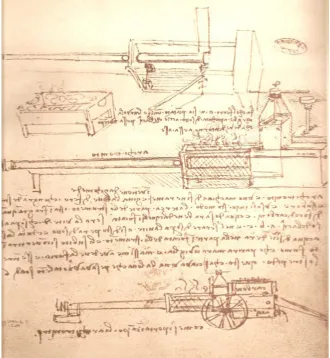
The Archimedes Steam Cannon, feared as a weapon of mass destruction, that was invented and used in the Siege of Syracuse, in 214-212 BC, is a Cannon that uses steam or gaseous H2O to push a projectile, such as 5-pound Iron ball, at a deadly velocity. Velocity so great, that it had the potential to destroy battleships in 214-212 BC.
Figure 1. Representation of Archimedes Steam Cannon, from Leonardo da Vinci, Volume II Istituto Geografico de Agostini Novara 1956.
This is a diagram from the ArchiMIT‟s team, where students from MIT tested to see, whether this experiment really worked or not. And sure enough, it did.
According to Da Vinci‟s drawings, we need a vessel or a tank that is capable of holding a lot of pressure, and add water inside the vessel[7]. When the water is heated at really high temperatures in a closed system, the water molecules leave the liquid and start to populate the vessel. As the temperature increases, the pressure in the vessel increases, as the gaseous water particles exert a force on the inside of the vessel. After the pressure reaches to a considerable quantity ( approx. 4500 PSI),and the valve being yanked open, the projectile will be exposed to the burst of steam that was in the vessel, all at once, providing enough energy to shoot out of a barrel at a great speed. The ArchiMIT‟s used this theory to conduct an experiment on 5th November 2006, by setting up apparatus with the following details:
barrel length: 2 feet barrel bore: 1.5 inches volume of water: ½ cup
projectile mass: 0.5 kg (1-pound, 1 oz.) estimated firing pressure: 3,500-4,000 PSI estimated muzzle velocity: 280 m/s (630 mph)
estimated range: 1,200 meters, shell drag coefficient of 1.1
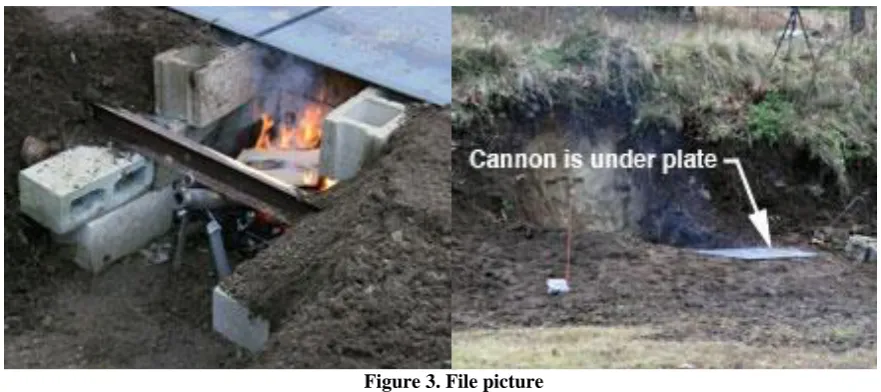
Figure 3. File picture
They observed the firings, which were aimed at a sand berm, on remote moniters, behind a hill, 150 feet away from the cannon. Two rounds were fired from the cannon, with the time to reload the cannon being close to 2 minutes. The muzzle velocity observed from a high speed camera was over 300m/s (approx. 630 mph). The shells kinetic energy was calculated to be approximately 23 KJ - which is 1.3 to 1.8 times the energy of a 0.50 BMG caliber bullet fired from a M2 machine gun (a comparison made by the ArchiMIT‟s). Now with this data, we are safe to say that Archimedes isn‟t wrong.[11]
II.
WORKING PRINCIPLE
2.1 Using Archimedes‟ idea for Rocket Launch:
The experiments conducted above prove that Archimedes Steam cannon, is a plausible working idea. Using this idea we can achieve 100% fuel efficiency, to get a body or projectile such as a rocket or a shuttle, out of the earths atmosphere. It would be 100% fuel efficiency for the rocket as, we aren‟t using the fuel stored in the rocket, but instead giving the rocket a little push from below, using the priniciples of Archimedes‟ steam cannon. Instead of us, using ½ a cup of water, we can use 8453.5 US customary cups (2000 litres), then achieve a pressure of 6000-10,000 PSI. With the drag cooeficient being 1.1, the 1 pound mass, will gain a velocity of 4750.586. Mind you that, escape velocity is 11.8 km/s.This is excluding drag force. The drag force calculated, is an approximate of 4823497856 Newtons.
Drag Force = 𝐃𝐫𝐚𝐠 𝐂𝐨𝐞𝐟𝐟𝐢𝐜𝐢𝐞𝐧𝐭 𝐱 (𝐦𝐚𝐬𝐬 𝐱 𝐯𝐞𝐥𝐨𝐜𝐢𝐭𝐲
𝟐)
𝟐 𝐱 𝐫𝐞𝐟𝐞𝐫𝐞𝐧𝐜𝐞 𝐚𝐫𝐞𝐚 ………..(ii)
Considering the technology of today, it won‟t be a problem for NASA or any other space association for that matter, to gain a vessel, that can sustain so much pressure and volume (considering the amount of RP-1 they use in the rockets). So if we use 757,082 litres of water (which is almost the amount of Kerosene, used in a Saturn V ), we can comfortably lift a rocket, withs its mass at a velocity well over the escape velocity of earth (11.8km/s). Even though Theorectically, this means that we aren‟t using any fuel from the rocket for getting out of the earths atmosphere, therefore the rocket will have 100% of fuel at its disposal, for travel. Normally, we use about 50-60% or even more rocket fuel just to get of our atmosphere, with this method, we can all of our rocket fuel judicously, instead of wasting half of it to get out of the atmosphere.
If the vessel containing the 757,082 litres of water, is placed underneath the rocket, with the valve being yanked open at 6000-10,000 PSI, the thrust created by the steam will be more than enough to exceed escape velocity, or even orbital speed for sattelites. At least, we can save on our fossil fuels by this method, and use it for normal day peoples, commuting fuel.
2.2 Launching into space using this method :
With this method, the projectile will literally be pushed into space, unlike a normal rocket which gradually accelerates out of the earths orbit. Therefore the force applied on the rocket is sudden, and not gradual. Hence, Human cargo or even living cargo cannot be launched in to space. This method can help us by firing probes or Satellites into space, but not humans. As, if humans are made to sit in the space craft that is being launched, the sudden “push” will force almost all of the blood in his body, straight to his brain, which will either knock him or her out or make him or her suffer from a brain hemorrhage. This is not safe for the pilot, and therefore he or she cannot board the spacecraft. The Steam launch, can however be very resourceful, as supply drops for existing spacestations, and even for discovery probes that are sent to explore our solar system. The drag coefficient for this probe or any another space capsule for that matter, will be 1.2. The efficiency of the steam launch, can even help us push our boundaries, and explore beyond the Solar systems. We aren‟t able to explore more of the space around us, due to the lack of supplies that we have, which can now be solved using this Steam Launch.
Theorectically speaking, the probe can be manouvered, using remote control. On earth, can send signals to the probe and steer it in space. This can be done by using one of our existing sattelite‟s, that are orbiting around the earth, to amplify the bandwidth of our signal. This example is similar to WiFi, where the router transmits a signal, and devices like Net Gear, can help us increase the range of the signal, so that people can connect to the WiFi router, even though they are at a distance. In this case, the sattelite will be our Net Gear. Therefore, we can propell the probe even without a pilot. This can help us with providing supplies to existing space stations, or even take images, or footages of the space around us.
We may even be able to propel the probe, to reach a certain destination without us propelling it, by setting a GPS that helps the probe or ship to be self-propelled. But then again, in time we may be able to figure out how to send human cargo in space using this method of Rocket Launch.
With the extra fuel that we have to our disposal, the new possibilities of space expeditions are high. As you can now travel further, and even last longer in space. In time, we will develop a fuel that will be titled as “Most Efficient”, but for the time being, even using 100% of fuel in outer space is huge. At least now we can travel twice or maybe thrice the distance than travelled before, and this is just the start. Rockets today are launched in sections, and it is only the payload that goes out of the atmosphere. The payload is approximately 20 times less than the sections of the rocket that fall back down to earth. That means that using the Steam Launch, we are even cutting down on the rockets total weight. More importantly, Archimedes had designed the Steam Cannon, as a weapon of mass destruction. The principles used in the cannon, can now benefit the masses. After presenting all the data I have, I am safe to say that the Archimedes Steam Launch can theoretically and practically help us achieve, 100% fuel efficiency to get a rocket out of the earth‟s atmosphere.
III.
CONCLUSION
The Steam Cannon, can help us achieve 100% fuel efficiency in a rocket launch, which will help us last longer in space, and with the extra fuel we have to our disposal, we can travel a greater distance in space, and even decrease the weight of a the rocket itself, as the payload of the rocket weighs approximately 20 times less than the sections of the rocket that are dropped back to earth.
REFRENCES
[1]. Horst O.Hardenberg, The Middle Ages of the I.C. engine (Warrendale, 1999, 41) Carnegie, p 137
[2]. Chaloner, W. H.; Farnie, D. A.; Henderson, W. O., eds. (1990). Industry and Innovation: Selected Essays of W.H. Chaloner. Routledge. ISBN 0-7146-3335-6.
ignited the gas so produced. But by 1794 a much larger retort in his back yard allowed him to light his living room, as Francis Trevithick later wrote: „Those still live who saw the gas-pipes conveying gas from the retort in the little yard to near the ceiling of the room, just over the table. A hole for the pipe was made in the window-frame‟ (F. Trevithick, Life of Richard Trevithick, with an account of his inventions, 2 vols. (1872), page 64).
[4]. Chisholm, Hugh, ed. (1911). "Murdock, William". Encyclopædia Britannica (11th ed.). Cambridge University Press.
[5]. Joseph R. Mitchell, David Stebenne (2007). New City Upon a Hill: A History of Columbia, Maryland. The History Press. p. 23. ISBN 978-1596290679.
[6]. Mike Radinsky (28 November 2010). "Huge Civil War-Era Gun A Curious Piece of Elkridge History". Patch Media.[dead link]
[7]. Lamb, John (2011). A Strange Engine of War: The "Winans" Steam Gun and Maryland in the Civil War. Baltimore: Chesapeake Book Company.
[8]. US patent 24,031, William Joslin, "Improvement in Centrifugal Guns", issued 1859-5-17 [9]. US patent 24,997, Charles S. Dickinson, "Improvement in Centrifugal Guns", issued 1859-8-9 [10]. "The Baltimore Steam Battery". Scientific American. 4 (21): 321. May 25, 1861.[permanent dead link]
[11]. http://web.mit.edu/2.009/www/experiments/steamCannon/ArchimedesSteamCannon.html