DISSERTATION ON
“A STUDY TO ASSESS THE EFFECTIVENESS OF
STRUCTURED TEACHING PROGRAMME ON LEVELS OF
KNOWLEDGE REGARDING POTTY TRAINING (TOILET
TRAINING) AMONG MOTHERS OF TODDLERS AT
RESIDING AT MEDAVAKK AM RURAL AREA CHENNAI.”
M.SC (NURSING) DEGREE EXAMINATION
BRANCH- II CHILD HEALTH NURSING
COLLEGE OF NURSING
MADRAS MEDICAL COLLEGE, CHENNAI-600 003
A dissertation submitted to
THE TAMIL NADU DR.M.G.R.MEDICAL UNIVERSITY,
CHENNAI- 600 032
In partial fulfillment of the requirement for the award of the degree of
MASTER OF SCIENCE IN NURSING
“A STUDY TO ASSESS THE EFFECTIVENESS OF
STRUCTURED TEACHING PROGRAMME ON LEVELS OF
KNOWLEDGE REGARDING POTTY TRAINING (TOILET
TRAINING) AMONG MOTHERS OF TODDLERS AT
RESIDING AT MEDAVAKK AM RURAL AREA CHENNAI.”
Examination : M.Sc (Nursing) Degree Examination
Examination Month and Year :
Branch & Course : II – CHILD HEALTH NURSING Register Number : 301616253
Institution : COLLEGE OF NURSING,
MADRAS MEDICAL COLLEGE, CHENNAI – 600 003.
Sd: __________________ Sd: ___________________ Internal Examiner External Examiner
Date: ____________ Date: ____________
CERTIFICATE
This is to certify that this dissertation titled, “A STUDY TO ASSESS THE EFFECTIVENESS OF STRUCTURED TEACHING PROGRAMME ON LEVELS OF KNOWLEDGE REGARDING POTTY TRAINING (TOILET TRAINING) AMONG MOTHERS OF TODDLERS AT RESIDING AT MEDAVAKKAM RURAL AREA CHENNAI” is a bonafide work done by Mr.G.KEERTHI, M.Sc Nursing II Year student, College of Nursing, Madras Medical College, Chennai-03, submitted to The Tamil Nadu Dr.M.G.R. Medical University, Chennai-32, in partial fulfillment of the university rules and regulations towards the award of the degree of Master of Science in Nursing, Branch-II, Child Health Nursing under our guidance and supervision during academic year from 2016-2018.
Mrs.A.Thahira Begum, M.Sc(N)., MBA., M.Phil., Principal,
College of Nursing, Madras Medical College, Chennai – 03.
Dr.R.Jayanthi, M.D., F.R.C.P. (Glasg)., Dean,
“A STUDY TO ASSESS THE EFFECTIVENESS OF
STRUCTURED TEACHING PROGRAMME ON LEVELS OF
KNOWLEDGE REGARDING POTTY TRAINING (TOILET
TRAINING) AMONG MOTHERS OF TODDLERS AT
RESIDING AT MEDAVAKK AM RURAL AREA CHENNAI”
Approved by the Dissertation Committee on 11.07.2017. RESEARCH GUIDE
Mrs.A.Thahira Begum, M.Sc (N)., MBA., M.Phil., ____________
Principal,
College of Nursing, Madras Medical College, Chennai – 600 003.
CLINICAL SPECIALITY GUIDE
Mrs.G.Mary, M.Sc (N)., MBA., _____________
Lecturer, Head of the Department, Department of Child Health Nursing,
College of Nursing, Madras Medical College, Chennai – 600 003.
MEDICAL EXPERT
Dr.A.T.Arasar Seeralar, M.D., D.C.H., _____________ Director and Superintendent,
Institute of Child Health and Hospital for Children, Egmore Chennai-08.
A Dissertation submitted to
THE TAMIL NADU DR.M.G.R.MEDICAL UNIVERSITY,
CHENNAI – 600 032.
In partial fulfillment of requirement for the award of degree of
MASTER OF SCIENCE IN NURSING
ACKNOWLEDGEMENT
“Among the remedies which it has pleased Almighty God to give to man to
relieve his sufferings, none is so universal and so efficacious as opium.”
-Thomas Syndenham
I would like to thank Almighty for his abundant grace, blessings, wisdom, knowledge, guidance, strength and unconditional love showered in completing this study without any interruption.
I express my genuine gratitude to the Institutional Ethics Committee of Madras Medical College for giving me an opportunity to conduct this study.
My sincere thanks to Dr.R.Jayanthi, M.D, F.R.C.P (Glasg)., Dean, Madras Medical College, Chennai-3, for permitting me to conduct this study in Community area.
I would like to express my deep and sincere gratitude to our respected Prof.Sudha Seshayyan, M.S., Vice Principal, Member Secretary, Institutional Ethics Committee, Madras Medical College, Chennai-3, for approval of this study.
I render my deep sense of sincere thanks to Dr.A.T.Arasar Seeralar, M.D., D.C.H, Director and Superintendent, Institute of Child Health and Hospital for Children, Egmore, Chennai - 08, for his valuable suggestions and guidance for this study.
I render my deep sense of sincere thanks to Dr.T.Ravichandran, M.D., D.C.H., Former Director and Superintendent, Institute of Child Health and Hospital for Children, Egmore, Chennai - 08, for his valuable suggestions and guidance for this study.
My great pleasure and privileges to express my gratitude to,
Ms.A.Thahira Begum, M.Sc(N)., MBA., M.Phil., Principal College of Nursing, Madras Medical College, Chennai-03, for her support, encouragement, prudent guidance, and valuable suggestions in completing this study.
With deep sense of collosal contemplation, I express my whole hearted gratitude to my esteemed Speciality guide Mrs.G.Mary, M.Sc (N)., MBA., Lecturer, H.O.D - Child Health Nursing, College of Nursing, Madras Medical College, Chennai – 03, for her academic and professional excellence, brain storming ideas, treasured guidance, highly instructive research mentorship, thought provoking suggestions, moral support and patience that has moulded me to conquer the spirit of knowledge for sculpturing my manuscript into thesis.
I am grateful to Mr.A.Senthil Kumaran, M.Sc(N)., Lecturer, Department of Child Health Nursing, College of Nursing, Madras Medical College, Chennai – 03, for his valuable guidance, suggestion, motivation, timely help and support throughout this study.
I am thankful to all the Faculty of College of Nursing, Madras Medical College, for their timely advice, encouragement and support.
I owe my deepest sense of gratitude to Dr.A.Venkatesan, M.Sc., Ph.D., former Statistician at DDME for his suggestion and guidance in statistical analysis.
I thank our librarian Mr.S.Ravi., M.L.I.S, College of Nursing, Madras Medical College for his co-operation and assistance which built the sound knowledge for this study.
I thank Mr.A.Joseph Santhaseelan, M.A., B.Ed., M.Phil., B.T Assistant for editing and providing certificate of English editing.
I thank Ms.K.Shameem Banu M.A, M.A, B.ed,M.Phil, B.T Assistant for editing and providing certificate of Tamil editing.
I thank Mr.Jas Ahamed Aslam, Shajee Computers, Mr.Hussain, City Dot Net and Mr. Ramesh, MSM Xerox, for their help utilizing patience in printing the manuscript and completing this dissertation work.
I have much pleasure of expressing my cordial appreciation and thanks to all the Mothers who participated in the study with interest and cooperation.
Words are beyond expressions for meticulous effort and guidance of my beloved Father Mr.M.Gopal My lovable mother
Mrs.Ravaneetham Gopal for their whole consent, encouragement, support and funding, otherwise this work would not be successfully completed.
It is my pleasure and privilege to express my deep sense of gratitude to my cousin sisters Ms.Ashwini, M.Sc (N)., Ms.P.Tamil Selvi, M.Sc(N)., for guidance and support to complete this study.
I take this opportunity to thank all my Colleagues, Friends,
Teaching and Non-Teaching Staff Members, and Office Staff Members of Madras Medical College – College of Nursing for their co-operation and help rendered
I extend my heartfelt gratitude to those who have contributed directly or indirectly for the successful completion of this dissertation.
ABSTRACT
The researcher has been selected study because even today the mothers are not aware of the importance of toilet training and consequently leads to behavioural disorders. Hence, the researcher felt to identify the learning needs of mothers and to educate them regarding toilet training by introducing structured teaching programme and promoting the psycho behavioural health of toddlers which in turn reduces the behavioural disorders among toddler children.
TITLE: “A study to assess the effectiveness of structured teaching programme on levels of knowledge regarding potty training (toilet training) among mothers of toddlers at residing at medavakkam rural area Chennai.”
OBJECTIVES: To assess the pre test level of knowledge regar ding potty training among the mothers of toddlers, to assess the post test level of knowledge regarding potty training among the mothers of toddlers, to evaluate the effectiveness of structured teaching programme regarding potty training among the mothers of toddlers, to associate the post test level of knowledge regarding potty training and with selected demographic variables of mothers of toddlers.
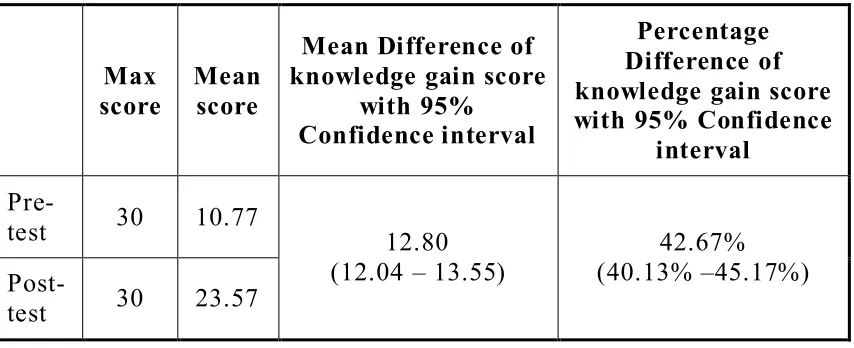
RESULTS: The result shows in post test after structured teaching programme mothers were gained 42.67% knowledge score, mean differences were 12.80% by using students paired t-test and generalized McNemar’s. It is statistically significant.
TABLE OF CONTENTS
CHAPTER CONTENT PAGE NO
I INTRODUCTION 1
1.1 Need for the study 4
1.2 Statement of the problem 7
1.3 Objectives of the study 7
1.4 Operational definition 8
1.5 Assumption 9
1.6 Hypothesis 9
1.7 Delimitations 9
II REVIEW OF LITERATURE
2.1 Literature review related to the study 10
2.2 conceptual frame work 26
III RESEARCH METHODLOGY
3.1 Research approach 28
3.2 Study design 28
3.3 Study setting 29
3.4 Duration of the study 29
3.5 Study population 29
3.6 Sample size 29
3.7 Sampling criteria 29
3.8 Sampling technique 30
3.9 Research variables 30
CHAPTER CONTENT PAGE NO
3.12 Reliability of the tool 33
3.13 Ethical consideration 33
3.14 Pilot study 33
3.15 Procedure for data collection 34 3.16 Data entry and analysis 35 IV DATA ANALYSIS AND
INTERPRETATION
37
V DISCUSSION 55
VI SUMMARY,IMPLICATION,
RECOMMENDATION, LIMITATION AND CONCLUSION
6.1 Summary of the study 62
6.2 Major findings of the study 62
6.3 Implications 66
6.4 Recommendations 68
6.5 Limitation 68
6.6 Conclusion 68
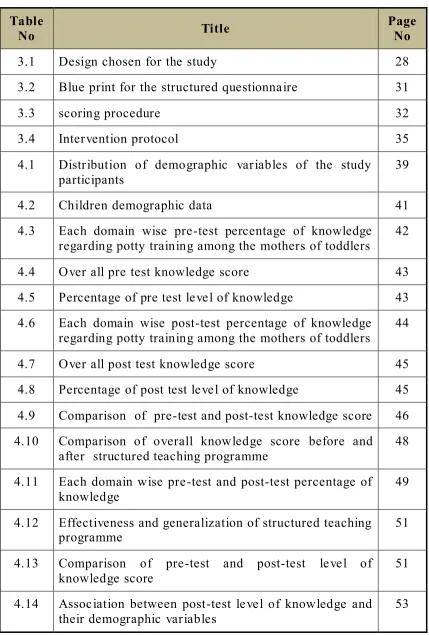
LIST OF TABLES
Table
No Title Page No
3.1 Design chosen for the study 28
3.2 Blue print for the structured questionnaire 31
3.3 scoring procedure 32
3.4 Intervention protocol 35
4.1 Distribution of demographic variables of the study participants
39
4.2 Children demographic data 41
4.3 Each domain wise pre-test percentage of knowledge regarding potty training among the mothers of toddlers
42
4.4 Over all pre test knowledge score 43 4.5 Percentage of pre test level of knowledge 43 4.6 Each domain wise post-test percentage of knowledge
regarding potty training among the mothers of toddlers 44 4.7 Over all post test knowledge score 45 4.8 Percentage of post test level of knowledge 45 4.9 Comparison of pre-test and post-test knowledge score 46 4.10 Comparison of overall knowledge score before and
after structured teaching programme 48 4.11 Each domain wise pre-test and post-test percentage of
knowledge
49
4.12 Effectiveness and generalization of structured teaching
programme 51
4.13 Comparison of pre-test and post-test level of
knowledge score 51
4.14 Association between post-test level of knowledge and
[image:13.596.85.514.99.734.2]LIST OF FIGURES
Figure
number Title
2.1 Conceptual frame work based on modified Imogene kings goal attainment theory (1981)
3.1 Schematic prepresentation of research methodology 4.1 Percentage distribution of age of the study participants 4.2 Percentage distribution of educational status of the study
participants
4.3 Percentage distribution of occupational status of the mother 4.4 Percentage distribution of family monthly income of the
participants
4.5 Percentage distribution of religion of the study participants 4.6 Percentage distribution of number of children in the
family
4.7 Percentage distribution of previous exposure to bowel training programme
4.8 Percentage distribution of care taker of the study participants
4.9 Percentage distribution of age of child study participants 4.10 Percentage distribution of gender of the child of study
participants
4.11 Percentage distribution of order of birth of child of study participants
4.12 Percentage distribution of pre test level of knowledge score.
4.13 Percentage distribution of post test level of knowledge 4.14 Box Plot compares the mothers pre-test and post-test
Figure
number Title
4.15 Percentage distribution of comparison of overall
knowledge score before and after structured teaching programme
4.16 Percentage distribution of domain wise knowledge gain score
4.17 Percentage distribution of comparison of pre-test and post-test level of knowledge score
4.18 Percentage distribution of association between post test level of knowledge score and mothers age
4.19 Percentage distribution of association between post test level of knowledge score and mothers educational status 4.20 Percentage distribution of association between post test
level of knowledge score and family income
4.21 Percentage distribution of association between post test level of knowledge score and previous exposure to bowel training programme
APPENDICES
S.No Content
1. Certificate approval by Institutional Ethics Committee 2. Certificate of Content Validity by Experts
3. Letter Seeking permission to conduct study in Medavakkam 4. Tool for data collection – English and Tamil
5. Lesson plan for structured teaching program on toilet training – English and Tamil
6. Informed consent – English and Tamil 7. Certificate of English Editing
8. Certificate of Tamil Editing 9. Coding sheet
LIST OF ABBREVIATION
S.
No Abbreviation Expansion
1. ANOVA Analysis of Variance 2. CI Class Interval
3. DDHS Deputy Director of Health Services 4. DF Degrees of Freedom
5. ETT Enhanced Toilet Training
6. NS Non Significant
7. P Significance
8. PVR Post Voiding Residual Urine 9 PHC Primary Health Centre
10. SD Standard Deviation
11. SPSS Statistical Package for Social Sciences 12. STP Structured Teaching Programme
13. TT Toilet Training
14. TTU Toilet Training for Urine continence
CHAPTER – I
INTRODUCTION
“Let us sacrifice our today so that our children can have a better tomorrow”
– A.P.J. Abdul Kalam
Toilet training is the process of teaching young children to control of bladder and bowel movements and to use the toilet. It is one of the first step that children take to become self sufficient. Learning bladder and bowel control is based on the two process, training by the parents, who teach the child where and how to urinate and pass stools and learning by the child to recognize their body signals on how to control release and retain by sphincters. Each child exhibits an individual rhythm of development. Hence toilet training is a challenge for both mother and child.
What is the best way to train my child on toilet? This is a common question parents ask, and so as to guide families and health care workers with evidenced-based information, a systematic review was recently conducted on this topic1. While a meta-analysis would have been a more powerful study (prevented by heterogeneity of the included studies), practical information was still obtained by this first-ever systematic review on toilet training (TT).
and achieved during 18 months to 24 months of age. It is the time of intense exploration of the environment as children attempts to find out how things work and how to control others through temper tantrums, negativism, and obstinacy. Although this can be a challenging time for parents and child as each learns to know the other better. It is an extremely important period for developmental achievement and intellectual growth.
Toilet training is felt to be a natural process that occurs with development, yet very little scientific information is available for the physicians who care for children. In reality, toilet training is a complex process that can be affected by anatomic, physiologic and behavioural conditions. Accepted norms of toilet training relate more to cultural differences than scientific evidence. Despite this, parents continue to approach their family physicians and pediatricians for advice about toilet training. This article summarizes the most common methods of toilet training and provides an overview of the literature in an attempt to help physicians provide advice to their patients.2
Toilet readiness is a combination of both child and parent willingness to participate in toilet training. Child signals the parents about the readiness to begin toilet training. In addition, the parent must be willing to toilet train the child and be aware of training obstacles, such as the child attending day care or any physical or mental disability that the child may have. The child must be physiologically and behaviourally ready to toilet train. They must exhibit some degree of bladder and bowel control, having the neurological maturity to co- operate, and voluntarily participate in toilet training. “The brazelton child –oriented approach” is strongly supported in the pediatric literature. It emphasizes gradual toilet training beginning only after specific physical and psychological mile stones are achieved. Readiness for toilet training doesn‟t automatically occur when a child reaches a certain age. Rather, children, over the course of many months gradually become physically and emotionally ready to take on this challenge. A child is completely toilet trained when the child is able to be conscious of his or her own need to eliminate urine and stool and can initiate the act without being reminded or prepared by parents. Acquiring autonomy to use the toilet requires that the child has mastered not only language but also motor, sensory, neurological and social skills. Biological development growth slowly considerably during toddler hood. It is a periods of steady growth curve that is step like in nature.2
GLOBAL SCENARIO
The worldwide prevalence of enuresis among children aged 6 –12 years is 1.4%–28%.3
INDIAN SCENARIO
prevalence is highest in children aged 5–8 years (and 6–8 years) and lowest in children aged 11–12 years (8–10 years).Nocturnal enuresis has been reported in 18.4% of children with sleep problems fro m a single center in India..4, 5, 7
1.1 NEED FOR THE STUDY
“It is easier to build a strong child than to repair broken men”
– Frederick douglass
American academy of pediatrics reported that learning to use the toilet, the child takes a dramatic step toward control of his own life. This is often the first real opportunity the child is given to independently manage an activity of daily living, one that no one can do for him. It is, however, an activity both emotionally charged and often messy. Not surprisingly, more abuse occurs during toilet training than during any other developmental step. Parents' expectations often exceed the child's abilities or understanding, and the child's frustrations and imperfect attempts at self-control are easily mistaken for wilfu l disobedience.7
There are some habitual problems like enuresis and encopresis and personality problems like shyness, timidity, fear, anger, conflict due to rejected or isolated, jealousy and rivalry towards younger child in the family who have already achieved bladder control, resentment and tension for disturbed bladder control seen due to improper toilet training.8
rural and half from urban areas). A constipation score that was based on modified Rome III criteria was developed for each child. Functional constipation was reported 1.6 times more in the rural than the urban population (P < .001). Toilet training was initiated and completed earlier in the urban (18.6 ± 6.8 and 46 ± 12.5 months) than the rural children (28.6 ± 6.1 and 56.5 ± 6.7 months) (P < .001). The daily calorie, macronutrient, fiber, and water intake was higher in the urban population (P < .001). Functional constipation was significantly (P = .016) negatively correlated (r = −0.076) with the fiber intake.9
Bedwetting affects five to seven million children in the United States. 15 percent of children still wet the bed at age 5, 7% to 10% of children still wet the bed at age7, 3% of boys and 2% of girls still wet the bed at age 10, 1% of boys and very few girls still wet the bed at age 18. So you can see while it is not uncommon for older child to wet the bed, most outgrow bedwetting as they get older. In fact, about 15 % of children outgrow bedwetting each year.10, 11
Shepard JA, Poler JE Jr, Grabman JH (2016) Pediatric elimination disorders are common in childhood, yet psychosocial correlates are generally unclear. Given the physiological concomitants of both enuresis and Encopresis, and the fact that many children with elimination disorders are initially brought to their primary care physician for treatment, medical evaluation and management are crucial and may serve as the first-line treatment approach. Scientific investigation on psychological and behavioural interventions has progressed over the past couple of decades, resulting in the identification of effective treatments for enuresis and Encopresis. For nocturnal enuresis, the urine alarm and dry-bed training were identified as well-established treatments, Full Spectrum Home Therapy was probably efficacious, lifting was possibly efficacious, and hypnotherapy and retention control training were classified as treatments of questionable efficacy. For Encopresis, only two probably e fficacious treatments were identified: biofeedback and enhanced toilet training (ETT). Best practice recommendations and suggestions for future research are provided to address existing limitations, including heterogeneity and the multicomponent nature of many of the interventions for pediatric elimination disorders.13
and 24 months of age, parents should be informed that TT is a complex skill integrating physiological and behavioural processes.11,12 Girls are successfully trained approximately three months earlier than boys, with both sexes achieving success by approximately three years of age13
The nurse should educate the mothers of toddlers regarding toilet training as part of her health services, so the mothers can improve their child‟s personality, developmental milestones, health level through getting knowledge regarding definition, age for toilet training, indication for readiness, process, problems, complication, parental role of potty training will provide normal development positively.
The researcher has been selected study because even today the mothers are not aware of the importance of toilet training and consequently leads to behavioural disorders. Hence, the researcher felt to identify the learning needs of mothers and to educate them regarding toilet training by introducing structured teaching programme and promoting the psycho behavioural health of toddler children which in turn reduces the behavioural disorders among toddler children.
1.2 STATEMENT OF THE PROBLEM
“A study to assess the Effectiveness of structured teaching programme on levels of knowledge regarding potty Training (toilet training) among the mothers of toddlers at residing at Medavakkam rural area Chennai.”
1.3 OBJECTIVES
1) To assess the pre test level of knowledge regarding potty training among the mothers of toddlers
3) To evaluate the effectiveness of structured teaching programme regarding potty training among the mothers of toddlers
4) To associate the post test level of knowled ge regarding potty training with selected demographic variables of mothers of toddlers
1.4 OPERATIONAL DEFINITION
Assess
It refers to any activity to estimate the outcome of structured teaching programme and knowledge of mothers regarding potty training (toilet training) as revealed by suitable knowledge questionnaire.
Effectiveness
It refers to the amount of knowledge gained and the extent to which teaching on potty training has impact among mothers of toddlers which is measured in terms of structured questionnaire.
Structured Teaching Programme
It is a well prepared systematic design of education regarding potty training which includes the importance, appropriate methods, age to initiate potty training techniques, advantages and parental role in toilet training for the mothers of toddler by the investigator.
Knowledge
It refers to correct facts and information obtained by the mothers of toddlers on potty training assessed by answering semi structured questionnaire.
Potty Training
Mothers
Refers to mothers of children between 18- 36 months
1.5 ASSUMPTION
1) Mothers have varying level of knowledge on potty training.
2) Structured teaching programme may improve the knowled ge about potty training.
3) Adequate knowledge on potty training will reduce the incidence constipation enuresis and encopresis
1.6 HYPOTHESIS
At P ≤ 0.001 level
H1 – There is a significant difference between pre test and post test knowledge score on potty training after structured teaching programme among mothers of toddlers
H2 – There is significant association between post test knowledge scores with selected demographic variables, regarding potty training among mothers of toddlers
1.7 DELIMITATION
1) The data collection period is only four weeks
CHAPTER –II
LITERATURE REVIEW
Review of literature provides the basis for future investigations and indicates constraints data collection. According to Polit and Hungler (1999) literature are critical, summaries of what is known about a particular topic with background of understanding what has been already learned a topic and specify accumulation of knowledge and illuminate about the significant of the new study.14
2.1 LITERATURE REVIEW RELATED TO THE STUDY
For the purpose of logical sequence the chapter is divided into following parts
2.1.1 : Studies related to age at initiation of toilet training 2.1.2 : Studies related to toilet training
2.1.3 : Studies related to toilet training problems 2.1.4 : Studies related to toilet training methods
2.1.1:STUDIES RELATED TO AGE AT INITIATION OF
TOILET TRAINING
and use of a potty chair were determined to be factors affecting toilet training age. In conclusion, toilet training age in Turkey, a developing country, was found to be lower than that in developed countries.15
Nanik budiastuti, (2014) a cross sectional study was conducted to determine the pattern of Toilet Training and the factor that may be related to its timing and duration and the approaches of different socio-cultural groups within a developing country. 745 children who live in three different socio-cultural groups by survey method. The duration of training was longer in families living in rural and semi- urban groups. This study concluded that Toilet Training shows differences among cultures. The age of initiation may be increased. As the parents are educated better and a child oriented approach becomes more popular than the parent oriented approach.16
Shelly.J, (2014) research study was carried out to pin-point the appropriate time framework for initiating Toilet Training. The researcher observed 150 children and divided into 2 groups, which included children between the ages of 4 and 12 who had experienced some form of urge incontinence. He determined that children within the age group who received Toilet Training after 32 months of age showed more incidence of bed wetting, day-wetting and others of urge incontinence issues. It was concluded that the period between t he age group of 24 to 32 months as the parents to begin Toilet Training lessons with their children.17
children start toilet training at 30 months and were ended at 39 months of age .When surveyed 50% of African Americans felt it was important their child to be Toilet Trained by age of two, while only 4% of Caucasian parent agreed with the statement. So this study was concluded that 21 month of appropriate Age for Toilet Training.18
Karolien van Nunen, Nore Kaerts, et al., (2013) in recent years, the age at which parents start and finish toilet training (TT) their children have increased. To cope with the problems caused by this later completion, it is essential to identify the beliefs and attitudes of the parents. 2000 questionnaires were distributed to parents of children aged 30 to 36 months, attending 50 randomly selected schools in Antwerp, Belgium. Too many children are toilet trained after the minimum school age of 30 months. Higher the mother‟s educationa l level, the more likely she will send her child to school toilet trained. More of single parents think that children who are not yet toilet trained should be allowed to go to school and more often send them not fully toilet-trained children to school.19
Nore Kaerts, Guido Van Hal, et al., (2012) confusion exists about when to start toilet training, which causes stress and anxiety. Another consequence can be the actual postponement of the toilet training process, which has created extra social problems. They gathered information about the normal development of healthy children and at which age skills needed for each readiness sign are acquired. Twenty‐one readiness signs were found. Results show that there is no consensus on which or how many readiness signs to use. More studies are needed to define which readiness signs are most important and how to detect them easily.20
training and development of daytime bladder control. The Sample comprises of 8000 children, aged 4.5 to 9 years. Compared with children whose toilet training was initiated between 15 and 24 months, initiation of toilet training after 24 months was associated with higher odds of membership to the trajectory groups represe nting persistent daytime wetting (1.52 [1.23–1.88], p < .001), delayed acquisition of daytime bladder control (1.47 [1.29–1.66], p < .001), or relapse in daytime wetting (1.52 [1.28–1.80], p < .001). There is evidence that initiating toilet training after 24 months is associated with problems attaining and maintaining bladder control.21
Ivor B. Horn, Ruth Brenner, et al., (2006) to examine racial and socio economic differences in parental beliefs about the appropriate age at which to initiate toilet training. A cross-sectional survey of 779 parents visiting child health providers in 3 clinical sites in Washington and the surrounding metropolitan area completed a self-report survey. Among respondents, parents felt that the average age at which toilet training should be initiated was 20.6 months with a range of 6 to 48 months. Caucasian parents believed that toilet training should be initiated at a significantly later age (25.4 months) compared with both African-American parents (18.2 months) and parents of other races (19.4 months).22
frequent constipation. In conclusion, a later age at initiation of toilet training, stool toileting refusal, and constipation may explain some of the trend toward completion of toilet training at later ages.23
Blum NJ, Taubman B, et al., (2003) conducted a study on relationship between age at initiation of toilet training, age at completion of toilet training, and the duration of toilet trainin g. A total of 406 children seen at a suburban private pediatric practice were enrolled in a study of toilet training between 17 and 19 months of age, and 378 (93%) were followed by telephone interviews with the parents every 2 to 3 months until the child completed daytime toilet training. Results are Age of initiation of toilet training correlated with age of completion of training (r = 0.275). The correlation between age at initiation of intensive training and age at completion was even stronger (r = 0.459). Indicating that initiation of training at younger ages was associated with a longer duration of training.24
Parents often want to know when to start TT and how long the process should take. On average, neuromuscular development of bowel and bladder control is present by 18 months of age; however, other factors amenable to TT (communication and gross motor skills, and temperament) may not yet be appropriately developed. One longitudinal study 11 suggested that children may not be ready for successful TT until two years of age, and yet another study 12 suggested that if TT is started before two years of age, duration of training may be relatively longer. Girls are successfully trained approximately three months earlier than boys, with both sexes achieving success by approximately three years of age 13
a cohort of children who were 15 to 42 months of age and attending 4 pediatric practices in the Milwaukee area .The median ages for readiness skills for girls and boys, respectively, were as follows: “showing an interest in using the potty,” 24 and 26 months; “staying dry for 2 hours,” 26 and 29 months; “indicating a need to go to the bathroom,” 26 and 29 months. There was a marked concordance in the sequences in which girls and boys achieve individual skills.25
2.1.2: STUDIES RELATED TO TOILET TRAINING
Manish K. Goyal (2017) the study was conducted to determine the knowledge of toilet training among the mothers of toddlers of selected area, Jaipur. In pre-experimental ,one group pre-test post test design. The sample 50 is selected by the convenient sampling techniques. Results Findings from this study pre-test that about 80% of participants were inadequate knowledge, 16% participants were in moderate knowledge and 04% participants were adequate knowledge of toilet training among the mother of toddlers. After the post –test 06% participants were inadequate knowledge, 10% participants were moderate knowledge and 84% participants were adequate knowledge of toilet training among the mother of toddlers. These findings shows that structured teaching programme will improve the knowledge of the mothers about toilet training.26
awareness regarding toilet training and to decrease the problems while giving toilet training to the toddlers.27
Davina Richardson, June Rogers, et al., (2017) becoming toilet trained is a milestone all parents strive for; but for families of children with additional needs this may appear to be an unobtainable goal. It is important that assessment and introduction of toilet-training skills should not be delayed purely on the basis of the child's perceived lack of „readiness‟. Studies have identified that a delay in achieving bladder control increases the risk of both bladder problems and constipation, and lack of assessment could result in potential underlying co -morbidities being missed. The introduction of a step-by-step approach to toilet training with ongoing assessment enables the child to develop the appropriate skills and any underlying pathology to be identified and addressed in a timely manner.28
Solarin, A U, Olutekunbi, O A, et al., (2017) this study reports on toilet training with a focus on the effect of age, methods used, and factors that can affect urinary incontinence in Nigerian children. This was a cross-sectional hospital-based study carried out in public and private hospitals in South-Western Nigeria. A questionnaire was used to obtain information about toilet training practices from 350 adults, who toilet trained 474 children. Results shows that Daytime continence was achieved by 33.4% of children at ≤12 months old, and night -time continence was achieved in 29.7% of children between 12 and 18 months old. By 30 months, 91.1% and 86.9% had attained day - and night-time continence, respectively, and only 8.6% of the children were incontinent at night.29
study .The sample consisted of 60 mothers having preschool children and Convenience sampling technique was used to select the subjects. The tool consisted of structured questionnaire. Results found Among 7 demographic variables it was noticed that four varia bles i.e., age, education, occupation and income found to be statistically significant at 5 per cent level (P<0.05) & the association with Knowledge of practice level, it can be seen that age, education, occupation and religion found to be significant at 5 per cent level (P<0.05) and the remaining variables found non-significant.30
Van nunen K, kaerts.n, et al., (2015) a study was conducted to identify the belief and attitudes of parents concerning Toilet Training. A sample size of 2000 questionnaire were distributed to parents of children aged 32 -36 months. 50 children were randomly selected schools in. Belgium. The study resulted in a conclusion that maximum numbers of children are Toilet Trained after the minimum school age of 30 months. Most of the parents are not aware of the possible negative consequences, so parents should be better informed about the possible negative consequences of later completion of Toilet Training. 31
Mallappa.A, Santosh Kumar S.K, et al., (2014) the descriptive study was conducted in Hebbur village the sampling was Random sampling technique. The statistical analysis showed that out of 100 mothers of early childhood (17 to 30 months) children, 17% had adequate knowledge, 68% had moderately adequate knowledge and only 15% had inadequate knowledge regarding toilet training of early childhood children. The mean percentage level of knowledge mothers of early childhood (17 to 30 months) children regarding toilet training was 59.5% .33
Kaerts.N, vanhal.G , et al., (2014) study was conducted to investigate how the Toilet Training is dealt with day care centre and parents. A sample size of totally 256 parents of healthy children between 15 - 35 months aged children were assessed using structured questionnaire and analysis was done by using statistical Package for the social sciences [SPSS] 18.0. The study resulted that the cooperation between parents and day-care seen as positive .Finally concluded that several Concerns were raised regarding method of Toilet Training between parents and day care centre. It shows further research on this topic is needed.34
beneficial to prevent voiding dysfunction. The recommendations of physicians might be more readily adopted if they fit culturally accepted ideas of good parenting techniques.35
Yang S.S.D, Zhao L.L., et al., (2011) to report the relationship between the ages initiating toilet training for urinary continence (TTU) and bladder function in healthy kindergarteners in 3 years were evaluated urinary continence status and bladder function in 318 healthy kindergarteners. Children started daytime TTU earlier (≤ 18, 19 -24, and >24 months, N = 66, 71, and 98, respectively) was associated with earlier attainment of both daytime and night time continence (correlation coefficient = 0.60 and 0.31, respectively, P < 0.01). Children started night time TTU earlier (<30 months vs. ≥ 30 months) was associated with early attainment of night time continence and lower rate of enuresis (14.3% vs. 33.3%, P < 0.01). The prevalence rate of repeat abnormal uroflow patterns and repeat elevated PVR (>20 ml) was not different between early and late TTU. 36
Shulamit Natan Ritblatt, Amy Dale Obegi, et al., (2009) this study examines the differences in attitudes and practices of 89 parents and 97 child care professionals from San Diego County regarding toilet training. The results indicate that parents and child care professionals hold significantly different beliefs about when to initiate training, readiness cues, toileting practices, and response to accidents. Professionals sought guidance from books, other staff members, and children's parents when difficulties in training arose. Parents, alternatively, sought toileting advice from family members and friends. Recommendations focus on encouraging partnership building among professionals, parents, and children to create individually tailored and culturally sensitive toilet training plans.37
Russell K (2008) Over the past 100 years, recommended toilet training (TT) methods have oscillated between the two most common TT methods used in North America – rigid adult-directed programs and child-oriented ones (1). In 1962, Brazelton (2) developed the „child readiness‟ approach, which focused on gradual training and is child -oriented. Current TT guidelines developed by the Canadian Paediatric Society and the American Academy of Pediatrics include a child -oriented approach, not starting before 18 to 24 months of age, and beginning when the child displays.38
2.1.3: STUDIES RELATED TO TOILET TRAINING
PROBLEMS
Heron .J, Grzeda M, et al (2018) conducted a study on early childhood risk factors for constipation and soiling at school age. They extracted four latent classes: 'normative' (74.5%: very low probability of constipation or soiling), „constipation alone‟ (13.2%), 'soiling alone' (7.5%) and 'constipation with soiling' (4.8%). Hard stools at 2½ years were associated with increased odds of constipation alone. Developmental delay at 18 months was associated soiling alone and constipation with soiling, but not constipation alone. They found limited evidence of associations with socioeconomic background and evidence of associations with age at initiation of toilet training, breast feeding, gestational age or birth weight.40
Jumana Hanna, Albaramki, et al., (2017) aim of this study was to determine the pattern of toilet training (TT) in Jordan, the factors that are related to the initiation age, duration and the methods of training used among different socio cultural groups. Mean initiation and completion ages were 22.5 - 6.50 and 26.48 - 9.37 months respectively. Intensive method was used in 59.4%, child-oriented in 40.6%. Young mothers used more frequently the intensive method. Constipation and stool toilet refusal developed in 15.4% and 15.1% respectively and there was a significant association between constipation and older age of starting toilet training. The age of initiation may be increased as parents are better educated and a child-oriented approach becomes more popular than the intensive approach.41
efficacious, and hypnotherapy and retention control training were classified as treatments of questionable efficacy. For Encopresis, only two probably efficacious treatments were identified: biofeedback and enhanced toilet training (ETT). 12
Steve J Hodges, Gorbachinsky I, et al., (2014) to determine whether age of toilet training is associated with dysfunctional voiding in children. Initiation of toilet training prior to 24 months and later than 36 months of age were associated with dysfunctional voiding. However, dysfunctional voiding due to late toilet training was also associated with constipation. Dysfunctional voiding may be due to delayed emptying of the bowel and bladder by children. The symptoms of dysfunctional voiding are more common when toilet training early, as immature children may be less likely to empty in a timely manner, or when training late due to (or in association with) constipation.42
Benjasuwantep B, Ruangdaraganon.N, et al., (2011) prospective study was conducted to investigate the association between age at initiation of toilet training and development of daytime bladder control. The study is based on more than 8000 children, aged 2.5 to 3 years from UK birth cohort The avon longitudinal study of parents and children. The analysis examined the association between age at initiation of Toilet Training and 4 previously established trajectory groups representing different patterns of development of daytime bladder control .It was concluded that there is evidence that initiating Toilet Training after 24 months is associated with problems attaining and maintaining bladder control.43
was associated with urge incontinence (P=0.02). For children who display signs of toilet-training readiness, training should be initiated prior to 32 months of age to reduce the risk for urge incontinence.44
Mota DM, Barros AJ et al., (2008) to review both the scientific literature and lay literature on toilet training, covering parents' expectations, the methods available for achieving bladder and bowel control and associated morbidities. Training methods are rarely used. Children who have not been trained correctly present with enuresis, urinary infection, voiding dysfunction, constipation, Encopre sis and refusal to go to the toilet more frequently. Toilet training is occurring later in the majority of countries. The training methods that exist are the same from decades ago and are rarely used by mothers and valued little by pediatricians; incorrect training can be a causative factor for bladder and bowel disorders, which in turn cause problems for children and their families.45
Nathan J. Blum, Taubman B, et al., (2004) conducted a study on factors associated with later training. Children between 17 and 19 months of age (n=406) were enrolled in the study. At enrollment, parents completed the Parenting Stress Index and the Receptive -Expressive Emergent Language Scale. Follow-up parent interviews were conducted every 2 to 3 months until children completed daytime toilet training. Models including these variables explained 25% to 39% of the variance in age at completion of toilet training. In conclusion, a later age at initiation of toilet training, stool toileting refusal, and constipation may explain some of the trend towar d completion of toilet training at later ages.47
Edward R. Christophersen, Ph.D., (2003) the term evidence-based medicine refers to an approach to problem solving and continual professional learning that requires the use of the current best evidence in making medical decisions about individual patients the area of toilet training and toilet-training problems is a fascinating one. All children eventually are toilet trained, and virtually every parent and many day -care workers have to do it. Yet, at present, there is very little in the way of empirical data to guide the primary care physician in making recommendations to parents about toilet training or the problems that come when toilet training is unsuccessful. In a review of the literature on treating problems related to toilet training, such as encopresis, functional constipation, and stool toileting refusal.48
completed daytime toilet training. The behavior of hiding while defecating before completion of toilet training is associated with stoo l toileting refusal, constipation, and stool withholding. These behaviors may make toilet training more difficult.49
2.1.4 : STUDIES RELATED TO TOILET TRAINING
METHODS
Carol Joinson, (2009) Cross-sectional survey was performed on 745 children who live in three different socio cultural settlements. The factors that might have affected initiation and completion age and duration of toilet training were assessed with t-test, ANOVA and logistic regression analysis. The duration of training was longer in families living in rural and semi-urban settlements, mothers educated for less than 5 years, unoccupied mothers, and children living in houses which do not have a toilet inside, families who use washable diapers and when the initiation was before the child was 18 months old. It was concluded that Toilet training shows differences among cultures. The age of initiation may be increased as the parents are educated better and a child-orientated approach becomes more popula r than the parent-orientated approach. 50
2.2 CONCEPTUAL FRAMEWORK
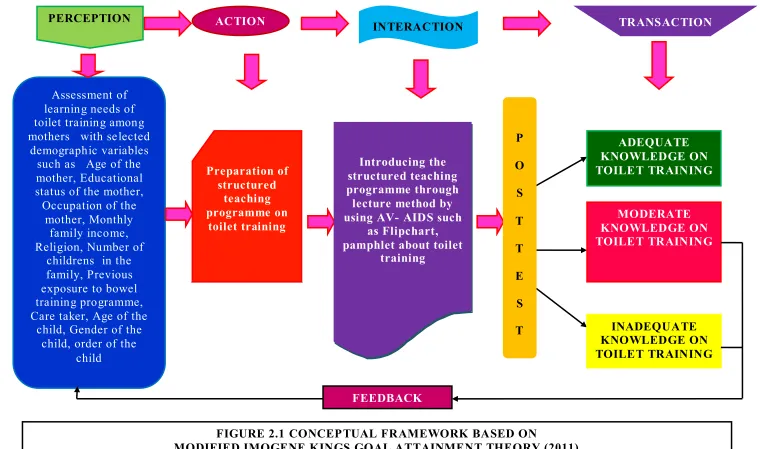
This investigator has adopted Imogene King's Goal Attainment Theory (2011) based on personal and interpersonal systems including perception, action, interaction and transaction. The investigator adopted this basic theory for conceptual framework which is aimed to find out the effectiveness of structured teaching programme on level of knowledge regarding toilet training among mothers of toddlers. This involves interaction between the researcher and mothers of toddlers.
There are six major concepts.
PERCEPTION
It refers to people‟s representation of reality. It is not observable but it can be inferred, hence the investigator has the perception for the assessment of demographic variables and pretest assessment about the effectiveness of structured teaching programme on level of knowledge regarding toilet training among mothers of toddlers residing at Medavakkam rural area, Chennai.
JUDGEMENT
The investigator has found mother has inadequate knowledge on toilet training. He has decided to give education to mothers of toddlers to improve their knowledge about toilet training.
ACTION
REACTION
The investigator reaction is to set goal which is increasing the knowledge regarding toilet training.
INTERACTION
It refers to the verbal and nonverbal behaviour between one individual and environment or between two or more individual who involve goal directed perception and communication. Here the investigator interacts with the mothers of toddlers by giving pretest and structured teaching programme by using flipchart for the process of toilet training and role of parents using pamphlet.
TRANSACTION
CHAPTER – III
METHODOLOGYThis chapter deals with the research approach, data collection period, study setting, design, population, sample size, criteria for sample selection, sampling techniques, research va riables, development and description of the data collection tool, ethical consideration, content validity, pilot study, reliability, data collection procedure and data entry and analysis.
3.1 RESEARCH APPROACH
Quantitative approach is adopted for the study.
3.2 RESEARCH DESIGN
The research design selected for the study was the pre experimental design (One group pre-test post-test design) to assess the effectiveness of structured teaching programme on toilet training among mothers of toddlers.
Table 3.1: Pre experimental one group pre test and post test Design
Pre- Experimental
Group Pre Test Intervention Post test
60 mothers of toddlers
Assessment of level of knowledge (O1) Structured teaching programme (X) Assessment of level of knowledge
(O2)
KEY
X : Intervention (structured teaching programme on toilet training among mothers of toddlers )
O2 : Post test (assessment of level of knowledge about toilet training following with structured teaching programme)
3.3 STUDY SETTING
Medavakkam Rural Area, Chennai.
3.4 DURATION OF THE STUDY
The study limited for 4 weeks
3.5 STUDY POPULATION
The Mothers who were having toddlers residing at Medavakkam rural area, Chennai.
Target Population
The Mothers who are having toddlers between the ages of one to three years of age.
Accessible Population
The Mothers who are having toddlers between the ages of 18 months to 36 months of age.
3.6 SAMPLE SIZE
Sample size comprises of 60 mothers of toddlers who met inclusion criteria, residing at Medavakkam rural area Chennai.
3.7 CRITERIA FOR SAMPLE SELECTION:
3.7.1 Inclusion Criteria The Mothers who
Who are available during data collection
Who can read and write Tamil.
3.7.2 EXCLUSION CRITERIA
The Mothers who
Not willing to participate in the study.
Mothers of toddlers age more than 36 months.
3.8 SAMPLING TECHNIQUE
Non probability convenient sampling technique.
3.9 RESEARCH VARIABLES
Independent variables
It refers to structured teaching programme on toilet training among mothers of toddlers
Dependent variable
It refers to Knowledge of the mothers regarding toilet training among their childrens.
3.10 DEVELOPMENT AND DESCRIPTION OF DATA
COLLECTION TOOL
Development of the Tool
Section -A
It deals with demographic variables of the subject that includes age of the mother, educational status of the mother, occupational of the mother, monthly family income, religion, number of childrens in the family, previous exposure to bowel training programme, care taker, age of the child, gender of the child, order of birth of the child.
Section -B
It consists of multiple choice questions which were prepared to assess the knowledge among mothers on toilet training.
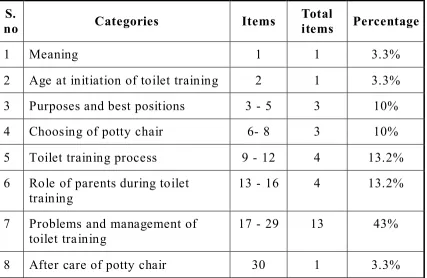
[image:48.596.87.514.457.735.2]The questions were related to knowledge aspects of toilet training, assisted a general knowledge about meaning, age at initiation of toilet training, purposes and best positions of toilet training, choosing of potty chair, toilet training process, role of parents during toilet training, problems and management of toilet training and after care of potty chair. Table 3.2 Blue Print for the Structured Questionnaire
S.
no Categories Items
Total
items Percentage
1 Meaning 1 1 3.3%
2 Age at initiation of toilet training 2 1 3.3% 3 Purposes and best positions 3 - 5 3 10%
4 Choosing of potty chair 6- 8 3 10%
5 Toilet training process 9 - 12 4 13.2% 6 Role of parents during toilet
training 13 - 16 4 13.2%
7 Problems and management of
toilet training 17 - 29 13 43%
SCORE INTERPRETATION:
The semi structured questionnaire was used to assess the knowledge among mothers on toilet training. It consists of 30 multiple choice questions.
SCORING TECHNIQUE
Section-A: Information on demographic data was collected from the samples. The samples were asked to sele ct the option against the response.
Section-B: In the structured knowledge questionnaire to assess the knowledge of mothers regarding Potty Training (Toilet Training).It consist of 30 multiple choice questions. The answer were selected against each question. For each correct answer was given a score of one and for the wrong answer was given a score of zero. The total score is 30.
Table 3.3 Scoring Procedure
Marks Percentage Level of knowledge
Less than 15 Less than 50% Inadequate
16 - 23 51- 75% Moderate
24 – 30 Above 75 % Adequate
3.11 CONTENT VALIDITY
3.12 RELIABILITY OF THE TOOL
After pilot study reliability of the tool was assessed by using Test retest method. Knowledge score reliability correlation coefficient value is 0.81. This correlation coefficient is very high and it is good tool for assessing effectiveness of structured teaching programme on levels of knowledge regarding potty Training (toilet training) among the mothers of toddlers at residing at Medavakkam rural area Chennai.
3.13 ETHICAL CONSIDERATION
The proposal of the study was approved by the experts prior to the pilot study by the Institutional Ethics Committee of Madras Medical College, Chennai. Each mother was informed about the purpose of the study. Informed consent was obtained. Assurance was given to them that confidentiality and privacy would be maintained. The parents were informed that they were having freedom to leave the study with their own reason. The investigator ensured that privacy, dignity, religion, cultural belief and ethical values were respected during the process of data collection. Informed written consent was received from each study participants after giving full information about the study. Anonymity was assured to each participant and maintained by the researcher
3.14 PILOT STUDY
In order to check feasibility,relevance and practicability of the study, pilot study was conducted for 6 mothers of toddlers in Medavakkam rural area, Chennai. Pre test done on the first day by using the semi structured questionnaire.After pre test 45 minutes structured teaching programme on potty Training (toilet training) was given to th e mothers of toddlers by using Flipchart and pamphlet.
included in main study.Result of the pilot study showed that there was a positive correalation between knowledge of mothers of toddlers and the study was found feasible.
3.15 PROCEDURE FOR DATA COLLECTION
Permission was obtained from Institutional Ethics Committee, DDHS Chengalpattu, and Medical officer from Medavakkam PHC Chennai for conducting pilot study and main study. The data collection was done from 02.01.18 to 28.01.18 the researcher introduced to him to the selected mothers of children. Assurance wa s given to them that confidentiality and privacy would be maintained. The mothers were informed that they are having freedom to leave the study with their own reason. The investigator ensured that privacy, dignity, religion, cultural belief, and ethical va lues were respected during the process of data collection. Informed written consent was received from the study participants after giving full information about the study. Anonymity was assured each participant and maintained by the researcher.
INTERVENTION PROTOCOL
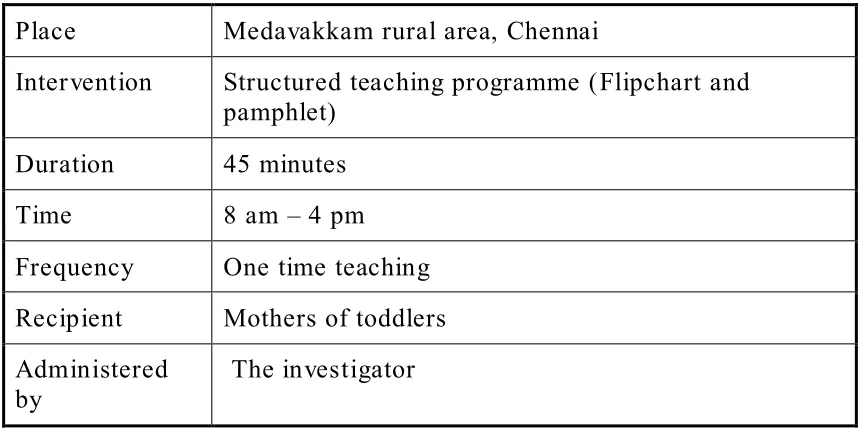
Table: 3.4 Intervention Protocol
Place Medavakkam rural area, Chennai
Intervention Structured teaching programme (Flipchart and pamphlet)
Duration 45 minutes Time 8 am – 4 pm Frequency One time teaching Recipient Mothers of toddlers Administered
by The investigator
3.16: DATA ENTRY AND ANALYSIS
The data was collected and the coding was done through SPSS. All the data which was collected were entered in the coding s heet on the same day.
The collected data was analysed by using descriptive and inferential statistics.
DESCRIPTIVE STATISTICS
1) Frequency and percentage distribution was used to assess the demographic variables.
INFERENTIAL STATISTICS INCLUDES
1) Paired„t‟ test is used to compare the pre test and post test knowledge.
2) Categorical variable difference between pre test and post test were calculated using Mc Nemars test
CHAPTER– IV
DATA ANALYSIS AND INTERPRETATION
This chapter deals with the data analysis and interpretation of data collected from 60 mothers of toddlers who are living in Medavakkam rural area, Chennai.
Descriptive and inferential statistics were used for the analysis of the data. According to the study objectives, the interpretation has been tabulated and organized as follows:
OBJECTIVES
1) To assess the pre test level of knowledge regarding potty training among the mothers of toddlers.
2) To assess the post test level of knowledge regarding potty training among the mothers of toddlers.
3) To evaluate the effectiveness of structured teaching programme regarding potty training among the mothers of toddlers.
4) To associate the post test level of knowledge regarding potty training with selected demographic variables of mothers of toddlers.
ORGANIZATION OF DATA
Section-A : Distribution of demographic variable of the study participants
Section-B : Assessment of pre test level of knowledge among mothers of toddlers
Section-C : Assessment of post test level of knowledge among mothers of toddlers
Section-E : Evaluate the effectiveness of structured teaching programme on level of knowledge regarding toilet training among mothers of toddlers
Section-F : Association of post test level of knowledge with demographic variables of mothers.
STATISTICAL ANALYSIS
Demographic variables in categories were given in frequencies with their percentages.
Knowledge score were given in mean and standard deviation.
Association between demographic variables and knowledge score were analysed using pearson chi square test
Quantitative knowledge score in pretest and posttest were compared using student‟s paired t-test.
Qualitative level of knowledge in pretest and posttest were compared using Stuart-Maxwell test /extended McNemar test
Association between knowledge gain score/ practice gain score with demographic variables are assessed using ch i square student independent t –test.
Simple bar diagram, Multiple bar diagram, Pie diagram, subdivided bar diagram and Box plot were used to represent the data.
SECTION-A: DISTRIBUTION OF DEMOGRAPHIC
VARIABLES OF THE STUDY PARTICIPANTS
Table-4.1: Distribution of demographic variables of the study participants
Demographic variables mothers No.of %
Age 18 – 22 years 7 11.6%
23 – 27 years 13 21.7%
28 – 32 years 27 45.0%
> 32 years 13 21.7%
Education Primary education 6 10.0%
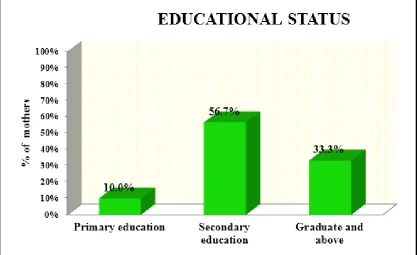
Secondary education 34 56.7%
Graduate and above 20 33.3%
Occupation Home maker 48 80.0%
Daily labour 6 10.0%
Business 3 5.0%
Professional 3 5.0%
Family Monthly
Income Less than Rs 3000 Rs 3001 – 5000 14 2 23.4% 3.3%
Rs 5001 – 7000 21 35.0%
Above Rs. 7000 23 38.3%
Religion Hindu 56 93.3%
Muslim 0 0.0%
Christian 4 6.7%
No. of children
in the family One child Two children 27 33 45.0% 55.0%
Three children 0 0.0%
> Three children 0 0.0%
Previous exposure to Bowel training programme
Yes 14 23.3%
No 46 76.7%
Care taker Mother 49 81.7%
Grand mother 11 18.3%
Table 4.1 shows the demographic information of mothers of toddler those who are participated for the following study “A study to assess the Effectiveness of structured teaching programme on levels of knowledge regarding potty Training (toilet training) among the mothers of toddlers at residing at Medavakkam rural area Chennai. ”
Age of the mother: Between 18-22 years were 7 (11.6%), between 23-27 years were 13 (21.7%), between 28-32 years were 27 (45%), and 13 (21.7% ) were between above 32 years of age.
Education: 6 (10%) were studied up to primary education, 34 (56.7%) were studied upto secondary education, 20 (33.3%) wer e studied up to graduate and above.
Occupation: 48 (80%) were homemakers, 6 (10%) were daily labour, 3 (5%) were business, 3 (5%) were professionals.
Family monthly income: 2 (3.3%) were getting less than RS 3000, 14 (23.4%) were earning RS. 3001- 5000, 21 (35%) were earning RS 5001- 7000, and 23 (38.3%) were earning above RS 7000.
Religion: 56 (93.3%) were belongs to Hindu, 0(0%) were belongs to Muslim, 4(6.7%) were belongs to Christian.
No. Of children in the family: 27 (45%) were having one child, 33 (55%) were having two children, 0 (0%) were having three childrens, 0(0%) were having more than three childrens.
Previous exposure to bowel training programme: 14 (23.3%) were attended this programme, 46 (76.7%) were not attended this programme.
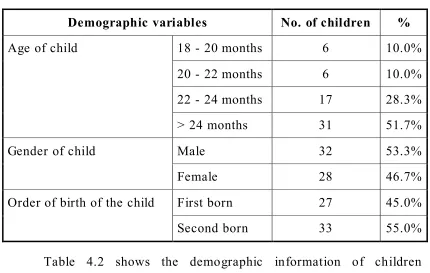
Table 4.2: Children demographic data:
Demographic variables No. of children %
Age of child 18 - 20 months 6 10.0%
20 - 22 months 6 10.0%
22 - 24 months 17 28.3% > 24 months 31 51.7%
Gender of child Male 32 53.3%
Female 28 46.7%
Order of birth of the child First born 27 45.0%
Second born 33 55.0%
Table 4.2 shows the demographic information of children mothers those who are participated in this study
[image:58.596.83.513.89.362.2]SECTION-B: ASSESSMENT OF PRE TEST LEVEL OF
KNOWLEDGE AMONG MOTHERS OF TODDLERS
Table 4.3: Each Domain wise Pre-Test Percentage of Knowledge Regarding Potty Training among the Mothers of Toddlers
Table 4.3 shows each domain wise pre-test percentage of knowledge regarding potty training among the mothers of toddlers.
Mothers were having maximum knowledge in after care of potty chair (52.00%) and minimum knowledge score in Toilet training process (28.00%).
Domains questions No. of
Min – Max score
Knowledge score
Mean SD mean % of score
Meaning 1 0 -1 .39 .49 39.00%
Age at initiation of
toilet training 1 0 -1 .37 .49 37.00% Purposes and best
positions 3 0 - 3 1.17 .67 39.00%
Choosing of potty
chair 3 0 - 3 .95 .83 31.67%
Toilet training process 4 0 - 4 1.12 .76 28.00% Role of parents during
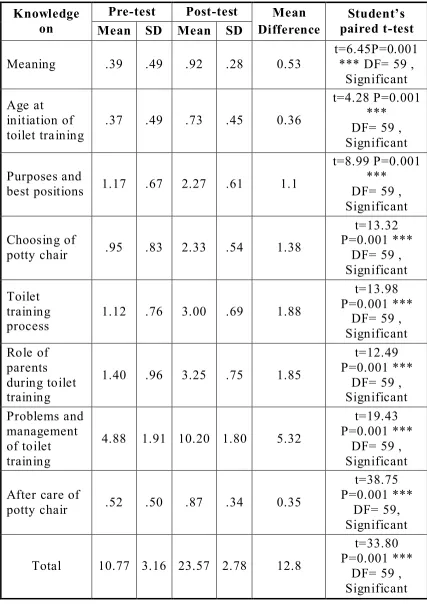
toilet training 4 0 - 4 1.40 .96 35.00%