
Discontinuous Statistical Machine Translation
with Target-Side Dependency Syntax
Nina SeemannandAndreas Maletti
Institute for Natural Language Processing, Universit¨at Stuttgart Pfaffenwaldring 5b, 70569 Stuttgart, Germany
{seemanna,maletti}@ims.uni-stuttgart.de
Abstract
For several languages only potentially non-projective dependency parses are readily available. Projectivizing the parses and utilizing them in syntax-based trans-lation systems often yields particularly bad translation results indicating that those translation models cannot properly utilize such information. We demonstrate that our system based on multi bottom-up tree transducers, which can natively handle discontinuities, can avoid the large transla-tion quality deterioratransla-tion, achieve the best performance of all classical syntax-based translation systems, and close the gap to phrase-based and hierarchical systems that do not utilize syntax.
1 Introduction
Syntax-based machine translation, in which the transfer is achieved from and/or to the level of syntax, has become widely used in the statisti-cal machine translation community (Bojar et al., 2014). Different grammar formalisms have been proposed and evaluated as translation models driv-ing the translation systems. We use a variant of the local multi bottom-up tree transducer as pro-posed by Maletti (2011). More precisely, we use a
string-to-treevariant of it, which offers two imme-diate advantages: (i) The source side of the rules is a simple string containing terminal symbols and the unique non-terminal X. Consequently, we do not need to match an input sentence parse, which allows additional flexibility. It has been demonstrated that this flexibility in the input of-ten yields improved translation quality (Chiang, 2010). (ii) The target language side offers discon-tinuities because rules can contain a sequence of target tree fragments instead of a single tree frag-ment. These fragments are applied synchronously,
which allows the model to synchronously develop discontinuous parts in the output (e.g., to realize agreement). Overall, this translation model al-ready proved to be useful when translating from English into German, Chinese, and Arabic as demonstrated by Seemann et al. (2015). The goal of the current contribution is to adjust the approach and the system to Eastern European languages, for which we expect discontinuities to occur. The ex-isting system (Seemann et al., 2015) cannot read-ily be applied since it requires constituent-like parses for the target side in our string-to-tree set-ting. However, for the target languages discussed here (Polish and Russian), only dependency parses are readily available. Those parses relate the lexi-cal items of the sentence via edges that are labeled with the syntactic function between the head and its dependent. Overall, these structures also form trees, but they are often non-projective for our tar-get languages. Such non-projective dependency trees do not admit a constituent-like tree represen-tation, so we first need to convert them into pro-jective dependency trees, which can be converted easily into a constituent-like tree representation. The conversion into projective dependency trees is known to preserve discontinuities, so we expect that out model is an ideally suited syntax-based translation model for those target languages.
We evaluate our approach in 2 standard trans-lation tasks translating from English to both Pol-ish and Russian. Those two target languages have rather free word order, so we expect discontinu-ities to occur frequently. For both languages, we use a (non-projective) dependency parser to ob-tain the required target trees, which we projec-tivize. Indeed, we confirm that non-projective parses are a frequent phenomenon in both lan-guages. We then train our translation model on the constituent-like parse trees obtained from the projective dependency trees and evaluate the ob-tained machine translation systems. In both cases,
our system significantly outperforms the string-to-tree syntax-based component (Hoang et al., 2009) of MOSES. To put our evaluation scores into per-spective, we also report scores for a vanilla phrase-based system (Och and Ney, 2004), a GHKM-based system (Galley et al., 2004), and a hierarchi-cal phrase-based system (Chiang, 2007). It shows that our system suffers much less from the syntac-tic discontinuities and is thus much better suited for syntax-based translation systems in such set-tings.
2 Related work
Modern statistical machine translation sys-tems (Koehn, 2009) are build using various different translation models as their core. Syntax-based systems are widely used nowadays due to their innate ability to handle non-local reordering and other linguistic phenomena. For certain language pairs they even outperform phrase-based models (Och and Ney, 2004) and constitute the state-of-the-art (Bojar et al., 2014). Our MBOT is a variant of the shallow local multi bottom-up tree transducer presented by Braune et al. (2013). Alternative models include the synchronous tree substitution grammars of Eisner (2003), which use a single source and target tree fragment per rule. Our MBOT rules similarly contain a single source tree fragment, but a sequence of target tree fragments. The latter feature enables discontinuous translations. Another model that offers this feature for the source and the target language side is the non-contiguous synchronous tree-sequence substitution grammar of Sun et al. (2009), which offers sequences of tree fragments on both sides.
The idea of utilizing dependency trees in ma-chine translation is not novel. Bojar and Hajiˇc (2008) built a system based on synchronous tree substitution grammars for English-to-Czech that uses projective dependency trees. Xie et al. (2011) present a dependency-to-string model that extracts head-dependent rules with reordering in-formation. Their model requires a custom de-coder to deal with the dependency information in the input. Li et al. (2014) follow up on this work by transforming these dependency trees into (a kind of) constituency trees. In this ap-proach, they are able to use the conventional syntax-based models of MOSES. In contrast to our work, these two models do not use the
syn-tactic functions provided by the parser but rather extract head-dependent rules based on the lexical items. Sennrich et al. (2015) transformed (non-projective) dependency trees into constituency trees using the syntactic functions provided by the parser. They used the string-to-tree GHKM model (Williams and Koehn, 2012) of MOSESand evaluated their approach on an English-to-German translation task. It shows that the system utiliz-ing the (transformed) dependency parses outper-forms competing systems utilizing various vari-ants of constituent parses for the German side. We follow up on their work for translation tasks, where constituent parses are not readily available, and achieve translation quality that is comparable to phrase-based systems for two language pairs (English-to-Polish and English-to-Russian).
3 Transformation of Dependency Trees into Constituency Trees
In this section, we present a short overview of de-pendency parsing and introduce the non-projective tree structures that occur as parses. We need to transform these structures into projective trees, which are then converted into the shape of clas-sical constituency trees.
3.1 Description
The syntax of languages with relatively free word order, which includes Polish and Russian, is of-ten difficult to express in terms of constituency structure (Kallestinova, 2007). Since the parts that need to (grammatically) agree can occur spread out over the whole sentence, constituents cannot be hierarchically organized as in a classical con-stituency parse tree. Dependency parses do not pre-suppose such a hierarchical structure and are thus often more suitable for languages with free word order.
In a dependency parse each occurrence of a lex-ical item (i.e., token) in the input sentence forms a node. The dependency parser constructs a tree structure over those nodes by relating them via edges pointing from ahead nodeh to its depen-dentnoded. Such an edge is denoted byh → d. In addition, each edge is assigned a label indicat-ing the type of the syntactic dependence. Often an artificial root node is added for convenience. An example parse for a Polish sentence is depicted in Figure 1.
S A P S S I S I konwencja haska w sprawie obligacji ( głosowanie )
ROOT
ADJUNCT ADJUNCT COMP
MWE PAR
MWE
[image:3.595.137.462.62.162.2]PAR
Figure 1: Non-projective Polish dependency tree [gloss: hague convention on securities (vote)].
S A P S S I S I
konwencja haska w sprawie obligacji ( głosowanie ) ROOT
ADJUNCT ADJUNCT COMP
MWE↓ PAR
MWE↑
[image:3.595.136.465.208.303.2]PAR
Figure 2: Projective dependency parse obtained by ‘path’-lifting.
non-projective edges. The edge h → d is pro-jectiveif and only if its head node h dominates1 all nodes representing the tokens in the linear span between h and d. For example, the edge ‘obligacji → głosowanie’ is non-projective be-cause ‘obligacji’ does not dominate ‘(’, which oc-curs in the relevant linear span. A dependency parse is projective if and only if all its edges are projective. A non-projective dependency parse is easily recognized in graphical representations be-cause it has a crossing edge provided that all the edges are drawn on one side of the sentence as in Figure 1.
Non-projective dependency structures cannot be directly used in the translation framework MOSES (Koehn et al., 2007), so we first have to turn them into projective trees. To this end, Ka-hane et al. (1998) came up with the idea of lift-ing. Given a non-projective edgeh→ dthere ex-ists (at least) one nodenthat occurs in the linear span betweenhanddsuch thatnis not dominated by h. In the lifting process, the edgeh → dis replaced by an edge g → d, whereg is the low-est node that dominates both h and n (i.e., the least common ancestor of h and n). Repeating this process for all non-projective edges eventually yields a projective tree. Nivre and Nilsson (2005) refined this approach and introduced three addi-1A nodendominatesa nodediffnis an ancestor ofd; i.e., there is a path fromntod.
tional ways of lifting: ‘head’, ‘head+path’, and ‘path’, which perform the same replacement but annotate different information in the labels to doc-ument the lifting process. The annotation schemes ‘head’ and ‘head+path’ might increase the number of labels quadratically, whereas ‘path’ only intro-duces a linear number of new labels. Since we deal with millions of trees in our syntax-based machine translation experiments, we need to select a com-promise between (i) inflating the number of labels and (ii) documenting the lifts. We decided to use the ‘path’ scheme to obtain projective parse trees for our experiments (see Section 5).
Let us explain the ‘path’ scheme. In the situa-tion described earlier, in which the edge h → d
was replaced by the edgeg → d, we set the label ofg → dto the label of the original edgeh → d
annotated by↑to indicate that this edge was lifted. Additionally, all edges connecting the new headg
and the syntactical headhare annotated with↓ in-dicating where the syntactic head is found. Fig-ure 2 shows the projective tree obtained from the non-projective parse of Figure 1. In it we have the new edge ‘sprawie → głosowanie’ with la-bel ‘MWE↑’. Moreover, the edge ‘sprawie → obligacji’ now has the label MWE↓ because it is the edge that connects the new head with the syn-tactical head of ‘głosowanie’.
of a non-projective edge by the root. From a lin-guistic point of view, it makes more sense to at-tach it (as described) to the least common ancestor, which in a sense is the minimal required change that leaves the remaining edges in place. Fur-thermore, the used implementation always lifts the most nested2 non-projective edge until the tree is projective. In this way, the minimal number of lifts required to projectivize the tree is achieved as demonstrated by Buch-Kromann (2005).
3.2 Implementation
We aim to investigate string-to-tree machine trans-lation systems, so we need syntactic annotations on the target side. First, the target-side sen-tences (in Polish and Russian) are annotated with part-of-speech tags with the help of TREETAG -GER (Schmid, 1994). The TREETAGGER out-put is then converted into the (comma-separated) CONNL-X format3, which lists each token of the sentence in one line with 10 attributes like word position, word form, lemma, and part-of-speech tag. A new sentence is started by an empty line. This representation is passed to the MALT parser (Nivre et al., 2006; Sharoff and Nivre, 2011), which fills the remaining attribute fields like position of the head and the label of depen-dency edges. The resulting output represents the (potentially) non-projective dependency parses of the target-side sentences.
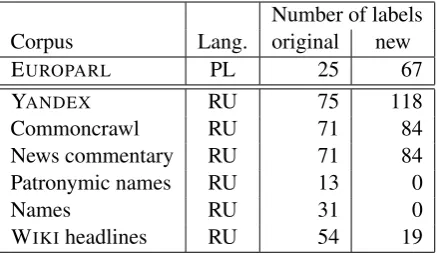
In the next step, we apply the ‘path’-lifting as described in Section 3.1. In total, we performed 500,507 lifts for Polish (corpus size: 14,147,378 tokens) and 137,893 lifts for Russian (corpus size: 30,808,946 tokens) to make the corresponding parses projective. As described in Section 3.1 we introduce at most 3 additional labels for each ex-isting label. In Table 1 we report for each corpus the exact number of original parse labels and the number of labels newly introduced by the transfor-mation into projective parses.
Finally, we transform the projective dependency parse trees directly into the standard representa-tion of constituent parse trees in MOSES.4 We use the part-of-speech tags as pre-terminal nodes. Ad-ditionally, we make the labels and part-of-speech tags more uniform as follows:
2deepest or most distant from the root
3documented onhttp://ilk.uvt.nl/conll/
4http://www.ims.uni-stuttgart.
de/forschung/ressourcen/werkzeuge/ mbotmoses.html
Number of labels Corpus Lang. original new
EUROPARL PL 25 67
YANDEX RU 75 118
Commoncrawl RU 71 84
News commentary RU 71 84
Patronymic names RU 13 0
Names RU 31 0
[image:4.595.308.527.62.189.2]WIKIheadlines RU 54 19
Table 1: Number of parse labels before and after the ‘path’-lifting.
• All parentheses are labeled ‘PAR’.
• All slashes, quotation marks, and dashes are labeled ‘PUNCT’ and their part-of-speech tag is ‘INTJ’.
• All punctuation marks are labeled ‘PUNC’ and their part-of-speech tag is ‘,’.
• If the tagger did not assign a part-of-speech tag, then we label it ‘UNK’.
The final constituency tree representation obtained from the projective dependency tree of Figure 2 is shown in Figure 3.
4 Translation Model
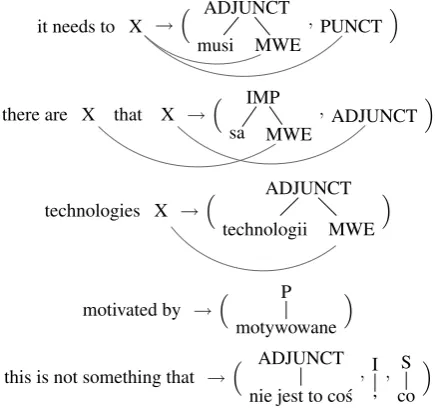
We use the string-to-tree variant (Seemann et al., 2015) of the multi bottom-up tree trans-ducer (Maletti, 2010) as translation model. For simplicity, we call the variant ‘MBOT’. A more detailed discussion of the model can be found in (Seemann et al., 2015; Maletti, 2011). Let us at-tempt a high-level description. An MBOT is a syn-chronous grammar (Chiang, 2006) that is similar to a synchronous context-free grammar. Instead of a single source and target fragment in each rule, MBOT rules are of the forms→(t1, . . . , tn)
con-taining a singlesource stringsand potentially sev-eraltarget tree fragments t1, . . . , tn. The source
trans-ROOT ADJUNCT
S
konwencja A haska
COMP ADJUNCT
P w
S
sprawie MWE↓
S obligacji
PAR
I
(
MWE↑
S głosowanie
PAR I
[image:5.595.72.289.63.137.2])
Figure 3: Final constituency representation for the parse of Figure 2.
it needs to X → ADJUNCT
musi MWE
,PUNCT
there are X that X → IMP
sa MWE,ADJUNCT
technologies X → ADJUNCT
technologii MWE
motivated by → P
motywowane
this is not something that → ADJUNCT
nie jest to co´s, I ,,
S co
Figure 4: Several rules of an MBOT.
lating from English (source) to Polish (target) are shown in Figure 4. The bottom rule is both lexi-cal and discontinuous. Note that it can be used in a continuous manner, but it is as well possible to plug additional material between the three target tree fragments.
The rules were extracted with the method de-scribed and the implementation provided by See-mann et al. (2015). The standard log-linear model (Koehn, 2009) is used with the following features:
(1) forward translation weight (2) indirect translation weight (3) forward lexical translation weight (4) indirect lexical translation weight (5) target-side language model (6) word penalty
(7) rule penalty
(8) gap penalty1001−c, wherecis the number of
target tree fragments used in the derivation of the output tree.
All those features are standard except for the gap penalty, which is intended to discourage derivations that involve large numbers of target
tree fragments, thus providing a feature to favor or disfavor continuous derivations. As usual, the (forward and indirect) translation weights are ob-tained as products of corresponding rule weights, which are obtained by maximum likelihood es-timation. All rules that were extracted at most 10 times are smoothed using GOOD-TURING smoothing (Good, 1953). Both lexical transla-tion weights are obtained from the co-occurrence statistics obtained during word alignment. The standard decoder of MBOT-MOSES by Braune et al. (2013) is used to generate translations us-ing our model. As in the standard syntax-based component (Hoang et al., 2009), this decoder is a CYK+ chart parser based on standard X-style parse trees with integrated language model scor-ing that is accelerated by cube prunscor-ing (Chiang, 2007).
5 Experimental Results
We evaluate the MBOT-based system (see Sec-tion 4) on two translaSec-tion tasks: English-to-Polish and English-to-Russian. For both target lan-guages only (potentially) non-projective depen-dency parses are easily available. Our goal is to evaluate whether the discontinuity offered by the MBOT model helps in tasks involving such de-pendency parses. Consequently, the baseline sys-tem is the syntax-based component (Hoang et al., 2009) of the MOSES toolkit (Koehn et al., 2007), which uses a translation model that only permits continuous rules. Both systems arestring-to-tree
in the sense that the projectivized parses are only used on the target side. As mentioned in Section 3, the non-projective parses are obtained using the MALT parser and then converted to constituent-like trees. Glue-rules in both systems ensure that partial translation candidates can always be con-catenated without any reordering.
5.1 Setup
[image:5.595.71.290.189.393.2]English to Polish English to Russian
training data size ≈618K sentence pairs ≈1.7M sentence pairs target-side parser Malt parser (Nivre et al., 2006; Sharoff and Nivre, 2011)
parser grammar (Wr´oblewska and Przepi´orkowski, 2012) (Nivre et al., 2008) language model (LM) 5-gram SRILM (Stolcke, 2002)
additional LM data Polish sentences in EuroParl WMT 2014 LM data size ≈626K sentences ≈43M sentences development test size 3,030 sentences 3,000 sentences
[image:6.595.92.510.62.201.2]test size 3,029 sentences 3,003 sentences Table 2: Summary of the experimental setup.
length-ratio filtered, tokenized, and lowercased. We used GIZA++ (Och, 2003) with the ‘grow-diag-final-and’ heuristic (Koehn et al., 2005) to automatically derive the word alignments. The feature weights of the log-linear models were trained with the help of minimum error rate train-ing (Och and Ney, 2003) and optimized for 4-gram BLEU (Papineni et al., 2002) on the devel-opment test set (lowercased, tokenized). In the end, the systems were evaluated (also using 4-gram BLEU) on the test set. Significance judg-ments of the differences in the reported translation quality (as measured by BLEU) were computed with the pairwise bootstrap resampling technique of Koehn (2004) on 1,000 samples. Table 2 sum-marizes the setup information.
A particular detail is worth mentioning. The authors were unable to identify standard develop-ment and test sets for the English-to-Polish trans-lation task. Consequently, we manually removed one session of the EUROPARL corpus. After re-moving duplicate sentences, we used the odd num-bered sentences as development set and the even numbered sentences as test set.
5.2 Analysis
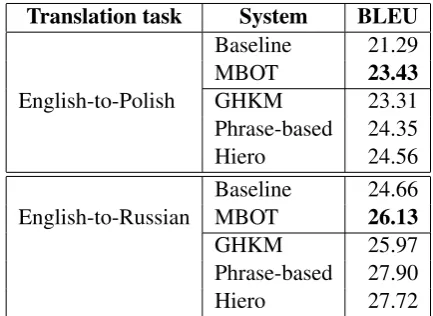
We present the quantitative evaluation for both ex-periments in Table 3. In both cases (English-to-Polish and English-to-Russian) the MBOT system significantly outperforms the baseline, which is the syntax-based component of MOSES. For Pol-ish we obtain a BLEU score of 23.43 resulting in a gain of 2.14 points over the baseline. Similarly, for Russian we achieve a BLEU score of 26.13, which is an increase of 1.47 points over the baseline. To put our results in perspective, we also trained a GHKM system, a phrase-based system, and a hi-erarchical phrase-based system (Hiero) with
stan-Translation task System BLEU
English-to-Polish
Baseline 21.29 MBOT 23.43
GHKM 23.31
Phrase-based 24.35
Hiero 24.56
English-to-Russian BaselineMBOT 24.6626.13
GHKM 25.97
Phrase-based 27.90
Hiero 27.72
Table 3: Evaluation results incl. MOSES phrase-based system, GHKM-phrase-based system, and hierar-chical system for reference. The bold MBOT results are statistically significant improvements over the baseline (at confidencep <1%).
dard settings for each translation task on the same resources as described in Table 2 and present their evaluation also in Table 3.
[image:6.595.307.524.251.409.2]To quantitatively support our claim that the mul-tiple target tree fragments (and the discontinuity) of an MBOT are useful, we provide statistics on the MBOT rules that were used to decode the test set. To this end, we distinguish several types of rules. A rule is continuous if it has only 1 tar-get tree fragment, and all other rules are (poten-tially)discontinuous. Additionally, we distinguish
lexical rules, which only contain lexical items as leaves, andstructuralrules, which contain at least one non-lexical leaf. In Table 4 we report how many rules of each type are used during decod-ing.5
For Polish, 41% of all used rules were dis-continuous and only 4% were structural. Sim-ilarly, 35% of the used Russian rules were dis-continuous and again only 4% were structural. The low proportion of structural rules is not very surprising since both languages are known to be morphologically rich and thus have large lexicons (167,657 lexical items in Polish and 911,397 lexi-cal items in Russian). Another interesting point is the distribution of discontinuous structural rules. Polish and Russian use 83% and 62%, respec-tively, showing that the majority of the used struc-tural rules is discontinuous in both tasks. Addi-tionally using the data of Seemann et al. (2015), we can confirm that morphologically rich lan-guages have a small minority of structural rules (4%, 4%, and 5% for Polish, Russian, and Ger-man, respectively), whereas Arabic and Chinese use a much larger proportion of structural rules (26% and 18%, respectively). In addition, we sus-pect that the additional non-projectivity of Polish makes discontinuous rules more useful (as an indi-cator for induced discontinuity). Whereas for Rus-sian, German, Arabic and Chinese approx. 2 out of 3 used structural rules are discontinuous (62%, 64%, 67%, and 68%, respectively), more than 4 out of 5 (83%) used structural rules are discon-tinuous for Polish.
Finally, we present a fine-grained analysis based on the number of target tree fragments in Table 4. Useful Polish rules have at most6target tree frag-ments, whereas Russian rules with up to 9 tar-get tree fragments have been used. Similar num-bers have been reported in (Seemann et al., 2015).
5The provided analysis tools currently do not support an analysis whether a discontinuous rule was actually used in a discontinuous manner or whether the components were later combined in a continuous manner. The reported numbers thus represent potential discontinuity.
Using their data, we also note that Polish, Rus-sian, and Chinese seem to use a larger percent-age of discontinuous rules with2output tree frag-ments (80%–90%) compared to German and Ara-bic (50%–60%).
6 Conclusion
We presented an application of string-to-tree lo-cal multi bottom-up tree transducers as translation model of a syntax-based machine translation sys-tem. The obtained system uses rules with a string on the source language side and a sequence of target tree fragments on the target language side. The availability of several target tree fragments in a single rule enables the model to realize dis-continuous translations. We expected that partic-ularly translation into languages with discontin-uous constituents would benefit from our model. However, such languages often have rather free word order and often only dependency parsers are available for them. The mentioned discontinuities often produce non-projective parses, which we need to transform into projective constituent-like parse trees before they can be utilized in MOSES. Hence, we (i) applied a lifting technique to projec-tivize the dependency trees, which stores informa-tion about the performed lift operainforma-tions in the new labels, and (ii) transformed the obtained projective dependency trees into constituent-like trees.
Next, we demonstrated that the discontinu-ous string-to-tree system significantly outperforms the standard MOSES string-to-tree system on two different translation tasks (English-to-Polish and English-to-Russian) with large gains of 2.14 and 1.47 BLEU points, respectively. We also trained a vanilla phrase-based system, a GHKM-based sys-tem, and a hierarchical system for each transla-tion task. In comparison to the string-to-string phrase-based system, the discontinuous string-to-tree system is only 0.92 BLEU points worse on English-to-Polish and 1.77 BLEU points worse for English-to-Russian. It thus remains to be seen whether machine translation systems can bene-fit from syntactic information in those translation tasks, but the proposed model at least avoids the large quality drop observed for the continuous string-to-tree system.
Target tree fragments
Translation task Type Lex Struct Total 2 3 4 5 ≥6
English-to-Polish discont. 16,312cont. 25,327 1,595 17,907 15,805 1,818 254 27307 25,634 3
[image:8.595.72.524.74.168.2]English-to-Russian discont. 12,767cont. 24,100 1,108 13,875 11,087 2,308 412 58664 24764 10
Table 4: Number of rules per type used when decoding test (Lex = lexical rules; Struct = structural rules; [dis]cont. = [dis]contiguous).
likely due to the morphological richness of the lan-guages. Furthermore, they use a lot of discontinu-ous structural rules, which confirms our assump-tion that a system allowing discontinuous target tree fragments is the right choice for such lan-guages.
Acknowledgment
The authors would like to express their grati-tude to the reviewers for their helpful comments. Furthermore, we would like to thank ANDERS BJORKELUND¨ and WOLFGANGSEEKERfor their shared expertise on dependency parsing.
The authors were financially supported by the German Research Foundation (DFG) grant MA 4959 / 1-1, which we gratefully acknowledge.
References
Ondˇrej Bojar and Jan Hajiˇc. 2008. Phrase-based and deep syntactic English-to-Czech statistical machine translation. InProc. 3rd WMT, pages 143–146. As-sociation for Computational Linguistics.
Ondˇrej Bojar, Christian Buck, Christian Federmann, Barry Haddow, Philipp Koehn, Johannes Leveling, Christof Monz, Pavel Pecina, Matt Post, Herve Saint-Amand, Radu Soricut, Lucia Specia, and Aleˇs Tamchyna. 2014. Findings of the 2014 work-shop on statistical machine translation. InProc. 9th WMT, pages 12–58. Association for Computational Linguistics.
Fabienne Braune, Nina Seemann, Daniel Quernheim, and Andreas Maletti. 2013. Shallow local multi bottom-up tree transducers in statistical machine translation. InProc. 51st ACL, pages 811–821. As-sociation for Computational Linguistics.
Matthias Buch-Kromann. 2005. Discontinuous Gram-mar — A dependency-based model of human pars-ing and language learnpars-ing. Ph.D. thesis, Copen-hagen Business School.
David Chiang. 2006. An introduction to synchronous grammars. InProc. 44th ACL. Association for Com-putational Linguistics. Part of a tutorial given with Kevin Knight.
David Chiang. 2007. Hierarchical phrase-based trans-lation.Computational Linguistics, 33(2):201–228. David Chiang. 2010. Learning to translate with source
and target syntax. InProc. 48th ACL, pages 1443– 1452. Association for Computational Linguistics. Jason Eisner. 2003. Learning non-isomorphic tree
mappings for machine translation. In Proc. 41st ACL, pages 205–208. Association for Computa-tional Linguistics.
Michel Galley, Mark Hopkins, Kevin Knight, and Daniel Marcu. 2004. What’s in a translation rule? In Proc. NAACL, pages 273–280. Association for Computational Linguistics.
Irving J. Good. 1953. The population frequencies of species and the estimation of population parameters.
Biometrika, 40(3–4):237–264.
Hieu Hoang, Philipp Koehn, and Adam Lopez. 2009. A unified framework for phrase-based, hierarchical, and syntax-based statistical machine translation. In
Proc. 6th IWSLT, pages 152–159. ISCA.
Sylvain Kahane, Alexis Nasr, and Owen Rambow. 1998. Pseudo-projectivity: A polynomially parsable non-projective dependency grammar. InProc. 36th ACL, pages 646–652. Association for Computa-tional Linguistics.
Elena Dmitrievna Kallestinova. 2007. Aspects of Word Order in Russian. Ph.D. thesis, University of Iowa, IA, USA.
Philipp Koehn, Amittai Axelrod, Alexandra Birch Mayne, Chris Callison-Burch, Miles Osborne, and David Talbot. 2005. Edinburgh system description for the 2005 IWSLT Speech Translation Evaluation. InProc. 2nd IWSLT, pages 68–75. ISCA.
Richard Zens, Chris Dyer, Ondˇrej Bojar, Alexan-dra Constantin, and Evan Herbst. 2007. Moses: Open source toolkit for statistical machine transla-tion. InProc. 45th ACL, pages 177–180. Associa-tion for ComputaAssocia-tional Linguistics.
Philipp Koehn. 2004. Statistical significance tests for machine translation evaluation. In Proc. EMNLP, pages 388–395. Association for Computational Lin-guistics.
Philipp Koehn. 2005. Europarl: A parallel corpus for statistical machine translation. In Proc. 10th MT Summit, pages 79–86. Association for Machine Translation in the Americas.
Philipp Koehn. 2009.Statistical Machine Translation. Cambridge University Press.
Liangyou Li, Jun Xie, Andy Way, and Qun Liu. 2014. Transformation and decomposition for efficiently implementing and improving dependency-to-string model in Moses. InProc. 8th SSST, pages 122–131. Association for Computational Linguistics.
Andreas Maletti. 2010. Why synchronous tree sub-stitution grammars? In Proc. HLT-NAACL, pages 876–884. Association for Computational Linguis-tics.
Andreas Maletti. 2011. How to train your multi bottom-up tree transducer. InProc. 49th ACL, pages 825–834. Association for Computational Linguis-tics.
Joakim Nivre and Jens Nilsson. 2005. Pseudo-projective dependency parsing. InProc. 43rd ACL, pages 99–106. Association for Computational Lin-guistics.
Joakim Nivre, Johan Hall, and Jens Nilsson. 2006. Maltparser: A data-driven parser-generator for de-pendency parsing. InProc. 5th LREC, pages 2216– 2219. European Language Resources Association. Joakim Nivre, Igor M. Boguslavsky, and Leonid L.
Iomdin. 2008. Parsing the SYNTAGRUS treebank of Russian. InProc. 22nd CoLing, pages 641–648. Association for Computational Linguistics.
Franz J. Och and Hermann Ney. 2003. A systematic comparison of various statistical alignment models.
Computational Linguistics, 29(1):19–51.
Franz J. Och and Hermann Ney. 2004. The alignment template approach to statistical machine translation.
Computational Linguistics, 30(4):417–449.
Franz J. Och. 2003. Minimum error rate training in statistical machine translation. In Proc. 41st ACL, pages 160–167. Association for Computational Lin-guistics.
Kishore Papineni, Salim Roukos, Todd Ward, and Wei-jing Zhu. 2002. BLEU: a method for auto-matic evaluation of machine translation. In Proc. 40th ACL, pages 311–318. Association for Compu-tational Linguistics.
Helmut Schmid. 1994. Probabilistic part-of-speech tagging using decision trees. In Proc. Int. Conf. New Methods in Language Processing, pages 44–49. University of Manchester, Institute of Science and Technology.
Nina Seemann, Fabienne Braune, and Andreas Maletti. 2015. String-to-tree multi bottom-up tree transduc-ers. InProc. 53rd ACL, pages 815–824. Association for Computational Linguistics.
Rico Sennrich, Philip Williams, and Matthias Huck. 2015. A tree does not make a well-formed sen-tence: Improving syntactic string-to-tree statistical machine translation with more linguistic knowledge.
Computer Speech & Language, 32(1):27–45. Serge Sharoff and Joakim Nivre. 2011. The proper
place of men and machines in language technology processing Russian without any linguistic knowl-edge. In Proc. Dialogue, pages 657–670. Russian State University for the Humanities.
Andreas Stolcke. 2002. SRILM — an extensible language modeling toolkit. In Proc. 7th INTER-SPEECH, pages 257–286. ISCA.
Jun Sun, Min Zhang, and Chew Lim Tan. 2009. A non-contiguous tree sequence alignment-based model for statistical machine translation. In Proc. 47th ACL, pages 914–922. Association for Computational Lin-guistics.
Philip Williams and Philipp Koehn. 2012. GHKM rule extraction and scope-3 parsing in Moses. InProc. 7th WMT, pages 388–394. Association for Compu-tational Linguistics.
Alina Wr´oblewska and Adam Przepi´orkowski. 2012. Induction of dependency structures based on weighted projection. In Proc. 4th ICCCI, volume 7653 of LNAI, pages 364–374. Springer.
![Figure 1: Non-projective Polish dependency tree [gloss: hague convention on securities (vote)].](https://thumb-us.123doks.com/thumbv2/123dok_us/1495732.690041/3.595.137.462.62.162/figure-projective-polish-dependency-gloss-hague-convention-securities.webp)
![Table 4: Number of rules per type used when decoding test (Lex = lexical rules; Struct = structural rules;[dis]cont](https://thumb-us.123doks.com/thumbv2/123dok_us/1495732.690041/8.595.72.524.74.168/table-number-rules-decoding-lexical-rules-struct-structural.webp)
