ISSN(Online): 2319-8753 ISSN (Print) : 2347-6710
I
nternational
J
ournal of
I
nnovative
R
esearch in
S
cience,
E
ngineering and
T
echnology
(A High Impact Factor, Monthly, Peer Reviewed Journal)
Visit: www.ijirset.com
Vol. 7, Issue 9, September 2018
Analysis of Optimal Selection of Machining
Parameters in CNC Turning Process on MRR
and Surface Roughness of Al Using Taguchi
Method
B D Sawant1, G A Bhosale2, M R Desai3, P S Dhavan4, V B Doifode5
Lecturer, Dept. of MECH. Yashwantrao Bhonsale Polytechnic, Sawantwadi, India1,3
Principal, Dept. of MECH. Yashwantrao Bhonsale Polytechnic, Sawantwadi, India2
Scholars, Dept. of MECH. Yashwantrao Bhonsale Polytechnic, Sawantwadi, India4,5
ABSTRACT:The challenge of recent machining industries is to reduce lead time and increase production rate in order to maintain their competitiveness and to increase the product accuracy. This paper investigates the analysis of cutting parameter in CNC machine of Aluminium. In the present paper, an effective approach for the optimization of turning parameter based on the Taguchi method with Analysis of Variance is presented for minimizing required surface roughness and maximizing the Material Removal Rate (MRR) in machining of Aluminium. Experiment were conducted based on Taguchi’s technique L9 orthogonal array. Three machining parameters are chosen as process parameter - Cutting speed, Feed Rate and Depth of cut. The orthogonal array and analysis of variance are employed to study the performance characteristics in CNC Turning operation. The main aim of this work is to save a power , useful machining time, maximize the productivity
KEYWORDS:Machining Surface Roughness, Material Removal Rate, Taguchi’s Technique, Design Of Experiment, ANNOVA,MINITAB.
I. INTRODUCTION
ISSN(Online): 2319-8753 ISSN (Print) : 2347-6710
I
nternational
J
ournal of
I
nnovative
R
esearch in
S
cience,
E
ngineering and
T
echnology
(A High Impact Factor, Monthly, Peer Reviewed Journal)
Visit: www.ijirset.com
Vol. 7, Issue 9, September 2018
optimal value of surface roughness and maximum Material Removal Rate (MRR) while machining of Aluminium bar with HSS tool.
II. LITERATURE REVIEW
U D Gulhane.1 presented an optimization method of cutting parameters cutting speed, depth of cut, feed on shaping process parameters on MRR and Surface roughness of Al6061 using Taguchi Method to achieve lower value of surface roughness and maximise the MRR by considering three independent parameters, feed rate depth of cut and cutting speed. And concluded optimum MRR with smooth surface finish.
Sourabh Sighvi2 investigate material removal rate in turning operation by using Taguchi technique considering three parameters rake angle, feed, spindle speed, where rake angle and feed uses at different levels. After analysis of data it is clear that effect of feed is more than rake angle on material removal rate.
Mohammed Nooruddin3investigate the effect of process parameters in dry turning of grey cast iron FG 260 in a CNC lathe. The parameters namely the spindle speed, feed rate and depth of cut are varied to study their effect on material removal rate and concluded depth of cut and speed was most influencing parameters on MRR.
S.V.Alagarsamy4 worked on an effective approach for the optimization of turning parameters based on the Taguchi’s method with Response surface methodology (RSM) is presented. This paper discusses the use of Taguchi’s technique for minimizing required surface roughness and maximizing the material removal rate in machining Aluminium Alloy 7075 using TNMG 115 100 tungsten carbide tool and conclude that input parameter feed rate most influencing on quality of surface roughness and depth of cut on material removal rate.
Ghan H R5 has developed surface roughness and material removal rate prediction model for machining turningand milling of Al-alloy using multi regression analysis for optimization machining parameter. Design ofexperiment with orthogonal L9 array has been used for conduct the experiment. The experimental data wasanalyzed by using Minitab16 software. From this study they concluded that most significant parameter onsurface roughness are speed and depth of cut while in case material removal rate, speed is most influencingparameter followed by feed but in case of machining time, speed is most influencing parameter followed bydepth of cut.
Tayab6 worked on optimize cutting parameters like spindle speed, feed, depth of cut to minimization of surfaceroughness and maximization of material removal rate in CNC turning of aluminium alloy(AL 6063-T6) usingcarbon insert tool in dry condition. Taguchi design of experiment with L9 orthogonal array was used forexperiment and minitab17 statistical software used to analysis the experimental data. The ANOVA is used toinvestigate which design factor and their interaction affects the response significantly. The result show thatsignificant factor for surface roughness are feed rate and spindle speed while for material removal rate, depth ofcut and spindle speed are most significant factor.
III. METHODOLOGY
ISSN(Online): 2319-8753 ISSN (Print) : 2347-6710
I
nternational
J
ournal of
I
nnovative
R
esearch in
S
cience,
E
ngineering and
T
echnology
(A High Impact Factor, Monthly, Peer Reviewed Journal)
Visit: www.ijirset.com
Vol. 7, Issue 9, September 2018
Table 1: Mechanical properties of work piece
Physical properties Mechanical properties
Density-2.70g/cm3 Melting point -6600C Poisson’s ratio-0.33
Modulus of elasticity-68.9GPa
Young modulus-38.2GPa Tensile strength-82.7MPa Yield strength-75.8MPa
Ultimate tensile strength-110MPa
V. EXPERIMENTATION
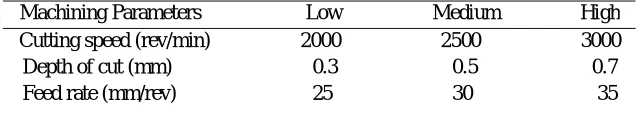
Turning operation was carried out on CNC Machine (CNC Lathe Trainer Power Turn SS-PT-100) using high speed steel tool. Al was used as a work material for experimentation. The chemical composition of Al is shown in Table2, Properties of the material are shown in the following table1. Long Circular bar of the material was cut in the required size of 80×25 mm2 using hacksaw & then ends of specimens were turned on file for proper aligning and removal of extra waste material. The tool, High speed steel (HSS has point angle is 118º. At room temperature, in their generally recommended heat treatment, HSS grades generally display high hardness. The composition of high speed steel are carbon (0.6%to0.75%), tungsten (14%to20%), Chromium (3%to5%), vanadium (1%to1.5%), Cobalt (5%to10%) and remaining is iron. CNC machine used is 1.5 H.P.,3000rpm, The input parameters are depth of cut, Speed, feed rate as shown in table and the responses considered are material removal rate (MRR) and surface roughness (Ra).
Initially the weights of work pieces were measured before machining on the high precision digital balance meter. Weight is required for calculating the MRR. Work piece was fixed in the vice firmly. Before fixing care should be taken for alignment & horizontal surface of work piece. According to the combination of OA as shown in table 4, proper feed, speed & depth of cut were set on the machine. After checking all the arrangements, machining was started. Simultaneously time for the machining is noted down. On completion of machining on first specimen, it was removed from the vice. File was used for removing burr present on it & then its weight is measured on the balance. In this way all 9 work pieces were machined with their parameter levels. Care should be taken while fixing the specimen on the vice & while setting the required feed on it. Before starting the machine, it must be confirmed that depth of cut is not so large The surface roughness is measured using Surface Tester SJ-210 Mitutoyo — Portable Surface Roughness Tester with 10mm of measuring range. The MRR Step Turning was calculated on the basis of theoretical formula.
TABLE 2: COMPOSITION OF AL
SAE Designation %Al % Cr % Fe % Mg % Mn% Si % Zn % Ti Other
ISSN(Online): 2319-8753 ISSN (Print) : 2347-6710
I
nternational
J
ournal of
I
nnovative
R
esearch in
S
cience,
E
ngineering and
T
echnology
(A High Impact Factor, Monthly, Peer Reviewed Journal)
Visit: www.ijirset.com
Vol. 7, Issue 9, September 2018
Figure1: Pictorial view of CNC lathe trainer power turnSS-PT-100
We are conduct the experiment of step turning on CNC lathe trainer power turn SS-PT-100 machine (Figure 1) with the help of G codes and M codes programing. With the advent of CNC technology, the machining processes are automated through which high quality of the machined component, high material rate can achieved with high surface finish. In general CNC machine operated with several controllable factors such as spindle speed, feed rate, depth of cut etc. The optimization of CNC turning process is often achieved by trial and error method based on the shop floor experiences by determining certain parameters of the process, but neither guarantee the quality nor the machine economics. Therefore a general optimization plan is required to avoid cumbersome trial runs on machine and wastages.
TABLE 3: MACHINING PARAMETERS AND LEVELS
VI. RESULTS AND DISCUSSION
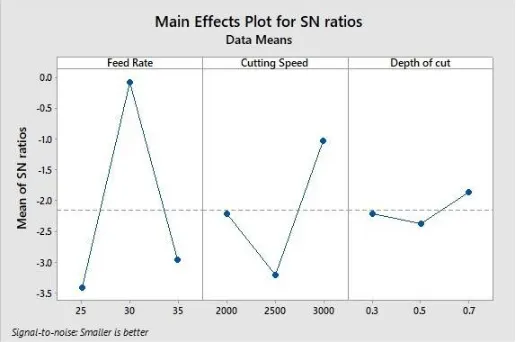
Table 4 shows orthogonal array and response values calculations for Al. S/N ratio is calculated using Lower the better characteristics for surface roughness and larger the better characteristics for MRR. Responses for Signal to Noise Ratios of both responses are shown in Table 5 & 6
In Taguchi method, there are three categories for analysis of S/N Ratio i.e. the smaller is better, the larger is better and the nominal is best. For this experimental analysis,‘The smaller is better’ was chosen to reach the optimization condition for minimum Surface Roughness, and ‘The larger is better’ was chosen to reach the optimization conditions
ISSN(Online): 2319-8753 ISSN (Print) : 2347-6710
I
nternational
J
ournal of
I
nnovative
R
esearch in
S
cience,
E
ngineering and
T
echnology
(A High Impact Factor, Monthly, Peer Reviewed Journal)
Visit: www.ijirset.com
Vol. 7, Issue 9, September 2018
TABLE 4:ORTHOGONAL ARRAY & CALCULATIONS FOR RESPONSE VARIABLES
Specimen No
Feed Rate (mm/rev)
Cutting Speed (rpm)
Depth Of Cut (mm)
Surface Roughness
(Ra) µm
S/N Ratio of Ra
Material Removal
Rate (mm3/min)
S/N Ratio of MRR
1 25 2000 0.3 1.633 -4.2597 1060287 120.50
2 25 2500 0.5 1.646 -4.3286 2208932 126.88
3 25 3000 0.7 1.212 -1.6700 3710738 131.38
4 30 2000 0.5 1.003 -0.0260 2120575 126.52
5 30 2500 0.7 1.196 -1.5546 3711006 131.39
6 30 3000 0.3 0.853 1.3810 1908517 125.61
7 35 2000 0.7 1.311 -2.3520 3463605 130.79
8 35 2500 0.3 1.543 -3.7673 1855503 125.36
9 35 3000 0.5 1.375 -2.7660 3710014 131.38
Taguchi method cannot judge and determine effect of individual parameters on entire process while percentage contribution of individual parameters can be well determined using ANOVA. MINITAB software of ANOVA module was employed to investigate effect of process parameters (cutting speed, Depth of Cut, Feed rate).
RESPONSE TABLES FOR SURFACE ROUGHNESS AND MRR
TABLE 5:SIGNAL TO NOISE RATIOS OFSURFACEROUGHNESS, SMALLER IS BETTER
Level Feed Rate Speed Depth of Cut
1 1.497 1.316 1.343
2 1.017 1.462 1.341
3 1.410 1.1147 1.240
Delta 0.480 0.315 0.103
ISSN(Online): 2319-8753 ISSN (Print) : 2347-6710
I
nternational
J
ournal of
I
nnovative
R
esearch in
S
cience,
E
ngineering and
T
echnology
(A High Impact Factor, Monthly, Peer Reviewed Journal)
Visit: www.ijirset.com
Vol. 7, Issue 9, September 2018
Table 5 Showsthat feed rate is more significant on surface roughness as compare to other parameters, and depth of cut is less significant on surface roughness. Theory suggests that surface roughness is function of feed rate. In practice it is more like directly related to feed rate.
TABLE 6:SIGNAL TO NOISE RATIOS OF MRR, LARGER IS BETTER
Level Feed Rate Speed Depth of Cut
1 2326742 2214822 1608102
2 2580033 2591814 2680171
3 3010038 3110176 3628539
Delta 683296 895354 2020437
Rank 3 2 1
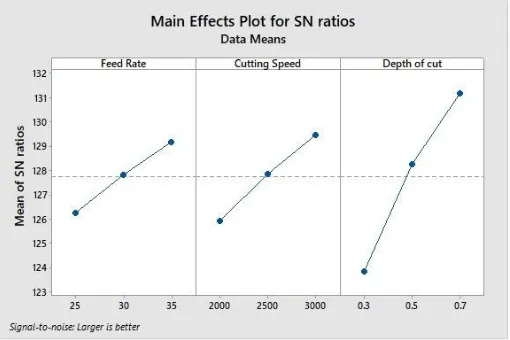
Table 6 Shows that depth of cut is more significant on material removal rate as compare to other parameters and feed rate is less significant on material removal rate. Therefore depth of cut is directly related to the material removal rate. Utilizing right approach for tool can result in prolonged tool life, minimizing the rate of normal tool wear.
ISSN(Online): 2319-8753 ISSN (Print) : 2347-6710
I
nternational
J
ournal of
I
nnovative
R
esearch in
S
cience,
E
ngineering and
T
echnology
(A High Impact Factor, Monthly, Peer Reviewed Journal)
Visit: www.ijirset.com
Vol. 7, Issue 9, September 2018
Figure 3. Effect of Feed, Speed & Depth of cut on MRR
Significance of machining parameters of material removal rate indicates that depth of cut is significantly contributing towards the machining performance as difference gives higher values. Plot for S/N ratio shown in Figure 3 explains that there is less variation in feed rate where as there is significant variation for depth of cut.
ANALYSIS OF VARIANCE FOR S/N RATIOS OF SURFACE ROUGHNESS AND MRR
Table 7:Surface Roughness Analysis
Source DF Adj SS Adj MS F P
Feed
Rate 2 0.39163 0.19582 9.88 0.092 Cutting
Speed 2 0.14910 0.07455 3.76 0.210 Depth
Of Cut 2 0.02102 0.01051 0.53 0.654
Error 2 0.03965 0.01983
Total 8 0.60140
ISSN(Online): 2319-8753 ISSN (Print) : 2347-6710
I
nternational
J
ournal of
I
nnovative
R
esearch in
S
cience,
E
ngineering and
T
echnology
(A High Impact Factor, Monthly, Peer Reviewed Journal)
Visit: www.ijirset.com
Vol. 7, Issue 9, September 2018
Table 8:MRR Analysis
Source DF Adj SS Adj MS F P
Feed
Rate 2 7.15E+11 3.57E+11 4.43 0.184 Cutting
Speed 2 1.21E+12 6.06E+11 7.50 0.118 Depth
Of Cut 2 6.13E+12 3.06E+12 37.9 0.026
Error 2 1.61E+12 8.08E+10
Total 8 8.22E+12
From MRR analysis (table 8), F value (37.9) of parameter indicates that Depth of Cut is significantly contributing towards MRR & machining performance. F value (4.43) of parameter indicates that Feed Rate is contributing less towards Material removal rate. The specimen No. 5 (cutting speed - 2500 rpm; depth of cut – 0.7 mm; feed – 30 mm/rev) has highest Material removal rate and the specimen No. 1 (cutting speed – 2000 rpm; depth of cut – 0.3 mm; feed – 25 mm/rev) has lowest MRR (table 4)
VII. CONCLUSION
Based on the scope and limitations of the present work, the following conclusions may bedrawn from the results of the experiments and analysis of the experimental data in connectionwith CNC turning of aluminium.Taguchi method of experimental design has been applied for optimizing multi response process parameter for CNC turning Al are optimized with L9 orthogonal array. Results obtained from Taguchi method closely matches with ANOVA
1) In the study, the Taguchi method and ANOVA was applied for analyzing to get a minimum surface roughness and maximum material removal rate for turning process of Aluminium using CNC machine via considering three influencing input parameters- Speed, Feed and Depth of Cut.
2) Best parameters found for surface finish machining are cutting speed:– 3000 rpm; depth of cut:– 0.3 mm; feed :– 30 mm/rev. The parameters found for rough machining are cutting speed:- 2500 rpm; depth of cut:– 0.5 mm; feed :– 25 mm/rev. Feed is most influencing parameters corresponding to the quality characteristics of surface roughness.
3) Best parameters found for MRR are cutting speed - 2500 rpm; depth of cut – 0.7 mm; feed – 30 mm/rev. The parameters for very less MRR are cutting speed – 2000 rpm; depth of cut – 0.3 mm; feed – 25 mm/rev. Depth of cut being most affecting parameter on MRR.
ISSN(Online): 2319-8753 ISSN (Print) : 2347-6710
I
nternational
J
ournal of
I
nnovative
R
esearch in
S
cience,
E
ngineering and
T
echnology
(A High Impact Factor, Monthly, Peer Reviewed Journal)
Visit: www.ijirset.com
Vol. 7, Issue 9, September 2018
[3] Mohammed Nooruddin, Dr. U V Hambire “Analysis of Process Parameters for Material Removal Rate During Dry Turning of FG260 Grey Cast Iron” International Journal of Engineering Research and Technology (IJERT).ISSN:2278-0181 Vol 4 Issue 04pp 605-610, April2015 [4] S.V.Alagarsamy, N.Rajakumar “Analysis of Influence of Turning Process Parameters on MRR & Surface Roughness Of AA7075 Using
Taguchi’s Method and Rsm” International Journal of Applied Research and Studies (iJARS) ISSN: 2278-9480Vol 3, Issue 4 pp 01-08,2014 [5] Ghan, H. R., and Ambekar, S. D., “Optimization of cutting parameter for Surface Roughness, Material Removal rate and Machining Time of
Aluminium LM-26 Alloy”, International Journal of Engineering Science and Innovative Technology, vol. 3, issue2, pp 294-298,2014. [6] Tayab, M. D., and Nath, T., “Cutting Parameters Optimization for Turning AA6063-T6 Alloy by Using Taguchi Method”, International