Volume 4, No. 6, May 2013 (Special Issue)
International Journal of Advanced Research in Computer Science
REVIEW ARTICAL
Available Online at www.ijarcs.info
CONFERENCE PAPER
Enhanced Ant Colony Based Algorithm for Routing in Mobile Ad Hoc Network
Ms. Sneha R. Kaware
*, Prof .K.G. Bagde
First year M.E*, Asst. Professor, Department of
(Computer Science & engineering) H.V.P.M’s college of Engg & tech Amravati, India [email protected]*, [email protected]
Abstract- Mobile Ad hoc network consists of a set of mobile nodes. It is a dynamic network which does not have fixed topology. This network does not have any infrastructure or central administration, hence it is called infrastructure-less network. The change in topology makes the route from source to destination as dynamic fixed and changes with respect to time. The nature of network requires the algorithm to perform route discovery, maintain route and detect failure along the path between two nodes [1]. This paper presents the ant colony optimization technique to improve the performance of routing algorithm. ACO finds route between nodes in mobile ad-hoc network. The algorithm is on-demand source initiated routing algorithm. ACO is a probabilistic technique for solving computational problems which can be reduced to finding good paths through graphs. This algorithm is a member of ant colony algorithms family, in swarm intelligence methods, and it constitutes some metaheuristic optimizations. The algorithm is adaptive, scalable and favors load balancing. The improvements suggested in this paper are handling of loss ants and resource reservation.
Keywords- ACO,Ad hoc networks, MANET, Swarm intelligence.
I. INTRODUCTION
Mobile Ad-Hoc Network is the collection of wireless nodes that does not depends on any infrastructure. Therefore MANET is a “spontaneous network “that automatically “emerges” when nodes gather together. Each node in a MANET can perform as a router. Nodes in the MANET can communicate with other all nodes within their radio range or can use intermediates nodes to communicate with the nodes that are not present in their radio range. MANET is characterized by dynamic topology, use unidirectional links, constrained resources and network partitions. The main two attributes are mobility and multi-hop communication between the nodes. One tries to find the route which has lower cost in comparison to other routes in the network. [1][2]
There are several search algorithms for the shortest path (SP) problem: the breadth-first search algorithm, the Dijkstra algorithm and the Bellman-Ford algorithm, to name a few [3]. Since these algorithms are effective in fixed infrastructure wireless or wired networks. But, they exhibit high computational complexity for real-time communications involving rapidly changing network topologies [3][4].In MANET nodes are free to move randomly, thus the network topology which is typically multi-hop may change randomly in unpredictable time. Since the network topologies are changing, it is necessary to change the routes randomly and find out the optimum path in real time.
Swarm Intelligence (SI) is the local interaction of many simple agents to achieve a global goal. SI is based on social insect metaphor for solving different types of problems [5]. Insects like ants, bees and termites live in colonies. Every single insect in a social insect colony seems to have its own agenda. The integration of all individual activities does not
have any supervisor. In a social insect colony, a worker usually does not perform all tasks, but rather specializes in a set of tasks. This division of labor based on specialization is believed to be more efficient than if tasks were performed sequentially by unspecialized individuals. SI is emerged with collective intelligence of groups of simple agents. SI offers an alternative way of designing intelligent system, in which autonomy, emergence and distributed functioning replace control, preprogramming and centralization. This approach emphasizes on distributed ness, flexibility, robustness and direct or indirect communication among relatively simple agents [6][7].
Ant algorithms are the class of optimizing algorithms under swarm intelligence [3]. Routing in ant algorithm is through interaction of mobile agents called ants. According to this algorithm, a group of mobile agents builds path between pairs of nodes by exchanging information through stigmergy (indirect communication through pheromone) and updating routing tables[3][4].
II. LITERATURE SURVEY
In data networks, the main function of network layer is routing. Routing is the process used to determine route for packet traveling from source to destination. Routing is performed by the routers, which updates the routing tables with minimizing cost functions like physical distance, link delay, etc. The metric for optimization can be distance, number of hops or estimated transit time. Protocols are used to implement handshaking activities such as error checking and receiver acknowledgements. Some of the algorithms used for routing in ad hoc networks are destination-sequenced distance vector routing, wireless routing protocol, ad hoc on-demand distance vector routing and dynamic source routing protocol [8]. The algorithm presented in this paper has the following difference compared to the existing ones.
a. All the above algorithms have overhead involved as they have to transfer their routing tables to other nodes over the network. They either transfer them on time-based approach or event based approach. This problem does not exist with ant algorithm as there is no need for the transfer of the routing tables [9]. b. Some of the algorithms do not support multiple paths
and hence there is no possibility of load balancing, in case the optimal path is heavily congested. Ant algorithm supports generation of multiple paths and hence favors load balancing [10].
c. Above algorithms require special packets for the purpose of route maintenance. Ant algorithm uses data packets for route maintenance.
III. ANT COLONY OPTIMIZATION
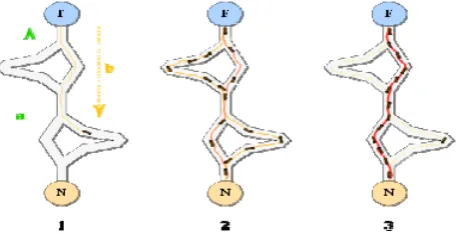
The original idea comes from observing the exploitation of food resources among ants, in which ants’ individually limited cognitive abilities have collectively been able to find the shortest path between a food source and the nest.
a. The first ant finds the food source (F), via any way (a), then returns to the nest (N), leaving behind a trail pheromone (b)
b. Ants indiscriminately follow four possible ways, but the strengthening of the runway makes it more attractive as the shortest route.
c. Ants take the shortest route; long portions of other ways lose their trail pheromones.
In a series of experiments on a colony of ants with a choice between two unequal length paths leading to a source of food, biologists have observed that ants tended to use the shortest route. A model explaining this behavior is as follows:
a) An ant (called "blitz") runs more or less at random around the colony;
b) If it discovers a food source, it returns more or less directly to the nest, leaving in its path a trail of pheromone;
c) These pheromones are attractive, nearby ants will be inclined to follow, more or less directly, the track;
d) Returning to the colony, these ants will strengthen the route;
e) If there are two routes to reach the same food source then, in a given amount of time, the shorter one will be traveled by more ants than the long route;
f) The short route will be increasingly enhanced, and therefore become more attractive;
g) The long route will eventually disappear because pheromones are volatile.
h) Eventually, all the ants have determined and therefore "chosen" the shortest route.
Figure 1: Pheromone update path
Ants use the environment as a medium of communication. They exchange information indirectly by depositing pheromones, all detailing the status of their "work". The information exchanged has a local scope, only an ant located where the pheromones were left has a notion of them. This system is called "Stigmergy" and occurs in many animal societies. The mechanism to solve a problem is too complex to be addressed by single ants is a good example of a self-organized system. This system is based on positive feedback and negative feedback. Theoretically, if the quantity of pheromone remained the same over time on all edges, no route would be chosen. However, because of feedback, a slight variation on an edge will be amplified and thus allow the choice of an edge. The algorithm will move from an unstable state in which no edge is stronger than another, to a stable state where the route is composed of the strongest edges.
IV. WORKING OF ANT ALGORITHM
Mobile Ad Hoc network consists of nodes which are mobile hence the route from source node to destination node changes. The routing algorithm has to detect the dynamic topology and generate path between nodes and it should also handle route failures. The routing algorithm is performed in three phases.
CONFERENCE PAPER
a. Route discovery phase– This phase finds all possible
paths from source node to destination node.
b. Route maintenance phase– This phase strengthens the
path between the nodes.
c. Route failure handling– If any node along the source
to destination fails or moves away from the network, alternate paths will be generated [2].
A. Data Structure:
Each node in the network consists of mainly two data structures viz., routing table and neighbor list.
a. Routing table: Routing table at each node stores the
list of reachable nodes and their pheromone value. It is represented as structure consisting of following fields:
a) destination_id – This represents the address of the destination node
b) next_id – This represents the address of the adjacent node used to reach destination node.
c) pheremone – This represents the value used by the node to calculate the probability of each adjacent node to be the next hop in order to reach the destination.
b. Neighbor list: Neighbor list is used to store the
information of all the neighboring nodes.
B. Route Discovery:
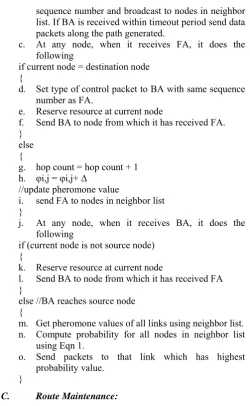
Route discovery is responsible for generating all possible routes between source and destination. It uses control packet to discover route. The control packets are mobile agents which walk through the network to establish routes between nodes. Route discovery uses two mobile agents called Forward Ant (FA) and Backward Ant (BA). These two ants are similar in structure but differ in the type of work they perform. A FA is an agent which establishes the pheromone track to the source node and BA establishes pheromone track to the destination. A forward ant is broadcast by the sender and relayed by the intermediate nodes till it reaches the destination. A node receiving a FA for the first time creates a record in its routing table. The record includes destination address, next hop and pheromone value. The node interprets the source address of the FA as the destination address, the address of the previous node as the next hop and computes the pheromone value depending on then number of hops the FA needed to reach the node. Then the node forwards the FA to its neighbors. FA packets have unique sequence number. Duplicate FA is detected through sequence number. Once the duplicate ants are detected, they are dropped by the nodes. When the FA reaches the destination, its information is extracted and it is destroyed. BA is created with same sequence number and sent towards the source. BA reserves the resources at along the nodes towards source. BA establishes path to destination node. Once the source receives the BA from the destination, the path is generated and the data can be sent along the path.
Working of this phase is as follows:
a. At source node create FA and broadcast to nodes in neighbor list.
b. At source node, wait for BA. If BA not received within timeout period, generate FA with new
sequence number and broadcast to nodes in neighbor list. If BA is received within timeout period send data packets along the path generated.
c. At any node, when it receives FA, it does the following
if current node = destination node {
d. Set type of control packet to BA with same sequence number as FA.
e. Reserve resource at current node
f. Send BA to node from which it has received FA. }
i. send FA to nodes in neighbor list }
j. At any node, when it receives BA, it does the following
if (current node is not source node) {
k. Reserve resource at current node
l. Send BA to node from which it has received FA }
else //BA reaches source node {
m. Get pheromone values of all links using neighbor list. n. Compute probability for all nodes in neighbor list
using Eqn 1.
o. Send packets to that link which has highest probability value.
}
C. Route Maintenance:
Route maintenance phase is responsible for the maintenance of the path generated during the discovery phase. This phase basically helps in maintaining the route which has already been established during route discovery phase. As the topology of the network changes, it is required to refresh the route between the nodes. Once the path between source and destination is set up, it is up to the data packets to maintain the route. When a node Vi forwards the data packet to node Vj to reach the destination Vd, it increments the pheromone value along the path Vj and Vd by Δ thus strengthening the path. An acknowledgement is sent to all the packets received. If acknowledgement is not received with in timeout period then the route error message is transmitted to previous node. Working of this module is as follows:
At each node, when it receives data packet, it does the following
if current node = destination node {
a. Extract data
b. Send packet (acknowledge packet) to previous node }
c. Get pheromone values of all links using neighbor list. d. Compute probability for all nodes in neighbor list
using Eqn 1.
e. Send packets to that link which has highest probability value.
f. Increment pheromone value for the highest probability link.
}
g. At regular intervals decrement pheromone value by
α.
If the pheromone value = 0 for any destination then call route discovery phase.
h. If acknowledgement is not received at current node before timeout sends route error to previous node (handling by error handling phase)
i. Refresh route after time out.
D. Route Failure Handling:
This phase is responsible for generating alternative routes in case the existing route fails. Node mobility in ad hoc network may cause certain links to fail. Every packet is associated with acknowledgement; hence if a node does not receive an acknowledgement, it indicates that the link is failed. On detecting a link failure the node sends a route error message to the previous node and deactivates this path by setting the pheromone value to zero. The previous node then tries to find an alternate path to the destination. If the alternate path exists, the packet is forwarded on to that path else the node informs its neighbors to relay the packet towards source. This continues till the source is reached. On reaching the source, the source initiates a new route discovery phase. Ant algorithm provides multiple paths. If the optimal path fails, it leads to choosing next best path. Next best path will be that path with links having next highest pheromone value (second best path). Hence ant algorithm does not break down on failure of optimal path. This helps in load balancing. That is, if the optimal path is heavily loaded, the data packets can follow the next best paths. Working of this phase is as follows:
At any node if a route error message is received, it performs the following function
a. If alternate path exist to reach destination send packets through other route
else {
b. Set pheromone = 0 in routing table //deactivate link c. Send route error message to previous node.
}
If route error message reaches source, it calls route discovery phase.
V. ISSUES
Study of Ant algorithm is concentrated mainly on two issues. One is Ant loss and other is resource reservation at nodes.
A. Ant loss during transmission:
There is a possibility of ant loss during the process of determining the reliable path. This can be of two types-the loss of the forward ant and the loss of the backward ant.
Loss of forward ant - Whenever a forward ant is lost, there will be a preset time-out period (say 6 seconds) at the source node within which if the backward ant does not return to the source, then a new forward ant with a different sequence number will be launched.
Loss of backward ant - Whenever a backward ant is lost after being dispatched from the destination node, the same time-out mechanism will be used at the source node to handle the ant loss. Another forward ant will be launched, or to make it more time efficient and dynamic, a backward ant with the same sequence number will be launched at the node where it was last seen thereby reducing the time taken for ant movement.
B. Reserving memory at each node:
Sometimes, it is necessary to store the packets at intermediate nodes in order to avoid packet or ant loss during transmission. Loss may be due to failure of links. If the packet is stored in the previous node, it can be retransmitted. Hence the algorithm stores packets at intermediate nodes during transmission in a fixed buffer of memory. In case of ant loss, it helps in regeneration of ants for path finding.
VI. CONCLUSION
This paper presents an enhanced algorithm for generating all possible paths between source node and destination node in mobile ad hoc network using swarm intelligence. Routing of data packets is only through optimal path which is generated by route discovery phase as defined by ARA [2]. Route maintenance is done periodically to retain optimal path. This is done through data packets. Due to change in topology of ad hoc network, existing routes may fail or new paths may be generated. In order to adapt for the change in topology, route refreshing is done periodically. This paper describes the method for handling loss of ants and avoids retransmission of lost packets by reserving resources at nodes, which in turn enhances the performance.
VII. REFERENCES
[1]. Andrew S Tannenbaum, “Computer Networks”, 4th Edition,
Prentice- Hall of India.
[2]. Cauvery N K, Dr K V Viswanatha, “Ant Algorithm for
Mobile Ad Hoc network” Proceedings of the International Conference on Advanced Computing and Communication Technologies for High Performance Applications,2008. [3]. Schoonderwoerd R, Holland O, Bruten J, Rothkrantz L.
“Ant-Based load Balancing in telecommunications networks, Adaptive Behavior Hewlelt- Packard Laboratories, Bristol-England, pp 162-207, 1996.
[4]. Di Caro, G., Dorigo, M, “Antnet: Distributed stigmergetic control communications networks. Journal of Artificial Intelligence Research pp 317-365, 1998.
CONFERENCE PAPER
[6]. Di Caro and Marco Dorigo, “Mobile Agents for adaptive
Routing”, Gianni, http://www.cs.berkeley.edu/~culler/cs294-s00/antnet.ps
[7]. Dorigo M, Di Caro G, “A mobie agents approach to Adaptive Routing Technical report”, IRIDA-Free Brussels University, Belgium, 1997
[8]. Nader F Mir, “Computer and communication Networks”,
Pearson Education, 2007
[9]. Liang S, Zincir Heywood A N, Heywood M I, “The effect of Routing under local information using a Social insect Metaphor”, IEEE International Congress of Evolutionary Computation, pp 1438-1443, May 2002.
[10]. Mesut Gunes,Udo Sorges, Imed Bouazizi, “ARA-The