Improving Syllabification Models with Phonotactic Knowledge
Karin M ¨uller
Institute of Phonetic Sciences University of Amsterdam
Abstract
We report on a series of experiments with probabilistic context-free grammars predicting English and German syllable structure. The treebank-trained grammars are evaluated on a syllabification task. The grammar used by M¨uller (2002) serves as point of comparison. As she evalu-ates the grammar only for German, we re-implement the grammar and experiment with additional phonotactic features. Us-ing bi-grams within the syllable, we can model the dependency from the previous consonant in the onset and coda. A 10-fold cross validation procedure shows that syllabification can be improved by incor-porating this type of phonotactic knowl-edge. Compared to the grammar of M¨uller (2002), syllable boundary accuracy in-creases from 95.8% to 97.2% for En-glish, and from 95.9% to 97.2% for Ger-man. Moreover, our experiments with different syllable structures point out that there are dependencies between the on-set on the nucleus for German but not for English. The analysis of one of our phonotactic grammars shows that inter-esting phonotactic constraints are learned. For instance, unvoiced consonants are the most likely first consonants and liquids and glides are preferred as second conso-nants in two-consonantal onsets.
1 Introduction
In language technology applications, unknown words are a continuous problem. Especially, Text-to-speech (TTS) systems like those described in Sproat (1998) depend on the correct pronunciation of those words. Most of these systems use large pro-nunciation dictionaries to overcome this problem. However, the lexicons are finite and every natural language has productive word formation processes. Thus, a TTS system needs a module which con-verts letters to sounds and a second module which syllabifies these sound sequences. The syllabifica-tion informasyllabifica-tion is important to assign the stress sta-tus of the syllable, to calculate the phone duration (Van Santen et al. (1997)), and to apply phonologi-cal rules (Kahn (1976), Blevins (1995)). Many au-tomatic syllabification methods have been suggested e.g., (Daelemans and van den Bosch, 1992; Van den Bosch, 1997; Kiraz and M¨obius, 1998; Vroomen et al., 1998; M¨uller, 2001; Marchand et al., to ap-pear 2006). M¨uller (2001) shows that incorporat-ing syllable structure improves the prediction of syl-lable boundaries. The syllabification accuracy in-creases if the onset and coda is more fine-grained (M¨uller, 2002). However, she only incorporates par-tial phonotactic knowledge in her approach. For in-stance, her models cannot express that the phoneme /l/ is more likely to occur after an /s/ than after a /t/ in English. The information that a phoneme is very probable in a certain position (here, the /l/ ap-pears as second consonant in a two-consonantal on-set cluster) will not suffice to express English phono-tactics of an entire consonant cluster. Moreover, she
only reports the performance of the German gram-mar. Thus, we are interested if the detection of syl-lable boundaries can be improved for both English and German by adding further phonotactic knowl-edge to a grammar.
Phonotactic constraints within the onset or coda seem to be important for various tasks. Listeners in-deed use phonotactic knowledge from their mother language in various listening situations. Vitevitch and Luce (1999), e.g., showed if English speak-ers have to rate nonsense words how “English-like” the stimuli are, highly probable phonotactic stimuli were rated more “English-like” than stimuli with a lower probability. Speakers make also use of their phonotactic knowledge when they have to segment a sequence into words. In a words spotting task, Weber and Cutler (2006) found evidence that speak-ers of American English can segment words much easier when the sequence contains phonotactic con-straints of their own language.
Beside many perception experiments which show that phonotactic constraints are useful information, many different methods have been suggested to model phonotactic constraints for language tech-nology applications. Krenn (1997), for instance, uses Hidden Markov Models to tag syllable struc-ture. The model decides whether a phoneme be-longs to the onset, nucleus or coda. However, this model does not incorporate fine-grained phonotac-tics. Belz (2000) uses finite state automatons (FSA) to model phonotactic structure of different sylla-ble types. We use similar positional features of syllables. Moreover, Carson-Berndsen (1998) and Carson-Berndsen et al. (2004) focus on automat-ically acquiring feature-based phonotactics by in-duction of automata which can be used in speech recognition. In our approach, we concentrate on explicit phonotactic grammars as we want to test different suggestions about the internal structure of words from phonological approaches (e.g. Kessler and Treiman (1997)). We assume, for instance, that codas depend on the previous nucleus and that on-sets depend on the subsequent nucleus.
In this paper, we present experiments on a series of context-free grammars which integrate step by step more phonological structure. The paper is or-ganized as follows: we first introduce our grammar development approach. In section 3, we describe our
experiments and the evaluation procedure. The sub-sequent section 4 shows what kind of phonotactic in-formation can be learned from a phonotactic gram-mar. Last, we discuss our results and draw some conclusions.
2 Method
We build on the approach of M¨uller (2001) which combines the advantages of treebank and brack-eted corpora training. Her method consists of four steps: (i) writing a (symbolic i.e. non-probabilistic) context-free phonological grammar with syllable boundaries, (ii) training this grammar on a pronunci-ation dictionary which contains markers for syllable boundaries (see Example 1; the pre-terminals “X[” and “X]” denote the beginning and end of a sylla-ble such that syllasylla-bles like[strIN]can be unambigu-ously processed during training), (iii) transforming the resulting probabilistic phonological grammar by dropping the syllable boundary markers1 (see Ex-ample 2), and (iv) predicting syllable boundaries of unseen phoneme strings by choosing their most probable phonological tree according to the trans-formed probabilistic grammar. The syllable bound-aries can be extracted from theSylnode which gov-erns a whole syllable.
(1) Word→X[Sylone ]X
(2) Word→Sylone
We use a grammar development procedure to de-scribe the phonological structure of words. We ex-pect that a more fine-grained grammar increases the precision of the prediction of syllable boundaries as more phonotactic information can be learned. In the following section, we describe the development of a series of grammars.
2.1 Grammar development
Our point of comparison is (i) the syllable com-plexity grammar which was introduced by M¨uller (2002). We develop four different grammars: (ii) the
phonotactic grammar, (iii) the phonotactic on-nuc grammar (iv) the phonotactic nuc-coda grammar
and (v) thephonotactic on-nuc-coda grammar. All five grammars share the following features: The grammars describe a word which is composed of one
to n syllables which in turn branch into onset and rhyme. The rhyme is re-written by the nucleus and the coda. Onset or coda could be empty. Further-more, all grammar versions differentiate between monosyllabic and polysyllabic words. In polysyl-labic words, the syllables are divided into syllables appearing initially, medially, and word-finally. Additionally, the grammars distinguish be-tween consonant clusters of different sizes (ranging from one to five consonants).
We assume that phonotactic knowledge within the onset and coda can help to solve a syllabifica-tion task. Hence, we change the rules of the syl-lable complexity grammar(M¨uller, 2002) such that phonotactic dependencies are modeled. We express the dependencies within the onset and coda as well as the dependency from the nucleus by bi-grams.
2.1.1 Grammar generation
The grammars are generated automatically (using perl-scripts). As all possible phonemes in a language are known, our grammar generates all possible re-write rules. This generation process naturally over-generates, which means that we receive rules which will never occur in a language. There are, for in-stance, rules which describe the impossible English onset /tRS/. However, our training procedure and our training data make sure that only those rules will be chosen which occur in a certain language.
The monosyllabic English wordstringis used as a running example to demonstrate the differences of the grammar versions. The word string is tran-scribed in the pronunciation dictionary CELEX as ([strIN]) (Baayen et al., 1993). The opening square bracket, “[“, indicates the beginning of the syllable and the closing bracket, “]”, the end of the syllable. The word consists of the tri-consonantal onset[str]
followed by the nucleus, the short vowel[I]and the coda[N].
In the following paragraphs, we will introduce the different grammar versions. For comparison rea-sons, we briefly describe the grammar of M¨uller (2002) first.
2.1.2 Syllable complexity grammar (M ¨uller, 2002)
The syllable complexity grammar distinguishes between onsets and codas which contain a
differ-ent number of consonants. There are different rules which describe zero to n-consonantal onsets. Tree (3) shows the complete analysis of the word
string.
(3) Word
Sylone
H H H H H
Onsetone
Onone.3.1
HH
s Onone.3.2
HH
t Onone.3.3
r
Rhymeone
H H H
Nucleusone
I
Codaone.1
Coone.1.1
N
(4) Onone.3.1→s Onone.3.2
(5) Onone.2.1→s Onone.2.2
Rule 4, e.g., describes a tri-consonantal onset, e.g.,
[str]. This rule occurs in example tree 3 and will be used for words such asstringorspray. Rule (5) describes a two-consonantal onset occurring in the analysis of words such assnakeorstand. However, this grammar cannot model phonotactic dependen-cies from the previous consonant.
2.1.3 Phonotactic grammar
Thus, we develop a phonotactic grammar which differs from the previous one. Now, a consonant in the onset or coda depends on the preceding one. The rules express bi-grams of the onset and coda conso-nants. The main difference to the previous gram-mars can be seen in the re-writing rules involving phonemic preterminal nodes (rule 6) as well as ter-minal nodes for consonants (rule 7).
(6) X.r.C.s.t→C X.r.C+.s.t (7) X.r.C.s.t→C
Rules of this type bear four features for a conso-nant C inside an onset or a coda (X=On, Cod), namely: the position of the syllable in the word (r=ini, med, fin, one), the current terminal node (C =consonant), the succeeding consonant (C+), the cluster size (t = 1. . .5), and the position of a consonant within a cluster (s= 1. . .5).
rule (9) comes from the example tree showing that the onset consonant[t]depends on the previous con-sonant[s].
2.1.4 Phonotactic on-nuc grammar
We also examine if there are dependencies of the first onset consonant on the succeeding nucleus. The dependency of the whole onset on the nucleus is indirectly encoded by the bi-grams within the on-set. The phonotactic onset-nucleus grammar distin-guishes between same onsets with different nuclei. In example tree (12), the triconsonantal onset start-ing with a phoneme[s]depends on the Nucleus[I]. Rule (10) occurs in tree (12) and will be also used for words such asstrictorstripwhereas rule (11) is used for words such asstrongorstrop.
(10) Onsetone.I.3 →Onone.s.3.1
2.1.5 Phonotactic nuc-coda grammar
The phonotactic nucleus-coda grammar encodes the dependency of the first coda consonant on the nucleus. The grammar distinguishes between codas that occur with various nuclei. Rule 13 is used, for instance, to analyze the wordstring, shown in Ex-ample tree 15. The same rule will be applied for
words such asbring, king, ringorthing. If there is a different nucleus, we get a different set of rules. Rule 14, e.g., is required to analyze words such as
long, song, strongorgong.
(13) Codaone.I.1→ N Coone.t.1.1
2.1.6 Phonotactic on-nuc-coda grammar
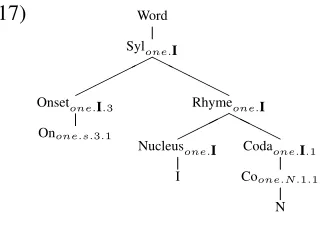
The last tested grammar is the phonotactic onset-nucleus-coda grammar. It is a combination of gram-mar 2.1.4 and 2.1.5. In this gramgram-mar, the first con-sonant of the onset and coda depend on the nucleus. Tree 16 shows the full analysis of our running exam-ple wordstring.
(16) Word
(17) Word
Sylone.I
H H H H
Onsetone.I.3
Onone.s.3.1
Rhymeone.I
H H H
Nucleusone.I
I
Codaone.I.1
Coone.N.1.1
N
3 Experiments
In this section, we report on our experiments with four different phonotactic grammars introduced in Section 2.1 (see grammar 2.1.3-2.1.6), as well as with a re-implementation of M¨uller’s less complex grammar (M¨uller, 2002). All these grammars are trained on a corpus of transcribed words from the pronunciation lexiconCELEX. We use the full forms of the lexicon instead of the lemmas. The German lexicon contains 304,928 words and the English lex-icon 71,493 words. Homographs with the same pro-nunciation but with different part of speech tags are taken only once. We use for our German exper-iments 274,435 words for training and 30,492 for testing (evaluating). For our English experiments, we use 64,343 for training and 7,249 for testing.
3.1 Training procedure
We use the same training procedure as M¨uller (2001). It is a kind of treebank training where we obtain a probabilistic context-free grammar (PCFG) by observing how often each rule was used in the training corpus. The brackets of the input guaran-tee an unambiguous analysis of each word. Thus, the formula of treebank training given by (Charniak, 1996) is applied: r is a rule, let |r|be the number of timesroccurred in the parsed corpus andλ(r)be the non-terminal thatrexpands, then the probability assigned toris given by
p(r) = P |r|
r0∈{r0|λ(r0)=λ(r)}|r0|
After training, we transform the PCFG by drop-ping the brackets in the rules resulting in an anal-ysis grammar. The bracket-less analanal-ysis grammar is used for parsing the input without brackets; i.e., the phoneme strings are parsed and the syllable bound-aries are extracted from the most probable parse.
In our experiments, we use the same technique. The advantage of this training method is that we learn the distribution of the grammar which maxi-mizes the likelihood of the corpus.
3.2 Evaluation procedure
We evaluate our grammars on a syllabification task which means that we use the trained grammars to predict the syllable boundaries of an unseen corpus. As we drop the explicit markers for syllable aries, the grammar can be used to predict the aries of arbitrary phoneme sequences. The bound-aries can be extracted from thesyl-span which gov-erns an entire syllable.
Our training and evaluation procedure is a 10-fold cross validation procedure. We divide the original (German/English) corpus into ten parts equal in size. We start the procedure by training on parts 1-9 and evaluating on part 10. In a next step, we take parts 1-8 and 10 and evaluate on part 9. Then, we evaluate on corpus 8 and so forth. In the end, this procedure yields evaluation results for all 10 parts of the orig-inal corpus. Forig-inally, we calculate the average mean of all evaluation results.
3.2.1 Evaluation Metrics
Our three evaluation measures are word accuracy, syllable accuracy and syllable boundary accuracy. Word accuracy is a very strict measure and does not depend on the number of syllables within a word. If a word is correctly analyzed the accuracy increases. We defineword accuracyas
# of correctly analyzed words total # of words
Syllable accuracyis defined as
# of correctly analyzed syllables total # of syllables
The last evaluation metrics we used is thesyllable boundary accuracy. It expresses how reliable the boundaries were recognized. It is defined as
# of correctly analyzed syllable boundaries total # of syllable boundaries
transferring trA:ns–f3:–rIN
wet wEt
Table 1: Example: evaluation corpus
transferring trA:n–sf3:–rIN
wet wEt
Table 2: Example: predicted boundaries
(1correct word2words ), the syllable accuracy will be 50% (2correct syllables4syllables ), and the syllable boundary
accu-racy is 75% (3correct syllable boundaries4syllable boundaries ). The differ-ence between syllable accuracy and syllable bound-ary accuracy is that the first metric punishes the wrong prediction of a syllable boundary twice as the complete syllable has to be correct. The syllable boundary accuracy only judges the end of the sylla-ble and counts how often it is correct. Mono-syllabic words are also included in this measure. They serve as a baseline as the syllable boundary will be always correct. If we compare the baseline for English and German (tables 3 and 4, respectively), we observe that the English dictionary contains 10.3% monosyl-labic words and the German one 1.59%.
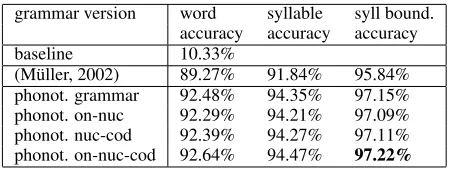
Table 3 and table 4 show that phonotactic knowl-edge improves the prediction of syllable bound-aries. The syllable boundary accuracy increases from 95.84% to 97.15% for English and from 95.9% to 96.48% for German. One difference between the two languages is if we encode the nucleus in the on-set or coda rules, German can profit from this in-formation compared to English. This might point at a dependence of German onsets from the nucleus. For English, it is even the case that the on-nuc and the nuc-cod grammars worsen the results compared to the phonotactic base grammar. Only the combi-nation of the two grammars (the on-nuc-coda gram-mar) achieves a higher accuracy than the phonotactic grammar. We suspect that the on-nuc-coda grammar encodes that onset and coda constrain each other on the repetition of liquids or nasals between /s/C on-sets and codas. For instance,lullandmamare okey, whereasslullandsmameare less good.
4 Learning phonotactics from PCFGs
We want to demonstrate in this section that our phonotactic grammars does not only improve
syl-grammar version word syllable syll bound. accuracy accuracy accuracy baseline 10.33%
(M¨uller, 2002) 89.27% 91.84% 95.84% phonot. grammar 92.48% 94.35% 97.15% phonot. on-nuc 92.29% 94.21% 97.09% phonot. nuc-cod 92.39% 94.27% 97.11% phonot. on-nuc-cod 92.64% 94.47% 97.22%
Table 3: Evaluation of four English grammar ver-sions.
grammar version word syllable syll bound. accuracy accuracy accuracy baseline 1.59%
(M¨uller, 2002) 86.06% 91.96% 95.90% phonot. grammar 87.95% 93.09% 96.48% phonot. nuc-cod 89.53% 94.09% 97.01% phonot. on-nuc 89.97% 94.35% 97.15% phonot. on-nuc-cod 90.45% 94.62% 97.29%
Table 4: Evaluation of four German grammar ver-sions.
labification accuracy but can be used to reveal in-teresting phonotactic2information at the same time. Our intension is to show that it is possible to aug-ment symbolic studies such as e.g., Hall (1992), Pierrehumbert (1994), Wiese (1996), Kessler and Treiman (1997), or Ewen and van der Hulst (2001) with extensive probabilistic information. Due to time and place constraints, we concentrate on two-consonantal clusters of grammar 2.1.3.
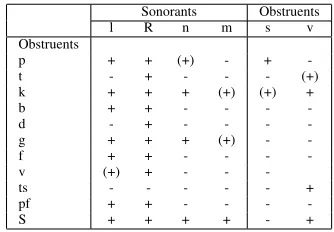
Phonotactic restrictions are often expressed by ta-bles which describe the possibility of combination of consonants. Table 5 shows the possible combi-nations of German two-consonantal onsets (Wiese, 1996). However, the table cannot express differ-ences in frequency of occurrence between certain clusters. For instance, it does not distinguish be-tween onset clusters such as[pfl]and[kl]. If we con-sider the frequency of occurrence in a German dic-tionary then there is indeed a great difference.[kl]is much more common than[pfl].
4.1 German
Our method allows additional information to be added to tables such as shown in table 5. In what follows, the probabilities are taken from the rules of grammar 2.1.3. Table 6 shows the probability of
mono l R n m s v f t ts p k j z g
0.380 S 0.160 0.093 0.056 0.074 0.165 0.318 0.131
0.158 k 0.351 0.322 0.175 0.151
0.090 b 0.489 0.510
0.086 t 0.955 0.044
0.083 f 0.620 0.364 0.015
0.066 g 0.362 0.617 0.019
0.042 p 0.507 0.400 0.030 0.061
0.033 d 1.000
0.019 s 0.200 0.066 0.100 0.133 0.033 0.133 0.333
0.019 ts 1.000
0.011 pf 0.882 0.117
0.007 v 1.000
Table 6: German two-consonantal onsets in monosyllabic words - sorted by probability of occurrence
mono l r n m s v f t ts p k j z g w S d
0.322 s 0.157 0.001 0.099 0.060 0.001 0.004 0.223 0.150 0.174 0.006 0.120
0.148 k 0.375 0.390 0.003 0.003 0.030 0.196
0.093 b 0.420 0.574 0.004
0.083 f 0.591 0.333 0.075
0.079 p 0.480 0.457 0.056 0.005
0.072 g 0.283 0.709 0.006
0.068 t 0.686 0.039 0.274
0.048 d 0.822 0.112 0.065
0.035 h 0.089 0.910
0.018 T 0.857 0.047 0.095
0.014 S 0.878 0.030 0.030 0.060
0.004 m 1.000
0.003 n 1.000
0.002 l 1.000
0.002 v 1.000
Table 7: English two-consonantal onsets in monosyllabic words - sorted by probability of occurrence
Sonorants Obstruents
l R n m s v
Obstruents
p + + (+) - +
-t - + - - - (+)
k + + + (+) (+) +
b + + - - -
-d - + - - -
-g + + + (+) -
-f + + - - -
-v (+) + - -
-ts - - - +
pf + + - - -
-S + + + + - +
Table 5: (Wiese, 1996) German onset clusters
occurrence of German obstruents ordered by their probability of occurrence. [S]occurs very often in German words as first consonant in two-consonantal onsets word initially. In the first row of table 6, the consonants which occur as second consonants are listed. We observe, for instance, that [St] is the most common two-consonantal onset in mono-syllabic words. This consonant cluster appears in words such asStaub (dust), stark(strong), orStolz
(pride). We believe that there is a threshold indicat-ing that a certain combination is very likely to come from a loanword. If we define the probability of a two-consonantal onset as
p(onset ini 2) =def p(C1)×p(C2)
wherep(C1)is the probability of the rule
X.r.C1.s.t→C1 X.r.C2.s.t
andp(C2)is the probability of the rule
X.r.C2.s.t→C2,
then we get a list of two-consonantal onsets ordered by their probabilities:
p(St)> ... > p(sk)> p(pf l)> p(sl)> ... > p(sf)
These onsets occur in words such as Steg (foot-bridge), stolz (proud), Staat (state), Skalp (scalp),
Skat (skat) Pflicht (duty), Pflock (stake), or Slang
(slang) and Slum (slum). The least probable combination is [sf] which appears in the German word Sph¨are(sphere) coming from the Latin word
conso-nant /p/ became the affricate /pf/. The English trans-lation of these words shows that the second sound shift was not applied to English. However, the most probable two-consonantal onset is [St]. The whole set of two-consonantal onsets can be seen in Table 8.
4.2 English
English two-consonantal onsets show that unvoiced first consonants are more common than voiced ones. However, two combinations are missing. The alveo-lar plosives /t/ and /d/ do not combine with the lateral /l/ in English two-consonantal onsets. Table 8 shows the most probable two-consonantal onsets sorted by their joint probability.
4.3 Comparison between English and German
The fricatives /s/ and /S/ are often regarded as extra syllabic. According to our study on two-consonantal onsets, these fricatives are very probable first con-sonants and combine with more second concon-sonants than all other first consonants. They seem to form an own class. Liquids and glides are the most impor-tant second consonants. However, English prefers /r/ over /l/ in all syllable positions and /j/ over /w/ (ex-cept in monosyllabic words) and /n/ as second con-sonants. Nasals can only combine with very little first consonants. In German, we observe that /R/ is preferred over /l/ and /v/ over /n/ and /j/. Moreover, the nasal /n/ is much more common in German than in English as second consonants which applies espe-cially to medial and final syllables.
When we compare the phonotactic restrictions of two languages, it is also interesting to observe which combinations are missing. If certain consonant clus-ters are not very likely or never occur in a language, this might have consequences for language under-standing and language learning. Phonotactic gaps in one language might cause spelling mistakes in a second language. For instance, a typical Northern German name isDetlef which is often misspelled in English asDeltef. The onset cluster /tl/ can occur in medial and final German syllables but not in En-glish. The different phonetic realization of /l/ may play a certain role that /lt/ is more natural than /tl/ in English.
Mono-syllabic:/st/>/kr/>/sk/>/kl/>/br/>/gr/>/sl/>/fl/>/sp/>/tr/
>/dr/>/bl/>/sw/>/pl/>/pr/>/sn/>/hw/>/kw/>/fr/>/gl/>/sm/>
/tw/>/Tr/>/Sr/>/fj/>/dj/>/kj/>/pj/>/mj/>/dw/>/hj/>/nj/>/tj/
>/vj/>/lj/>/sj/>/Tw/>/sf/>/Tj/>/Sw/>/km/>/kv/>/gw/>/Sn/
>/Sm/>/pS/>/bj/>/sr/>/sv/
Initial/pr/>/st/>/tr/>/kr/>/sp/>/sk/>/br/>/gr/>/fl/>/kl/>/fr/>
/bl/>/pl/>/sl/>/kw/>/dr/>/sn/>/sw/>/gl/>/hw/>/nj/>/sm/>/sj/
>/pj/>/Tr/>/mj/>/kj/>/dj/>/tw/>/tj/>/fj/>/hj/>/lj/>/bj/>/ps/
>/Sr/>/dw/>/sf/>/vj/>/gj/>/gw/>/pw/>/mn/>/Sm/>/Tj/>/Tw/
>/Sn/>/tsw/>/zj/>/pt/>/mw/>/kn/>/gz/
Medial:/st/>/tr/>/pr/>/sp/>/gr/>/kj/>/kr/>/kw/>/pl/>/br/>/tj/
>/lj/>/dj/>/dr/>/kl/>/nj/>/sk/>/mj/>/fr/>/pj/>/bl/>/fl/>/bj/
>/gl/>/gj/>/fj/>/Sn/>/sj/>/vj/>/Sj/>/Tr/>/vr/>/gw/>/sl/>
/nr/>/sw/>/mr/>/sn/>/hj/>/hw/>/sm/>/zj/>/tSr/>/rj/>/sr/>
/dw/>/Zr/>/Sr/>/jw/>/tSw/>/tSn/>/vw/>/Dr/>/dZr/>/dn/>/Tj/
>/tw/>/Sw/>/Zj/>/zr/>/zn/>/zw/>/Zw/>/dZj/>/dZn/>/dZw/
Final:/st/>/tr/>/kl/>/bl/>/gr/>/dr/>/pl/>/br/>/sk/>/sp/>/pr/
>/kr/>/tj/>/fr/>/nj/>/fl/>/lj/>/kw/>/dj/>/sj/>/kj/>/sl/>/gl/
>/hw/>/Sn/>/vr/>/Sj/>/vj/>/bj/>/pj/>/fj/>/Tr/>/mj/>/gw/>
/sr/>/sw/>/sm/>/nr/>/sn/>/tSr/>/mr/>/tw/>/dZr/>/zj/>/gj/>
/dZj/>/Sr/>/Zr/>/sf/>/nw/>/zr/>/Tj/>/rj/>/Dr/>/vw/>/dw/>
/dn/>/tSj/>/pw/>/jw/>/hj/>/St/>/Zw/>/tSn/>/Zj/>/pn/>/Dj/>
/dZn/>/zn/>/Sw/>/Zn/>/tSw/>/Tw/>/bd/>/tsj/>/Dw/
Monosyllabic:/St/>/tR/>/Sv/>/Sl/>/kl/>/fl/>/kR/>/Sp/>/bR/>
/bl/>/gR/>/SR/>/dR/>/fR/>/Sm/>/kn/>/gl/>/kv/>/pl/>/Sn/>
/tsv/>/pR/>/pfl/>/vR/>/sk/>/sl/>/tv/>/ps/>/sp/>/sv/>/sm/>
/pfR/>/pn/>/gn/>/sn/>/fj/>/sf/
Initial:/St/>/tR/>/pR/>/Sp/>/kR/>/Sv/>/gR/>/Sl/>/fR/>/kl/>
/bR/>/bl/>/fl/>/Sm/>/gl/>/tsv/>/pl/>/kv/>/kn/>/Sn/>/dR/>
/SR/>/sk/>/pfl/>/ps/>/gn/>/sl/>/sm/>/sts/>/sf/>/sv/>/ks/>
/tv/>/vR/>/sn/>/mn/>/st/>/pn/>/sp/>/fj/>/pfR/>/mj/
Medial:/St/>/tR/>/bR/>/fR/>/Sl/>/gR/>/kR/>/bl/>/dR/>/Sp/
>/kl/>/fl/>/pR/>/gl/>/Sv/>/SR/>/st/>/pl/>/ks/>/kv/>/gn/>
/Sn/>/Sm/>/kn/>/tsv/>/pfl/>/dl/>/dn/>/gm/>/sp/>/sn/>/fn/>
/bn/>/vj/>/xR/>/tn/>/sl/>/vR/>/sk/>/pj/>/ps/>/sts/>/xn/>/xl/
>/ml/>/Rn/>/Nn/>/NR/>/zn/>/zl/>/mn/>/tl/>/sf/>/ln/>/tsR/
>/tsl/>/sR/>/ft/>/zR/>/pfR/>/pt/>/nR/>/sg/>/pn/>/dm/>/tz/
>/sv/>/zv/>/tv/
Final:/St/>/tR/>/bl/>/Sl/>/bR/>/fl/>/kl/>/dR/>/gR/>/Sp/>
/kR/>/Sv/>/fR/>/SR/>/gl/>/ks/>/dl/>/pl/>/gn/>/pR/>/Sn/>
/Sm/>/kn/>/dn/>/kv/>/tsv/>/tl/>/ml/>/xl/>/tsl/>/gm/>/pfl/>
/Nl/>/zl/>/tn/>/xR/>/vR/>/fn/>/bn/>/vj/>/zn/>/Nn/>/pn/>
/RR/>/mn/>/xn/>/zR/>/NR/>/lR/>/dZm/>/tsR/>/nl/>/gv/>/ps/
>/ft/>/pfR/>/tZl/>/nR/>/sp/>/st/>/sv/>/sk/>/sR/>/sn/>/sl/>
/sm/>/sts/
5 Discussion
Comparison of the syllabification performance with other systems is difficult: (i) different approaches differ in their training and evaluation corpus; (ii) comparisons across languages are hard to inter-pret; (iii) comparisons across different approaches require cautious interpretations. Nevertheless, we want to refer to several approaches that examined the syllabification task. Van den Bosch (1997) in-vestigated the syllabification task with five induc-tive learning algorithms. He reported a general-ization error for words of 2.22% on English data. However, the evaluation procedure differs from ours as he evaluates each decision (after each phoneme) made by his algorithms. Marchand et al. (to ap-pear 2006) evaluated different syllabification algo-rithms on three different pronunciation dictionaries. Their best algorithm (SbA) achieved a word accu-racy of 91.08%. The most direct point of compari-son are the results presented by M¨uller (2002). Her approach differs in two ways. First, she only eval-uates the German grammar and second she trains on a newspaper corpus. As we are interested in how her grammars perform on our corpus, we re-implemented her grammars and tested both in our 10-fold cross evaluation procedure. We find that the first grammar (M¨uller, 2001) achieves 85.45% word accuracy, 88.94% syllable accuracy and 94.37% syl-lable boundary accuracy for English and 84.21%, 90.86%, 95.36% for German respectively. The re-sults show that the syllable boundary accuracy in-creases from 94,37% to 97.2% for English and from 95.3% to 97.2% for German. The experiments point out that phonotactic knowledge is a valuable source of information for syllabification.
6 Conclusions
Phonotactic restrictions are important for language perception and production. They influence the abil-ity of children to segment words, and they help to recognize words in nonsense sequences. In this paper, we presented grammars which incorporate phonotactic restrictions. The grammars were trained and tested on a German and an English pronuncia-tion dicpronuncia-tionary. Our experiments show that English and German profit from phonotactic knowledge to predict syllable boundaries. We find evidence that
German codas depend on the nucleus which does not apply for English. The English grammars which model the dependency of part of the onset or coda on the nucleus worsen the syllabification accuracy. However, the combination of both show a better per-formance than the base phonotactic grammar. This suggests that there are constrains in the selection of the onset and coda consonants.
7 Acknowledgments
I would like to thank Paul Boersma who invited me as a guest researcher at the Institute of Phonetic Sciences of the University of Amsterdam. Special thanks also to Detlef Prescher as well as to the three anonymous reviewers, whose comments were very useful while preparing the final version of this pa-per.
References
Harald R. Baayen, Richard Piepenbrock, and H. van Rijn. 1993. The CELEXlexical database—Dutch, English, German. (Release 1)[CD-ROM]. Philadelphia, PA: Linguistic Data Consortium, Univ. Pennsylvania.
Anja Belz. 2000. Multi-syllable phonotactic mod-elling. In Proceedings of SIGPHON 2000: Finite-State Phonology, Luxembourg.
Juliette Blevins. 1995. The Syllable in Phonological Theory. In John A. Goldsmith, editor, Handbook of Phonological Theory, pages 206–244, Blackwell, Cambridge MA.
Julie Carson-Berndsen, Robert Kelly, and Moritz Neuge-bauer. 2004. Automatic Acquisition of Feature-Based Phonotactic Resources. In Proceedings of the Work-shop of the ACL Special Interest Group on Computa-tional Phonology (SIGPHON), Barcelona, Spain.
Julie Carson-Berndsen. 1998. Time Map Phonology. Fi-nite State Models and Event Logics in Speech Recog-nition, volume 5 ofText, Speech and Language Tech-nology. Springer.
Eugene Charniak. 1996. Tree-bank grammars. In Pro-ceedings of the Thirteenth National Conference on Ar-tificial Intelligence, AAAI Press/MIT Press, Menlo Park.
Colin J. Ewen and Harry van der Hulst. 2001. The Phonological Structure of Words. An Introduc-tion. Cambridge University Press, Cambridge, United Kingdom.
Tracy Hall. 1992. Syllable structure and syllable related processes in German. Niemeyer, T¨ubingen.
Daniel Kahn. 1976. Syllable-based Generalizations in English Phonology. Ph.D. thesis, Massachusetts Insti-tute of Technology, MIT.
Brett Kessler and Rebecca Treiman. 1997. Syllable Structure and the Distribuation of Phonemes in En-glish Syllables. Journal of Memory and Language, 37:295–311.
George Anton Kiraz and Bernd M¨obius. 1998. Mul-tilingual Syllabification Using Weighted Finite-State Transducers. InProc. 3rd ESCA Workshop on Speech Synthesis (Jenolan Caves), pages 59–64.
Brigitte Krenn. 1997. Tagging syllables. InProceedings of the 5th European Conference on Speech Commu-nication and Technology, Eurospeech 97, pages 991– 994.
Yannick Marchand, Connie A. Adsett, and Robert I. Damper. to appear 2006. Automatic syllabification in English: A comparison of different algorithms. Lan-guage and Speech.
Karin M¨uller. 2001. Automatic Detection of Syllable Boundaries Combining the Advantages of Treebank and Bracketed Corpora Training. InProc. 39th Annual Meeting of the ACL, Toulouse, France.
Karin M¨uller. 2002. Probabilistic Context-Free Gram-mars for Phonology. InProceedings of the Workshop on Morphological and Phonological Learning at ACL 2002.
Janet Pierrehumbert. 1994. Syllable structure and word structure: a study of triconsonantal clusters in English. In Patricia A. Keating, editor,Phonological Structure and Phonetic Form, volume III of Papers in Labo-ratory Phonology, pages 168–188. University Press, Cambridge.
Richard Sproat, editor. 1998. Multilingual Text-to-Speech Synthesis: The Bell Labs Approach. Kluwer Academic, Dordrecht.
Antal Van den Bosch. 1997. Learning to Pronounce Written Words: A Study in Inductive Language Learn-ing. Ph.D. thesis, Univ. Maastricht, Maastricht, The Netherlands.
Jan P.H. Van Santen, Chilin Shih, Bernd M¨obius, Eve-lyne Tzoukermann, and Michael Tanenblatt. 1997. Multilingual duration modeling. In Proceedings of
the European Conference on Speech Communication and Technology (Eurospeech), volume 5, pages 2651– 2654, Rhodos, Greece.
Michael S. Vitevitch and Paul A. Luce. 1999. Proba-bilistic Phonotactics and Neighborhood Activation in Spoken Word Recognition. Journal of Memory and Language, (40):374–408.
Jean Vroomen, Antal van den Bosch, and Beatrice de Gelder. 1998. A Connectionist Model for Boot-strap Learning of Syllabic Structure. Language and Cognitive Processes. Special issue on Language Ac-quisition and Connectionism, 13(2/3):193–220.
Andrea Weber and Anne Cutler. 2006. First-language phonotactics in second-language listening. Journal of the Acoustical Society of America, 119(1):597–607.