Systems: Controller Synthesis, Architecture Design
and System Identification
Thesis by
Nikolai Matni
In Partial Fulfillment of the Requirements for the Degree of
Doctor of Philosophy
California Institute of Technology Pasadena, California
2016
Acknowledgments
I want to thank my advisor, John Doyle, for his generous support & encouragement during these years. He has been an incredible mentor and role model, constantly challenging me to grow as a researcher and providing me with opportunities rarely given to graduate students. He has changed the way that I view science, engineering and research, and for this I am eternally grateful. I also want to thank my unofficial co-advisor, Venkat Chandrasekaran. Venkat brings a rare elegance and sophistication to his work, and I am incredibly fortunate to have been able to collaborate with and learn from him these past few years.
I would also like to express my thanks to the remaining members of my thesis committee, Adam Wierman and Richard M. Murray, as well as to Steven Low, Joel Tropp, Babak Hassibi, Anders Rantzer and Joel Burdick. Be it through teaching, informal discussions, or collaborations, all of these amazing professors have played an instrumental role in making my time at Caltech intellectually stimulating and enjoyable. I would also like to thank Andrew Lamperski for his mentorship early in my graduate student career: without his guidance and support, this thesis would most certainly look very different. I must also thank my master’s advisor, Meeko Oishi, for introducing me to the field of control theory, and for giving me my first shot at research.
survived my time here without you.
Contents
Acknowledgments iv
Abstract xv
1 Introduction 1
1.1 Non-Classical Information Sharing Constraints . . . 2
1.2 Thesis Contribution and Outline . . . 5
2 Distributed Control subject to Delays Satisfying anH∞Norm Bound 8 2.1 Introduction . . . 8
2.2 Problem Formulation . . . 10
2.2.1 Notation and Operator Theoretic Preliminaries . . . 11
2.2.2 The model-matching problem subject to delay . . . 12
2.3 A Review of “1984” H∞ Control . . . 15
2.3.1 T3 =I Case . . . 15
2.3.2 GeneralT3 . . . 19
2.4 DistributedH∞ Control Subject to Delays . . . 20
2.4.1 T3 =I Case . . . 21
2.4.2 GeneralT3 . . . 26
2.5 Example . . . 28
2.6 Conclusion . . . 29
2.7 Factorization Formulas . . . 30
2.7.1 Inner-Outer Factorizations . . . 30
2.7.3 Stable Approximations . . . 31
3 Optimal Two Player LQR State Feedback with Varying Delay 33 3.1 Introduction . . . 33
3.2 Problem Formulation . . . 35
3.2.1 The two-player problem . . . 35
3.3 Main Result . . . 38
3.3.1 Effective delay . . . 38
3.3.2 Partial Nestedness . . . 39
3.3.3 Information Graph and Controller Coordinates . . . 40
3.4 Controller Derivation . . . 42
3.4.1 Controller States and Decoupled Dynamics . . . 42
3.4.2 Finite Horizon Dynamic Programming Solution . . . 45
3.4.3 Infinite Horizon Solution . . . 48
3.5 Conclusion . . . 49
3.6 Proofs of Intermediate Lemmas . . . 49
4 Regularization for Design 54 4.1 Introduction . . . 54
4.2 Preliminaries & Notation . . . 58
4.3 RFD as Structured Approximation . . . 59
4.3.1 Convex Model Matching . . . 60
4.3.2 Architecture Design through Structured Solutions . . . 62
4.4 RFD Cost Functions and Regularizers . . . 67
4.4.1 Convex Cost Functions . . . 67
4.4.2 The H2 RFD Problem with an Atomic Norm Penalty . . . 70
4.4.3 Further Connections with Structured Inference . . . 75
4.5 The RFD Procedure . . . 77
4.5.1 The Two-Step Algorithm . . . 77
4.5.2 Simultaneous Actuator, Sensor and Communication RFD . . . 78
4.6.1 Identifiability Conditions in Control . . . 85
4.6.2 Sufficient Conditions for Recovery . . . 88
4.7 A RFD Signal to Noise Ratio . . . 90
4.8 Case Study . . . 93
4.9 Future Work . . . 97
4.10 Proofs . . . 97
5 Communication Delay Co-design in H2 Distributed Control Using Atomic Norm Minimization 100 5.1 Introduction . . . 100
5.2 Preliminaries . . . 103
5.2.1 Operator Theoretic Preliminaries . . . 103
5.2.2 Notation . . . 104
5.3 Communication Architecture Co-Design . . . 105
5.3.1 DistributedH2 Optimal Control subject to Delays . . . 105
5.3.2 Communication Delay Co-Design via Convex Optimization . . 109
5.4 Communication Graphs and Quadratically Invariant Subspaces . . . . 110
5.4.1 Generating Subspaces from Communication Graphs . . . 111
5.4.2 Quadratically Invariant Communication Graphs . . . 114
5.5 The Communication Graph Co-Design Algorithm . . . 120
5.5.1 The Communication Link Norm . . . 121
5.5.2 Co-Design Algorithm and Solution Properties . . . 125
5.6 Computational Examples . . . 127
5.7 Discussion . . . 131
6 Low-Rank and Low-Order Decompositions for Local System Identi-fication 134 6.1 Introduction . . . 134
6.2 Problem Formulation . . . 136
6.2.1 Notation . . . 136
6.2.3 Local and interconnection observations . . . 138
6.2.4 Local system identification . . . 139
6.3 Full interconnection measurements . . . 140
6.3.1 A robust variant . . . 142
6.4 Hidden interconnection measurements . . . 143
6.5 Numerical Experiments . . . 146
6.6 Conclusion . . . 148
7 Conclusions and Future Work 150 7.1 Future Work: A theory of dynamics, control and optimization in lay-ered architectures . . . 150
7.1.1 Software Defined Networking . . . 152
7.2 Concluding Remarks . . . 153
List of Figures
1.1 A schematic diagram of norm-optimal control. The objective is to de-sign a feedback controller that minimizes the size (as measured by an appropriate signal-to-signal norm) of the system’s closed-loop response to the environment. . . 1 1.2 Schematics of centralized, decentralized and distributed control
archi-tectures. . . 3 1.3 A schematic of Witsenhausen’s counterexample [courtesy of wikipedia], a
control problem subject to non-classical information sharing constraints for which nonlinear control can arbitrarily outperform linear control. . 4 2.1 The graph depicts the communication structure of the three-player chain problem.
Edge weights (not shown) indicate the delay required to transmit information be-tween nodes. . . 13 3.1 The distributed plant considered in (3.6), shown here forD= 4. Dummy
3.2 The information graph G = (V,E), and label sets {Lst}s∈V, for system (3.6), shown here for D = 4, and et = (3,2). Notice that: (i) for
each (r, s) ∈ E, with |r| < D + 1, we have that |s| = |r|+ 1, (ii) that |s|corresponds exactly to how delayed the information in the label set is, and (iii) that LVt contains all of the information at nodes s.t. |s| > eit, s3i. We also see that the graph is naturally divided into two branches, with each branch corresponding to information pertaining to a specific plant. . . 37 4.1 A diagram of the generalized plant defined in (4.2). . . 60 4.2 Examples of QI sparsity patterns generated via a) actuator, b) sensor,
and c) actuator/sensor RFD procedures without any distributed con-straints, and d) actuator RFD subject to nested information constraints. 66 4.3 Three player chain system . . . 73 4.4 Topology of system considered for RFD example. Solid lines indicate
both physical interconnections and existing communication links be-tween controllers. Dashed lines correspond to possible additional edges to be added. . . 79 4.5 A small degradation in closed loop performance allows for a significant
decrease in architectural complexity. . . 81 4.6 Resulting architecture for λ = 500: despite only using eight
5.3 The closed loop norms achieved by distributed optimal controllers imple-mented on communication graphs constructed by adding k = 1, . . . ,|E|
links to the base QI communication graph Γ6-chain are plotted as circles. The solid line denotes the performance achieved by distributed opti-mal controllers implemented on the communication graphs identified by the co-design procedure described in Algorithm 1. The dotted/dashed lines indicate the closed loop norm achieved by the distributed optimal controllers implemented on the base and maximal QI communication graphs, respectively. . . 129 5.4 The solid line denotes the performance achieved by distributed optimal
controllers implemented on the communication graphs identified by the co-design procedure described in Algorithm 1. The dotted and dashed lines indicate the closed loop norm achieved by the distributed optimal controllers implemented on the base and maximal QI communication graphs, respectively. . . 131 6.1 Illustrated in Figures 6.1 (a) and (b) are the full and hidden
interconnec-tion measurement cases, respectively. Dashed green lines correspond to low-order signals, and dotted/solid black/red lines correspond to mea-sured/hidden high-order interconnection signals. In the full measure-ment case, the high order dynamics of the large scale system are iso-lated from the local measurements, as the interconnection signals can simply be treated as inputs to the system. In the hidden interconnec-tion measurement setting, high order global signals “leak” into our local measurements via the hidden interconnection signal (solid red), but do so through a low-rank transfer function. . . 136 6.2 The graph depicts the physical interconnection structure of the
6.3 By examining how the values of the singular values ofH( ˆSi)vary across different values ofδ and δh, the order of the local subsystem is correctly
List of Tables
4.1 A dictionary relating various SLIP methods in structured inference and Actuator RFD problems. . . 76 4.2 Interpretation of parameters in Structured Controller Design and
Struc-tured Inference. . . 82 4.3 Summary of relevant values for the controllerU2 with actuators at nodes
Abstract
The centralized paradigm of a single controller and a single plant upon which modern control theory is built is no longer applicable to modern cyber-physical systems of interest, such as the power-grid, software defined networks or automated highways systems, as these are all large-scale and spatially distributed. Both the scale and the distributed nature of these systems has motivated the decentralization of control schemes into local sub-controllers that measure, exchange and act on locally available subsets of the globally available system information. This decentralization of con-trol logic leads to different decision makers acting on asymmetric information sets, introduces the need for coordination between them, and perhaps not surprisingly makes the resulting optimal control problem much harder to solve. In fact, shortly after such questions were posed, it was realized that seemingly simple decentralized optimal control problems are computationally intractable to solve, with the Wisten-hausen counterexample being a famous instance of this phenomenon. Spurred on by this perhaps discouraging result, a concerted 40 year effort to identify tractable classes of distributed optimal control problems culminated in the notion of quadratic invariance, which loosely states that if sub-controllers can exchange information with each other at least as quickly as the effect of their control actions propagates through the plant, then the resulting distributed optimal control problem admits a convex formulation.
with a particular focus on closing the gap between theory and practice by relaxing or removing assumptions made in the traditional distributed optimal control framework. Our contributions are to the foundational theory of distributed optimal control, and fall under three broad categories, namely controller synthesis, architecture design and system identification.
Chapter 1
ControllerkClosed Loop Systemk
Figure 1.1: A schematic diagram of norm-optimal control. The ob-jective is to design a feedback controller that minimizes the size (as measured by an appropriate signal-to-signal norm) of the sys-tem’s closed-loop response to the environment.
Robust and optimal control theory [2, 3] have been active areas of research since the 1970s: they aim to provide rigorous mathematical meth-ods for analyzing and designing complex cyber-physical systems that are composed of a cyber-physical plant coupled in feedback with a controller. The need for control theory, and robust control theory in particular, arises from the inherent uncertainty present in any model of a complex physical sys-tem – this uncertainty captures un-modeled dy-namics, measurement errors, and exogenous dis-turbances from the environment. Indeed even if we could obtain a perfect model of a given phys-ical system and its environment, it would be too complex (i.e., high-dimensional and nonlinear) to be amenable to any kind of useful analysis. The role of feedback control is thus to mitigate and
minimize undesirable behavior in a system despite our inability to exactly model the world.
a feedback controller that minimizes the size (as capture by an appropriate signal-to-signal norm) of the system’s closed-loop response to the environment (this may include model-uncertainty, exogenous disturbances or measurement errors) – see Fig. 1.1 for an illustration. When dealing with linear systems, as we do in this thesis, this formulation establishes a natural connection to mathematical optimization theory, and to convex analysis and optimization in particular. This connection will be a cornerstone of our results, and play a determining role when we move to extend classical centralized results to distributed settings.
1.1
Non-Classical Information Sharing Constraints
Robust and optimal control theory were originally formulated in the context of cen-tralized control: that is to say a single physical system coupled in feedback with a single control unit (cf. Fig 1.2a) – this was indeed a reasonable paradigm for the dominant applications of the time such as aerospace and chemical process control. However, modern cyber-physical systems such as the smart-grid, software defined networks and automated highway systems are large-scale and spatially distributed
– this shift has motivated the study of decentralized and distributed control prob-lems. In such problems, the plant is modeled as being composed of a collection of
Plant
(b) Decentralized control for a sys-tem composed of two subsyssys-tems.
Plant
(c) Distributed control for a sys-tem composed of two subsyssys-tems.
Figure 1.2: Schematics of centralized, decentralized and distributed control architec-tures.
We now provide a brief overview of the relevant aspects of the rich literature on norm optimal control subject to non-classical information sharing, and refer the interested reader to the excellent review paper [4] and the references therein for a more exhaustive and in depth exploration of these ideas. Non-classical information sharing leads to an asymmetry in the information available to each sub-controller – it was realized early on that this asymmetry can make seemingly simple optimal con-trol problems (e.g., those with linear dynamics, Gaussian disturbances and quadratic costs) have extremely complex solutions. The canonical example of such a “hard sim-ple” problem is the Witsenhausen counterexample [5], illustrated in Fig. 1.3 – this well studied problem (cf. [6, 7] and references therein) is one for which a nonlinear control policy can perform arbitrarily better than a linear control policy. Informally, Witsenhausen’s counterexample is a difficult control problem because it involves an implicit communication problem: controller C1 must attempt to communicate the
valuex0 (viax1 =x0+u1) to controllerC2 through a channel corrupted by the
Figure 1.3: A schematic of Witsenhausen’s counterexample [courtesy of wikipedia], a control problem subject to non-classical information sharing constraints for which nonlinear control can arbitrarily outperform linear control.
This observation led to a concerted effort in the control community to identify
Chapters 2, 4 and 5.
It is important to note however, that convexity is often necessary but not imme-diately sufficient to guarantee the computational tractability of an optimal control problem. This is because in general, even if a distributed optimal control problem admits a convex formulation, the resulting convex optimization problem may still be infinite dimensional. Indeed, it was a great triumph of centralized modern control the-ory to reduce the solution of infinite dimensional robust and optimal control problems to solving two finite dimensional Algebraic Riccati Equations (AREs) [11]. Likewise, a renewed enthusiasm in the controller synthesis community has led to a bevy of results that show how certain distributed optimal control problems can be reduced to solving a finite dimensional optimization problem or set of equations (e.g., [2,12–17]).
1.2
Thesis Contribution and Outline
The contributions of this thesis are to the foundational theory of distributed optimal control, and can be divided into three categories: synthesis, architecture design and system identification. Our contributions to distributed optimal controller synthesis can be found in
• Chapter 2, where we provide a characterization of distributed controllers subject to delay constraints induced by a strongly connected communication graph that achieve a prescribed closed loop H∞ norm. Inspired by the solution to the H2
problem subject to delays, we exploit the fact that the communication graph is strongly connected to decompose the controller into a local finite impulse response component and a global but delayed infinite impulse response component. This allows us to reduce the control synthesis problem to a linear matrix inequality feasibility test. The results of this chapter have been published in [17].
accommodate this varying delay, and show that under suitable assumptions, the optimal control actions are linear in their information, and that the resulting con-troller has piecewise linear dynamics dictated by the current effective delay regime. The results of this chapter have been published in [18, 19].
The results of Chapter 3 should be viewed as part of a broader agenda of removing or relaxing the unrealistic assumptions that are made in the distributed optimal control framework. In Chapter 3, by no longer assuming that delays are fixed, we allow for a more realistic model of communication channels in which packet drop-outs, coding, noise, and congestion are captured by the varying end-to-end delay. The rest of the contributions of this thesis are in line with the overall aim of relaxing unrealistic assumptions in the existing distributed optimal control literature so as to help close the gap between theory and practice.
The next assumption that we tackle is that of a preexisting controller architec-ture, that is to say a preexisting set of sensors, actuators and communication links connecting them. Indeed, for large-scale cyber-physical systems, the architectural aspects of the controller can no longer be taken as given, and the task of designing this architecture is now as important as the design of the control laws themselves. To that end, in
design of communication topologies that are well suited to distributed optimal control. Using this atomic norm we then show that in the context ofH2 distributed
optimal control, the communication architecture/control law co-design task can be performed through the use of finite dimensional second order cone programming. The results of this chapter have been published in [23].
Finally, an underlying assumption in all of the previous results is that the space parameters specifying the model of the distributed system are given. Such state-space parameters are most often obtained through system identification techniques. However, traditional system identification methods developed for centralized systems, such as subspace identification or prediction error, are not computationally scalable and do not preserve or identify the structure of the underlying distributed system. To that end, in
• Chapter 6 we argue that in the context of system identification, an essential building block of any scalable algorithm is the ability to estimate local dynamics within a large interconnected system. We show that in what we term the “full interconnection measurement” setting, this task is easily solved using existing sys-tem identification methods. We also propose a promising heuristic for the “hidden interconnection measurement” case, in which contributions to local measurements from both local and global dynamics need to be separated. Inspired by the machine learning literature, and in particular by convex approaches to rank minimization and matrix decomposition, we exploit the fact that the transfer function of the local dynamics is low-order, but full-rank, while the transfer function of the global dynamics is high-order, but low-rank, to formulate this separation task as a nuclear norm minimization. The results of this chapter are based on the preprint [24].
Finally, we end with concluding remarks and directions for future work in Chap-ter 7.
Chapter 2
Distributed Control subject to Delays
Satisfying an
H
∞
Norm Bound
2.1
Introduction
The identification of Quadratic Invariance1(QI) [9] as an appropriate condition for the convexification of structured model matching problems has brought a renewed enthusiasm and excitement to optimal controller synthesis. In the following discus-sion, we survey recent results in this area, and in particular comment on three classes of quadratically invariant constraints: (1) sparsity constraints, in which we assume no delay in information sharing, but rather a restriction of what measurements each controller has access to, (2) delay constraints, in which we assume that controllers communicate with each other subject to delays induced by a strongly connected com-munication graph, and hence eventually have access to global, but delayed, infor-mation, and (3) delay-sparsity constraints, in which we allow both restrictions on measurement access and communication delay between controllers.
Related work: Before proceeding into a more detailed review of QI based results, it is worth mentioning that novel approaches to distributed control, not based on the QI framework, have begun to appear in the literature. Representative examples include: sparsity inducing control [26, 27], convex relaxations of rank constrained problems [28, 29], the minimization of convex surrogates to traditional performance
metrics [30, 31], spatial truncation [32, 33], positive systems [34, 35], and localized distributed control [36–38].
Returning to QI constraint sets, in theH2 case, explicit state-space solutions exist
for fixed and varying delay constrained [19,39] , sparsity constrained [14,40] and delay-sparsity constrained [41] state-feedback problems. For the special case of the one-step delay information sharing pattern, the general H2 problem was solved in the 1970s
using dynamic programming ( [42–44]). When moving to the output feedback case, specific sparsity constrained problems have been solved explicitly, such as the state-space solution for the two-player problem [12] and for lower-triangular systems [45]. The delay-sparsity-constrained case has earned considerable attention, with solutions via vectorization [9] and semi-definite programming [46, 47] existing – we note that although computationally tractable, in contrast with the sparsity constrained setting, none of these methods claim to yield a controller of minimal order. In the case of delay constraints without sparsity, the aforementioned results are applicable, but an additional method based on quadratic programming and spectral factorization [16] also exists. It is worth noting that for specific systems, sufficient statistics and a generalized separation principle have been identified and successfully applied in work by [48]. Furthermore, recent work by [49, 50] provides dynamic programming decompositions for the general delayed sharing model.
computa-tionally tractable manner.
Contributions: This chapter is based on [17], and aims to provide a solution to the sub-optimal distributed H∞ control problem subject to delay constraints – in particular, we seek a delay constrained controller that achieves a prescribed closed loop norm. Inspired by the results in [16], we exploit the fact that the controller can be written as a direct sum of a local FIR filter and a delayed, but global, infinite impulse response (IIR) element, and show that the synthesis problem can be reduced to a linear matrix inequality (LMI) feasibility test.
A caveat is that our method is based on the so-called “1984” approach to H∞ control, and as such, suffers from the same computational burden that the centralized solution is subject to. We do not claim that our solution is computationally scalable, but provide it rather as evidence that in the case of delay constrainedH∞ synthesis, the problem admits a finite-dimensional formulation. Our hope is that this result, much as was the case for its centralized analogue, will be a stepping stone to more computationally scalable and explicit results.
Chapter organization: This chapter is organized as follows: Section 2.2 estab-lishes notation, and formalizes the distributed H∞ model matching problem subject to delay constraints. In Section 2.3, we provide a refresher on the “1984” solution to the H∞ problem, as described in [53]. Section 2.4 provides the main result of the chapter, and we demonstrate our algorithm on a three-player chain example in Section 2.5. We end with a discussion and conclusions in Section 2.6, and Section 2.7 contains useful formulae for computing the transfer matrix factorizations and approximations required by our method.
2.2
Problem Formulation
2.2.1
Notation and Operator Theoretic Preliminaries
Here we establish notation and remind the reader of some standard results from operator theory, taken from [53].
• H2denotes the set of stable proper transfer matrices that are norm square integrable
on the unit circle with vanishing negative Fourier coefficients; i.e. if G ∈ H2 then
H(z) = P∞i=0Hiz−i and kHk22 =trace(
P∞
i=0Hi∗Hi).
• H∞ denotes the set of stable proper transfer matrices. Note that G∈ H∞ implies
G∈ H2.
• L∞denotes the frequency domain Lesbesgue space of essentially bounded functions. • The prefix R to a set X indicates the restriction to real-rational members ofX. • k · k∞ denotes the norm on L∞.
• ForR ∈ L∞, let dist (R,H∞) := inf{kR−Xk∞ : X ∈ H∞}. • k · kdenotes the spectral norm (maximum singular value).
• For a transfer matrix G∈ RL∞,G∼ denotes its conjugate, i.e. G∼(z) = G∗(z−1). • For a transfer matrix G∈ RL∞,G† denotes its Moore-Penrose pseudo-inverse. • ⊕, and ⊥, denote the direct sum, and orthogonality, respectively, as defined with
respect to the standard inner product on H2.
• Decompose R ∈ RL∞ as R = R∼1 +R2, with R1, R2 ∈ RH∞, and R1 strictly
proper. We shall refer to (R1, R2) as an anti-stable/stable decomposition of R.
• ΓF denotes the Hankel operator with symbolF, that is to say the Hankel mapping
fromH2 toH⊥2. Note that if (F1, F2) is an anti-stable/stable decomposition of F,
then ΓF = ΓF∼
• Γ˜F denotes the adjoint Hankel operator with symbol F, that is to say the Hankel
mapping fromH⊥2 to H2. The following useful fact then holds:
kΓFk=kΓF∼
1 k=kΓ˜F1k. (2.1)
• ∆N denotes the N-delay operator, i.e. ∆NG= z1NG.
2.2.2
The model-matching problem subject to delay
We provide a brief overview of the distributed optimal control problem subject to delay, and refer the reader to [16] for a much more thorough and general exposition.
Let P be a stable discrete-time plant given by
P =
A B1 B2
C1 0 D12
C2 D21 0
=
P11 P12
P21 P22
(2.2)
with inputs of dimensionp1, p2 and outputs of dimensionq1, q2. We restrict attention
to stable plants for simplicity. These methods could also be applied to an unstable plant if a stable stabilizing nominal controller can be found, as in [9]. Future work will look to incorporate the results in [16], which are based on those in [54], into our procedure so as to have a general solution to the model matching problem.
Throughout, we assume thatDT12D12>0, D21D21T >0,C1TD12= 0, andB1D21T = 0,
so as to ensure the existence of stabilizing solutions to the necessary discrete algebraic Riccati equations (DAREs).
ForN ≥1, define the space ofRH∞FIR transfer matrices byXN =⊕Ni=0−1z1iCp2×q2.
In this paper, we are concerned with controller constraints described by delay patterns that are imposed by strongly connected communication graphs. As such, let S ⊂ RH∞ be a subspace of the form
Fig. 2. The graph depicts the the communication structure of the three-player chain problem. Players1and 3pass information to player2after a single step delay, while player2passes information to players1and3
after a single step of delay.
V. NUMERICALEXAMPLES
The results in this paper demonstrate that decentralized model matching with communication delays can be effi-ciently solved by optimization. In particular, aside from cen-tralized Riccati equations, the only numerical computation required is a quadratic program specified by Equations (26) and (27). This section demonstrates the method with a few examples.
A. The Chain Problem
The three-player chain structure, [8], is a delayed informa-tion sharing pattern specified by the graph in Figure 2. In the frequency domain, the information structure is represented
by the constraint K ∈ SCh = YCh⊕z13Rp, where YCh is
given in Equation (4). Consider the plant specified by
A =
For comparison purposes, the optimalH2norm was
com-puted using model matching from this paper, the LMI method of [16], [17], and the vectorization method of [15]. In all
three cases the norm was found to be2.1082. In contrast, the
centralized controller,Q0, gives a norm of2.0853, while the
delayed controller,Q2, gives a norm of2.1780. This is to be
expected, since the controller obeying the three-player chain
structure is more constrained than Q0, but less constrained
thanQ2: z13H2⊂�SCh∩z1H2�⊂1zH2.
B. Increasing Delays
Consider the plant with matrices given by
A=
Fig. 3. This plot shows the closed-loop norm forQN
Tri,QNDi,QNLow, and
QN(the pure delay case). For a givenN, the controllers with fewer sparsity
constraints give rise to lower norms. As N increases, all of the norms increase monotonically since the controllers have access to less information. The dotted lines correspond to the optimal norms for sparsity structures given in Equation (28). For pure delay,QN→0asN→ ∞, and thus the
norm approaches the open-loop value.
C=
ized model matching problem, Equation (3), with the form
QNTri = UTriN +VTriN,
QNDi = UDiN+VDiN,
QNLow = ULowN +VLowN .
Here UN
Tri, UDiN, ULowN ∈ zN1+1H2 and VTriN, VDiN, VLowN are FIR transfer matrices with sparsity structure given by
VTriN =
The resulting norms are plotted in Figure (3).
AsN → ∞, the resulting controllers appear to approach
Figure 2.1: The graph depicts the communication structure of the three-player chain problem. Edge weights (not shown) indicate the delay required to transmit information between nodes.
where
Specifically, this implies that every decision-making agent has access to all mea-surements that are at leastN time-steps old.
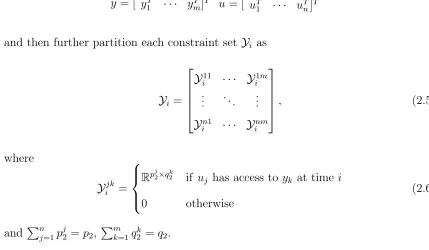
We can therefore partition the measured outputsyand control inputsuaccording to the dimension of the subsystems:
y= [ yT1 · · · ymT]T u= [ uT1 · · · uTn]T
and then further partition each constraint set Yi as
Yi =
with communication delay τc between nodes. Then
where, for compactness, * is used to denote a space of appropriately sized real matrices.
In this setting, every decision maker then has access to all measurements that are at
least 2τc time-steps old.
The distributed control problem of interest is to design a controller K ∈ S so as to achieve a pre-defined closed loopH∞ norm. Specifically, the problem is to find an internally stabilizing K ∈ S such that
||P11+P12K(I−P22K)−1P21||∞≤γ (2.9)
for some pre-defined γ > γinf, where γinf is the optimal achievable closed loop H∞
norm.
Definition 2.1 A set S is quadratically invariant under P22 if
KP22K ∈ S for all K ∈ S
In [9], it was shown that if S is quadratically invariant under P22, then K ∈ S
if and only if Q = K(I −P22K)−1 ∈ S. In the case of delay-constraints imposed
by a communication graph, intuitive and easily verifiable conditions for QI can be stated [10]. Essentially these conditions say that in order to have QI, controllers must be able to communicate with each other faster than their control actions propagate through the plant – this is closely related to funnel causality [25], partial nestedness [8] and poset causality [14].
Thus, if quadratic invariance holds, the feasibility problem (2.9) can be reduced, via the Youla parameterization, to the following equivalent model matching problem:
Problem 2.1 Find Q∈ S TRH∞ such that
||T1− T2QT3||∞ ≤γ (2.10)
for some γ > γinf, with T1 =P11, T2 =P12 and T3 =P21.
2.3
A Review of “1984”
H
∞Control
As our solution is based on the so-called “1984” approach to H∞ control, we review it in this section. The following is based on material found in chapter 8 of [53].
2.3.1
T
3=
I
Case
We begin with the solution to the sub-optimal model matching problem withT3 =I
Problem 2.2 Find Q ∈ RH∞ such that kT1 − T2Qk∞ ≤ γ for some γ > γinf ≥ 0,
where γinf is the optimal achievable closed loop H∞ norm.
In order to state the main result, we first define the following transfer matrices: 1. LetUi, Uo be an inner-outer factorization ofT2 such that T2 =UiUo, with Ui∼Ui =
I, andUi, Uo, Uo†∈ RH∞.
2. Let Y := (I−UiUi∼)T1.
3. For γ > kYk∞, let Yo be a bi-stable spectral factor of γ2I − Y∼Y such that γ2I−Y∼Y =Yo∼Yo, with Yo, Yo−1 ∈ RH∞.
4. Define the RL∞ matrix R:=Ui∼T1Yo−1.
Theorem 2.1 Let α := inf{kT1− T2Qk∞ : Q∈ RH∞}. Then
1. α= inf{γ : kYk∞< γ, dist (R,RH∞)<1}, and
2. For γ > α and Q, X ∈ RH∞ such that
• kR−Xk∞ ≤1, and
• X =UoQYo−1,
we have that kT1− T2Qk∞≤γ.
Before proving this result, we need the following two preliminary lemmas:
Lemma 2.1 Let U be inner and E ∈ RL∞ be given by
E :=
U∼
I−U U∼
.
Lemma 2.2 For F, G∈ RL∞ with the same number of columns, if
Lemma 2.3 (Nehari’s Theorem) For any R∈ RL∞, we have that
dist (R,RH∞) = dist (R,H∞) =kΓRk,
and that there exists X ∈ RH∞ such that kR−Xk∞= dist (R,RH∞).
Applying Lemma 2.2, this then implies that
kYk∞< γ, (2.15)
and
kUi∼T1Yo−1−UoQYo−1k∞ <1 (2.16)
By Lemma 2.3, this in turn implies that dist (R, Uo(RH∞)Yo−1) < 1, which, noting
that Uo is right invertible in RH∞ and thatYo is invertible inRH∞, is equivalent to
dist (R,RH∞)<1 (2.17)
Then, from (2.15) and (2.17), and the definition of γinf we conclude that γinf ≤ γ,
and thus that γ < α+. Since was arbitrary, we then have that γinf ≤α.
To prove the reverse inequality, again choose > 0 and γ such that γinf < γ <
γinf +. Then (2.15) and (2.17) hold, so (2.16) holds for some Q∈ RH∞. Applying the converse of Lemma 2.2, this in turn implies that
Ui∼T1−UoQ Y
∞
≤γ. (2.18)
Finally, reversing the above steps, this leads to kT1− T2Qk∞ ≤ γ. Thus α ≤ γ < γinf +, and hence α≤γinf.
2) This follows immediately from the previous derivation.
Thus, a high level outline for computing anH∞ controller satisfying a γ bound in closed loop is
1. Compute Y and kYk∞.
2. Select a trial value γ >kYk∞.
3. ComputeRandkΓRk. Then kΓRk<1if and only ifα < γ, so increase or decrease γ accordingly, and return to step 2 until a sufficiently accurate upper bound for α
4. Find a matrix X ∈ RH∞ such thatkR−Xk∞≤1.
5. Solve X =UoQYo−1 for aQ∈ RH∞ satisfying kT1− T2Qk∞ ≤γ.
2.3.2
General
T
3We now state the result for general T3. First, define the following matrices
1. LetUi, Uo be an inner-outer factorization ofT2 such that T2 =UiUo, with Ui∼Ui = I, andUi, Uo, Uo†∈ RH∞.
2. Let Y := (I−UiUi∼)T1.
3. For γ > kYk∞, let Yo be a bi-stable spectral factor of γ2I − Y∼Y such that γ2I−Y∼Y =Yo∼Yo, with Yo, Yo−1 ∈ RH∞.
4. Let Vco, Vci be a co-inner-outer factorization of T3Yo−1 such that T3Yo−1 = VcoVci
and Vci, Vco, Vco† ∈ RH∞.
5. Let Z :=Ui∼T1Yo−1(I−Vci∼Vci).
6. If kZk∞ < 1, let Zco be a bi-stable co-spectral factor of I −ZZ∼ such that I − ZZ∼ =ZcoZco∼, with Zco, Zco−1 ∈ RH∞.
7. Let R:=Zco−1Ui∼T1Yo−1Vci∼.
Theorem 2.2 Let α := inf{kT1− T2QT3k∞:Q∈ RH∞}. Then
1. α= inf{γ : kYk∞ < γ,kZk∞ <1, dist (R,RH∞)<1}, and
2. For γ > α and Q, X ∈ RH∞ such that
• kR−Xk∞ ≤1, and
• X =Zco−1UoQVco,
Proof: Analogous from that of Theorem 2.1, and therefore omitted.
Similarly, we may outline a general high level algorithm for computing a controller using Theorem 2.2:
1. Compute Y and kYk∞.
2. Select a trial value γ >kYk∞. 3. Compute Z and kZk∞.
4. If kZk∞ <1, continue; if not, increaseγ and return to step 3.
5. ComputeRandkΓRk. Then kΓRk<1if and only ifα < γ, so increase or decrease γ accordingly, and return to step 3 until a sufficiently accurate upper bound for α
is obtained.
6. Find a matrix X ∈ RH∞ such thatkR−Xk∞≤1.
7. Solve X =Zco−1UoQVco for a Q∈ RH∞ satisfying kT1− T2QT3k∞≤γ.
2.4
Distributed
H
∞Control Subject to Delays
As in [16], we exploit the fact that the communication graph is strongly connected to decompose Q into a local distributed FIR filter V ∈ Y and a global, but delayed, IIR component ∆ND∈ z1NRH∞, where in particular,D ∈ RH∞ is unconstrained:
Q=V + ∆D∈ S, with V ∈ Y, D ∈ RH∞ (2.19)
We will show that when Q admits such a decomposition, the norm bound test of Theorem 2.1 reduces to verifying the existence of a FIR filter V ∈ Y such that kΓRˆ(V)k <1, where R(Vˆ ) is a transfer matrix to be defined that depends affinely on
2.4.1
T
3=
I
Case
We begin with a solution to theT3 =I case to simplify the exposition, as the general
case, much as in the centralized problem, follows from an analogous argument. Let
• Tˆ1(V) :=T1− T2V,
• Tˆ2 :=T2∆N,
• Uˆi :=Ui∆N,Uˆo =Uo ∈ RH∞be inner and outer, respectively, such thatTˆ2 = ˆUiUˆo,
and Uˆo−1 ∈ RH∞.
• R(Vˆ ) := ∆∼NR−Uˆo(∆∼NV)Yo−1,
with Yo−1 and R defined as in Section 2.3.1. We then have that
Theorem 2.3 Let α := inf{kTˆ1(V)−Tˆ2Dk∞ : D∈ RH∞, V ∈ Y}. Then
1. α= inf{γ : kYk∞< γ, ∃V ∈ Y s.t. distR(Vˆ ),RH∞<1}, and
2. For γ > α and D, X ∈ RH∞ such that
• kR(Vˆ )−Xk∞≤1, and
• X = ˆUoDYo−1,
we have that kTˆ1(V)−Tˆ2Dk∞≤γ.
Before proving this result, we will need the following lemma:
Lemma 2.4 For Yˆ(V) := (I−UˆiUˆi∼) ˆT1(V), we have that Yˆ(V) =Y, where Y is as
defined in Section 2.3.1.
Proof: Straightforward, and thus omitted. We may now prove Theorem 2.3.
Proof: 1) Choose > 0 such that α < γ < α+, implying that there exists
We now proceed as in the proof of Theorem 2.1, and premultiply by
By Lemma 2.2 and Lemma 2.4, (2.21) is equivalent to
kYk∞ < γ (2.22)
this is then equivalent to
kR(Vˆ )−UˆoDYo−1k∞<1, (2.25)
which by the arguments of the proof of Theorem 2.1, is equivalent to kΓRˆ(V)k<1.
The rest of the proof proceeds as that of Theorem 2.1.
Thus, for a fixed γ, we have reduced the problem to a feasibility test: does there exist a FIR filterV ∈ Y such thatkΓRˆ(V)k<1. As per identity (2.1), this is equivalent
Reduction to a LMI
LetR1 and R2 be an anti-stable/stable decomposition of∆∼NR. Now, define G(V)∈
RH∞ as
G(V) := UˆoV Yo−1 = P∞i=0z1iGi(V).
(2.26)
where the terms Gi(V) are the impulse response elements of G. It is easily verified
that these terms are affine in {Vi}, the impulse response elements of V (i.e. V =
PN−1
i=0 z1iVi). Note that G(V)∈ RH∞ follows from Uo, V, Yo−1 ∈ RH∞. As such, let
G(V) :=
AG BG
CG DG
be a minimal stable realization ofG. We then have that
ˆ
Uo∆∼NV Yo−1 = ∆∼NG
= zNP∞i=0z1iGi(V)
= PNk=1zkGN−k(V) +P∞j=0z1jGj+N(V)
=: q(V)∼+NG(V).
(2.27)
with q(V) = PNk=1z1kG>N−k(V)∈ RH∞ and strictly proper.
Also note that NG(V)has the following state space representation
NG(V) =
AG BG
CGANG CGANG−1BG
, (2.28)
and is therefore also clearly in RH∞.
The following lemma is an immediate consequence of the previous discussion.
ˆ
From our previous discussion, we have thus reduced the problem to finding an FIR filterV such that kΓ˜Rˆ1(V)k<1, for Rˆ1(V) given as in (2.29).
We begin by deriving a state space representation for Rˆ1(V), and then use this representation to formulate the Hankel norm bound test as a LMI.
First note that q(V) is simply a strictly causal FIR filter, and thus has a state space representation given by
where Aq is the down-shift operator (i.e. a block matrix with appropriately
dimen-sioned Identity matrices along the first sub block diagonal, and zeros elsewhere),
Bq = [I, 0. . . , 0]>, and Cq(V) = [GN−1(V)>, . . . , G0(V)>]. Note that only Cq(V) is
a function of our design variable V.
Letting the strictly proper R1 ∈ RH∞ have a minimal stable realization
R1 =
We emphasize again that our design variable V appears only in CR(V).
Proposition 2.1 For a system
F =
A B
C 0
∈ RH∞,
we have that kΓ˜Fk<1 if and only if there exist matrices P, Q≥ 0 and scalar λ≥0
such that
A>QA−Q C>
C −λI
≤ 0
−P P B P A B>P −I 0 A>P 0 −P
≤ 0
P −Q ≥ 0 λ <1
(2.33)
Proof: This is the discrete-time analog of the variational formulation found in Section 6.3.1 of [55].
Substituting our realization (2.32) into (2.33), we see that this is an LMI in the variables{Vi}iN=0−1,P,Q, andλ, and is feasible if and only if there exists an FIR filter
V ∈ Y such that kΓ˜Rˆ1(V)k<1.
Thus, a high level outline for computing a distributed controller satisfying anH∞ norm bound of γ in closed loop is
1. Compute Y and kYk∞.
3. ConstructRˆ1(V) and check if the LMI in variables {Vi}iN=0−1, Q, P and λ
A>RQAR−Q CR(V)> CR(V) −λI
≤ 0
−P P BR P AR BR>P −I 0 A>RP 0 −P
≤ 0
P −Q ≥ 0 λ <1
(2.34)
is feasible forV =PNi=0−1 z1iVi ∈ Y. This LMI is feasible if and only ifkΓ˜Rˆ1(V)k<1,
which in turn occurs if and only if α < γ, so increase or decrease γ accordingly. This feasibility test will additionally yield an FIR filter V ∈ Y that satisfies this bound.
4. Find a matrixX ∈ RH∞, implicitly dependent onV, such thatkR(Vˆ )−Xk∞≤1
(such a matrix is guaranteed to exist by the same arguments as those used in the centralized case).
5. Solve X = ˆUoDYo−1 forD ∈ RH∞ satisfying kTˆ1(V)−Tˆ2Dk∞≤γ.
6. Set Q=V + ∆ND∈ STRH∞
2.4.2
General
T
3Define the following transfer matrices 1. Zˆ = ˆUi∼T1Yo−1(I−VciVci∼),
2. R(Vˆ ) := ∆∼NR−Zco−1Uˆo(∆∼NV)Vco,
and letYo−1, R,Vcoand Zco−1 be as defined in Section 2.3.2, andTˆ1(V), Tˆ2, Uˆi andUˆo
Theorem 2.4 Let α := inf{kTˆ1(V)−Tˆ2DT3k∞:D∈ RH∞, V ∈ Y}. Then
1. α= inf{γ : kYk∞< γ, kZk∞ <1,∃V ∈ Y s.t. dist
ˆ
R(V),RH∞
<1}, and
2. For γ > α and D, X ∈ RH∞ such that
• kR(Vˆ )−Xk∞≤1, and
• X =Zco−1UˆoDVco,
we have that kTˆ1(V)−Tˆ2DT3k∞≤γ.
Proof: Analogous to that of Theorem 2.3, and therefore omitted.
Just as in the T3 =I case, this problem has now been reduced to finding an FIR
filter V ∈ Y such that kΓ˜Rˆ(V)k < 1. The arguments of the preceding section apply
nearly verbatim, with the exception of replacing equation (2.26) with
G(V) :=Zco−1UˆoV Vco (2.35)
Therefore, a high level outline for computing a distributed controller satisfying an H∞ norm bound of γ in closed loop is
1. Compute Y and kYk∞.
2. Select a trial value γ >kYk∞. 3. Compute Zˆ and kZˆk∞.
4. If kZˆk∞ <1, continue; if not, increaseγ and return to step 3.
5. ConstructRˆ1(V)according to (2.29), with G(V)defined as in (2.35), and check if
there exists V ∈ Y such that LMI (2.34) is feasible. This LMI is feasible if and only if kΓ˜Rˆ1(V)k < 1, which in turn occurs if and only if α < γ, so increase or
decrease γ accordingly. This feasibility test will additionally yield an FIR filter
6. Find a matrixX ∈ RH∞, implicilty dependent onV, such thatkR(Vˆ )−Xk∞≤1. 7. Solve X =Zco−1UˆoDVco forD∈ RH∞ satisfying kTˆ1(V)−Tˆ2DT3k∞≤γ.
8. Set Q=V + ∆ND∈ STRH∞
2.5
Example
For the convenience of the reader, we provide explicit state-space formulae for the factorizations and approximations required to implement our algorithm in Section 2.7.
We consider a three-player chain with communication delay ofτc= 1– the sparsity
constraint Y on the FIR filter is as given in equation (2.8). We first consider the simplified case of P21 =I – the remaining dynamics of P11, P12 and P22 are given by
Note that this is a suitably modified version of the output feedback problem considered in [16].
closed loop norm of .9772. This is a significant improvement over the delayed system (i.e.V0 andV1 constrained to be zero), for which we were only able to achieve a closed
loop norm of 1.6856.
We then considered the general output-feedback problem, with P21 given by the
parameters in (2.36) as well. The centralized and LMI computed centralized closed loop norms were both found to be 1.502, with the best distributed norm found to be 1.515. Once again, we see near identical performance from the centralized and distributed solutions, whereas the delayed controller was only able to achieve a closed loop norm of 2.213.
2.6
Conclusion
This chapter presented an LMI based characterization of the sub-optimal delay-constrained distributed H∞ control problem. By exploiting the strongly connected nature of the communication graph, we were able to reduce the problem to a feasi-bility test in terms of the Hankel norm of a certain transfer matrix that is a function of the localized FIR component of the controller. We note that much as in the H2
case, by reducing the control synthesis problem to one that is convex in the FIR filter, communication delay co-design [23,56] and augmentation [57] methods are applicable. However, although finite dimensional, this method is based on the “1984” approach to H∞ control – as such, the computational burden is quite high, limiting the scalability of the approach.
2.7
Factorization Formulas
In all of the following, we assume that the conditions needed for the existence of the required stabilizing solution of the corresponding Discrete Algebraic Riccati Equations (DARE) are met – the reader is referred to [2] and [58] for more details. All “co-X” factorizations, where ““co-X” may be either inner-outer or bi-stable spectral, can be obtained by transposing the “X” factorization of the transpose system.
2.7.1
Inner-Outer Factorizations
Let
G:=
A B
C D
∈ RH∞.
From [2], an inner-outer factorization G=UiUo of G, with Ui inner and Uo outer, is
given by
Ui =
A+BF BH−1
C+DF DH−1
(2.37)
Uo =
A B
−HF H
(2.38)
with H = (D>D+B>XB)12, and X the stabilizing solution of the following DARE
X = A>XA+C>C+A>XBF, F = −(D>D+B>XB)−1B>XA.
(2.39)
2.7.2
Bi-stable Spectral Factorizations
LetY ∈ RH∞ be strictly proper, and let
GY =
AY BY
CY 0
If AY is invertible, then it holds that
γ2I−Y∼Y =GY +G∼Y +DY +DY>
where DY = 12 γ2I+BY>A−>Y CY>
.
A bi-stable spectral factorization γ2I −Y∼Y =M∼M, with M, M−1 ∈ RH∞ is then given by
M =
AY BY
H−1(CY +BY>XAY) H
(2.40)
with H = (DY +DY>+BY>XBY)
1
2, and X the stabilizing solution of the following DARE
X = A>YXAY + (A>YXBY +CY>)F,
F = −(D>Y +DY +BY>XBY)−1(BY>XAY +CY).
(2.41)
This result follows directly from standard results on spectral factors and positive real systems [2]
2.7.3
Stable Approximations
The following is taken from [58]. Let
G:=
A B
C D
∈ RH∞
be a minimal state-space representation, and assume that ρ=kΓ˜Gk< γ. Let X and Y be the controllability and observability Gramians of G, respectively.
Let Q∈ RH∞ have the state-space representation
Q:=
AQ BQ
CQ DQ
AQ =A−BCQ, BQ =AXC>+BE>, CQ = (E>C+B>Y A)N, DQ =D>−E>,
where N = (γ2I−XY)−1, and for any unitary matrix U,
E =−(I +CN XC>)−1CN XA>Y B
+γ(I+CN XC>)−21U(I+B>Y N B)− 1 2.
Chapter 3
Optimal Two Player LQR State
Feedback with Varying Delay
3.1
Introduction
As described in Section 2.1, quadratic invariance has spurred on a flurry of activ-ity in distributed optimal control synthesis subject to sparsactiv-ity and delay constraints. However, an underlying assumption in the aforementioned results is that information, albeit delayed, can be transmitted perfectly across a communication network with a
fixed delay. A realistic communication network, however, is subject to data rate lim-its, quantization, noise and packet drops – all of these issues result in possibly varying delays (due to variable decoding times) and imperfect transmission (due to data rate limits/quantization). The assumption that these delays are fixed necessarily intro-duces a significant level of conservatism in the control design procedure. In particular, to ensure that the delays under which controllers exchange information do not vary, worst case delay times must be used for control design, sacrificing performance and robustness in the process.
results exist, however, that seek to combine NCS and decentralized optimal control. A notable exception is the work by [62], in which an explicit state space solution to a sparsity constrained two-player decentralized LQG state-feedback problem over a TCP erasure channel is solved.
Chapter contributions: We take a different view from these results, and sup-press the underlying details of the communication network, and instead assume that packet drops, noise, and congestion manifest themselves to the controllers as varying delays. Indeed, as shown in [63], delays play a dominant role in determining closed-loop performance relative to channel issues such as quantization. In particular, we seek to extend the distributed state-feedback results of [39, 64] and [15] to accom-modate varying delays. In addition to allowing for communication channels to be more explicitly accounted for in the control design procedure, the ability to accom-modate varying delays provides flexibility in the coding design aspect of this problem – we are currently exploring the application of deadline based coding schemes devel-oped by [65], initially designed for real-time video streaming, to optimal decentralized control.
In this chapter, we focus on a two plant system in which communication between controllers occurs across a communication link with varying delay. We extend the dynamic programming methods in [39] and [15] to accommodate this varying delay, and show that under suitable assumptions, the optimal control actions are linear in their information, and that the resulting controller has piecewise linear dynamics dictated by the current effective delay regime. The results in this chapter were first presented in [18, 19].
3.2
Problem Formulation
We begin by describing the general problem of interest, and then specialize the for-mulation to the particular case to be addressed in this paper.
Notation
For a matrix partitioned into blocks
M = process r0:t, we denote the conditional probability of an event A occurring given this history by Pr0:t(A). If Y = {y
1, . . . , yM} is a set of random vectors (possibly of
different sizes), we say that z ∈lin (Y)if there exist appropriately sized real matrices
C1, . . . , CM such that z =PMi=1Ciyi.
3.2.1
The two-player problem
This paper focuses on a two plant system with physical propagation delay of D
between plants, and varying communication delaysdit ∈ {0, . . . , D}– to ease notation, we letdt := (d1t, d2t). We impose some additional assumptions on the stochastic process
dt in Section 3.3 such that the infinite horizon solution is well defined.
x
1 1 2 3x
2Figure 3.1: The distributed plant considered in (3.6), shown here forD= 4. Dummy nodes δti, i = 1, . . . , D−1, as defined by (3.5), are introduced to make explicit the propagation delay ofD between plants.
equation:
xit+1 = Aiixit+Aijxjt−(D−1)+Biuit+wti (3.1)
with mutually independent Gaussian initial conditions and noise vectors
xi0 ∼ N(µi0,Σ0i), wit∼ N(0, Wti) (3.2)
We may describe the information available to controller i at time t, denoted by Ii
t, via the following recursion:
Ii
0 = {xi0}
Ii
t+1 = Iti∪ {xit+1} ∪ {x
j
k : 1≤k ≤t+ 1−d j t+1}
(3.3)
The inputs are then constrained to be of the form
uit = γti(Iti) (3.4)
for Borel measurable γti.
In order to build on the results in [15], we model the two plant system as a
D+ 1 node graph, with “dummy delay” nodes introduced to explicitly enforce the propagation delay between plants. Specifically, letting
δit=
x1t−i x2t−(D−i)
, i= 1, . . . , D−1 (3.5)
{1} the information in the label set is, and (iii) that LVt contains all of the information at nodes s.t. |s| > eit, s 3 i. We also see that the graph is naturally divided into two branches, with each branch corresponding to information pertaining to a specific plant.
representation for the system
xt+1 =Axt+But+wt (3.6)
where, to condense notation, we let
x=
and A and B are such that (3.6) is consistent with (3.1) and (3.5). The physical topology of the plant is illustrated in Figure 3.1.
Problem 3.1 Given the linear time invariant (LTI) system described by (3.1), (3.5) and (3.6), with disturbance statistics (3.2), minimize the infinite horizon expected cost
subject to the input constraints (3.4).
The weight matrices are assumed to be partitioned into blocks of appropriate dimension, i.e. Q = (Qij) and R = (Rij), conforming to the partitions of x and u. We assume Q to be positive semi-definite, and R to be positive definite, and in order to guarantee existence of the stabilizing solution to the corresponding Riccati equation, we assume (A, B) to be stabilizable and (Q12, A)to be detectable.
3.3
Main Result
3.3.1
Effective delay
The information constraint sets (3.3) are defined in such a way that controllers do not forget information that they have already received. This leads to the xj component of the information setIti being a function of theeffective delay seen by the controller, as opposed to the current delay value of the communication channel djt.
Definition 3.1 Let
ejt := min{djt, djt−1 + 1, djt−2 + 2, . . . , dtj−(D−2)+ (D−2), dtj−(D−1) + (D−1)} (3.9)
be the effective delay in transmitting information from controller j to controller i.
Lemma 3.1 The information set available to controller i at time t may be written as
Ii
t =Iti−1∪ {xit} ∪ I j
t−ejt (3.10)
Proof: See §3.6.
In order to ensure that the infinite horizon solution is well defined, we assume that
lim T→∞
1 T
T−1
X
t=0
Pd0:t e
i t+1 ≤d
exists for any integerd, i.e. we assume that the asymptotic distribution ofei, condi-tioned on its history, is stationary and well defined.
3.3.2
Partial Nestedness
Here we show that the information constraints (3.4) and system (3.6) are partially nested (c.f. [8]), and hence that the optimal control policies γti are linear in their information set.
Definition 3.2 A system (3.6) and information structure (3.4) is partially nested if, for every admissible policy γ, whenever uiτ affects Itj, then Iτi ⊂ Itj.
Lemma 3.2 (see [8]) Given a partially nested information structure, the optimal control law that minimizes a quadratic cost of the form (3.8) exists, is unique, and is
linear.
Using partial nestedness, the following lemma shows that the optimal state and input lie in the linear span of Iti and Ht, where Ht is the noise history of the system
given by
Ht={x0, w0:t−1} (3.12)
Lemma 3.3 The system (3.6) and information structure (3.4) is partially nested, and for any linear controller, we have that
xit, uit ∈lin Iti xt, ut∈lin (Ht) (3.13)
3.3.3
Information Graph and Controller Coordinates
Lemma 3.3 indicates that each Iti is a subspace of Ht: in this section, we exploit
this observation to define pairwise independent controller coordinates. An explicit characterization of these subspaces is given in Section 3.4.
We begin by defining the information graph, as in [15], associated with system (3.6) by G = (V,E), with
V := {1},{1, δ1}, . . . ,1, δ1, . . . , δD−1 ∪
{2},δD−1,2 , . . . ,δ1, . . . , δD−1,2 ∪V
E := {(r, s)∈ V × V : |s|=|r|+ 1} ∪ {(V, V)}
(3.14)
where V :=1, δ1, . . . , δD−1,2 . For the case of D = 4, the graph G is illustrated in Figure 3.2.
Before proceeding, we define the following sets, which will help us state the main result. Let
vi,t+ := {s ∈ V\V |i∈s, |s| ≥eit} vti,++ := {s ∈ V\V |i∈s, |s|> eit}
(3.15)
and similarly define vti,− and vti,−− as in (3.15), but with the (strict) inequality re-versed.
Theorem 3.1 Consider Problem 3.1, and let G(V,E) be the associated information graph. Let
XV = Q+A>XVA+A>XVBKV KV := − R+B>XVB−1B>A,
(3.16)
be the stabilizing solution to the discrete algebraic Riccati equation, and the centralized
node such that (r, s)∈ E. Define the matrices
The optimal control decisions then satisfy
ζtV+1 = AζtV +BϕVt +
and the corresponding infinite horizon expected cost is
2
X
i=1
Trace X{i}Wi (3.20)
Proof: See Section 3.4.
mechanism is in place such that the et is known to both players; relaxing this
assump-tion will be the subject of future work.
Remark 3.2 The probabilities pr and qr can be computed directly if we assume the
{pi,dt } to be independently and identically distributed. In this case, ejt evolves accord-ing to an irreducible and aperiodic Markov chain with transition probability matrix
computable directly from the definition of effective delay and the pmf of dt. As such,
pr and qr can be computed from the chain’s stationary distribution, which is
guaran-teed to exist. Future work will explore what additional distributions on dt will lead to
closed form expressions for pr andqr. Failing the existence of closed form expressions
for these asymptotic distributions, computing estimates via simulation should be a
feasible option for many interesting pmfs {pi,dt } .
3.4
Controller Derivation
3.4.1
Controller States and Decoupled Dynamics
As mentioned previously, each Iti is a subspace of Ht: in this section, we aim to
explicitly characterize these subspaces by assigning label sets {Ls0:t}s∈V to the graph G = (V,E)as defined by (3.14). In particular, they are defined recursively as:
Ls
0 = ∅, for |s|>1
Li
0 = {xi0}
Li
t+1 = {wit}
Ls
t+1 = Lrt, for (r, s)∈ E, 1<|s|< D+ 1
LV
t+1 = LVt ∪i∪s∈vi,+
t+1L
s t
(3.21)
where we have let ∪i denote∪2i=1 to lighten notational burden. An example of these
label sets for the case of D= 4 is illustrated in Figure 3.2.
spreading. As can be seen in Figure 3.2, for each(r, s)∈ E, with|r|< D+ 1, we have that |s| = |r|+ 1, and additionally, that |s| corresponds exactly to how delayed the information in the label set is. We also see that the graph is naturally divided into twodisjoint branches, with each branch corresponding to information about a specific plant. Finally, the label corresponding to the root node V can be interpreted as the information available to both controllers – this is reflected by its explicit dependence on the effective delay eit.
Remark 3.3 Note that in contrast to [15], the label sets as defined will in general
not be disjoint. However, as will be made explicit in Lemma 3.5, an effective delay dependent subset of the label sets will indeed form a partition (i.e. a pairwise disjoint
cover) of the noise history.
We may now characterize the subspaces of Ht that are associated with each Iti.
This characterization will be shown to depend on the effective delay ejt seen at node
i, and will lead to an intuitive partitioning of both the state and the control input. We begin by pointing out the following useful facts that will be used repeatedly in the derivation to come
Lemma 3.4 Let vti,∗, ∗ ∈ {−,−−}, be given as in (3.15). Then, for a fixed i, we have that
∪s∈vi,t+1− L s
t+1 =∪r∈vi,t+1−−L r
t ∪ Lit+1, (3.22)
and for integers a, b∈ {0, . . . , D−1}
∪a<|s|≤b+1Lst+1 =∪a≤|r|≤bLrt (3.23)
Proof: Follows i