147
Abstract Graphs and Abstract Paths
for Knowledge Graph Completion
Vivi Nastase University of Heidelberg
Heidelberg, Germany
Bhushan Kotnis
NEC Laboratories Europe GmbH Heidelberg, Germany
Abstract
Knowledge graphs, which provide numerous facts in a machine-friendly format, are incom-plete. Information that we induce from such graphs – e.g. entity embeddings, relation rep-resentations or patterns – will be affected by the imbalance in the information captured in the graph – by biasing representations, or caus-ing us to miss potential patterns. To par-tially compensate for this situation we describe a method for representing knowledge graphs that capture an intensional representation of the original extensional information. This rep-resentation is very compact, and it abstracts away from individual links, allowing us to find better path candidates, as shown by the results of link prediction using this information.
1 Introduction
Knowledge graphs have become a very useful framework to organize and store knowledge. Their interconnected nature is not just a natural way to represent facts, but it has potential that the separate storage of facts does not have, such as: (i) we can use it as a relational model of meaning, and de-rive jointly representations for nodes (entities) and edges (relations); (ii) the structure can be explored to discover systematic patterns that reveal interest-ing and exploitable regularities, such as paths con-necting nodes in direct relations, (iii) discovering and inducing new connections.
Link prediction methods in knowledge graphs (see (Nickel et al., 2016) for an overview) pre-dict additional edges in the graph, based on in-duced node and edge representations that encode the structure of the graph and thus capture regular-ities (such as homophily).
Lao and Cohen(2010) introduced a new method that predicts direct links based on paths that con-nect the source and target nodes. Such paths are not only useful for link prediction (Lao et al.,
2011;Gardner et al., 2014), but also for finding explanations for direct links and help with targeted information extraction to fill in incomplete knowl-edge repositories (Yin et al.,2018;Zhou and Nas-tase,2018).
These approaches rely on the structure of the knowledge graph, which is inherently incomplete. This incompleteness can affect the process in dif-ferent ways, e.g. it leads to representations for nodes with few connection that are not very in-formative, it can miss relevant patterns/paths (or derive misleading patterns/paths).
fea-tures, and a model for predicting the direct rela-tions is learned and tested on training and test sets for 24 relations in Freebase and 10 relations in NELL. Our analysis shows that we find different and much fewer paths than the PRA method does (mostly because the abstract paths do not contain back-and-forth sequences of generalizing or type relations). The paths found in the abstract graphs lead to better performance on NELL than the PRA paths, which could be explained by the fact that NELL’s relation inventory was designed to cap-ture interdependencies (Carlson et al.,2010a). On Freebase the results we obtain are lower, but this could be due to a different negative sampling pro-cess. Inspection of the paths produced reveal that they seem to capture legitimate dependencies.
2 Related Work
Representing facts in a knowledge graph has mul-tiple advantages: (i) they provide knowledge in an easily accessible and machine-friendly format; (ii) they facilitate various ways of encoding this infor-mation and deriving representations for nodes and edges that reflect their connectivity in the graph; (iii) they allow for the discovery of connectivity patterns, and possibly more.
In recent years, projecting the knowledge graph in ann-dimensional vector space, or learning em-beddings for predicting missing facts has attracted a lot of interest. Embedding models aim to map entities, relations and triples to vector space such that additional facts can be inferred from known facts using notions of vector similarity. A class of embedding models that aim to factorize the graph are termed as latent factor models. Neural net-work based models such as ER-MLP (Dong et al., 2014), NTN (Socher et al., 2013), RNNs ( Nee-lakantan et al.,2015;Das et al.,2016) and Graph CNNs (Schlichtkrull et al.,2018) are examples of embedding models while RESCAL (Nickel et al., 2012), DistMult (Yang et al.,2015), TransE ( Bor-des et al.,2013), ComplEx (Trouillon et al.,2017) are examples of latent factor models.
Lao and Cohen(2010) introduced a novel way to exploit information in knowledge graphs: using weighted extracted paths as features in four dif-ferent recommendation tasks, which can be mod-eled as typed proximity queries. The idea of us-ing paths in the graph has then been applied to the task of link prediction (Lao et al.,2011), and ex-tended to incorporate textual information (
Gard-ner et al., 2014). Lao et al. (2011) obtain paths for given node pairs using random walks over the knowledge graph. To be used as features shared by multiple instances, the information about nodes on the paths is removed, transforming the actual paths into ”meta-paths”.
The paths themselves can be incorporated in different ways in a model – as features (Lao et al., 2011; Gardner et al., 2014), as Horn clauses to provide rules for inference in KGs whether di-rectly or through scores that represent the strength of the path as a direct relation (Neelakantan et al., 2015; Guu et al., 2015), also taking into ac-count information about intermediary nodes (Das et al., 2017; Yin et al., 2018). Gardner and Mitchell(2015) perform link prediction using ran-dom walks but do not attempt to connect a source and target node, but rather to characterize the lo-cal structure around a (source or target) node us-ing such localized paths. Usus-ing these subgraph features leads to better results for the knowledge graph completion task.
We focus here on discovering useful and ex-planatory paths, not on optimizing or further im-proving the KGC task. Using paths can lead to in-terpretable models because the paths can help ex-plain the predicted fact.Meng et al.(2015) present a method to automate the induction of meta-paths in large heterogeneous information networks (a.k.a. knowledge graphs) for given node pairs, even if the given node pairs are not connected by a direct relation.
Path information is also found to improve per-formance since paths help the model learn logical rules. However, mining paths from a large knowl-edge graph is often computationally expensive since it involves performing a traversal through the graph. To overcome this limitation (Das et al., 2017) proposed deep reinforcement learning and (Chen et al., 2018) proposed RNNS for generat-ing paths. However, many datasets suffer from paths sparsity, lack of enough paths connecting source target pairs, resulting in poor performance for many relations.
Wang et al. (2013) have a different approach – they start with patterns in the form of first-order probabilistic rules, which they then ground in a small subgraph of a large knowledge graph.
pat-terns that would be similar to those used by (Wang et al.,2013). To test the quality of these paths we ground them using the original KG and use these grounded paths in a learning framework similar to (Gardner et al.,2014).
3 Abstract Graphs and Abstract Paths
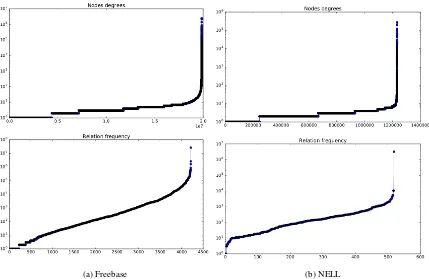
Knowledge graphs are incomplete in an imbal-anced way. Figures 1a-1b show how much the relation and node frequencies for Freebase 15k and NELL vary, and the fact that numerous nodes and edges have very low frequency (each data point corresponds to a node/relation, and the value is the degree of the node/frequency of the relation respectively). Freebase and NELL have a helpful characteristic: they have strongly typed relations, i.e. the source and target of a relation have a very specific type. NELL for example, has relations such as like Ac-torStarredinMovie, StateHasLake, and Freebase has /film/film/rating, /book/literary series/author, whose arguments have typePerson, Movie, State, etc.
Previous work has shown that using node type information – provided in Freebase through the domain and range types for each relation – can help optimize computation for link prediction by filtering the entity matrix for each relation based on the relation’s domain and range types (Chang et al.,2014), improve prediction by adding a fac-tor in the loss function that accounts for the type of the entities involved in a relation (Kotnis and Nas-tase,2017), or improve predictions based on paths in the graph by using the types of intermediary en-tities (Yin et al.,2018).
Entity types and the type of the domain and range of a relation have been proven to be useful for improving link prediction models. We inves-tigate here the hypothesis that by relying on the fact that such strong constraints on the arguments of relations in Freebase exist, we can build an in-tensional graph of the knowledge repository that is smaller and thus easier to analyze than the full KG. We also hypothesize that at this abstract level we can induce better patterns/paths that are indicative of direct relations, because individual missing re-lation instances will not obfuscate useful patterns. We verify whether these patterns are good by test-ing their usefulness for link prediction. Findtest-ing qualitative patterns would have additional benefits, as they could be used to explain direct relation, and
fill in the KG through targeted information extrac-tion (Zhou and Nastase,2018).
3.1 Abstract graphs
A knowledge graph (KG) is an extensional representation of a relation schema, where each instance of a relation type r corresponds to an edge connecting two nodes, a sourcesand a target
t, usually represented as a triple: < s, r, t >. We replace this representation with an intesional representation, where we have only one edge for each relation type, and draw additional edges to capture set relations (intersection, subset, superset) between the (original graph’s) relations’ domain and ranges. These edges are weighed with the size of the overlap between the sets. Formally:
for a knowledge graph
KG = (V,E,R) with:
verticesV ={v1, ..., vn}, relation typesR={r1, ..., rk} relation instances (i.e. edges)
E ={(vi, rx, vj)|vi, vj ∈ V;rx ∈ R},
we build the abstract graph
KGA= (VA,EA,RA) with:
verticesVA={V1,s, V1,t, V2,s, V2,t, ..., Vk,s, Vk,t}, where:
the source node of relationriin the abstract graph is theset of source nodes(the domain) of relation
riinKG:
Vi,s={vx|(vx, ri,∗)∈ E}
the target node of relationri in the abstract graph isthe set of target nodes(the range) ofriinKG:
Vi,t ={vx|(∗, ri, vx)∈E}
relation typesRA=R ∪ Rset where:
Ris the set of relation types ofKG,
Rset={intersection, subset, superset}1. weighted edges
EA={(Vi,s, ri, Vi,t,1)|ri∈ R, Vi,s, Vi,t∈ VA}
∪ {(Vi,x, r, Vj,y, w)|r∈ Rset, Vi,x, Vj,y ∈ VA
w=overlap(Vi,x, Vj,y))}
where the weight of a set relation betweenKGA’s nodes quantifies the overlap between the two sets:
overlap(Vi,x, Vj,y) = |Vi,x|V∩Vi,x|j,y|
1There is no
(a) Freebase (b) NELL
Figure 1: Knowledge graphs statistics on a logarithmic scale: relation and nodes frequencies for Freebase and NELL (the version used by (Gardner et al.,2014) and in this paper). Every data point is the degree of a node (top plots), or frequency of a relation (bottom plots). The data points are ordered monotonically, the x axis is just an index.
Building such a graph makes sense only for knowledge repositories that have strongly typed relations – like Freebase and NELL – but we do not require knowledge of the types of the relations’ domains and ranges. Such information is not fine-grained enough: for example, the relationcapital has a typeCityas a domain, but capital cities are a very small subset of the set of all cities. Using an ”atomic” node to represent the domain/range of a relation would not allow us to make finer grained connections and distinctions between the domains and ranges of the existing relations.
Figure 2 shows a subset of the abstract graph built from the Freebase dataset. The blue edges are set relations – intersection, superset, subset – between the domains and ranges of a subset of the relations in the dataset. The black edges corre-spond to the actual relations in the dataset.
3.2 Abstract paths
The Path Ranking Algorithm formalism originally proposed by (Lao and Cohen,2010) performs two main steps to represent of a pair of nodes in a graph: (i) feature selection – adding paths that connect the node pair; (ii) feature computation –
[image:4.595.311.523.436.676.2]KB variation Freebase NELL
Original graph Abstract graph Original graph Abstract graph # nodes # edges # nodes # edges # nodes # edges # nodes # edges
KB 20M 67M 4086 22,946 1.2M 3.4M 587 2746
KB + SVO 30M 97M 35,905 1.7M 20M 71M 68,149 512,503
KB + Vector SVO 30M 97M 4112 23,257 1.3M 4.3M 613 3383
[image:5.595.77.525.61.153.2]KB + Clustered SVO 30M 125M 4138 24,098 1.3M 3.9M 639 3818
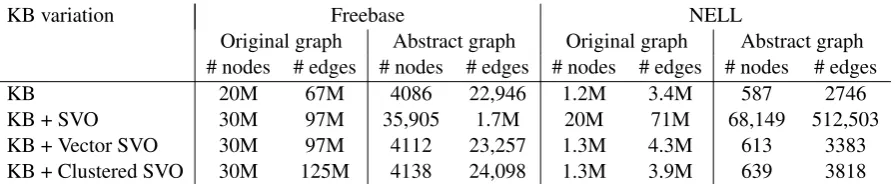
Table 1: Graph statistics on the datasets used by (Gardner et al.,2014), and their abstract versions
associating a value for each added path.
Obtaining paths from a large graph is a compu-tationally intensive problem, particularly in graphs that have numerous nodes with high degrees. Fig-ure 1a shows that about 60% of Freebase nodes have degree higher than 10, which leads to an ex-ponential growth in the number of paths starting in a node. Algorithms that harness path information often mine paths either by performing costly ran-dom walks (Guu et al.,2015), traversals (Gardner et al., 2014;Neelakantan et al., 2015;Das et al., 2016) or by constructing paths through generative models (Das et al.,2017;Ding et al.,2018). Here, we adopt a different approach, by abstracting the graph first, then finding paths in this graph through traversal algorithms.
For a relationri, we start at its domain (source) node Vi,s and search for a path to its range (tar-get) nodeVi,t using breadth first search. We con-strain this path to contain at mostk”proper” rela-tions2, and we do not allow consecutive set rela-tions, thus forcing the algorithm to move from one ”proper” relation to another through a set relation that connects the range of one with the domain of the next. An abstract path, just like a meta-path ex-tracted by previous work, is a sequence of relation types: πj =< rj,1, rj,2, ...rj,m >, some of which are ”proper” relations, some are set relations.
Because of the more general view of the graph, we lose information about individual paths (i.e. in-stances of a path in the original graph). Because of this, the paths we extract are hypothetical, but will have associated a confidence score based on the frequency of occurrence of relations in the origi-nal KG, and the strength of the connection of the range of one relation on the path with the domain of the next one. The weight of an abstract pathπj is computed as:
w(πj) = m Y
i=1
w(rj,i)
2In our experiments we usedk= 5
where the weightw(rj,i)of an individual relation is defined based on whetherri,jis a ”proper” rela-tion or a set relarela-tion as:
w(rj,i) =
( |{<∗,r
j,i,∗>∈E}
|E| ifrj,i∈ R
overlap(rj,i) ifrj,i∈ Rset
We use this weight to rank abstract relations for potential filtering, and to compute the weight of its grounding for specific node pairs.
3.3 Grounded paths
The abstract paths are hypothetical paths that could connect the source s and target t of a < s, r, t >tuple. They can be used in different ways, e.g. (i) as features in a link prediction system (e.g. (Gardner et al., 2014)), (ii) to fill in larger por-tions of the graph by producing, rather than find-ing, groundings of the path for specific instances.
In the work presented here we test the abstract paths through the link prediction task, so we will try to ground abstract paths for relation instances in the training and test data. After finding the set of abstract paths{πi,r}associated with a relationr, for a given instance of the relationr–< s, r, t >– we can (try to) ground the paths as follows: (i) we first eliminate set relations from the abstract paths: at this point set relations between relation types domain and ranges are not useful (they were nec-essary only for the connectivity and search process in the abstract graph). Set relations have no coun-terpart in the extensional graph, as at this level nodes themselves make the connection between successive relations (ii) starting at the source node, we follow again a breadth first traversal, constrain-ing at each step the type of relation to follow based on the ”cleaned up” abstract path.
We compute the weight of a grounded path
gp=< v0, rx1, v1, ..., vl−1, rxl, vl>(wherev0 = sandvl =t) as a combination of the weight of the corresponding abstract path π =< r1, ..., rm > (rxi ∈ π) and specific information for the current
w(π) =Ql
i=1w(vi−1, ri, vi)
where the weights of the relations on the grounded path reflect the specificity of the relation to its source node:
w(vi−1, ri, vi) =
[image:6.595.306.514.63.131.2]( 1
|{<vi−1,ri,∗>∈E} ifri ∈gp
1 ifri ∈ Rset
4 Experiments
Because we want to compare the abstract paths found using the abstract graph with paths found using PRA, we use the experimental set-up of (Gardner et al., 2014), where we replace the fea-ture selection and feafea-ture computation steps with the approach presented here. A big difference will be caused by the negative sampling, which also makes the results not directly comparable. The is-sues are explained in thenegative sampling para-graph below. The data thus obtained is used for training a linear regression model (similarly to (Gardner et al.,2014)), and tested on the provided test sets and evaluated using mean average preci-sion (MAP).
4.1 Data
We build abstract graphs and paths from the Free-base and NELL data described in (Gardner et al., 2014). We then use the extracted paths for link prediction.
The graphs built byGardner et al. (2014) cover several variations, where the KGs were enhanced with < subject, verb, object >triples extracted from dependency parses of ClueWeb documents. Table1 shows the statistics for each original and abstract graph. The generated abstract graph is several degrees of magnitude smaller compared to the original KG. The abstract graph approach we present here does not fit well the combina-tion of the knowledge base (Freebase or NELL) with unstructured SVO triples, because we rely on strongly typed relations to build node sets. The SVO triples bring in numerous low frequency re-lations, that without additional processing are not beneficial. The results presented byGardner et al. (2014) show that this configuration very rarely (and never overall) leads to better results than the other graph variations. The numerous relation types brought in by the SVO triples also lead to high computation time for the abstract graph: its shortcoming is the computation of set relations be-tween the different relations’ domains and ranges,
KG Avg. no. inst min max
NELL train 650.7 81 1468
NELL test 163.2 21 367
Freebase train 122.9 10 600
Freebase test 41.6 4 200
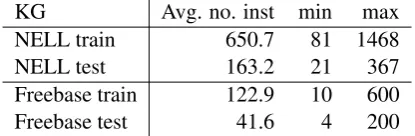
Table 2: Statistics on the size of the training and test sets
which grows quadratically with the number of re-lation types. We will skip this graph variation in the rest of the experiments presented here.
Gardner et al. (2014) use these graphs to gen-erate paths for augmenting the representation of node pairs, for link prediction, for a subset of 24 relation types from Freebase’s inventory, and 10 relations from NELL. Each relation has a training and test set, whose numbers vary quite a bit, as shown through the statistics in Table2.
Negative sampling The number of negative instances used in (Gardner et al., 2014) is not clearly stated. Both the number and methods of generating the negative samples can impact the results (Kotnis and Nastase,2018). We use (up to) 200 negative samples for each positive pair: for a pair (s, t)in the provided training or test sets for each relation r, we make 100 negative samples by corrupting the source s, and 100 negative samples by corrupting the targett. The corrupted
s0 and t0 are chosen from r’s domain Vr,s and range Vr,t respectively, such that these corrupted triples are not part of the training, test or graph. If 100 instances do not exist, we extract as many as possible.
N eg(s, r, t) ={(s0, r, t)|s0 ∈Vr,s,(s0, r, t)6∈ E}
∪ {(s, r, t0)|t0 ∈Vr,t,(s, r, t0)6∈ E}
Because the relations are strongly typed, pro-ducing negative instances by corrupting the source/target nodes from the relation’s domain and range leads to difficult negative instances. In-stances with source and target nodes that don’t match the argument types of the direct relation we want to predict can be filtered out before the link prediction.
rela-Source_401
Source_266 Source_260
Target_260 Target_266
Target_401 stadium located in city
inters
stadium home team inters team plays in city
[image:7.595.312.525.63.208.2]inters
Figure 3: An abstract path for relation StadiumLocate-dInCityfrom NELL
tionStadiumLocatedInCityis shown in figure3. Each of the 24 Freebase and 10 NELL relations has a set of training and test examples. After build-ing abstract paths, for each instance < s, r, t >
in these datasets we will ground the correspond-ing abstract paths as described in Section3.3. For each relation type the set of features representing the corresponding data will be twice the number of abstract paths. We produce two features for each abstract path: one that is the weight of this path, and one that is the weight of its grounding for a given relation instance. If a relation instance does not have a grounding for an abstract path, the val-ues of these features will be 0.
4.2 Results and discussion
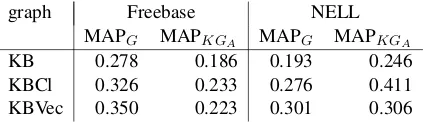
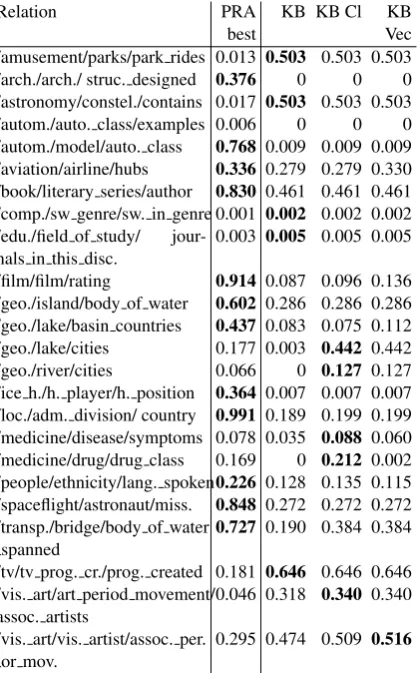
The overall results of the experiments are pre-sented in Table3, and the relation-level results are in Tables4for NELL, and5for Freebase.
graph Freebase NELL
MAPG MAPKGA MAPG MAPKGA KB 0.278 0.186 0.193 0.246 KBCl 0.326 0.233 0.276 0.411 KBVec 0.350 0.223 0.301 0.306
Table 3: Results on the three graph variations of Free-base and NELL as reported by (Gardner et al.,2014) (G) and using abstract graphs (KGA).
Overall, the results indicate that enhanc-ing Freebase and NELL with additional facts from textual sources leads to better results, particularly when these additional facts (< subject, verb, object >triples) are processed and clustered using low dimensional dense representa-tions (Gardner et al.;Gardner et al. (2014;2013) use embeddings obtained by running PCA on the matrix of SVO triples).
Freebase has 4200+ relation types, and NELL 500+. More than 500 relation types in Freebase have less than 10 instances, wheres NELL does not have this issue (see Figures1a and1b). Be-cause we test the approach for knowledge graph completion using classification based on the pat-terns as features, having features that appear too
Relation PRA
best
[image:7.595.77.288.68.104.2]KB KB Cl KB Vec ActorStarredInMovie 0.037 0 0 0 AthletePlaysForTeam 0.589 0.145 0.089 0.136 CityLocatedInCountry 0.347 0.078 0.071 0.057 JournalistWritesForPub. 0.319 0.317 0.515 0.436 RiverFlowsThroughCity 0.076 0.027 0.146 0.058 SportsTeamPos.ForSport 0.217 0 0.615 0 StadiumLocatedInCity 0.321 0.316 0.414 0.110 StateHasLake 0.000 0 0.688 0.681 TeamPlaysInLeague 0.947 0.910 0.916 0.917 WriterWroteBook 0.202 0.661 0.659 0.661
Table 4: Relation results for the NELL KB. The second column is the best result for each relation reported by (Gardner et al.,2014).
few times will not help the system find a robust model. For the purpose of the presented experi-ments we filter the Freebase abstract graph to use only relation types that have at least 10 instances (Table 1 shows the statistics for this configura-tion).
It is not surprising that overall the results for NELL are higher – NELL has been designed on the principle of coupled learning, where connec-tions between different relaconnec-tions are the basis of the resource and its continuous growth (Carlson et al., 2010b). It also has more training data for each relation (see table in Section4.1). There is no consistent trend – for some relations using the paths extracted with this approach leads to better results, for others it does not (although, as we fre-quently mentioned, the fact that we used different negative sampling methods, the results are not di-rectly comparable).
A more complete picture emerges when we look at the paths found, and compare them with the paths obtained with the PRA approach3. For all Freebase KG configurations,Gardner et al. (2014) have 1000 paths for most relations (approx. 6 of the relations have between 230 and 973). For NELL the number varies more, between 58 and 5509, 6 of the relations have more than 1000 meta-paths. With the abstract graphs the numbers are much lower. For Freebase we find between 1 and 258 abstract paths, most of the relations (21) hav-ing fewer than 30 abstract paths for all KG con-figurations. For NELL we find between 1 and 157 paths, 5 of the relations having more than 100
ab-3We used the archive shared by Matt Gardnerhttps:
[image:7.595.76.288.428.489.2]Relation PRA KB KB Cl KB
best Vec
/amusement/parks/park rides 0.013 0.503 0.503 0.503
/arch./arch./ struc. designed 0.376 0 0 0
/astronomy/constel./contains 0.017 0.503 0.503 0.503
/autom./auto. class/examples 0.006 0 0 0
/autom./model/auto. class 0.768 0.009 0.009 0.009
/aviation/airline/hubs 0.336 0.279 0.279 0.330
/book/literary series/author 0.830 0.461 0.461 0.461
/comp./sw genre/sw. in genre 0.001 0.002 0.002 0.002
/edu./field of study/
jour-nals in this disc.
0.003 0.005 0.005 0.005
/film/film/rating 0.914 0.087 0.096 0.136
/geo./island/body of water 0.602 0.286 0.286 0.286
/geo./lake/basin countries 0.437 0.083 0.075 0.112
/geo./lake/cities 0.177 0.003 0.442 0.442
/geo./river/cities 0.066 0 0.127 0.127
/ice h./h. player/h. position 0.364 0.007 0.007 0.007
/loc./adm. division/ country 0.991 0.189 0.199 0.199
/medicine/disease/symptoms 0.078 0.035 0.088 0.060
/medicine/drug/drug class 0.169 0 0.212 0.002
/people/ethnicity/lang. spoken0.226 0.128 0.135 0.115
/spaceflight/astronaut/miss. 0.848 0.272 0.272 0.272
/transp./bridge/body of water spanned
0.727 0.190 0.384 0.384
/tv/tv prog. cr./prog. created 0.181 0.646 0.646 0.646
/vis. art/art period movement/ assoc. artists
0.046 0.318 0.340 0.340
/vis. art/vis. artist/assoc. per. or mov.
[image:8.595.79.288.62.399.2]0.295 0.474 0.509 0.516
Table 5: Statistics of the number of instances in the training and testing sets for the relations analyzed, and the number of paths extracted for each set (in parenthe-ses the number of abstract paths for each graph).
stract paths. The overlap between the sets of paths discovered with the two methods is very small: for Freebase the average overlap with respect to PRA is around 0.004 (for the different graph con-figurations), and with respect to the abstract paths around 0.2; for NELL around 0.003 relative to PRA and 0.27 relative to the abstract paths.
We note that overall, the system found more paths than what could be grounded for the given training instances for both Freebase and NELL. Another general observation is that rela-tions for which we found the most patterns (Ath-letePlaysForTeam and StateHasLake for NELL, /medicine/disease/symptoms and /film/film/rating for Freebase) do not necessarily perform the best.
NELL The results for each relation in terms of average precision are presented in Table 4. We include the best result on PRA (on any varia-tion of the graph), as reported by (Gardner et al., 2014), although since we used different negative
instances the results are not directly comparable. Several of the NELL target relations have interest-ing patterns in the abstract graph, in particular Sta-diumLocatedInCity, TeamPlaysInLeague. In sev-eral cases, the algorithm has discovered ”parallel” relations. For the relation WriterWroteBook, the most useful feature is the relation AgentCreated, which connects many of the source-target pairs in theWriterWroteBook relation. We found a simi-lar situation with the relation JournalistWritesFor-Publication, which hasWorksFor paralleling it in the graph.
Looking at specific relations, the paths ex-tracted from the abstract graph are more focused. An example of this is the relation StadiumLocate-dInCity. Numerous paths detected by PRA seem irrelevant, as illustrated by the following (highest frequency) paths:
generalizations→generalizations−1 generalizations→generalizations−1
→generalizations→generalizations−1 generalizations→generalizations−1
→CityHotels
generalizations→generalizations−1
→StadiumLocatedInCity generalizations→generalizations−1
→BuildingLocatedInCity
The paths found in the abstract graph, as the ex-ample in Figure 3 shows, seem to capture more informative relation interdependencies.
Our system does not always find high qual-ity patterns. It also finds surprising and most probably idiosyncratic patterns. In particular, for the StateHasLakerelation, from the paths found, some very unexpected ones had groundings for the given training data:
Agric.P rod.GrowingInStateOrP rov.−1
→Agric.P rod.GrowingInStateOrP rov. →StateHasLake
M aleM ovedT oStateOrP rov.−1 →M aleM ovedT oStateOrP rov.
→StateHasLake
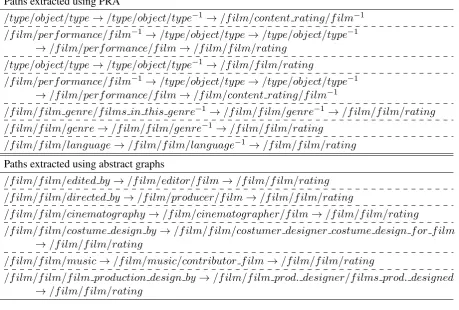
Paths extracted using PRA
/type/object/type→/type/object/type−1 →/f ilm/content rating/f ilm−1 /f ilm/perf ormance/f ilm−1 →/type/object/type→/type/object/type−1
→/f ilm/perf ormance/f ilm→/f ilm/f ilm/rating
/type/object/type→/type/object/type−1 →/f ilm/f ilm/rating
/f ilm/perf ormance/f ilm−1 →/type/object/type→/type/object/type−1 →/f ilm/perf ormance/f ilm→/f ilm/content rating/f ilm−1
/f ilm/f ilm genre/f ilms in this genre−1 →/f ilm/f ilm/genre−1 →/f ilm/f ilm/rating
/f ilm/f ilm/genre→/f ilm/f ilm/genre−1 →/f ilm/f ilm/rating
/f ilm/f ilm/language→/f ilm/f ilm/language−1→/f ilm/f ilm/rating
Paths extracted using abstract graphs
/f ilm/f ilm/edited by→/f ilm/editor/f ilm→/f ilm/f ilm/rating
/f ilm/f ilm/directed by→/f ilm/producer/f ilm→/f ilm/f ilm/rating
/f ilm/f ilm/cinematography→/f ilm/cinematographer/f ilm→/f ilm/f ilm/rating
/f ilm/f ilm/costume design by→/f ilm/f ilm/costumer designer costume design f or f ilm →/f ilm/f ilm/rating
/f ilm/f ilm/music→/f ilm/music/contributor f ilm→/f ilm/f ilm/rating
[image:9.595.74.534.70.380.2]/f ilm/f ilm/f ilm production design by→/f ilm/f ilm prod. designer/f ilms prod. designed →/f ilm/f ilm/rating
Table 6: Sample relations extracted using PRA and abstract graphs, respectively
Freebase The fine-grained results for Freebase, in terms of average precision, are presented in Ta-ble5. We make the same observation as for NELL – for several relations, the paths obtained from the abstract graph are different and more focused than the PRA ones. For the relation/film/film/ratingfor which the PRA approach gives very high results with the abstract graph has lower scores, some of the highest scoring paths found by the PRA are presented in Table6. For comparison we also in-clude the highest rated paths obtained using the abstract graph. While some of these paths were also found by the PRA, they are much lower in the list of extracted paths. The highest weighted paths found in the abstract graph connect specific properties of films with their rating.
An archive containing the abstract graphs, the abstract paths, the train/test data, negative samples and the groundings of the abstract paths for these relations for the variations of Freebase and NELL presented here is available from the University of Heidelberg4.
4https://www.cl.uni-heidelberg.de/
english/research/downloads/resource_ pages/AbstractGraphs/AbstractGraphs. shtml
5 Conclusions
References
Kurt Bollacker, Colin Evans, Praveen Paritosh, Tim Sturge, and Jamie Taylor. 2008. Freebase: A col-laboratively created graph database for structuring human knowledge. In Proceedings of the 2008 ACM SIGMOD International Conference on Man-agement of Data, SIGMOD ’08, pages 1247–1250, New York, NY, USA. ACM.
Antoine Bordes, Nicolas Usunier, Alberto Garcia-Duran, Jason Weston, and Oksana Yakhnenko. 2013. Translating embeddings for modeling multi-relational data. In C. J. C. Burges, L. Bottou, M. Welling, Z. Ghahramani, and K. Q. Weinberger, editors,Advances in Neural Information Processing Systems 26, pages 2787–2795. Curran Associates, Inc.
Andrew Carlson, Justin Betteridge, Bryan Kisiel, Burr Settles, Estevam R. Hruschka, and Tom M. Mitchell. 2010a. Toward an architecture for never-ending lan-guage learning. InAAAI.
Andrew Carlson, Justin Betteridge, Richard C. Wang, Estevam R. Hruschka, Jr., and Tom M. Mitchell. 2010b. Coupled semi-supervised learning for infor-mation extraction. InProceedings of the Third ACM International Conference on Web Search and Data Mining, WSDM ’10, pages 101–110, New York, NY, USA. ACM.
Kai-Wei Chang, Wen-tau Yih, Bishan Yang, and Christopher Meek. 2014. Typed tensor decompo-sition of knowledge bases for relation extraction. In Proceedings of the 2014 Conference on Em-pirical Methods in Natural Language Processing (EMNLP), pages 1568–1579. Association for Com-putational Linguistics.
Wenhu Chen, Wenhan Xiong, Xifeng Yan, and William Wang. 2018. Variational knowledge graph reason-ing. arXiv preprint arXiv:1803.06581.
Rajarshi Das, Shehzaad Dhuliawala, Manzil Zaheer, Luke Vilnis, Ishan Durugkar, Akshay Krishna-murthy, Alex Smola, and Andrew McCallum. 2017. Go for a walk and arrive at the answer: Reasoning over paths in knowledge bases using reinforcement learning.arXiv preprint arXiv:1711.05851.
Rajarshi Das, Arvind Neelakantan, David Belanger, and Andrew McCallum. 2016. Chains of reasoning over entities, relations, and text using recurrent neu-ral networks. arXiv preprint arXiv:1607.01426.
Boyang Ding, Quan Wang, Bin Wang, and Li Guo. 2018. Improving knowledge graph embed-ding using simple constraints. arXiv preprint arXiv:1805.02408.
Xin Dong, Evgeniy Gabrilovich, Geremy Heitz, Wilko Horn, Ni Lao, Kevin Murphy, Thomas Strohmann, Shaohua Sun, and Wei Zhang. 2014. Knowledge vault: a web-scale approach to probabilistic knowl-edge fusion. InKDD.
Matt Gardner and Tom Mitchell. 2015. Efficient and expressive knowledge base completion using sub-graph feature extraction. InProceedings of the 2015 Conference on Empirical Methods in Natural Lan-guage Processing, pages 1488–1498. Association for Computational Linguistics.
Matt Gardner, Partha Talukdar, Jayant Krishnamurthy, and Tom Mitchell. 2014. Incorporating vector space similarity in random walk inference over knowledge bases. InProceedings of the 2014 Conference on Empirical Methods in Natural Language Processing (EMNLP), pages 397–406, Doha, Qatar. Association for Computational Linguistics.
Matt Gardner, Partha Pratim Talukdar, Bryan Kisiel, and Tom Mitchell. 2013. Improving learning and in-ference in a large knowledge-base using latent syn-tactic cues. InProceedings of the 2013 Conference on Empirical Methods in Natural Language Pro-cessing, pages 833–838, Seattle, Washington, USA. Association for Computational Linguistics.
Kelvin Guu, John Miller, and Percy Liang. 2015. Traversing knowledge graphs in vector space. In Proceedings of the 2015 Conference on Empirical Methods in Natural Language Processing, pages 318–327. Association for Computational Linguis-tics.
Bhushan Kotnis and Vivi Nastase. 2017. Learning knowledge graph embeddings with type regularizer. In Proceedings of the Knowledge Capture Confer-ence, K-CAP 2017, pages 19:1–19:4. ACM.
Bhushan Kotnis and Vivi Nastase. 2018. Analysis of the impact of negative sampling on link prediction in knowledge graphs. InWorkshop on Knowledge Base Construction, Reasoning and Mining (KB-COM).
Ni Lao and William W. Cohen. 2010. Relational re-trieval using a combination of path-constrained ran-dom walks.Mach. Learn., 81(1):53–67.
Ni Lao, Tom Mitchell, and William W. Cohen. 2011. Random walk inference and learning in a large scale knowledge base. InProceedings of the Conference on Empirical Methods in Natural Language Pro-cessing, EMNLP ’11, pages 529–539, Stroudsburg, PA, USA. Association for Computational Linguis-tics.
Changping Meng, Reynold Cheng, Silviu Maniu, Pierre Senellart, and Wangda Zhang. 2015. Discov-ering meta-paths in large heterogeneous information networks. InProceedings of the 24th International Conference on World Wide Web, WWW ’15, pages 754–764.
Joint Conference on Natural Language Processing (Volume 1: Long Papers), pages 156–166. Associa-tion for ComputaAssocia-tional Linguistics.
Maximilian Nickel, Lorenzo Rosasco, and Tomaso Poggio. 2016. Holographic embeddings of knowl-edge graphs. InProceedings of the Thirtieth AAAI Conference on Artificial Intelligence, AAAI’16, pages 1955–1961. AAAI Press.
Maximilian Nickel, Volker Tresp, and Hans-Peter Kriegel. 2012. Factorizing yago: Scalable machine learning for linked data. In Proceedings of the 21st International Conference on World Wide Web, WWW ’12, pages 271–280, New York, NY, USA. ACM.
Michael Schlichtkrull, Thomas N Kipf, Peter Bloem, Rianne van den Berg, Ivan Titov, and Max Welling. 2018. Modeling relational data with graph convolu-tional networks. InEuropean Semantic Web Confer-ence, pages 593–607. Springer.
Richard Socher, Danqi Chen, Christopher D Manning, and Andrew Ng. 2013. Reasoning with neural ten-sor networks for knowledge base completion. In C. J. C. Burges, L. Bottou, M. Welling, Z. Ghahra-mani, and K. Q. Weinberger, editors, Advances in Neural Information Processing Systems 26, pages 926–934. Curran Associates, Inc.
Th´eo Trouillon, Christopher R Dance, Johannes Welbl, Sebastian Riedel, ´Eric Gaussier, and Guillaume Bouchard. 2017. Knowledge graph completion via complex tensor factorization. arXiv preprint arXiv:1702.06879.
William Yang Wang, Kathryn Mazaitis, and William W. Cohen. 2013. Programming with personalized Pagerank: A locally groundable first-order probabilistic logic. In Proceedings of the 22Nd CIKM, pages 2129–2138, New York, NY, USA. ACM.
Bishan Yang, Wen-tau Yih, Xiaodong He, Jianfeng Gao, and Li Deng. 2015. Embedding entities and relations for learning and inference in knowledge bases. In Proceedings of the 2015 International Conference on Representation Learning.
Wenpeng Yin, Yadollah Yaghoobzadeh, and Hinrich Sch¨utze. 2018. Recurrent one-hop predictions for reasoning over knowledge graphs. InProceedings of the 27th ACL, pages 2369–2378. Association for Computational Linguistics.