A Bayesian Model for Generative Transition-based Dependency Parsing
Jan Buys1 and Phil Blunsom1,2
1Department of Computer Science, University of Oxford2Google DeepMind
{jan.buys,phil.blunsom}@cs.ox.ac.uk
Abstract
We propose a simple, scalable, fully generative model for transition-based de-pendency parsing with high accuracy. The model, parameterized by Hierarchical Pitman-Yor Processes, overcomes the lim-itations of previous generative models by allowing fast and accurate inference. We propose an efficient decoding algorithm based on particle filtering that can adapt the beam size to the uncertainty in the model while jointly predicting POS tags and parse trees. The UAS of the parser is on par with that of a greedy discriminative baseline. As a language model, it obtains better perplexity than an-gram model by performing semi-supervised learning over a large unlabelled corpus. We show that the model is able to generate locally and syntactically coherent sentences, opening the door to further applications in lan-guage generation.
1 Introduction
Transition-based dependency parsing algorithms that perform greedy local inference have proven to be very successful at fast and accurate discrimina-tive parsing (Nivre, 2008; Zhang and Nivre, 2011; Chen and Manning, 2014). Beam-search decoding further improves performance (Zhang and Clark, 2008; Huang and Sagae, 2010; Choi and McCal-lum, 2013), but increases decoding time. Graph-based parsers (McDonald et al., 2005; Koo and Collins, 2010; Lei et al., 2014) perform global inference and although they are more accurate in some cases, inference tends to be slower.
In this paper we aim to transfer the advantages of transition-based parsing to generative depen-dency parsing. While generative models have been used widely and successfully for constituency
parsing (Collins, 1997; Petrov et al., 2006), their use in dependency parsing has been limited. Gen-erative models offer a principled approach to semi-and unsupervised learning, semi-and can also be applied to natural language generation tasks.
Dependency grammar induction models (Klein and Manning, 2004; Blunsom and Cohn, 2010) are generative, but not expressive enough for high-accuracy parsing. A previous generative transition-based dependency parser (Titov and Henderson, 2007) obtains competitive accuracies, but training and decoding is computationally very expensive. Syntactic language models have also been shown to improve performance in speech recognition and machine translation (Chelba and Jelinek, 2000; Charniak et al., 2003). However, the main limitation of most existing generative syntactic models is their inefficiency.
We propose a generative model for transition-based parsing (§2). The model, parameterized by Hierarchical Pitman-Yor Processes (HPYPs) (Teh, 2006), learns a distribution over derivations of parser transitions, words and POS tags (§3).
To enable efficient inference, we propose a novel algorithm for linear-time decoding in a gen-erative transition-based parser (§4). The algorithm is based on particle filtering (Doucet et al., 2001), a method for sequential Monte Carlo sampling. This method enables the beam-size during decod-ing to depend on the uncertainty of the model.
Experimental results (§5) show that the model obtains88.5%UAS on the standard WSJ parsing task, compared to88.9%for a greedy discrimina-tive model with similar features. The model can accurately parse up to200sentences per second. Although this performance is below state-of-the-art discriminative models, it exceeds existing gen-erative dependency parsing models in either accu-racy, speed or both.
As a language model, the transition-based parser offers an inexpensive way to incorporate
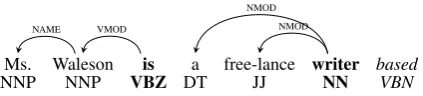
Ms. Waleson is a free-lance writer based
NNP NNP VBZ DT JJ NN VBN
[image:2.595.77.289.63.111.2]NAME VMOD NMOD NMOD
Figure 1: A partially-derived dependency tree for the sentence Ms. Waleson is a free-lance writer based in New York.The next word to be predicted by the generative model isbased. Words in bold are on the stack.
syntactic structure into incremental word predic-tion. With supervised training the model’s per-plexity is comparable to that of n-gram models, although generated examples shows greater syn-tactic coherence. With semi-supervised learning over a large unannotated corpus its perplexity is considerably better than that of an-gram model.
2 Generative Transition-based Parsing Our parsing model is based on transition-based projective dependency parsing with the arc-standard parsing strategy (Nivre and Scholz, 2004). Parsing is restricted to (labelled) projective trees. An arc(i, l, j) ∈ Aencodes a dependency between two words, where iis the head node, j the dependent andl is the dependency type of j. In our generative model a word can be represented by its lexical (word) type and/or its POS tag. We add a root node to the beginning of the sentence (although it could also be added at the end of the sentence), such that the head word of the sentence is the dependent of the root node.
A parser configuration (σ, β, A)for sentence s consists of a stackσof indices ins, an indexβ to the next word to be generated, and a set of arcsA. The stack elements are referred to asσ1, . . . , σ|σ|,
where σ1 is the top element. For any node a,
lc1(a) refers to the leftmost child of ain A, and
rc1(a)to its rightmost child.
The initial configuration is([],0,∅). A terminal configuration is reached whenβ >|s|, andσ con-sists only of the root. A sentence is generated left-to-right by performing a sequence of transitions. As a generative model it assigns probabilities to sentences and dependency trees: A word w (in-cluding its POS tag) is generated when it is shifted on to the stack, similar to the generative models proposed by Titov and Henderson (2007) and Co-hen et al. (2011), and the joint tagging and parsing model of Bohnet and Nivre (2012).
The types of transitions in this model are shift (sh), left-arc (la) and right-arc (ra):
shw:(σ, i, A)`(σ|i, i+ 1, A)
lal:(σ|i|j, β, A)`(σ|j, β, A∪ {(j, l, i)})
ral:(σ|i|j, β, A)`(σ|i, β, A∪ {(i, l, j)})
Left-arc and right-arc (reduce) transitions add an arc between the top two words on the stack, and also generate an arc labell. The parsing strat-egy adds arcs bottom-up. No arc that would make the root node the dependent of another node may be added. To illustrate the generative process, the configuration of a partially generated dependency tree is given in Figure 1.
In general parses may have multiple derivations. In transition-based parsing it is common to define an oracle o(c, G) that maps the current configu-ration c and the gold parse G to the next transi-tion that should be performed. In our probabilistic model we are interested in performing inference over all latent structure, including spurious deriva-tions. Therefore we propose a non-deterministic oracle which allows us to find all derivations of G. In contrast to dynamic oracles (Goldberg and Nivre, 2013), we are only interested in derivations of the correct parse tree, so the oracle can assume that givencthere exists a derivation forG.
First, to enforce the bottom-up property our ora-cle has to ensure that an arc(i, j)inGmay only be added oncejhas been attached to all its children – we refer to these arcs asvalid. Most determin-istic oracles add valid arcs greedily. Second, we note that if there exists a valid arc betweenσ2and
σ1 and the oracle decides to shift, the same pair
will only occur on the top of the stack again after a right dependent has been attached toσ1.
There-fore right arcs have to be added greedily if they are valid, while adding a valid left arc may be delayed ifσ1 has unattached right dependents inG.
3 Probabilistic Generative Model
Our model defines a joint probability distribution over a parsed sentence with POS tagst1:n, words
w1:nand a transition sequencea1:2nas
p(t1:n,w1:n,a1:2n)
=
n
Y
i=1
p(ti|htmi)p(wi|ti,h w mi)
mYi+1
j=mi+1
p(aj|haj)
where mi is the number of transitions that have
been performed when (ti, wi) is generated and
ht,hwandhaare sequences representing the con-ditioning contexts for the tag, word and transition distributions, respectively.
In the generative process a shift transition is fol-lowed by a sequence of 0 or more reduce tran-sitions. This is repeated until all the words have been generated and a terminal configuration of the parser has been reached. We shall also consider unlexicalised models, based only on POS tags.
3.1 Hierarchical Pitman-Yor processes
The probability distributions for predicting words, tags and transitions are drawn from hierarchical Pitmar-Yor Process (HPYP) priors. HPYP mod-els were originally proposed forn-gram language modelling (Teh, 2006), and have been applied to various NLP tasks. A version of approximate in-ference in the HPYP model recovers interpolated Kneser-Ney smoothing (Kneser and Ney, 1995), one of the best preformingn-gram language mod-els. The Pitman-Yor Process (PYP) is a general-ization of the Dirichlet process which defines a distribution over distributions over a probability space X, with discount parameter 0 ≤ d < 1, strength parameter θ > −dand base distribution B. PYP priors encode the power-law distribution found in the distribution of words.
Sampling from the posterior is characterized by the Chinese Restaurant Process analogy, where each variable in a sequence is represented by a customer entering a restaurant and sitting at one of an infinite number of tables. Letckbe the number
of customers sitting at tablekandK the number of occupied tables. The customer chooses to sit at a table according to the probability
P(zi=k|z1:i−1) =
(
ck−d
i−1+θ 1≤k≤K Kd+θ
i−1+θ k=K+ 1,
whereziis the index of the table chosen by theith
customer andz1:i−1 is the seating arrangement of
the previousi−1customers.
All customers at a table share the same dish, corresponding to the value assigned to the vari-ables they represent. When a customer sits at an empty table, a dish is assigned to the table by drawing from the base distribution of the PYP.
For HPYPs, the PYP base distribution can it-self be drawn from a PYP. The restaurant analogy is extended to the Chinese Restaurant Franchise,
where the base distribution of a PYP corresponds to another restaurant. So when a customer sits at a new table, the dish is chosen by letting a new cus-tomer enter the base distribution restaurant. All dishes can be traced back to a uniform base distri-bution at the top of the hierarchy.
Inference over seating arrangements in the model is performed with Gibbs sampling, based on routines to add or remove a customer from a restaurant. In our implementation we use the effi-cient data structures proposed by Blunsom et al. (2009). In addition to sampling the seating ar-rangement, the discount and strength parameters are also sampled, using slice sampling.
In our model Tht, Whw and Aha are HPYPs
for the tag, word and transition distributions, re-spectively. The PYPs for the transition prediction distribution, with conditioning context sequence ha
1:L, are defined hierarchically as
Aha
1:L ∼PYP(d
A
L, θLA, Aha
1:L−1)
Aha
1:L−1 ∼PYP(d
A
L−1, θLA−1, Aha
1:L−2)
. . . .
A∅ ∼PYP(dA0, θ0A,Uniform),
where dAk and θAk are the discount and strength discount parameters for PYPs with conditioning context length k. Each back-off level drops one context element. The distribution given the empty context backs off to the uniform distribution over all predictions. The word and tag distributions are defined by similarly-structured HPYPs.
The prior specifies an ordering of the symbols in the context from most informative to least in-formative to the distributions being estimated. The choice and ordering of this context is crucial in the formulation of our model. The contexts that we use are given in Table 1.
4 Decoding
Context elements
ai σ1.t, σ2.t, rc1(σ1).t, lc1(σ1).t, σ3.t,
rc1(σ2).t, σ1.w, σ2.w
tj σ1.t, σ2.t, rc1(σ1).t, lc1(σ1).t, σ3.t,
rc1(σ2).t, σ1.w, σ2.w
[image:4.595.317.495.76.413.2]wj β.t, σ1.t, rc1(σ1).t, lc1(σ1).t, σ1.w, σ2.w
Table 1: HPYP prediction contexts for the transi-tion, tag and word distributions. The context ele-ments are ordered from most important to least im-portant; the last elements in the lists are dropped first in the back-off structure. The POS tag of node sis referred to ass.tand the word type ass.w.
O(n2)decoding complexity. Another option is to prune the beam every time after the next word is shifted in all derivations – however the number of reduce transitions that can be performed between shifts is bounded by the stack size, so decoding complexity remains quadratic.
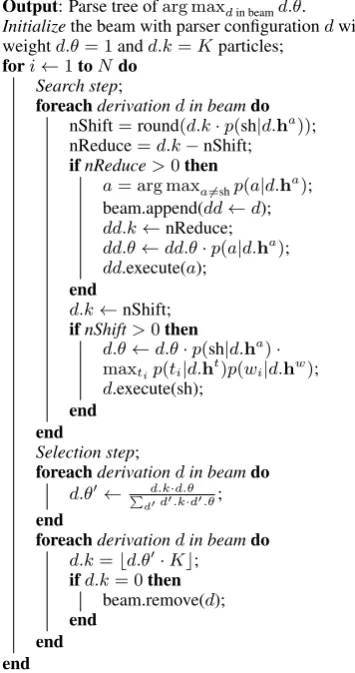
We propose a novel linear-time decoding algo-rithm inspired by particle filtering (see Algoalgo-rithm 1). Instead of specifying a fixed limit on the size of the beam, the beam size is controlled by setting the number of particlesK. Every partial derivationdj
in the beam is associated with kj particles, such
thatPjkj =K. Each pass through the beam
ad-vances eachdjuntil the next word is shifted.
At each step, to predict the next transition for dj, kj is divided proportionally between taking a
shift or reduce transition, according top(a|dj.ha).
If a non-zero number of particles are assigned to reduce, the highest scoring left-arc and right-arc transitions are chosen deterministically, and derivations that execute them are added to the beam. In practice we found that adding only the highest scoring reduce transition (left-arc or right-arc) gives very similar performance. The shift transition is performed on the current derivation, and the derivation weight is also updated with the word generation probability.
A POS tag is also generated along with a shift transition. Up to three candidate tags are assigned (more do not improve performance) and corre-sponding derivations are added to the beam, with particles distributed relative to the tag probability (in Algorithm 1 only one tag is predicted).
A pass is complete once the derivations in the beam, including those added by reduce transitions during the pass, have been iterated through. Then a selection step is performed to determine which
Input: Sentencew1:n,Kparticles. Output: Parse tree ofarg maxdin beamd.θ.
Initializethe beam with parser configurationdwith
weightd.θ= 1andd.k=Kparticles;
fori←1toNdo
Search step;
foreachderivationdin beamdo
nShift=round(d.k·p(sh|d.ha)); nReduce=d.k−nShift;
ifnReduce>0then
a= arg maxa6=shp(a|d.ha); beam.append(dd←d);
dd.k←nReduce;
dd.θ←dd.θ·p(a|d.ha);
dd.execute(a);
end
d.k←nShift;
ifnShift>0then
d.θ←d.θ·p(sh|d.ha)
· maxtip(ti|d.ht)p(wi|d.hw);
d.execute(sh);
end end
Selection step;
foreachderivationdin beamdo d.θ0← Pd.k·d.θ
d0d0.k·d0.θ; end
foreachderivationdin beamdo d.k=bd.θ0·Kc;
ifd.k= 0then
beam.remove(d);
end end end
Algorithm 1: Beam search decoder for arc-standard generative dependency parsing.
derivations are kept. The number of particles for each derivation are reallocated based on the nor-malised weights of the derivations, each weighted by its current number of particles. Derivations to which zero particles are assigned are eliminated. The selection step allows the size of the beam to depend on the uncertainty of the model during de-coding. The selectional branching method pro-posed by Choi and McCallum (2013) for discrim-inative beam-search parsing has a similar goal.
After the last word in the sentence has been shifted, reduce transitions are performed on each derivation until it reaches a terminal configuration. The parse tree corresponding to the highest scor-ing final derivation is returned.
by sampling from a peaked version of the distribu-tion over derivadistribu-tions.
5 Experiments
5.1 Parsing Setup
We evaluate our model as a parser on the stan-dard English Penn Treebank (Marcus et al., 1993) setup, training on WSJ sections 02-21, devel-oping on section 22, and testing on section 23. We use the head-finding rules of Yamada and Matsumoto (2003) (YM)1 for
constituency-to-dependency conversion, to enable comparison with previous results. We also evaluate on the Stanford dependency representation (De Marneffe and Manning, 2008) (SD)2.
Words that occur only once in the training data are treated as unknown words. We clas-sify unknown words according to capitalization, numbers, punctuation and common suffixes into classes similar to those used in the implementa-tion of generative constituency parsers such as the Stanford parser (Klein and Manning, 2003).
As a discriminative baseline we use Malt-Parser (Nivre et al., 2006), a discriminative, greedy transition-based parser, performing arc-standard parsing with LibLinear as classifier. Al-though the accuracy of this model is not state-of-the-art, it does enable us to compare our model against an optimised discriminative model with a feature-set based on the same elements as we in-clude in our conditioning contexts.
Our HPYP dependency parser (HPYP-DP) is trained with 20 iterations of Gibbs sampling, re-sampling the hyper-parameters after every itera-tion, except when performing inference over la-tent structure, in which case they are only resam-pled every5iterations. Training with a determin-istic oracle takes28seconds per iteration (exclud-ing resampl(exclud-ing hyper-parameters), while a non-deterministic oracle (sampling with100particles) takes458seconds.
5.2 Modelling Choices
We consider several modelling choices in the con-struction of our generative dependency parsing model. Development set parsing results are given in Table 2. We report unlabelled attachment score
1http://stp.lingfil.uu.se/ nivre/research/Penn2Malt.html 2Converted with version 3.4.1 of the Stanford parser, available at http:/nlp.stanford.edu/software/lex-parser.shtml.
Model UAS LAS
MaltParser Unlex 85.23 82.80
MaltParser Lex 89.17 87.81
Unlexicalised 85.64 82.93
Lexicalised, unlex context 87.95 85.04 Lexicalised, tagger POS 87.84 85.54
Lexicalised, predict POS 89.09 86.78
[image:5.595.315.519.61.171.2]Lexicalised, gold POS 89.30 87.28
Table 2: HPYP parsing accuracies on the YM de-velopment set, for various lexicalised and unlexi-calised setups.
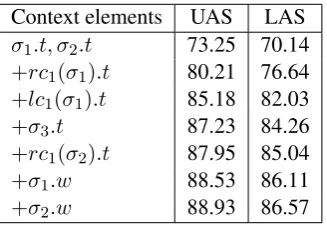
Context elements UAS LAS σ1.t, σ2.t 73.25 70.14
+rc1(σ1).t 80.21 76.64
+lc1(σ1).t 85.18 82.03
+σ3.t 87.23 84.26
+rc1(σ2).t 87.95 85.04
+σ1.w 88.53 86.11
+σ2.w 88.93 86.57
Table 3: Effect of including elements in the model conditioning contexts. Results are given on the YM development set.
(UAS) and labelled attachment score (LAS), ex-cluding punctuation.
HPYP priors
The first modelling choice is the selection and or-dering of elements in the conditioning contexts of the HPYP priors. Table 3 shows how the devel-opment set accuracy increases as more elements are added to the conditioning context. The first two words on the stack are the most important, but insufficient – second-order dependencies and further elements on the stack should also be in-cluded in the contexts. The challenge is that the back-off structure of each HPYP specifies an or-dering of the elements based on their importance in the prediction. We are therefore much more re-stricted than classifiers with large, sparse feature-sets which are commonly used in transition-based parsers. Due to sparsity, the word types are the first elements to be dropped in the back-off struc-ture, and elements such as third-order dependen-cies, which have been shown to improve parsing performance, cannot be included successfully in our model.
[image:5.595.336.500.232.345.2]89.09UAS. Adding the root symbol at the end of the sentence rather than at the front gives very sim-ilar parsing performance. When unknown words are not clustered according to surface features, performance drops to88.60UAS.
POS tags and lexicalisation
It is standard practice in transition-based parsing to obtain POS tags with a stand-alone tagger be-fore parsing. However, as we have a generative model, we can use the model to assign POS tags in decoding, while predicting the transition se-quence. We compare predicting tags against us-ing gold standard POS tags and tags obtain usus-ing the Stanford POS tagger3(Toutanova et al., 2003).
Even though the predicted tags are slightly less ac-curate than the Stanford tags on the development set (95.6%), jointly predicting tags and decoding increases the UAS by1.1%. The jointly predicted tags are a better fit to the generative model, which can be seen by an improvement in the likelihood of the test data. Bohnet and Nivre (2012) found that joint prediction increases both POS and parsing accuracy. However, their model rescored ak-best list of tags obtained with an preprocessing tagger, while our model does not use the external tagger at all during joint prediction.
We train lexicalised and unlexicalised versions of our model. Unlexicalised parsing gives us a strong baseline (85.6 UAS) over which to con-sider our model’s ability to predict and condition on words. Unlexicalised parsing is also consid-ered to be robust for applications such as cross-lingual parsing (McDonald et al., 2011). Addi-tionally, we consider a version of the model that don’t include lexical elements in the condition-ing context. This model performs only 1%UAS lower than the best lexicalised model, although it makes much stronger independence assumptions. The main benefit of lexicalised conditioning con-texts are to make incremental decoding easier.
Speed vs accuracy trade-offs
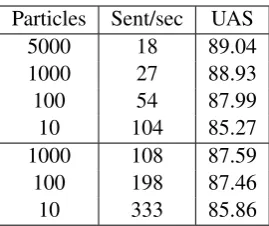
We consider a number of trade-offs between speed and accuracy in the model. We compare using different numbers of particles during decoding, as well as jointly predicting POS tags against using pre-obtained tags (Table 4).
3We use the efficient “left 3 words” model, trained on the same data as the parsing model, excluding distributional fea-tures. Tagging accuracy is95.9%on the development set and
96.5%on the test set.
Particles Sent/sec UAS
5000 18 89.04
1000 27 88.93
100 54 87.99
10 104 85.27
1000 108 87.59
100 198 87.46
[image:6.595.349.484.60.173.2]10 333 85.86
Table 4: Speed and accuracy for different configu-rations of the decoding algorithm. Above the line, POS tags are predicted by the model, below pre-tagged POS are used.
Model UAS LAS
Eisner (1996) 80.7
-Wallach et al. (2008) 85.7
-Titov and Henderson (2007) 89.36 87.65
HPYP-DP 88.47 86.13
MaltParser 88.88 87.41
Zhang and Nivre (2011) 92.9 91.8 Choi and McCallum (2013) 92.96 91.93
Table 5: Parsing accuracies on the YM test set. compared against previous published results. Titov and Henderson (2007) was retrained to en-able direct comparison.
The optimal number of particles is found to be 1000 - more particles only increase accuracy by about 0.1 UAS. Although jointly predicting tags is more accurate, using pre-obtained tags provides a better trade-off between speed and accuracy – 87.59against85.27UAS at around100sentences per second. In comparison, the MaltParser parses around500sentences per second.
We also compare our particle filter-based gorithm against a more standard beam-search al-gorithm that prunes the beam to a fixed size af-ter each word is shifted. This algorithm is much slower than the particle-based algorithm – to get similar accuracy it parses only3sentences per sec-ond (against27) when predicting tags jointly, and 29(against108) when using pre-obtained tags.
5.3 Parsing Results
[image:6.595.310.524.245.358.2]Eis-ner’s model is given as reported by Wallach et al. (2008) on the WSJ). The accuracy of our model is only0.8UAS below the generative model of Titov and Henderson (2007), despite that model being much more powerful. The Titov and Henderson model takes3days to train, and its decoding speed is around1sentence per second.
The UAS of our model is very close to that of the MaltParser. However, we do note that our model’s performance is relatively worse on LAS than on UAS. An explanation for this is that as we do not include labels in the conditioning contexts, the predicted labels are independent of words that have not yet been generated.
We also test the model on the Stanford de-pendencies, which have a larger label set. Our model obtains87.9/83.2 against the MaltParser’s 88.9/86.2UAS/LAS.
Despite these promising results, our model’s performance still lags behind recent discriminative parsers (Zhang and Nivre, 2011; Choi and Mc-Callum, 2013) with beam-search and richer fea-ture sets than can be incorporated in our model. In terms of speed, Zhang and Nivre (2011) parse 29sentences per second, against the110sentences per second of Choi and McCallum (2013). Re-cently proposed neural networks for dependency parsers have further improved performance (Dyer et al., 2015; Weiss et al., 2015), reaching up to 94.0%UAS with Stanford dependencies.
We argue that the main weakness of the HPYP parser is sparsity in the large conditioning con-texts composed of tags and words. The POS tags in the parser configuration context already give a very strong signal for predicting the next transi-tion. As a result it is challenging to construct PYP reduction lists that also include word types with-out making the back-off contexts too sparse.
The other limitation is that our decoding algo-rithm, although efficient, still prunes the search space aggressively, while not being able to take advantage of look-ahead features as discriminative models can. Interestingly, we note that a discrimi-native parser cannot reach high performance with-out look-ahead features.
5.4 Language Modelling
Next we evaluate our model as a language model. First we use the standard WSJ language modelling setup, training on sections 00 −20, developing on 21 − 22 and testing on 23 −24.
Punctua-tion is removed, numbers and symbols are mapped to a single symbol and the vocabulary is limited to 10,000 words. Second we consider a semi-supervised setup where we train the model, in ad-dition to the WSJ, on a subset of 1 million sen-tences (24.1 million words) from the WMT En-glish monolingual training data4. This model is
evaluated onnewstest2012.
When training our models for language mod-elling, we first perform standard supervised train-ing, as for parsing (although we don’t predict la-bels). This is followed by a second training stage, where we train the model only on words, regarding the tags and parse trees as latent structure. In this unsupervised stage we train the model with parti-cle Gibbs sampling (Andrieu et al., 2010), using a particle filter to sample parse trees. When only training on the WSJ, we perform this step on the same data, now allowing the model to learn parses that are not necessarily consistent with the anno-tated parse trees.
For semi-supervised training, unsupervised learning is performed on the large unannotated corpus. However, here we find the highest scoring parse trees, rather than sampling. Only the word prediction distribution is updated, not the tag and transition distributions.
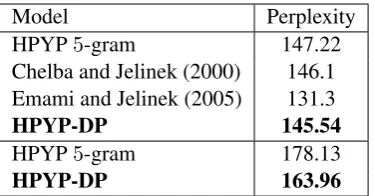
Language modelling perplexity results are given in Table 6. We note that the perplexities reported are upper bounds on the true perplexity of the model, as it is intractable to sum over all possi-ble parses of a sentence to compute the marginal probability of the words. As an approximation we sum over the final beam after decoding.
The results show that on the WSJ the model per-forms slightly better than a HPYPn-gram model. One disadvantage of evaluating on this dataset is that due to removing punctuation and restricting the vocabulary, the model parsing accuracy drops to84.6 UAS. Also note that in contrast to many other evaluations, we do not interpolate with a n-gram model – this will improve perplexity further. On the big dataset we see a larger improvement over the n-gram model. This is a promising re-sult, as it shows that our model can successfully generalize to larger vocabularies and unannotated datasets.
Model Perplexity
HPYP5-gram 147.22
Chelba and Jelinek (2000) 146.1 Emami and Jelinek (2005) 131.3
HPYP-DP 145.54
HPYP5-gram 178.13
[image:8.595.89.277.61.159.2]HPYP-DP 163.96
Table 6: Language modelling test results. Above, training and testing on WSJ. Below, training semi-supervised and testing on WMT.
5.5 Generation
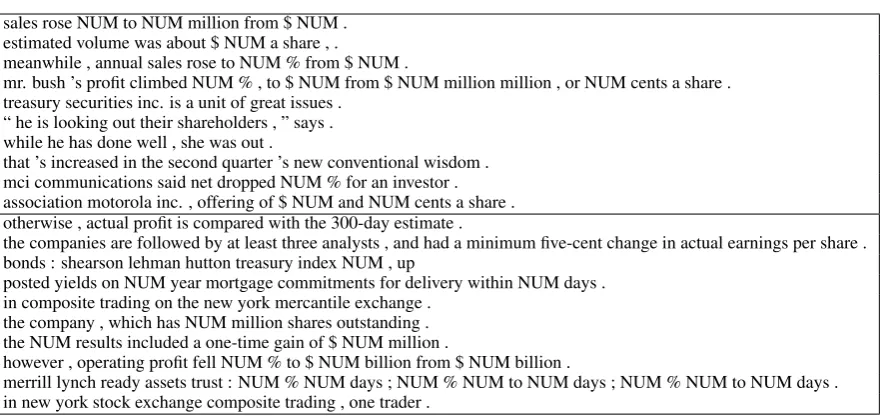
To support our claim that our generative model is a good model for sentences, we generate some ex-amples. The samples given here were obtained by generating1000samples, and choosing the10 highest scoring ones with length greater or equal to10. The models are trained on the standard WSJ training set (including punctuation).
The examples are given in Table 7. The qual-ity of the sentences generated by the dependency model is superior to that of then-gram model, de-spite the models have similar test set perplexities. The sentences generated by the dependency model tend to have more global syntactic structure (for examples having verbs where expected), while re-taining the local coherence ofn-gram models. The dependency model was also able to generate bal-anced quotation marks.
6 Related work
One of the earliest graph-based dependency pars-ing models (Eisner, 1996) is generative, estimatpars-ing the probability of dependents given their head and previously generated siblings. To counter sparsity in the conditioning context of the distributions, backoff and smoothing are performed. Wallach et al. (2008) proposed a Bayesian HPYP parameteri-sation of this model.
Other generative models for dependency trees have been proposed mostly in the context of unsu-pervised parsing. The first successful model was the dependency model with valence (DMV) (Klein and Manning, 2004). Several extensions have been proposed for this model, for example us-ing structural annaelus-ing (Smith and Eisner, 2006), Viterbi EM training (Spitkovsky et al., 2010) or richer contexts (Blunsom and Cohn, 2010). How-ever, these models are not powerful enough for ei-ther accurate parsing or language modelling with
rich contexts (they are usually restricted to first-order dependencies and valency).
Although any generative parsing model can be applied to language modelling by marginalising out the possible parses of a sentence, in prac-tice the success of such models has been lim-ited. Lexicalised PCFGs applied to language mod-elling (Roark, 2001; Charniak, 2001) show im-provements overn-gram models, but decoding is prohibitively expensive for practical integration in language generation applications.
Chelba and Jelinek (2000) as well as Emami and Jelinek (2005) proposed incremental syntac-tic language models with some similarities to our model. Those models predict binarized con-stituency trees with a transition-based model, and are parameterized by deleted interpolation and neural networks, respectively. Rastrow et al. (2012) applies a transition-based dependency lan-guage model to speech recognition, using hierar-chical interpolation and relative entropy pruning. However, the model perplexity only improves over ann-gram model when interpolated with one.
Titov and Henderson (2007) introduced a gen-erative latent variable model for transition-based parsing. The model is based on an incremental sig-moid belief networks, using the arc-eager parsing strategy. Exact inference is intractable, so neural networks and variational mean field methods are proposed to perform approximate inference. How-ever, this is much slower and therefore less scal-able than our model.
A generative transition-based parsing model for non-projective parsing is proposed in (Cohen et al., 2011), along with a dynamic program for in-ference. The parser is similar to ours, but the dy-namic program restricts the conditioning context to the top2 or3words on the stack. No experi-mental results are included.
Le and Zuidema (2014) proposed a recursive neural network generative model over dependency trees. However, their model can only score trees, not perform parsing, and its perplexity (236.58on the PTB development set) is worse than model’s, despite using neural networks to combat sparsity.
sales rose NUM to NUM million from $ NUM . estimated volume was about $ NUM a share , .
meanwhile , annual sales rose to NUM % from $ NUM .
mr. bush ’s profit climbed NUM % , to $ NUM from $ NUM million million , or NUM cents a share . treasury securities inc. is a unit of great issues .
“ he is looking out their shareholders , ” says . while he has done well , she was out .
that ’s increased in the second quarter ’s new conventional wisdom . mci communications said net dropped NUM % for an investor . association motorola inc. , offering of $ NUM and NUM cents a share . otherwise , actual profit is compared with the 300-day estimate .
the companies are followed by at least three analysts , and had a minimum five-cent change in actual earnings per share . bonds : shearson lehman hutton treasury index NUM , up
posted yields on NUM year mortgage commitments for delivery within NUM days . in composite trading on the new york mercantile exchange .
the company , which has NUM million shares outstanding . the NUM results included a one-time gain of $ NUM million .
however , operating profit fell NUM % to $ NUM billion from $ NUM billion .
[image:9.595.81.523.56.265.2]merrill lynch ready assets trust : NUM % NUM days ; NUM % NUM to NUM days ; NUM % NUM to NUM days . in new york stock exchange composite trading , one trader .
Table 7: Sentences generated, above by the generative dependency model, below by an-gram model. In both cases,1000samples were generated, and the most likely sentences of length10or more are given.
7 Conclusion
We presented a generative dependency parsing model that, unlike previous models, retains most of the speed and accuracy of discriminative parsers. Our models can accurately estimate prob-abilities conditioned on long context sequences. The model is scalable to large training and test sets, and even though it defines a full probabil-ity distribution over sentences and parses, decod-ing speed is efficient. Additionally, the genera-tive model gives strong performance as a language model. For future work we believe that this model can be applied successfully to natural language generation tasks such as machine translation.
References
Christophe Andrieu, Arnaud Doucet, and Roman Holenstein. 2010. Particle Markov chain Monte Carlo methods. Journal of the Royal Statisti-cal Society: Series B (StatistiStatisti-cal Methodology), 72(3):269–342.
Phil Blunsom and Trevor Cohn. 2010. Unsupervised induction of tree substitution grammars for depen-dency parsing. InEMNLP, pages 1204–1213.
Phil Blunsom, Trevor Cohn, Sharon Goldwater, and Mark Johnson. 2009. A note on the implementation of hierarchical Dirichlet processes. InACL/IJCNLP (Short Papers), pages 337–340.
Bernd Bohnet and Joakim Nivre. 2012. A transition-based system for joint part-of-speech tagging and labeled non-projective dependency parsing. In EMNLP-CoNLL, pages 1455–1465.
Eugene Charniak, Kevin Knight, and Kenji Yamada. 2003. Syntax-based language models for statistical machine translation. InProceedings of MT Summit IX, pages 40–46.
Eugene Charniak. 2001. Immediate-head parsing for language models. In Proceedings of ACL, pages 124–131.
Ciprian Chelba and Frederick Jelinek. 2000. Struc-tured language modeling. Computer Speech & Lan-guage, 14(4):283–332.
Danqi Chen and Christopher D Manning. 2014. A fast and accurate dependency parser using neural net-works. InEMNLP.
Jinho D. Choi and Andrew McCallum. 2013.
Transition-based dependency parsing with selec-tional branching. InACL.
Shay B. Cohen, Carlos G´omez-Rodr´ıguez, and Gior-gio Satta. 2011. Exact inference for generative probabilistic non-projective dependency parsing. In EMNLP, pages 1234–1245.
Michael Collins. 1997. Three generative, lexicalised models for statistical parsing. InACL, pages 16–23. Marie-Catherine De Marneffe and Christopher D Man-ning. 2008. The Stanford typed dependencies rep-resentation. In Coling 2008: Proceedings of the workshop on Cross-Framework and Cross-Domain Parser Evaluation, pages 1–8.
Arnaud Doucet, Nando De Freitas, and Neil Gordon. 2001. Sequential Monte Carlo methods in practice. Springer.
Jason Eisner. 1996. Three new probabilistic models for dependency parsing: An exploration. In COL-ING, pages 340–345.
Ahmad Emami and Frederick Jelinek. 2005. A neural syntactic language model. Machine Learning, 60(1-3):195–227.
Yoav Goldberg and Joakim Nivre. 2013. Training deterministic parsers with non-deterministic oracles. TACL, 1:403–414.
Liang Huang and Kenji Sagae. 2010. Dynamic pro-gramming for linear-time incremental parsing. In ACL, pages 1077–1086.
Dan Klein and Christopher D. Manning. 2003. Accu-rate unlexicalized parsing. InACL, pages 423–430.
Dan Klein and Christopher D Manning. 2004. Corpus-based induction of syntactic structure: Models of de-pendency and constituency. InACL, pages 478–586.
Reinhard Kneser and Hermann Ney. 1995. Improved backing-off for m-gram language modeling. In ICASSP, volume 1, pages 181–184. IEEE.
Terry Koo and Michael Collins. 2010. Efficient third-order dependency parsers. InACL, pages 1–11.
Phong Le and Willem Zuidema. 2014. The inside-outside recursive neural network model for depen-dency parsing. InEMNLP, pages 729–739.
Tao Lei, Yu Xin, Yuan Zhang, Regina Barzilay, and Tommi Jaakkola. 2014. Low-rank tensors for scor-ing dependency structures. InProceedings of ACL (Volume 1: Long Papers), pages 1381–1391.
Roger P Levy, Florencia Reali, and Thomas L Griffiths. 2009. Modeling the effects of memory on human online sentence processing with particle filters. In Advances in neural information processing systems, pages 937–944.
Mitchell P. Marcus, Beatrice Santorini, and Mary Ann Marcinkiewicz. 1993. Building a large annotated corpus of English: The Penn Treebank. Computa-tional Linguistics, 19(2):313–330.
Ryan T. McDonald, Koby Crammer, and Fernando C. N. Pereira. 2005. Online large-margin training of dependency parsers. InACL.
Ryan McDonald, Slav Petrov, and Keith Hall. 2011. Multi-source transfer of delexicalized dependency parsers. InEMNLP, pages 62–72. Association for Computational Linguistics.
Joakim Nivre and Mario Scholz. 2004. Deterministic dependency parsing of English text. InCOLING.
Joakim Nivre, Johan Hall, and Jens Nilsson. 2006. Maltparser: A data-driven parser-generator for de-pendency parsing. In Proceedings of LREC, vol-ume 6, pages 2216–2219.
Joakim Nivre. 2008. Algorithms for deterministic in-cremental dependency parsing. Computational Lin-guistics, 34(4):513–553.
Slav Petrov, Leon Barrett, Romain Thibaux, and Dan Klein. 2006. Learning accurate, compact, and in-terpretable tree annotation. InCOLING-ACL, pages 433–440.
Ariya Rastrow, Mark Dredze, and Sanjeev Khudanpur. 2012. Efficient structured language modeling for speech recognition. InINTERSPEECH.
Brian Roark. 2001. Probabilistic top-down parsing and language modeling. Computational linguistics, 27(2):249–276.
Noah A. Smith and Jason Eisner. 2006. Annealing structural bias in multilingual weighted grammar in-duction. In Proceedings of COLING-ACL, pages 569–576.
Valentin I. Spitkovsky, Hiyan Alshawi, Daniel Juraf-sky, and Christopher D. Manning. 2010. Viterbi training improves unsupervised dependency parsing. InCoNLL, pages 9–17.
Yee Whye Teh. 2006. A hierarchical Bayesian lan-guage model based on Pitman-Yor processes. In ACL.
Ivan Titov and James Henderson. 2007. A latent vari-able model for generative dependency parsing. In Proceedings of the Tenth International Conference on Parsing Technologies, pages 144–155.
Kristina Toutanova, Dan Klein, Christopher D. Man-ning, and Yoram Singer. 2003. Feature-rich part-of-speech tagging with a cyclic dependency network. InHLT-NAACL, pages 173–180.
Hanna M Wallach, Charles Sutton, and Andrew Mc-Callum. 2008. Bayesian modeling of dependency trees using hierarchical Pitman-Yor priors. InICML Workshop on Prior Knowledge for Text and Lan-guage Processing.
David Weiss, Chris Alberti, Michael Collins, and Slav Petrov. 2015. Structured training for neural net-work transition-based parsing. In Proceedings of ACL 2015.
Hiroyasu Yamada and Yuji Matsumoto. 2003. Statis-tical dependency analysis with support vector ma-chines. InProceedings of IWPT.
Yue Zhang and Stephen Clark. 2008. A tale of two parsers: Investigating and combining graph-based and transition-graph-based dependency parsing. In EMNLP, pages 562–571.