Volume 2008, Article ID 598401,9pages doi:10.1155/2008/598401
Research Article
Structured LDPC Codes over Integer Residue Rings
Elisa Mo and Marc A. Armand
Department of Electrical and Computer Engineering, National University of Singapore, Singapore 117576
Correspondence should be addressed to Marc A. Armand,[email protected] Received 31 October 2007; Revised 31 March 2008; Accepted 3 June 2008 Recommended by Jinhong Yuan
This paper presents a new class of low-density parity-check (LDPC) codes overZ2a represented by regular, structured Tanner graphs. These graphs are constructed using Latin squares defined over a multiplicative group of a Galois ring, rather than a finite field. Our approach yields codes for a wide range of code rates and more importantly, codes whose minimum pseudocodeword weights equal their minimum Hamming distances. Simulation studies show that these structured codes, when transmitted using matched signal sets over an additive-white-Gaussian-noise channel, can outperform their random counterparts of similar length and rate.
Copyright © 2008 E. Mo and MarcA. Armand. This is an open access article distributed under the Creative Commons Attribution License, which permits unrestricted use, distribution, and reproduction in any medium, provided the original work is properly cited.
1. INTRODUCTION
The study of nonbinary LDPC codes over GF(q) was initiated
by Davey and Mackay [1]. However, the symbols of a
nonbinary code over a finite field cannot be matched to any signal constellation. In other words, it is not possible to obtain a geometrically uniform code (wherein every codeword has the same error probability), from a nonbinary, finite field code. The subject of geometrically uniform codes has been well studied by various authors including Slepian
[2] and Forney Jr. [3]. More recently, Sridhara and Fuja [4]
introduced geometrically uniform, nonbinary LDPC codes over certain rings, including integer residue rings. Their codes are however unstructured. Structured LDPC codes,
which include the family of finite geometry (FG) codes [5]
and balanced incomplete block design (BIBD) codes [6], are
favored over their random counterparts due to the reduction in storage space for the parity check matrix and the ease in performance analysis they provide, while achieving relatively similar performance. Structured nonbinary LDPC codes that have been proposed thus far however, are constructed over
finite fields, for example, [1, 7], and therefore cannot be
geometrically uniform.
This paper therefore addresses the problem of designing structured, geometrically uniform, nonbinary LDPC codes over integer residue rings. Motivated by the fact that
short nonbinary LDPC codes can outperform their binary
counterparts [8–10], we focus our investigations on codes of
short codelength. Studies of the so-called pseudocodewords arising from finite covers of a Tanner graph, for example,
[11–13], have revealed that while a code’s performance
under maximum-likelihood (ML) decoding is dictated by its (Hamming) weight distribution, its performance under iterative decoding is dictated by the weight distribution of the pseudocodewords associated with its Tanner graph. More specifically, the presence of pseudocodewords of low weight, particularly those of weight less than the minimum Hamming distance of the code, is detrimental to a code’s performance under iterative decoding. We therefore adopt
the Latin-squares-based approach of Kelley et al. [14] to
con-struct con-structured codes, as their method aims at maximizing the minimum pseudocodeword weight of a code. While we maintain the pseudocodeword framework used there, our
work nevertheless differs from [14] primarily because our
construction relies on an extension of the notion of Latin squares to multiplicative groups of a Galois ring—a key contribution of this paper.
We note that codes based on Latin squares were also
studied in [7,15–17]. However, the authors of these works
did not do so in the pseudocodeword framework. Codes con-structed using other combinatorial approaches, such as those
the notion of pseudocodewords. Specifically, these related works focused on the optimization of design parameters such as girth, expansion, diameter, and stopping sets. Our work
therefore differs from these earlier studies in this regard.
For practical reasons, we only consider linear codes over
Z2a. In the next section, we provide an overview of codes
over Z2a and their natural mapping to a matched signal
constellation, that is, the 2a-PSK constellation. Section 3
introduces the notion of Latin squares over finite fields, followed by our extension of Latin squares to multiplicative groups of a Galois ring. A method to construct Tanner graphs using Latin squares (over a multiplicative group
of a Galois ring) is presented in Section 4. We show that
from these graphs, a wide range of code rates may be obtained. We further derive in the same section certain properties of the corresponding codes and, in particular, show that their minimum pseudocodeword weights equal their minimum Hamming distances. This is one of our
main results. Finally, Section 5 presents computer
simula-tions which demonstrate that our codes, when mapped to matched signal sets and transmitted over the additive-white-Gaussian-noise (AWGN) channel, outperform their random counterparts of similar length and rate.
2. CODES OVERZ2a
2.1. An overview
LetCbe aZ2a-submodule of the freeZ2a-moduleZn2a. ItsnG×
ngenerator matrixGcan be expressed in the form [20]
G=
2a is a set of linearly independent
elements. The rate ofCis
r=1
The dual codeC⊥is generated by thenH×nparity-check
matrix ofC, which can be expressed in the form
H=
2a is a set of linearly independent
elements. The rate ofCcan also be obtained by
r=1−1
one could perform Gaussian elimination without dividing
a row by a zero divisor to obtain the nG (ornH) linearly
independent rows.
Remark 1. C is a free Z-submodule ifλi = 0 fori = 1, 2,. . .,nG. This also implies thatμi=0 fori=1, 2,. . .,nH.
2.2. The matched signal set
The 2a-PSK signal set contains 2apoints that are equidistant
from the origin while maximally spread apart on a two-dimensional space. Projecting one dimension on the real axis
and the other on the imaginary axis, a symbolx ∈ Z2a is
Euclidean distance between these two signal vectors is
d2
Observe that the Hamming distance between two code-words is mapped proportionally to the Euclidean distance between their corresponding signal vectors.
3. LATIN SQUARES
3.1. Definition and application to galois fields
The following definition and example are taken from [22,
Chapter 17].
Definition 1. A Latin square of order q is denoted as
(R,C,S;L), whereR,C, and Sare sets of cardinalityq and
Lis a mappingL(i,j)=k, wherei∈R, j ∈C, andk ∈S,
such that given any two ofi,j, andk, the third is unique.
A Latin square can be written as aq×qarray for which
the cell in rowiand column j contains the symbolL(i,j).
Two Latin squares with mapping functions L and L are
orthogonal if (L(i,j),L(i,j)) is unique for each pair (i,j).
Further, a complete family ofq−1 mutually orthogonal Latin
squares (MOLS) exists forq=ps, wherepis prime.
The notion of Latin squares can be easily applied to
Galois fields by settingR =C =S =GF(ps) and mapping
Example 1. Let R = C = S = GF(22) = {0, 1,α,α2}.
3.2. Extension to multiplicative groups of a Galois ring
Extending the notion of Latin squares over integer residue
rings is not trivial. SettingR =C = S =Z2s and mapping
are obtained, respectively. Since the elements in each row of
M2is not unique,M2is not a Latin square. Therefore, we do
not have a complete family of three MOLS.
Hence, we propose an alternative way of constructing Latin squares over integer residue rings. Let extension ring
R = GR(2a,s) = Z2a[y]/φ(y), whereφ(y) is a degrees
basic irreducible polynomial overZ2a. Embedded inRis a
multiplicative groupG2s−1of units of order 2s−1. Further,
we leta < aand definez =zmod 2a
, wherez ∈R, and
extend this notation ton-tuples and matrices overR.
Example 3. Let R = GR(22, 2) = Z4[y]/y2 + y + 3.
respectively. SinceG3∪ {0}is not closed underR-addition,
S⊂Rso that|S|= |/ R| = |C| =2s. Thus, all three matrices
are not Latin squares.
To overcome this problem, the mapping functions have
to be altered slightly such that they mapi ∈ Rand j ∈ C
binomial expansion, the mapping function can be expressed as
Theorem 2. Consider two multiplicative groups G2s−1 ⊂
GR(2a,s) = Z2a[y]/φ(y) and G2s−1 ⊂ GR(2a
Proof. Using binomial expansion,
Now, observe that
i+β j coincides with the mapping function applied to the
Galois fields. SinceL(1)β (i,j)= Lβ(a)(i,j) (fromTheorem 2),
respectively. A complete family of three MOLS is obtained.
In addition, the mapping functionL0(i,j)=iyields a matrix
Figure1: Portion of parity check matrix constructed in each step.
which is orthogonal to each Latin square in the complete family of MOLS.
4. STRUCTURED LDPC CODES OVERZ2a
4.1. Construction of graphs using latin squares
The construction method proposed in [14, Section IV-A] can
be generalized to construct graphs for different values ofa
and s by altering the mapping functions according to the
value ofa. The procedure is stated here for easy reference by
Theorem 3that follows. The graph is a tree that has three layers that enumerate from its root; the root is a variable
node, the first layer has 2s+ 1 check nodes, the second layer
has 2s(2s
+ 1) variable nodes and the third layer has 22scheck
nodes. Thus there are 22s+ 2s+ 1 variable nodes and the same
number of check nodes. The connectivity of the nodes are executed in the following steps.
(1) The variable root node is connected to each of the check nodes in the first layer.
(2) Each check node in the first layer is connected to 2s
consecutive variable nodes in the second layer.
(3) Each of the first 2svariable nodes in the second layer
is connected to 2s consecutive check nodes in the
LetT(a,s) denote the resultant tree constructed using the
complete family of MOLS derived fromG2s−1∪ {0} ⊆ R.
T(a,s) is a degree-2s+ 1 regular tree. By reading the variable
(check) nodes as columns (rows) of a matrix H(a,s) ∈
Z2(2a2s+2s+1)×(22s+2s+1) in top-bottom, left-right manner while
setting the edge weights to be randomly chosen units from
Z2a, the portion of H(a,s) constructed at each step is
illustrated in Figure 1. The null space of H(a,s) yields an
LDPC codeC(a,s) overZ2a.
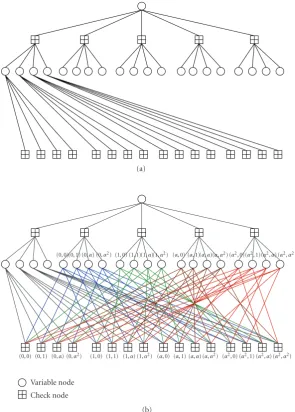
Example 5. Leta=2 ands=2. The Latin squares are shown inExample 4. Steps (1)–(3) are illustrated inFigure 2(a). As observed, this can be perceived as the nonrandom portion of the parity-check matrix. Step 4, on the other hand, executes the pseudorandom portion of the parity-check matrix that is commonly seen in most LDPC parity-check matrices. The
resultant tree is shown inFigure 2(b).
4.2. Properties ofC(a,s)
C(a,s) is a length n(s)=22s+ 2s+ 1 regular LDPC code
represented byH(a,s) (orT(a,s)). We denote the minimum
distance of C(a,s) as dmin(a,s). Following the definition
given in [14],wmin(a,s) denotes the minimum
pseudocode-word weight that arises from the Tanner graph ofC(a,s) for
the 2a-ary symmetric channel.
Theorem 3. LetT(a,s)denote the graph resulting from
reduc-ingmod 2a
, all edge weights ofT(a,s).T(a,s) = T(a,s), that is,H(a,s)=H(a,s).
Proof. First, the connection procedure is regardless of a
in steps (1)–(3), and similarly for β = 0 in step (4).
Since L(βa)(i,j) = L(βa)(i,j) (from Theorem 2), the edge ((β,i), (j,Lβ(a)(i,j))) in T(a,s) is equivalent to the edge
((β,i), (j,Lβ(a)(i,j))) inT(a,s).
Remark 3. The graphs constructed by settinga = 1 yield
binary codes that are the same as those in [14, Section
IV-A]. Further, it has also been shown that these codes are the binary projective geometry (PG) LDPC codes introduced in [5]. Thus, it is known thatdmin(1,s)=2s+ 2.
Before deriving dmin(a,s), we state two relationships
between the codewords inC(a,s) andC(a,s).
Corollary 1. (i)Ifc∈C(a,s), thenc∈C(a,s).
(ii)Ifc ∈ C(a,s)can be expressed asc=2a−ac, where C∈Zn
2a, thenc∈C(a,s)and is unique.
Proof. Corollary 1(i) is a simple consequence ofTheorem 3;
while forCorollary 1(ii),
2a−acHT(a,s)=0 mod 2a =⇒cHT(a,s)=0 mod 2a =⇒cHT(a,s)=0 mod 2a
(from Theorem 3). (16)
The uniqueness of c follows from the natural group
embedding, GR(2a,s)→R:r →2a−a
r.
Theorem 4. dmin(a,s)=dmin(1,s).
Proof. Letdcbe the Hamming weight ofc∈C(a,s)\ {0}.
Case 1. c contains at least one unit. From Corollary 1(i), whena=1,c∈C(1,s). Further,dc≥dc. Ifdc=dmin(1,s),
dc≥dmin(1,s).
Case 2.1. ccan be expressed asc=2a−ac, whereccontains
at least one unit ofZ2a. FromCorollary 1(ii),c ∈C(a,s).
Further,dc =dcand from Case1,dc ≥dc. Whena =1,
c=2a−1c, andc∈C(1,s). Ifd
c=dmin(1,s),dc=dmin(1,s). Case 2.2. ccan be expressed asc=2a−ac, wherecdoes not
contain any unit ofZ2a. Similarly, fromCorollary 1(ii),c∈
C(a,s). Therefore, dc = dc and the bounds on dc follow
Case2.1.
Thus,dmin(a,s)=dmin(1,s).
It has already been shown in [14, Section IV-A] that
wmin(1,s) = dmin(1,s). The following theorem states the
relationship betweenwmin(a,s) anddmin(a,s).
Theorem 5. wmin(a,s)=dmin(a,s).
Proof. Since T(1,s) = T(a,s) when a = 1 (from
Theorem 3) and all edge weights inT(a,s) are units ofZ2a,
wmin(a,s) and wmin(1,s) share the same tree bound [14],
that is, wmin(a,s) ≥ 2s+ 2, for alla. Further, dmin(a,s) =
dmin(1,s)=2s+ 2 (fromTheorem 4). Thus,
2s+ 2≤wmin(a,s)≤dmin(a,s)=2s+ 2
=⇒wmin(a,s)=dmin(a,s)=2s+ 2. (17)
The code rater(a,s) has to be computed first by reducing
H(a,s) to the form as discussed in Section 2.1. r(a,s) is
bounded by
22s+ 2s−3s
a22s+ 2s+ 1 ≤r(a,s)≤
22s+ 2s−3s
22s+ 2s+ 1, (18)
where the upper bound corresponds to the code rates
of the binary PG-LDPC codes [5]. We observe that by
setting the edge weights of T(a,s) as randomly chosen
units from Z2a, r(a,s) tends to the lower bound which
results in codes suitable for low-rate applications. On the
other hand, by setting all edge weights to be unity, r(a,s)
increases significantly. The corresponding codes can thus be
deployed in moderate-rate applications.Table 1compiles the
properties ofC(a,s) for various values ofaands.
5. SIMULATION RESULTS
Figures 3and4show the bit error rate (BER) and symbol
(a)
(0, 0)(0, 1) (0,α) (0,α2) (1, 0) (1, 1)(1,α)(1,α2) (α, 0) (α, 1)(α,α)(α,α2) (α2, 0)(α2, 1)(α2,α) (α2,α2)
(0, 0) (0, 1) (0,α) (0,α2) (1, 0) (1, 1) (1,α) (1,α2) (α, 0) (α, 1) (α,α) (α,α2) (α2, 0) (α2, 1) (α2,α) (α2,α2)
Variable node Check node
(b)
Figure2: Tree constructed fora=2,s=2 after (a) steps (1)–(3), and (b) step (4) (the final structure).
the AWGN channel. InFigure 3(a), the corresponding edge
weights of the codes simulated are randomly chosen units
of Z4, while those in Figures 3(b) and 4 are set to unity.
The codewords are transmitted using the matched signals
discussed in Section 2.2. The received signals are decoded
using the sum-product algorithm. The performance of random, near-regular LDPC codes with constant variable node degree of 3, is also shown. These codes have similar codelengths and rates to that of the structured codes. For
each data point, 104error bits are obtained for a maximum
of 100 iterations allowed for decoding each received signal vector.
Figure 3(a)shows our structuredZ4code outperforming
the random code when the codelength is small, that is,
42 bits. On the other hand,Figure 3(b)shows our structured
code performing worse than its random counterpart when the codelength is much larger, specifically, 2114 bits. At a
glance, it therefore appears that our structured codes are only better than random codes for short codelengths. To get a clearer picture as to how our codes fair in comparison to their
random counterparts, we turn to Figures4(a)and4(b)which
summarize the BER performance of random and structured
codes over Z4, respectively, Z8, for increasing codelengths
of 21, 146, and 546 bits, respectively, 63, 219, and 819 bits. From these empirical results, we conclude that our codes significantly outperform their random counterparts over a wide BER range for very small codelengths, that is, less than 100 bits. On the other hand, for larger codelengths, random codes perform better in the higher BER region while our structured codes are superior at lower BERs, specifically,
10−4and below for codelengths close to 1000 bits and 10−6
Table1: Properties ofC(a,s).
a s n(s) Degree of dmin(a,s) r(a,s) r(a,s)
T(a,s) =wmin(a,s) (Lower bound) (Unity edge weights)
1 0.5238 0.5238
2 2 21 5 6 0.2619 0.4762
3 0.1746 0.3175
4 0.1309 0.2381
1 0.6164 0.6164
2 3 73 9 10 0.3082 0.5548
3 0.2055 0.4932
4 0.1541 0.3699
1 0.6996 0.6996
2 4 273 17 18 0.3498 0.6337
3 0.2332 0.5653
4 0.1749 0.4982
1 0.7692 0.7692
2 5 1057 33 34 0.3846 0.7053
3 0.2564 0.6367
4 0.1923 0.5669
10−6
10−5
10−4
10−3
10−2
10−1
100
Er
ro
r
rat
e
1 2 3 4 5 6 7 8 9
Eb/N0(dB)
Structured BER Structured SER
Random BER Random SER (a)a=2,s=2, random edge weights
10−4
10−3
10−2
10−1
100
Er
ro
r
rat
e
1 1.5 2 2.5 3 3.5 4 4.5
Eb/N0(dB)
Structured BER Structured SER
Random BER Random SER (b)a=2,s=5, unity edge weights
Figure3: Performance of structured and random LDPC codes overZ4with QPSK signaling over the AWGN channel.
their codelength. On the other hand, from [23, Theorem 26],
we have that the minimum distance of a random, regular LDPC code with constant variable node degree of 3 grows linearly with its codelength with high probability. As the random codes considered here are near regular, we believe that they have superior minimum distances compared to our structured codes.
6. CONCLUSION
To summarize, we have extended the notion of Latin squares to multiplicative groups of a Galois ring. Using the generalized mapping function, we have constructed Tanner graphs representing a family of structured LDPC codes over
10−6
10−5
10−4
10−3
10−2
10−1
100
BER
1 2 3 4 5 6 7 8
Eb/N0(dB)
s=4
s=3
s=2
Structured Random
(a)a=2, unity edge weights, transmitted using QPSK signaling
10−6
10−5
10−4
10−3
10−2
10−1
BER
7 8 9 10 11 12 13
Eb/N0(dB)
s=4
s=3
s=2
Structured Random
(b)a=3, unity edge weights, transmitted using 8-PSK signaling
Figure4: Performance of structured and random LDPC codes transmitted using matched signals over the AWGN channel.
have shown that the minimum pseudocodeword weight of these codes are equal to their minimum Hamming distance—a desirable attribute under iterative decoding. Finally, our simulation results show that these codes, when transmitted by matched signal sets over the AWGN channel, can significantly outperform their random counterparts of similar length and rate, at BERs of practical interest.
ACKNOWLEDGMENTS
The authors would like to thank the anonymous reviewers for their helpful comments which led to significant
improve-ments in Sections1 and5 of this paper. The authors also
gratefully acknowledge financial support from the Ministry of Education ACRF Tier 1 Research Grant no. R-263-000-361-112.
REFERENCES
[1] M. C. Davey and D. J. C Mackay, “Low density parity check codes over GF(q),”IEEE Communications Letters, vol. 2, no. 5, pp. 159–166, 1998.
[2] D. Slepian, “Group codes for the Gaussian channel,” Bell System Technical Journal, vol. 47, pp. 575–602, 1968.
[3] G. D. Forney Jr., “Geometrically uniform codes,”IEEE Trans-actions on Information Theory, vol. 37, no. 5, pp. 1241–1260, 1991.
[4] D. Sridhara and T. E. Fuja, “LDPC codes over rings for PSK modulation,” IEEE Transactions on Information Theory, vol. 51, no. 9, pp. 3209–3220, 2005.
[5] Y. Kou, S. Lin, and M. P. C. Fossorier, “Low-density parity-check codes based on finite geometries: a rediscovery and new results,”IEEE Transactions on Information Theory, vol. 47, no. 7, pp. 2711–2736, 2001.
[6] B. Vasic and O. Milenkovic, “Combinatorial constructions of low-density parity-check codes for iterative decoding,”IEEE Transactions on Information Theory, vol. 50, no. 6, pp. 1156– 1176, 2004.
[7] I. B. Djordjevic and B. Vasic, “Nonbinary LDPC codes for optical communication systems,”IEEE Photonics Technology Letters, vol. 17, no. 10, pp. 2224–2226, 2005.
[8] A. Bennatan and D. Burshtein, “Design and analysis of nonbinary LDPC codes for arbitrary discrete-memoryless channels,”IEEE Transactions on Information Theory, vol. 52, no. 2, pp. 549–583, 2006.
[9] X.-Y. Hu and E. Eleftheriou, “Binary representation of cycle Tanner-graph GF(2b) codes,” inProceedings of IEEE Interna-tional Conference on Communications (ICC ’04), vol. 1, pp. 528–532, Paris, France, June 2004.
[10] C. Poulliat, M. Fossorier, and D. Declercq, “Using binary image of nonbinary LDPC codes to improve overall perfor-mance,” in Proceedings of IEEE International Symposium on Turbo Codes, Munich, Germany, April 2006.
[11] C. A. Kelley, D. Sridhara, and J. Rosenthal, “Pseudocodeword weights for non-binary LDPC codes,” inProceedings of IEEE International Symposium on Information Theory (ISIT ’06), pp. 1379–1383, Seattle, Wash, USA, July 2006.
[12] R. Koetter and P. O. Vontobel, “Graph-covers and iterative decoding of finite length codes,” inProceedings of the 3rd IEEE International Symposium on Turbo Codes and Applications, pp. 75–82, Brest, France, September 2003.
[13] N. Wiberg,Codes and decoding on general graphs, Ph.D. thesis, Link¨oping University, Link¨oping, Sweden, 1996.
[14] C. A. Kelley, D. Sridhara, and J. Rosenthal, “Tree-based construction of LDPC codes having good pseudocodeword weights,”IEEE Transactions on Information Theory, vol. 53, no. 4, pp. 1460–1478, 2007.
[16] O. Milenkovic and S. Laendner, “Analysis of the cycle-structure of LDPC codes based on Latin squares,” in Pro-ceedings of IEEE International Conference on Communications (ICC ’04), vol. 2, pp. 777–781, Paris, France, June 2004. [17] B. Vasic, I. B. Djordjevic, and R. K. Kostuk, “Low-density
parity check codes and iterative decoding for long-haul optical communication systems,”Journal of Lightwave Technology, vol. 21, no. 2, pp. 438–446, 2003.
[18] I. B. Djordjevic and B. Vasic, “Iteratively decodable codes from orthogonal arrays for optical communication systems,”IEEE Communications Letters, vol. 9, no. 10, pp. 924–926, 2005. [19] O. Milenkovic, N. Kashyap, and D. Leyba, “Shortened array
codes of large girth,”IEEE Transactions on Information Theory, vol. 52, no. 8, pp. 3707–3722, 2006.
[20] G. Caire and E. M. Biglieri, “Linear block codes over cyclic groups,”IEEE Transactions on Information Theory, vol. 41, no. 5, pp. 1246–1256, 1995.
[21] H. A. Loeliger, “Signal sets matched to groups,”IEEE Trans-actions on Information Theory, vol. 37, no. 6, pp. 1675–1682, 1991.
[22] J. H. van Lint and R. M. Wilson,A Course in Combinatorics, Cambridge University Press, Cambridge, UK, 2nd edition, 2001.