SOCIALLY SIGNIFICANT ASPECTS OF HEALTH CARE FOR THE CHRONICALLY ILL AT HOME - THE EDUCATION AS A STAGE OF THE NURSING PROCESS
Pepa R. Bikova, Galina S. Chaneva, Ivanka K. Stambolova, Maria I. Dimitrova
Department of Health Care, Faculty of Public Health,
Medical University - Sofia, 8 "Bialo more" Str., Sofia, Bulgaria
Abstract
The development of science allows medicine to be more successful and accessible for the users of health care.
Each treatment scheme has eight key points, one of which is health education. A basic requirement for this scheme to be operational and efficient is individualization. According to the modern understanding of health, it’s a personal responsibility of each individual. The role of the consumer, as a major factor in this relationship, is rising along with the awareness of his rights and obligations as a patient or client. In order to be an equal he must be knowledgeable. This knowledge is acquired through family education, the moral values of society, work in schools, mass media, and last but not least, by the nurse – by fulfilling his or her second function: "education of the patients and their relatives on the queries related to the conservation and maintenance of a certain level of health". Key words: education, healthcare, nurse, chronic diseases
For a short period in the medical practice innovative methods for diagnosis and treatment were introduced. The attitude toward doctors and the status of other health care professionals who work in the health care team has changed.
Patient care consists in a collection of activities carried out during the treatment to create a favorable environment and to provide mental health. Some of these activities are a timely and proper execution of the medical appointments, perfectly conducting various treatments to heal the patient and to create a hygienic environment around him. Without health care it is impossible to achieve quality treatment in the modern medical practice. Quality health care must be timely, appropriate, scientifically proven and must be done with responsibility.
Patient care has a long history, almost as medicine itself. The nursing profession is placed on a scientific basis in the XIX century, during the Crimean War. At the same time, in both warring countries: Russia and England as an ally of Turkey, the need of good doctors and health care was perceived. That's why they started to develop the idea of special training and participation of women in the care of the sick in the infirmary.
The results of the work of Nightingale and Pirogov validate the need of training of nurses, and separate the profession that is actively developed in Europe and North America in the XIX century.
At the same time the rich trader William Rathbone of Liverpool, understands from personal experience how important and useful the care at home is and in 1859 he hires nurses to care for patients in their homes in the slums of Liverpool. After two years and consultation with Nightingale, which at this point has created a training program for hospital nurses in London, he creates a school where Rathbone prepares nurses to work equally well in hospitals and at home. - Liverpool Royal Infirmary. (Turner; G. J; KH Chavigny, 1988)
The work of the nurses in the home environment contributes to the implementation of the health reform in the industrial areas of England, without political commitment and legislative changes.
"First, they need to be good teachers to teach family members appropriate health measures and preventive measures;
- Second, the district nurse must understand the nature of poverty and "impoverishment";
- Third, the nurses who are taking care at home should understand the importance of the prevention of disease. "The preventable diseases should be treated as a social crime - it is cheaper to prevent disease than to cure the sick." (Nightingale, (Turner; G. J; KH Chavigny, 1988)
The nurses receive official recognition In North America in 1886 with the formation of organized municipal associations (family) nurses. This is influenced by the activity of Rathbone in England. In America, the title "family nurse" is used for someone who does home care. It is also called "visiting", she does not live with the family. Winslow determines that the public nurses need to know, to apply and to train the population in social and hygienic principles. (Turner; G. J; KH Chavigny, 1988)
In the U.S.A. they develop specializations for nurses - hospital nurses, private nurses, visitor nurses to protect public health, social work departments in hospitals, school nurses, nurses in institutes, factories and mines, in the field of obstetrics and gynecology. The American model for preparing nurses returns to England and Europe as an example of modern nursing education. (Apostolov M., P. Ivanova, 1998)
In 1862 Henry Dunant proposed to create societies in each country to help the wounded and sick in times of war, this is the International Red Cross. Each country established such organizations and the foundations of the international cooperation in the field of health. After the Second World War the World Health Organization (WHO) is created.
The Bulgarian association "Red Cross" (BDChK) is the initiator, organizer and inspirer of nursing education. The first course for nurses was opened in 1894 and the first nursing school - in 1900. In 1914 the idea of Queen Eleanor, lead to the school modernization. The school management accepted and worked on the program of the International Union of nursing. (Apostolov M., P. Ivanova, 1998)
In the seventies years of the twentieth century, the nursing and midwifery department at the Regional Office of the World Health Organization in Europe, as a result of organized study, reaches awareness of the need for reorganization of nursing and to the formulation of 38 regional tasks.
The European Regional Office of the World Health Organization (WHO) identified the main functions of the sisterhood as:
1. Making nursing- primarily through nursing process.
2. Education of the patients and their relatives.
3. Implementation of both the dependent and the independent role.
4. Research in the field of care. (Muhina S, I.Tornovskaia, 2006).
Brief historical overview of the development of the nurse's profession shows that in every stage of the last 170 years, training is the primary responsibility of the working nurses. The main task has been and is to educate the individuals and the society to know and observe hygiene and epidemiological norms to prevent illness, reduce disability and reduce treatment costs.
The health promotion and the disease prevention as the guiding principle in the organization of health care today, requires the patient / client to be responsible for their own health, making it an equal partner in the medical team. The status of the patient is radically different - from a passive receiver of medical treatment and care, the patient is now an active participant in the health care system.
The training is an ongoing process. It can be done in a formal (institution, school) or informal situation (home, hospital room, etc.).
The work of the nurse is a complex sequence of activities and actions that are united by the common name "nursing process". The nursing process is a method of organization and provision of nursing care. It is based on the patient as a person who requires an integrated approach. One of the conditions for the implementation of the nursing process is the involvement of the patient and his relatives (family members, friends) in decisions concerning the objectives of the care plan and the way of nursing intervention. Evaluation of the results of care are also carried out with the patient and his relatives. The degree of involvement of the patient depends on the following factors:
- The relationship between the nurse and the patient and the degree of confidence;
- The attitude of the patient to his health;
- The level of knowledge and culture of the patient;
- Awareness of the need for care.
While educating the patient, the nurse assists him to adapt to the new situation, to maintain the highest possible level of comfort or to change his lifestyle to reduce risk factors for the disease. The nurse can help to consolidate the habits derived from another specialist (eg, breathing exercises). (Bikova P., 2012)
The effectiveness of the training of the patient and / or his relatives is determined by the following factors:
- Baseline knowledge that the patient has;
- The attitude or opinion of man to what he needs to know and subsequently to change;
- Past experience;
- To have certain conditions such as the presence of a clear purpose and motivation, friendly attitude nurse; creation of associations between the new information and the past experience;
- the nurse must have a good communication technique- nonverbal behavior, verbal technique, ability to ask leading questions, the ability to hear the interlocutor; patience, empathy, the ability to allocate the time and the duration of the lesson depending on the patient / his relatives, well-chosen breaks and ability to notice even the smallest successes, to praise them and to assess the results. (Stambolova, 2012)
The willingness and readiness for training, the learning ability and the surrounding environment are the three main factors that should be evaluated in order to have effective training. The health condition changes the characteristics of these factors, and they should be carefully evaluated prior to planning a training. No matter how well planned, the nurse must always be ready to change something in this plan so it could meet the changing health and motivation of the patient - student. When the condition improves, the level of motivation and desire is growing and the learning abilities improve. On the other hand when the health is deteriorated, the attention is compromised, the motivation is lower, training undergoes regression.
The presence of a chronic disease puts people in a very difficult situation - mental, emotional, physical, economic, etc. There is a difference where the treatment takes place: in a hospital or at home. How often in a month you go in a hospital? How many times in a month you call an emergency medical team? What kind of finances, are needed for treatment when a relative / close person does not work because they need constant care for the sick?
These questions and answers convert the chronic disease from a personal problem in a social one.
OBJECTIVE
TASKS
1. To determine the attitude of the patient to his health;
2. To investigate the level of knowledge and the culture of the patient;
3. To explore the awareness of the need for care
MATERIALS AND METHODS
The study was conducted in February and March 2014 with 638 people from 45 settlements randomly selected. For this purpose, a sociological study was made especially for this questionnaire. The survey is anonymous. Other methods that are also used: the documentary, interview, observation and the statistical methods. The SPSS software is used for processing the results.
RESULTS AND DISCUSSION
In this study mostly women are involved - 69.9%. The men were reluctant to answer questions. They expressed distrust of the purpose of the study.
The respondents are in a wide age range - from 14 to 89 years. Nearly all of them - 96.6% completed the questionnaire themselves.
The study was conducted in the outpatient environment. Approximately 30% of the respondents reported that they have a chronic disease, 11.8% of them by decision of the EMC (Employment Medical Commission) have a certain degree of invalidity. 19, 2% of the respondents are caring for a chronically ill at home. This indicates that approximately half of the respondents (49.2%) are directly affected by the problems of the chronic disease.
The people were asked where from do they gather information on health and preventive healthcare. Anyone of the respondents could indicate more than one correct answer, so the amount in Table 1 exceeds 100%. From the listed sources of health information, the highest is the percentage of people who are informed by the general practitioner doctor - 51.6%. After them are the people who are informed mainly by the Internet - 42.5%. Only 16.6% receive information from the nurse. The network is achieving a big impact not only among young people. More and more people are seeking solutions to their problems on the Internet.
Sources of information on health and preventive healthcare GP Internet TV Professional
literature
Friends Nurse Newspapers Radio other
51.60% 42.50% 26.90% 26.30% 25.90% 16.20% 14.70% 3.60% 4.40%
Scheme 1
In the eighth column "others" answers like "I have a doctor in the family" or "I'm a doctor", "I work as a nurse" are mentioned.
Exploring the level of healthcare knowledge is very delicate moment. It does not have a clear definition of values and criteria. As a base for the questionnaire we have used the European Quality of Life Surveys (EQLS), as well as the principles of docimology. Here we have a five a five point scale of validation: 1 - Never (no); 2 - Somewhat No; 3 - Neither yes nor no; 4 - Somewhat Yes; 5 - Yes, always. In this publication we have united the dubious and firm negative, as well as positive answers.
In table number 2 you may see the percentage of each of these answers.
The next set of questions are looking for the link between a healthy life, prophylaxis, and chronic disease. The survey investigates how many of the respondents can identify the symptoms of aggravation or crisis within a chronic disease. More than half (58.5%) have answered affirmatively.
Fifty-five (55.4%) percent are aware of the complications of their disease, provided that they do not follow their strictly their treatment and regimen.
Approximately sixty (59.8%) percent are aware of the risk factors that can cause a disease.
Knowledge of chronic diseases
Question No Yes and No Yes No answer
Do you know the
symptoms of exacerbation in a chronic disease?
25.3% 13.7% 59.3% 1.7%
Do you recognize the complications in a chronic disease?
29.3% 12.6% 55.4% 2.7%
Information from
0.00% 10.00% 20.00% 30.00% 40.00% 50.00% 60.00%
from GP Internet TV profess.
literature
friends nurse newspaper radio other
Source %
factors that are related to a chronic disease?
Table 2
More than half of the people we have surveyed are aware of the risk factors of a disease and the complications around it. When we compare the people that are already affected, or have someone with a chronic disease at home that they are taking care of (49%), it is safe to estimate that these are the people that already have a chronic disease as sickness and necessity have thought them about it. What is lacking is prophylaxis and the knowledge of protecting oneself, how to stay in good health, or how to prevent a sickness from turning into a chronic burden.
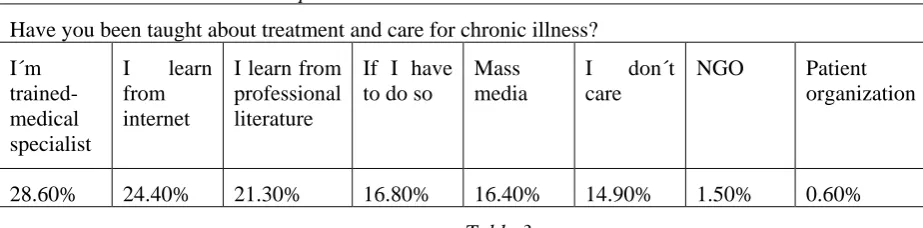
We’ve asked our surveyed if they have ever been in educational forms in regards to health and healthcare, as well as who was the specialist that has taken part in increasing their knowledge levels.
The results can be found in Table 3 and illustrated in diagram 2.
People trained in chronic disease healthcare Have you been taught about treatment and care for chronic illness?
I´m trained-medical specialist
I learn from internet
I learn from professional literature
If I have to do so
Mass media
I don´t care
NGO Patient organization
28.60% 24.40% 21.30% 16.80% 16.40% 14.90% 1.50% 0.60%
Table 3
Nearly a third of the surveyed subjects(28.6%) have been trained by a medical expert. About 15% have not been trained and state that they do not care, whereas 17% will seek training if they have to. The internet, as an available form of education, has almost a quarter of the votes (24.4). Only 20% of the surveyed will seek help and training by a nurse.
Every treatment scheme has these main points:
1 Diagnostic events
2 Medicaments treatment
3 Diet regimen
4 Motion regimen
5 Rehabilitation and physiotherapy
6 Personal hygiene
7 Health Care education and health raising procedures
People trained in chronic disease healthcare
Scheme 2
The nursing process is built on the base of the treatment schedule which consists of five successive phases:
- Assessment of the patient's condition;
- Interpretation of the obtained data (identifying problems);
- Planning of the upcoming activities;
- Execution of the plan;
- Evaluation of the results of those stage.
At all stages prerequisites for the actions of the nurse should be:
- Professional competence, observation, communication, analysis and interpretation of data;
- Sufficient time and atmosphere of trust;
- Confidentiality;
- Patients involvement;
- Where appropriate, the participation of other medical and / or social workers. (Popov, 2010)
These are the conditions that are taught in nursing schools. Every practice that is guaranteeing quality care also fulfills these conditions. Less emphasis is put on the development of a training plan. For each case several training plans are being developed, because it is necessary to create an individual plan for the patient and for every person who lives with the patient and is directly involved in the healing and recovery process.
The learning process has the following stages:
- Assessment of baseline knowledge and skills of the patient and/or his family;
- Assessment of the learning outcomes. (Popov, 2010)
In the practice several successful training programs are used, such as:
- "Training of diabetic patients" - the program has been developed internationally and is implemented by Bulgarian specialists. Most of the nurses who are working in endocrine departments or offices of such patients have undergone training courses for trainers.
- "Training of patients with groan colon (colonostoma) " -
- "Training of patients with tracheostomy"
- "Training of patients with stroke"
- "Training of patients with endoprosthesis"; and many others.
CONCLUSIONS
1. In the recent years, the role of the health care made in the outpatient environment is increasing. The historical review shows that this is a well forgotten "old." Treatment in hospitals is a good practice, but extremely costly to the economy of each country. The psychosocial comfort of each patient and his relatives is better when the treatment is carried out at the home of the patient. Not every disease is suitable for hospital treatment.
2. The educational function of the specialist is not only in the hospital. The health education and training is a priority in each age group and it occurs in all standard and non-standard teaching situations.
3. Priority for the Medical University is to prepare students for work in the pre-hospital environment - the patient's home, schools, kindergartens, industrial enterprises, family practice nurse, etc. Other priority is to develop a legal framework for the validation of any manipulation, moral and ethical standards of the profession to work in the patient's home.
4. Internet is an accessible, innovative form of information and educational impact. The nurses must work closely with the users of this media.
5. To develop and implement the training function of nurses it is necessary to develop algorithms that support their pedagogical skills. Along with the development of nursing care plans it is a must to produce such plans for the patient education.
REFERENCES
Apostolov, M.; P.Ivanova, "History of medicine and nursing" GorexPress, 1998, R.; p. 198-203
Bikova P. Zh.Georgieva, M.Dimitrova, Place the portfolio in the education of health professionals; 29 HT session INGA, contact 2012, TEMTO, S.2012,p.184-187
Chaneva G., "The quality of nursing care as a priority ", 2008; Sofia
Gyurova C; Andragogy the art to teach adults,“Universal Todorov”, 1998, R.
Mladenova C., "Health Education" Artic 2001, 2009, Sofia
Medical Education, under the supervision and editing of Prof. T. Popov, ed. "Ex- press" 2010, R. p.57; 90
Muhina SA; I.Tornyova; Theoretical foundations of nursing, IC MU - Pleven, 2006
Markova S., I. Stambolova; G.Chaneva et al.; Family nurse; Textbook Program Home Care, BRC, 2009, Sofia
Stambolova I.; Nursing in somatic diseases; TSMB, 2012, Sofia, p.82-83
Stambolova I., "Management and Ethics in General Practice" 2008; Sofia
Shopova K.; Bikova; Kikarina , " Health education at school age " INGA ; TEMTO, 2009, Sofia
Turner G. J; KH Chavigny; Community Health Nursing; 1988; p.7-9
Vodenitcharov C., R. Popova, Social Medicine, Ecoprint, 2009, Sofia
http://www.diuu.bg/ispisanie http://www.westga.edu/ ~ distance / webct / facultymanual /