TRAINING OF QUALIFIED PROFESSIONALS AT UNIVERSITY María J. Latorre-Medina, Francisco J. Blanco-Encomienda Faculty of Education, Economics and Technology, University of Granada
Campus Universitario de Ceuta, s/n. 51001, Ceuta (Spain)
Abstract
The professional training of candidates for the teaching practice has become a topic of concern for all those dedicated to it professional, academic and politically. In this sense, it is important to identify the qualities (knowledge, skills and other competencies) which a highly qualified teacher must have. This issue is now more essential since the current convergence policies of the European Union raise more demands and needs in preparing excellent teachers, requiring a thorough study prior to the design of any training proposal. The present work is a clear contribution in this direction; we analyze in detail the professional profile required by the university professor in order to contribute to the training of internationally qualified professionals.
Key words: professional knowledge, teacher training, competencies, university professor
1. INTRODUCTION
The professional training of candidates for the teaching practice has become a topic of concern for all those dedicated to it professional, academic and politically (Glatthorn, Jones and Adams, 2006). And although it is true that all of them present differences of speech in relation to how this attention should be concretized in the practice, they maintain a matching position about the reason that underlies this concern: the essential role of teachers in the education system. This role is more visible in times of changes and reforms such as the current ones.
The awareness that few educational changes will be materialized in the practice without the active involvement of teachers foregrounds the special attention to the training programs of student teachers (Beck and Kosnik, 2006). In this sense, González (1993), being aware that there is no improvement in education that does not require the self-improvement of teachers, reveals the interesting and committed reflection that emerges in most documents, proposals and debates in this respect: “if we want to get an advance in the world of education, we must concentrate our efforts on the training of teachers, which implies a preferential attention to the training programs” (p. 556).
The configuration of new social scenarios and the demands emerged from them seem to be contributing decisively to the increase of this attention. The current university policy, interested in promoting the convergence with Europe in creating an educational environment and in meeting the challenges of a globalized, multicultural and with a high technological development society, considers increasing the quality of the training and the university education as a priority action. The university is thus confronted with an unstoppable transformation process aimed at meeting the new educational challenges that involve the consolidation of these socio-cultural spaces (Inayatullah and Gidley, 2003). And, in communion with the university, the school has to face this process, as we know that the quality of teachers depends largely on the quality of the training that the institutions are able to offer (González and Fuentes, 1997).
In this regard, the implementation of the European Higher Education Area (EHEA) has not only upset the field of qualification of teachers, but also the professional profile of the university professor, who is proclaimed as guarantee of that quality education; this professor must know how to unite the elements of a good teaching with the own conditions of an effective teaching. This paper is a contribution in this direction: first, we analyze the professional profile required by the university professor, who is committed to the training of qualified professionals for teaching. Secondly, we identify the knowledge, skills and other competencies which a highly qualified teacher must have.
2. THE FIGURE OF THE UNIVERSITY PROFESSOR IN PROMOTING A QUALITY EDUCATION
Torrego (2004) begins his study by pointing out that a good university professor has to be so with or without the process of building of the EHEA. It is unquestionable that being well-trained, motivated and committed to student learning does not depend on the process of European convergence. The dynamism of the own change of the current education scenario is what demands that the university professors assume new roles and new professional competencies.
In this respect, Thatch and Murphy (1995) describe the following roles of the university professor: trainer, tutor, pedagogical engineer, technology expert, administrator, archivist, evaluator, graphic designer and editor of documents, along with some key competencies related to communication and other purely technical (broad thinking and ability to reflect critically about the training as a complex global system). On the other hand, Sangrà (2001) points to a more collaborative teaching profile; a professor who encourages the participation, who recognizes/accepts the fact that he/she has not the knowledge exclusively, who has important organizational skills, who is open to the experimentation and who has the ability to modify his/her own methodology.
Despite the difficulty of defining a teacher profile for the new times, Villar (1999) described twenty-four teaching metaphors. Each of these professional metaphors draws a profile and a particular teacher; they also provide interesting elements for the analysis and the understanding of the teaching profession. In addition, this author groups the competencies around several metacategories describing the teaching skills that should have this professional about the teaching and learning resources and methodologies, the curriculum that he/she must promote or teach, the strategies and the sense of the evaluation and professional initiative to project his/her work, the didactic strategies concerning the innovation and cooperation processes, the strategies for knowing the students (perceptions, prior knowledge, learning styles, etc.) and for adapting the contexts in which they work to promote stimulating classroom environments.
This system of competencies regarding the university professor appears well described around the different phases of the teaching programming, as follows:
Phase 1. Define the roles of student teachers:
▪
Reflect about his/her practice.▪
Respect the autonomy of the students.▪
Identify the learning styles of the students. Phase 2. Analyze the context of the university:▪
Take part in the professional culture of the department.▪
Check the sources of social influence on teaching. Phase 3. Select the contents of the subject:▪
Explicit educational principles and values.▪
Determine, select and organize the contents of the subject.▪
Concrete the specific objectives of the discipline. Phase 4. Organize the subject:
▪
Design an instructional action.▪
Articulate the developed knowledge.▪
Generate connections through concept maps.▪
Relate the new knowledge to the previous one. Phase 5. Develop the teaching:
▪
Graduate the complexity of an explanation.▪
Explore the knowledge through different resources.▪
Motivate the students. Phase 6. Establish communication in class:
▪
Generate discussion.▪
Collaborate and negotiate. Phase 7. Value the students and himself/herself:
▪
Value the students.▪
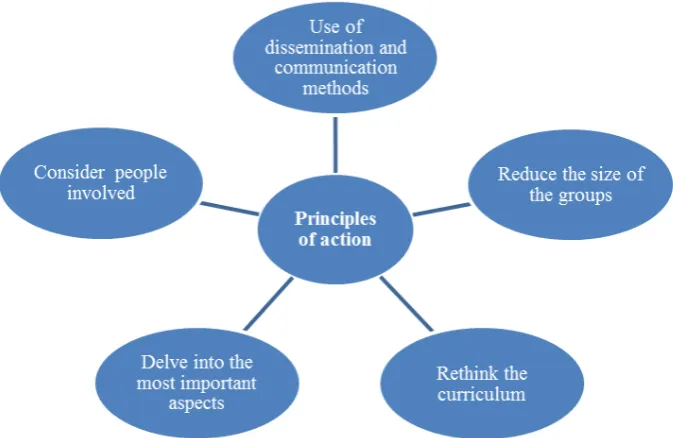
Value his/her own action.According to Zabalza (2002), the key competencies of the university professor are the scientific and the pedagogical ones, united by a commitment to the best possible training and to the student learning from the available knowledge. Moreover, this author proposes moving from a training-oriented teaching to a learning-oriented teaching. In this respect, Figure 1 shows the basic principles of action to take into account in this process:
Figure 1. Basic principles of action in the process of change
More recently, Palomares (2007) points out as competencies of this professional: the planning of the teaching-learning process, the relevance of contents, the didactic communication, the technologies applied to education, the design of the methodology, the tutorial function and the democratic assessment, clarifying that professionals are required to have the ability to act competently in divergent situations, regardless of the model of teachers advocated for working within the framework of the EHEA. This practical ability configures an affective, cognitive, normative and explanatory set, consisting of knowledge, skills, attitudes, theories and beliefs. Specifically, the main competencies that the university professor should dominate in order to contribute to the training of internationally qualified professionals are:
Leadership and entrepreneurship. Reflective and critical attitude. Ethics and values.
International perspective.
Knowledge connected to the reality. Social responsibility and solidary attitude.
We hope these lists of the competencies that a good university professor must dominate invite to think the kind of professor we want to have in the university context: trained and committed to the training of highly qualified teachers. This last issue is addressed in the next sections.
3. RECENT CHANGES IN TEACHER EDUCATION
Following De Vicente (2003), we know that the teacher training is a construct that has undergone profound changes in its design over time and that, in turn, has been and is closely related to the education. It is not our intention to review the different traditions or paradigms of the initial teacher training. We just want to emphasize the idea that new forms and moves about teachers and their training and varied ways of understanding this training have been appearing over time.
Reviewing the existing documentation it is possible to observe the evolution presented by the training of teachers about their embodiments and, especially, about the increasingly demands and requirements to achieve the certification that empower them to the teacher profession. Studies by Darling-Hammond (1999), Cochran-Smith and Lytle (1999), and López (2003) provide an excellent idea of the changes occurring in the qualification of these professionals and the new way of thinking about their training, emerged during the last decades.
In line with future prospects, Darling-Hammond (1999) underlines the need of training programs with the following characteristics:
A clear vision of the teaching to be imparted.
A curriculum based on the knowledge of all the elements involved in the context of the practice. Extensive experiences that support the ideas and the practices presented in the training programs. Standards of practice to guide the work during the studies at university and the practical training in
external institutions.
Deep relationships between the school staff and the university one. Extensive use of the case studies, the inquiry and the portfolio assessment.
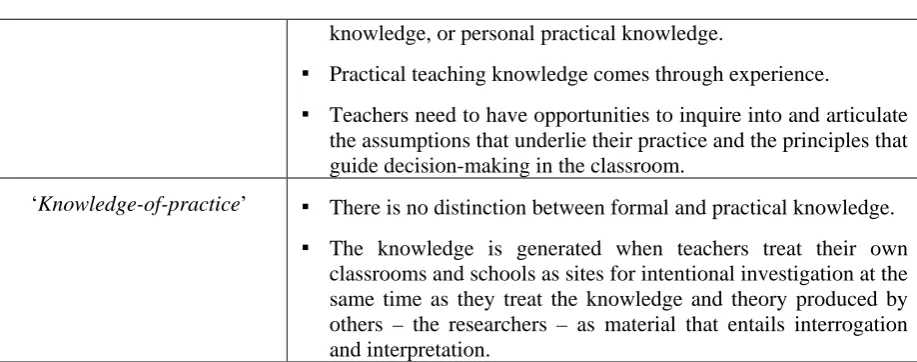
Moreover, Cochran-Smith and Lytle (1999) report a new perspective to the teacher training, which has a constructivist character. Specifically, they present three relevant approaches about the professional learning of teachers. Each of them comes from a different conception of practice and knowledge in action, and how both aspects are related to the work of teachers, deriving from each approach a different way of conceiving the relationship between theory and practice in the initial teacher training. The three approaches are described in Table 1.
Conception Description
‘Knowledge-for-practice’
▪
The formal knowledge is generated by university researchers and passed on by experts to the novice in order to improve practice.▪
Teachers are knowledge users, not generators.‘Knowledge-in-practice’
▪
It is also referred to as ‘craft’ knowledge, pedagogical contentknowledge, or personal practical knowledge.
▪
Practical teaching knowledge comes through experience.▪
Teachers need to have opportunities to inquire into and articulate the assumptions that underlie their practice and the principles that guide decision-making in the classroom.‘Knowledge-of-practice’
▪
There is no distinction between formal and practical knowledge.▪
The knowledge is generated when teachers treat their ownclassrooms and schools as sites for intentional investigation at the same time as they treat the knowledge and theory produced by others – the researchers – as material that entails interrogation and interpretation.
Table 1. Conceptions of the knowledge-practice relationship
As noted, the basis of the third conception (theoretical and practical) is that teachers play a crucial role in generating knowledge of practice, making their workplaces into places of inquiry, connecting their work at schools to more general issues and adopting a critical perspective about the theory and the research of others. However, this does not mean that the research of teachers provides all the knowledge required to improve practice or that the knowledge generated by university professors has no utility for teachers. In the approach of knowledge-of-practice it is thought that teachers, across the whole range of their professional lives (from trainees and novices to experienced teachers) question their own knowledge and practice, as well as the practice and knowledge of others, and thus establish a different relationship with knowledge.
On the other hand, López (2003) indicates that, according to the demands of society, a new view in the field of teacher training is intended. The initial training programs should be:
More flexible and open.
Directed to the development of the critical thinking and reflection. Linked to an appropriate selection of candidates.
Less ethnocentric.
More attentive to the needs, interests and experiences of individuals.
Able to return the illusion for teaching to the applicants, increasing their level of commitment and responsibility.
More inclusive.
It is logical that if society changes, the way in which the professional training of future teachers is understood and developed changes too. “If the initial training has to make a difference, it is fair to be scrutinized” (De Vicente, 2003, p. 43).
4. THE DOMAIN OF A COMPLEX NETWORK OF ACTIONS REQUIRED TO BECOME A GOOD TEACHER
To identify the qualities (knowledge, skills and other competencies) which a highly qualified teacher must possess has become an essential issue. This question is now more important since the current convergence policies of the European Union raise more demands and needs in preparing excellent teachers, requiring a thorough study prior to the design of any training proposal. To meet these demands, many efforts have been made to define clearly which the standards required for the qualification of the teachers are (Korthagen, 2004; Darling-Hammond and Bransford, 2005; Cantrell
and Askins, 2011; Collin, Karsenti and Komis, 2013), especially at elementary and primary level, because they are the basic pillars on which the personal development and the framework of the educational system sit, as one of the fundamental keys of the society progress (Rodríguez, 1998).
4.1. Acquisition of the different types of professional knowledge for teaching
To foresee the different types of professional knowledge to be acquired by student teachers in order to meet the challenges of the future is a well-known subject of study and analysis for those directly involved in the teacher training. In this regard, the work reported by León (2004) collects some of the studies that have been undertaken with the intention of clarifying the knowledge that teachers must possess to perform a good teaching: the work carried out at the Institute of Ontario (Canada), those conducted at the University of Calgary, where a research group, including Elbaz, Connelly and Clandinin, studied the ‘personal practical knowledge’, and studies conducted by Leinhardt, Smith and some of their colleagues at the Learning Research and Development Center in Pittsburgh. The works of Shulman, at Stanford University, are particularly noteworthy. He established the base of knowledge that teachers must have in addition to the definition of the different types of knowledge base for teaching.
We think it is important to note that in all these early works, as well as later (Fenstermacher, 1994; Cochran-Smith and Lytle, 1999), a clear distinction between two types of knowledge is made: a theoretical, propositional or formal knowledge and a practical knowledge, which come to be the two fundamental types of knowledge that teachers must possess (Darling-Hammond and Baratz-Snowden, 2005) if they want to be considered as well qualified, informed and trained (Perrenoud, 2004).
Moreover, Martín (1994) considers that there are four components of the professional knowledge that future teachers have to acquire during their university training:
Professionalized knowledge of the content: it is the knowledge of the subject matter included in the school curriculum. According to the author, it is based on a training about disciplines and not on the own disciplines.
General pedagogical and contextual knowledge: it is not directly related to the curriculum.
Specific pedagogical knowledge: this knowledge implies a didactic transposition of content to be the subject of teaching and learning in the school context. It is the main category of the professional knowledge.
Practical knowledge: it comes from the experience of the teacher and it is the knowledge that he/she reflects on his/her actions in the classroom.
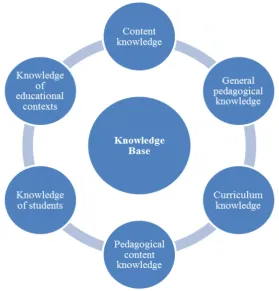
In short, if we consider the different types of knowledge given above, we can say that if future teachers want to impart an effective teaching they need to acquire several categories of knowledge during their university studies (Shulman, 1986), which are shown in Figure 2.
Figure 2. Categories of teacher knowledge
4.2. Acquisition of competencies and other dispositions for teaching
In the scientific literature, in addition to the studies about the different types of knowledge for teaching, we find references to the core competencies for professorial action. Below we expose the professional capacities that student teachers have to develop and/or enhance during their university training.
Imbernón (1994) includes the following capacities: reflection in action and about the action; ability to listen and dialogue; disposition to act as researcher in the classroom and enable strategies to maintain a critical and constructive vision of society and the curriculum; ability to work with other professionals; competency to make connections between theory and practice in a framework broader than strictly at school; ability to make decisions to design tasks and curriculum projects, adapting them to students; ability to decide what to do in real situations; commitment to the school, participating in its organization and management; and take the profession as a continuous learning process.
According to Violant (2004), there are four areas of general competencies that a teacher has to master: competencies related to the profession; psychosocial competencies; pragmatic competencies or competencies to solve specific problems, and ethical competencies.
On the other hand, De Vicente (2002) argues that some of the competencies that the novices must learn to teach effectively are the following:
Domain of the general principles of teaching and learning. Effective management of the students learning processes. Effective organization of the classroom environment.
Meticulous knowledge of the unique characteristics of students.
Regulation of students conduct, avoiding disruptions and uncontrolled behavior.
Ability to interact effectively with students and others at school.
Domain of a wide range of strategies and resources that make learning attractive to students. Domain of two instruments that facilitate the student learning: motivation and feedback.
Reflection in practice and about the practice, because through reflection they can grow professionally and become excellent teachers.
Furthermore, Perrenoud (2004) outlines ten new capacities needed for teaching, called ‘emerging competencies’. Such capacities are: organize and encourage learning situations; manage the progression of learning; develop and evolve differentiation devices; involve students in their learning and in their work; work as a team; participate in the management of the school; inform and involve parents; use new technologies; meet the duties and ethical dilemmas of the profession; and organize continuous training.
5. DISCUSSION
The revisions of the latest scientific contributions that have been made about the initial teacher training, in general, and about the professional profile of future teachers, particularly, show the enormous scientific interest that this issue arouses between researchers and an idea of the volume of production about this focus of scientific inquiry.
In light of the evidence discussed above, it is unquestionable that teachers need to be trained and committed to achieve effective teaching and learning. Fortunately, since the times of European convergence in higher education, a whole new line of interesting study about knowledge and other competencies required by teachers in promoting a quality education has appeared.
In conclusion, mastering such knowledge, competencies and other dispositions mentioned in this paper teachers will become experts in the subject taught, pedagogical experts (consideration of the ethical and moral dimensions of teaching and the standards and values involved in teacher-student relations) and didactical experts (domain of the teaching models and media for reflection and learning from the practice) (Beijaard, Verloop and Vermunt, 2000).
ACKNOWLEDGEMENTS
This work is supported by the Research Program from the Faculty of Education, Economics and Technology of Ceuta.
REFERENCES
Beck, C & Kosnik, C 2006, Innovations in Teacher Education. A Social Constructivist Approach, State University of New York Press, New York.
Beijaard, D, Verloop, N & Vermunt, JD 2000, ‘Teachers' perceptions of professional identity: an exploratory study from a personal knowledge perspective’, Teaching and Teacher Education, vol. 16, no. 7, pp. 749-764.
Cantrell, RJ & Askins, J 2011, ‘Preparing Teachers at the University of Virginia’s College at Wise’, Fuentes: Revista de la Facultad de Ciencias de la Educación, vol. 11, pp. 29-40.
Cochran-Smith, M & Lytle, SL 1999, ‘Relationships of knowledge and practice: Teacher learning in community’, in A Iran-Nejad & PD Pearson (eds.), Review of Research in Education, vol. 24, American Educational Research Association, Washington, DC, pp. 249-306.
Collin, S, Karsenti, T & Komis, V 2013, ‘Reflective practice in initial teacher training: critiques and perspectives’, Reflective Practice, vol. 14, no. 1, pp. 104-117.
Darling-Hammond, L 1999, ‘Evaluating teachers for the new century: Rethinking practice and police’, in GA Griffin (ed.), The education of teachers. Ninety-eighth yearbook of the National Society for the Study of Education, The University of Chicago Press, Chicago, pp. 221-256.
Darling-Hammond, L & Baratz-Snowden, J 2005, A good teacher in every classroom. Preparing the highly qualified teachers our children deserve, Jossey-Bass, San Francisco.
Darling-Hammond, L & Bransford, J 2005, Preparing teachers for a changing world: what teachers should learn and be able to do, Jossey-Bass/Wiley, New Jersey.
De Vicente, PS 2002, ‘Cultura e iniciación profesional del docente’, in A Medina & F. Salvador (dirs.), Didáctica General, Prentice-Hall, Madrid, pp. 379-403.
De Vicente, PS 2003, ‘Pasado, presente y futuro de la formación inicial’, in A Romero, J Gutiérrez & M Coriat (eds.), La formación inicial del profesorado a la luz de los nuevos retos de convergencia de las políticas de la Unión Europea, Editorial Universidad de Granada, Granada, pp. 41-59.
Fenstermacher, GD 1994, ‘The knower and the known: The nature of knowledge in research on teaching’, in L Darling-Hammond (ed.), Review of Research in Education, vol. 20, American Educational Research Association, Washington, DC, pp. 3-56.
Glatthorn, AA, Jones, BK & Adams, A 2006, Developing highly qualified teachers. A handbook for school leaders. Corwin Press, California.
González, M 1993, ‘Perspectivas para el desarrollo del conocimiento profesional de los profesores en formación’, PhD thesis, University of Santiago de Compostela, Santiago de Compostela.
González, M & Fuentes, EJ 1997, ‘La formación inicial del profesorado de primaria e infantil: luces y sombras después de una reforma’, Profesorado. Revista de Currículum y Formación de Profesorado, vol. 1, pp. 59-77.
Imbernón, F 1994, La formación y el desarrollo profesional del profesorado. Hacia una nueva cultura profesional, Graó, Barcelona.
Inayatullah, S & Gidley, J 2003, La universidad en transformación: perspectivas globales sobre los futuros de la universidad, Pomares, Barcelona.
Korthagen, FA 2004, ‘In search of the essence of a good teacher: toward a more holistic approach in teacher education’, Teaching and Teacher Education, vol. 20, pp. 77-97.
León, MJ 2004, ‘Conocimiento profesional’, in F Salvador, JL Rodríguez & A Bolívar (dirs.), Diccionario Enciclopédico de Didáctica, Ediciones Aljibe, Málaga, pp. 216-217.
López, MC 2003, ‘La formación inicial del profesorado. ¿Qué dicen los futuros docentes?’, in J Gutiérrez, A Romero & M Coriat (eds.), El Prácticum en la formación inicial del profesorado de Magisterio y Educación Secundaria: Avances de investigación, fundamentos y programas de formación, Editorial Universidad de Granada, Granada, pp. 51-59.
Martín, MR 1994, ‘El conocimiento del cambio químico en la Formación inicial del profesorado. Estudio de las concepciones disciplinares y didácticas de los estudiantes de Magisterio’, PhD thesis, University of Seville, Seville.
Palomares, A 2007, Nuevos retos educativos. El modelo docente en el espacio europeo, Ediciones de la Universidad de Castilla-La Mancha, Cuenca.
Perrenoud, P 2004, Diez nuevas competencias para enseñar. Invitación al viaje, Graó, Barcelona. Rodríguez, A 1998, ‘Introducción’, in A Rodríguez, E Sanz & MV Sotomayor (eds.), La formación de los maestros en los países de la Unión Europea, Narcea, Madrid, pp. 9-16.
Sangrà, A 2001, ‘Enseñar y aprender en la virtualidad’, Educar, vol. 28, pp. 117-131.
Shulman, LS 1986, ‘Those who understand: knowledge growth in teaching’, Educational Researcher, vol. 15, pp. 4-14.
Thatch, EC & Murphy, KM 1995, ‘Competences for distance education professionals’, Educational Technology, Research and Development, vol. 43, no. 1, pp. 57-79.
Torrego, L 2004, ‘Ser profesor universitario, ¿un reto en el contexto de convergencia europea? Un recorrido por declaraciones y comunicados’, Revista Interuniversitaria de Formación del Profesorado, vol. 51, pp. 259-268.
Villar, LM 1999, Construcción y análisis de los procesos de enseñanza. Teoría e investigación, Oikos-Tau, Barcelona.
Violant, V 2004, ‘Habilidades profesionales’, in F Salvador, JL Rodríguez & A Bolívar (dirs.), Diccionario Enciclopédico de Didáctica, Ediciones Aljibe, Málaga, pp. 67-68.
Zabalza, MA 2002, La enseñanza universitaria: el escenario y los protagonistas, Narcea, Madrid.