Improving Transition-Based Dependency Parsing with Buffer Transitions
Daniel Fern´andez-Gonz´alez Departamento de Inform´atica
Universidade de Vigo Campus As Lagoas, 32004
Ourense, Spain [email protected]
Carlos G´omez-Rodr´ıguez Departamento de Computaci´on
Universidade da Coru˜na Campus de Elvi˜na, 15071
A Coru˜na, Spain [email protected]
Abstract
In this paper, we show that significant im-provements in the accuracy of well-known transition-based parsers can be obtained, with-out sacrificing efficiency, by enriching the parsers with simple transitions that act on buffer nodes.
First, we show how adding a specific tran-sition to create either a left or right arc of length one between the first two buffer nodes produces improvements in the accuracy of Nivre’s arc-eager projective parser on a num-ber of datasets from the CoNLL-X shared task. Then, we show that accuracy can also be improved by adding transitions involving the topmost stack node and the second buffer node (allowing a limited form of non-projectivity).
None of these transitions has a negative im-pact on the computational complexity of the algorithm. Although the experiments in this paper use the arc-eager parser, the approach is generic enough to be applicable to any stack-based dependency parser.
1 Introduction
Dependency parsing has become a very active search area in natural language processing in re-cent years. The dependency representation of syn-tax simplifies the syntactic parsing task, since no non-lexical nodes need to be postulated by the parsers; while being convenient in practice, since dependency representations directly show the head-modifier and head-complement relationships which form the basis of predicate-argument structure. This
has led to the development of various data-driven dependency parsers, such as those by Yamada and Matsumoto (2003), Nivre et al. (2004), McDonald et al. (2005), Martins et al. (2009), Huang and Sagae (2010) or Tratz and Hovy (2011), which can be trained directly from annotated data and produce ac-curate analyses very efficiently.
Most current data-driven dependency parsers can be classified into two families, commonly called graph-based and transition-based parsers (Mc-Donald and Nivre, 2011). Graph-based parsers (Eis-ner, 1996; McDonald et al., 2005) are based on global optimization of models that work by scoring subtrees. On the other hand, transition-based parsers (Yamada and Matsumoto, 2003; Nivre et al., 2004), which are the focus of this work, use local training to make greedy decisions that deterministically se-lect the next parser state. Among the advantages of transition-based parsers are the linear time complex-ity of many of them and the possibilcomplex-ity of using rich feature models (Zhang and Nivre, 2011).
In particular, many transition-based parsers (Nivre et al., 2004; Attardi, 2006; Sagae and Tsujii, 2008; Nivre, 2009; Huang and Sagae, 2010; G´omez-Rodr´ıguez and Nivre, 2010) arestack-based(Nivre, 2008), meaning that they keep a stack of partially processed tokens and an input buffer of unread to-kens. In this paper, we show how the accuracy of this kind of parsers can be improved, without com-promising efficiency, by extending their set of avail-able transitions withbuffer transitions. These are transitions that create a dependency arc involving some node in the buffer, which would typically be considered unavailable for linking by these
rithms. The rationale is that buffer transitions con-struct some “easy” dependency arcs in advance, be-fore the involved nodes reach the stack, so that the classifier’s job when choosing among standard tran-sitions is simplified.
To test the approach, we use the well-known arc-eager parser by (Nivre, 2003; Nivre et al., 2004) as a baseline, showing improvements in accuracy on most datasets of the CoNLL-X shared task (Buch-holz and Marsi, 2006). However, the techniques dis-cussed in this paper are generic and can also be ap-plied to other stack-based dependency parsers.
The rest of this paper is structured as follows: Section 2 is an introduction to transition-based parsers and the arc-eager parsing algorithm. Section 3 presents the first novel contribution of this paper, projective buffer transitions, and discusses their empirical results on CoNLL-X datasets. Section 4 does the same for a more complex set of transitions, non-projective buffer transitions. Finally, Section 5 discusses related work and Section 6 sums up the conclusions and points out avenues for future work.
2 Preliminaries
We now briefly present some basic definitions for transition-based dependency parsing; a more thor-ough explanation can be found in (Nivre, 2008).
2.1 Dependency graphs
Let w = w1. . . wn be an input string. A depen-dency graphforwis a directed graphG= (Vw, A); where Vw = {0,1, . . . , n} is a set of nodes, and
A ⊆ Vw×L×Vw is a set of labelled arcs. Each node in Vw encodes the position of a token in w, where0is a dummy node used as artificial root. An arc(i, l, j)will also be called adependency link la-belled lfrom itoj. We say that iis the syntactic headofjand, conversely, thatjis adependentof
i. Thelengthof the arc(i, l, j)is the value|j−i|. Most dependency representations of syntax do not allow arbitrary dependency graphs. Instead, they re-quire dependency graphs to beforests, i.e., acyclic graphs where each node has at most one head. In this paper, we will work with parsers that assume depen-dency graphsG = (Vw, A)to satisfy the following properties:
• Single-head: every node has at most one
in-coming arc (if (i, l, j) ∈ A, then for every
k6=i,(k, l0, j)6∈A).
• Acyclicity: there are no directed cycles inG.
• Node 0is a root, i.e., there are no arcs of the form(i, l,0)inA.
A dependency forest with a single root (i.e., where all the nodes but one have at least one incoming arc) is called atree. Every dependency forest can triv-ially be represented as a tree by adding arcs from the dummy root node0to every other root node.
For reasons of computational efficiency, many de-pendency parsers are restricted to work with forests satisfying an additional restriction called projectiv-ity. A dependency forest is said to be projective if the set of nodes reachable by traversing zero or more arcs from any given nodek corresponds to a continuous substring of the input (i.e., is an interval
{x ∈ Vw | i ≤ x ≤ j}). For trees with a dummy root node at position0, this is equivalent to not al-lowing dependency links to cross when drawn above the nodes (planarity).
2.2 Transition systems
Atransition systemis a nondeterministic state ma-chine that maps input strings to dependency graphs. In this paper, we will focus onstack-based transi-tion systems. A stack-based transition system is a quadrupleS = (C, T, cs, Ct)where
• Cis a set of parserconfigurations. Each con-figuration is of the formc= (σ, β, A)whereσ
is a list of nodes ofVw called thestack,β is a list of nodes ofVwcalled thebuffer, andAis a set of dependency arcs,
• Tis a finite set oftransitions, each of which is a partial functiont:C→C,
• csis an initialization function, mapping a sen-tence w1. . . wn to an initial configuration
cs= ([0],[1, . . . , n],∅),
• Ctis the set ofterminal configurationsCt = (σ,[], A)∈C.
from a transition system, a classifier is trained to greedily select the best transition at each state. This training is typically done by using anoracle, which is a functiono :C →T that selects a single transi-tion at each configuratransi-tion, given a tree in the training set. The classifier is then trained to approximate this oracle when the target tree is unknown.
2.3 The arc-eager parser
Nivre’s arc-eager dependency parser (Nivre, 2003; Nivre et al., 2004) is one of the most widely known and used transition-based parsers (see for example (Zhang and Clark, 2008; Zhang and Nivre, 2011)). This parser works by reading the input sentence from left to right and creating dependency links as soon as possible. This means that links are created in a strict to-right order, and implies that while left-ward links are built in a bottom-up fashion, a right-ward link a → b will be created before the nodeb
has collected its right dependents.
The arc-eager transition system has the following four transitions (note that, for convenience, we write a stack with nodeion top asσ|i, and a buffer whose first node isiasi|β):
• SHIFT: (σ, i|β, A)⇒(σ|i, β, A).
• REDUCE : (σ|i, β, A) ⇒ (σ, β, A).
Precondi-tion:∃k, l0 |(k, l0, i)∈A.
• LEFT-ARCl : (σ|i, j|β, A) ⇒ (σ, j|β, A ∪
{(j, l, i)}). Preconditions: i 6= 0and6 ∃k, l0 |
(k, l0, i)∈A(single-head)
• RIGHT-ARCl:
(σ|i, j|β, A)⇒(σ|i|j, β, A∪ {(i, l, j)}).
The SHIFT transition reads an input word by re-moving the first node from the buffer and placing it on top of the stack. The REDUCE transition pops the stack, and it can only be executed if the topmost stack node has already been assigned a head. The LEFT-ARC transition creates an arc from the first node in the buffer to the node on top of the stack, and then pops the stack. It can only be executed if the node on top of the stack does not already have a head. Finally, the RIGHT-ARC transition creates
an arc from the top of the stack to the first buffer node, and then removes the latter from the buffer and moves it to the stack.
The arc-eager parser has linear time complex-ity. In principle, it is restricted to projective depen-dency forests, but it can be used in conjunction with the pseudo-projective transformation (Nivre et al., 2006) in order to capture a restricted subset of non-projective forests. Using this setup, it scored as one of the top two systems in the CoNLL-X shared task.
3 Projective buffer transitions
In this section, we show that the accuracy of stack-based transition systems can benefit from adding one of a pair of new transitions, which we callprojective buffer transitions, to their transition sets.
3.1 The transitions
The two projective buffer transitions are defined as follows:
• LEFT-BUFFER-ARCl :
(σ, i|j|β, A)⇒(σ, j|β, A∪ {(j, l, i)}).
• RIGHT-BUFFER-ARCl:
(σ, i|j|β, A)⇒(σ, i|β, A∪ {(i, l, j)}).
The LEFT-BUFFER-ARCtransition creates a left-ward dependency link from the second node to the first node in the buffer, and then removes the first node from the buffer. Conversely, the RIGHT -BUFFER-ARCtransition creates a rightward
depen-dency link from the first node to the second node in the buffer, and then removes the second node. We call these transitions projective buffer transitions because, since they act on contiguous buffer nodes, they can only create projective arcs.
Adding one (or both) of these transitions to a projective or non-projective stack-based transition system does not affect its correctness, as long as this starting system cannot generate configurations (σ, β, A) where a buffer node has a head inA1: it cannot affect completeness because we are not re-moving existing transitions, and therefore any de-pendency graph that the original system could build
1
will still be obtainable by the augmented one; and it cannot affect soundness (be it for projective depen-dency forests or for any superset of them) because the new transitions can only create projective arcs and cannot violate the single-head or acyclicity con-straints, given that a buffer node cannot have a head. The idea behind projective buffer transitions is to create dependency arcs of length one (i.e., arcs in-volving contiguous nodes) in advance of the stan-dard arc-building transitions that need at least one of the nodes to get to the stack (LEFT-ARCand RIGHT -ARCin the case of the arc-eager transition system).
Our hypothesis is that, as it is known that short-distance dependencies are easier to learn for transition-based parsers than long-distance ones (McDonald and Nivre, 2007), handling these short arcs in advance and removing their dependent nodes will make it easier for the classifier to learn how to make decisions involving the standard arc tran-sitions.
Note that the fact that projective buffer transitions create arcs of length1 is not explicit in the defini-tion of the transidefini-tions. For instance, if we add the LEFT-BUFFER-ARCltransition only to the arc-eager transition system, LEFT-BUFFER-ARClwill only be able to create arcs of length1, since it is easy to see that the first two buffer nodes are contiguous in all the accessible configurations. However, if we add RIGHT-BUFFER-ARCl, this transition will have the potential to create arcs of length greater than1: for example, if two consecutive RIGHT-BUFFER-ARCl transitions are applied starting from a configuration (σ, i|i+ 1|i+ 2|β, A), the second application will create an arci→i+ 2of length2.
Although we could have added the length-1 re-striction to the transition definitions, we have cho-sen the more generic approach of leaving it to the oracle instead. While the oracle typically used for the arc-eager system follows the simple principle of executing transitions that create an arc as soon as it has the chance to, adding projective buffer transi-tions opens up new possibilities: we may now have several ways of creating an arc, and we have to de-cide in which cases we train the parser to use one of the buffer transitions and in which cases we prefer to train it to ignore the buffer transitions and dele-gate to the standard ones. Following the hypothe-sis explained above, our policy has been to train the
parser to use buffer transitions whenever possible for arcs of length one, and to not use them for arcs of length larger than one. To test this idea, we also conducted experiments with the alternative policy “use buffer transitions whenever possible, regardless of arc length”: as expected, the obtained accuracies were (slightly) worse.
The chosen oracle policy is generic and can be plugged into any stack-based parser: for a given transition, first check whether it is possible to build a gold-standard arc of length1with a projective buffer transition.2 If so, choose that transition, and if not, just delegate to the original parser’s oracle.
3.2 Experiments
To empirically evaluate the effect of projective buffer transitions on parsing accuracy, we have con-ducted experiments on eight datasets of the CoNLL-X shared task (Buchholz and Marsi, 2006): Arabic (Hajiˇc et al., 2004), Chinese (Chen et al., 2003), Czech (Hajiˇc et al., 2006), Danish (Kromann, 2003), German (Brants et al., 2002), Portuguese (Afonso et al., 2002), Swedish (Nilsson et al., 2005) and Turk-ish (Oflazer et al., 2003; Atalay et al., 2003).
As our baseline parser, we use the arc-eager pro-jective transition system by Nivre (2003). Table 1 compares the accuracy obtained by this system alone with that obtained when the LEFT-BUFFER-ARC
and RIGHT-BUFFER-ARC transitions are added to it as explained in Section 3.1.
Accuracy is reported in terms of labelled (LAS) and unlabelled (UAS) attachment score. We used SVM classifiers from the LIBSVM package (Chang and Lin, 2001) for all languages except for Chinese, Czech and German. In these, we used the LIB-LINEAR package (Fan et al., 2008) for classifica-tion, since it reduces training time in these larger datasets. Feature models for all parsers were specif-ically tuned for each language.3
2
In this context, “possible” means that we can create the arc without losing the possibility of creating other gold-standard arcs. In the case of RIGHT-BUFFER-ARC, this involves check-ing that the candidate dependent node has no dependents in the gold-standard tree (if it has any, we cannot remove it from the stack or it would not be able to collect its dependents, so we do not use the buffer transition).
3All the experimental settings and feature models used are
included in the supplementary material and also available at
NE NE+LBA NE+RBA
Language LAS UAS LAS UAS LAS UAS
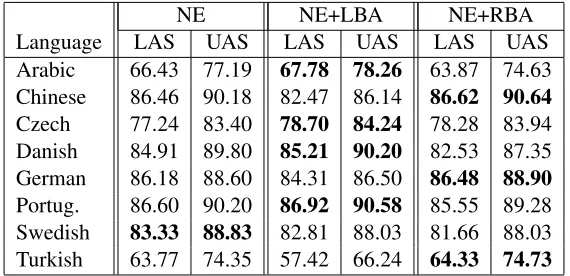
[image:5.612.164.449.54.192.2]Arabic 66.43 77.19 67.78 78.26 63.87 74.63 Chinese 86.46 90.18 82.47 86.14 86.62 90.64 Czech 77.24 83.40 78.70 84.24 78.28 83.94 Danish 84.91 89.80 85.21 90.20 82.53 87.35 German 86.18 88.60 84.31 86.50 86.48 88.90 Portug. 86.60 90.20 86.92 90.58 85.55 89.28 Swedish 83.33 88.83 82.81 88.03 81.66 88.03 Turkish 63.77 74.35 57.42 66.24 64.33 74.73
Table 1: Parsing accuracy (LAS and UAS, excluding punctuation) of Nivre’s arc-eager parser without modification (NE), with the LEFT-BUFFER-ARCtransition added (NE+LBA) and with the RIGHT-BUFFER-ARCtransition added (NE+RBA). Best results for each language are shown in boldface.
As can be seen in Table 1, adding a projective buffer transition improves the performance of the parser in seven out of the eight tested languages. The improvements in LAS are statistically significant at the .01 level4in the Arabic and Czech treebanks.
Note that the decision of which buffer transition to add strongly depends on the dataset. In the majority of the treebanks, we can see that when the LEFT-BUFFER-ARCtransition improves
perfor-mance the RIGHT-BUFFER-ARCtransition harms it, and vice versa. The exceptions are Czech, where both transitions are beneficial, and Swedish, where both are harmful. Therefore, when using projective buffer transitions in practice, the language and anno-tation scheme should be taken into account (or tests should be made) to decide which one to use.
Table 2 hints at the reason for this treebank-sensitiveness. By analyzing the relative frequency of leftward and rightward dependency links (and, in particular, of leftward and rightward links of length 1) in the different treebanks, we see a rea-sonably clear tendency: the LEFT-BUFFER-ARC
transition works better in treebanks that contain a large proportion ofrightward arcs of length1, and the RIGHT-BUFFER-ARCtransition works better in
treebanks with a large proportion ofleftwardarcs of length 1. Note that, while this might seem coun-terintuitive at a first glance, it is coherent with the hypothesis that we formulated in Section 3.1: the
4Statistical significance was assessed using Dan Bikel’s
ran-domized parsing evaluation comparator:http://www.cis. upenn.edu/˜dbikel/software.html#comparator
Language L% R% L1% R1% Best PBT
Arabic 12.3 87.7 6.5 55.1 LBA
Chinese 58.4 41.6 35.8 15.1 RBA
Czech 41.4 58.6 22.1 24.9 LBA*
Danish 17.1 82.9 10.9 43.0 LBA
German 39.8 60.2 20.3 19.9 RBA
Portug. 32.6 67.4 22.5 26.9 LBA
Swedish 38.2 61.8 24.1 21.8 LBA*
[image:5.612.315.544.260.372.2]Turkish 77.8 22.2 47.2 10.4 RBA
Table 2: Analysis of the datasets used in the experiments in terms of: percentage of leftward and rightward links (L%, R%), percentage of leftward and rightward links of length 1 (L1%, R1%), and which projective buffer transition works better for each dataset according to the results in Table 1 (LBA = LEFT-BUFFER-ARC, RBA = RIGHT-BUFFER-ARC). Languages where both tran-sitions are beneficial (Czech) or harmful (Swedish) are marked with an asterisk.
advantage of projective buffer transitions is not that they build arcs more accurately than standard arc-building transitions (in fact the opposite might be expected, since they work on nodes while they are still on the buffer and we have less information about their surrounding nodes in our feature models), but that they make it easier for the classifier to decide among standard transitions. The analysis on Table 2 agrees with that explanation: LEFT-BUFFER-ARC
NE NE+LBA NE+RBA NE+LBA+RBA
Language LA RA LA* RA LBA LA RA* RBA LA* RA* LBA RBA
[image:6.612.82.532.53.166.2]Arabic 58.28 67.77 42.61 68.65 77.46 55.88 60.63 79.70 37.40 62.28 66.78 75.94 Chinese 85.69 85.79 80.92 84.19 89.00 85.96 84.77 88.01 81.08 79.46 87.72 86.33 Czech 85.73 76.44 80.79 78.34 91.07 86.25 76.62 82.58 79.49 75.98 90.26 81.97 Danish 89.47 83.92 88.65 84.16 91.72 86.27 78.04 92.30 90.23 77.52 88.79 92.10 German 89.15 87.11 83.75 87.23 94.30 89.55 84.38 95.98 79.26 81.60 91.66 90.73 Portuguese 94.77 84.91 90.83 85.11 97.07 93.84 81.86 92.29 88.72 79.86 96.02 89.26 Swedish 87.75 80.74 84.62 81.30 92.83 87.12 74.77 90.73 78.10 72.50 90.86 89.89 Turkish 59.68 74.21 53.02 74.01 72.78 60.23 69.23 73.91 49.34 48.48 65.57 41.94 Table 3: Labelled precision of the arcs built by each transition of Nivre’s arc-eager parser without modification (NE), with a projective buffer transition added (NE+LBA, NE+RBA) and with both projective buffer transitions added (NE+LBA+RBA). We mark a standard LEFT-ARC(LA) or RIGHT-ARC(LA) transition with an asterisk (LA*, RA*) when it is acting only on a “hard” subset of leftward (rightward) arcs, and thus its precision is not directly comparable to that of (LA, RA). Best results for each language and transition are shown in boldface.
To further test this idea, we computed the la-belled precision of each individual transition of the parsers with and without projective buffer transi-tions, as shown in Table 3. As we can see, projec-tive buffer transitions achieve better precision than standard transitions, but this is not surprising since they act only on “easy” arcs of length 1. There-fore, this high precision does not mean that they ac-tually build arcs more accurately than the standard transitions, since it is not measured on the same set of arcs. Similarly, adding a projective buffer tran-sition decreases the precision of its corresponding standard transition, but this is because the standard transition is then dealing only with “harder” arcs of length greather than1, not because it is making more errors. A more interesting insight comes from com-paring transitions that are acting on the same tar-get set of arcs: we see that, in the languages where LEFT-BUFFER-ARC is beneficial, the addition of this transition always improves the precision of the standard RIGHT-ARC transition; and the converse
happens with RIGHT-BUFFER-ARCwith respect to LEFT-ARC. This further backs the hypothesis that the filtering of “easy” links achieved by projective buffer transitions makes it easier for the classifier to decide among standard transitions.
We also conducted experiments adding both tran-sitions at the same time (NE+LBA+RBA), but the results were worse than adding the suitable transi-tion for each dataset. Table 3 hints at the reason: the precision of buffer transitions noticeably decreases when both of them are added at the same time, pre-sumably because it is difficult for the classifier to
NE+LBA/RBA NE+PP(CoNLL X)
Language LAS UAS LAS UAS
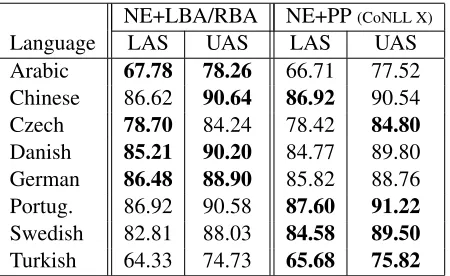
Arabic 67.78 78.26 66.71 77.52 Chinese 86.62 90.64 86.92 90.54 Czech 78.70 84.24 78.42 84.80 Danish 85.21 90.20 84.77 89.80 German 86.48 88.90 85.82 88.76 Portug. 86.92 90.58 87.60 91.22 Swedish 82.81 88.03 84.58 89.50 Turkish 64.33 74.73 65.68 75.82
Table 4: Comparison of the parsing accuracy (LAS and UAS, excluding punctuation) of Nivre’s arc-eager parser with projective buffer transitions (NE+LBA/RBA) and the parser with the pseudo-projective transformation (Nivre et al., 2006)
decide between both with the restricted feature in-formation available for buffer nodes.
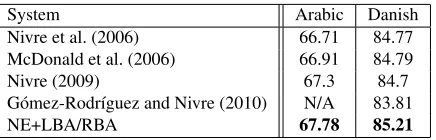
[image:6.612.316.541.257.395.2]System Arabic Danish Nivre et al. (2006) 66.71 84.77 McDonald et al. (2006) 66.91 84.79
Nivre (2009) 67.3 84.7
G´omez-Rodr´ıguez and Nivre (2010) N/A 83.81
[image:7.612.79.297.53.123.2]NE+LBA/RBA 67.78 85.21
Table 5: Comparison of the Arabic and Danish LAS ob-tained by the arc-eager parser with projective buffer tran-sitions in comparison to other parsers in the literature that report results on these datasets.
for the participants in the shared task; on the other hand, we did not fine-tune the classifier parameters for each dataset like Nivre et al. (2006), but used de-fault values for all languages.
As can be seen in the table, even though the pseudo-projective parser is able to capture non-projective syntactic phenomena, the algorithm with projective buffer transitions (which is strictly pro-jective) outperforms it in four of the eight treebanks, including non-projective treebanks such as the Ger-man one.
Furthermore, to our knowledge, our LAS results for Arabic and Danish are currently the best pub-lished results for a single-parser system on these datasets, not only outperforming the systems partic-ipating in CoNLL-X but also other parsers tested on these treebanks in more recent years (see Table 5).
Finally, it is worth noting that adding projective buffer transitions has no negative impact on effi-ciency, either in terms of computational complex-ity or of empirical runtime. Since each projective buffer transition removes a node from the buffer, no more than n such transitions can be executed for a sentence of length n, so adding these transitions cannot increase the complexity of a transition-based parser. In the particular case of the arc-eager parser, using projective buffer transitions reduces the aver-age number of transitions needed to obtain a given dependency forest, as some nodes can be dispatched by a single transition rather than being shifted and later popped from the stack. In practice, we ob-served that the training and parsing times of the arc-eager parser with projective buffer transitions were slightly faster than without them on the Arabic, Chi-nese, Swedish and Turkish treebanks, and slightly slower than without them on the other four tree-banks, so adding these transitions does not seem to
noticeably degrade (or improve) practical efficiency.
4 Non-projective buffer transitions
We now present a second set of transitions that still follow the idea of early processing of some depen-dency arcs, as in Section 3; but which are able to create arcs skipping over a buffer node, so that they can create some non-projective arcs. For this reason, we call themnon-projective buffer transitions.
4.1 The transitions
The two non-projective buffer transitions are defined as follows:
• LEFT-NONPROJ-BUFFER-ARCl:
(σ|i, j|k|β, A) ⇒ (σ, j|k|β, A∪ {(k, l, i)}). Preconditions:i 6= 0and6 ∃m, l0 | (m, l0, i) ∈ A(single-head)
• RIGHT-NONPROJ-BUFFER-ARCl:
(σ|i, j|k|β, A)⇒(σ|i, j|β, A∪ {(i, l, k)}).
The LEFT-NONPROJ-BUFFER-ARC transition creates a leftward arc from the second buffer node to the node on top of the stack, and then pops the stack. It can only be executed if the node on top of the stack does not already have a head. The RIGHT -NONPROJ-BUFFER-ARC transition creates an arc from the top of the stack to the second node in the buffer, and then removes the latter from the buffer. Note that these transitions are analogous to projec-tive buffer transitions, and they use the second node in the buffer in the same way, but they create arcs involving the node on top of the stack rather than the first buffer node. This change makes the pre-condition that checks for a head necessary for the transition LEFT-NONPROJ-BUFFER-ARCto respect the single-head constraint, since many stack-based parsers can generate configurations where the node on top of the stack has a head.
We call these transitions non-projective buffer transitions because, as they act on non-contiguous nodes in the stack and buffer, they allow the creation of a limited set of non-projective dependency arcs. This means that, when added to a projective parser, they will increase its coverage.5 On the other hand,
5
par-NE NE+LNBA NE+RNBA
Language LAS UAS LAS UAS LAS UAS
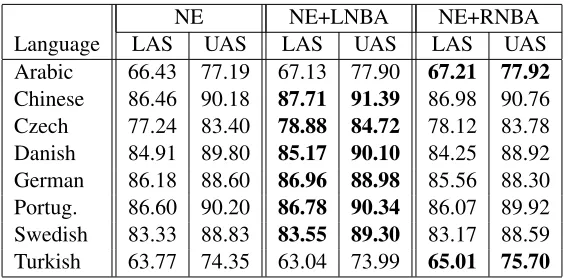
[image:8.612.165.450.53.192.2]Arabic 66.43 77.19 67.13 77.90 67.21 77.92 Chinese 86.46 90.18 87.71 91.39 86.98 90.76 Czech 77.24 83.40 78.88 84.72 78.12 83.78 Danish 84.91 89.80 85.17 90.10 84.25 88.92 German 86.18 88.60 86.96 88.98 85.56 88.30 Portug. 86.60 90.20 86.78 90.34 86.07 89.92 Swedish 83.33 88.83 83.55 89.30 83.17 88.59 Turkish 63.77 74.35 63.04 73.99 65.01 75.70
Table 6: Parsing accuracy (LAS and UAS, excluding punctuation) of Nivre’s arc-eager parser without modifica-tion (NE), with the LEFT-NONPROJ-BUFFER-ARCtransition added (NE+LNBA) and with the RIGHT-NONPROJ -BUFFER-ARCtransition added (NE+RNBA). Best results for each language are shown in boldface.
adding these transitions to a stack-based transition system does not affect soundness under the same conditions and for the same reasons explained for projective buffer transitions in Section 3.1.
Note that the fact that non-projective buffer tran-sitions are able to create non-projective dependency arcs does not mean thatall the arcs that they build are non-projective, since an arc on non-contiguous nodes in the stack and buffer may or may not cross other arcs. This means that non-projective buffer transitions serve a dual purpose: not only they increase coverage, but they also can create some “easy” dependency links in advance of standard transitions, just like projective buffer transitions.
Contrary to projective buffer transitions, we do not impose any arc length restrictions on non-projective buffer transitions (either as a hard con-straint in the transitions themselves or as a policy in the training oracle), since we would like the increase in coverage to be as large as possible. We wish to allow the parsers to create non-projective arcs in a straightforward way and without compromising effi-ciency. Therefore, to train the parser with these tran-sitions, we use an oracle that employs them when-ever possible, and delegates to the original parser’s oracle otherwise.
4.2 Experiments
We evaluate the impact of non-projective buffer tran-sitions on parsing accuracy by using the same
base-ticular subset of non-projective structures captured by each such parser.
line parser, datasets and experimental settings as for projective buffer transitions in Section 3.2. As can be seen in Table 6, adding a non-projective buffer transition to the arc-eager parser improves its per-formance on all eight datasets. The improvements in LAS are statistically significant at the .01 level (Dan Bikel’s comparator) for Chinese, Czech and Turk-ish. Note that the Chinese treebank is fully projec-tive, this means that non-projective buffer transitions are also beneficial when creating projective arcs.
While with projective buffer transitions we ob-served that each of them was beneficial for about half of the treebanks, and we related this to the amount of leftward and rightward links of length1in each; in the case of non-projective buffer transitions we do not observe this tendency. In this case, LEFT -NONPROJ-BUFFER-ARCworks better than RIGHT -NONPROJ-BUFFER-ARC in all datasets except for Turkish and Arabic.
As with the projective transitions, we gathered data about the individual precision of each of the transitions. The results were similar to those for the projective transitions, and show that adding a non-projective buffer transition improves the preci-sion of the standard transitions. We also experimen-tally checked that adding both non-projective buffer transitions at the same time (NE+LNBA+RNBA) achieved worse performance than adding only the most suitable transition for each dataset.
NE+LNBA/RNBA NE+PP(CoNLL X)
Language LAS UAS LAS UAS
Arabic 67.21 77.92 66.71 77.52 Chinese 87.71 91.39 86.92 90.54 Czech 78.88 84.72 78.42 84.80 Danish 85.09 89.98 84.77 89.80 German 86.96 88.98 85.82 88.76 Portug. 86.78 90.34 87.60 91.22 Swedish 83.55 89.30 84.58 89.50 Turkish 65.01 75.70 65.68 75.82
Table 7: Comparison of the parsing accuracy (LAS and UAS, excluding punctuation) of Nivre’s arc-eager parser with non-projective buffer transitions (NE+LNBA/RNBA) and the parser with the pseudo-projective transformation (Nivre et al., 2006).
System PP PR NP NR
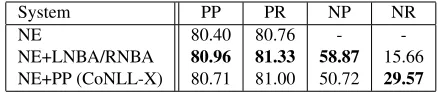
NE 80.40 80.76 -
[image:9.612.74.300.53.191.2]-NE+LNBA/RNBA 80.96 81.33 58.87 15.66 NE+PP (CoNLL-X) 80.71 81.00 50.72 29.57 Table 8: Comparison of the precision and recall for pro-jective (PP, PR) and non-propro-jective (NP, NR) arcs, av-eraged over all datasets, obtained by Nivre’s arc-eager parser with and without non-projective buffer transitions (NE+LNBA/RNBA, NE) and the parser with the pseudo-projective transformation (Nivre et al., 2006).
the parser with the pseudo-projective transformation by Nivre et al. (2006) in the CoNLL-X shared task. Note that, like the one in Table 4, this should not be interpreted as a homogeneous comparison. We can see that the algorithm with non-projective buffer transitions obtains better LAS in five out of the eight treebanks. Precision and recall data on projective and non-projective arcs (Table 8) show that, while our parser does not capture as many non-projective arcs as the pseudo-projective transformation (unsur-prisingly, as it can only build non-projective arcs in one direction: that of the particular non-projective buffer transition used for each dataset); it does so with greater precision and is more accurate than that algorithm in projective arcs.
Like projective buffer transitions, non-projective transitions do not increase the computational com-plexity of stack-based parsers. The observed train-ing and parstrain-ing times for the arc-eager parser with non-projective buffer transitions showed a small
overhead with respect to the original arc-eager (7.1% average increase in training time, 17.0% in parsing time). For comparison, running the arc-eager parser with the pseudo-projective transforma-tion (Nivre et al., 2006) on the same machine pro-duced a 23.5% increase in training time and a 87.5% increase in parsing time.
5 Related work
The approach of adding an extra transition to a parser to improve its accuracy has been applied in the past by Choi and Palmer (2011). In that pa-per, the LEFT-ARCtransition from Nivre’s arc-eager
transition system is added to a list-based parser. However, the goal of that transition is different from ours (selecting between projective and non-projective parsing, rather than building some arcs in advance) and the approach is specific to one algo-rithm while ours is generic – for example, the LEFT
-ARC transition cannot be added to the arc-standard and arc-eager parsers, or to extensions of those like the ones by Attardi (2006) or Nivre (2009), because these already have it.
The idea of creating dependency arcs of length1 in advance to help the classifier has been used by Cheng et al. (2006). However, their system creates such arcs in a separate preprocessing step rather than dynamically by adding a transition to the parser, and our approach obtains better LAS and UAS results on all the tested datasets.
The projective buffer transitions presented here bear some resemblance to the easy-first parser by Goldberg and Elhadad (2010), which allows cre-ation of dependency arcs between any pair of con-tiguous nodes and is based on the idea of “easy” de-pendency links being created first. However, while the easy-first parser is an entirely newO(nlog(n)) algorithm, our approach is a generic extension for stack-based parsers that does not increase their com-plexity (so, for example, applying it to the arc-eager system as in the experiments in this paper yields
O(n)complexity).
[image:9.612.75.294.279.325.2]to create some arcs in advance. The non-projective buffer transitions presented in this paper can also be added to Attardi’s parser.
6 Discussion
We have presented a set of two transitions, called
projective buffer transitions, and showed that adding one of them to Nivre’s arc-eager parser improves its accuracy in seven out of eight tested datasets from the CoNLL-X shared task. Furthermore, adding one of a set ofnon-projective buffer transitionsachieves accuracy improvements in all of the eight datasets. The obtained improvements are statistically signif-icant for several of the treebanks, and the parser with projective buffer transitions surpassed the best published single-parser LAS results on two of them. This comes at no cost either on computational com-plexity or (in the case of projective transitions) on empirical training and parsing times with respect to the original parser.
While we have chosen Nivre’s well-known arc-eager parser as our baseline, we have shown that these transitions can be added to any stack-based de-pendency parser, and we are not aware of any spe-cific property of arc-eager that would make them work better in practice on this parser than on others. Therefore, future work will include an evaluation of the impact of buffer transitions on more transition-based parsers. Other research directions involve in-vestigating the set of non-projective arcs allowed by non-projective buffer transitions, defining dif-ferent variants of buffer transitions (such as non-projective buffer transitions that work with nodes lo-cated deeper in the buffer) or using projective and non-projective buffer transitions at the same time.
Acknowledgments
This research has been partially funded by the Spanish Ministry of Economy and Competitive-ness and FEDER (projects TIN2010-18552-C03-01 and TIN2010-18552-C03-02), Ministry of Educa-tion (FPU Grant Program) and Xunta de Galicia (Rede Galega de Recursos Ling¨u´ısticos para unha Sociedade do Co˜necemento).
References
Susana Afonso, Eckhard Bick, Renato Haber, and Diana Santos. 2002. “Floresta sint´a(c)tica”: a treebank for Portuguese. InProceedings of the 3rd International Conference on Language Resources and Evaluation (LREC 2002), pages 1968–1703, Paris, France. ELRA. Nart B. Atalay, Kemal Oflazer, and Bilge Say. 2003. The annotation process in the Turkish treebank. In Pro-ceedings of EACL Workshop on Linguistically Inter-preted Corpora (LINC-03), pages 243–246, Morris-town, NJ, USA. Association for Computational Lin-guistics.
Giuseppe Attardi. 2006. Experiments with a multilan-guage non-projective dependency parser. In Proceed-ings of the 10th Conference on Computational Natural Language Learning (CoNLL), pages 166–170. Sabine Brants, Stefanie Dipper, Silvia Hansen, Wolfgang
Lezius, and George Smith. 2002. The tiger treebank. InProceedings of the Workshop on Treebanks and Lin-guistic Theories, September 20-21, Sozopol, Bulgaria. Sabine Buchholz and Erwin Marsi. 2006. CoNLL-X shared task on multilingual dependency parsing. In Proceedings of the 10th Conference on Computational Natural Language Learning (CoNLL), pages 149–164. Chih-Chung Chang and Chih-Jen Lin, 2001. LIBSVM: A Library for Support Vector Machines. Software avail-able at http://www.csie.ntu.edu.tw/∼cjlin/libsvm. K. Chen, C. Luo, M. Chang, F. Chen, C. Chen, C. Huang,
and Z. Gao. 2003. Sinica treebank: Design criteria, representational issues and implementation. In Anne Abeill´e, editor,Treebanks: Building and Using Parsed Corpora, chapter 13, pages 231–248. Kluwer. Yuchang Cheng, Masayuki Asahara, and Yuji
Mat-sumoto. 2006. Multi-lingual dependency parsing at NAIST. InProceedings of the Tenth Conference on Computational Natural Language Learning, CoNLL-X ’06, pages 191–195, Stroudsburg, PA, USA. Asso-ciation for Computational Linguistics.
Jinho D. Choi and Martha Palmer. 2011. Getting the most out of transition-based dependency parsing. In Proceedings of the 49th Annual Meeting of the Asso-ciation for Computational Linguistics: Human Lan-guage Technologies: short papers - Volume 2, HLT ’11, pages 687–692, Stroudsburg, PA, USA. Associ-ation for ComputAssoci-ational Linguistics.
Jason M. Eisner. 1996. Three new probabilistic models for dependency parsing: An exploration. In Proceed-ings of the 16th International Conference on Compu-tational Linguistics (COLING), pages 340–345. R.-E. Fan, K.-W. Chang, C.-J. Hsieh, X.-R. Wang, and
Yoav Goldberg and Michael Elhadad. 2010. An effi-cient algorithm for easy-first non-directional depen-dency parsing. In Human Language Technologies: The 2010 Annual Conference of the North American Chapter of the Association for Computational Linguis-tics (NAACL HLT), pages 742–750.
Carlos G´omez-Rodr´ıguez and Joakim Nivre. 2010. A transition-based parser for 2-planar dependency struc-tures. InProceedings of the 48th Annual Meeting of the Association for Computational Linguistics, ACL ’10, pages 1492–1501, Stroudsburg, PA, USA. Asso-ciation for Computational Linguistics.
Jan Hajiˇc, Otakar Smrˇz, Petr Zem´anek, Jan ˇSnaidauf, and Emanuel Beˇska. 2004. Prague Arabic Dependency Treebank: Development in data and tools. In Proceed-ings of the NEMLAR International Conference on Ara-bic Language Resources and Tools.
Jan Hajiˇc, Jarmila Panevov´a, Eva Hajiˇcov´a, Jarmila Panevov´a, Petr Sgall, Petr Pajas, Jan ˇStˇep´anek, Jiˇr´ı Havelka, and Marie Mikulov´a. 2006. Prague Depen-dency Treebank 2.0. CDROM CAT: LDC2006T01, ISBN 1-58563-370-4. Linguistic Data Consortium. Liang Huang and Kenji Sagae. 2010. Dynamic
program-ming for linear-time incremental parsing. In Proceed-ings of the 48th Annual Meeting of the Association for Computational Linguistics, ACL ’10, pages 1077– 1086, Stroudsburg, PA, USA. Association for Compu-tational Linguistics.
Matthias T. Kromann. 2003. The Danish dependency treebank and the underlying linguistic theory. In Pro-ceedings of the 2nd Workshop on Treebanks and Lin-guistic Theories (TLT), pages 217–220, V¨axj¨o, Swe-den. V¨axj¨o University Press.
Andre Martins, Noah Smith, and Eric Xing. 2009. Con-cise integer linear programming formulations for de-pendency parsing. InProceedings of the Joint Confer-ence of the 47th Annual Meeting of the ACL and the 4th International Joint Conference on Natural Language Processing of the AFNLP (ACL-IJCNLP), pages 342– 350.
Ryan McDonald and Joakim Nivre. 2007. Charac-terizing the errors of data-driven dependency parsing models. InProceedings of the 2007 Joint Conference on Empirical Methods in Natural Language Process-ing and Computational Natural Language LearnProcess-ing (EMNLP-CoNLL), pages 122–131.
Ryan McDonald and Joakim Nivre. 2011. Analyzing and integrating dependency parsers. Comput. Lin-guist., 37:197–230.
Ryan McDonald, Fernando Pereira, Kiril Ribarov, and Jan Hajiˇc. 2005. Non-projective dependency pars-ing uspars-ing spannpars-ing tree algorithms. In Proceedings of the Human Language Technology Conference and
the Conference on Empirical Methods in Natural Lan-guage Processing (HLT/EMNLP), pages 523–530. Ryan McDonald, Kevin Lerman, and Fernando Pereira.
2006. Multilingual dependency analysis with a two-stage discriminative parser. In Proceedings of the 10th Conference on Computational Natural Language Learning (CoNLL), pages 216–220.
Jens Nilsson, Johan Hall, and Joakim Nivre. 2005. MAMBA meets TIGER: Reconstructing a Swedish treebank from Antiquity. In Peter Juel Henrichsen, ed-itor, Proceedings of the NODALIDA Special Session on Treebanks.
Joakim Nivre, Johan Hall, and Jens Nilsson. 2004. Memory-based dependency parsing. In Proceedings of the 8th Conference on Computational Natural Lan-guage Learning (CoNLL-2004), pages 49–56, Morris-town, NJ, USA. Association for Computational Lin-guistics.
Joakim Nivre, Johan Hall, Jens Nilsson, G¨ulsen Eryi˘git, and Svetoslav Marinov. 2006. Labeled pseudo-projective dependency parsing with support vector ma-chines. In Proceedings of the 10th Conference on Computational Natural Language Learning (CoNLL), pages 221–225.
Joakim Nivre. 2003. An efficient algorithm for projec-tive dependency parsing. InProceedings of the 8th In-ternational Workshop on Parsing Technologies (IWPT 03), pages 149–160. ACL/SIGPARSE.
Joakim Nivre. 2008. Algorithms for Deterministic Incre-mental Dependency Parsing. Computational Linguis-tics, 34(4):513–553.
Joakim Nivre. 2009. Non-projective dependency parsing in expected linear time. InProceedings of the Joint Conference of the 47th Annual Meeting of the ACL and the 4th International Joint Conference on Natural Lan-guage Processing of the AFNLP (ACL-IJCNLP), pages 351–359.
Kemal Oflazer, Bilge Say, Dilek Zeynep Hakkani-T¨ur, and G¨okhan T¨ur. 2003. Building a Turkish treebank. In Anne Abeill´e, editor,Treebanks: Building and Us-ing Parsed Corpora, pages 261–277. Kluwer.
Kenji Sagae and Jun’ichi Tsujii. 2008. Shift-reduce de-pendency DAG parsing. InProceedings of the 22nd International Conference on Computational Linguis-tics (COLING), pages 753–760.
Stephen Tratz and Eduard Hovy. 2011. A fast, accurate, non-projective, semantically-enriched parser. In Pro-ceedings of the 2011 Conference on Empirical Meth-ods in Natural Language Processing, pages 1257– 1268, Edinburgh, Scotland, UK., July. Association for Computational Linguistics.
In Proceedings of the 8th International Workshop on Parsing Technologies (IWPT), pages 195–206. Yue Zhang and Stephen Clark. 2008. A tale of two
parsers: Investigating and combining graph-based and transition-based dependency parsing. InProceedings of the Conference on Empirical Methods in Natural Language Processing (EMNLP), pages 562–571. Yue Zhang and Joakim Nivre. 2011. Transition-based