Neural Network for Heterogeneous Annotations
Hongshen Chen∗†§ Yue Zhang‡ Qun Liu♢†
†Key Laboratory of Intelligent Information Processing Institute of Computing Technology, Chinese Academy of Sciences
§University of Chinese Academy of Sciences ‡Singapore University of Technology and Design
♢ADAPT centre, School of Computing, Dublin City University
[email protected], yue [email protected]
Abstract
Multiple treebanks annotated under heteroge-neous standards give rise to the research ques-tion of best utilizing multiple resources for im-proving statistical models. Prior research has focused on discrete models, leveraging stack-ing and multi-view learnstack-ing to address the problem. In this paper, we empirically inves-tigate heterogeneous annotations using neu-ral network models, building a neuneu-ral network counterpart to discrete stacking and multi-view learning, respectively, finding that neural models have their unique advantages thanks to the freedom from manual feature engineering. Neural model achieves not only better accu-racy improvements, but also an order of mag-nitude faster speed compared to its discrete baseline, adding little time cost compared to a neural model trained on a single treebank.
1 Introduction
For many languages, multiple treebanks have been annotated according to different guidelines. For ex-ample, several linguistic theories have been used for defining English dependency treebanks, includ-ing Yamada and Matsumoto (2003), LTH (Johans-son and Nugues, 2007) and Stanford dependencies (De Marneffe et al., 2006). For German, there exist TIGER (Brants et al., 2002) and T¨uBa-D/Z (Telljo-hann et al., 2006). For Chinese, treebanks have been made available under various segmentation granu-larities (Sproat and Emerson, 2003; Emerson, 2005; Xue, 2003). These give rise to the research problem
∗Work done when the first author was visiting SUTD.
of effectively making use of multiple treebanks un-der heterogeneous annotations for improving output accuracies (Jiang et al., 2015; Johansson, 2013; Li et al., 2015).
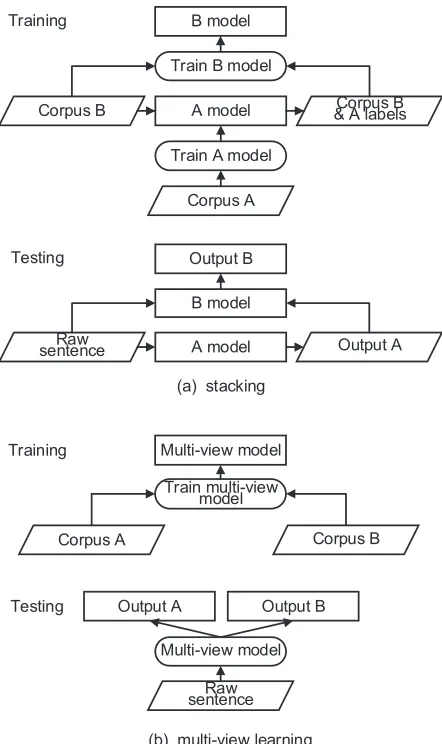
The task has been tackled using two typical ap-proaches. The first is based on stacking (Wolpert, 1992; Breiman, 1996; Wu et al., 2003). As shown in Figure 1(a), the main idea is to have a model trained using a source treebank, which is then used to guide a target treebank model by offering source-style fea-tures. This method has been used for leveraging two different treebanks for word segmentation (Jiang et al., 2009; Sun and Wan, 2012) and dependency pars-ing (Nivre and McDonald, 2008; Johansson, 2013).
The second approach is based on multi-view
learning (Johansson, 2013; Li et al., 2015). The
idea is to address both annotation styles simul-taneously by sharing common feature representa-tions. In particular, Johansson (2013) trained depen-dency parsers using the domain adaptation method of Daum´e III (2007), keeping a copy of shared fea-tures and a separate copy of feafea-tures for each tree-bank. Li et al. (2015) trained POS taggers by cou-pling the labelsets from two different treebanks into a single combined labelset. A summary of such multi-view methods is shown in Figure 1(b), which demonstrates their main differences compared to stacking (Figure 1(a)).
Recently, neural network has gained increasing research attention, with highly competitive results being reported for numerous NLP tasks, including word segmentation (Zheng et al., 2013; Pei et al., 2014; Chen et al., 2015), POS-tagging (Ma et al., 2014; Plank et al., 2016), and parsing (Chen and
B model
A model
Train A model
Corpus A Train B model
Corpus B & A labelsCorpus B
Output B
A model B model
Raw
sentence Output A
Multi-view model
Train multi-view model
Corpus A Corpus B
Output A
Multi-view model
Raw sentence Training
(a) stacking
(b) multi-view learning Testing
Training
[image:2.612.75.296.59.431.2]Testing Output B
Figure 1: Two main approaches to utilizing hetero-geneous annotations.
Manning, 2014; Dyer et al., 2015; Weiss et al., 2015; Zhou et al., 2015). On the other hand, the aforemen-tioned methods on heterogeneous annotations are in-vestigated mainly for discrete models. It remains an interesting research question how effective multiple treebanks can be utilized by neural NLP models, and we aim to investigate this empirically.
We follow Li et al. (2015), taking POS-tagging for case study, using the methods of Jiang et al. (2009) and Li et al. (2015) as the discrete stacking and multi-view training baselines, respectively, and building neural network counterparts to their mod-els for empirical comparison. The base tagger is a neural CRF model (Huang et al., 2015; Lample et al., 2016), which gives competitive accuracies to discrete CRF taggers.
Results show that neural stacking allows deeper
integration of the source model beyond one-best out-puts, and further the fine-tuning of the source model during the target model training. In addition, the ad-vantage of neural multi-view learning over its dis-crete counterpart are many-fold. First, it is free from the necessity of manual cross-labelset inter-active feature engineering, which is far from triv-ial for representing annotation correspondence (Li et al., 2015). Second, compared to discrete model, parameter sharing in deep neural network eliminates the issue of exponential growth of search space, and allows separated training of each label type, in the same way as multi-task learning (Collobert et al., 2011).
Our neural multi-view learning model achieves not only better accuracy improvements, but also an order of magnitude faster speed com-pared to its discrete baseline, adding little time cost compared to a neural model trained on a single treebank. The C++ implementations of our neural network stacking and multi-view learning models are available under GPL, at
https://github.com/chenhongshen/NNHetSeq.
2 Baseline Neural Network Tagger
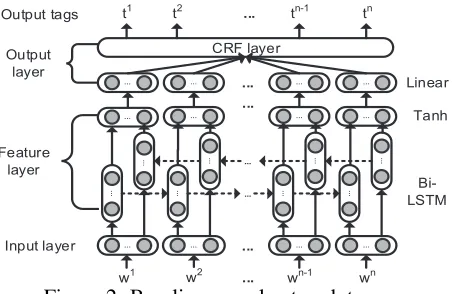
We adopt a neural CRF with a Long-Short-Term-Memory (LSTM) (Hochreiter and Schmidhuber, 1997) feature layer for baseline POS tagger. As shown in Figure 2, the model consists of three main neural layers: theinput layercalculates dense rep-resentation of input words using attention model on character embeddings; thefeature layeremploys a bi-directional LSTM model to extract non-local fea-tures from input vectors; the output layer uses a CRF structure to infer the most likely label for each input word.
2.1 Input Layer
Given a sentencew(1:n), the input layer builds a
vec-tor representation⃗riwfor each wordwibased on both
word and character embeddings. In particular, an embedding lookup table is used to convert vocabu-lary words into their embedding forms directly. To obtain a character based embedding of wi, we
de-note the character sequence ofwiwithc(1:n), where cj is thejth character inwi.
char-Input layer ... ...
...
... ... ... ...
...
CRF layer
Feature layer
...
...
... ...
...
...
...
...
... ...
... ... ... ... ... ... ... ...
Bi-LSTM
Tanh Linear Output tags
w1 w2
wn-1 wn
Output layer
...
[image:3.612.73.299.57.204.2]t1 t2 tn-1 tn
Figure 2: Baseline neural network tagger.
acter cj into a character embedding ⃗ej
c. The
char-acter embeddings⃗e1c, ⃗e2c, ..., ⃗emc are combined using
an attention model(Bahdanau et al., 2015): w⃗ic = ∑m
j=1a
j
c ⊙⃗ejc,where ajc is the weight for⃗ejc, ⊙is
the Hadamard product function, and∑m
j=1a
j
c= 1.
Eachajcis computed according to both the word
embedding vector and 5-character embedding win-dow with the current character⃗ejcin the middle:
ajc= t
j c
∑m
1 t
j c
tjc= exp(Wt⃗hjc+Ut⃗eiw+⃗bt)
⃗hi
c= tanh
(
Wc(⃗ejc−2⊕⃗ecj−1⊕⃗ejc⊕⃗ejc+1
⊕⃗ejc+2) +⃗bc)
Here⊕denotes vector concatenation and⃗eiw is the
embedding of current wordwi.Wt,Ut,Wcand⃗bt, ⃗bcare model parameters. Finally,w⃗i
cis concatenated
with word embedding to form final word represen-tation⃗ri
w:⃗riw =⃗eiw⊕w⃗ci
2.2 Feature Layer
Recently, bi-directional LSTM has been success-fully applied in various NLP tasks (Liu et al., 2015; Zhou and Xu, 2015; Klerke et al., 2016; Plank et al., 2016). The feature layer uses a bi-directional LSTM to extract a feature vector⃗hi for each wordwi,
re-spectively. An input vector⃗xi = (⃗rwi−2⊕⃗rwi−1⊕⃗rwi ⊕
⃗rwi+1⊕⃗riw+2)is used to represent each wordwi.
We use a LSTM variation with peephole connec-tions (Graves and Schmidhuber, 2005) to extract fea-tures based on⃗x(1:n). The model computes a
hid-den vector⃗hifor each input⃗xi, passing information
from⃗h1, ..., ⃗hi−1to⃗hnvia a sequence of cell states
⃗c1, ⃗c2, ..., ⃗cn. Information flow is controlled using an
input gate⃗gi, a forget gatef⃗i, and an output gate⃗oi: ⃗
gi=σ(W(g)x⃗i+U(g)⃗hi−1+V(g)⃗ci−1+⃗b(g))
⃗
fi=σ(W(f)x⃗i+U(f)⃗hi−1+V(f)⃗ci−1+⃗b(f))
⃗
ci=f⃗i⊙⃗ci−1+
⃗
gi⊙tanh(W(u)x⃗i+U(u)⃗hi−1+⃗b(u))
⃗
oi=σ(W(o)x⃗i+U(o)⃗hi−1+V(o)c⃗i+⃗b(o))
⃗
hi=⃗oi⊙tanh(c⃗i),
whereσdenotes the component-wise sigmoid
func-tion. W(g),W(f),W(u),W(o),U(g),U(f),U(u), U(o), V(g), V(f), V(o), ⃗b(g), ⃗b(f), ⃗b(u), ⃗b(o) are model parameters.
Bi-directional extension of the above LSTM structure is applied in both the left-to-right direc-tion and the right-to-left direcdirec-tion, resulting in two hidden vector sequencesh(1:l n), h(1:r n), respectively.
Each⃗hi
l is combined with its corresponding⃗hir for
final feature vector⃗hi
f:
⃗ hi
f = tanh(Wl⃗hil+Wr⃗hir+⃗b),
whereWl,Wrand⃗bare model parameters.
2.3 Output Layer
The output layer employs a conditional random field (CRF) to infer the POStiof each wordwibased on
the feature layer outputs. The conditional probabil-ity of a tag sequence given an input sentence is:
p(⃗y|⃗x) = ∏n
i=1Ψ(⃗x, ⃗yi) ∏n
i=1Φ(⃗x, ⃗yi, ⃗yi−1)
Z(⃗x) ,
whereZ(⃗x)is the partition function:
Z(⃗x) =∑
⃗ y
n
∏
i=1
Ψ(⃗x, ⃗yi)
n
∏
i=1
Φ(⃗x, ⃗yi, ⃗yi−1)
In particular, the output clique potentialΨ(⃗x, ⃗yi) shows the correlation between inputs and output la-bels: Ψ(⃗x, ⃗yi) = exp(⃗si),with the emission vector ⃗si being defined as:
⃗si=⃗θ0⃗hif, (1)
where⃗θ0is the model parameter.
A tagger
...
B tagger
... Å...
w2 ta2
tb2
... Å
w1 ta1
...
tb1
... Å...
wn-1 tan-1
tbn-1
wn
... Å...
tan
tbn
A tagger
...
B tagger
... Å...
w2 tb2
... Å
w1
...
tb1
... Å...
wn-1 tbn-1
wn
... Å... tbn
... ... ... ...
[image:4.612.90.518.53.289.2](a) one-best-output level stacking (b) feature level stacking
Figure 3: Neural stacking.
3 Stacking
3.1 Discrete Stacking
Stacking integrates corpora A and B by first training a tagger on corpus A, and then using the A tagger to provide additional features to a corpus B model. Figure 1(a) shows the training and testing of dis-crete stacking models, where the B tagger extracts features from both the raw sentence and A tagger output. This method achieves feature combination at the one-best-output level.
3.2 Neural Stacking
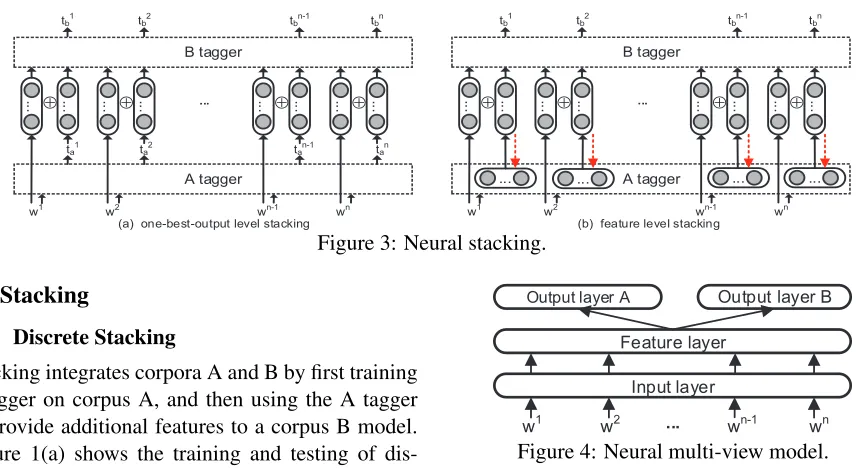
Figure 3(a) and (b) shows the two neural stacking methods of this paper, respectively.
Shallow Integration.Figure 3(a) is a variation of
discrete stacking, with the output tags from tagger A being converted to a low-dimensional dense ding features, and concatenated to the word embed-ding inputs to tagger B. Formally, for each wordwi,
denote the tagger A output astia, we concatenate the
embedding form of tia, denoted as⃗eia, to the word
representation⃗ri
w.
⃗rwi′ =⃗rwi ⊕⃗eia=⃗eiw⊕w⃗ci⊕⃗eia (2)
Deep Integration. Figure 3(b) offers deeper
inte-gration between the A and B models, which is fea-sible only with neural network features. We call this method feature-level stacking. For feature-level in-tegration, the emission vector ⃗si in Eq.(1) is taken
for input to tagger B via a projection:
⃗
wia= tanh(Ws⃗si)
⃗riw =⃗eiw⊕w⃗ci⊕w⃗ai,
whereWsis a model parameter.
Fine-tuning. Feature-level stacking further
al-lows tagger A to be fine-tuned during the training
Output layer A
Input layer Feature layer
Output layer B
...
w1 w2 wn-1 wn
Figure 4: Neural multi-view model.
of tagger B, with the loss function being back prop-agated to tagger A via thew⃗i
alayer (shown in the red
dotted lines in Figure 3(b)). This is a further benefit of neural stacking compared with discrete stacking.
4 Multi-view Learning
4.1 Discrete Label Coupling
As shown in Figure 1(b), multi-view learning (Li et al., 2015) utilizes corpus A and corpus B simultane-ously for training. The coupled tagger directly learns the logistic correspondences between both corpora, therefore can lead a more comprehensive usage of corpus A compared with stacking. In order to better capture such correlation, specifically designed fea-ture templates between two tag sets are essential.
For each training instances, both A and B labels are needed. However, one type of tag is missing. Li et al. (2015) used a mapping function to supple-ment the missing annotations with the help of the annotated tag. The result is a set of sentence with bundled tags in both annotations, but with ambigu-ities on one side, due to one-to-many mappings. Li et al. (2015) showed that speed can be significantly improved by manually restricting possible mappings between the labelsets, but a full mapping without re-striction yields the highest accuracies.
4.2 Neural Multi-task Learning
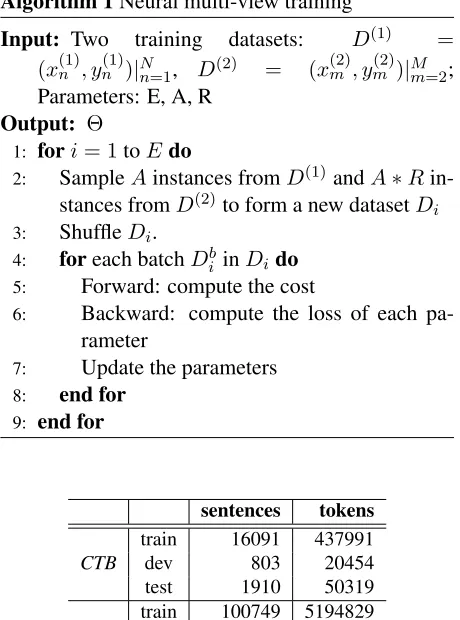
func-tions between tag sets by establishing two separate output layers, one for each type of label, with shared low-level parameters. The general structure of a neural multi-view model is shown in Figure 4, which can be regarded as a variation of the parameter shar-ing model of Caruana (1993) and Collobert et al. (2011). Leveraging heterogeneous annotations for the same task, compared to parameter sharing be-tween different NLP tasks (Collobert et al., 2011), can benefit from tighter integration of information, and hence allows deeper parameter sharing. These are verified empirically in the experiments.
In training and testing, sentences from both cor-pora go through the same input layer and feature layer. The outputs of each type of tag is then com-puted separately according to the shared parameters. The conditional probability of a tag sequence given an input sentence and its corpus type is:
p(⃗y|⃗x, T) = ∏n
i=1ΨT(⃗x, ⃗yi) ∏n
i=1ΦT(⃗x, ⃗yi, ⃗yi−1)
ZT(⃗x)
,
whereT is the corpus type,T ∈ {A, B}. ΨT(⃗x, ⃗yi)
and ΦT(⃗x, ⃗yi, ⃗yi−1) are the corresponding output
clique potential and edge clique potential, respec-tively.ZT(⃗x)is the partition function:
ZT(⃗x) =
∑
⃗ y
n
∏
i=1
ΨT(⃗x, ⃗yi) n
∏
i=1
ΦT(⃗x, ⃗yi, ⃗yi−1)
This indicates that each time only one output layer is activated according to the corpus type of input sentences.
5 Training
A max-margin objective is used to train the full set of model parametersΘ:
L(Θ) = 1
D D
∑
d=1
l(x⃗d, ⃗yd,Θ) + λ
2∥Θ∥ 2,
where ⃗xd, ⃗yd|Dd=1 are the training examples, λ is a regularization parameter, and l(⃗xd, ⃗yd,Θ) is the
max-margin loss function towards one example (⃗xd,y¯d).
The max-margin loss function is defined as:
l(⃗xd, ⃗yd,Θ) = max y
(
s(⃗y|⃗xd,Θ) +δ(⃗y, ⃗yd))
−s(⃗yd|⃗xd,Θ),
Algorithm 1Neural multi-view training
Input: Two training datasets: D(1) =
(x(1)n , y(1)n )|Nn=1, D(2) = (x(2)m , y(2)m )|Mm=2;
Parameters: E, A, R
Output: Θ
1: fori= 1toEdo
2: SampleAinstances fromD(1)andA∗R in-stances fromD(2)to form a new datasetD
i
3: ShuffleDi.
4: foreach batchDbi inDido
5: Forward: compute the cost
6: Backward: compute the loss of each pa-rameter
7: Update the parameters
8: end for
9: end for
sentences tokens
CTB traindev 16091803 43799120454 test 1910 50319
[image:5.612.313.543.64.374.2]PD traindev 100749 519482918875 958026 Table 1: Data statistics.
where⃗yis the model output,s(⃗y|⃗x) =logP(⃗y|⃗x)is the log probability of⃗yandδ(⃗y, ⃗yd)is the Hamming
distance between⃗yand⃗yd.
We adopt online learning, updating parameters using AdaGrad (Duchi et al., 2011). To train the neural stacking model, we first train a base tagger using corpus A. Then, we train the stacked tagger with corpus B, where the parameters of the A tagger has been pretrained from corpus A and the B tagger is randomly initialized.
6 Experiments
6.1 Experimental Settings
We adopt the Penn Chinese Treebank version 5.0 (CTB5) (Xue et al., 2005) as our main corpus, with the standard data split following previous work (Zhang and Clark, 2008; Li et al., 2015). People’s Daily (PD) is used as second corpus with a differ-ent scheme. We filter outPDsentences longer than 200 words. Details of the datasets are listed in Table 1. The standard token-wise POS tagging accuracy is used as the evaluation metric. The systems are implemented with LibN3L (Zhang et al., 2016).
For all the neural models, we set the hidden layer size to 100, the initial learning rate for Adagrad to 0.01 and the regularization parameter λ to 10−8.
word2vec1 is used to pretrain word embeddings.
The Chinese Giga-word corpus version 5 (Graff and Chen, 2005), segmented byzpar2(Zhang and Clark,
2011), is used for the training corpus for word em-beddings. The size of word embedding is 50.
6.2 Development Experiments
We use the development dataset for two main pur-poses. First, under each setting, we tune the model parameters, such as the number of training epochs. Second, we study the influence of several important hyper-parameters using the development dataset. For example, for the NN multi-view learning model, the corpus weights ratio (section 5) plays an im-portant role for the performance. We determine the parameters of the model by studying the accuracy along with the increasing epochs.
Effect of batch size and dropout.The batch size
affects the speed of training convergence and the fi-nal accuracies of the neural models, and the dropout rate has been shown to significantly influence the performance (Chen et al., 2015). We investigate the effects of these two hyper-parameters by adopting a corpus weight ratio of1 : 1 (All the CTB train-ing data is used, while the same amount of PD is sampled randomly), drawing the accuracies of the neural multi-view learning model against the num-ber of training epochs with various combinations of the dropout rated and batch sizeb. The results are
1https://code.google.com/p/word2vec 2https://github.com/SUTDNLP/ZPar
87 88 89 90 91 92 93 94 95 96
0 5 10 15 20 25 30
Accuracy on CTB-dev(\%)
epoches
[image:6.612.315.534.61.214.2]b=1;d=0.2 b=20;d=0.2 b=1;d=0 b=20;d=0 b=1;d=0.5 b=20;d=0.5
Figure 5: Accuracy onCTB-devwith different batch sizes and dropout rates for a multi-view learning model. b represents batch size, ddenotes dropout rate.
92.5 93 93.5 94 94.5 95 95.5 96
0 5 10 15 20 25 30
Accuracy on CTB-dev(\%)
epoches
1:0.2 1:1 1:4
Figure 6: Accuracy onCTB-devwith different cor-pus weights ratio.
shown for the multi-view learning model. For the stacking model, we useb=100 for thePDsub model.
[image:6.612.315.534.281.433.2]over-System Accuracy CRF Baseline (Li et al., 2015) 94.10 CRF Stacking (Li et al., 2015) 94.81 CRF Multi-view (Li et al., 2015) 95.00
NN Baseline 94.24
NN Stacking 94.74
NN Feature Stacking 95.01 NN Feature Stacking & Fine-tuning 95.32
NN Multi-view 95.40
[image:7.612.78.294.57.188.2]Integrated NN Multi-view & Stacking 95.53 Table 2: Accuracies onCTB-test.
fitting and underfitting.
Figure 5 also shows that the batch size has a rela-tive small influence on the accuracies, which varies according to the dropout rate. We simply choose a batch size of 1 for the remaining experiments ac-cording to the performance at the dropout rate 20%.
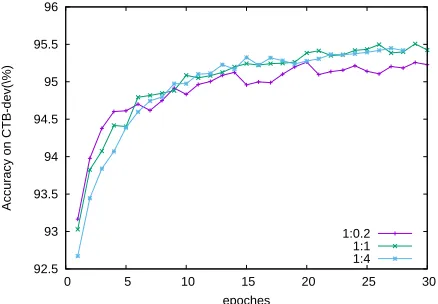
Effect of corpus weights ratio. Figure 6 shows
the effects of different corpus weights ratios. In par-ticular, a corpus weights ratio of 1:0.2 yields relative low accuracies. This is likely because it makes use of the least amount of PD data. The ratios of 1:1 and 1:4 give comparable performances. We choose the former for our final tests because it is a much faster choice.
6.3 Final Results
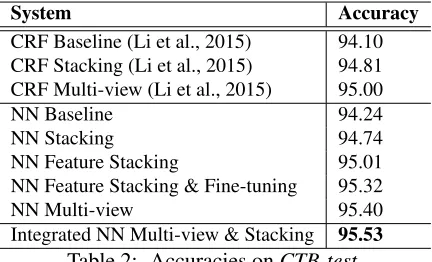
Table 2 shows the final results on theCTBtest data. We lists the results of stacking method of Jiang et al. (2009) re-implemented by Li et al. (2015), and CRF multi-view method reported by Li et al. (2015). We adopt pair-wise significance test (Collins et al., 2005) when comparing the results between two dif-ferent models.
Stacking. For baseline tagging using onlyCTB,
NN model achieves a result of 94.24, slightly higher than CRF baseline (94.10). NN stacking model in-tegratingPDdata achieves comparable performance (94.74) compared with CRF stacking model (94.81). Compared with NN baseline, NN stacking model boosts the performance from 94.24 to 94.74, which is significant at the confidence levelp <10−5. This demonstrates that neural network model can utilize one-best prediction of the PD model for the CTB
task as effectively as the discrete stacking method of Jiang et al. (2009).
One advantage of NN stacking as compared with discrete stacking method is that it can directly
lever-age features ofPD model forCTB tagging. Com-parison between feature-level stacking and one-best-output level stacking of the NN stacking model shows that the former gives significantly higher re-sults, namely 95.01vs94.74 at the confidence level p <10−3.
One further advantage of NN stacking is that it allows thePDmodel to be fine-tuned as an integral sub-model duringCTBtraining. This is not possible for the discrete stacking model, because the output of the PD model are used as atomic feature in the stackingCTB model rather than a gradient admis-sive neural layer. By fine-tuning thePDsub-model, the performance is further improved from 95.01 to 95.32 at the confidence levelp < 10−3. The final NN stacking model improves over the NN baseline model from 94.24 to 95.32. The improvement is sig-nificantly higher compared to that by using discrete stacking which improves over the discrete baseline from 94.01 to 94.74. The final accuracy of the NN stacking model is higher than that of the CRF stack-ing model, namely 94.81vs95.32 at the confidence
levelp <10−3. This shows that neural stacking is a preferred choice for stacking.
Multi-view training. With respect of the
multi-view training method, the NN model improves over the NN baseline from 94.24 to 95.40, by a margin of +1.16, which is higher than that of 0.90 brought by discrete method of Li et al. (2015) over its base-line, from 94.10 to 95.00. NN multi-view training method gives relatively higher improvements com-pared with NN stacking method. This is consis-tent with the observation of Li et al. (2015), who showed that discrete label coupling training gives slightly better improvement compared with discrete stacking. The final accuracies of NN multi-view training is also higher than that of its CRF counter-part, namely 95.00vs95.40 at the confidence level p < 10−3. The difference between the final NN multi-view training result of 95.40 and the final NN stacking results is not significant.3
Integration. The flexibility of the NN models
further allows both stacking (on the input) and multi-viewing (on the output) to be integrated. When
3Note, however, NN stacking method with one-bestPD
System Time Cost(s)
CRF Baseline 176.925
CRF Multi-view (Li et al., 2015) 3992.27
NN Baseline 416.338
[image:8.612.80.292.56.121.2]NN Multi-view 418.484 Table 3: Time for testingCTBtraining data.
NN multi-view training is combined with a fine-tuned NN feature stacking model, the performance further increases from 95.40 to 95.53. This is the best results we are aware of on this dataset. The improvement is significant at the confidence level
p < 10−2 compared with fine-tuned NN stacking model (95.32). This indicates that NN multi-view training and stacking model each provide unique ad-vantages for heterogeneous annotations.
6.4 Speed Test
We compare the efficiencies of neural and discrete multi-view training by running our models and the model of Li et al. (2015)4 with default
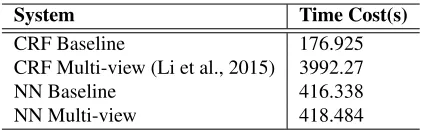
configura-tions on theCTB5training data. The CRF baseline is adapted from Li et al. (2015). All the systems are implemented in C++ running on an Intel E5-1620 CPU. The results are shown in Table 3.
The NN baseline model is slower than the CRF baseline model. This is due to the higher computa-tion cost of a deep neural network on a CPU. Com-pared with the CRF baseline, the CRF multi-view model is significantly slower because of its large fea-ture set and the multi-label search space. However, the NN multi-view model achieves almost the same time cost with the NN baseline, and is much more efficient than the CRF counterpart. This shows the efficiency advantage of the NN multi-view model by parameter sharing and output splitting.
7 Related Work
Early research on heterogeneous annotations fo-cuses on annotation conversion. For example, Gao et al. (2004) proposed a transformation-based method to convert the annotation style of a word segmentation corpus to that of another. Manually designed transformation templates are used, which makes it difficult to generalize the method to other
4
http://hlt.suda.edu.cn/zhli/resources/zhenghua-acl2015-resources.zip
tasks and treebanks.
Jiang et al. (2009) described a stacking-based model for heterogeneous annotations, using a pipeline to integrate the knowledge from one cor-pus to another. Sun and Wan (2012) proposed a structure-based stacking model, which makes use of structured features such as sub-words for model combination. These feature integration is stronger compared to those of Jiang et al. (2009). Johansson (2013) introduced path-based feature templates in using one parser to guide another. In contrast to the above discrete methods, our neural stacking method offers further feature integration by directly connect-ing the feature layer of the source tagger with the in-put layer of the target tagger. It also allows the fine-tuning of the source tagger. As one of the reviewers mentioned, two extensions of CRFs, dynamic CRFs (Sutton et al., 2004) and hidden-state CRFs (Quat-toni et al., 2004), can also perform similar deep in-tegration and fine-tuning.
For multi-view training, Johansson (2013) used a shared feature representation along with separate individual feature representation for each treebank. Qiu et al. (2013) proposed a multi-task learning model to jointly predict two labelsets given an in-put sentences. The joint model uses the union of baseline features for each labelset, without consid-ering additional features to capture the interaction between the two labelsets. Li et al. (2015) im-proves upon this method by using a tighter integra-tion between the two labelsets, treating the Carte-sian product of the base labels as a single combined labelset, and exploiting joint features from two la-belsets. Though capturing label interaction, their method suffers speed penalty from the sharply in-creased search space. In contrast to their methods, our neural approach enables parameter sharing in the hidden layers, thereby modeling label interaction without directly combining the two output labelsets. This leads to a lean model with almost the same time efficiency as a single-label baseline.
defined on heterogenous treebanks.
8 Conclusion
We investigated two methods for utilizing heteroge-neous annotations for neural network models, show-ing that they have respective advantages compared to their discrete counterparts. In particular, neural stacking allows tighter feature integration compared to discrete stacking, and neural multi-view training is free from the feature and efficiency constraints of discrete one. On a standard CTB test, the neu-ral method gives the best integration effect, with a multi-view training model enjoying the same speed as its single treebank baseline.
Acknowledgments
The corresponding author is Yue Zhang. We thank Zhenghua Li and Meishan Zhang for providing data and the anonymous reviewers for their constructive comments, which helped to improve the paper. This work is supported by Singapore Ministry of Educa-tion Tier 2 Grant T2MOE201301 and Natural Sci-ence Foundation of China (61379086).
References
Dzmitry Bahdanau, Kyunghyun Cho, and Yoshua Ben-gio. 2015. Neural machine translation by jointly learning to align and translate. In Proceedings of ICLR.
Sabine Brants, Stefanie Dipper, Silvia Hansen, Wolfgang Lezius, and George Smith. 2002. The tiger treebank. InProceedings of the workshop on treebanks and lin-guistic theories, volume 168.
Leo Breiman. 1996. Stacked regressions. Machine learning, 24(1):49–64.
Richard A Caruana. 1993. Multitask learning: A knowledge-based source of inductive bias1. In Pro-ceedings of the Tenth International Conference on Ma-chine Learning, pages 41–48. Citeseer.
Danqi Chen and Christopher D Manning. 2014. A fast and accurate dependency parser using neural net-works. InEMNLP, pages 740–750.
Xinchi Chen, Xipeng Qiu, Chenxi Zhu, Pengfei Liu, and Xuanjing Huang. 2015. Long short-term memory neural networks for chinese word segmentation. In
Proceedings of the Conference on Empirical Methods in Natural Language Processing.
Michael Collins, Philipp Koehn, and Ivona Kuˇcerov´a. 2005. Clause restructuring for statistical machine
translation. InProceedings of the 43rd annual meet-ing on association for computational lmeet-inguistics, pages 531–540. Association for Computational Linguistics. Ronan Collobert, Jason Weston, L´eon Bottou, Michael
Karlen, Koray Kavukcuoglu, and Pavel Kuksa. 2011. Natural language processing (almost) from scratch.
The Journal of Machine Learning Research, 12:2493– 2537.
Hal Daum´e III. 2007. Frustratingly easy domain adapta-tion. pages 256–263.
Marie-Catherine De Marneffe, Bill MacCartney, Christo-pher D Manning, et al. 2006. Generating typed de-pendency parses from phrase structure parses. In Pro-ceedings of LREC, volume 6, pages 449–454.
John Duchi, Elad Hazan, and Yoram Singer. 2011. Adaptive subgradient methods for online learning and stochastic optimization. The Journal of Machine Learning Research, 12:2121–2159.
Chris Dyer, Miguel Ballesteros, Wang Ling, Austin Matthews, and Noah A. Smith. 2015. Transition-based dependeny parsing with stack long short-term memory. In Proceedings of the 53rd Annual Meet-ing of the Association of Computational LMeet-inguistics and the7thInternational Joint Conference on Natural Language Processing of the Asian Federation of Natu-ral Language Processing (ACL-IJCNLP 2015). ACL. Thomas Emerson. 2005. The second international
chi-nese word segmentation bakeoff. In Proceedings of the fourth SIGHAN workshop on Chinese language Processing, volume 133.
Jianfeng Gao, Andi Wu, Mu Li, Chang-Ning Huang, Hongqiao Li, Xinsong Xia, and Haowei Qin. 2004. Adaptive chinese word segmentation. In Proceed-ings of the 42nd Annual Meeting on Association for Computational Linguistics, page 462. Association for Computational Linguistics.
David Graff and Ke Chen. 2005. Chinese gigaword.
LDC Catalog No.: LDC2003T09, ISBN, 1:58563– 58230.
Alex Graves and J¨urgen Schmidhuber. 2005. Frame-wise phoneme classification with bidirectional lstm and other neural network architectures. Neural Net-works, 18(5):602–610.
Sepp Hochreiter and J¨urgen Schmidhuber. 1997. Long short-term memory. Neural computation, 9(8):1735– 1780.
Zhiheng Huang, Wei Xu, and Kai Yu. 2015. Bidirec-tional lstm-crf models for sequence tagging. arXiv preprint arXiv:1508.01991.
Wenbin Jiang, Liang Huang, and Qun Liu. 2009. Au-tomatic adaptation of annotation standards: Chinese word segmentation and pos tagging: a case study. In
Joint Conference on Natural Language Processing of the AFNLP: Volume 1-Volume 1, pages 522–530. As-sociation for Computational Linguistics.
Wenbin Jiang, Yajuan , Liang Huang, and Qun Liu. 2015. Automatic adaptation of annotations. Compu-tational Linguistics, 41(1):1–29.
Richard Johansson and Pierre Nugues. 2007. Extended constituent-to-dependency conversion for English. In
Proceedings of NODALIDA 2007, pages 105–112, Tartu, Estonia, May 25-26.
Richard Johansson. 2013. Training parsers on incompat-ible treebanks. InHLT-NAACL, pages 127–137. Sigrid Klerke, Yoav Goldberg, and Anders Søgaard.
2016. Improving sentence compression by learning to predict gaze. arXiv preprint arXiv:1604.03357. Guillaume Lample, Miguel Ballesteros, Sandeep
Subra-manian, Kazuya Kawakami, and Chris Dyer. 2016. Neural architectures for named entity recognition.
arXiv preprint arXiv:1603.01360.
Zhenghua Li, Jiayuan Chao, Min Zhang, and Wenliang Chen. 2015. Coupled sequence labeling on hetero-geneous annotations: pos tagging as a case study. In
Proceedings of the 53rd Annual Meeting of the Associ-ation for ComputAssoci-ational Linguistics and the 7th Inter-national Joint Conference on Natural Language Pro-cessing, volume 1, pages 1783–1792.
Pengfei Liu, Shafiq Joty, and Helen Meng. 2015. Fine-grained opinion mining with recurrent neural networks and word embeddings. In Conference on Empirical Methods in Natural Language Processing (EMNLP 2015).
Ji Ma, Yue Zhang, and Jingbo Zhu. 2014. Tagging the web: Building a robust web tagger with neural network. In Proceedings of the 52nd Annual Meet-ing of the Association for Computational LMeet-inguistics (Volume 1: Long Papers), pages 144–154, Baltimore, Maryland, June. Association for Computational Lin-guistics.
Joakim Nivre and Ryan T McDonald. 2008. Integrating graph-based and transition-based dependency parsers. InACL, pages 950–958.
Wenzhe Pei, Tao Ge, and Baobao Chang. 2014. Max-margin tensor neural network for chinese word seg-mentation. InACL, pages 293–303.
Barbara Plank, Anders Søgaard, and Yoav Goldberg. 2016. Multilingual part-of-speech tagging with bidi-rectional long short-term memory models and auxil-iary loss. arXiv preprint arXiv:1604.05529.
Xipeng Qiu, Jiayi Zhao, and Xuanjing Huang. 2013. Joint chinese word segmentation and pos tagging on heterogeneous annotated corpora with multiple task learning. InEMNLP, pages 658–668.
Ariadna Quattoni, Michael Collins, and Trevor Darrell. 2004. Conditional random fields for object recogni-tion. Advances in Neural Information Processing Sys-tems, pages 1097–1104.
Richard Sproat and Thomas Emerson. 2003. The first international chinese word segmentation bakeoff. In
Proceedings of the second SIGHAN workshop on Chi-nese language processing-Volume 17, pages 133–143. Association for Computational Linguistics.
Weiwei Sun and Xiaojun Wan. 2012. Reducing approx-imation and estapprox-imation errors for chinese lexical pro-cessing with heterogeneous annotations. In Proceed-ings of the 50th Annual Meeting of the Association for Computational Linguistics: Long Papers-Volume 1, pages 232–241. Association for Computational Lin-guistics.
Charles Sutton, Andrew Mccallum, and Khashayar Ro-hanimanesh. 2004. Dynamic conditional random fields: Factorized probabilistic models for labeling and segmenting sequence data. InICML, pages 693–723. Heike Telljohann, Erhard W Hinrichs, Sandra K¨ubler,
Heike Zinsmeister, and Kathrin Beck. 2006. Style-book for the t¨ubingen treebank of written german (t¨uba-d/z). In Seminar fur Sprachwissenschaft, Uni-versitat Tubingen, Tubingen, Germany.
David Weiss, Chris Alberti, Michael Collins, and Slav Petrov. 2015. Structured training for neural network transition-based parsing. In Proceedings of the 53rd Annual Meeting of the Association for Computational Linguistics and the 7th International Joint Conference on Natural Language Processing (Volume 1: Long Pa-pers), pages 323–333, Beijing, China, July. Associa-tion for ComputaAssocia-tional Linguistics.
David H Wolpert. 1992. Stacked generalization. Neural networks, 5(2):241–259.
Dekai Wu, Grace Ngai, and Marine Carpuat. 2003. A stacked, voted, stacked model for named entity recognition. InProceedings of the seventh conference on Natural language learning at HLT-NAACL 2003-Volume 4, pages 200–203. Association for Computa-tional Linguistics.
Naiwen Xue, Fei Xia, Fu-Dong Chiou, and Marta Palmer. 2005. The penn chinese treebank: Phrase structure an-notation of a large corpus.Natural language engineer-ing, 11(02):207–238.
Nianwen Xue. 2003. Chinese word segmentation as character tagging. Computational Linguistics and Chinese Language Processing, 8(1):29–48.
Hiroyasu Yamada and Yuji Matsumoto. 2003. Statistical dependency analysis with support vector machines. In
Proceedings of IWPT, volume 3, pages 195–206. Yue Zhang and Stephen Clark. 2008. A tale of
and transition-based dependency parsing using beam-search. In Proceedings of the Conference on Empir-ical Methods in Natural Language Processing, pages 562–571. Association for Computational Linguistics. Yue Zhang and Stephen Clark. 2011. Syntactic
process-ing usprocess-ing the generalized perceptron and beam search.
Computational linguistics, 37(1):105–151.
Yuan Zhang and David Weiss. 2016. Stack-propagation: Improved representation learning for syntax. In Pro-ceedings of the 54th Annual Meeting of the Associa-tion for ComputaAssocia-tional Linguistics (Volume 1: Long Papers), pages 1557–1566. Association for Computa-tional Linguistics.
Meishan Zhang, Jie Yang, Zhiyang Teng, and Yue Zhang. 2016. Libn3l:a lightweight package for neu-ral nlp. In Nicoletta Calzolari (Conference Chair), Khalid Choukri, Thierry Declerck, Sara Goggi, Marko Grobelnik, Bente Maegaard, Joseph Mariani, He-lene Mazo, Asuncion Moreno, Jan Odijk, and Stelios Piperidis, editors, Proceedings of the Tenth Interna-tional Conference on Language Resources and Evalu-ation (LREC 2016), Paris, France, may. European Lan-guage Resources Association (ELRA).
Xiaoqing Zheng, Hanyang Chen, and Tianyu Xu. 2013. Deep learning for chinese word segmentation and pos tagging. InEMNLP, pages 647–657.
Jie Zhou and Wei Xu. 2015. End-to-end learning of se-mantic role labeling using recurrent neural networks. InProceedings of the Annual Meeting of the Associa-tion for ComputaAssocia-tional Linguistics.
Hao Zhou, Yue Zhang, Shujian Huang, and Jiajun Chen. 2015. A neural probabilistic structured-prediction model for transition-based dependency parsing. In