www.ijemst.com
Investigating the Effect of Different
Verbal Formats of Advance Organizers
on Third Graders’ Understanding of
Heat Transfer Concept
Hsueh-Hua Chuang1, Han-Chin Liu2 1 National Sun Yat-sen University 2
National Chiayi University
To cite this article:
Chuang, H-H. & Liu, H-C. (2014). Investigating the effect of different verbal formats of
advance organizers on third graders’ understanding of heat transfer concept.
International
Journal of Education in Mathematics, Science and Technology, 2
(1), 78-84.
This article may be used for research, teaching, and private study purposes.
Any substantial or systematic reproduction, redistribution, reselling, loan, sub-licensing,
systematic supply, or distribution in any form to anyone is expressly forbidden.
Authors alone are responsible for the contents of their articles. The journal owns the
copyright of the articles.
Volume 2, Number 1, January 2014, Page 78-84
ISSN: 2147-611X
Investigating the Effect of Different Verbal Formats of Advance Organizers
on Third Graders’ Understanding of Heat Transfer Concept
Hsueh-Hua Chuang1, Han-Chin Liu2* 1
National Sun Yat-sen University 2 National Chiayi University
Abstract
The emergence of computer and multimedia technology change the forms of instructional materials and instructional design plays an important role on student learning outcome in multimedia learning. Research has found that using advance organizers has the potential for achieving learning objectives. Thus, this study investigated how using different forms (oral narration/onscreen text) of advance organizers (AOs) with different formats (oral narration/onscreen text) of learning content affected third graders’ learning on heat transfer concepts. A 2X2 design was employed and 126 third grade students participated in this study. It was found in the form of advance organizers that there was a significant interaction with the format of learning content on student post test performance. The form of AOs did not affect student performance when reading onscreen text content. Also, the format of the learning content did not influence student learning when using oral forms of AO. When using onscreen text as AO, it was found that students who read onscreen text content perform better than those who listen to oral narration content. Meanwhile, students who listened to the oral narration AO perform better than those who read the onscreen text AO before listening to the same oral narration learning content. It showed that processing message encoded in the same format in advance help learners later in processing information that was encoded in the same format. Detailed discussions on the findings are provided in this article.
Key words: Advance organizer, multimedia learning, science education, web-based learning
Introduction
The emerging e-learning technology and instructional design have broken the limit of time and space for learning to occur. E-learning has affected learning situations in the K-12 level. Today’s classrooms are equipped with personal computers, projectors, and interactive blackboards; and all of them are Internet connected. To achieve learning objectives, digital age learners are required to process information encoded in different forms through different delivery technologies such computer screens, screen projections, and handheld devices. However, processing information encoded in multiple modalities can be cognitive demanding because of the limited capacity of working memory of each individual (Mayer, 2001). Baddeley (2003) proposed a model of working memory system based on Miller’s (1956) 7 plus/minus 2 principle indicating that individuals process visual and verbal information separately in working memory. Mayer (2001) proposed a cognitive theory of multimedia learning (CTML) based on Paivio’s (1986) dual-coding theory and Sweller’s (1994) cognitive load theory indicating that learners process text and pictorial information through two channels namely visual and verbal channels respectively in working memory. Because of the limited capacity of working memory, processing excessive amount of information in working memory can overload one’s cognitive capacity and only selected information can be processed. As a result, the learner’s cognitive ability plays an important role in determining the effectiveness of multimedia on one’s understanding of learning contents encoded in multimodalities.
When multimedia becomes popular and is often the major medium in delivering instructional contents in today’s learning environments, it has invited research to further investigate effective multimedia design for learners of various levels in various domains. Recent studies have investigated the impact of multimedia environments on learning in various disciplines both in science and social science domains (Arguel & Jamet,
*
79
IJEMST (International Journal of Education in Mathematics, Science and Technology)
2009; Atkinson, Mayer, & Merrill, 2005; De Westelinck, Valcke, De Craene, & Kirschner, 2005; She & Chen, 2009). However, a majority of the studies tested the effectiveness of multimedia learning on learners in the college level. Only a few empirical studies have redirected their attention toward learners in K-12 levels to realize the impact of multimedia on learners’ understanding of multimedia content. Meanwhile, learners of different prior knowledge are placed in a context in which learning materials can be encoded in different forms of presentations and delivered by a variety of emerging digital technologies. Information encoded in different representations has different degrees of impact on individuals with different backgrounds and abilities in interpretation of the messages depicting the learning content. Therefore, research has argued that it is the instructional design rather than the media that plays an important role in affecting learning in multimedia learning environments (Clark, 1994).
The concept of advance organizers was first proposed by Ausubel (1968) as an instructional strategy offering lesson-related summaries prior to primary learning/reading activities to help learners recall and integrate prior knowledge with to-be-learned information. Presenting summarized information related to lesson content before proceeding to the main learning activity is believed to make such content more meaningful to learners (Ausubel, 1968; Dembo, 1991). Although early studies found positive results on student learning from advance organizers (Ausubel & Fitzgerald, 1961, 1962; Ausubel & Youssef, 1963; Fitzgerald & Ausubel, 1963), recent studies (Luiten, Ames, & Ackerson, 1980; Stone, 1983; Gil-Garcia & Villegas, 2003; Millet, 2000) examining various types and formats of advance organizers have reported inconclusive results. The effectiveness of advance organizers is likely to remain undetermined when more variables, like types and formats, are taken into account. As a result, more studies are needed to examine the interactions of learners’ prior knowledge and formats of information on affecting learners’ cognitive load and achievement when advance organizer intervention is used in the multimedia learning environments. The purpose of this study is to explore the impact of different types of advance organizer learning strategies on third graders’ understanding of heat transfer concept in a multimedia environment in which learning contents were encoded in different types of verbal information.
Related Literature review
Advance organizers
who have insufficient prior knowledge or capability, and might be more effective with respect to knowledge transfer rather than retention.
Later reviews of advance organizer studies have reported their overall positive effects on learning; however, controversial results have been produced when additional variables were taken into account (Luiten, Ames, & Ackerson, 1980; Stone, 1983). Luiten, Ames, and Ackerson (1980) reviewed 135 studies and found overall positive effects of advance organizers on learning as measured by student performance on immediate and retention tests. However, their review did not find effects favoring student ability. Stone’s (1983) review echoed Luiten, Ames, and Ackerson’s findings that advance organizers positively impacted student learning. Meanwhile, similarly to Luiten, Ames, and Ackerson’s analysis, learner ability and grade level were not found to be associated with the effects of advance organizers on student learning. Although Luiten, Ames, and Ackerson (1980) suggested that oral forms of advance organizers seemed to work best, Stone (1983) found that only written forms worked in facilitating learning. Other recent studies have also found results in favor of using advance organizers, along with a variety of other instructional strategies, as an effective support strategy. For example, in Box’s (2003) study, social-studies material was presented in the form of advance organizers incorporating a Jigsaw cooperative learning approach in order to support third-grade students’ self-concept and academic achievement in a social studies course. Students’ self-concept was found to be improved by such instructional strategy, while a significant decline was found in the control group class. The author suggests that incorporating collaborative learning with advance organizers is likely to have a positive impact on student self-concept and achievement. Echoing Box’s suggestion, Barbosa, Marques, and Torres (2005) used a series of six diagrams as advance organizers to help students understand metabolic pathways of particular types of bacteria. Students were asked to work in groups to solve one problem without access to the textbook and using only these diagrams. The diagrams were found to promote interactions among group members. Faculty members and students in this study responded that such instructional strategy was productive in achieving student understanding of complex metabolic processes of different types of bacteria.
With the emergence of multimedia learning, recent studies have examined effects of different styles of advance organizers such as printed and onscreen text, oral description, graphics, concept maps, video, animation, and hypermedia on student learning (Herron, York, Cole, & Linden, 1998; Barbosa, Marques, & Torres, 2005; Lin & Chen, 2006; Chen, Hirumi, & Zhang, 2007; Lagerwerf, Cornelis, de Geus, & Jansen, 2008). Some researchers have compared the effect of graphics-based to verbal forms of advance organizers. Herron, York, Cole, and Linden (1998) investigated the structure of oral advance organizers on students’ foreign language learning. They had sixty-seven beginning college students receive 3 conditions of instructional strategies in learning French. Their results showed no significant effect resulting from the type of structure of the oral advance organizers, while a significantly positive effect from the use of advance organizers was found. Controversial results have also been found in later studies. Lagerwerf, Cornelis, de Geus, and Jansen (2008) tested the impact of oral and graphic-based advance organizers on 159 professional readers’ selective reading, recall, and perception. After reading large documents constrained by time limits, readers’ selective reading skills were found to be improved by graphical advance organizers. Meanwhile, readers’ recall of the reading content was facilitated by verbal advance organizers presented in problem descriptions. In general, Lagerwerf et al. found that verbal advance organizers in the style of problem descriptions was effective in facilitating recall, while graphic advance organizers were found to help readers read more selectively and experience enhanced recall. The authors also found that graphic organizers reinforce the quality of the text structure because poor recalls were found when graphic organizers were used in poorly structured text.
81
IJEMST (International Journal of Education in Mathematics, Science and Technology)
different prior knowledge levels on their comprehension of heat transfer concept that was encoded in web-based multimedia format.
Method
This study sought to investigate if different types of advance organizers affected third graders on their understanding of the learning content in a web-based multimedia environment in which the learning content was encoded in different types of verbal information. The details of the methods implemented in this study are described in the following sections.
Participants and design
A total of 251 third grade students participated in this study each student read a web-based learning content in which different types of advance organizers (oral narration vs. onscreen text) were integrated with different formats of learning content (oral narration vs. onscreen text). As a result, a 2x2 factorial design was employed to attain the research purpose. Students were randomly assigned into either oral narration advance organizer (nAO) or onscreen text advance organizer (tAO) group. Therefore, there were 125 students in the nAO group and 126 students in the tAO group. In each advance organizer (AO) group, students were also randomly assigned to read either oral narrative content (NC) or onscreen text content (TC) as the main reading material. As a result, 63 NC and 62 TC students were assigned in the nAO group while 63 NC and 63 TC students were assigned in the tAO group .
Instructional materials
Two sets of multimedia presentations were developed and the learning material for this study. The material was either encoded in onscreen text or oral narration format with accompanied illustrations. Each set of presentation includes three multimedia web pages depicting basic principles of heat transfer. An example of the web page is shown in Figure 1. Prior to each presentation, a web page on which a summary of the heat transfer encoded in either oral narration or onscreen text format was presented to the participants as the advance organizer for the learning content.
Figure 1. An example of the web-based learning presentation.
Instruments
Procedure
The participants were asked to read the learning material on a computer screen. The first web page served as the advance organizer for the main learning content. The advance organizer content was encoded in either oral narration or onscreen text format. The advance organizer was followed by the main learning content web pages on which the verbal content was encoded in either oral narration or onscreen text format. The participants were allowed to click on the link for next web page when they finish reading the learning content on each individual web page. A post test was given to the participants to test their understanding of the learning content after they finish reading the learning content.
Data Analysis
A MANCOVA was employed using the type of advance organizer and type of the learning content as the independent variables and participants’ post test score as the dependent variable by controlling the participants’ language ability.
Results
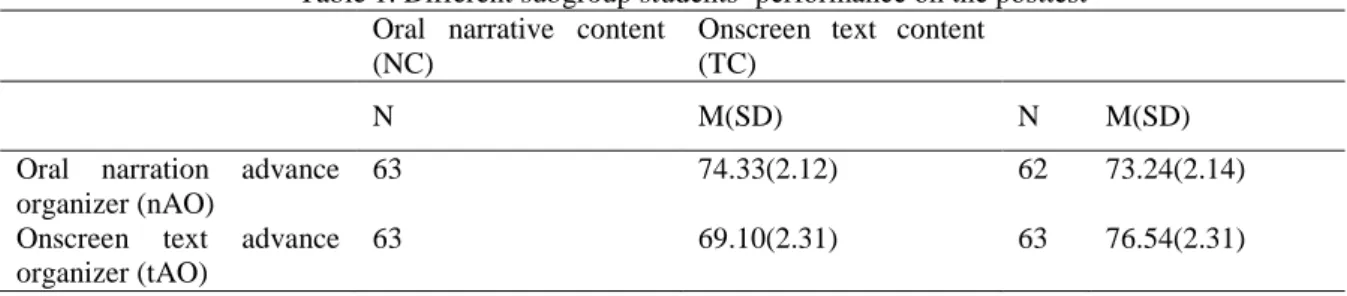
No significant of main effect from either the type of advance organizers (F=.48, p=.49) or the type of learning content (F=3.27, p=.072) on student post test performance. However, the type of advance organizers was found to significantly interact with the type of content on affecting student post test performance (F=4.02, p=.046). Within group t-tests was performed to test the effect of different types of advance organizer and content on student performance.
Within the nAO group, no significant differences were found between NC and TC subgroup students’ performance (F=.11, p=.75). However, a significant difference was found between the performance of the TC and NC subgroup within the tAO group (F=5.029, p=.027). Using on onscreen text as the advance organizer, students who read onscreen text content (M=76.54, SD=2.31) were found to perform better than those who listen to oral narration content (M=69.10, SD=2.31). Meanwhile, within NC group, the nAO subgroup (M=74.33, SD=2.12) was found to perform significantly better than the tAO subgroup on post test performance (F=5.91, p=.016). However, no significances were found between the performance of nAO and tAO subgroups within TC group (F=.45, p=.50). The mean and standard deviation of each subgroup is presented in Table 1.
Table 1. Different subgroup students’ performance on the posttest Oral narrative content
(NC)
Onscreen text content (TC)
N M(SD) N M(SD)
Oral narration advance organizer (nAO)
63 74.33(2.12) 62 73.24(2.14)
Onscreen text advance organizer (tAO)
63 69.10(2.31) 63 76.54(2.31)
83
IJEMST (International Journal of Education in Mathematics, Science and Technology)
attributes of oral advance organizers on learners with different ages, prior knowledge levels, and learning style in order to explore the effectiveness of the use of advance organizers in multimedia learning environments.
Conclusion
In digital age, emerging technologies have changed the forms of instructional material; however, instructional design is still advanced as a potentially important component in determining the effectiveness of digitized learning methodology on student learning. Research has found that using advance organizers has the potential in achieve learning, we found that the format of advance organizers seemed to have an impact on learners’ processing of different formats of learning content. Because the concept of advance organizer intervention originated from cognition theories, studies should examine its effectiveness from cognitive perspectives.
References
Arguel, A., & Jamet, E. (2009). Using video and static pictures to improve learning of procedural contents.
Computers in Human Behavior, 25(2), 354-359.
Atkinson, R. K., Mayer, R. E., & Merrill, M. M. (2005). Fostering social agency in multimedia learning: Examining the impact of an animated agent's voice. Contemporary Educational Psychology, 30(1), 117-139.
Ausubel, D. P. (1960). The use of advance organizers in the learning and retention of meaningful verbal material. Journal of Educational Psychology,51(5), 267–272.
Ausubel, D. P. (1968). Educational psychology: A cognitive view. New York: Holt, Rinehart & Winston. Ausubel, D. P. (2000). The acquisition and retention of knowledge: A cognitive view. Boston: Kluwer Academic
Publishers.
Ausubel, D. P., & Fitzgerald, D. (1961). The role of discriminability in meaningful parallel learning and retention. Journal of Educational Psychology, 52, 266-274.
Ausubel, D. P., & Fitzgerald, D. (1962). Organizer, general background, and antecedent learning variables in sequential verbal learning. Journal of Educational Psychology, 53, 243-249.
Ausubel, D. P., & Robinson, F. G. (1969). School learning: An introduction to educational psychology. New York-Holt, Rinehart & Winston.
Ausubel, D. P., & Youssef, M. (1963). The role of discriminability in meaningful parallel learning. Journal of
Educational Psychology, 54, 331-336.
Baddeley, A. (2003). Working memory: Looking back and looking forward. Nature Reviews Neuroscience, 4(10), 829-839.
Barbosa, H., Marques, M., & Torres, B. (2005). An Advance Organizer for Teaching Bacterial Metabolism.
Biochemistry and Molecular Biology Education, 33(4), 265-268.
Box, J. (2003). Cooperative Small-Group Instruction Combined with Advanced Organizers and Their Relationship to Self-Concept and Social Studies Achievement of Elementary School Students. Journal
of Instructional Psychology, 30(4), 285-287.
Chen, B., Hirumi, A., & Zhang, N. (2007). Investigating the Use of Advance Organizers as an Instructional Strategy for Web-Based Distance Education. Quarterly Review of Distance Education, 8(3), 223-231. Clark, R. E. (1994). Media Will Never Influence Learning. Etr & D- Educational Technology Research and
Development, 42(2), 21-29.
De Westelinck, K., Valcke, M., De Craene, B., & Kirschner, P. (2005). Multimedia learning in social sciences: limitations of external graphical representations. Computers in Human Behavior, 21(4), 555-573. Dembo, M. H. (1991). Applying educational psychology in the classroom. (4th edition). New York: Longman. Driscoll, M. P. (1999). Meaningful learning and schema theory. In M. P. Driscoll (Ed.), Psychology of learning
for instruction (2nd ed., pp. 113-151). Needham Heights, MA: Allyn & Bacon.
Fitzgerald, D., & Ausubel, D. P. (1963). Cognitive versus affective factors in the learning and retention of controversial material. Journal of Educational Psychology, 54, 73-84.
Gil-Garcia, A., & Villegas, J. (2003, June). Engaging minds, enhancing comprehension and constructing
knowledge through visual representations. Paper presented at the Conference on Word Association for
Case Method Research and Application, Bordeaux, France.
Herron, C., York, H., Cole, S., & Linden, P. (1998). A Comparison Study of Student Retention of Foreign Language Video: Declarative Versus Interrogative Advance Organizer. Modern Language
Lagerwerf, L., Cornelis, L., de Geus, J., & Jansen, P. (2008). Advance Organizers in Advisory Reports: Selective Reading, Recall, and Perception. Written Communication, 25(1), 53-75.
Lin, H., & Chen, T. (2006). Decreasing Cognitive Load for Novice EFL Learners: Effects of Question and Descriptive Advance Organizers in Facilitating EFL Learners' Comprehension of an Animation-Based Content Lesson. System: An International Journal of Educational Technology and Applied Linguistics, 34(3), 416-431.
Luiten, J., Ames, W., & Ackerson, G. (1980). A meta-analysis of the effects of advance organizers on learning and retention. Review of Educational Research, 17(2), 11-218.
Mayer, R. E. (1979). Twenty years of research on advance organizers: Assimilation theory is still the best predictor of results. Instructional Science, 8(2), 133-167.
Mayer, R. E. (2001). Multimedia learning. New York: Cambridge University Press.
Miller, G. A. (1956). The Magical Number 7, Plus or Minus 2 - Some Limits on Our Capacity for Processing Information. Psychological Review, 63(2), 81-97.
Millet, C. P. (2000). The effects of graphic organizers on reading comprehension achievement of second grade
students (Unpublished doctoral dissertation). University of New Orleans, New Orleans.
Paivio, A. (1986). Mental representation: A dual coding approach. New York: Oxford University Press. She, H.-C., & Chen, Y.-Z. (2009). The impact of multimedia effect on science learning: Evidence from eye
movements. Computers & Education, 53(4), 1297-1307.
Stone, C. L. (1983). A meta-analysis of advanced organizer studies. Journal of Experimental Education, 51(4), 194-199.