Multilevel LDPC Codes Design for Multimedia
Communication CDMA System
Jia Hou
Institute of Information and Communication, Chonbuk National University, Chonju 561-756, Korea Email:[email protected]
Yu Yi
Institute of Information and Communication, Chonbuk National University, Chonju 561-756, Korea Email:[email protected]
Moon Ho Lee
Institute of Information and Communication, Chonbuk National University, Chonju 561-756, Korea Email:[email protected]
Received 25 October 2003; Revised 25 February 2004
We design multilevel coding (MLC) with a semi-bit interleaved coded modulation (BICM) scheme based on low density parity check (LDPC) codes. Different from the traditional designs, we joined the MLC and BICM together by using the Gray mapping, which is suitable to transmit the data over several equivalent channels with different code rates. To perform well at signal-to-noise ratio (SNR) to be very close to the capacity of the additive white Gaussian noise (AWGN) channel, random regular LDPC code and a simple semialgebra LDPC (SA-LDPC) code are discussed in MLC with parallel independent decoding (PID). The numerical results demonstrate that the proposed scheme could achieve both power and bandwidth efficiency.
Keywords and phrases:multilevel coding, BICM, LDPC, PID.
1. INTRODUCTION
In the next generation of code division multiple access (CDMA) system, the primary challenge is high-quality and high data rate multimedia communication. Normally, the mobile transmission systems deal with various kinds of infor-mation such as voice, data, and images. The volume of traffic required is therefore far higher than current voice or data-based applications. This increase in traffic rates is expected to become even more serious when full interactive multi-media transfers are required. As the information volume in-creases, so does the required instantaneous transmission rate. Table 1shows an estimate of the bit rates required for vari-ous multimedia services. It implies that the next generation of CDMA transmission should be of higher data rate, mul-tilevel, or multirate, such as wideband CDMA (WCDMA), adaptive modulation, and so on. Coded modulation is a good choice for multimedia communication CDMA system, since it can efficiently combine various rate channel coders into the modulation. Multilevel coding (MLC) [1] and semi-bit in-terleaved coded modulation (BICM) [2] are two well-known coded modulation schemes proposed to achieve both power
Table1: Typical application bit rates for multimedia services.
Types of data Types of services Bit rate
Voice/audio CBR, low delay 8–256 kbps
Digital data ABR/UBR, low error 0.1–10 Mbps
Video telephony
(H261) CBR, low error 64–384 kbps
Motion video
(MPEG1/MPEG2) CBR/VBR, low delay 1.5–6 Mbps
numerical results show that the proposed scheme can offer one lower rate channel and two higher rate channel in 8PSK transmission, and it can be applied for 256 kbps voice trans-mission and about 1 Mbps higher rate data transtrans-mission si-multaneously with low error and low delay. For instance, when 256 kbps voice data is inR=0.510 lower rate channel, the two parallel higher rate channelsR=0.745 can transmit about 900 kbps data for 8PSK modulation.
The outline of this paper is as follows. InSection 2, we in-troduce the system model and capacity results. InSection 3, we first discuss the concept of the proposed MLC/PID with semi-BICM construction and prove that the capacity of the proposed scheme is the same as that of the traditional de-signs. Next, we introduce the SA-LDPC code construction and its design criterion. Finally,Section 4concludes the pa-per.
2. SYSTEM MODEL AND CAPACITY
The typical structures of the LDPC-coded MLC scheme and BICM scheme are shown inFigure 1. In the case of LDPC-coded MLC/PID, each option of bitci,i = 0, 1,. . .,m−1,
is protected by a different binary LDPC code ofCi length
n and rate Ri = k
i/n, where ki is the information word
length in bits. The Gray mapping maps a binary vectorc= (c0,. . .,cm−1) to a symbol pointx ∈A, whereAis the
sym-bol set and|A| =2m, as shown inFigure 2. We consider a
dis-crete equivalent AWGN channel model, wherezandyare the channel noise and channel output, respectively. The spectral efficiencyRs(bit/symbol) of the scheme is equal to the sum
of the component code rates, that is,Rs =
m−1
i=0 Ri. In [6], Hou et al. proposed an LDPC-coded MLC/PID which uses mLDPC component codes. In the case of BICM, normally, it requires only one encoder. The capacity of the BICM scheme is the same as the performance limit that can be achieved by the MLC/PID [1,2,6].
Since theci,i=0, 1,. . .,m−1, are independent of each
other in the PID model, the capacity function can be shown as
whereYpresents the received signals, and the maximum in-dividual rate at levelito be transmitted at arbitrary low error rate is bounded by
Ri≤IY,C i
, i=0, 1,. . .,m−1. (2)
Consequently, the total rateRsis restricted to
Rs=
We consider here an AWGN channel characterized by a tran-sition probability density functionp(yk|xk) given by
pykxk
where dx,y designates the Euclidean distance between the
complex signals xk and yk, andσ2 is the variance of
com-plex zero mean Gaussian noise. In [6,7] the independent PID subchannel capacity is given by
Ri=1−E
and then the totalRscan be obtained by
Rs=
ci designate the subset of all symbols a ∈ Awhose labels
have the valueci ∈ {0, 1}in positioni.Figure 3shows the
capacity results for a Gray-mapped 8PSK modulation on an AWGN channel [1,6]. Note thatI(Y,C1)= I(Y,C2), since the Gray labeling forc1andc2 differs only by a rotation of 90◦, as shown inFigure 2. According to the capacity results, the component code rate distribution atRs=2 bit/symbol is
R0/R1/R2=0.510/0.745/0.745 for PID [1,6].
3. PROPOSED MLC/PID WITH SEMI-BICM SCHEME BASED ON LDPC CODES
LDPC 0
Figure1: Structure of (a) MLC/PID, (b) BICM, and (c) MLC/PID with BICM by using LDPC codes.
011
Figure2: 8PSK Gray mapping.
BICM design [2], to achieve the capacity of two equivalent channels. There are two advantages. First, we use a larger bi-nary encoder (lower density) with the same rate as before; it can improve the performance well. The number of com-ponent codes is reduced, but the demerits arise due to the double length of codeword. Second, the bit interleaver af-ter LDPC encoders can serve as a channel inaf-terleaver to
per-0
Figure3: Capacities of the equivalent subchannels of an MLC/PID scheme based on 8PSK with Gray mapping over AWGN channels.
LDPC 0
PID scheme for semi-BICM MLC/PID with semi-BICM structure
LDPC 0
LDPC 1 Rate=0.510
Rate=0.745 Code length:n
Code length: 2n
Semi-BICM
Figure4: Structure of the MLC/PID with semi-BICM by using LDPC codes for 8PSK modulation.
Table2: Comparing the gain from bit interleaver and lower density based on regular LDPC codes (PN interleaver, 8PSK Gray mapping, 1/2 code rate, column weight=3, AWGN channel).
Eb/N0 H(1536×3072) H(1536×3072) H(3072×6144)
no interleaver with bit interleaver no interleaver, larger size
3 dB BER=0.2368 BER=0.1491 BER=0.1503
case, as shown inTable 2. For an 8PSK modulation, we can write the channel capacity of the proposed scheme as follows [2,8]: where two equivalent BICM channels are used. In addition, the one residual channel according to MLC/PID can be pre-sented as
Thus the total capacity of the proposed scheme can be given by
Cproposal=CBICM+CMLC
=Ec,y
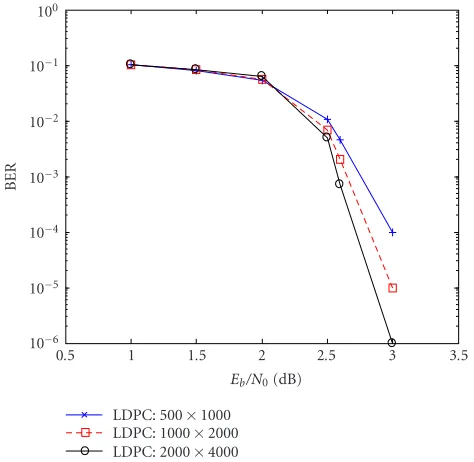
it is the same as the capacity of the 8PSK BICM and MLC/PID which were shown in [1]. The advantage from lower density is shown in Figure 5; the simulation results demonstrate that the two times larger LDPC code can get about 0.2 dB improvement from the smaller LDPC code in BPSK-AWGN channel at the required BER=0.0001.
SA-LDPC construction
To optimize LDPC component code in MLC/PID scheme, we now investigate a new construction which is called semial-gebra LDPC code (SA-LDPC). In [9], a semistructure which can simply extend the regular LDPC code to an irregular case was introduced. Based on this idea, we extend algebra LDPC code [4] to an SA-LDPC to obtain a very good performance and reduce the encoding complexity [5]. Following the no-tations of [9] to describe the quasi-random matrix pattern, we can create parity check matrix composed of two subma-trices,H= Hp|Hd.Hpis anM×Msquare matrix andHd
is anM×(n−M) matrix. TheHpmatrix is a dual-diagonal
pattern. An example is shown as
10−6
10−5
10−4
10−3
10−2
10−1
100
BER
0.5 1 1.5 2 2.5 3 3.5
Eb/N0(dB)
LDPC: 500×1000 LDPC: 1000×2000 LDPC: 2000×4000
Figure5: Regular LDPC codes withr=3 and different matrix sizes.
wherenis the code length andM is the parity bits length. Corresponding to the parity check submatrices are sub-vectors,up, the parity check vector,ud, and the information
vector of the codeword vector,u, such that
Hpup=Hdud. (11)
Given an arbitrary information vector, we can generate code-word vectors by considering theprojection vector,v,
Hpup=v=Hdud. (12)
Especially, we can note that [Hp]−1 = Up, whereUp is the
upper triangular matrix and thus
up=Upv. (13)
In each case, we can obtainupby first calculatingvand then
transformingv. In the following, we develop a process to cre-ateHd based on algebraic theory. We can partitionHdinto
blocks oft×tmatrices,tis aprimeinteger. An (r,l)Hd
ma-trix with lengthl×t, wherer is the column weight andlis the row weight ofHd, can be designed as the following three
steps [4].
(1) LetBi
r,l be an It×t identity matrix located at the rth
block row andlth block column of parity check matrix having its rows shifted to the rightimodtpositions for i∈S= {0, 1, 2,. . .,t−1}.
(2) Aq exists such thatql ≡ 1(modt),Scan be divided
into several sets ofLand one set containing the integer s, such asL = {s,sq,sq2,. . .,sqms−1}, wheremsis the smallest positive integer satisfyingsqms≡s(modt). (3) The locations of 1’s inHdcan be determined using the
setsL1,. . .,Lrand the parametert.
Table3: Permutation numbers of sets.
s/ms sqms≡s(modt) L= {s,sq,sq2,. . .,sqms−1}
s=0/ms=1 0·2ms=0(mod 31) {0}
s=1/ms=5 1·2ms=1(mod 31) {1, 2, 4, 8, 16}
s=3/ms=5 3·2ms=3(mod 31) {3, 6, 12, 24, 17}
s=5/ms=5 5·2ms=5(mod 31) {5, 10, 20, 9, 18}
s=6/ms=5 6·2ms=6(mod 31) {6, 12, 24, 17, 3}
s=7/ms=5 7·2ms=7(mod 31) {7, 14, 28, 25, 19}
s=9/ms=5 9·2ms=9(mod 31) {9, 18, 5, 10, 20}
s=10/ms=5 10·2ms=10(mod 31) {10, 20, 9, 18, 5}
s=11/ms=5 11·2ms=11(mod 31) {11, 22, 13, 26, 21}
s=12/ms=5 12·2ms=12(mod 31) {12, 24, 17, 3, 6}
s=13/ms=5 13·2ms=13(mod 31) {13, 26, 21, 11, 22}
s=14/ms=5 14·2ms=14(mod 31) {14, 28, 25, 19, 7}
s=15/ms=5 15·2ms=15(mod 31) {15, 30, 29, 27, 23}
H93p×93 Hd93×155
B1
1,1 B1,22 B41,3 B1,48 B1,516
B3
2,1 B2,26 B122,3 B2,424 B2,517
B5
3,1 B3,210 B203,3 B3,49 B3,518
Figure6: Example of the SA-LDPC code.
For example, we can design a SA-LDPC code withr=3, l=5, andt=31. According toqt ≡1(modt), we getq=2
and the parity check matrix is
H=H93p×93H93d×155
, (14)
and its code rate is
code rate= n−M
n =0.625. (15)
Based on the second step of Hd construction, we can
show the setLi,i= {0, 1, 2,. . ., 13}, distributions inTable 3,
and the location of 1’s inHdcan be decided byL1,L2,L r=3.
As a result, the semialgebra parity check matrix is shown in Figure 6, where the dotted lines represent entries of 1 inH, while other entries are 0.
The simulation results of SA-LDPC codes are shown in Figure 7. It can be seen that the SA-LDPC can achieve about 0.5 dB enhancement from random regular LDPC codes [3] by using a very simple structure which only consists of sev-eral selected permutation matrices at the required BER = 0.0001.
10−5
10−4
10−3
10−2
10−1
100
BER
1 1.5 2 2.5 3
Eb/N0(dB)
Regular LDPC: 663×1326 (R=0.5) SA-LDPC: 663×1326 (t=221) Regular LDPC: 723×2651 (R=0.7273) SA-LDPC: 723×2651 (t=241)
Figure7: Performance of SA-LDPC codes compared with random construction regular LDPC codes.
Since we cannot find a suitable SA-LDPC code for a given code rate, we now construct the SA-LDPC code with an ap-proximate rate according to the given one. A code rate from the SA-LDPC can be written as
code rate=n−M
n =
tl tl+tr =
l
l+r. (16)
In the proposed scheme, we should have R0 = 0.510 with code lengthnandR1=0.745 with code length 2n. Therefore, whenr =3, we have
R0= l0
l0+ 3 =0.510,
R1= l1
l1+ 3 =0.745,
(17)
and thus we obtainl0≈3 andl1≈8. By considering the code length, we should calculate
t0l0+t0r =t1l1 +t1r 2 ,
t0
l0+r=t1 2
l1+r,
t0(3 + 3)=t
1 2(8 + 3), t0
t1 =11
12,
(18)
where t0,t1 are the nearest prime numbers fromt0,t1, re-spectively. It also implies that we need to insert several zeros to keep the balance of the code lengthn. According to these parameters, we may design such SA-LDPC codes which can be suitable for the proposed MLC/PID scheme.
10−8
10−7
10−6
10−5
10−4
10−3
10−2
10−1
100
BER
3.5 4 4.5 5 5.5 6 6.5 7 7.5 8 8.5 9
Eb/N0(dB) C0in MLC/PID with BICM (R=0.510) C1in MLC/PID with BICM (R=0.745) C2in MLC/PID with BICM (R=0.745) C1in MLC/PID with semi-BICM (R=0.745) C0in MLC/PID with semi-BICM (R=0.510)
Figure 8: MLC/PID with semi-BICM scheme by using random construction regular LDPC codes (length ofC1is 2800).
Simulation results
From signal yk, the logarithm of likelihood ratio (LLR),
Λ(ck,i) associated with each bitck,i,i∈ {0, 1,. . .,m−1}, and
k ∈ {0, 1,. . .,n−1}, is computed and used as a soft deci-sion in the binary LDPC decoder. Over an AWGN channel, the LLRsΛ(ck,i) are obtained as
Λck,i
=Klog
a∈Ai,ci=0p
yka
a∈Ai,ci=1p
yka
=K
log
a∈Ai,ci=0exp
−d2
a,y/σ2
a∈Ai,ci=1exp
−d2
a,y/σ2
,
(19)
10−8
10−7
10−6
10−5
10−4
10−3
10−2
10−1
100
BER
3.5 4 4.5 5 5.5 6 6.5 7 7.5 8 8.5 9
Eb/N0(dB) C0in MLC/PID with BICM (R=0.510) C1in MLC/PID with BICM (R=0.745) C2in MLC/PID with BICM (R=0.745) C1in MLC/PID with semi-BICM (R=0.745) C0in MLC/PID with semi-BICM (R=0.510)
Figure 9: MLC/PID with semi-BICM scheme by using random construction regular LDPC codes (length ofC1is 1400).
the numerical result demonstrates that the proposed scheme can achieve about 0.15 dB when a rate 0.745 smaller LDPC code is used asC1, at the required BER = 10−6, as shown inFigure 9. Otherwise, as shown inFigure 10, the SA-LDPC code can obtain much enhancement from random construc-tion regular LDPC code, however, it should pay the loss of bandwidth efficiency, and its design parameters are hard to be decided. In the simulation, the lower rate code R = 0.5 and higher rate codeR=0.7273, code lengths are 1326 and 2651, respectively. Since the weight-two codes have the er-ror floor, the SA-LDPC code in the proposed scheme cannot outperform sharply after 8.4 dB, as shown inFigure 10.
4. CONCLUSION
In this paper, we investigate a novel MLC/PID with semi-BICM scheme which could be applied for multimedia CDMA communication systems. Otherwise, a new SA-LDPC code construction is discussed. It is introduced in this pa-per to approach the Shannon limit and simple generator im-plementation over AWGN channel. However, for MLC/PID design, the parameters of SA-LDPC code are difficult to be decided. Generally, in the special case, the SA-LDPC code can be used to design MLC system with good performance and very simple implementation. Normally, the random con-struction LDPC codes can be widely used in MLC design to achieve the bandwidth efficiency for any given rates.
Moreover, the performance of the MLC/PID with semi-BICM scheme will be improved even though a turbo code is used, because a turbo code with large length has good
perfor-10−8
10−7
10−6
10−5
10−4
10−3
10−2
10−1
100
BER
3.5 4 4.5 5 5.5 6 6.5 7 7.5 8 8.5 9
Eb/N0(dB)
Random regular LDPC (R=0.745,n=2800) Random regular LDPC (R=0.510,n=1400) SA-LDPC (R=0.5,t=221)
SA-LDPC (R=0.7273,t=241)
Figure10: MLC/PID with semi-BICM scheme by using SA-LDPC codes over AWGN channel.
mance due to the large size of a random interleaver. However, by comparing with turbo codes, the LDPC codes have sim-ple decoding and better performance to approach the error correction capacity, as mentioned in [3,6].
ACKNOWLEDGMENT
This work was supported in part by University IT Re-search Center Project, Ministry of Information and Com-munication, and Korea Science and Engineering Foundation (KOSEF-R05-2003-000-10843-0(2003)), Korea.
REFERENCES
[1] U. Wachsmann, R. F. H. Fischer, and J. B. Huber, “Multilevel codes: theoretical concepts and practical design rules,” IEEE Transactions on Information Theory, vol. 45, no. 5, pp. 1361– 1391, 1999.
[2] G. Caire, G. Taricco, and E. Biglieri, “Bit-interleaved coded modulation,”IEEE Transactions on Information Theory, vol. 44, no. 3, pp. 927–946, 1998.
[3] D. J. C. MacKay, “Good error-correcting codes based on very sparse matrices,”IEEE Transactions on Information Theory, vol. 45, no. 2, pp. 399–431, 1999.
[4] M. M. Mansour and N. R. Shanbhag, “Low-power VLSI de-coder architectures for LDPC codes,” inProc. International Symposium on Low Power Electronics and Design, pp. 284–289, Monterey, Calif, USA, August 2002.
[6] J. Hou, P. H. Siegel, L. B. Milstein, and H. D. Pfister, “Capacity-approaching bandwidth-efficient coded modulation schemes based on low-density parity-check codes,” IEEE Transactions on Information Theory, vol. 49, no. 9, pp. 2141–2155, 2003. [7] G. Ungerboeck, “Channel coding with multilevel/phase
sig-nals,” IEEE Transactions on Information Theory, vol. 28, no. 1, pp. 55–67, 1982.
[8] S. Y. Le Goff, “Channel capacity of bit-interleaved coded mod-ulation schemes using 8-ary signal constellations,” IEEE Elec-tronics Letters, vol. 38, no. 4, pp. 187–189, 2002.
[9] P. Li, W. K. Leung, and N. Phamdo, “Low density parity check codes with semi-random parity check matrix,”IEEE Electronics Letters, vol. 35, no. 1, pp. 38–39, 1999.
Jia Houreceived his B.S. degree in commu-nication engineering from Wuhan Univer-sity of Technology in 2000, China, and M.S. degree in information and communication from Chonbuk National University in 2002, Korea. He is now a Ph.D. candidate at the Institute of Information and Communica-tion, Chonbuk National University, Korea. His main research interests are sequences, CDMA mobile communication systems, er-ror coding, and space time signal processing.
Yu Yi received his Master’s degree from the Institute of Information and Com-munications, Chonbuk National University, Chonju, South Korea, in 2004. Since March 2004, he has been with the Bell Laboratories Research China, Lucent Technology, Bei-jing, China. His research interests include the error correcting coding and signal pro-cessing for digital communication systems.