Perfectly Secure Multiparty Computation and
the Computational Overhead of Cryptography
Ivan Damg˚ard1, Yuval Ishai2?, and Mikkel Krøigaard3?? 1
University of Aarhus, Denmark. Email:[email protected]
2
Technion and UCLA. Email:[email protected]
3 Eindhoven University of Technology. Email:
Abstract. We study the following two related questions:
– What are the minimal computational resources required for general secure multiparty computation in the presence of an honest major-ity?
– What are the minimal resources required for two-party primitives such as zero-knowledge proofs and general secure two-party compu-tation?
We obtain a nearly tight answer to the first question by presenting a per-fectlysecure protocol which allows nplayers to evaluate an arithmetic circuit of sizes by performing a total ofO(slogslog2n) arithmetic op-erations, plus an additive term which depends (polynomially) onnand the circuit depth, but only logarithmically ons. Thus, for typical large-scale computations whose circuit width is much bigger than their depth and the number of players, the amortized overhead is just polylogarith-mic innands. The protocol provides perfect security with guaranteed output delivery in the presence of an active, adaptive adversary cor-rupting a (1/3−ε) fraction of the players, for an arbitrary constant ε >0 and sufficiently largen. The best previous protocols in this setting could only offer computationalsecurity with a computational overhead of poly(k,logn,logs), wherekis a computational security parameter, or perfect security with a computational overhead ofO(nlogn).
We then apply the above result towards making progress on the second question. Concretely, under standard cryptographic assumptions, we ob-tain zero-knowledge proofs for circuit satisfiability with 2−k soundness error in which the amortized computational overhead per gate is only polylogarithmicink, improving over theω(k) overhead of the best pre-vious protocols. Under stronger cryptographic assumptions, we obtain similar results for general secure two-party computation.
1
Introduction
This work studies two different but closely related questions: the complexity ofsecure multiparty computation(MPC) in the presence of an honest majority,
?Supported by BSF grant 2008411, ISF grant 1310/06, and NSF grants 0830803,
0716835, 0627781.
??
and the complexity oftwo-partycryptographic primitives such as zero-knowledge proofs and secure two-party computation.
1.1 The Complexity of MPC
We consider the question of MPC over secure point-to-point channels in the presence of an active (malicious) adversary, who may corrupt up to some constant fraction δ of the n players. In this work we focus on the case of an honest majority, where δ < 1/2. Unlike the case of MPC with no honest majority, in this case it is possible to guarantee output delivery and provide unconditional security. Following the initial feasibility results of [16, 3, 8, 26], a long sequence of works, initiated by [13, 14, 18, 10], attempted to minimize the communication and computation resources required for general MPC in this setting.
To make the question cleaner and less sensitive to variations in the model, we adopt the following standard conventions. First, to measure the growth of complexity with the number of players, we considernas a parameter which tends to infinity. A large value of n captures not only computations which combine inputs from many players, but also “cloud computing” scenarios in which a large numbernof untrusted or unreliableserversare used to distribute computations on inputs that originate from a small number of clients or even from just a single client. Second, to eliminate from consideration anadditiveoverhead which depends (polynomially) onnand a security parameter4but does not grow with the complexity of the functionality f, we assume the circuit complexity of f to be much bigger than n. This is in line with most typical MPC application scenarios, and may capture both complex computations on small inputs and simple computations on massive inputs.
More concretely, we consider the task of securely evaluating a function f represented by a boolean circuit C whose inputs and outputs are arbitrarily partitioned between the n players. We letk denote a security parameter, such that the simulation error of the protocol is bounded by 2−k. (This should hold for computationally unbounded adversaries in the case of statistical security and for 2k-bounded adversaries in the case of computational security; the parameter k can be ignored in the case of perfect security.) We say that a general MPC protocol hascomputational overhead c(n, k, s) if for all positive integers n, k, s, and circuit C of size s, the total number of bit operations5 performed by all
nplayers together is at mosts·c(n, k, s) + poly(n, k,logs). The computational overhead can be thought of as the amortized multiplicative price for achieving security: the ratio between the cost of securely distributing an expensive task betweennplayers and the cost of a centralized (insecure) solution for the same task.
4 Such an overhead is very sensitive to the underlying network and MPC model, and
is required in our settings even for performing the simple MPC task of broadcasting a single bit.
5
Note that the computational overhead of a protocol implies a similar bound on itscommunicationoverhead with respect to the circuit size. However, in light of Gentry’s recent candidate for a fully homomorphic encryption scheme [15], the circuit size should no longer be generally seen as a barrier for the communication complexity of MPC. This notion still looks meaningful in the setting of uncon-ditional security or for circuits whose input or output length are comparable to their size. See Section 8 for further discussion.
The computation and communication overhead of the first general MPC pro-tocols [16, 3, 8] were large polynomials inn, k (e.g.,O(n8) for a naive implemen-tation of the perfectly secure BGW protocol over a point-to-point network [3, 18]). Following a long sequence of works (see [12] for a survey) the current state of the art can be summarized as follows. For simplicity, we do not state the resilience level of each protocol. Using a general protocol composition technique from [6, 17, 12], all protocols can be made nearly optimally resilient with the same asymptotic overhead.
In the setting of computational security, an overhead ofc(n, k, s) = poly(k, logn,logs) was achieved in [12]. This protocol can be realized with a constant number of rounds under standard cryptographic assumptions.
In the case of unconditional security, all efficient MPC protocols from the literature require the round complexity to grow with the circuit depth d. Since all players in these protocols are active in each round, we redefine computational overhead for the unconditional case to allow an additive term of poly(n, k, d,logs) (the exponent ofdshould be extremely low here, or the term can become dom-inant). The computational overhead of the best perfectly secure protocol prior to this work [2] was n·polylog(n). This protocol has a similar communication overhead. In the case ofstatisticalsecurity and protocols which take inputs from and deliver outputs to only a constant number of clients (but still distribute the computation amongnservers) a variant of the protocol from [11] based on algebraic geometric secret-sharing [9] (see [19, 21]) has computation overhead of k·polylog(n) and communication overhead ofO(1).
This state of the art leaves open several natural questions:
– Can the computational overhead be simultaneously sublinear in bothnand kin anyMPC model? This question turns out to be relevant for the appli-cations discussed in Section 1.3 below.
– Can the computational overhead be sublinear inn withperfectsecurity, or alternatively with statistical security even when inputs can originate from all players (as opposed to a constant number of clients as in [11, 21])? These questions are open even for the easier case ofcommunicationoverhead.
1.2 Our Results
More concretely, the protocol can tolerate an active, adaptive adversary corrupting up to a 1/3−ε fraction6 of the players, for an arbitrary constant
ε >0 and all sufficiently largen. The computational (and communication) com-plexity required for evaluating a boolean circuit C of size s and depth d is polylog(n) logs·s+d2·poly(n,logs). IfC is anarithmeticcircuit over a finite
field of size bigger thann, the total computational work involvesO(log2nlogs· s) +d2·poly(n,logs) arithmetic operations and the communication includes
O(lognlogs·s) +d2·poly(n,logs) field elements.
Alternatively, in the case where d2 is too large, we provide an option to increase the circuit size by a factor logdwhile decreasing thed2factor todlogd. The intuition is that the first factor on the second term is dX, where X is defined as follows. Dividing the circuit into layers in the natural way, we define the numberXto be the maximal number of layers reachable by one wire from any given layer. In general,X =O(d) and so the factor isd2. With our alternative
approach,X =O(logd) and so the factor isdlogd. The real calculation is a bit more involved, but this is the basic idea.
Thus, with the above alternative, the computational complexity for an arith-metic circuit becomesO(log2nlogslogd·s)+dlogd·poly(n,logs), and similarly for the other complexities.
Since the modification of the circuit increases its size by a factor logd, it is not always the best solution. Only for circuits with a large depth is the alternative a good choice. Furthermore, the d2 factor is the result of a somewhat pessimistic
worst-case analysis, and for most typical circuits the additive term grows only linearly withd.
As a final remark about our protocol, it seems “lean” enough to be imple-mented in practice. This should be contrasted with the previous best protocol from [12], which involves a distributed evaluation of a pseudorandom function for every gate in the circuit.
Techniques. Our protocol employs several techniques that were used in previous works along this line, including the share-packing technique from [13], allowing to secret-share a block of secrets with a low amortize cost, and the efficient ver-ifiable secret sharing protocol from [2, 12]. The main technical challenge is to perform “non-homogenous” computations on pairs of blocks, i.e., ones that are different from coordinate-wise addition or multiplication of blocks. We address this challenge by embedding the computation in a special form of a universal cir-cuit based on the so-called Beneˇs network [5, 28]. The high level idea is that the structure of the circuit reduces the computation in a given layer of the circuit to an arbitrary permutation between blocks (which can be done locally), ho-mogenous operations, and a logarithmic number of distinct permutationswithin
blocks. We propose an efficient procedure for the latter. See Section 4 for a more detailed technical overview.
6 In our model we assume that only point-to-point channels are available, in which case
An independently interesting contribution is a new methodology for the se-curity analysis of honest-majority MPC protocols. Similarly to most protocols of this type, our protocol is composed from subprotocols that generate auxiliary secret shared values to help in the computation, a subprotocol for sharing the inputs, and finally a “layer-protocol” that performs secure computation corre-sponding to one layer of the circuit, i.e., it starts with the shares of values going into the layer, consumes some auxiliary shared values, and outputs shares of values coming out of the layer. Our proof of security first proves all subprotocols to be UC secure. We then define a functionality Fi that takes inputs from the players and outputs shares of the values output by the i’th layer of the circuit (where layer 0 just produces the inputs to the circuit). We then show thatF0
can be implemented by calling the auxiliary subprotocols, andFi fori >0 can be (UC-)implemented by calling Fi−1 and then executing the layer-protocol.
We believe this may be the first example of a general honest-majority MPC protocol with a fully modularized proof of security. The main challenge is that it is non-trivial to define functionalities for the subprotocols such that 1) the subprotocol actually realizes the functionality and 2) the functionality provides what is needed in the larger context. It is well known that even for a simple task such as digital signatures, defining the “right” functionality is not easy.
In our case, the main idea turn out to be that a functionality that is supposed to output shares of some secrets, should not simply choose those shares on its own and send them to the players, although that may seem like the most natural approach. Instead, our functionalities ask the adversary which shares it wants the corrupted players to get, and the functionality then chooses shares for the honest players conditioned on the shares obtained from the adversary and the secret. In a sense, this models the fact that we do not care about the distribution of shares the adversary sees, as long as the secret is safe.
1.3 The Computational Overhead of Cryptography
A somewhat unexpected motivation for this work comes from the recent appli-cations of honest-majority MPC to two-party primitives such as zero-knowledge proofs and general secure two-party computation [19, 21]. We note that these general tasks can be used as building blocks for more specialized two-party tasks such as identification or different flavors of signatures.
The computation and communication overhead of standard two-party cryp-tographic primitives can be defined similarly to the overhead of MPC as defined above, except that here n is viewed as a constant and s corresponds to work required for an insecure implementation (e.g., length of message in case of en-cryption, or size of witness verification circuit in the case of zero-knowledge). For instance, typical implementations of encryption have a constant communi-cation overhead, but a poly(k) computation overhead.7 In contrast, for typical
7 Since for the purpose of concreteness we consider attackers that run in time 2k, this
implementations of zero-knowledge proofs or secure two-party computation pro-tocols from the literature, both the communication and computation overhead are poly(k).
In [20] it was shown that, under plausible assumptions, various primitives including encryption, signatures, and secure two-party computation in the semi-honestmodel can be implemented with a constant computational overhead. For primitives such as encryption, commitment, hashing, and signatures, construc-tions with polylog(k) overhead relying on lattice-based assumpconstruc-tions or error-correcting codes were given in [25, 23, 1].
Obtaining similar results for zero-knowledge proofs and secure two-party computation against malicious parties is one of the main questions left open in [20]. Combining our main result with general transformations from [19, 21], we can make progress on the this question. Concretely, under standard cryp-tographic assumptions (e.g., assuming 2nε-hardness of decoding random linear codes [1]), our main result yields zero-knowledge proofs for circuit satisfiability with 2−k soundness error and simulation error, in which the amortized com-putational overhead per gate is only polylogarithmic in k, improving over the ω(k) overhead of the best previous protocols under any assumptions. Under stronger cryptographic assumptions, we obtain similar results for general secure two-party computation with simulation error 2−k. Both types of protocols are unconditionally secure when implemented in the natural hybrid model (i.e., us-ing ideal commitments in the case of zero-knowledge, or oblivious transfer in the case of secure computation). This implies that all “cryptographic” computations can be done during a preprocessing stage, before the actual inputs are known. See Section 7 for more details.
2
The Model
We consider the standard setting ofperfectlyUC-secure MPC [7], with guaran-teed output delivery, over a synchronous network of secure point-to-point chan-nels. Our protocols also employ a broadcast primitive, but since the number of broadcasts will be small they can be simulated over point-to-point channels without affecting the amortized overhead.
The players in our protocol are divided into three categories:input clientswho contribute inputs, output clients who receive outputs, and n servers who help distribute the computation. To simplify the asymptotic complexity expressions, the number of clients is assumed to beO(n). Note that a player in the protocol is permitted to have one or more roles, and therefore this client-server model generalizes the usual model where every player has all three roles. The adversary is unbounded, active and adaptive, may corrupt up totservers and any number of clients, wheretis some constant fraction ofn. (Concretely, one can uset=n/8 in the basic version of our protocol.)
results in an additional logarithmic communication overhead and polylogarith-mic computation overhead.) The inputs and outputs of C may be arbitrarily partitioned between the input clients and the outputs clients, respectively.
It will be convenient to partition the gates intolayers, such that each layer gets its input only from the previous layers and provides output to subsequent layers. This can be done by partitioning the gates according to the length of a longest path from an input. The sizeof the circuit C is written as |C|, and it is defined to be the number of gates plus the number of wires. Its depth is the length of the longest path from an input to an output, which is equal to the number of layers in the case of layered circuits.
Finally, since our efficiency goals are impossible to meet if each server needs to read an entire description ofC, we separate theprotocol compilationfrom the
protocol execution. The protocol compiler takes a description of an arithmetic circuit C (whose inputs and outputs are partitioned between the clients) and a number of servers n and generates the “code” of each player in the proto-col. When analyzing the complexity of the protocol we count only the cost of the protocol execution (combined over all players), but note that the protocol compilation can be performed with the same asymptotic computational cost as executing the protocol.
3
Packed Secret-Sharing
We will use the packed secret-sharing technique introduced by Franklin and Yung [13]. This is similar to standard Shamir secret-sharing [27] over Zp, but where a block of l different values (x1, .., xl) are shared at once using a poly-nomial that evaluates to x1, ..., xl in l distinct points. For privacy if t players are corrupted, the polynomial must be random of degree at mostd=t+l−1. We need that, from a set of n shares, one from each player, where at most t are incorrect, the correct block of secrets can be efficiently determined, even if the polynomial has degree up to 2d. This will be the case if we sett=n/8 and l =n/4. Also, to have enough distinct evaluation points, we need thatp >2n. This is the same variant of packed secret sharing as was used in [12], which we refer to for further details.
Denote by [x]d a packed secret-sharing of the blockxusing a polynomial of degree at most d. Any vector of shares {s1, . . . , sn} among n servers is called d-consistent if the shares correctly match a degree at mostdpolynomial in the nfirst points and therefore uniquely defines a block of secrets.
4
Overview of the Protocol
Using packed secret sharing, it is straightforward to do secure addition or mul-tiplication on l values in parallel, at the price of what a single operation would cost using normal secret sharing. This was already observed in [13] and can be used to compute the circuitCsecurely and efficiently if we arrange it such that every layer contains only one type of gates, and if we can produce sets of shared blocksS1, S2, ..such that blocks inSicontain thei’th input bit to the gates in a given layer, in some fixed order. We will call this acorrect line-upfor the given layer.
Demanding correct line-up is a problem, however: It implies that the values in the computation will have to be permuted between layers in arbitrary ways that depend on the concrete circuit. This is not easy to implement efficiently using packed secret sharing. We solve this problem by first constructing from C a new circuit C0 that computes the same function but is more well-behaved. More precisely, we have
Lemma 1. Given an arithmetic circuit C that is at leastl gates wide, there is an efficient algorithm to transform it into another circuit C0 with the following properties:
1. C0(x) =C(x)for all inputsx.
2. Every layer contains only one type of gate.
3. If all values are stored in blocks using packed secret sharing where the block sizelis a 2-power, the action between any two layers to achieve correct line-up is to permute the blocks and then in some blocks permute the elements within the block, where the same permutation applies to all blocks in the layer8. In the entire circuit, only logl different permutations are needed to handle permutations within blocks.
4. |C0|=O(|C|log|C|+depth(C)2nlog3
|C|),depth(C0) =O(log2|C|depth(C)).
The restriction on the width of the circuit is fairly insignificant, since n is generally small compared to the circuit size. Some of the layers in C0 will not be a block wide, but since those layers also do not require a permutation, it will cause no problems.
We show in Appendix A how this construction works in detail. The basic idea is to handle the arbitrary permutations needed in C by inserting a small piece of circuitry that permutes the values as desired. This subcircuit can be made very regular using permutation networks as described by Waksman [28]. These are based on Beneˇs networks [5]. It follows from the construction that C0 only contains addition, multiplication and h-gates, where h swaps two input values x, y or leaves them alone, depending on a control-bitc: h(x, y, c) = (cx+ (1− c)y, cy+ (1−c)x).
Now, given the input arithmetic circuitC, we first transform it into C0 as described in the lemma. We begin our actual computation by secret-sharing the
8
input values in blocks of size l =Θ(n), where l is a 2-power, and we then go throughC0 layer by layer, computing at each stage the output values from the layer in packed secret-shared form. Once we have the output from the last layer, shares of these are sent to the output clients for reconstruction.
Going into each layer we permute the shared blocks we have so far as needed to get correct line-up for the layer, and then do the computation required. The only non-trivial issue is how to permute the elements inside a shared block, i.e., how to compute [π(x)]d from [x]d for a permutationπ. The idea is to first precompute pairs of the form [r]d,[π(r)]d for random blocks r. We show below how to generate many such pairs using the sameπat a small amortized cost per pair. This is sufficient, since by the above lemma, we only need a small number of different permutations. The idea then is to reveal x+r to a single server, who then locally computesπ(x+r) and secret-shares it, proving in the process that [π(x+r)]d was correctly formed. This can be done efficiently if we do many blocks in parallel. Then, given [π(x+r)]d = [π(x) +π(r)]d and [π(r)]d, players subtract shares locally to get [π(x)]d.
5
Subprotocols
In the previous sections, we have covered how to evaluate a circuitC by trans-forming it intoC0and computing layer by layer. We begin this section by listing known protocols that we will be using for this. Subsequently we cover new pro-tocols we propose.
Known protocols. From [12] we borrow the following protocols:
– Share(D, d): A dealer D computes shares of a block of l secrets using a degree d polynomial and sends a share to each player. Communication is O(n) and computation isO(nlogn).
– Reco(R, d): Assumes a block has been shared using a polynomial of degree at mostd. All players send their shares of the block toR, who uses standard error correction techniques to reconstruct the block. Communication isO(n) and computation isO(nlogn).
– RobustShare(d): This protocol basically implements verifiable secret-sharing for one or more dealers who want to secret-share Θ(n) blocks each using polynomials of degree d. The functionality it implements, FRobustShare, is shown in Figure 1 on the next page.
– RanDouSha(d): Generates a vector of random blocks and a degreedand a de-gree 2dsharing of each block. More precisely, it implements the functionality shown in Figure 2 on page 11.
– RobustReshare(d, d0): Takes as input a number of secret shared blocks. For each input [x]d it outputs a new sharing [x]d0. However, it does not keepx secret.
For every protocol above except for the first two, the communication com-plexity is O(βn2), and the computational complexity is O(βn2logn), for
han-dlingβgroups ofΘ(n) blocks. In both cases we must additionally payO(n2) per
complaint. Complaints are handled as in our protocolRandomPairs in Figure 4 on page 12. Since each complaint results in at least one corrupted player being eliminated from the protocol, at mosttcomplaints can occur in total.
Furthermore, there is a minimal cost for these protocols, since they are built to handle groups of blocks and not just single blocks at a time. RobustShare
for example always costs at least as much as for β = n. For a protocol like
SemiRobustShare, it is possible to handleβ= 1 efficiently, but then we need to add O(n3) forn broadcasts. However, as we will show later, these cases make no difference in our final complexity; for this we do not care about how well our protocols handle a small number of elements, we care about how they scale.
In [12] there is a proof of perfect privacy and correctness for each of the protocols above, but it was not proved there thatRanDouShaandRobustShare
implement the corresponding functionalities. A proof of this follows quite easily from correctness and privacy in the same way as in the proof for the protocol
RandomPairs, which we present in detail below.
We define functionalities only for some of the protocols above. The rest are mentioned because we use them as parts of other protocols. The final UC proof in Appendix C only requires these parts to have perfect privacy and correctness.
1. Receive from all honest players the identities of the dealers and the number of blocks they want to share. Abort if the input is inconsistent. Receive also a set of input blocks to share from each honest dealer.
2. Send “Shares?” to the adversary together with the identities of the dealers and the number of blocks they want to share.
3. Receive from the adversary, for each block to be shared by an honest dealer, one share for each corrupted player (this should be thought of as the shares the adversary wants the corrupted players to receive). For each corrupt dealer, receive a polynomial of degree at mostd. 4. For each block to be shared by an honest dealer, choose a random polynomial of degree at most
dthat is consistent with the block and the shares the adversary chose for the corrupted players. Compute and send the resulting shares to the honest players, and send the entire polynomial to the dealer.
5. For each block to be shared by a corrupt dealer, if the adversary sent a polynomial of correct degree, compute shares using this polynomial and send them to the players, otherwise tell all players that the dealer failed.
Fig. 1:The functionalityFRobustShare
5.1 Permuting Elements within a Block
1. Each honest player sends a natural numberrtoFdouble. If the honest players sent different
values forr,Fdoublehalts and outputsabort. Otherwise, sendrand message “Shares?” to the adversary.
2. The adversary chooses 2rsets of shares for the corrupted players.
3. Fdouble choosesrrandom blocks (x1, . . . , xr) and creates random sharings ([x1]d, . . . ,[xr]d)
and ([x1]2d, . . . ,[xr]2d) such that they are consistent with the shares submitted by the
adver-sary.
4. Fdoubleoutputs the resulting shares to the players.
Fig. 2:The functionalityFdouble
yet very similar, and for that case we provide only a sketch. The protocol makes use of hyperinvertible matrices. A matrix is hyperinvertible if any intersection betweenkrows andkcolumns of the matrix is invertible. In [2], it is described how such a matrix can be constructed. We refer to [2] for the details, but it is important to note, as was also done in [12], that we may use theO(nlogn) FFT algorithms to multiply our hyperinvertible matrices onto vectors.
Creating Permuted Pairs The functionalityFpairsshown in Figure 3 details our requirements for the creation of permuted pairs. It works almost exactly like Fdouble.
1. Each honest player sends a natural numberrand a permutationπtoFpairs. If the honest
players sent different values forrorπ,Fpairshalts and outputsabort. Otherwise, sendrand message “Shares?” to the adversary
2. The adversary chooses 2rsets of shares for the corrupted players.
3. Fpairschoosesrrandom blocks (x1, . . . , xr) and chooses random sharings ([x1], . . . ,[xr]) and
([π(x1)], . . . ,[π(xr)]) such that they are consistent with the shares submitted by the adversary.
4. Fpairsoutputs the chosen shares to the players.
Fig. 3:The functionalityFpairs
An observation is needed before we present the protocol. Say we have some permutation πon l different elements, a vector of random blocks (x1, . . . , xn), and a vector ofyi =π(xi). Now suppose we apply some mbynmatrixM and get the resulting vectors (x01, . . . , x0m) and (y10, . . . , y0m)
ApplyingM to a vector of blocks corresponds to applyingM to l different vectors at once. Permuting all blocks and then applyingM clearly has the same result as applying M and then permuting the resulting blocks. More precisely, after applyingM,π(x0
i) =yi0.
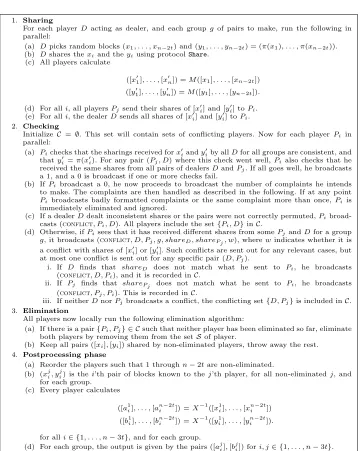
We now present the protocolRandomPairs. It is run in parallel for all of the players with the restriction thatn−3t=Ω(n). The matrixM is hyperinvertible of dimensionnbyn−2t, andX is hyperinvertible of dimensionn−2tbyn−2t. The protocol is shown in Figure 4 on the next page.
1. Sharing
For each playerDacting as dealer, and each groupgof pairs to make, run the following in parallel:
(a) Dpicks random blocks (x1, . . . , xn−2t) and (y1, . . . , yn−2t) = (π(x1), . . . , π(xn−2t)).
(b) Dshares thexiand theyiusing protocolShare.
(c) All players calculate
([x01], . . . ,[x0n]) =M([x1], . . . ,[xn−2t])
([y10], . . . ,[y0n]) =M([y1], . . . ,[yn−2t]).
(d) For alli, all playersPjsend their shares of [x0i] and [y0i] toPi. (e) For alli, the dealerDsends all shares of [x0
i] and [y 0 i] toPi.
2. Checking
InitializeC = ∅. This set will contain sets of conflicting players. Now for each playerPi in
parallel:
(a) Pichecks that the sharings received forx0iandy 0
iby allDfor all groups are consistent, and
thatyi0=π(xi0). For any pair (Pj, D) where this check went well,Pialso checks that he
received the same shares from all pairs of dealersDandPj. If all goes well, he broadcasts
a 1, and a 0 is broadcast if one or more checks fail.
(b) IfPibroadcast a 0, he now proceeds to broadcast the number of complaints he intends
to make. The complaints are then handled as described in the following. If at any point
Pibroadcasts badly formatted complaints or the same complaint more than once,Pi is
immediately eliminated and ignored.
(c) If a dealerDdealt inconsistent shares or the pairs were not correctly permuted,Pi
broad-casts (conflict, Pi, D). All players include the set{Pi, D}inC.
(d) Otherwise, ifPisees that it has received different shares from somePjandDfor a group
g, it broadcasts (conflict, D, Pj, g, shareD, sharePj, w), wherewindicates whether it is a conflict with shares of [x0i] or [yi0]. Such conflicts are sent out for any relevant cases, but at most one conflict is sent out for any specific pair (D, Pj).
i. If D finds that shareD does not match what he sent to Pi, he broadcasts (conflict, D, Pi), and it is recorded inC.
ii. If Pj finds that sharePj does not match what he sent to Pi, he broadcasts (conflict, Pj, Pi). This is recorded inC.
iii. If neitherDnorPjbroadcasts a conflict, the conflicting set{D, Pj}is included inC.
3. Elimination
All players now locally run the following elimination algorithm:
(a) If there is a pair{Pi, Pj} ∈ Csuch that neither player has been eliminated so far, eliminate
both players by removing them from the setSof player.
(b) Keep all pairs ([xi],[yi]) shared by non-eliminated players, throw away the rest.
4. Postprocessing phase
(a) Reorder the players such that 1 throughn−2tare non-eliminated.
(b) (xji, yji) is thei’th pair of blocks known to thej’th player, for all non-eliminatedj, and for each group.
(c) Every player calculates
([a1i], . . . ,[ani−2t]) =X−1([x1i], . . . ,[xni−2t]) ([b1i], . . . ,[bni−2t]) =X−1([yi1], . . . ,[yin−2t]).
for alli∈ {1, . . . , n−3t}, and for each group.
pairs at a time with a communication complexity ofO(n3), and a computational complexity ofO(n3logn). In both cases, we addO(n2)per complaint.
Proof. The proof is divided into three parts. The first two are correctness and simulation, and together they prove security in the UC model. The last part deals with the complexity.
Correctness: To show correctness, we must prove that all generated pairs are consistently shared and correctly permuted. Consider the set of playersP. If we denote by P0 the subset of non-eliminated players, we know that by the end of
the elimination step, only sharings coming from players inP0 will be used.
We know that for any dealerD ∈ P0, there are no conflicts{P
i, D} ∈ C for anyPi∈ P0. If there were such conflicts, they would have caused the elimination of eitherDorPi in the elimination phase. This means that all honest players in P0 agree that the shares they have received from dealersD ∈ P0 are consistent
and represent correctly permuted pairs, and furthermore these shares agree with all shares received from Pj ∈ P0.
Now consider all non-eliminated honest players. We know that at least for every two players eliminated, one of the players must have been corrupted. There-fore, we have at least n−2t honest players inP0. Now select exactlyn−2t of
those and form the setH. It can be seen then that
([x0i])Pi∈H=MH([xi])1≤i≤n−2t,
whereMH is a matrix containing only the rows ofM with indices corresponding to the players inH. SinceMH is a square submatrix of a hyperinvertible matrix, it must be invertible. This means that
([xi])1≤i≤n−2t=MH−1([x
0
i])Pi∈H.
The calculations above also hold for theyi. We know that all pairs (x0i, yi0) wherePi∈H are guaranteed to be consistently shared and correctly permuted. Applying the linear transformationMH−1preserves this property, and so we know that all of the original pairs (xi, yi) must be correct as long as the dealer is in P0, but these are exactly the pairs we keep after the elimination phase.
Following the elimination phase, new pairs are created by applying yet an-other linear transformation. As before, linear transformations preserve the con-sistency of sharings and the property that pairs are correctly permuted, and thus correctness is ensured.
For perfect privacy, all values seen by the adversary should be independent of the secret, which in this case is the set of output pairs. Throughout the protocol, A learns openings of sharings from honest players, and it knows its own sharings as well. It is these values that should be independent of the output. More specifically, we need only examine sharings by non-eliminated players, since the others are not used to create the output.
First, we prove that the sharings distributed by non-eliminated honest players are independent of the sharings opened towards A. For any honest dealer and any group, letI={1, . . . , n−3t}be the indices of the initial blocks andRthose of the remaining blocks. Now choose a setC of sizetthat contains all indices of the corrupted players. The corrupted players now know openings of
([x0i])i∈C=MCI([xi])i∈I+MCR([xi])i∈R, where MB
A means the matrix M restricted to rows in A and columns in B. A similar equation holds for theyi0. Since |C|=|R|, there is exactly one choice of blocks inR that matches what the adversary can see for any set of blocks inI. In other words, the blocks opened toAare independent of the ones dealt by the honest dealers.
The final output blocks are created using the sharings from all non-eliminated servers, possibly including some corrupted servers. Therefore, we must also prove that the final outputs are independent of sharings from non-eliminated corrupt players. For the aji and any group (the proof is the same for thebji), let I = {1, . . . , n−3t}be the set of the initialn−3tindices,Rthe subsequentt, andC a set of sizetcontaining the indices of all non-eliminated corrupted players (fill the rest of C with other players if there are less thant). The adversary knows xji for allj∈R, so the sharings known toAare
([xji])j∈C=XCI([a j
i])j∈I+XCR([a j i])j∈R, for all i. Since |C| = |R|, and since X is hyperinvertible, XR
C is invertible. Therefore, for any set of blocks known to the adversary, there is exactly one choice of blocks [aji]j∈R not output for any set of output blocks. In other words, the blocks dealt byAare independent of the output blocks. This concludes our proof of privacy.
We can now show how to construct a simulatorS. It simply runs dummy versions of the honest players and lets the execute the protocol with A. We know that any values seen byAduring the protocol are independent of the ac-tual secrets shared, so the values generated byS towards Amust be correctly distributed. When the protocol is done, the shares for corrupted players gener-ated by the simulgener-ated run is fed intoFpairs. The functionality now chooses the output sharing so to match these values, i.e. the honest players obtain shares that are consistent with a set of correctly distributed secrets and with the shares held by the adversary. By correctness of the protocol, this matches exactly the distribution of the output of a real protocol run.
receive outputs fromFpairs, we may simply open up one of the dummy parties to the adversary and continue from there. The only difficult part is if a server is corrupted after the output sharings have been chosen, because in that case the view of a dummy party does not match the output sharings. To adjust the view of a dummy party to the actual output shares ofFpairs, we examine how these shares are constructed. We start by adjusting the shares of the [aji] forj∈I(all of the following works in the same way for thebji). The adversary knows the full sharings of
([xji])j∈C=XCI([a j
i])j∈I+XCR([a j i])j∈R,
so for those we simply pick the correct shares of [aji] for j ∈ R to match the adjusted shares forj ∈I. Now calculate ([xji])j=X([aji])jto find the remaining shares owned by the newly corrupted player. This of course means that the other dummy parties have to adjust their sharings from this point. The last problem is xji created by this player. We can easily adjust its sharing of those values to match what we need, but it also needs to match the values opened to the adversary during the sharing of them. Luckily, we already know that this is simply a matter of adjusting the randomness used in the sharing.
Complexity: We now examine the complexity of the protocol. Going through each step of the protocol and remembering that every server is a dealer, we see that each step has a maximum communication complexity of O(n3). Clearly
this is also the total communication complexity. The computational complexity is O(n3logn) plus the cost of each complaint, since in the slowest step, every server must check the consistency ofΘ(n) sharings by interpolation, which can be done by usingO(nlogn) FFT. Every complaint addsO(n2) to both complexities for the broadcast.
Permuting Elements within Blocks The next subprotocolPermuteWithinBlocks, and it is shown in Figure 5 takes as input the shares of blocks ([x1], . . . ,[xn]), a vector of random pairs (([s1],[π(s1)]), . . . ,([sn],[π(sn)])), and the permutation π. It outputs shares of new sharings ([π(x1)], . . . ,[π(xn)]). For this protocol, we prove correctness and privacy here, and use these properties in the simulation proof for the main protocol.
1. For everyninput blocks, we do the following.
2. The servers locally compute [xi+si] = [xi] + [si], 1≤i≤n.
3. The servers select the non-eliminated serverjthat has least recently been chosen in this way and invokeRecoto reconstruct the [xi+si] toj.
4. Serverjlocally computesπ(xi) for alli.
5. Serveriuses protocol Permutedto share [π(xi+si)] for alli, proving in the process that it has been consistently shared and permuted. If Permuted outputs fail, return to step 3 (see description ofPermutedin the text).
6. The players locally compute [π(xi)] = [π(xi+si)]−[π(si)], 1≤i≤n.
Note that we only run the protocol fornblocks at a time to limit the cost of
Permutedfailing. For efficiency, we must work on at leastnblocks at a time, so this is the natural choice. The protocolPermutedthat was mentioned above is an adaptation of RandomPairs: there is only one dealer, server j. Rather than sharing both the xi’s and π(xi)’s, the server shares only π(xi), since servers already have shares of thexi’s in question. However some extra randomxi’s are added to ensure privacy (recall thatRandomPairsrequires extra random blocks that will not be output). Otherwise, we do exactly the same as inRandomPairs
but if fail if server j is eliminated we stop immediately and output fail. The postprocessing phase is omitted, since there is only a single dealer who is allowed to know the (masked) secret.
It is perfectly private and correct by for the same reason thatPermutedPairs
is. As for the complexities, we consider permutingβgroups ofΘ(n) blocks (i.e. we permuteΘ(βn) blocks). Ignoring broadcasts for a moment, we see that commu-nication is at its most expensive when initially sharing, which costsO(βn2). The most expensive computational step is still checking, which costs O(βn2logn). For both computation and communication, we need to addO(n3) in broadcast costs in both cases (regardless of the number of groups) and a furtherO(n2) per complaint.
For the protocolPermuteWithinBlocks, it is clear that we still have privacy, since random blocks are added before opening. Correctness is trivial from the construction. As for the complexities, the most expensive step is Permuted. So both computational and communication complexities are as above, with the exception that the cost is multiplied by the number of times we fail and have to rerun Permuted. Since each failure results in at least one corrupt player being eliminated, the worst case is having to rerunt times.
5.2 Multiplications
As explained earlier, our circuit consists of only addition, multiplication andh -gates, whereh(x, y, c) = (cx+ (1−c)y, cy+ (1−c)x). Since addition is trivially done by local computation, it is sufficient to explain how to handle multiplica-tions. In order to do this, we need the protocol RobustReshare; as mentioned above it coverts a vector of blocks from being shared with degree d1 to shares
with degree d2. In a nutshell, it publicly reconstructs the values and then
re-shares them. Assume that we are given shared blocks [x]d,[y]d with degree d and sharings [r]d,[r]2d of the same r but with degree d and 2d. The protocol
Multiplythen works as shown in Figure 6.
1. For every pair of blocksx, yto multiply, we assume sharings [r]d,[r]2dare available. The servers
locally compute [xy+r]2d= [x]d[y]d+ [r]2d.
2. RobustReshareis run to obtain [xy+r]dfor allx, y.
3. For everyx, ythe servers locally compute [xy]d= [xy+r]d−[r]d.
The pairs [r]d,[r]2d we need can be generated using RanDouShamentioned above. Correctness follows from correctness of RobustReshare. Privacy follows from privacy of RanDouShasince we can then assume theris uniformly random from the adversary’s point of view. The complexity is clearly dominated by
RobustResharewhose complexity was covered earlier.
6
The Main Protocol
The final protocol is described in Figure 8, while the functionality realized is in Figure 7. This leads to:
1. The input clients send their inputs (x1, . . . , xr) toFC.
2. FC distributes (y1, . . . , yt) =C(x1, . . . , xr) to the intended output clients.
Fig. 7:The functionalityFC for the circuitC
Preprocessing: TransformCintoC0.
Step0: Input clients invoke the functionalityFRobustShare to share their inputs to the servers.
The servers invokeFpairsand Fdouble to create a setPi of pairs and a setDSi of double
sharings for every layer 1≤i≤dofC0, whered= depth(C0).
Stepi: For 1≤i≤d, we have from the previous layers the setIiof inputs for this layer as well as
pairs and double sharingsPiandDSifor this layer. Layeriis evaluated onIiby the servers
through local computations and a constant number of calls toMultiply.
The outputs of the layer may need to be permuted. If the blocks are to be permuted, they are permuted by local computation. If the elements within the blocks need to be permuted, the servers invokePermuteWithinBlockson the blocks in question.
Stepd+ 1: The servers open sharings to the relevant output clients usingReco. Fig. 8:ProtocolEvalCircuit
Theorem 1. There exists0< δ <1/3 such that givenn servers and an arith-metic circuit C that is at least Ω(n) gates wide, the protocol EvalCircuit re-alizes FC with perfect security in the UC model against an active and adaptive
adversary corrupting up tot < δn servers. The total communication complexity is
O(lognlog|C| · |C|) + poly(n,log|C|)·depth(C)2,
while the total computational complexity is
O(log2nlog|C| · |C|) + poly(n,log|C|)·depth(C)2.
construction. The basic idea is to construct virtual servers that run our protocol. To simulate each virtual server, a subset of the servers run a less efficient protocol, the inner protocol, that has a high threshold.
The difference from [12] is that here we are interested in perfect security. Therefore we need an inner protocol that also has perfect security. To this end, we can employ the BGW protocol [3]. Since it has thresholdn/3, the construction from [12] gives us a threshold ofn/3−εfor sufficiently largen, whereε >0 may be chosen arbitrarily.
The construction increases both the computational and communication plexities to be the sum of the previous computational and communication com-plexities. Therefore, the new bound for both will be
O(log2nlog|C| · |C|+ poly(n,log|C|)·depth(C)2).
The proof of Theorem 1 on the previous page is given in Appendix C.
In Appendix B we prove Corollary 1, which is a reduction in the complexity in some cases, namely when the depth is large and there are many pairs of layers (i, j) inC such that there is a wire fromito j.
Corollary 1. With the modification of Appendix B, the complexities of Theo-rem 1 can be altered to
O(log depth(C) lognlog|C| · |C|) + poly(n,log|C|)·depth(C) log depth(C)
for communication and
O(log depth(C) log2nlog|C| · |C|) + poly(n,log|C|)·depth(C) log depth(C)
for computation.
7
Application to Two-Party Cryptography
In this section we sketch the application of our main result to reducing the com-putational overhead of zero-knowledge proofs and secure two-party computation. In [19] it is shown how to obtain a zero-knowledge proof for the satisfiability of a circuit C from any MPC protocol for n servers in which one client (“the prover”) has an inputwand another client (“the verifier”) should outputC0(w), whereC0is a constant-depth circuit of roughly the same size asCwhich is easily determined by C. If the MPC protocol is adaptively secure against an active adversary who corrupts the prover and a constant fraction of the servers, the resulting zero-knowledge protocol will have soundness error of 2−Ω(n) plus the
The above transformation was combined with the MPC techniques from [11, 9] to yield zero-knowledge proofs with aconstantcommunication overhead. How-ever, to guarantee soundness error of 2−k, the computational overheadof this protocol must be Ω(k), even if ideal commitments are used. Plugging in our main result, we obtain a perfect zero-knowledge protocol in the commitment-hybrid model (i.e., using ideal commitments) in which both the communication and computation overhead are polylogarithmic ink. As a side benefit, the perfect security of our protocol allows for a simpler and more round-efficient transfor-mation into a zero-knowledge proof protocol (see [19], Section 4).
To implement the commitment-hybrid model, we can use the constant over-head constructions from [20] or the polylog-overover-head constructions from [1]. The latter have the advantage of relying on fairly standard cryptographic assump-tions, related to the intractability of decoding random linear codes or learning with errors.
We note that in the case of zero-knowledgearguments(with computational soundness), it is possible to combine the PCP-based approach of [22, 24] for efficient arguments with state of the art PCP constructions [4] and efficient lattice-based constructions of collision-resistant hash functions [25, 23] to get alternative constructions with polylogarithmic computational overhead. How-ever, other than offering only computational soundness, the resulting protocol requires stronger assumptions, inherits the complex and seemingly impractical nature of current PCP constructions, and does not allow to eliminate the need for cryptography using preprocessing.
We finally note that similar results can be obtained in the more general con-text of secure two-party computation. One approach to obtain these results is to apply the GMW-compiler [16], with the efficient zero-knowledge proofs described above, to a constant-overhead protocol for the semi-honest model from [20]. The latter protocol relies on the existence of a pseudorandom generator stretchingn bits ton2 bits in which each bit of the output depends on just a constant num-ber of input bits — a plausible but nonstandard assumption. Another approach, which can offersunconditionalsecurity in the OT-hybrid model, is to instantiate the protocol compiler from [21] with our main protocol as the “outer protocol”.
8
On the Relevance of Gentry’s Scheme
too inefficient for practical purposes. Finally, for circuits whose output length is not much smaller than their size (as in the case of performing a large num-ber of simple computations), even the communication overhead of this protocol becomes a large polynomial in kand n. In contrast, our protocol has the same overhead even in this case. In light of the above, it seems fair to conclude that Gentry’s result has limited relevance to the results of the present work from both a theoretical and from a practical point of view.
References
1. Benny Applebaum, David Cash, Chris Peikert, and Amit Sahai. Fast cryptographic primitives and circular-secure encryption based on hard learning problems. In CRYPTO ’09: Proceedings of the 29th Annual International Cryptology Conference on Advances in Cryptology, pages 595–618, Berlin, Heidelberg, 2009. Springer-Verlag.
2. Zuzana Beerliov´a-Trub´ıniov´a and Martin Hirt. Perfectly-secure MPC with linear communication complexity. In Ran Canetti, editor,TCC, volume 4948 ofLecture Notes in Computer Science, pages 213–230. Springer, 2008.
3. Michael Ben-Or, Shafi Goldwasser, and Avi Wigderson. Completeness theorems for non-cryptographic fault-tolerant distributed computation (extended abstract). InSTOC, pages 1–10. ACM, 1988.
4. Eli Ben-Sasson, Oded Goldreich, Prahladh Harsha, Madhu Sudan, and Salil P. Vadhan. Short pcps verifiable in polylogarithmic time. In IEEE Conference on Computational Complexity, pages 120–134. IEEE Computer Society, 2005. 5. V.E. Benes. Optimal rearrangable multistage connecting networks. The Bell
Sys-tem Technical Journal, 43:1641–1656, 1964.
6. Gabriel Bracha. An O(log n) expected rounds randomized byzantine generals protocol. J. ACM, 34(4):910–920, 1987.
7. R. Canetti. Universally composable security: A new paradigm for cryptographic protocols. InFOCS ’01: Proceedings of the 42nd IEEE symposium on Foundations of Computer Science, pages 136–145, Washington, DC, USA, 2001. IEEE Computer Society.
8. David Chaum, Claude Cr´epeau, and Ivan Damgard. Multiparty unconditionally secure protocols. InSTOC ’88: Proceedings of the twentieth annual ACM sympo-sium on Theory of computing, pages 11–19, New York, NY, USA, 1988. ACM. 9. Hao Chen and Ronald Cramer. Algebraic geometric secret sharing schemes and
secure multi-party computations over small fields. In Cynthia Dwork, editor, CRYPTO, volume 4117 of Lecture Notes in Computer Science, pages 521–536. Springer, 2006.
10. Ronald Cramer, Ivan Damg˚ard, and Jesper Buus Nielsen. Multiparty computa-tion from threshold homomorphic encrypcomputa-tion. In EUROCRYPT ’01: Proceedings of the International Conference on the Theory and Application of Cryptographic Techniques, pages 280–299, London, UK, 2001. Springer-Verlag.
11. Ivan Damg˚ard and Yuval Ishai. Scalable secure multiparty computation. In Cyn-thia Dwork, editor,CRYPTO, volume 4117 ofLecture Notes in Computer Science, pages 501–520. Springer, 2006.
InCRYPTO 2008: Proceedings of the 28th Annual conference on Cryptology, pages 241–261, Berlin, Heidelberg, 2008. Springer-Verlag.
13. Matthew K. Franklin and Moti Yung. Communication complexity of secure com-putation (extended abstract). InSTOC, pages 699–710. ACM, 1992.
14. Rosario Gennaro, Michael O. Rabin, and Tal Rabin. Simplified VSS and fast-track multiparty computations with applications to threshold cryptography. In PODC ’98: Proceedings of the seventeenth annual ACM symposium on Principles of distributed computing, pages 101–111, New York, NY, USA, 1998. ACM. 15. Craig Gentry. Fully homomorphic encryption using ideal lattices. In STOC ’09:
Proceedings of the 41st annual ACM symposium on Theory of computing, pages 169–178, New York, NY, USA, 2009. ACM.
16. Oded Goldreich, Silvio Micali, and Avi Wigderson. How to play any mental game or a completeness theorem for protocols with honest majority. In STOC, pages 218–229. ACM, 1987.
17. Martin Hirt and Ueli M. Maurer. Player simulation and general adversary struc-tures in perfect multiparty computation. J. Cryptology, 13(1):31–60, 2000. 18. Martin Hirt, Ueli M. Maurer, and Bartosz Przydatek. Efficient secure multi-party
computation. InASIACRYPT ’00: Proceedings of the 6th International Conference on the Theory and Application of Cryptology and Information Security, pages 143– 161, London, UK, 2000. Springer-Verlag.
19. Yuval Ishai, Eyal Kushilevitz, Rafail Ostrovsky, and Amit Sahai. Zero-knowledge from secure multiparty computation. InSTOC ’07: Proceedings of the thirty-ninth annual ACM symposium on Theory of computing, pages 21–30, New York, NY, USA, 2007. ACM.
20. Yuval Ishai, Eyal Kushilevitz, Rafail Ostrovsky, and Amit Sahai. Cryptography with constant computational overhead. In STOC ’08: Proceedings of the 40th annual ACM symposium on Theory of computing, pages 433–442, New York, NY, USA, 2008. ACM.
21. Yuval Ishai, Manoj Prabhakaran, and Amit Sahai. Founding cryptography on oblivious transfer — efficiently. In CRYPTO 2008: Proceedings of the 28th An-nual conference on Cryptology, pages 572–591, Berlin, Heidelberg, 2008. Springer-Verlag.
22. Joe Kilian. A note on efficient zero-knowledge proofs and arguments (extended abstract). InSTOC ’92: Proceedings of the twenty-fourth annual ACM symposium on Theory of computing, pages 723–732, New York, NY, USA, 1992. ACM. 23. Vadim Lyubashevsky and Daniele Micciancio. Generalized compact knapsacks are
collision resistant. In Michele Bugliesi, Bart Preneel, Vladimiro Sassone, and Ingo Wegener, editors,ICALP (2), volume 4052 ofLecture Notes in Computer Science, pages 144–155. Springer, 2006.
24. Silvio Micali. Computationally sound proofs. SIAM J. Comput., 30(4):1253–1298, 2000.
25. Chris Peikert and Alon Rosen. Efficient collision-resistant hashing from worst-case assumptions on cyclic lattices. In Shai Halevi and Tal Rabin, editors,TCC, volume 3876 ofLecture Notes in Computer Science, pages 145–166. Springer, 2006. 26. T. Rabin and M. Ben-Or. Verifiable secret sharing and multiparty protocols with
A
Transforming the Circuit
In this section we show how to transform arbitrary arithmetic circuits into the type we need for our protocol. We start by repeating the lemma that describes the requirements.
Lemma 2. Given an arithmetic circuit C that is at leastl gates wide, there is an efficient algorithm to transform it into another circuit C0 with the following properties:
1. C0(x) =C(x)for all inputsx.
2. Every layer contains only one type of gate.
3. If all values are stored in blocks using packed secret sharing where the block sizelis a 2-power, the action between any two layers to achieve correct line-up is to permute the blocks and then in some blocks permute the elements within the block, where the same permutation applies to all blocks in the layer9. In the entire circuit, only logl different permutations are needed to handle permutations within blocks.
4. |C0|=O(|C|log|C|+depth(C)2nlog3|C|),depth(C0) =O(log2|C|depth(C)).
Before we describe the transformation, we give a description of our main tool, the Beneˇs network. Note that we are essentially building the same permutation networks as Waksman [28], but we present the construction here in full for completeness.
A.1 Beneˇs Networks
A Beneˇs network [5] is a type of graph that can model all permutationsπ on {1, . . . , m} form = 2w. Note that we intend to implement such a graph using gates as nodes and wires as edges.
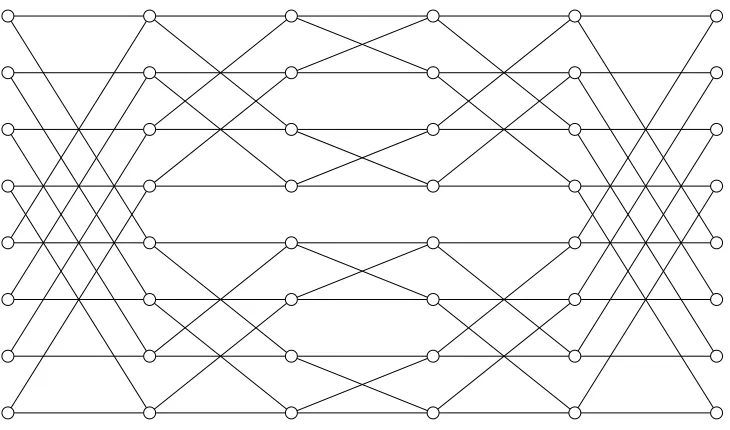
We describe Beneˇs networks recursively in terms of layers of nodes. The base case (m= 1) is just a single node. Now for anym >1, a Beneˇs network consists of two networks of size m/2 on top of each other, yielding a graph with layers of sizem. Additionally, there is always an input layer to the left and an output layer to the right.
Each node in an input/output layer is connected to the next/previous layer using two edges – ones goes horizontally and the other goes diagonally eitherm/2 nodes up orm/2 nodes down.
Figure 9 on the facing page illustrates the layout of a Beneˇs network form= 8, and it is easy to see how this generalizes to other values ofm. As described above, the middle of the graph is clearly seen to be two networks of sizem= 4. In the following, we shall need some facts about Beneˇs networks, and the most crucial observation is stated in the following proposition:
9
Fig. 9:A Beneˇs network
Proposition 2. Given a Beneˇs network for some size m, we may model any permutation π on 2m elements by inputting two elements per node on the left and routing them, one element per edge, through the network to two elements per output node on the right.
Proof. The proof is along the same lines as the one by Waksman [28]. It is a proof by induction. The basis is trivial. The inductive step assumes that our network consists of the input layer, the output layer, and the two half-size networks in the middle (the upper and lower subnetworks).
We now pick the first element on the upper left,x1. This is routed to the
upper subnetwork, and from there to the relevant node whereπ(x1) resides. In
that node we find another element,π(xi). This is routed through the only unused edge back to the lower subnetwork and back to the node containing xi. If the node containing xi also contains another used element, it must be x1, and in
that case we know that since we always return on the lower subnetwork, we took the unused edge to the node. At that point, we have found a loop. If instead the node contains some otherxj, we repeat the procedure as for x1 until we find a
loop back tox1.
This procedure is repeated until all elements have been routed. If we start a loop on the lower half, we just mirror the situation above and go through the lower subnetwork on the way to the right and the upper when returning.
Proposition 3. A Beneˇs network withmstarting and ending nodes has exactly
2 logmlayers and 2mlogmnodes.
Proof. This follows trivially from the construction.
A.2 Permutation Circuits
Assume that the block size is l and that we are givenB blocks of elements in one vectorX = (x1, . . . , xBl). We now wish to permute this vector according to some permutation π. This is needed to put the outputs from a layer into the correct order for the other layers. However, since the permutation is intended to be computed using packed secret-sharing, where the input vector is divided between multiple shared blocks, we want to break the computation ofπ(X) into simpler parts.
The idea is to make a circuit that takesX as input and outputsπ(X). This circuit has the same width everywhere, is layered (i.e. outputs go directly from one layer to the subsequent one), and the outputs of a layer must be permuted before being given to the next one. However, this time the permutation is not arbitrary, and we explain in detail how to compute the circuit in Section A.3.
To construct a permutation circuit for 2m elements, we first construct a Beneˇs network of width 2m. Then we transform it into a circuit by replacing every edge with a wire and every node with a special gate we callh. Obviously
h must have at least 2 inputs and 2 outputs for the wires to fit. However, it is
also given a third input that is a control bit. If the control bit isc, we defineh as follows:
h(x, y, c) = (cx+ (1−c)y, cy+ (1−c)x).
In other words, if the control bit is 0, the inputs are swapped, otherwise they are left unchanged.
The circuit may be programmed to follow the correct routing for any per-mutation merely by setting the control bits correctly. As for how this circuit is used, the inputs to permute are simply connected to the input gates in the first (left) layer, and the permuted outputs are taken from the last (right) layer. The control bits are publicly known inputs.
A.3 Evaluating Permutation Circuits
Permutation circuits are quite different from the overall circuit. The action for each layer is as always to compute a single type of gates on a vector of blocks, however the actions between the layers are of a completely different nature. Although the actions to perform between layers are not entirely trivial, in some sense they are simpler and more elegant than before, because the input to a layer is always a very simple function of the output from the previous layer and that layer only. In the following we will show how to compute permutation circuits in detail.
gates in layeri. We defineOi,j,b in the same way, only for outputs from layeri. Note that the control bitsIi,3,b are given as default sharings of publicly known values.
We now consider the i’th layer of the circuit (not the final layer). Assume without loss of generality that the first wire out of each gate is always directed horizontally to the next layer. In other words:
Ii+1,1,b=Oi,1,b.
The second wires are always connected diagonally with the next layer. Keep-ing in mind the construction of Beneˇs networks and the fact that the block sizel is a power of two, a block for one of the second channels can be in two situations: either the whole block is connected diagonally, or the block consists of two halves that switch places. Again due to the nature of Beneˇs networks, we can clearly only have one of the two situations for the whole layer.
In the first situation where whole blocks are switched over diagonally, there is some permutationπsuch that
(Ii+1,2,b)1≤b≤B=πi((Oi,2,b)1≤b≤B),
where B is the maximal block number. In the second situation, there is a per-mutationπi such that
Ii+1,2,b=πi(Oi,2,b).
Note that because we use one permutation per layer of the circuit, and there are at most lognlayers, we can get at most logndifferent permutations.
This also explains the logl bound on the total number of different permu-tations that can happen within blocks. Because l is a power of 2, we reach a subnetwork size of exactly l at some point. When we do, we need to permute within blocks. Because the size of halved for each subnetwork, there are only logl ways we can permute within blocks.
As mentioned earlier, we still need to perform permutations to evaluate a permutation circuit. However, the permutations are clearly either permutations of entire blocks or they are permutations of elements within a single block.
A.4 Transforming the Circuit
At this point we have all the tools to completely describe the transformation of CintoC0. We shall deal with this in three steps, and at each of them we examine the impact on circuit size and depth.
A.5 One Gate Type per Layer
The first requirement is that any layer contains only one type of gates. We ignore fanout/fanin problem for now and divide gates into two types, mul and add. Dividing the original circuit C into a minimal amount of layers first, we now split each layer into two layers; one layer consists of all themulgates, and the other of all theadd gates. Every layer now only consists of one type of gates, but the depth has doubled. We call the circuit in this stateC1. Before we go any
further, we write down explicitly what has happened to the circuit dimensions. The size remains the same:
|C1|=|C|,
and the depth is doubled:
depth(C1) = 2·depth(C).
Note that although this may make layers less than a block wide, for every layer that is too narrow, there is another that is at last half a block wide, which is enough to pay for the narrow layer.
A.6 Handling Variable Fanin and Fanout
InC1, the gates in each layer may have the same type, but they do not necessarily
have the same fanout/fanin and can therefore not be computed easily in parallel. To address this problem, we limit our choice of gates to two-input, one-output
addandmulgates, as well as a two-input, two-outputaddgate. Now consider
any layer inC1. It is clear that by adding layers of the two-outputaddgates, we
may simulate any fanout greater than 1. Note that we copy a number by adding it and 0.
As for the fanin, we address this problem in a similar way by adding extra layers of addormulgates before the layer in question. In case we have an odd number of inputs, we may need to provide an extra dummy input of either 0 or 1, depending on whether we are dealing with multiplication or addition.
In both the case of fanin and fanout, we are adding at most a linear number of extra gates; that is, it is linear in the fanin/fanout to simulate. However, per layer we are adding a number of layers that is at most the logarithm of the (largest) fanin/fanout size. Thus, if we denote byC2 the circuit after this stage
of transformation, the size is given by:
|C2|=O(|C1|) =O(|C|),
while the depth is now:
depth(C2) =O(log|C1| ·depth(C1)) =O(log|C| ·depth(C)).
We note that inserting these fanin and fanout trees creates layers that may have less than a block’s width. However, for fanin, the order of the inputs does not matter in any way. For fanout, we just make sure that the public (default inputs) are placed correctly, and the order of the other inputs do not matter (as they are all the same). This shows that within fanin and fanout trees, no permutations are needed. Fortunately, this also means that we can allow ourselves a width that is as small as we want.
A.7 Inserting Permutation Circuits
The only problem left to solve withC2 to make sure it can be computed by only
having to permute blocks, permute within blocks, or doing nothing between two layers.
We first consider the output from a layer inC2. This output can be used in
many subsequent layers, and we do not want outputs for different layers in the same block. To avoid this, we insert a permutation circuit that permutes all of the outputs into different sections of blocks, one for each of the following layers. These sections are maintained for every layer that produces outputs, by having it permute its output into the sections as above.
When we reach a layer ofC2, its input is given by a section of blocks, most
likely with the elements in the wrong order. We insert a permutation circuit that permutes the inputs back into the correct order.
This construction ensures that we have exactly the property we wanted about the action between layers. Every permutation is handled by a permutation cir-cuit, and those require only permutations of blocks or permutations within some blocks. Furthermore, we get the nice property that outputs from a layer to an-other does not need to be copied through every layer between those two. It is just stored on the side.
To conclude our section on transformations, we need only calculate the new size and depth of the final transformed circuitC0=C
3. We know that the depth
of a permutation circuit is logarithmic in the number of elements involved, and that to permute nelements, we need a circuit of size nlogn. The circuits need to be inserted for every layer in C2. The number of elements to permute is the
Letd= depth(C2) and letwi be the width of layeri. The size of the final circuitC0 is then given by
|C0|=O(|C2|+
d
X
i=1
(wi+Xn) log(wi+Xn))
=O(|C|+ log|C| d
X
i=1
(wi+Xn)) =O(|C|log|C|+dXnlog|C|)
=O(|C|log|C|+ depth(C)2nlog3|C|),
where we use the fact that for general circuitsX =O(d). The depth is given by
depth(C0) =O(log|C|depth(C2)) =O(log2|C|depth(C)).
B
Reducing the Complexity
In this section we attempt to reduce the complexity in Theorem 1 on page 17. To understand how to do this, we look back to Appendix A.7, where the circuit size of the final transformed circuit is calculated.
The goal is to reduceX, the maximal number of layers reachable from any single layer. Note that the wires containing public default inputs are not counted in this number.
One way to reduceX is as follows. Take the original circuit C (i.e. before any transformation has taken place) and replace any wire (i, j) with a path of length logarithmic in the depth. First find the bit composition ofj−i:
j−i=bm. . . b0.
Now we add wires corresponding to that representation. Add a wire (i, i+2bm) (bm = 1 always). Then from any intermediate layer i+P
m
i=kbi2bi, we simply add 2bk0 for the next non-zero bit positionk0 to find the next wire. Clearly this eventually takes us to j, and the length of such a path is logarithmic in the depth. But the point of the trick is that now every layer i has only wires to other layers of the form (i, i+ 2k), wherekis at most the depth. In other words:
X =O(log depth(C)),
and the size of the new circuit, which we denoteC is now:
|C|=O(log depth(C)|C|).