Volume 3, No. 3, May-June 2012
International Journal of Advanced Research in Computer Science
RESEARCH PAPER
Available Online at www.ijarcs.info
ISSN No. 0976-5697
Shape Based Features Extracted Using Wavelet Decomposition and Morphological
Operators
Padmashree D. Desai*
Dept of CSE
B.V.B. College of Engineering and Technology Hubli, India
Jagadeesh Pujari
Dept. of ISE
S.D.M. College of Engineering and Technology Dharwad, India
Nagaratna Yaligar
Dept. of CSE
B.V.B. College of Engineering and Technology Hubli, India
Abstract: Content-Based Image Retrieval (CBIR) allows automatic extraction of target images from a database of images according to objective visual contents of the image itself. Shape, colour and texture represent the visual features of an image. Among all these features shape gains its importance because of its complexity in representation. We propose a novel image retrieval method based on shape features extracted using wavelet decomposition and morphological operators. As edge detection is the fundamental step in identifying the shape of an image, the proposed method uses wavelet decomposition to find the edge map and mathematical morphological operators to obtain better shape features of an image. The proposed technique is tested on Wang’s bench mark image database with 1000 images spread across 10 categories. The average precision and recall of all queries are computed and considered for performance analysis. In all, 50 queries (5 from each category) are fired on the image database. The results show that the methods discussed in this paper overcome the problems existed in traditional methods of edge detection in an image, such as noise- sensitive, no clear boundary etc, and can obtain good effect on edge detection.
Keywords: CBIR; Wavelets; Morphological operators; Edge detection; shape
I. INTRODUCTION
The effective image retrieval techniques from a large database are a difficult problem and still far being solved. Retrieval of relevant images, based on automatically derived imagery features color, texture and shape etc. is popularly known as content-based image retrieval (CBIR). Shape has become increasingly attractive in multimedia information service system (MISS). The aim of CBIR is to avoid the use of textual descriptions. In CBIR each image stored in the database, has its features extracted and compared to the features of the query image. It involves two processes viz feature extraction and feature matching process. The combination of the color, texture and shape features provide a robust feature set for image retrieval. There are several popular CBIR techniques reported in the literature [1]. The information in an image sometimes involve significant amount of reasoning, about the meaning or the purpose of objects or scenes depicted. As a result, it is not possible to achieve desired accuracy from a fully automated CBIR system [2].
The accuracy of a CBIR system may be improved by iterative process of refinement of queries and features decided by users’ feedback [4] known as relevance feedback mechanism. Owing to these facts, derivation and selection of optimal set of features still remain a challenging issue in designing an effective CBIR system. Wavelets [5] have scale and time aspects, consequently every application has scale and
time aspects. Many applications use the wavelet decomposition taken as a whole for image retrieval [6] for extraction of texture feature. The common goals concern the signal or image clearance and simplification, which are parts of de-noising or compression [7]. The decomposition process can be iterated, with successive approximations being decomposed, so that one signal is broken down into many lower resolution components. The discrete wavelet transform initially decomposes an image into one approximation image and three detail images. It filters the original image with complementary low-pass and high- pass filters in each dimension. The filtered images are down sampled at every other pixel producing four images of half the resolution of the original. Wavelet has advantage of being easy to understand and simple to compute.
A. Organization of Paper:
This paper is organized as follows: Section II gives brief overview of classic methods of edge detection and advantage of wavelets used for edge detection. Section III discusses grayscale morphology and different morphological operators and its advantage in image processing. Section IV describes proposed method. Section V describes experimental setup. Section VI discusses results and performance evaluation. Section VII summarizes the conclusion.
II. EDGE DETECTION
Shape representation of an image is difficult, as much visual information will be lost when 3D image is depicted on 2D plane. Edge detection is the first step in the shape retrieval. An edge in an image is a contour across which the brightness of the image changes abruptly. In image processing, an edge is often interpreted as one class of singularities. In a function, singularities can be characterized easily as discontinuities where the gradient approaches infinity. However, image data is discrete, so edges in an image often are defined as the local maxima of the gradient. An edge detector is basically a high-pass filter that can be applied to extract the edge points in an image. Many classical edge detectors have been developed over time. The popular edge detection operators are Robert, Sobel, Prewitt and Laplacian operators. The results of edge detection by these operators are sensitive to noise, poor offensive, incomplete information of edge, these are the disadvantages of the follow-up process of images.
It is proved that wavelets are having the signal of both space and frequency domain they can be efficiently used in multi resolution analysis of image. By applying Wavelet on the color image, four sub images will be produced which are: A low resolution copy of original image, and three-band passed filters in specific directions: horizontal, vertical and diagonal respectively. These sub images contain information about texture characteristics. The simplest orthogonal filter Haar is used in the current work to get different edge pixels on vertical, horizontal and diagonal components of the image. Haar wavelet is the simplest, discontinuous and resembles a step
function. It represents the same wavelet as Daubechies.
III. GRAYSCALE MORPHOLOGY
Mathematical morphology has a unique advantage in edge detection of image because it is nonlinear and based on set operation. Different morphological operations like erosion, dilation, open and close can be applied on image with different structuring elements defined.
A. The Basic Concepts of Mathematical Morphology:
The basic concept of mathematical morphology [11] is that using the structure element of the certain form to measure and extract the corresponding shape in image to achieve the purposes of the image analysis and identification. The obtained image structure information has a relationship with the size and shape of structure element. Different structure elements can get
the image based on shapes is referred as morphology. In morphology the output image is created with the help of applying structuring element to input image, the value of each pixel in the output image is based on a comparison of the corresponding pixel in the input image with its neighbors.
A morphological operation that is sensitive to specific shapes in the input image can be constructed by choosing the size and shape of the neighborhood. Dilation and erosion [13] are the most basic morphological operations. Dilation creates the effect of swelling of shapes of the objects by adding pixels to the boundaries of objects in an image, while erosion forms the shrinking effect of the shape of the object by removing pixels on object boundaries. In dilation the value of the output pixel is the maximum value of all the pixels in the input pixel’s neighborhood and in erosion the value of the output pixel is the minimum value of all the pixels in the input pixel's neighborhood. The size and shape of structuring element decides the number of pixels added or removed from the objects in an image. In the morphological dilation and erosion operations, the state of any given pixel in the output image is determined by applying a rule to the corresponding pixel and its neighbors in the input image. The rule used to process the pixels, define the operation as dilation or erosion. Mathematical morphology is mainly divided into two value morphology, gray scale morphology and color morphology.
B. Basic Operation of Gray Scale Morphology:
The processing object of gray scale morphology is grayscale image. The basic operations include the dilation, erosion, open and close. f(x,y) is representative of the input gray image, b(i,j) is representative of the structure elements , Df and Db are respectively representative of the domain of f and b. Different operations of morphology used in current work are shown in (1) and (2).
Definition of dilation as in (1)
} (1) Definition of close as in (2)
IV. PROPOSED METHOD
Figure 1. Proposed CBIR frame work.
Algorithm for Image Retrieval
a. Input query image. Convert it to gray scale. b. Decompose the image using wavelets.
c. Obtain approximation a, horizontal h, vertical v and diagonal d components.
d. Filter out the strong edges of horizontal, vertical and diagonal components by applying thresholding, four edge maps are obtained for each input image.
e. Apply Morphological operations Dilation and Closing to each of the four edge maps .Eight edge maps are obtained for each input image.
f. Obtain shape feature using moment invariants
g. Combined feature vector for color, texture and shape is obtained.
h. Distances between feature vector of query image and the feature vectors of target images are obtained using Canberra distance.
i. Sort and Retrieve first top 10 and top 20 images.
A. Shape Feature:
Query image is converted to gray scale image as shown in Fig.2 and is decomposed using Haar wavelets. Thresholding [14] is applied on all four components to obtain the edge maps. Morphological operations are applied to obtain smooth edge maps of images.
[image:3.612.41.274.56.218.2]
Figure 2. (a)Original image (b)Gray image
B. Wavelet Decomposition:
Wavelet is applied on the color image and four sub images are obtained: A low resolution copy of original image and three band-pass filters in specific directions horizontal, vertical and diagonal respectively [14]. These sub images contain information about texture characteristics. Four sub bands obtained are shown in Fig. 3.
Figure 3. Image decomposition using Haar DWT.
C. Thresholding:
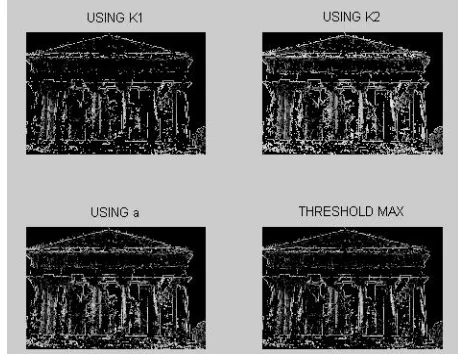
Thresholding [14] is applied to each of the Horizontal, Vertical and Diagonal components. During the thresholding process, individual pixels, if their value is greater than some threshold value. The main challenge here is the choice of the threshold value. Several methods exist for choosing threshold value. Main purpose of thresholding is to filter out strong edge pixels of horizontal, vertical and diagonal components by k1σ and k2σ
where σ is the standard deviation of respected image. (k1 and
k2 values depend on the standard deviation of an image). k1σ
and k2σ are set such that, strong edge pixels on both positive and negative side of pixel distribution should be obtained. Four edge maps are obtained after applying thresholding for query image is shown in Fig. 4.
Figure 4. Edge maps obtained after applying thresholding.
D. Morphology:
[image:3.612.340.569.457.634.2] [image:3.612.40.281.538.618.2]Figure 5. Edge maps obtained after applying morphology.
E. Colour Feature:
Color is the most probable and differentiable low-level visual feature in describing image. Several color descriptors have been approved including number of histogram descriptors and a dominant color descriptor (DCD) [15]. DCD contains two main elements as representative colors and the percentage of each color. DCD can provide an effective, compact and intuitive salient color representation and describes the color distribution in an image or a region of interest. We use a new and efficient dominant color extraction scheme to extract color features. First, the RGB color space is divided equally into 8 coarse partitions, as shown in Fig.6. If there are several colors located on the same partitioned block, they are assumed to be similar. After the above coarse partition, the centroid of each partition is selected as its quantized color. Let X=(XR,XG,XB) represent color components of a pixel with color components of a pixel with color components Red, Green, and Blue, and Ci be the quantized color for partition i.
.
Figure 6. The coarse division of RGB color space.
The average value of color distribution for each partition centre can be calculated by (3).
(3) After the average values are obtained, each quantized color can be determined. Where Ci is a 3D dominant color vector. Eight dominant colors are obtained per an image as in (4).
a. Data set: Wang’s [16] dataset comprising of 1000 Corel
images with ground truth. The image set comprises 100 images in each of 10 categories. The images are of the size 256 x 384 or 384X256. But the images with 384X256 are resized to 256X384. The 10 image categories available are: Africa, Beaches, Buildings, Buses, Dinosaurs, Elephants, Flowers, Horses, Mountains and Food. The images in each category are numbered (Category 1: 0 to 99, Category 2: 100 to 199 etc…). Matlab version 7.0 is used to implement the system. Cost of the proposed work depends on the cost of Matlab software tool. It does not include any other cost over-heads.
b. Feature set: The feature set comprises color, texture and
shape descriptors computed for an image.
c. Color: For every image eight dominant colors are
extracted by coarse partitioning the R, G and B planes into equal halves.
d. Texture: Texture includes standard deviation, variance
and min-max of pixel values.
e. Shape: Shape of an image is computed by applying
moment invariants on edge image which are invariant to rotation, scaling and translation. Totally 56 features are obtained for the image.
A. Computaion of Similarity:
Similarity between query image and images in database is obtained by applying the Canberra distance formula for the feature vectors of Query image and each image from database. Canberra distance formula is used for calculating the distance and is given by (5).
(5)
VI. RESULTS
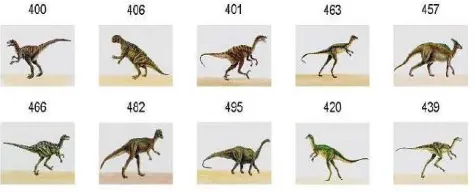
[image:4.612.36.279.51.217.2]The proposed technique is tested on Wang’s bench mark image database with 1000 images spread across 10 categories. The average precision and recall of all queries are computed and considered for performance analysis. In all, 50 queries are fired on the image database. The results proved to be satisfactory for retrieving the different query results. Sample results obtained for different queries like dinosaur, rose and elephant are shown in Fig. 7, Fig. 8 and Fig. 9 respectively.
[image:4.612.329.566.600.696.2]Figure 8. Top 10 images retrieved for Rose.
Figure 9. Top 10 images retrieved for an Elephant.
To assess the retrieval effectiveness, the precision and recall are used as statistical comparison parameters. The standard definitions of these two measures are given by equations (6) and (7). The retrieval performance is expressed using precision ~ recall graph.
(6)
(7)
Recall measures the ability of retrieving all relevant or similar items in the database. It is defined as the ratio between the number of relevant or perceptually similar items retrieved and the total relevant items in the database. Precession measures the retrieval accuracy and is defined as the ratio between the number of relevant or perceptually similar items and the total number of items retrieved.
Average Precision~Recall graph obtained for five categories of images are shown in Fig. 10. The large area under curve shows that retrieval efficiency is more for Dinosaur and Bus.
Figure 10. Average Precision~Recall graph for different images.
We bench mark our results with the well known standard image retrieval algorithms such as SIMPLIcity [17] and FIRM [18]. Weighted precision is calculated for different categories. The weighted average of precision values within k1 retrieved images are computed as shown in (8)
[image:5.612.342.558.211.513.2](8) k1 = 1,…., 100. nk
Table: 1Comparative evaluation of weighted average precision is the number of matches within the first k1 retrieved images. The weighted precision as obtained from each category is shown in Table I. In most of the cases the average precision for each category is better than SIMPLIcity [17] and FIRM [18] due to the robust feature set used in our proposed method. Comparison of our method with SIMPLIcity [17] and FIRM [18] is shown in bar graph Fig. 11. Our method proved to be better than other two methods.
Category Our Method
SIMPLIcity [ 17]
[image:5.612.42.282.315.386.2]FIRM [ 18 ]
1. Africa 0.46 0.48 0.47
2. Beach 0.40 0.32 0.35
3.Building 0.67 0.35 0.35
4. Bus 0.78 0.36 0.60
5.Dinosaur 0.98 0.95 0.95
6.Elephant 0.85 0.38 0.25
7.Flower 0.73 0.42 0.65
8.Horses 0.87 0.72 0.65
9.Mountains 0.56 0.35 0.30
10.Food 0.59 0.38 0.48
Figure 11. Weighted average precision for different methods.
VII.CONCLUSIONS
[image:5.612.43.261.536.654.2]VIII. REFERENCES
[1]. Ritendra datta, Dhiraj joshi, Jia li, and James z. Wang, “Image Retrieval: Ideas, Influences, and Trends of the New Age”, ACM Computing Surveys, Vol. 40, No. 2, Article 5, Publication date: April 2008.
[2]. Padmashree Desai, Jagadeesh Pujari, Shweta Parvitikar, “Image Retrieval using shape feature: A study”, CIIT 2011, CCIS 250, pp. 817–821,© Springer-Verlag Berlin Heidelberg 2011.
[3]. Jianlin Zhang Wensheng Zou, “Content-Based Image Retrieval Using Color and Edge Direction Features”,978-1-4244-5848-6/10/ ©2010 IEEE, 2011.
[4]. X.S.Zohu and T.S. Huang, “Relevance feedback in content based image retrieval; some recent advances”,Information Sciences,vol. 148,pp129-137,2002.
[5]. D.N. Verma,Vrinda Maru and Bharti, “An Efficient Approach for Color Image Retrieval Using Haar Wavelet”, International Conference on Methods and Models in Computer Science , 2009.
[6]. Ashok Kumar J. Esther “Comparative Study on CBIR based by Color Histogram, Gabor and Wavelet Transform”, International Journal of Computer Applications (0975 – 8887) Volume 17– No.3, March 2011.
[7]. Stephane Mallet, April, “Wavelets for a Vision”. Proceeding to the IEEE, Vol. 84:604-685, 1996.
[8]. Y. Z. Goh, A. B. J. Teoh, M. K. O. Gog, “Wavelet Based Illumination Invariant Preprocessing in Face Recognition”,Proceedings of the 2008 Congress on Image and Signal Processing, Vol. 3, IEEE Computer Society, pp. 421 – 425.
[9]. J. Pan, “Edge detection combining wavelet transform and Canny operator based on fusion rules”, IEEE Proceedings of the 2009 International conference on wavelet analysis and pattern recognition, July, 2009.
[10]. Mohsen Sharifi, Mahmoud Fathy, Maryam Tayefeh Mahmoudi ,“A Classified and Comparative Study of Edge Detection Algorithms”, Proceedings of the International Conference on Information Technology: Coding and Computing (ITCC.02)0-7695-1506-1/02 $17.00 © 2002 IEEE .
[11]. Chen Hai-yan, Wang Hui-qin, Cao Ming-hua, Hu Jia-qi,Hu Wen-tao, “The Research and Implementation on Edge
Computational and Information Sciences.
[12]. Guo Jun,Pan Shen,Hu Xiao-jian. “Edge Detection in Tobacco Leaf Image Based on Grayscale Morphology[J]”,Computer Engineering.2007,33 (21):163-16.
[13]. B.Kekre, Sudeep Thepade, Priyadarshini Mukherjee, Miti Kakaiya “Image Retrieval with Shape Features Extracted using Morphological Operators with BTC”, International Journal of Computer Applications (0975 – 8887) Volume 12– No.3, November 2010
[14]. Padmashree Desai, Jagadeesh Pujari, R.H.Goudar, “Image Retrieval Using Wavelet Based Shape Features”, (JISC)Journal of Information Systems and Communication ISSN: 0976-8742 , E-ISSN: 0976-8750, Vol.3,Issue1.2012,
[15]. M.Babu Rao,B.Prabhakara Rao,”Content Based Image Retrievalusing Dominant Color, Texture and Shape”, International Journal of Engineering Science and Technology (IJEST).Vol.3,No.4 April 2011.
[16]. http://wang.ist.psu.edu/
[17]. J.Li,J,Z wang and G. Wiederhold, “IRM: Integrated Region Matching for Image Retrieval”, in Proc.of the 8th ACM Int. Conf. on Multimedia,pp. 147-156,Oct 2000 [SIMPLIcity]
[18]. Y. Chen and J.Z.Wang, “A Region based Fuzzy Feature Matching Approach to Content based Image Retrieval”,IEEE Trans on PAMI,vol 24,No9,pp.1252-1267,2002.[FIRM]
[19]. Pengyu Liu, Kebin Jia, Zhuozheng Wang, ZhuoyiLv, “A New and Effective Image Retrieval Method Based on Combined Features” . IEEE, 2007.
[20]. P. S. Hiremath , Jagadeesh Pujari, “Content Based Image Retrieval using Color,Texture and Shape features”.15th International Conference on Advanced Computing and Communications.0-7695-3059-1/07©2007IEEE ADCOM.
[21]. P. S. Hiremath and Jagadeesh Pujari, “Content Based Image Retrieval based on Color, Texture and Shape features using Image and its complement”, International Journal of Computer Science and Security, Volume (1) : Issue (4)
[22]. P. S. Hiremath and Jagadeesh Pujari, “Content Based Image Retrieval using Color Boosted Salient Points and Shape features of an image”. International Journal of Image