Page 418
SCHOOL SELF-EVALUATION OF STUDENTS WITH PHYSICAL DISABILITIES AS AN IMPORTANT EDUCATIONAL PHENOMENON
Terézia Harčaríková, Kristína Nagyová
Comenius University in Bratislava, Faculty of Education, Department of Special Education, Bratislava, Slovakia
Abstract
School self-evaluation of students with various types and stages of physical disabilities is appeared as an important educational phenomenon that in important way impacts education of these students. It forms their attitude to school and school education, as well as their attitude to themselves. School evaluation of students with physical disabilities represents an important attribute of creating self-vision of these students. In the field of school successfulness is the school self-evaluation an important attribute affecting the personality of student with physical disabilities.
The authors of contribution attempt to analyse the school-evaluation of students with physical disabilities with the goal to determine the level and structure of school self-evaluation of these students in the conditions of school for students with physical disabilities, and its impact to school successfulness of these students. For basal research instrument the authors chose the standardized questionnaire of children school successfulness – SPAS (children self-concept of school successfulness).
Key words: self-evaluation, school self-evaluation, student with physical disabilities, education
1 INTRODUCTION
Healthy self-esteem is considered to be one of the fundamental aspects that play a significant role in the quality of life of each individual. A child-student's self-esteem is associated with his or her overall personal development, and it is developed in a certain social context. Various school-associated experiences have an impact on the quality of self-esteem during the time that a child attends school. It is therefore not only dependent on how children succeed at school, but they are also influenced by the experience of assessment and the approach taken by the teachers, comparisons with their peers, relationships within the classroom and the attitudes of children's peers to them.
2 SELF-ESTEEM AND SELF-PERCEPTION OF INDIVIDUALS WITH DISABILITIES The characteristics of self-perception of individuals with disabilities have been described by Vágnerová (2003):
• At one's own body image level
Some disabled people may have an inaccurate image of their body, because they are often unable to perceive it in a manner comparable to the non-disabled population. Difficulties in distinguishing themselves from the outside world and the definition of their own body, either at a psychological or a somatic level occur most frequently.
• At self-esteem level
Page 419
with disabilities. According to Koubeková (2000), inadequate self-perception and self-esteem in persons with disabilities can also be derived from long-term chronic stress, which is related to the lack of fulfilment of basic psychosocial needs.
• At future motivation level, i.e. aspirations and goals
“People with disabilities can seek something real or something completely unattainable, or they may react with resignation, and make no effort to push themselves forward” (Vágnerová, 2003 p. 62). Inappropriate aspirations in terms of over-estimation may result from lack of experience, a lower intellectual level, emotional stress, trying to experience success at least in one's imagination; on the other hand, though, we may encounter fear of failure, low self-esteem or over-dependence on others, which leads to a situation whereby a person with a disability prefers to not expect anything and does not set any goals for him/herself, because they may deem them unnecessary.
• At power level
The notion of what a person can actively do and influence in life is manifested as a measure of self-confidence. Also in this regard we may encounter extreme reactions, either in terms of passivity, by which affected persons highlight their helplessness, or by overestimating their capabilities and through the exertion of exaggerated efforts to exercise their own free will, which can lead to aggression and short-tempered reactions.
• At social role level
An individual with a disability automatically receives, in addition to the "normal" roles that a person normally acquires during life (child, student, friend, parent ...), also the role of a victim, the impact of which on self-perception and self-esteem tends to be negative. This "imputed" role is usually perceived as inferior and degrading, and therefore that individual often does not want to be identified with it.
According to Fontana (1997) a child's self-image of the child is learned from the way in which he or she is described by the outside world. The child's two most important "institutions" – family and school, have the biggest impact on self-esteem and self-perception, and they can also be influenced by their peer group.
3 SELF-ESTEEM IN STUDENTS WITH DISABILITIES
A child does not directly sense his/her disability, but instead perceives the complications arising therefrom (Požár, 1996). Whilst the preschool age is a relatively calm period (if one does not take into account the often onerous rehabilitation process), school brings new stresses to the child and the parents. The level achieved by the child does not usually meet the standard requirements of mainstream schools (Vágnerová et al., 2003). For the parents of such a child, however, acceptance into a "normal" school provides confirmation that their child is "normal"; for the child this period is an important social milestone that can lead to the first identity crisis (ibid.). Harčariková (2007) speaks of the first of two stages of awareness of their motor disorder – the 'external phase' of the crisis.
Page 420
and limitations, but primarily as a social reality. This means that for a child the disability is lent a meaning which is given to it by the attitudes and reactions of the people” (Vágnerová, 1995, p. 95).
Physical disability has many aspects - motor disability (a certain level of fine motor skills is important for school work), physical deformation, an adversely changing external appearance and secondary functional disability that is dependent on the development of motor skills, all place particular restrictions in the gaining of social skills. It is often associated also with learning difficulties that may be associated with a lack of intelligence, with a family environment that provides insufficient challenges or partial deficiencies which increase the risk of specific learning difficulties, which in such cases are usually associated with organic CNS damage (Svoboda et al., 2001). Difficulties in the field of social relationships may arise as a result of the child's visibility and social clumsiness of the child that result from a lack of skills (ibid.). Such children are not of great interest to their peers and they are unable to communicate with them at an acceptable or expected level. Moreover, the social contact itself does not provide such children with as much spontaneous satisfaction as intact children enjoy. They are forced into the roles of both student and classmate with disabilities. For teachers such children often represent a burden, "extra work", and they are not sufficiently socially attractive to their peers. A physical deviation from the norm represents a definite emphasis on abnormality in the realism of younger schoolchildren (Vágnerová, Koťátková, 1996). The need for power, praise and appreciation by personally relevant authorities (parents and teachers) is paramount in children, followed by recognition by peers and the gaining of a position of status amongst them. The failure to meet these needs may lead to a strong sense of inferiority, which often persists throughout their future life. “It is clear that this danger poses a risk particularly to children with disabilities who must fight for their position in what is for often a very disadvantageous position” (Jankovský, 2006, p. 67). It is often the case that children with disabilities do not have the appropriate conditions necessary for their development in a mainstream school; they are unable to cope with the demands placed upon them, they then fail and feel unsuccessful. Academic success is at this age one of the main factors that supports the self-esteem and self-confidence of the child (Svoboda et al., 2001). According to Erikson children are what they can prove themselves to be. However, compared to the reference group, consisting of non-disabled peers, children with disabilities in mainstream schools often have a greater sense of failure. Children gradually take on the image of themselves from their surroundings, they begin to see themselves as incompetent, their self-perception is disrupted, and this is reflected in their negative self-esteem, self-confidence and self-esteem (Krejčířová, 1997). Since self-esteem significantly affects the regulation of one's personality, in these children we can often encounter various manifestations of non-adaptive behaviour, with a tendency to isolation, resignation, escape or other emotional-volition and communication disorders (Koubeková, 2000). Čačka (2000), states that individuals with a disability may, despite everything, create an optimistic view of themselves, if those around them do not pay excessive attention to their disability.
3.1 Academic self-esteem
“If we were able to understand students' self-esteem, we would be able to explain many manifestations that are seemingly incomprehensible, be they good or bad” (Čačka, 2000, p. 145).
School is one of the important external factors that supports or undermines the influence of the family on a child.
Page 421
wishes with the requirements of those around them. They must therefore constantly come to terms with an increasing number of roles. (Čačka, 2000) Different roles are then integrated into the self-perception and self-esteem of individuals (Vágnerová, 2001).
The role of a student is the first important institutional role that allows children to gradually integrate into society. At the same time it brings children greater social prestige. Obtaining this role in society is seen as confirmation of an acceptable level i.e. a "child's normality" (Vágnerová, 2001). This role fundamentally affects the way they experience future stages of childhood. In school the students' personality, identity, self-esteem and self-respect are developed, and within this role children have to confirm their merit by meeting the requirements. The extent to which they succeed is reflected in their attitude towards school, and to society as a whole; this attitude can, with some fluctuations, persist throughout life (Vágnerová, 2001).
The role of a student is defined by the inclusion of children in a particular class and their relationship to a particular teacher (or teachers). For children, their teachers and peers become significant others and their appreciation increasingly begin to be reflected in children's self-esteem. At a very young age, although still unable to evaluate their performance, they are able to take in the appreciation expressed by their teachers, who represent authority for the child, about which there is no dispute. From the pre-teenage years onwards appreciation and acceptance by peers and status in the classroom takes on an increasing importance (Vágnerová, 2001).
The role of a peer is another important role played by children. Peers, between whom there is a relationship of formal equality, share similar experiences together and experience all the advantages and disadvantages in their role as a student. A sense of belonging to the class becomes part of children's social identity. The classroom is an important socialising factor and it is also an environment that gives children the opportunity to fulfil the psychological and social needs appropriate to their age. Similarly, it may also be the source of various frustrations. The way in which a child is reconciled with this role shows the level of social competence achieved, and significantly affects social behaviour and informal interpersonal relations in future life (Vágnerová, 2001).
The role of a peer with disabilities is determined by the somatic status of the child (Vágnerová, 2001). Children with disabilities are often unable to assert themselves among their healthy peers, they do not possess the required social competences and unless they have some "unique" qualities or abilities, they do not appeal to the other children in the class in any way. It sometimes happens that such children do not participate in various classroom or school extracurricular activities, or do not participate in the extracurricular life of the class. “They fulfil the role of a peer with a disability, who "must be protected" because they are ill or is not equal because they are ill. This means that although they have certain privileges, they do not have the same rights or the same status” (Vágnerová, Koťátková 1996, p. 156). It is interesting to note that whilst acceptance and support are provided by a child's parents, it is the global self-esteem, and the attitude of the teachers and peers, which have a greater impact; this is reflected in particular in the field of academic self-esteem (Langmeier, Krejčířová, 2006).
Page 422
• on the basis of the image that teachers, parents and classmates have of them (Burns, 1982 Cugman, 1992 Harter, 1986 in Schmidt, Čagran, 2008),
• on the basis of social comparison with their peers (Rogers, Smith, Coleman, 1987 in Schmidt, Čagran, 2008).
4 ACADEMIC SELF-ESTEEM OF STUDENTS WITH DISABILITIES
Pupils who are viewed in a positive light by the others have a much better chance of maintaining a positive academic self-esteem. Confident children work better and more effectively in school, achieve better academic results and this has an impact on the attitude of the teacher towards them.
In order to achieve the aim of the research that we conducted in primary schools for students with physical disabilities in Bratislava and Košice, we used the SPAS student academic success survey in students with disabilities. Two schools for students with disabilities were involved in the survey. Our aim was to determine the level and structure of the academic self-esteem of students with disabilities in terms of education provided at schools for students of different types and degrees of disability. The studied sample consisted of 91 students (49 boys and 42 girls) with different types and degrees of disability from primary schools for students with disabilities from years 4 to 9. The SPAS academic success survey is based on the subjective assessment of children. Self-esteem - self-image, has an effect on future performance and motivation to act that should result in the given performance. The SPAS survey has proved its worth also in chronically ill children, low-achieving children and high-achieving children.
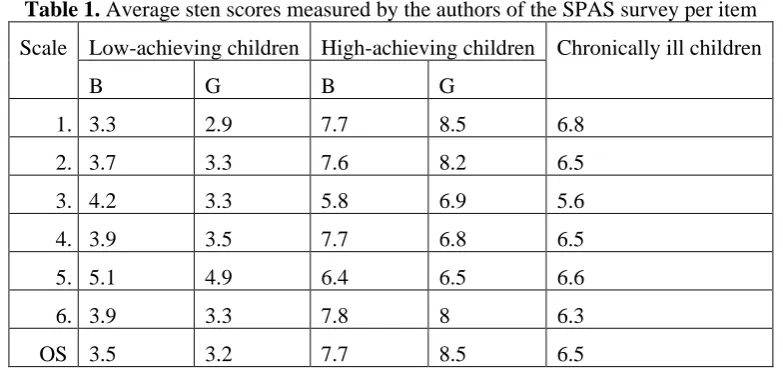
Table 1. Average sten scores measured by the authors of the SPAS survey per item Scale Low-achieving children High-achieving children Chronically ill children
B G B G
1. 3.3 2.9 7.7 8.5 6.8
2. 3.7 3.3 7.6 8.2 6.5
3. 4.2 3.3 5.8 6.9 5.6
4. 3.9 3.5 7.7 6.8 6.5
5. 5.1 4.9 6.4 6.5 6.6
6. 3.9 3.3 7.8 8 6.3
OS 3.5 3.2 7.7 8.5 6.5
Legend: 1. General ability 2. Mathematics, 3. Reading, 4. Spelling, 5. Writing, 6. Self-confidence, OS - Overall score, B - boys, G - girls
Table 2. Average value - gross score, sten scores on the SPAS scale - Bratislava (BA) - Košice (KE)
GS1 S1 GS2 S2 GS3 S3 GS4 S4 GS5 S5 GS6 S6 OS S
BA 3.78 5.73 5.16 7.08 5.39 5.37 4.20 5.86 4.10 5.82 4.82 6.57 27.43 5.86
KE 2.21 4.05 3.14 5.07 3.24 3.52 2.26 4.62 3.50 5.07 3.24 5.17 17.64 4.05
Sig. lev.
0.001 0.002 0.000 0.000 0.000 0.000 0.000 0.013 0.295 0.247 0.001 0.006 0.000 0.000
Legend: BA - Bratislava, KE - Košice, GS1-GS6-gross score, S1 - general ability, S2 - Mathematics, S3 - Reading, S4 - Spelling, S5 - Writing, S6 - Self-confidence, OS - Overall score,
Page 423
Chart 1. Sten scores on the SPAS scales - comparison Bratislava - Košice
Legend: BA - Bratislava, KE - Košice - 1 - General ability, 2. Mathematics, 3. Reading, 4. Spelling, 5. Writing, 6. Self-confidence, OS - overall score
The results in Table 2 and in Chart 1 show that the average measured values in the gross score and sten scores in the group of children with disabilities from Bratislava are statistically highly significant and higher than the average values that were measured in children with disabilities from Košice. The group of respondents from Bratislava, in addition to the writing scale, assess their intellectual skills, acumen, success and resourcefulness highly. Students with physical disabilities from Bratislava greatly exceed the academic self-esteem of physically disabled students from Košice in their average measured values.
Chart 2. Bratislava - Košice - sten scores on the SPAS scale comparing the groups of low-achieving, high-achieving and chronically ill children on the general skills scale
Legend: BA - Bratislava, KE - Košice BA-KE
0 1 2 3 4 5 6 7 8
1 2 3 4 5 6 O
S
BA KE
BA-KE general skills scale
0 1 2 3 4 5 6 7 8 9
Low-achieving B. Low-achieving G High-achieving B High-achieving G Chronically ill children BA
Page 424
Chart 3. Bratislava - Košice - sten scores on the SPAS scale comparing the groups of low-achieving, high-achieving and chronically ill children on the mathematics scale
Legend: BA - Bratislava, KE - Košice
Chart 4. Bratislava - Košice - sten scores on the SPAS scale comparing the groups of low-achieving, high-achieving and chronically ill children on the reading scale
Legend: BA - Bratislava, KE - Košice BA - KE mathematics scale
0 1 2 3 4 5 6 7 8 9
Low-achieving B.
Low-achieving G
High-achieving B
High-achieving G
Chronically ill children
BA
KE
BA-KE reading scale
0 1 2 3 4 5 6 7 8
Low-achieving B.
Low-achieving G
High-achieving B
High-achieving G
Chronically ill children
BA
Page 425
Chart 5. Bratislava - Košice - sten scores on the SPAS scale comparing the groups of low-achieving, high-achieving and chronically ill children on the spelling scale
Legend: BA - Bratislava, KE - Košice
Chart 6. Bratislava - Košice - sten scores on the SPAS scale comparing the groups of low-achieving, high-achieving and chronically ill children on the writing scale
Legend: BA - Bratislava, KE - Košice BA - KE spelling scale
0 1 2 3 4 5 6 7 8 9
Low-achieving B.
Low-achieving G
High-achieving B
High-achieving G
Chronically ill children
BA
KE
BA-KE writing scale
0 1 2 3 4 5 6 7
Low-achieving B. Low-achieving G High-achieving B High-achieving G Chronically ill children BA
Page 426
Chart 7. Bratislava - Košice - sten scores on the SPAS scale comparing the groups of low-achieving, high-achieving and chronically ill children on the self-confidence scale
Legend: BA - Bratislava, KE - Košice
Chart 8. Bratislava - Košice - sten scores on the SPAS scale comparing the groups of low-achieving, high-achieving and chronically ill children overall self-esteem
Legend: BA-Bratislava, KE-Košice, OS - overall self-esteem
When comparing the average sten scores of students with disabilities from Bratislava and Košice with the average measured values of low-achieving boys and girls on different scales (Charts 2, 3, 4, 5, 6, 7, 8) the results are as follows. The group of low-achieving students has a very low level of academic self-esteem. The average measured values of the group of students from Bratislava far outweigh the average measured values of low-achieving students. In the group of students with disabilities from Košice the only exceptions are the reading, spelling and writing scales (Charts 4, 5, 6), where the average values for physically disabled students from Košice exceed the average values for low-achieving students.
BA - KE self-confidence scale
0 1 2 3 4 5 6 7 8 9
Low-achieving B. Low-achieving G High-achieving B High-achieving G Chronically ill children BA
KE
BA - KE OS scale
0 1 2 3 4 5 6 7 8 9
Low-achieving B.
Low-achieving G High-achieving B
High-achieving G Chronically ill children
Page 427
The average measured values for the group of respondents from Bratislava on the mathematics and self-confidence scales (Charts 3, 7) exceed the average measured values for chronically ill children and are nearly identical to the average values for high-achieving girls. This means that students from Bratislava evaluate their knowledge and skills in mathematics very highly.
On the reading scale (Chart 4), students with physical disabilities from Bratislava are close to the average values for chronically ill children.
The group of students with physical disabilities is undoubtedly problematic, and this is demonstrated by the results of our research.
At the beginning of our research, we assumed that the level of academic self-esteem would be reduced in students with physical disabilities.
We compared the measured values of academic self-esteem in children with physical disabilities with the average measured values, which the authors of the questionnaire presented for chronically ill children, low-achieving children and high-achieving children (Table 1). We found that the level of academic self-esteem is reduced on all scales of the SPAS survey for students with physical disabilities in the group of children with physical disabilities from Bratislava and Košice. If we compare children with physical disabilities from Bratislava and Košice with the group of chronically ill children and the group of high-achievers, our hypothesis that children with physical disabilities have reduced levels of academic self-esteem is also confirmed. The level of academic self-esteem is significantly reduced in students with physical disabilities from both Bratislava and Košice (Table 1, 2).
Regarding the comparison of average values on the reading scale for children with physical disabilities, based on the results obtained we can conclude that the level of academic self-esteem on the reading scale for respondents from Bratislava and Košice are very low across the group. The academic self-esteem of students with physical disabilities from Bratislava is relatively high on the reading scale (Chart 6). Compared to their average values on the reading scale, the values for students with physical disabilities from Bratislava approximate to the average values for chronically ill children. Students from Bratislava assess themselves relatively highly on the reading scale compared with the average values for students from Košice. Physically disabled students from Kosice significantly underestimate their reading skills, do not believe in themselves and fear the possible consequences.
Pupils with physical disabilities from Bratislava greatly exceed the academic self-esteem of physically disabled students from Košice in their average measured values on the writing scale (Table 2, Chart 1). From Chart 6 we see that the average measured values on the writing scale for students with disabilities from Košice approximate to the average values for low-achieving boys. The average measured values on the writing scale for students with physical disabilities from Bratislava approximate to the average values of chronically ill children (see Chart 6).
5 CONCLUSION
Physical disability is accompanied by a number of different problems and peculiarities which have a negative, disruptive and, in many cases, even disadvantageous impact on children with physical disabilities in the school environment.
Page 428
The majority of respondents in both groups were students with cerebral palsy, followed by students with birth defects of the spine and the skull (hydrocephalus, spina bifida); there was also a large representation of students with chronic illnesses such as diabetes mellitus or a history of aggressive cancer treatment. The group of respondents from Košice also included children diagnosed with epilepsy. We believe that in both groups of respondents low academic self-esteem is brought about by physical disability alone. In the group of students from Košice this fact may also be brought about by the presence of students with epilepsy, its sequelae, and the treatment thereof.
REFERENCES
Čačka, O 2000, Psychologie duševního vývoje dětí a dospívajících s faktory optimalizace, Masarykova Univerzita, Brno.
Čáp, J 1996, Rozvíjení osobnosti a spůsob výchovy, ISV, Praha. Fontana, D 1997, Psychologie ve školní praxi, Portál, Praha.
Harčaríková, T 2007, ´Základy pedagogiky telesne postihnutých, chorých a zdravotne oslabených´ in Vančová, A & Tarcsiová, D (ed.), Základy špeciálnej pedagogiky pre prácu so študentmi stredných a vysokých škôl, Univerzita Komenského v Bratislave, Bratislava, pp. 131-140.
Harineková, M 1985, ´Niektoré psychologicko-pedagogické aspekty obezity v školskom veku´, Jednotná škola, vol. 37, no. 2, pp. 139-149.
Jankovský, J 2006, Ucelená rehabilitace dětí s tělesným a kombinovaným postižením, somatická a psychologická hlediska, TRITON, Praha.
Koubeková, E 2000, ´Osobná adjustácia telesne postihnutých pubescentov´, Psychológia a patopsychológia dieťaťa, vol. 35, no. 1, pp. 23-33.
Langmeier, J & Krejčířová, D 2006, Vývojová psychologie, Grada, Praha.
Lašek, J 2005, Komponenty sebehodnocení pubescentú, Gaudeamus, Hradec Králové.
Macek, P 1997, ´Sebesystém, vztah k vlastnímu Já´ in Výrost, J & Slaměnník, I (ed.), Sociální psychologie. ISV, Praha.
Požár, L 1997, Psychológia osobnosti postihnutých, Univerzita Komenského v Bratislave, Bratislava. Požár, L 1996, Psychológia osobnosti postihnutých, Univerzita Komenského v Bratislave, Bratislava.
Svoboda, M, Krejčířová, D & Vágnerová, M., 2001, Psychodiagnostika dětí a dospívajících. Portál, Praha.
Schmidt, M & Čagran, B, 2008, ´Self-Concept of students in inclusive settings´, International Journal of Special Education. vol. 23, no. 1, pp. 8-17.
Schnitzerová, E, 2003, ´Sebapoňatie žiakov základnej školy´, Pedagogické spektrum, vol. 12, no. 7/8, pp. 55-62.
Vágnerová, M 2003, Psychologie handicap, Technická univerzita, Liberec. Vágnerová, M 1995a, Psychologie školního dítěte, UK HTFa, Praha.
Vágnerová, M 1995b, Psychologie problémového dítěte školního věku, UK, Praha.
Vágnerová, M 1995c, ´Sebehodnocení a hodnocení školního výkonu dětí středního školního věku´, Psychológia a potopsychológia dieťaťa, vol. 30, no. 1, pp. 5-9.
Vágnerová, M 2001, Kognitívní a sociální psychologie žákú základní školy, Karolinum, Praha.