*Corresponding author: E-mail: [email protected]
Department of Chemistry, KSKV Kachchh University, Bhuj-370 001, Gujarat, India,Tel No: 02832-235008 Chemical Methodologies 3(2019) 328-345
Chemical Methodologies
Journalhomepage: http://chemmethod.com
Original Research article
Development and Validation of a Stability Indicating HPLC
Assay Method for Determination of Warfarin Sodium in
Tablet Formulation
Vijay R. Ramb *, Kapil L. Dubala, Pragnesh N. Daveb, Hitendra S. Joshia
a Department of Chemistry, Saurashtra University, Rajkot-360 005, Gujarat, India
b Department of Chemistry, KSKV Kachchh University, Bhuj-370 001, Gujarat, India
A R T I C L E I NF O R MA T I O N A B S T R A C T
Received: 07 August 2018
Received in revised: 30 October 2018
Accepted: 20 December 2018
Available online: 01 May 2019
The objective of the current study was to developed simple, precise and accurate isocratic reversed-phase stability indicating high performance liquid chromatography [HPLC] assay method validated the for determination of warfarin in solid pharmaceutical dosage forms. Isocratic reversed phase high performance liquid chromatography [RP-HPLC] separation was achieved on a SGE SS wakosil (150 mm × 4.6 mm i.d., C8RS 5 µm particle size) column using mobile phase of acetonitrile and 50 mM sodium hydrogen phosphate dibasic dihydrate buffer pH 3.0 (50:50 v/v) at a flow rate of 1.0 mL min-1, the injection volume was 20.0 μL and the
detection was carried out at 280 nm using photo-diode array detector. The drug was subjected to oxidation, hydrolysis, photolysis and heat in order to apply stress condition. The method was validated for specificity, linearity, precision, accuracy, robustness and solution stability. The method was linear in the drug concentration range of 40-160 μg mL-1 with a correlation
coefficient 0.9995. The precision (relative standard deviation RSD) amongst six-sample preparation was 0.22% for repeatability and the intermediate precision [RSD] amongst six-sample preparation was 0.70%. The accuracy (recovery) was between 99.95 and 99.15%. Degradation products produced as a result of stress studies did not interfere with detection of warfarin and the assay can thus be considered stability indicating.
KEYWORDS Warfarin
Stability indicating assay
Graphical Abstract
Introduction to warfarin sodium
Warfarin (also known under the brand names coumadin, jantoven, marevan, lawarin, and waran) is an anticoagulant. The name warfarin stems from the acronym WARF, for Wisconsin Alumni Research Foundation + the ending -arin indicating its link with coumarin.
Description
Chemically warfarin is (RS)-4-hydroxy-3-(3-oxo-1-phenylbutyl)-2H-chromen-2-one sodium salt
[Figure 1]. Warfarin was first registered for being used as a rodenticide in the US in 1948, and immediately became popular; although it was developed by Link, the WARF financially supported the research and was assigned the patent [1].
A few years after its introduction, warfarin was found to be effective and relatively safe for preventing thrombosis and embolism (abnormal formation and migration of blood clots) in many disorders. It was approved for use as a medication in the early 1950s and has remained popular ever since; warfarin is the most widely prescribed anticoagulant drug in North America [2].
Despite its effectiveness, treatment with warfarin has several shortcomings. Many commonly used medications interact with warfarin, as do some foods, and its activity has to be monitored by frequent blood testing for the international normalized ratio (INR) to ensure an adequate yet safe dose is taken.
Warfarin is a synthetic derivative of dicoumarol, a 4-hydroxycoumarin-derived mycotoxin anticoagulant found in spoiled clover-based animal feeds. Warfarin and related 4-hydroxycoumarin-containing molecules decrease blood coagulation by inhibiting vitamin K epoxide reductase, an enzyme that recycles oxidized vitamin K to its reduced form after it has participated in the carboxylation of several blood coagulation proteins, mainly prothrombin and factor VII. For this reason, drugs in this class are also referred to as vitamin K antagonists [3].
Literature review reveals that there are various analytical methods like LC-MS-MS [4], chiral HPLC [5], micellar electrokinetic mass spectrometry [6], UPLC-MS-MS [7] and dissolution methods [8] are available for the determination of warfarin in pharmaceutical formulations and in biological fluids are reported. These methods applied to the pharmacokinetic studies of warfarin sodium. So far, to our present knowledge, no validated stability indicating HPLC assay method for the determination of warfarin sodium in pharmaceutical formulation was available in literature. The present work deals with the forced degradation of warfarin sodium under stress condition like acid hydrolysis, base hydrolysis, oxidation, thermal and photolytic stress. This work also deals with the validation of the developed method for the assay of warfarin sodium from its formulations (tablets). Hence, the method is recommended for routine quality control analysis and also stability sample analysis.
Experimental
Materials
hydroxide pellets and 30% v/v hydrogen peroxide solution were obtained from RANKEM, New Delhi (India).
Instrumentation
The chromatographic system used to perform the development and validation of this assay method was comprised of a LC-10ATvp binary pump, a SPD-M10Avp photodiode-array detector and a rheodyne manual injector model 7725i with 20 μL loop (Shimadzu, Kyoto, Japan) connected to a multi-instrument data acquisition and data processing system (Class-VP 6.13 SP2, Shimadzu).
Mobile phase preparation
The mobile phase consisted of acetonitrile 50 mM sodium hydrogen phosphate dibasic dihydrate buffer pH 3.0 (50:50, v/v). Buffer solution was prepared by dissolving 8.9 g sodium hydrogen phosphate dibasic dihydrate in 900 mL HPLC grade water and then adjusted to pH 3.0 with ortho-phosphoric acid and the final volume was, then, made up to 1000 mL with HPLC grade water. Mobile phase was filtered through a 0.45 μm nylon membrane (Millipore Pvt. Ltd. Bengaluru, India) and degassed for 15 minutes in an ultrasonic bath. HPLC grade water was used as diluent.
Standard preparation
A warfarin sodium standard solution containing 100 μg/mL was prepared in a 100 mL volumetric flask by dissolving 10.00 mg of warfarin sodium and then diluted to volume with diluent.
Test preparation
Twenty tablets were weighed and the average weight of tablet was determined. From that, five tablets were weighed and transferred into a 250 mL volumetric flask. About 50 mL diluent was added and sonicated for a minimum 30 minutes with intermittent shaking. Then, the content was brought back to ambient temperature and diluted to volume with diluent. The sample was filtered through 0.45 μm nylon syringe filter. The obtained concentration was 100 μg/mL of warfarin sodium.
Chromatographic conditions
Chromatographic analysis was performed on a SGE make SS wakosil II 5C8RS column (150 mm, 4.6 mm i.d., 5 μm particle size) column. The flow rate of the mobile phase was adjusted to 1.0 mL/min and the injection volume was 20 μL. Detection was performed at 280 nm on a Photo diode array detector.
anti-inflammatory phytochemical markers. The chromatographic separation was achieved using C18 column (250 mm×4.0 mm, 5 μm) with 0.2% v/v formic acid: acetonitrile (50:50; v/v) as mobile phase at the flow rate of 0.7 mL/min. The dual wavelength (280 and 360 nm) was selected for the identification and quantification of rutin, gallic acid and quercetin (Rt 2.56, 2.95 and 4.60 min). The method was validated as per ICH guidelines in terms of specificity, linearity, precision, and accuracy, LOD and LOQ, respectively [9].
Result and discussion
Development and optimization of the HPLC method
Proper selection of the methods depends upon the nature of the sample (ionic or ionisable or neutral molecule), its molecular weight and solubility. Warfarin sodium is soluble in polar solvent therefore reversed phase mode of HPLC was chosen. To develop a rugged and suitable HPLC method for the quantitative determination of warfarin sodium, the analytical conditions were selected after testing the different parameters such as diluents, buffer, buffer concentration, organic solvent for mobile phase and mobile phase composition and other chromatographic conditions. Our preliminary trials using different composition of mobile phases consisting of water with methanol or acetonitrile, did not give good peak shape.
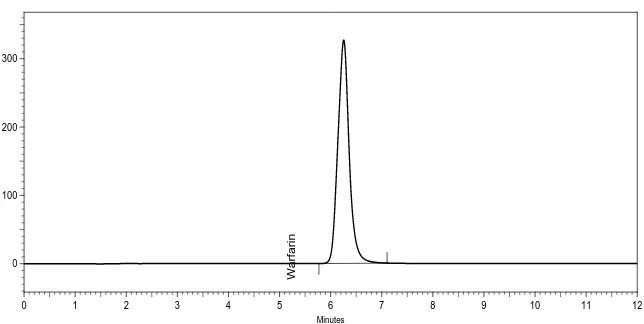
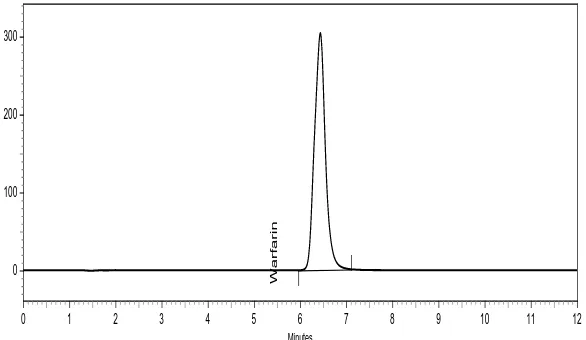
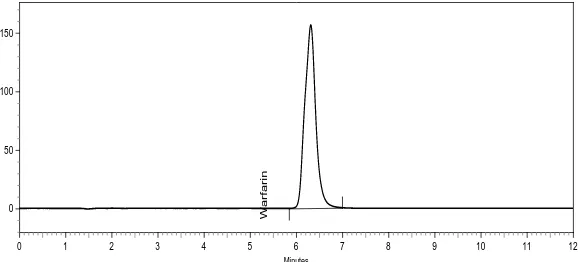
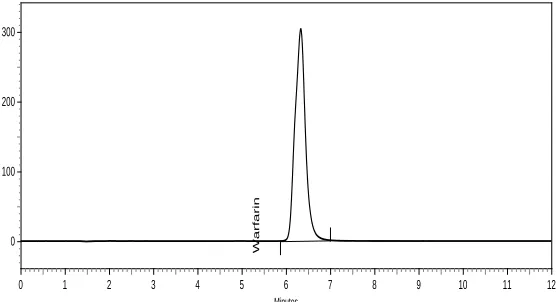
By using 50 mM disodium hydrogen phosphate dihydrate buffer, adjusted to pH 3.0 with ortho-phosphoric acid and keeping mobile phase composition as acetonitrile 50 mM sodium hydrogen phosphate dibasic dihydrate buffer pH 3.0 (50:50, v/v), best peak shape was obtained. For the selection of organic constituent of mobile phase, acetonitrile was chosen to reduce back pressure, the longer retention time and to achieve good peak shape. Figure 2 and 3. represents wavelength selection and PDA scan of standard preparation. Figure 4 and 5. represents the chromatograms of standard and test preparation respectively.
Figure 3. PDA scan for standard preparation
Minutes
0 1 2 3 4 5 6 7 8 9 10 11 12
mAU
0 100 200 300
Warfarin
Figure 4. Chromatogram of standard preparation
Minutes
0 1 2 3 4 5 6 7 8 9 10 11 12
mAU
0 100 200 300
Warfarin
Degradation study
The degradation samples were prepared by transferring powdered tablets, equivalent to 10 mg warfarin sodium into a 250 mL round bottom flask. Then, the prepared samples were employed for acidic, alkaline and oxidant media and also for thermal and photolytic conditions. After the degradation treatments were completed, the stress content solutions were allowed to equilibrate to ambient temperature and diluted with mobile phase to attain 100 μg/mL concentrations. Specific conditions were described as follows.
Acidic condition
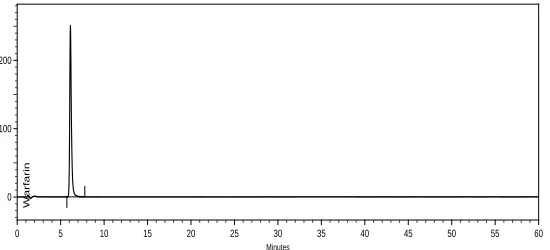
Acidic degradation study was performed by heating the drug content in 0.1 N HCl at 80 °C for 1.5 hours and mixture was neutralized. Warfarin sodium was found stable in acidic condition. (Figure 6).
Minutes
0 5 10 15 20 25 30 35 40 45 50 55 60
mAU
0 100 200
Warfarin
Figure 6. Chromatogram of acidic forced degradation study
Alkaline condition
Alkaline degradation study was performed by keeping the drug content in 1 N NaOH at ambient temperature for 2 hours and then, mixture was neutralized. In alkali degradation, it was found that around 2% of the drug degraded (Figure 7).
Minutes
2 4 6 8 10 12 14 16 18 20
mAU
-1 0 1
Warfarin
Oxidative condition
Oxidation degradation study was performed by keeping the drug content in 3% v/v H2O2 at
ambient temperature for 1 hour. Minor degradation was found in oxidative condition that 5% of the drug was degraded. The major impurity peaks was found at 2.6 and 3.8 min (Figure 8).
Minutes
2 4 6 8 10 12 14 16 18 20
mAU
-5 0 5
Warfarin
Figure 8. Chromatogram of oxidative forced degradation study
Thermal condition
Thermal degradation was performed by exposing formulation at 80 °C for 72 hours. Warfarin sodium is found to be stable under thermal degradation condition. There is no degradation observed in above specific thermal condition (Figure 9).
Minutes
0 5 10 15 20 25 30 35 40 45 50 55 60
mAU
0 50 100 150 200
Warfarin
Figure 9. Chromatogram of thermal degradation study
Photolytic condition
Minutes
2 4 6 8 10 12 14 16 18
mAU
0 2 4
Warfarin
Figure 10. Chromatogram of UV-light degradation study
Method validation Specificity
The evaluation of the specificity of the method was determined against placebo and stress (forced degradation) application. The interference of the excipients of the claimed placebo presence in the pharmaceutical dosage form was derived from placebo solution. Further, the specificity of the method toward the drug was established by means of the interference of the degradation products against drug during the forced degradation study.
Linearity
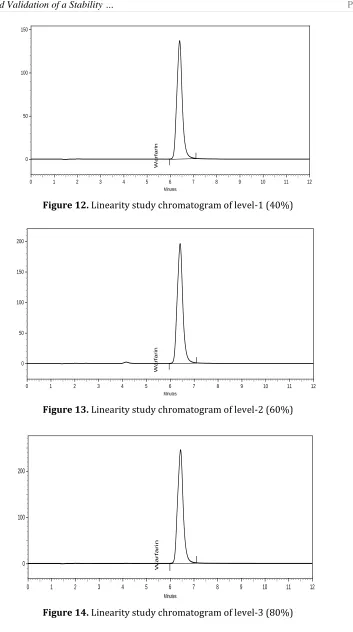
Seven points calibration curve was obtained in a concentration range from 40-160 μg/mL for warfarin sodium. The response of the drug was found to be linear in the investigation concentration range and the linear regression equation was y=49503136.60714 × +158762.26786 with correlation coefficient 0.9995 (Figure 11). Chromatogram obtain during linearity study were shown in Figure 12-18.
Linearity study for Warfarin Sodium
y = 49503136.60714x + 158762.26786 R2 = 0.9995
0 1000000 2000000 3000000 4000000 5000000 6000000 7000000 8000000 9000000
0 0.05 0.1 0.15 0.2
Concentration (mg/ml)
P
ea
k
ar
ea
Minutes
0 1 2 3 4 5 6 7 8 9 10 11 12
mAU
0 50 100 150
Warf
arin
Figure 12. Linearity study chromatogram of level-1 (40%)
Minutes
0 1 2 3 4 5 6 7 8 9 10 11 12
mAU
0 50 100 150 200
Warf
arin
Figure 13. Linearity study chromatogram of level-2 (60%)
Minutes
0 1 2 3 4 5 6 7 8 9 10 11 12
mAU
0 100 200
Warf
arin
Minutes
0 1 2 3 4 5 6 7 8 9 10 11 12
mAU
0 100 200 300
Warf
arin
Figure 15. Linearity study chromatogram of level-4 (100%)
Minutes
0 1 2 3 4 5 6 7 8 9 10 11 12
mAU
0 100 200 300
Warf
arin
Figure 16. Linearity study chromatogram of level-5 (120%)
Minutes
0 1 2 3 4 5 6 7 8 9 10 11 12
mAU
0 200 400
Warf
arin
Minutes
0 1 2 3 4 5 6 7 8 9 10 11 12
mAU
0 200 400
Warf
arin
Figure 18. Linearity study chromatogram of level-7 (160%)
LOD and LOQ
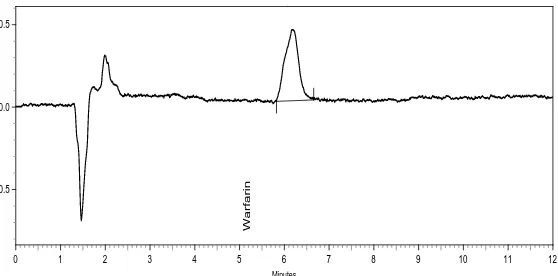
The limit of detection and limit of quantification were evaluated by serial dilutions of warfarin sodium stock solution in order to obtain signal to noise ratio of 3:1 for LOD and 10:1 for LOQ. The LOD value for warfarin sodium was found to be 0.25 µg/mL and the LOQ value 0.5 µg/mL. Chromatogram of LOD and LOQ study were shown in Figure 19-20.
Minutes
1 2 3 4 5 6 7 8 9 10 11 12
0.00 0.05 0.10
Warf
arin
Figure 19. Chromatogram of LOD Study of warfarin sodium
Minutes
0 1 2 3 4 5 6 7 8 9 10 11 12
mAU
-0.5 0.0 0.5
Warf
arin
Precision
The result of repeatability and intermediate precision study are shown in Table 1. The developed method was found to be precise as the % RSD values for the repeatability and intermediate precision studies were 0.22% and 0.70%, respectively, which confirm that method was precise.
Table 1. Evaluation data of precision study
Set Intraday (n = 6) Interday (n = 6)
1 100.8 101.1
2 100.4 99.9
3 100.3 100.9
4 100.3 100.5
5 100.7 99.5
6 100.3 99.5
Mean 100.5 100.2
Standard deviation 0.23 0.70
% RSD 0.22 0.70
Accuracy
The HPLC area responses for accuracy determination are depicted in Table 2. The result shows the best recoveries (98.95-99.15%) of the spiked drug were obtained at each added concentration, indicating that the method was accurate. Chromatogram obtain during accuracy study were shown in Figure 21-23.
Table 2. Evaluation data of accuracy study
Level (%) Amount added
concentration a (mg/mL)
Amount found
concentration a (mg/mL) % Recovery % RSD
50 0.05240 0.05196 99.15 0.42
100 0.10168 0.10076 99.09 0.17
150 0.15067 0.14908 98.95 0.28
a Each value corresponds to the mean of three determinations
Minutes
0 1 2 3 4 5 6 7 8 9 10 11 12
mAU
0 50 100 150
Warf
arin
Minutes
0 1 2 3 4 5 6 7 8 9 10 11 12
mAU
0 100 200 300
Warf
arin
Figure 22. Accuracy study chromatogram of level-2 (100%)
Minutes
0 1 2 3 4 5 6 7 8 9 10 11 12
mAU
0 200 400
Warf
arin
Figure 23. Accuracy study chromatogram of level-3 (150%)
Solution stability study
Table 3. shows the results obtain in the solution stability study at different time intervals for test preparation. It was concluded that the test preparation solution was found stable up to 48 h at 2-8 °C and ambient temperature, as during this time the result was not decrease below the minimum percentage.
Table 3. Evaluation data of solution stability study
Intervals
% Assay for test preparation solution
stored at 2-8 °C
% Assay for test preparation solution stored at ambient temperature
Initial -- 100.3
12 h 99.5 99.4
24 h 98.9 100.1
36 h 100.3 99.2
Robustness
The results of robustness study of the developed assay method are presented in Table 4. The result shows that during all variance conditions, assay value of the test preparation solution was slightly affected and it was in accordance with that of actual. System suitability parameters were also found satisfactory; hence, the analytical method would be concluded as robust. Chromatogram obtain during robustness study were shown in Figure 22-28.
Table 4. Evaluation data of robustness study
Robust conditions % Assay System suitability parameters
Theoretical plates Asymmetry
Flow 0.9 mL/min 100.9 1958.38 0.98
Flow 1.1 mL/min 99.7 1959.38 1.00
Buffer pH 2.5 97.0 2467.5 0.99
Buffer pH 3.5 98.4 2485.28 1.01
Buffer-ACN (52: 48, v/v) 102.9 2075.1 1.02
Buffer-ACN (48: 52, v/v) 95.5 2063.39 1.00
Column change 98.6 2526.77 1.00
Minutes
0 1 2 3 4 5 6 7 8 9 10 11 12
mAU
0 100 200
Warf
arin
Figure 22. Standard chromatogram (0.9 mL/min flow rate)
Minutes
0 1 2 3 4 5 6 7 8 9 10 11 12
mAU
0 100 200 300
Warf
arin
Minutes
0 1 2 3 4 5 6 7 8 9 10 11 12
mAU
0 100 200 300
Warf
arin
Figure 24. Standard chromatogram (Buffer-ACN (52:48, v/v))
Minutes
0 1 2 3 4 5 6 7 8 9 10 11 12
mAU
0 100 200 300
Warf
arin
Figure 25. Standard chromatogram (Buffer-ACN (48:52, v/v))
Minutes
0 1 2 3 4 5 6 7 8 9 10 11 12
mAU
0 200 400
Warf
arin
Minutes
0 1 2 3 4 5 6 7 8 9 10 11 12
mAU
0 100 200 300
Warf
arin
Figure 27. Standard chromatogram (pH 2.5)
Minutes
0 1 2 3 4 5 6 7 8 9 10 11 12
mAU
0 100 200 300
Warf
arin
Figure 28. Standard chromatogram (Column change)
System suitability
A system suitability test of the chromatographic system was performed before each validation run. Five replicate injections of standard preparation were injected and asymmetry, theoretical plate and % RSD of peak area were determined for the same. Acceptance criteria for system suitability, asymmetry not more than 2.0, theoretical plates not less than 1500 and % RSD of peak area not
more than 2.0,were full fill during all validation parameter.
Conclusion
This LC method for assay and determination of content uniformity of warfarin in a tablet
stability indicating. This method is recommended to the industry for quality control of drug content in pharmaceutical preparations.
Acknowledgements
The authors are thankful for facilities & grants given under UGC-special Assistance Programme (DRS), Department Research Support (Sanction letter No. 540/6/DRS/2004 (SAP-I) Dt. 26/03/2004, and Department of Science & Technology New Delhi Fund for Improvement of Science & Technology (FIST) (Sanction letter No. SR/FST/CSI-072/2003 Dt. 24/12/2003 and Department of Chemistry, Saurashtra University, Rajkot – 360 005 (INDIA) and Department of Chemistry, KSKV Kachchh University, Bhuj – 370 001 (INDIA) for providing facilities.
References
[1] Link K.P. Circulation., 1959, 19:97
[2] Holbrook A.M., Pereira J.A., Labiris R., McDonald H., Douketis J.D., Crowther M., Wells P.S. Arch.
Intern. Med., 2005, 165:1095
[3] Ansell J., Hirsh J., Polle L., Bussey H., Jacobson A., Hylek E. Chest., 2004, 126:204S
[4] Naidong W., Ring P.R., Midtlien C., Jiang X. J. Pharm. Biomed. Anal., 2001, 25:219
[5] Locatelli I., Kmetec V., Mrhar A., Grabnar I. J. Chromat., B: Anal. Technol. Biomed. Life Sci., 2005,
818:191
[6] HouJ., Zheng J., Shamsi S.A. J. Chromat. A, 2007, 1159:208
[7] Huang C., Yang J., Du Y., Miao L. Clin. Chimica Acta, 2008, 393:85
[8] McCormick T.J., Gibson A.B., Diana F.J. J. Pharm. Biomed. Anal., 1997, 15:1881
[9] Suganthi A., Ravi T.K, Chem. Method., 2019, 3:43
How to cite this manuscript: Vijay R. Ram*, Kapil L. Dubal, Pragnesh N. Dave, Hitendra S. Joshi. Development and Validation of a Stability Indicating HPLC Assay Method for Determination of
Warfarin Sodium in Tablet Formulation. Chemical Methodologies 3(3), 2019, 328-345. DOI: