Multiuser Delay-Tracking CDMA Receiver
Wei Zha
Department of Electrical and Computer Engineering, Faculty of Applied Science, Queen’s University, Kingston, Ontario, Canada K7L 3N6
Email: [email protected] Steven D. Blostein
Department of Electrical and Computer Engineering, Faculty of Applied Science, Queen’s University, Kingston, Ontario, Canada K7L 3N6
Email: [email protected]
Received 31 January 2002 and in revised form 7 May 2002
We propose to integrate delay tracking into a successive interference cancellation (SIC) code division multiple access (CDMA) multiuser detector. Delay-robust SIC was initially proposed for CDMA multiuser detection when there exist time delay estimation errors. When the delay error is small, the true user signature vector can be approximately expanded around the estimated time delay as a linear combination of an estimated signature vector and an error vector. The amplitude of the error signal can be recursively estimated and cancelled in the multistage SIC iterations by using the tentative feedback decisions. Since the relative amplitude of the error signal provides information about the delay error, we propose the application of error signal feedback to improve the delay estimation. In a sliding window implementation, the delay-robust SIC is used to track multiple time varying user delays. For constant or slowly varying channels, a soft-decision function can be used to improve the delay-robust SIC. For fast fading channels, a linear-decision function is used. Delay-tracking results for both rectangular chip pulses and band-limited chip pulses are shown.
Keywords and phrases:CDMA, multiuser detection, synchronization, delay tracking, successive interference cancellation.
1. INTRODUCTION
The capacity of a code division multiple access (CDMA) system is limited by the multiple access interference (MAI) from other users. CDMA multiuser detection at the bases-tation, which utilizes known user spreading codes for detec-tion, is an effective method to suppress MAI and improve re-ceiver performance. The optimal multiuser detector has ex-ponential computational complexity [1]. Several low com-plexity multiuser detectors including the decorrelating de-tector, MMSE dede-tector, successive interference cancellation (SIC) [2], and parallel interference cancellation (PIC) re-ceiver have been proposed [3].
These multiuser detectors all need accurate time delay in-formation from all users. If the time delays are estimated at the receiver even within a small error, the performance will degrade dramatically [4]. There is a rich literature on initial delay estimation (acquisition) of either a single user or of all users [5, 6]. However, little research has addressed the prob-lem of tracking the multiuser delays after the initial acquisi-tion.
Known multiuser delay-tracking receivers can be catego-rized into two types: those based on the extended Kalman filter (EKF) [7, 8, 9] and those based on delay-locked loops
(DLLs) combined with interference cancellation [10, 11]. Both types of delay trackers require the initial conditions (time delay and amplitude) to be close to their true values or they will not converge.
The EKF-based delay tracker of [7, 8] can track both complex channel gain and time delay variations. However, [7, 8] only demonstrate tracking ability for two users. The largest number of users that can track simultaneously is not investigated and is not known [7, 8]. The minimum mean square error EKF (MMSE-EKF) delay tracker of [9] usesK disjoint (separate) EKFs, one for each of theK users, so its complexity is lower than the EKF trackers of [7, 8] which track theKusers’ parameters jointly. The MAI is modeled as colored Gaussian noise and suppressed by the whitening fil-ter in [9]. Its performance is close to that of the ideal MMSE detector, and [9] also demonstrated tracking capability for a large number of users. However, [9] proposes a one-shot de-tector which is inherently suboptimal [12]. The EKF-based delay tracker also has high computational complexity since an innovation matrix inverse update is required for every symbol.
infinite memory length detector, that is, neglecting edge ef-fects [13]. The PIC can track a large number of users un-der ideal power control conditions, that is, a near-far ratio of 0 dB. However, the DLL is not fully integrated into the PIC iterations. When the near-far ratio increases to 10 dB, it breaks down since the residual interference, due to delay errors from the strong users, causes the weak users to make incorrect symbol decisions.
The objective in this paper is to improve the above ap-proaches by using a delay-robust SIC for delay tracking. The delay-robust SIC is based on a Taylor expansion of the true user signature vector into the sum of an estimated signa-ture vector and an error vector. The early-late DLL is widely used in single-user receivers for tracking time delay varia-tions [14]. Since the error vector used in the proposed delay-robust SIC is equivalent to a single-branch implementation of the early-late DLL, the delay-robust SIC implicitly com-bines a DLL into the SIC. Due to its robustness to delay errors even under severe near-far conditions, the tracking ability of the weakest users can be greatly improved.
The SIC regenerates and cancels the interference from other users before data detection of the desired user. The delay-robust SIC adds a delay error signal estimation and cancellation procedure onto the standard multistage SIC al-gorithm by using tentative decision-feedback. Since the am-plitude of the delay error signal is proportional to the time delay error, the time delay error estimate is implicitly ob-tained by the delay-robust SIC and can be used to refine the delay estimate. To track the users’ time delays, the delay-robust SIC is implemented as a sliding window. The delay error estimate of the current window is used to update the time delay information used in the next window.
If the channel is constant or varies slowly, the channel can be accurately estimated. A soft-decision function can be used in the delay-robust SIC to deliver close to single-user bit error rates (BER). For fast fading channels, we may use a linear-decision function combined with a delay-robust SIC to achieve robustness to both fading and time delay error.
Related research appears recently in [15, 16]. However, [15] assumes a fixed global timing error identical for all users and rectangular pulses. The method in [15] does not utilize the error vector combined with decision-feedback to estimate different users’ random timing error. In [15], the performance is evaluated under ideal power control condi-tions. Here, we consider drifting timing errors that differ among users and arbitrary band-limited pulses. We evalu-ated the performance under severe near-far conditions. Al-though the local reference adjustment [15, Scheme 3] ap-pears to be somewhat similar to our proposed method in updating the user signature sequence according to the esti-mated timing error, this updating is not used in the random timing error estimation procedure. Thus, the two algorithms are quite different and [15] cannot be generalized to the pro-posed method in this paper. In [16], it is assumed that the data is known, while we consider that the data symbols are unknown and to be estimated iteratively in the timing error estimation procedure. Although [16] can also be used in a decision-directed fashion, we emphasize that data detection
and timing error estimation must be performed jointly for best performance.
Section 2 describes the system model. Section 3 intro-duces the delay-robust SIC and applies it to the multiuser delay tracking. Section 4 provides simulation results for both constant and multipath fast fading CDMA channels. Section 4.4 considers the delay tracking for multipath fast fading CDMA channels. Section 5 discusses the problem with delay tracking in multipath fading multiuser CDMA systems and the possible future directions.
2. SYSTEM MODEL
We consider the base station receiver for the asynchronous uplink multipath fading CDMA channel with binary phase shift keying (BPSK) modulation.
The equivalent baseband received signal at the basesta-tion is ith time interval, ˜sk(t) is thekth user’s normalized signature waveform,n(t) is the white Gaussian noise,τk,l∈[0, T) is the kth user’s propagation delay for thelth path,Tis the symbol duration, andKis the total number of users. The amplitude is absorbed into the complex channel gain for thelth path of thekth user,αk,l(i). The channel is assumed to remain con-stant for the duration of a symbol interval and varies from symbol to symbol. For simplicity, the number of multipaths, L, is assumed to be the same for all users.
In (1), the normalized signature waveform of user k, ˜
spreading code,Tc is the chip duration, andh(t) is the chip pulse. The spreading codes of all users are assumed to be known at the receiver.
We use an observation window of length (M+ 1)T to detect theMtransmitted data symbols from each user,bk(i), i =1, . . . , Mandk =1, . . . , K. Due to asynchronismτk,l ∈ [0, T), we note that the observation interval must be of length (M+ 1)Tseconds.
After chip-matched filtering and chip-rate sampling, the received signal is discretized into a vector of (M+ 1) obser-vations,
Chip-matched filter response
Chip-rate sampling points Amplitude
g(t)
0 Tc 2Tc 3Tc 4Tc 5Tc 6Tc t
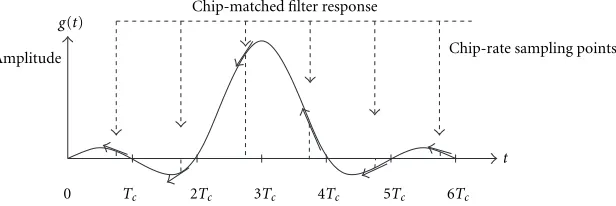
Figure1: Sampling of the chip-matched filter response for truncated band-limited chip-pulse shapes. The solid arrows represent the first-order derivative of the chip-matched filter response at the sampling points with estimated time delay.
of lengthN, that is,
r=rT(1)rT(2)· · ·rT(M+ 1)T∈Ꮿ(M+1)N, (4) where the element vectorr(m) in (4) corresponds to themth observation interval [(m−1)T, mT]
r(m)=r(mN+ 1)· · ·r(mN+N)T∈ᏯN. (5) Similarly, we may organize the zero-mean white Gaussian noise vector as
n=nT(1)nT(2)· · ·nT(M+ 1)T ∈Ꮿ(M+1)N. (6) The time delay oflth path of thekth user is decomposed into an integer, pk,l, and a fractional part,δk,l, whereτk,l = (pk,l+δk,l)Tc,pk,l∈ {0,1, . . . , N−1}, andδk,l∈[0,1).
We denoteck(pk,l, i) asckright-shifted by (i−1)N+pk,l chips, whereck ∈(M+1)N is thekth user’s spreading code vector for the (M+ 1)Tlength interval defined as
ck=
ck(0)ck(1)· · ·ck(N−1) 0 0 · · · 0 MN
T
. (7)
For the general band-limited chip pulse shapesh(t), the received discretized signature waveform of theith symbol of thelth path of thekth user,dk,l(i), is the convolution of the user spreading codes with the chip-matched filter response at the sampling points, that is,
dk,l(i)=ck
pk,l, i
∗gk,l, (8)
where vectorgk,lis thelth path of thekth user’s chip-matched filter response at the chip-rate sampling points, as shown in Figure 1. If the chip-matched filter response is truncated to lengthPTc, then the vectorgk,l will be of lengthP, and the signature waveformdk,l(i) will haveN+P−1 nonzero ele-ments. Themth element ofgk,lis given by
gk,l(m)=
∞
−∞h
τ−δk,lTc
h∗mTc−τ
dτ,
m∈ {1,2, . . . , P}.
(9)
For the special case of rectangular chip pulseh(t) with duration [0, Tc),P=2 andgk,l=
(1−δk,l) δk,l.
Substitut-ing into (8), the discretized signature waveform is
dk,l(i)=
1−δk,l
ck
pk,l, i
+δk,lck
pk,l+ 1, i
. (10)
The received signal vectorsr(i) over the (M+ 1) observa-tions,i=1, . . . , M+ 1, provide sufficient statistics for detect-ing the transmitted data symbols from theKusers.
3. DELAY-ROBUST SIC WITH MULTIUSER DELAY TRACKING
3.1. Delay-robust SIC
In practical systems, the time delay is not known and must be estimated at the receiver. Denote the estimated time delay of thelth path of thekth user as ˆτk,l =( ˆpk,l+ ˆδk,l)Tc, where
ˆ
pk,l∈ {0,1, . . . , N−1}and ˆδk,l∈[0,1) is the fractional part. Since most current time delay estimation methods have a delay estimation error standard deviation within 0.1Tc[5, 6], we assume that the delay error∆τk,l =τk,l−τˆk,lis small compared toTc.
The effect of imperfect time delay estimation, that is, de-lay mismatch, on the performance of multiuser detectors has been investigated in [4]. It is shown that these multiuser de-tectors are all sensitive to delay mismatch; BER performance degrades greatly even with relatively small delay estimation errors under severe near-far scenarios.
Modified multiuser detectors have thus been proposed to mitigate the effects of imperfect time delay estimation. The deterministic approach [17] applies only to rectangular chip-pulse shapes and has a capacity limit of 50% of the spread-ing factor. The stochastic approaches [18, 19] depend on the delay error distribution. The residual MAI caused by timing error is not completely eliminated and stochastic approaches are, therefore, not near-far resistant.
We adopt a delay-robust multiuser receiver based on SIC implementation which is denoted as delay-robust SIC [20]. At each SIC iteration, the timing delay error introduced in-terference is estimated and cancelled.
When the delay error is small, thekth user’s signature waveform for theith interval and thelth path,dk,l(i), is first-order Taylor expanded, as shown in Figure 1,
dk,l(i)≈dˆk,l(i) +
δk,l−δˆk,l
∆dk,l(i), (11)
Other users’ interference
Usersk’s timing error signal from stagej
r
Estimated userk’s signal for stage (j+ 1)
Standard SIC interference cancellation unit
Estimated userk’s timing error signal
Timing error signal estimation unit
Figure2: Interference cancellation unit of delay-robust SIC for userkat the (j+ 1)st stage.
The error vector∆dk,l(i) for the band-limited chip pulse shape is the convolution of the user spreading codes with the first derivative vectorfk,lof thelth path of thekth user’s chip-matched filter response at the sampling points, that is,
∆dk,l(i)=ck
In the special case of a rectangular chip pulse,P=2 and
fk,l=[−1 1], the error vector
If rectangular chip pulses are used, the expansion in (11) is exact [19]. We note that the linear approximation in (11) for band-limited chip pulses is a good approximation in tracking mode where the timing error is small.
The performance degradation of the CDMA multiuser detectors is caused by the delay error signal which is a multi-ple of the error vector∆dk,l(i). Since the error vector∆dk,l(i) is known, we may estimate the amplitude of error signal by using the tentative decision-feedback in the iterations of the SIC and cancel this interference. Robustness to time delay er-ror is achieved by this improved SIC algorithm under near-far conditions.
To improve the estimation accuracy of the error signal at each iteration, theMerror vectors of each user are com-bined into a long error vector,ek,l, based on the tentative data symbol decisions, ˆbk(i). If the complex fading gainsαk,l(i) are known, then
We note that this is actually averaging the estimate over a window ofMsymbols.
To simplify the algorithm description, we let the number of paths be L = 1 and drop the subscriptlfor the paths. The delay-robust SIC algorithm is as follows [21], where its interference cancellation unit for thekth user at stage (j+ 1) is as shown in Figure 2.
Initialization: Steps (1) through (4)
(2) For each symbol in the block,i=1, . . . , M, obtain the normalized soft data symbol esti-mate and make a data symbol decision. For theith symbol, the soft data symbol estimate is normalized with respect toαk(i),
˜
where Re(·) takes the real value. The data symbol decision is then made by the deci-sion functionfdec(·),
(3) Estimate the error signal of thekth user due to time delay error as
∆rkj+1=rkj+1−ˆrkj+1+∆akje j
k. (20)
(4) Update the normalized amplitude of the er-ror signal, mate of the normalized error signal amplitude∆akat (j+1)st iteration in (22) can be used to improve the delay estimate.
3.2. Delay tracking for known fading channels
We propose using a sliding window version of the delay-robust SIC as a multiuser delay-tracking receiver. The values computed during the previous window can be used as initial values for the current window computation so the compu-tation complexity can be greatly reduced. It is required that all users are initially under acquisition, that is, within±0.5Tc of the true delay. This initial acquisition can be obtained by using other delay estimation algorithms [5, 6].
The delay is updated in small steps, that is, 0.05Tc. When the delay error estimate is larger than±0.05Tc, the user time delay is updated by±0.05Tcand then used in the next win-dow where the same procedure is repeated.
We note that there are implementation advantages when the time delays are updated in fixed small steps; the recal-culation of the user signature sequence according to (11) is avoided if the delay change is small. Sudden large changes, due to impulse noise or interference, are also avoided.
It was shown in [12] that when the observation window lengthM is larger than 8 symbols, edge effects can be ne-glected. It is also shown in [20] that the delay-robust receiver has a capacity ofM/(M+ 1) of the standard SIC. As a com-promise, we chooseM=9 in our simulations.
The delay-robust SIC adds an error signal estimation procedure to the standard multistage SIC. As pointed in [20], this delay-robust SIC implicitly incorporates soft error signal
cancellation into its iterations; when some symbols of the tentative data symbol decisions are incorrect, the estimated amplitude of the error signal will be smaller than the actual value, which is equivalent to soft cancellation with a factor less than 100%. Thus, this delay-robust SIC is numerically stable.
When the complex fading channel gains αk,l(i) are known, which is the case of slow fading or additive white Gaussian noise (AWGN) channels where the channel gains and amplitudes can be easily estimated, we may use a soft-decision function in the SIC to improve BER performance. One possible soft-decision function that leads to good per-formance is [21] choice ofcon the performance of the SIC using the above soft-decision function was analyzed and simulated in [21]. It was found thatc =0.5 is a good choice, so we usec= 0.5 throughout this paper if soft decision is applied.
3.3. Delay tracking for unknown fading channels Channel estimation for a fast fading multiuser CDMA chan-nel is a difficult problem, since the effect of MAI must be suppressed or eliminated first to obtain an accurate channel estimate for the desired user. One suboptimum solution is the multipath decorrelating detector.
The multipath decorrelating detector can be first used to decorrelate each path of each user before channel estimation. The channel estimator works on these MAI-free decorrelator outputs [22]. The price paid for this MAI-free decorrelation is the noise enhancement and reduced system capacity since each user is detected asLusers.
As shown in [23], the linear SIC (multistage SIC with linear-decision function) is an iterative implementation of the decorrelator. The linear-decision function is fdec(x)=x
which is equivalent to estimate the data symbol bk(i) and complex channel gainαk,l(i) as a composite signalok,l(i) at stage (j+ 1), (1) and we replace the entire Step (2) by (24). The resulting delay-robust SIC with a linear-decision function can be used to track the time delays of all users for fast fading channels.
3.4. Implementation issues
actual CDMA basestation implementation [24]. It can be shown from Figure 2 that through the added timing error estimation and cancellation, the proposed delay-robust SIC approximately doubles both computational complexity and processing delay, compared to the standard SIC algorithm [2]. As a function of the number of users, the complexity and processing delay are of the same order of magnitude as the standard SIC.
4. NUMERICAL AND SIMULATION RESULTS
In this section, we will first evaluate the BER performance of the delay-robust SIC for a static channel using PN chip-level simulation. The sliding window version of the delay-robust SIC is then used to track the multiple user time delay variations for both the rectangular chip pulses and the band-limited chip pulses.
Throughout the simulations, Gold code sequences of length N = 31 are used. The number of users is fixed at K = 20 to account for a highly loaded system. The signal-to-noise ratio (SNR) is defined with respect to the user of in-terest, user 1. The near-far ratio is defined as the power ratio between the strongest user and user 1 which is fixed at 10 dB. All other users have an amplitude uniformly distributed be-tween those of the strongest user and the weakest user.
First, we consider the AWGN channel. Here, we can take advantage of the constant amplitude property by using a soft-decision function. The amplitude is estimated by averaging over a block ofMto reduce its noise variance by a factor of M [2]. The threshold used for the soft-decision function is c = 0.5, and the total number of interference cancellation stages isJ =5. The tracking for fast fading channels using a linear-decision function is simulated inSection 4.4 withJ =
10 interference cancellation stages.
4.1. BER performance
For the simulation of BER, a window size ofM=9 is used. Rectangular chip pulses are used. The estimated time delay is static, that is, fixed over the observation window with a delay error standard deviation ofστ=0.1Tc.
In Figure 3, the BER curve of the delay-robust SIC with soft-decision and amplitude averaging is shown as a function of SNR. As a comparison, the BER curve of the single user case is shown as a lower bound which can only achieved by the ideal multiuser detector with true time delay and ampli-tude information. From Figure 3, the delay-robust SIC per-formance is only about 1.2 dB away from the single user bound at a BER of 10−3. The BER curves of the decorrelating
detector with both true time delay and estimated time de-lays are also shown. Both of their performances are far from the single user bound because of the decorrelator’s noise en-hancement.
In Figure 4, we compare the BER performance of the delay-robust SIC and the standard SIC detectors [2] un-der two different delay error conditions ofστ = 0.1Tc and στ = 0.2Tc, respectively. As shown, the delay-robust SIC is much more insensitive to theστincrease. This indicates that
4 6 8 10 12 14
SNR (dB) 10−6
10−5 10−4 10−3 10−2 10−1 100
BER
Decorrelator (true delay) Decorrelator (estimated delay) Delay-robust SIC, soft-decision (c=0.5) Single-user lower bound
BER,K=20, time delay error standard deviation
στ=0.1Tc
Figure3: Bit error rate (BER) of user 1 for delay-robust SIC de-tector. Near-far ratio=10 dB. Soft-decision function is used with thresholdc=0.5.
it is advantageous to jointly estimate delay errors and detect data symbols.
4.2. Tracking for rectangular chip pulses
For simulating the tracking of multiuser time delays, data symbols are assumed to be transmitted continuously. We let sliding window length beM=9 symbols.
In this simulation, rectangular chip pulses are used. We tracked a total ofK=20 users’ delays. The SNR of the weak-est user is 14 dB. The weakweak-est user’s and the strongweak-est user’s delay tracking curves are shown in Figure 5 where the solid line and the dashed line represent the actual and estimated delay trajectories, respectively. The initial acquisition has a delay error standard deviation of 0.5Tc. The spreading factor isN=31. The update step of the delay tracker is 0.05Tc.
We assume the delay varies with time as a first-order Gauss-Markov process as in [7]
τ(m+ 1)=τ(m) +w(m) +u(m), (26)
wherew(m) is a zero-mean noise process with varianceσ2 w andu(m) is a deterministic scalar that models slow global drift. We useσ2
w =0.01σ2. The global time variationu(m) is selected to change at a rate of 0.005Tc per symbol. Assum-ing a propagation speed of 3.0×10⁸m/s, this is equivalent
to (0.005/31)×3.0×108 ≈5×10⁴m/s, or 1.8×10⁵km/h
[8].
4 6 8 10 12 14
SNR (dB) 10−6
10−5 10−4 10−3 10−2 10−1 100
BER
Delay-robust SIC,στ=0.1Tc
Standard SIC,στ=0.1Tc
Delay-robust SIC,στ=0.2Tc
Standard SIC,στ=0.2Tc
Single-user bound BER,K=20
Figure4: BER of user 1 for delay-robust SIC and standard SIC de-tectors. Near-far ratio=10 dB. Soft-decision function is used with thresholdc=0.5.
0 50 100 150 200 250 300 350 400 450 500 Symbols
3 4 5 6 7 8 9 10 11 12
Dela
y
(
Tc
)
Weakest user
Strongest user Delay tracking for rectangular chip pulse, SNR=14 dB
Figure5: Delay tracking curves of delay-robust SIC. Near-far ratio =10 dB. The weakest user has SNR=14 dB. Soft-decision function is used with thresholdc=0.5. The solid line is the true delay and the dashed line is the tracking result.
delay-robust SIC in the static model of Section 4.1. The time delay variation in the tracking model adds only a small amount of noise, and the BER error floor is not obvious.
From Figure 6, the delay tracking multiuser receiver has a BER of approximately 20% for the weakest user at SNR of 3 dB. Even for such high BER, the delay-robust SIC based de-lay tracker can still follow the dede-lay variation as shown in Figure 7.
3 4 5 6 7 8 9 10 11 12 13
SNR (dB) 10−4
10−3 10−2 10−1 100
BER
Delay-robust SIC (Tracking) Delay-robust SIC (Static) Single-user lower bound
BER,K=20, tracking
Figure6: BER of user 1 for delay-robust SIC detector in tracking time delays. Near-far ratio=10 dB. Soft-decision function is used with thresholdc=0.5.
4.3. Tracking for band-limited chip pulses
In Figure 8, a square-root raised cosine chip pulse with roll-offfactor 0.35 is used. The SNR of the weakest user is 14 dB. Since band-limited chip pulse is more sensitive to the time delay errors, the initial acquisition delay error standard de-viation is reduced to 0.1Tc, and the update step is smaller, 0.01Tc. We found that for band-limited chip pulses, the de-lay tracking algorithm cannot track the time variations of Section 4.2, so we used more mild conditions, that is, we set σ2
w 10 dB lower and reduce the global drift to 0.001Tc per symbol.
4.4. Tracking for time varying fading channels
In Section 4.2, we have assumed that the complex channel gain remains constant while only the user time delays are varying. However, in wireless mobile channels, the user time delays vary relatively slowly compared to the variation of the complex-channel gains.
0 50 100 150 200 250 300 350 400 450 500 Symbols
3 4 5 6 7 8 9 10 11 12
Dela
y
(
Tc
)
Weakest user
Strongest user Delay tracking for rectangular chip pulse, SNR=3 dB
Figure7: Delay tracking curves of delay-robust SIC. Near-far ratio =10 dB. The weakest user has SNR=3 dB. Soft-decision function is used with thresholdc=0.5. The solid line is the true delay and the dashed line is the tracking result.
0 50 100 150 200 250 300 350 400 450 500 Symbols
5.5 6 6.5 7 7.5 8 8.5 9
Dela
y
(
Tc
)
Weakest user
Strongest user Delay tracking for band-limited chip pulse
Figure 8: Delay tracking curves of delay-robust SIC for
band-limited chip pulses. Near-far ratio=10 dB. The weakest user has SNR=14 dB. Soft-decision function is used with thresholdc=0.5. The solid line is the true delay and the dashed line is the tracking result.
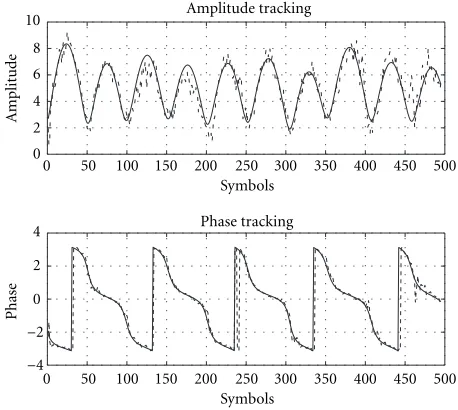
By assuming the exact knowledge of the transmitted data symbol bk(i), the complex channel gain is tracked in Figure 10 for user 1. The delay-robust SIC decorrelates the fading signal for different users, so it can be used to track both delay and channel variations.
5. DISCUSSION
Although we have demonstrated delay tracking using noisy estimates of the composite signal, it is desirable to have a
0 50 100 150 200 250 300 350 400 450 500 Symbols
3 4 5 6 7 8 9 10 11
Dela
y
(
Tc
)
Weakest user
Strongest user Delay tracking for fading channel
Figure9: Delay tracking curves of delay-robust SIC for Rayleigh
fading channels. Normalized Doppler fading rate is fDT = 0.01. Near-far ratio=10 dB. The weakest user has SNR=14 dB. Linear-decision function is used. The solid line is the true delay and the dashed line is the tracking result.
0 50 100 150 200 250 300 350 400 450 500 Symbols
−4
−2 0 2 4
Phase
Amplitude tracking
0 50 100 150 200 250 300 350 400 450 500 Symbols
0 2 4 6 8 10
Am
p
li
tu
d
e
Phase tracking
Figure10: Channel amplitude and phase tracking curves of
delay-robust SIC for Rayleigh fading channels for the weakest user. Nor-malized Doppler fading rate is fDT =0.01. The weakest user has SNR=14 dB. Linear-decision function is used. The solid line is the true delay and the dashed line is the tracking result.
smoothed estimate. In addition, for multipath fading chan-nels, it is advantageous to coherently combine the multipath signals before data detection. Coherent diversity combining requires the channel estimatesαk,l(i), not just the composite signalok,l(i) [22, 25].
Gauss-Markov model. In [26], disjoint Kalman filtering channel estimation is applied where each user uses a Kalman filter to estimate its channel coefficients based also on the MAI-free decorrelator outputs. However, the use of the mul-tipath decorrelator or mulmul-tipath linear MMSE receiver as the front-end for the channel estimator can only be applied to the case of relatively few users because of the loss of the de-grees of freedom in the signal subspace as the number of users gets large [27].
Multiuser channel estimation that does not use a mul-tipath decorrelator front-end may have less noise enhance-ment and larger capacity for relatively slow fading where there is no severe tracking problem. In [25], pilot symbols are periodically inserted for channel estimation using a Ham-ming windowed finite impulse response (FIR) low-pass fil-ter to approximate the optimal Wiener filfil-ter. Infil-terpolation is used to obtain the channel estimate for other symbols for the multistage SIC receiver [25]. The performance of a pilot sym-bol aided channel estimator with interpolation for a single user channel was analyzed in [28]. In [10, 11], a PIC-based channel estimator uses a decision-directed linear predictor and a linear smoother which were previously proposed for single-user channel estimation [29].
As seen in Section 4, the user-delay variation in a prac-tical system is far less than that used in our simulations. In our simulations, we have averaged the time delay error over a block ofM =9 symbols to filter out the noise. Although the delay-robust SIC based multiuser delay tracker does track the multiuser delay changes, it sometimes loses tracking be-cause of the small block length used. In practice, the de-lay error can be averaged over a longer block, that is,M =
70 symbols, to have better tracking performance. In prac-tical implementations, the block averaging may be replaced by exponential weighting with a forgetting factor less than unity.
The channel estimation and delay tracking can be sep-arated by using different block lengths for prediction or smoothing by using our delay-robust SIC technique, sim-ilar to the PIC-based delay tracker [10, 11]. This provides an alternative to the EKF based channel and delay track-ers [7, 8, 9]. The EKF was introduced since the time de-lay is a nonlinear function of the user signature sequence. When channel and delay estimation are separated, the sim-pler Kalman filter can be used for the channel estimation, while the delay tracking can be handled by the delay-robust SIC using a longer smoothing length.
6. CONCLUSION
We have proposed to use a delay-robust SIC detector for multiuser time delay tracking. The time delay error vec-tor in the robust SIC can be used to estimate the time delay changes of all users. The delay-robust SIC implic-itly combined the delay tracking into the multiuser detec-tion. For a static delay channel, the delay-robust SIC has a BER close to the single-user bound. For dynamic delay tracking, the BER of the multiuser delay-tracking receiver,
based on the sliding window implementation of delay-robust SIC, is only slightly inferior to that of the static channel. Accurate tracking occurs for both rectangular and band-limited chip pulses and for both constant and fast fading channels.
ACKNOWLEDGMENT
This research has been supported by the Canadian Institute for Telecommunications Research under the NCE program of the Government of Canada.
REFERENCES
[1] S. Verd ´u, “Minimum probability of error for asynchronous Gaussian multiple-access channels,”IEEE Transactions on In-formation Theory, vol. 32, no. 1, pp. 85–96, 1986.
[2] P. Patel and J. Holtzman, “Analysis of a simple successive in-terference cancellation scheme in a DS/CDMA system,”IEEE Journal on Selected Areas in Communications, vol. 12, no. 5, pp. 796–807, 1994.
[3] D. Koulakiotis and A. H. Aghvami, “Data detection tech-niques for DS/CDMA mobile systems: a review,” IEEE Per-sonal Communications, vol. 7, no. 3, pp. 24–34, 2000. [4] S. Parkvall, E. G. Str¨om, and B. Ottersten, “The impact of
tim-ing errors on the performance of linear DS-CDMA receivers,”
IEEE Journal on Selected Areas in Communications, vol. 14, no. 8, pp. 1660–1668, 1996.
[5] E. G. Str¨om, S. Parkvall, S. L. Miller, and B. Ottersten, “Prop-agation delay estimationin asynchronous direct-sequence code-division multiple access systems,”IEEE Trans. Commu-nications, vol. 44, no. 1, pp. 84–93, 1996.
[6] S. E. Bensley and B. Aazhang, “Subspace-based channel esti-mation for code division multiple access communication sys-tems,”IEEE Trans. Communications, vol. 44, no. 8, pp. 1009– 1020, 1996.
[7] T. J. Lim and L. K. Rasmussen, “Adaptive symbol and pa-rameter estimation in asynchronous multiuser CDMA detec-tors,” IEEE Trans. Communications, vol. 45, no. 2, pp. 213– 220, 1997.
[8] J. Caffery Jr. and G. L. St¨uber, “Nonlinear multiuser
pa-rameter estimation and tracking in CDMA systems,” IEEE
Trans. Communications, vol. 48, no. 12, pp. 2053–2063, 2000.
[9] R. A. Iltis, “A DS-CDMA tracking mode receiver with
joint channel/delay estimation and MMSE detection,” IEEE Trans. Communications, vol. 49, no. 10, pp. 1770–1779, 2001. [10] M. Latva-aho and J. Lilleberg, “Parallel interference cancella-tion based delay tracker for CDMA receivers,” inProc. the 30th Conference on Information Sciences and Systems (CISS96), pp. 852–857, Princeton, NJ, USA, March 1996.
[11] M. Latva-aho and J. Lilleberg, “Delay trackers for multiuser receivers,” inProc. Int. Conf. Universal Personal Communica-tions, pp. 326–330, Boston, Mass, USA, September 1996. [12] M. J. Juntti and B. Aazhang, “Finite memory-length linear
multiuser detection for asynchronous CDMA communica-tions,” IEEE Trans. Communications, vol. 45, no. 5, pp. 611– 622, 1997.
[13] J. Shen and Z. Ding, “Edge decision assisted decorrelators
for asynchronous CDMA channels,” IEEE Trans.
Communi-cations, vol. 47, no. 3, pp. 438–445, 1999.
[15] P. Xiao and E. G. Str¨om, “Synchronization algorithms for
iterative demodulated M-ary DS-CDMA systems,” inProc.
IEEE Global Telecommunications Conference, pp. 1371–1375, San Antonio, Tex, USA, November 2001.
[16] M. Guenach and L. Vandendorpe, “Design and performance analysis of DA multiuser path trackers for long code
DS-CDMA systems,” inProc. IEEE Global Telecommunications
Conference, vol. 2, pp. 1381–1385, San Antonio, Tex, USA, November 2001.
[17] F. van Heeswyk, D. D. Falconer, and A. U. H. Sheikh, “A de-lay independent decorrelating detector for quasi-synchronous CDMA,” IEEE Journal on Selected Areas in Communications, vol. 14, no. 8, pp. 1619–1626, 1996.
[18] L.-C. Chu and U. Mitra, “Performance analysis of an
improved MMSE multi-user receiver for mismatched delay channels,” IEEE Trans. Communications, vol. 46, no. 10, pp. 1369–1380, 1998.
[19] T. ¨Ostman, M. Kristensson, and B. Ottersten, “Asynchronous
DS-CDMA detectors robust to timing errors,” in Proc.
IEEE Vehicular Technology Conference, vol. 3, pp. 1704–1708, Phoenix, Ariz, USA, January 1997.
[20] W. Zha and S. D. Blostein, “Improved CDMA multiuser re-ceivers robust to time errors,” inProc. IEEE Int. Conf. Acous-tics, Speech, Signal Processing, Salt Lake City, Utah, USA, May 2001.
[21] W. Zha and S. D. Blostein, “Soft-decision successive interfer-ence cancellation CDMA receiver with amplitude averaging and robust to timing errors,” inProc. IEEE Global Telecommu-nications Conference, San Antonio, Tex, USA, November 2001. [22] M. Stojanovic and Z. Zvonar, “Performance of multiuser de-tection with adaptive channel estimation,”IEEE Trans. Com-munications, vol. 47, no. 8, pp. 1129–1132, 1999.
[23] L. K. Rasmussen, T. J. Lim, and A. L. Johansson, “A matrix-algebraic approach to successive interference cancellation in CDMA,”IEEE Trans. Communications, vol. 48, no. 1, pp. 145– 151, 2000.
[24] I. Seskar and N.B. Mandayam, “Software-defined radio archi-tectures for interference cancellation in DS-CDMA systems,”
IEEE Personal Communications, vol. 6, no. 4, pp. 26–34, 1999. [25] A. C. K. Soong and W. A. Krzymien, “A novel CDMA mul-tiuser interference cancellation receiver with reference symbol aided estimation of channel parameters,”IEEE Journal on Se-lected Areas in Communications, vol. 14, no. 8, pp. 1536–1547, 1996.
[26] P. H. Wu and A. Duel-Hallen, “Multiuser detectors with
disjoint Kalman channel estimators for synchronous CDMA mobile radio channels,”IEEE Trans. Communications, vol. 48, no. 5, pp. 752–756, 2000.
[27] M. Latva-Aho and M. J. Juntti, “LMMSE detection for DS-CDMA systems in fading channels,”IEEE Trans. Communica-tions, vol. 48, no. 2, pp. 194–199, 2000.
[28] J. K. Cavers, “An analysis of pilot symbol assisted modulation for Rayleigh fading channels,” IEEE Trans. Vehicular Technol-ogy, vol. 40, no. 4, pp. 686–693, 1991.
[29] Y. Liu and S. D. Blostein, “Identification of frequency non-selective fading channels using decision feedback and adaptive linear prediction,” IEEE Trans. Communications, vol. 43, no. 2/3/4, pp. 1484–1492, 2–4 1995.
Wei Zha received his B.S. and M.S. from Shanghai Jiao Tong University, Shanghai, China, in 1992 and 1995, respectively, both in electronics engineering. He worked as a Lecturer and Research Engineer at the Department of Electronics Engineering, Shanghai Jiao Tong University, Shanghai, China, from 1995 to 1998. Since 1998, he has been a Ph.D. student and Research As-sistant at the Department of Electrical and
Computer Engineering, Queen’s University, Kingston, Canada. His research areas are in CDMA, OFDM, MIMO systems, and general areas of wireless communications and signal processing.
Steven D. Blosteinreceived his B.S. degree in electrical engineering from Cornell Uni-versity, Ithaca, NY, USA, in 1983, and the M.S. and Ph.D. degrees in electrical and computer engineering from the University of Illinois, Urbana-Champaign, in 1985 and 1988, respectively. He has been on the Fac-ulty at Queen’s University since 1988 and currently holds the position of Professor at the Department of Electrical and Computer