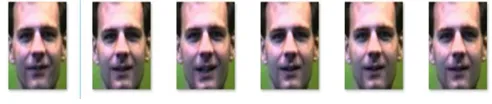
Face Recognition Attendance System using
Eigen Vectors and PCA with Smart Phone
A.Jeyanthi
1, Dr.J.Visumathi
2Associate Professor, Dept. of CSE, Misrimal Navajee Munoth Jain Engineering College, Research Scholar, Anna
University, Chennai, India 1
Professor, Dept. of CSE, Jeppiaar Engineering College, Chennai, India2
ABSTRACT: Here we describe an attendance system by face recognition using Principal Component Analysis (PCA). The facial recognition part, segmentation and localization uses Viola Jones algorithm. The facial features are extracted from face image by means of Eigen Vectors. The Attendance is recorded by utilizing a camera either front / back of a smart phone catching pictures of subject, detect the face in image and contrast the distinguished appearances and the database and mark the attendance. To handle the problem of fake entry our approach uses eye blind detector. Experiments are conducted using Libor Spacek’s Facial Images Databases give better performance in terms of 100% recognition rate for training set and 86.2% accuracy for test set. Thus the efficiency of the proposed method in enhancing the classification rate is high. In the end, the simulated results for the proposed technique is shown and established that proposed technique is performing better than other existing systems. The planned system is implemented using MATLAB version 9.2 R2017a and Android Studio 3.0.
KEYWORDS: Attendance System using Face recognition, Eigen Vectors, Face regions, Feature extraction, PCA
I.INTRODUCTION
Facial recognition, an important task in human computer interaction can be achieved in this work. We investigate how to recognize facial features automatically. Feature based Facial recognition uses three steps such as face detection, feature extraction and matching the face with the face in the database. To recognize facial expressions from the image, a set of key facial parameters that best describe the particular set of facial feature needs to be extracted from the face image so that it can be used to distinguish among expressions from the given dataset. This group of key parameters is called the “Feature Vector” of the image and the amount of information extracted from the image to the feature vector is the single most important factor of successful feature extraction technique.
There are different kinds of methods to extract feature vector from facial images such as DCT [1], wavelet [1], LBP [3],[12], PCA [4] and Gabor methods, amid Gabor features have been used widely after Lyons et al. [5] first projected that the Gabor representation shows a major degree of emotional plausibility. Due to this our work uses PCA for feature extraction from face image. Our conclusion points to that it is achievable to build a improved automatic facial recognition system based on a PCA.
II.RELATEDWORK
ISSN(Online): 2320-9801 ISSN (Print): 2320-9798
I
nternational
J
ournal of
I
nnovative
R
esearch in
C
omputer
and
C
ommunication
E
ngineering
(A High Impact Factor, Monthly, Peer Reviewed Journal)
Website: www.ijircce.com
Vol. 6, Issue 6, June 2018
for monitoring purposes.
Soniya V et al., [8] (2017) has developed a system automatically detects the student’s entry in the class and marks attendance for the particular student periodically. The data collected can be used by the system further for attendance score calculation and other managerial decisions. Arduino is used to create and control the system that could automatically mark the attendance for the students.
Nazare Kanchan Jayant et al.,[7] (2016) has developed a system that employs modified version of Viola-Jones algorithm for face detection, and alignment- free partial face recognition algorithm for facial recognition. After successful recognition of a student, the system automatically updates the attendance in the excel sheet. The system developed by them improves the performance of existing systems by avoiding any inconsistencies, proxy marking and entry of attendance in institutional websites.
S. L. Happy et al., [11] proposed a novel framework where few prominent facial patches, depending on the position of facial landmarks, are extracted which are active during emotion elicitation. These active patches are further processed to obtain the salient patches which contain discriminative features for classification of each pair of expressions, thereby selecting different facial patches as salient for different pair of expression classes. One-against-one classification method is adopted using these features.
Maja Pantic et al. [2] presented multi detector approach to facial feature localization to spatially sample the profile contour and the contours of the facial components such as the eyes and the mouth. From the extracted contours of the facial features, they extracted ten profile-contour fiducial points and 19 fiducial points of the contours of the facial components. Based on these, 32 individual facial muscle actions (AUs) occurring alone or in combination are recognized using rule-based reasoning.
L. Lei, S. w. Kim et al.[14] presented a novel feature descriptor Eigen Directional Bit-Plane (EDBP) which is obtained by decomposing Local Binary Pattern (LBP) into 8 directional bit-planes (DBP), each of which represents certain directional information of the facial image. Principal Component Analysis (PCA) was then applied to the DBP space to obtain a more compact feature, the EDBP.
Muge Carkı et al. [15] presented Eigen faces method is for face recognition. In the recognition process, an eigen face is formed for the given face image, and the Euclidian distances between this eigen face and the previously stored eigen faces are calculated. The eigen face with the smallest Euclidian distance is the one the person resembles the most.
III.PROPOSEDSYSTEMDESIGN
Figure 3.1 shows the outline of the system design. The procedure of the entire system consists of four parts a. Image Capture and Pre-processing
b. Feature Extraction c. Dimension Reduction
d. Recognition with Euclidean distance e. Attendance Marking.
A. Image Capture and Pre-processing :
The Android Smartphone camera is used as camera to capture the image here. An application is developed to capture the Image from Smartphone and send to the computer for processing. With the help of router which is used as a transmission medium. The Image is sent from the Smartphone to the System through the Router. There has to be an internet connection of minimum speed of 512 kbps. Also the application has to be in range of the Router. After the image has been received to the system, in pre-processing, the input image is cropped and resized.
3.2.Input image Fig.3.3. Cropped Image
Fig.3.1 Block Diagram of the System
B. Feature Extraction With Eigen faces :
To extract features from the gray scale face image, Eigen Value is applied to the gray scale face image with 8 orientation and 5 scales (size of 40) in the following equation (1)[15][16]
Image capture and sent
Face Cropping
Resizing
Input Image
Constructing Feature Vector of Testing Image using Eigen Vectors Dimension Reduction
with PCA Dimension Reduction with PCA
Constructing Feature Vector of Training Images using Eigen Vectors
Constructing PNN for Feature Vector and Assigning Target Class for Feature Vector
Classification of faces
ISSN(Online): 2320-9801 ISSN (Print): 2320-9798
I
nternational
J
ournal of
I
nnovative
R
esearch in
C
omputer
and
C
ommunication
E
ngineering
(A High Impact Factor, Monthly, Peer Reviewed Journal)
Website: www.ijircce.com
Vol. 6, Issue 6, June 2018
Value as a 0 of the characteristic polynomial. Thus any Eigen Vector can also be a generalized Eigen Vector, the geometric multiplicity should be less than or equal to algebraic multiplicity. These algebraic multiplicities add up to ‘n’, of the characteristic polynomial. The equation ‘pA(z)’ = 0 is called the characteristic equation, because its roots are exactly the Eigen Values of A.
Thus each pixel is then represented by 40 Eigen vector features.
Fig.3.4.Original parts of Eigen face Fig.3.5 Magnitude parts of Eigen faces
For a 256 × 256 image, the size of transformed image is 256 × 256 × 5 × 8. So the convolution output produce feature vector which has 16380 features for each image.
The Original and magnitude part vectors with eight orientations and five frequencies are given in Fig.3.4, 3.5.
C.
Dimension Reduced with PCA:As a consequence of Eigen vector, a high dimensional feature vector is obtained. Therefore, it is compulsory to reduce the dimensionality of the feature vector obtained.
Fig.3.7 Magnitude parts of Eigen feature vector
Principal component analysis as shortened to PCA [4] is an approach used to reduce the dimensionality of a feature space that contains an array of data points and constructs a smaller dimensional linear sub-space that best describes the changes in these data points from their average [13].
In effect of this some principal components can be removed, because they give details only a small amount of the data, whereas the largest amount of information is contained in the other principal components. Dimensionality reduction of PCA is as follows in equation (4):
eqn.(2)
Where Y defines lower dimensional feature vector, P = [P1, P2… Pn] contains ‘n’ eigenvectors corresponding to leading Eigen Values of the matrix of X. The lower dimensional vector matrix Y captures the most expressive features of the original data matrix X. This work has lower dimensional feature vector has 3200 features for each face image.
D. Recognition With Euclidean Distance:
Probabilistic neural network which is also called as PNN is one of the radial basis network approach suitable for classifying problems that are based on Image Processing. Probabilistic neural network (PNN) was developed by Specht [9]. It features a feed-forward architecture and supervised training algorithm. But still, a back-propagation neural network has to be trained which takes a long time to get trained and know about the relationship between input variables and output variables from the given dataset.
Furthermore, a sufficient dataset must be available to partition the data into a training dataset and a test dataset to avoid over fitting [6].
An alternative method is calculating Euclidean Distance. Without altering the given input layer weights using the generalized delta rule, each trained input pattern can be used as ta connection weights to a new hidden unit. This gives several advantages over back-propagation network. Training is much quicker and usually a single iteration process. Moreover, it allows true incremental learning where new training data can be added without needing the process of retraining the entire network. It also possesses some useful characteristics as the back-propagation algorithm such as generalization ability. The Euclidean distance
Between points p, q is
eqn.(3)
ISSN(Online): 2320-9801 ISSN (Print): 2320-9798
I
nternational
J
ournal of
I
nnovative
R
esearch in
C
omputer
and
C
ommunication
E
ngineering
(A High Impact Factor, Monthly, Peer Reviewed Journal)
Website: www.ijircce.com
Vol. 6, Issue 6, June 2018
The results reflect that the predictive ability of the calculating the Euclidean distance is efficient than the others.
E. Attendance Marking
After the image is matched, the id of that person has to be marked the attendance. An Excel spreadsheet is prepared with the names of the person in the class. Now this Spreadsheet has to be connected with the program. When the id is matched, the attendance for that person is marked. This Spreadsheet can be used for any future reference if needed.
IV.RESULTSANDDISCUSSION
Data required for experimentation is collected for testing. The Database contains 320 images of 10 facial expressions posed by 32 different male and female models.
Figure.4.1. Sample Facial expressions from data base
It was observed from the work that the images in the range 134–154 (all belong to the expresser UY) and 199–219 (all belong to expresser NA) were difficult to interpret and highly erratic. Hence expressers NA and UY were considered to be outliers. Thus it is found that the problem was present in the expressers expressing the expressions. So experiments were carried out by removing these persons images from the data set.
Thus by not including those images belong to that two unreliable expressers from the data set, generalized recognition rate of 86.2% for test data and 100% for training data is achieved as shown in Table 1.
Table 1 Confusion Matrix for 6-Classes of Facial Expressions
In Table 2 the result of the study is compared with earlier work in which the experimental settings are comparable. It shows that the given technique presented is equally good in discriminating faces.
V.CONCLUSION
This study effectively uses facial recognition and PCA as the feature extraction tool. The result is successful enough to discover real-life applications of facial expression recognition in fields like surveillance, Security purposes and human computer Interaction etc.
The present approach can be extended with different classifiers like Adaboost, SVM. It is also possible to include different techniques to avoid fake entry in the attendance system.
REFERENCES
[1]. Samuel Lukas, Aditya Rama Mitra, RirinI kana Desanti, Dion Krisnadi, “Student Attendance System in Classroom Using Face Recognition Technique”,Universitas Pelita Harapan Karawaci, Indonesia (2016)
[2]. Maja Pantic, and Leon J. M. Rothkrantz, “Facial Action Recognition for Facial Expression Analysis From Static Face Images”, IEEE transactions on systems, man, and cybernetics—part b: cybernetics, vol. 34, no. 3, june 2004 1449
[3]. Ceifeng Shan, et al., ”Facial expression recognition based on Local Binary Patterns: A comprehensive Study”, Elsevier Science Ltd Trans., 2009
[4]. Andrew J. Calder, et al., “A Principal Component analysis of facial expressions”, Elsevier Science Ltd Trans., 2001. [5]. P. Viola and M. J. Jones, Robust real-time face detection, International Journal of Computer Vision, 57 (2004), pp. 137–154.
[6]. Yichu Shan a, Ruihuan Zhaoa, Guowang Xua, H.M. Liebich b, Yukui Zhang, “Application of probabilistic neural network in the clinical diagnosis of cancers based on clinical chemistry data’’ 2002 Elsevier Science.
[7]. Nazare Kanchan Jayant,Surekha Borra, “Attendance Management System Using Hybrid Face Recognition Techniques”,2016 Conference on Advances in Signal Processing (CASP).
[8]. Soniya V, Swetha Sri R,Swetha Titty K,Ramakrishnan R,Sivakumar S, “Attendance Automation Using Face Recognition Biometric Authentication”,2017 IEEE, no:978-1-5090-4679-9/17
[9] D. F. Specht, “Probabilistic neural networks, Neural Networks”, vol. 3,no. 1, pp. 109–118, 1990.
[10] Marko Arsenovic, Srdjan Sladojevic, Andras Anderla, Darko Stefanovic, “Face Time Deep Learning Based Face Recognition Attendance System”, SISY 2017 • IEEE 15th International Symposium on Intelligent Systems and Informatics • September 14-16, 2017 • Subotica, Serbia [11] S. L. Happy and A. Routray, "Automatic facial expression recognition using features of salient facial patches," in IEEE Transactions on Affective Computing, vol. 6, no. 1, pp. 1-12, 2015.
[12] Caifeng shan A Shaogang Gong B Peter W Mc Owan“Facial expression recognition based on Local Binary Patterns:A comprehensive study” ,Image and vision Computing,volume 27 Issue 6,May 2009
[13] L. Oliveira, M. Mansano, A. Koerich and A. de Souza Britto, "2D Principal Component Analysis for Face and Facial-Expression Recognition," in Computing in Science & Engineering, vol. 13, no. 3, pp. 9-13, May-June 2011. .
[14] L. Lei, S. w. Kim, W. j. Park, D. h. Kim and S. j. Ko, "Eigen directional bit-planes for robust face recognition," in IEEE Transactions on
Consumer Electronics, vol. 60, no. 4, pp. 702-709, Nov. 2014.