Page 221
CURRICULUM CHANGE MANAGEMENT – A CASE STUDY OF THE LESS COMMONLY TAUGHT EUROPEAN LANGUAGES PROGRAMS IN CHINA
Yan Lu1,2, Ilze Kangro1
1Univerisity of Latvia, Raiņa boulv. 19, Riga, LV-1586, Latvia
2Beijing Foreign Studies University, No.2 North Xisanhua Avenue, Beijing, 100089, China
Abstract
Globalization constitutes a dramatically different environment in higher education, demanding standards and changes in higher education institutions to improve quality, either in management or in teaching process. In 2007, Beijing Foreign Studies University (BFSU), including the Less Commonly Taught European Languages (LCTELs) programs, standardized the curriculum in the undergraduate level. Based on needs analysis of both learners and society, the curriculum is being updated every 4-5 years. This research presented main findings from a case study of the LCTELs programs, focusing on the latest curriculum change management started in 2015. In the framework of Lewin’s change management model, this case study is designed to evaluate the curriculum change from the LCTELs teachers’ perspective. A 5-point Likert Scale questionnaire was employed to investigate the teachers’ opinions about the change in the three steps: unfreezing, changing and refreezing. 50 teachers in 20 LCTELs programs participated in the investigation which was carried out in January 2019. The data analysis presents answers to the following research questions: (a) Is the overall evaluation to the change from teachers’ perspective positive? (b) What are their assessments in each of the three steps? (c)Are problems existing? If yes, what are problems at the first place? The results, on one hand, help to refreeze the curriculum change; on the other hand, provide reference to further change management in the LCTELs programs.
Keywords: Less Commonly Taught European Languages, Lewin’s change management model, curriculum change management, higher education, China
1. INTRODUCTION
1.1. Lewin’s change management model
Lewin’s change management model was one of the earliest change models, which was developed by Kurt Lewin in 1947 and referenced in his Field Theory in Social Science in 1951 (Burnes, 2004; Armstrong, 2006; Brisson-Banks, 2010). Throughout more than half a century, Lewin’s change management model is regarded as classic and fundamental paradigm for new theory and practice (Schein, 1996; Levasseur, 2001; Sonenshein, 2010; Kaminski, 2011; Cummings et al., 2016).
Lewin’s change management model is referred to “3-Step Model” (Burnes, 2004; Armstrong, 2006), since it divides the whole change process into three distinct but coherent steps: unfreezing, changing and refreezing. “Unfreezing Step” is the preparation for the change. In this step, the potential change and change type are defined, comprehension to the necessity of change is gradually established, and resistance to change is minimized. In the “Changing Step” the change plan is implemented and vital communication, support and education are conducted in the management. The third step “Refreezing” is very important to stabilize the change. Monitoring, reflection and evaluation are necessary to check how the new process proceeds and what outcomes are generated. Then positive factors should to be reinforced, and modifications should be made to bridge the gap between the plan and reality, when it is necessary.
Page 222
important and implementable. The curriculum change management in the Less Commonly Taught European Languages (LCTELs) programs at Beijing Foreign Studies University (BFSU) is exactly such a case.
1.2. Change management in the LCTELs programs in China
Globalization constitutes a dramatically different environment in higher education, demanding standards and changes to realize the constant improvement of quality, either in management or in teaching process. In such a context, higher education institutions attach more attention to quality management, in order to meet the national and international requirements and stand out in the competition. To address the concern of quality, many standardized documents and mechanisms for external quality assurance have been created both in national and institutional levels. Furthermore, the rapid development of modern information technology and the increasing relevance between higher education and labour market demand to accelerate updates in knowledge, skills, theory and practice, as well as call for deeper and more frequent changes in higher education.
In the field of higher education in China, LCTELs teaching and management practice started more than 60 years ago, when the Polish and Czech language programs were initiated in 1954 at Peking University (Zhao, 2017). Over the 60 years, it has gradually grown into a unique group, which consists of 28 language programs. BFSU is the main university that engages in the LCTELs programs, and offers studies in all of the 28 languages in China. This research is based on the LCTELs teaching and management practice at BFSU.
Besides the comparatively small-sized teaching objects and needs, the development path of the LCTELs programs and the ups and downs that they have experienced form the individuality of this group. In 1950s to the early 1970s, the first LCTELs programs were initiated to serve diplomacy, international exchange and business. The support in national level promoted the growth of the LCTELs programs. However, in the following 30 years, the change of international situation and the popularization of English brought great impact to the LCTELs teaching and management and left them rather in periphery. As a result, the number of students decreased and staff outflowed. Until the new century, in the context of deeper internationalization, the LCTELs programs started rejuvenating from dormancy and to be involved into the new practice in higher education. This experience, especially the near 30-year halt, caused the difficult situation in the LCTELs programs: on one hand, the halt as well as the small volume restrict the programs to develop own standard management model, thus in the practice of standardization, they are mainly monitored and evaluated according to the standards in the English language program; on the other hand, the limited staff and resource make the programs hard to follow the change pace of the English language program. The uniqueness is not fully considered and respected. Moreover, in order to facilitate efficient management, the “small” LCTELs programs are organized as one group; however, in practice, the programs among themselves also greatly vary. Some programs, such as Italian Language Program, they are relatively mature, since the target languages are comparatively more influential and the programs have developed in a longer course. Consequently, their teams consist of more members and cooperate in a more professional way. The students of these programs are enrolled more frequently, for example, every year or every two years. In contrast, the new initiated programs, such as Lithuanian Language Program, just consist of one local and one expatriate teachers and the students’ enrolment frequency is every four or even five years. In such a situation, change should be considered and managed in a more sensitive and efficient way.
Page 223
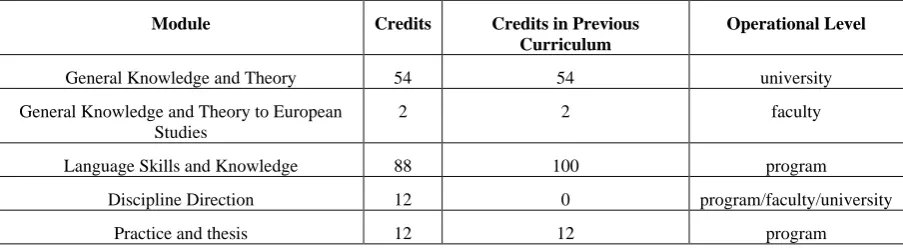
LCTELs programs keep the previous study hours instructed in the target languages and do not transfer part of them to the courses lectured in Chinese or English, the programs themselves need to rearrange all the courses in the new module. This is quite a heavy workload. The academic year 2018-2019 is already the third year implementing the new curriculum, while the discussions and debates are still heated among the LCTELs programs. Some programs already claim that part of courses need to be postponed due to the shortage of teachers and lack of adaptable teaching materials.
Module Credits Credits in Previous
Curriculum
Operational Level
General Knowledge and Theory 54 54 university
General Knowledge and Theory to European Studies
2 2 faculty
Language Skills and Knowledge 88 100 program
Discipline Direction 12 0 program/faculty/university
Practice and thesis 12 12 program
Table 1. The Modules in the New Curriculum
2. MATERIALS AND METHODS
This research was a case study of curriculum change management in the framework of Lewin’s model. It was designed to preliminarily evaluate the latest curriculum change management at BFSU from the LCTELs teachers’ perspective. Teachers’ opinions were collected and analysed to answer the following questions: (a) Is the teachers’ overall evaluation to the latest curriculum change positive? (b) What are their evaluations in each of the three steps: unfreezing, changing and refreezing? (c) What major problems are existing?
The research employed a 5-point Likert Scale questionnaire as the main instrument to collect the materials (strongly agree – 5, strongly disagree – 1). In the framework of Lewin’s change management model, based on the practice of the latest curriculum change management, 72 questions were designed and edited. The questions were divided into 4 parts: preparation for the curriculum change, design of the new curriculum, implementation of the new curriculum and general evaluation. An extra question was raised for participants to give free comments. In the process of designing questionnaire, observation and interview about the curriculum change were used to modify and justify the questions.
A Chinese data platform powered by www.wjx.cn was used to distribute the questionnaire. 5 teachers in different LCTELs programs participated in the pilot. According to feedback, 4 ambiguous expressions were clarified. The final questionnaire was conducted in January, 2019. All 54 in-service teachers in 20 LCTELs programs, who participated in the curriculum change, received the questionnaire. Finally, 50 responses were received and all of them were proved valid. However, the respondents’ in-service status varied: 3 of them haven’t executed the new curriculum, either since the program hasn’t enrolled new students after the curriculum update, or due to temporarily out of service; 9 respondents only started to take part in from the implementation phase, since they became in-service teachers after September, 2016. All of them skipped the irrelevant questions to them. Because the position for expatriate teachers is short-term, this research only involved the local teachers, and the questionnaire was written in Chinese language.
3. RESULTS
Page 224
with Cronbach Alpha. The results are 0.925 and 0.873 respectively. All respondents answered the first question in the general evaluation part. The mean value and standard deviation to each question was also calculated. (Table 2)
Preparation Phase (N=41, Cronbach Alpha = .925)
Question Mean SD
1. I was prepared for the curriculum change, because I am well informed that the curriculum will be updated every 4 years.
4.24 1.113
2. The curriculum change follows the top-down approach. 3.15 1.352
3. Teaching and learning practice is always in change, therefore it is necessary to regularly update curriculum.
4.61 .833
4. I have new ideas about curriculum and discuss them with colleagues. 4.59 .774
5. I have new ideas about curriculum and share them with teaching administrative staff. 3.63 1.067
6. The existing communication mechanism guarantees the response to my new ideas. 3.34 1.087
7. Curriculum design and change can help to promote teaching quality. 4.41 .836
8. Curriculum design and change is part of national standardization in higher education. 4.66 .575
9. It is reasonable to update curriculum every 4 years, as the period of bachelor program is 4 years. 3.44 .976
10.I am always ready to accept the curriculum change task. 3.41 1.095
11.I paid attention to new information and requirements about the latest curriculum change. 3.98 .987
12.I got necessary information from meeting or documents in university level. 3.95 .865
13.I got necessary information from meeting or notifications in faculty level. 4.61 .542
14.I got necessary information from meeting or informs in program level. 3.56 1.501
15.Information and requirements were delivered efficiently and timely in each level. 4.07 .848
16.Effective training about the latest curriculum change was offered. 4.05 .893
17.Colleagues and I were in cooperation, and we shared information and ideas with each other. 4.12 .954
18.Before design of the latest curriculum, I was clear about all the requirements. 3.44 1.184
19.As a target language lecturer, I only paid attention to courses related to the target language. 3.59 1.095
20.It is necessary to add Discipline Directional Module into new curriculum. 3.90 1.200
Curriculum Design Phase (N=41, Cronbach Alpha = .925)
21.Requirements to new curriculum reflected current teaching needs and criteria. 3.88 .954
22.New curriculum design was based on fully consultation and discussion in faculty level. 4.39 .737
23.New curriculum design in my program respected opinions of every lecturer. 4.32 .820
24.Both local and expatriate lecturers participated in new curriculum design. 3.63 1.318
25.Requirements to new curriculum were too high. 3.56 .950
26.I was actively involved in the new curriculum design. 4.22 .791
27.I conducted analysis on needs of students and society before I designed my courses. 3.88 1.005
28.I designed courses on my decisions and specialities. 4.24 .860
29.I combined research interest with my courses. 3.90 .889
30.New curriculum design respected my willingness in teaching. 3.93 .905
31.I had many questions during new curriculum design. 3.76 .943
Page 225
33.During curriculum design, I found that new aims and requirements were hard to achieve in practice. 4.12 .900
34.I reported problems to program managers or administrative staff in time. 4.34 .855
35.In Language Skills Module and Language Knowledge Module, I designed new courses. 4.00 1.140
36.In Language Skills Module and Language Knowledge Module, I modified content of the previous courses.
4.29 .873
37.In Discipline Directional Module, I designed new courses. 4.24 1.019
38.I am willing to lecture in General Knowledge and Theory Module in the faculty level, in order to communicate with more students in other programs.
3.51 1.267
39.When I designed the courses in Discipline Directional Module, I already had clear teaching objectives and plan, and I believed that I was capable to lecture the new courses.
3.85 1.108
40.When I designed the courses, I referred to experience in other programs, faculties or universities. 4.24 .916
41.When I designed my courses, I considered them as an integral part in the whole curriculum of the program.
3.63 .942
42.I had enough time to achieve the goal of the curriculum update. 3.22 1.151
43.It was a heavy workload to achieve the curriculum change, and I felt very tired. 3.90 .917
44.My work and effort were admired by my program and faculty. 3.88 .872
Implementation Phase (N=47, Cronbach Alpha = .873)
45.Till now, the new curriculum generally works well. 3.62 1.012
46.There is enough staff to guarantee the implementation of the new curriculum in my program. 3.09 1.412
47.There are enough teaching materials to guarantee the implementation of the new curriculum in my program.
3.21 1.232
48.I am attempting new teaching concepts and methods to achieve the optimal results. 4.19 .924
49.Students’ comments to my courses are positive. 4.06 .734
50.Students’ comments to courses related to the target language are positive. 3.98 .872
51.Students’ comments to the whole curriculum are positive. 3.43 .903
52.I can explain all the questions related to the new curriculum to students. 3.91 .952
53.In teaching process, I am always in negotiation with students and make modifications. 4.40 .681
54.I often discuss the implementation of the new curriculum with my colleagues. 3.94 .895
55.The scheme of the new curriculum was ideal, and in practice I have already met problems or difficulties.
3.79 .977
56.I report the problems and difficulties to program manager or administrators of teaching affairs. 4.26 .820
57.I can get feedback to my problems in time. 3.68 .980
58.I can get support to solve my problems. 3.72 1.077
59.It is necessary to make the management process more flexible, when problems emerge. 4.17 .963
60.It is a heavy workload to implement the new curriculum. 4.32 .810
61.Compared to the old curriculum, the new one increases the students’ study burden. 3.98 .967
62.The main burden to students mainly is brought by compulsory courses in other modules, and it
squeezes students’ time, which previously was devoted to improve the target language. 3.85 .932
63.In general, new curriculum modules in different levels do not match well with each other. 3.40 .993
64.New curriculum helps students to improve language skills. 3.34 1.089
65.New curriculum helps students to increase language knowledge. 4.00 .808
66.New curriculum helps students to find own interest in study and career. 3.79 .858
Page 226
68.New curriculum helps students to improve critical thinking. 3.98 .766
69.New curriculum helps me to improve teachings methods and techniques. 3.60 1.056
70.New curriculum shows me new aspects in my further research. 3.72 .994
General Evaluation (N=50)
71.The curriculum change is an essential work. 4.08 .877
General Evaluation (N=47)
72.The curriculum change is a successful work. 3.49 .930
Table 2. The Main Indicators in the Questionnaire
4. DISCUSSION
As showed in the results, from the teachers’ perspective, the general evaluation to the latest curriculum change is relatively positive. Teachers believed that the curriculum update is essential work that deserved attention and efforts (MV=4.08). However, the opinions to the outcome of the new curriculum varied, 6 participants asserted that it was not successful as expected. Further discussions are presented in the Lewin’s 3 steps as follows.
Unfreezing Step
The main tasks of management in Unfreezing Step were to generate understanding, to minimize resistance and to prepare participants involved in change. The results proved that this process was rather successful.
Curriculum design and change is an integral part of national standardization in modern higher education. The result showed that overall teachers understand the importance of curriculum change to the development of higher education. Besides, since teaching and learning practice is all the time in change, it is necessary to update curriculum regularly, in order to improve teaching quality. In fact, in daily practice, teachers autonomously pay attention to curriculum modifications. Ideas and discussions were generated among them, or even reported to administrators. They were also well informed that the curriculum is updated every 4 years. Moreover, in order to make every teacher involved in the change, seminars and training courses were organized in different levels. The management process promoted the importance to introduce new aims and modules, as well as to strength group cooperation. Therefore, in the first step, teachers understood change and prepared for the coming change. The status quo was unfrozen and change started.
Page 227 Changing Step
The whole change mechanism was hierarchical: department in university level formulated and passed on the requirements, while concrete operation was mainly managed in each faculty. To solve the problems and resistance in the previous step, the faculty negotiated with the upper level and reached the compromise that the LCTELs programs can combine two relevant disciplines in one direction and reduce the number of elective courses corresponding to own capacity. Besides, the faculty appointed special coordinator to take charge of the whole process and defined change agent in each program, in order to form a cooperative work net. New curriculum module demands teachers’ solid knowledge in specialities and professional tactics, which are weak points to young teachers. In order to make up for the disadvantages, the faculty organized special research projects to encourage teachers to integrate new courses design with investigation and research process. Financial support was used as one effective instrument both for research impetus and work reward.
As teachers asserted in the questionnaire that they were rather actively involved in the change. Generally based on own specialities and research interest, teachers conducted needs analysis and designed new courses or renewed the content either in the new module or in the previous modules, which guaranteed the completion of the new curriculum. However, they also claimed that they still faced problems. Firstly, the new curriculum is designed and implemented by both local and expatriate teachers. The expatriate teachers are not in permanent positions, so their fluidity hardly ensures the continuity of the new curriculum. Secondly, each student in the LCTELs programs has opportunity to do exchange studies during the 2nd or 3rd academic year. The courses offered by more than 20 mobility countries are quite various. How to match the different curricula and to accredit credits is also very ambiguous. Thirdly, the written curriculum was designed on anticipation, but the reality is not so ideal and quite changeable. If some courses cannot be offered as expected, what alternative can be used to compensate the credits? Besides, the new curriculum was planned to implement from 2016-2017 academic year. For the “small” programs with limited staff and resources, time for the whole work was also restricted. More than half of teachers claimed that the change was a stressful task for them.
Constant consultations and negotiations were arranged during the step, and further compromises also achieved. New curricula of 21 LCTELs bachelor programs were published in August, 2016 and implemented in September.
Although the change has been achieved either in written form or in practice, conflicts between the requirements of curriculum standardization and the particularity of the LCTELs programs still exist, which need to be adjusted and refrozen in the phase of implementation.
Refreezing Step
Curriculum implementation phase is not only part of change process, but also the process to stabilize the change. In this step, the Department of Teaching Affairs regularized the procedure to make curriculum modification and strengthened the system for daily class observation, in order to ensure the compliance to the new curriculum. Managers in the faculty attempted to use financial support, scholars’ exchange and expert consultations to solve the problems that emerged in this step. Teachers kept dialogues with students and colleagues. They reported problems and difficulties to program managers and administrators to get relevant feedback. From teachers’ perspective, the students’ feedback and comments on the new curriculum were relatively positive. Teachers claimed that, to some extent, the new curriculum either improved students’ all-round skills and knowledge, or optimized teaching ideas and methods in practice.
Page 228
language practice or self-reflection. Due to the infrequent enrolment, the LCTELs programs can hardly follow the change pace of other programs. During four years, most of the LCTELs programs can implement the new curriculum just to one or two students’ groups. The experience is too little for teachers to conclude the advantages and disadvantages of a curriculum, so the change management process is expected to be more flexible and autonomous.
In the open question section of the questionnaire, the respondents also indicated that in the refreezing step, the systematic assessment and feedback should be emphasized. Although university established the mechanism of regular class observation, it does not attach enough attention to the details and leaves many concrete problems unsolved.
5. CONCLUSIONS AND RECOMMENDATIONS
In general, the teachers’ evaluation to the latest curriculum change management in the LCTELs programs is positive. In the whole process, the managers followed the change model to ensure all the participants be fully informed and understand the change, and established supportive mechanism. The teachers understood the importance of updating curriculum, and most of them were willing to be firmly involved in the process.
However, even when today the LCTELs are becoming more popular because of global cooperation and policy support, the LCTELs programs are still periphery in foreign language teaching area, and hardly catch up with the development step of the commonly taught languages, especially English. The situation is also observed clearly in the change management: on one hand, the LCTELs programs are expected to meet the same requirements as for other programs; on the other hand, the limited staff and resources make it hard to realize.
Standardization makes the management process more effective and provides dimensions for evaluation and quality control, but the precondition is to respect particularity. Therefore, for the LCTELs programs, the cycle of curriculum update can be extended and leave teachers adequate time and autonomy to do pre-phrase analysis, consultation, design and experiment in its own pace. The biggest inadequacy is teaching staff with profound discipline capacity. Due to historical restrictions in the development, in a long period, the development of teacher-team in LCTELs programs mainly followed the traditional apprenticeship model and restricted the diversification of teachers’ background. In order to be adaptable to the new educational environment, the LCTELs programs should broaden ways to recruit and train teachers, focusing not only on language aspects and teaching skills, but also on research interest and academic ability. To stabilize the positions to qualified expatriate teachers with competitive payment is also a consideration to optimize the teacher-team. Barrier between different faculties and institutions is also a big obstacle to curriculum development and integration among different modules. In the present curriculum, modules organized by different levels split students’ focus to various directions. To strengthen the cooperation between different institutions and to establish interdisciplinary team are also recommended to solve the existing problems in the LCTELs programs.
ACKNOWLEDGMENTS
The research was supported by China Scholarship Council.
REFERENCES
1. Armstrong, M. (2006), A Handbook of Human Resource Management Practice, Kogan, London, pp.343-357.
Page 229
3. Burnes, B. (2004), “Kurt Lewin and the planned approach to change: a re-appraisal”, Journal of Management Studies, vol.41, no.6, pp.977-1001.
4. Cummings, S. et al. (2016), “Unfreezing change as three steps: Rethinking Kurt Lewin’s legacy for change management”, Human Relations, vol.69, no.1, pp.33-60.
5. Eaton, S. E. (2017), “Perception of ESL Program Management in Canadian Higher Education: A Qualitative Case Study”, International Journal of Learning, Teaching and Educational Research, vol.16, no.9, pp. 13-28.
6. Hussain, S.T. (2018), “Kurt Lewin’s change model: A critical review of the role of leadership and employee involvement in organizational change”, Journal of Innovation & Knowledge, vol.3, pp.123-127.
7. Kaminski, J. (2011), “Theory applied to informatics – Lewin’s Change Theory”, CJNI: Canadian Journal of Nursing Informatics, vol. 6, no. 1, Editorial. http://cjni.net/journal/?p=1210
8. Kirk, D. & MacDonald, D. (2001), “Teacher voice and ownership of curriculum change”, Journal of Curriculum Studies, vol.33, no.5, pp. 551-567.
9. Levasseur, R.E. (2001), “People Skills: Change Management Tools – Lewin’s Change Model”, Interfaces, vol.31, no.4, pp.71-73.
10. Lunenburg, F.C. & Ornstein, A.C. (2004), Educational Administration: Concepts and Practices, Beijing, pp. 432-473.
11. Mutch, C. (2012), “Curriculum change and teacher resistance”, Curriculum Matters, vol. 8, pp. 1-8.
12. Ostovar-Namaghi, S. A. (2017), “Language Teachers’ Evaluation of Curriculum Change: A Qualitative Study”, The Qualitative Report 2017, vol. 22, no. 2, pp. 391-409.
13. Schein, E. H. (1996), “Kurt Lewin’s Change Theory in the Field and in the Classroom: Notes Toward a Model of Manged Learning”, Systems Practice, vol. 9, no.1, pp.27-47.
14. Sonenshen, S. (2010), “We’re changing – or are we? Untangling the role of progressive, regressive, and stability narratives during strategic change implementation”, The Academy of Management Journal, vol.53, no.3, pp.477-512.
15. Talla, M. (2012), Curriculum Development: Perspectives, Principles and Issues, Delhi, Chennai, Chandigarh, pp. 243-264.
16. Worley, C.G. & Mohrman, S.A. (2014), “Is change management obsolete?”, Organizational Dynamics, vol. 43, pp. 214-224.