ISSN: 2319-8753
I
nternational
J
ournal of
I
nnovative
R
esearch in
S
cience,
E
ngineering and
T
echnology
(An ISO 3297: 2007 Certified Organization)
Vol. 3, Issue 10, October 2014
Age Classification with Co-Occurrence
Features on LBP Based Texton Matrix
Dr. P Chandra Sekhar Reddy
Associate Professor, Dept. of CSE, MVSR Engineering College, Hyderabad, Telangana, India
ABSTRACT: Age classification from facial images is increasingly receiving attention in computer vision applications. To address this classification problem, the present paper proposes a method, computes the local binary pattern on the image and Texton matrix on this LBP image is represented and then Co-occurrence features are evaluated. The age varying of persons is observed with these features. The proposed method is experimented on facial image datasets FG-Net and other scanned images. The experimental results indicate that proposed method outperforms with other existing methods.
KEYWORDS: Age classification, LBP, Texton, Co-occurrence features
I. INTRODUCTION
A human facial image comprises information, and it be can used in various applications like face recognition, age group classification, gender recognition, and facial expression classification. As an important attribute of face, age classification has attracted much attention in computer vision applications like Human Computer Interaction, electronic customer relationship management, surveillance monitoring and so on.Various age group classification method are implemented to classify facial images. Wen-Bing Horng, Cheng-Ping Lee and Chun-Wen Chen et.al[1] considered four age groups for classification, includingbabies, young adults, middle-aged adults, and old adults. Kwon et. al. [2]implemented age classification on facial images is based oncranio-facial development theory and skin wrinkle analysis inwhich only three age-groups babies, young adults, and senioradults. Classification into two age groups i.e. babies andadults [3], two age groups 20-39 and 40-49 [4]. In addition tothis classification of facial images based on sex [4, 5] arealso implemented. Ageclassificationimplemented by reducing the image dimensionality andclassified the human age into five categories[6]. Various ageclassification methods based on LBP are also proposed [7, 8, 9]. The present paperattempted to classify the age groups into two categories basedon Co-occurrence features extracted on integrated LBP and Texton of the facial image.Thepresent paper is organized as follows. The sectionII presents theproposed methodology, section IIIcovers results and discussions and conclusion is drawn in section IV.
II. METHODOLOGY
In this proposed method the color image is converted to gray image, on this image the Local Binary Pattern (LBP) is computed and then Texton matrix isformed and Co-occurrence matrix features are evaluated for age classification. This method is explainedin the following sub sections in detail.
Step-1: Local Binary Pattern
The LBP is computed on the image for obtaining local neighborhood information of pixels [10]. The computation of LBP is illustrated in figure 1. A 3×3 neighborhood consists of a set of nine elements, P = {pc, p0, p1,., p7}, where pcrepresents the gray level value of the central pixel and pi (0≤i≤7) represent the gray level values of neighbor pixels. Each 3×3 neighborhood then can be characterized by a set of binary values bi(0≤i≤7) as given in equation1.For each
3×3 neighborhood, a unique LBP is derived from the equation2.
0
0
1
0
i i i
p
p
b
Where ∆pi= pi-pc(1)
7
0
,
2
i
i
i i R
P
b
LBP
ISSN: 2319-8753
I
nternational
J
ournal of
I
nnovative
R
esearch in
S
cience,
E
ngineering and
T
echnology
(An ISO 3297: 2007 Certified Organization)
Vol. 3, Issue 10, October 2014
For each pixel in the image LBP code is generated. A single LBP code represents, locally how neighborhood pixels are varying with reference to central pixel by an integer code in between 0 and 255.
p0 p1 p2 b0 b1 b2 20 21 22
p3 pc p4 b7 b3 X 27 23 LBP
p5 p6 p7 b6 b5 b4 26 25 24
Fig. 2: Computation of LBP.
Step-2: Texton detection
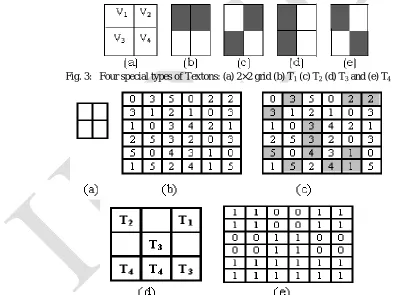
The term ‘‘texton’’ is conceptually proposed by Julesz [11]. Textons are defined which are having a close relationship with image features and local distribution. Textons are considered as texture primitives which are located with certain placement rules. The textons are defined as a set of blobs or emergent patterns or shape features sharing a common property all over the image [11, 12].The four types of textons on a 2×2 grid as shown in figure 3. In figure 3 the four pixels of a 2×2 grid are denoted as V1, V2, V3 and V4. If two pixels are highlighted in gray color of same value, the grid will form a binary 1 texton otherwise a binary 0 texton. The four texton typesused in the proposed method are denoted as T1, T2, T3 and T4 respectively as shown in figure 3. The process of texton detection is illustrated in figure 4.
Fig. 3: Four special types of Textons: (a) 2×2 grid (b) T1 (c) T2 (d) T3 and (e) T4
ISSN: 2319-8753
I
nternational
J
ournal of
I
nnovative
R
esearch in
S
cience,
E
ngineering and
T
echnology
(An ISO 3297: 2007 Certified Organization)
Vol. 3, Issue 10, October 2014
Step 3: Evaluation of Co-occurrence Features on LBP based TextonMatrix (LBPTM)
Grey level co-occurrence matrices (GLCM) introduced by Haralick attempt to describe texture by statistically sampling how certain grey levels occur in relation to other grey levels [13]. The present method evaluates the feature set contrast, correlation, energy, and, local homogeneity on reduced local information LBPTM. These features are computed using the equations 3 to 6 on LBPTM in four directions 0°, 45°, 90° and 135° age classification.
contrast = −ln (P )P
,
(3) Energy = −ln (P ) (4)
,
Local Homogenity = P
1 + (i−j) (5)
,
Correlation = P
,
(i− μ)(j− μ)
σ (6)
II. RESULTS AND DISCUSSIONS
The proposed method LBPTM with Co-occurrence featuresis applied for the classification of human faces into adult and child groups. This method established a database of the 1002 face images collected from FG-NET database and other 600 images collected from the scanned photographs. Sample images are shown in figure 5.
Fig. 5: Sample images from FG-NET Database
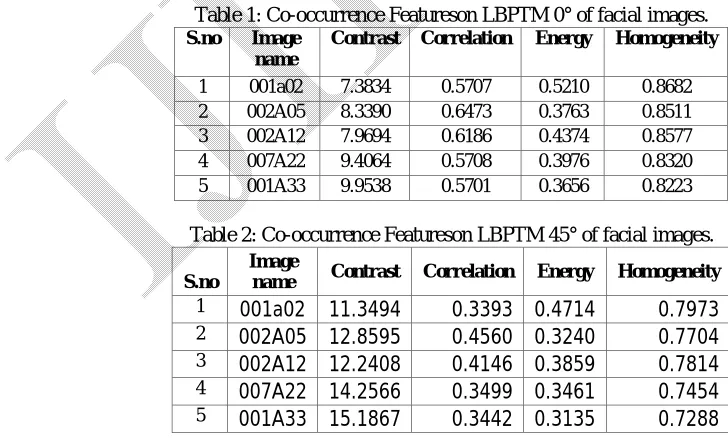
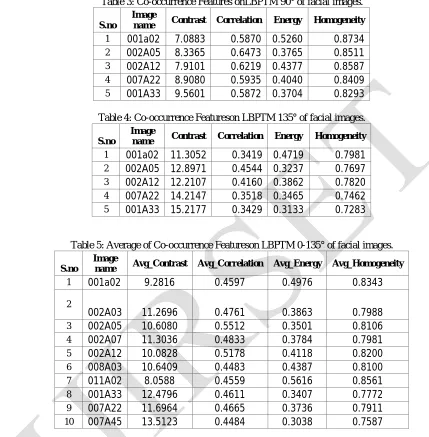
The Co-occurrence features contrast, correlation, energy and homogeneity are extracted on LBP based TextonMatrix of considered database images. Tables 1, 2, 3 and 4 represent the derived four features in four directions with 0° 45°, 90° and 135° orientation of LBPTM on 5 facial images. The average of these features in four directions are shown in Table 5 for ten images. The average of Co-occurrence features in four directions are used as feature vector for age classification. Algorithm1 is proposed with this feature vector on LBPTM. This algorithm is tested on considered facial image data base and has shown 96% successful classification rate.
Table 1: Co-occurrence Featureson LBPTM 0° of facial images.
S.no Image
name
Contrast Correlation Energy Homogeneity
1 001a02 7.3834 0.5707 0.5210 0.8682 2 002A05 8.3390 0.6473 0.3763 0.8511 3 002A12 7.9694 0.6186 0.4374 0.8577 4 007A22 9.4064 0.5708 0.3976 0.8320 5 001A33 9.9538 0.5701 0.3656 0.8223
Table 2: Co-occurrence Featureson LBPTM 45° of facial images.
S.no
Image
name Contrast Correlation Energy Homogeneity
1 001a02 11.3494 0.3393 0.4714 0.7973
2 002A05 12.8595 0.4560 0.3240 0.7704
3 002A12 12.2408 0.4146 0.3859 0.7814
4 007A22 14.2566 0.3499 0.3461 0.7454
ISSN: 2319-8753
I
nternational
J
ournal of
I
nnovative
R
esearch in
S
cience,
E
ngineering and
T
echnology
(An ISO 3297: 2007 Certified Organization)
Vol. 3, Issue 10, October 2014
Table 3: Co-occurrence Features onLBPTM 90° of facial images.
S.no
Image
name Contrast Correlation Energy Homogeneity
1 001a02 7.0883 0.5870 0.5260 0.8734
2 002A05 8.3365 0.6473 0.3765 0.8511
3 002A12 7.9101 0.6219 0.4377 0.8587
4 007A22 8.9080 0.5935 0.4040 0.8409
5 001A33 9.5601 0.5872 0.3704 0.8293
Table 4: Co-occurrence Featureson LBPTM 135° of facial images.
S.no
Image
name Contrast Correlation Energy Homogeneity
1 001a02 11.3052 0.3419 0.4719 0.7981
2 002A05 12.8971 0.4544 0.3237 0.7697
3 002A12 12.2107 0.4160 0.3862 0.7820
4 007A22 14.2147 0.3518 0.3465 0.7462
5 001A33 15.2177 0.3429 0.3133 0.7283
Table 5: Average of Co-occurrence Featureson LBPTM 0-135° of facial images.
S.no
Image
name Avg_Contrast Avg_Correlation Avg_Energy Avg_Homogeneity
1 001a02 9.2816 0.4597 0.4976 0.8343
2
002A03 11.2696 0.4761 0.3863 0.7988
3 002A05 10.6080 0.5512 0.3501 0.8106
4 002A07 11.3036 0.4833 0.3784 0.7981
5 002A12 10.0828 0.5178 0.4118 0.8200
6 008A03 10.6409 0.4483 0.4387 0.8100
7 011A02 8.0588 0.4559 0.5616 0.8561
8 001A33 12.4796 0.4611 0.3407 0.7772
9 007A22 11.6964 0.4665 0.3736 0.7911
10 007A45 13.5123 0.4484 0.3038 0.7587
Algorithm1:Classification algorithm with Avg_Contrast, Avg_Energy, and Avg_Homogeneity features.
Begin
If((Avg_Contrast >8.0588 && Avg_Contrast <11.2696) && (Avg_Energy >0.3501 && Avg_Energy <0.5616) && (Avg_Homogeneity <0.7988 && Avg_Homogeneity >0.8561))
{
Write (‘Child Image’); }
Else {
ISSN: 2319-8753
I
nternational
J
ournal of
I
nnovative
R
esearch in
S
cience,
E
ngineering and
T
echnology
(An ISO 3297: 2007 Certified Organization)
Vol. 3, Issue 10, October 2014
} End
The proposed algorithm classified the Image database into two groups adult and child with 96% correct classification rate. This method for age classification is compared with other existing methods. Age classification with shape features on lbp based texton by P. Chandra Sekhar Reddy et al. [9]. Child and adulthood classification with geometrical features by Chandra Mohan et al. [14] and other age classification methods Young H.Kwon et al. [2], Tsuneo Kanno et al. [15] and Wen-Bing Horng Cheng et.al. [1]. In Table 6, the percentage of classification of proposed method and other existing methods are shown.
Table 6: Comparison of the proposed method with other methods.
S.no Authors Name of the method
% of
Category of age classification Classification
Rate
1 Proposed method
LBPTM with Co-occurrence
features 96
Child and Adulthood
2 P. Chandra Sekhar Reddy et.al.[9]
Shape features on IT-LBP 95 Child and Adulthood
4
Chandra Mohan et.al.[14]
Child and Adulthood Classification based on Geometrical Features
94.5 Child and Adulthood
3
Young H.
Age classification from facial
images 78
Babies, adults, and Senior adults. Kwon
et.al.[2]
4
Tsuneo
Classification of age group based on facial images of young males by using neural networks
80
Only young males are age groups considered for classifications are 12,15,18 and 22 years
Kanno
et al.[15]
5
Wen-Bing
Classification of age groups based
on facial features 90.52
Babies, young adults, middle-aged adults, and old adults Horng
Cheng et.al.[1]
IV.CONCLUSION
ISSN: 2319-8753
I
nternational
J
ournal of
I
nnovative
R
esearch in
S
cience,
E
ngineering and
T
echnology
(An ISO 3297: 2007 Certified Organization)
Vol. 3, Issue 10, October 2014
REFERENCES
[1] Wen-Bing Horng, Cheng-Ping Lee and Chun-Wen Chen “Classification of Age Groups Based on Facial Features”, Tamkang Journal of Science and Engineering, Vol. 4, No. 3, pp. 183-192 Year: 2001.
[2] Young H. Kwon and Niels da Vitoria Loboy, “Age Classification from Facial Images”, Computer Vision and Image Understanding, Vol. 74, No. 1, pp. 1 –21, April 1999.
[3] Sirovich L. and Kirby M. “Low-dimensional procedure for the characterization of human face,” J. Opt. Am. A, vol.7, no.3, pp. 519–524, 1987.
[4] Hasegawa H. and Simizu E. “Discrimination of facial age generation using neural networks,” T.IEE Japan, vol.117-C, no.12, pp.1897–1898, 1997.
[5] Kosugi M. “Human-face recognition using mosaic pattern and neural networks,” IEICE Trans., vol.J76-DII, no.6, pp.1132– 1139, June 1993.
[6] Jangala. SasiKiran, V. Vijaya Kumar and B. Eswara Reddy. “Age classifications based on second order image compressed and fuzzy reduced grey level (SICFRG) model,” International Journal on Computer Science and Engineering (IJCSE), Vol. 5 No. 06, pp.481 –492, Jun
2013.
[7] GortiSatyanarayanaMurty, J SasiKiran and Dr. V.Vijaya Kumar, “ Facial Expression Recognition based on Features Derived from the Distinct LBP and GLCM,” International Journal of Image, Graphics and Signal Processing(IJIGSP), MECS Publisher, Hong Kong, Vol. 6, No. 2, pp. 68-77, January 2014.
[8] GortiSatyanarayanaMurty, Dr. V. Vijaya Kumar and A. Obulesu, “Age classification based on simple LBP transitions,” International Journal on Computer Science and Engineering (IJCSE), Vol. 5 No. 10, pp. 885-893, October 2013.
[9]P.ChandraSekhar Reddy, B. Eswara Reddy and V. VijayaKumar”Texton Based Shape Features on Local Binary Pattern forAge Classification,” International Journal of Image, Graphics and Signal Processing(IJIGSP), Volume4(7), pp.54-60, 2012. [10] Ojala, T., Pietikainen, M., and Maenpaa, T. , “ Multiresolution gray-scale and rotation invariant texture classification with local binary patterns.”, IEEE TPAMI, 24(7):971 –987, 2001.
[11] Julesz, B ,"Textons, the Elements of Texture Perception, and their Interactions". Nature. 290 (5802): 91–97, 1981.
[12] Alexander M. Bronstein, Michael M. et al.“Expression-Invariant Representations of Faces,” IEEE Transactions on Image Processing, Vol. 16, no. 1, January 2007.
[13] Haralick RM , Shanmugan K and Dinstein I, "Textural features for image classification," IEEE Trans. Sysr., Man., Cybern., Vol. SMC-3, pp.610-621, 1973.
[14] M. Chandra Mohan, V. Vijaya Kumar and B. Sujatha, “Classification of child and adult based on geometric features of face using linear wavelets”, International Journal of Signal and Image Processing, Vol. 1, No. 3, pp. 211 -220, 2010.
[15] Tsuneo Kanno, Classification of Age Group Based on Facial Images of Young Males by Using Neural Networks, IEICE Trans. Inf&Syst, VolE84-D, No 8, 2001.
BIOGRPHY