R E S E A R C H
Open Access
On the interference alignment with
limited feedback for device-to-device networks
Yang Zhang
1,2,4*, Chenglin Zhao
1, Jusheng Yu
2, Li Hong
3and Hongxia Zhang
4Abstract
In this paper, we analyze the performance of interference alignment of device-to-device (D2D) uplink underlay cellular networks. By fully considering the impact of imperfect precoding vectors caused by limited feedback, the exact closed-form expressions of average throughput for cellular network and D2D network are derived in terms of transmit power and the number of feedback bits. The accuracy of the average throughput is verified by simulation results. Our analytic results provide great promises to practical system designs.
Keywords: Device-to-device communication, Interference alignment, Limited feedback, MIMO
1 Introduction
Interferences in radar sensor networks and wireless com-munications have been one of the challenging problems. In radar sensor networks, the interference around the target degrades the detection capabilities of radars sig-nificantly, and various methods are proposed to suppress the sidelobe interference [1, 2] or mainlobe interference [3, 4]. For wireless sensor networks, interference reduces the throughput of networks and, therefore, restricts the spectral efficiency seriously [5, 6].
As a promising precoding technology, interference alignment is able to achieve the maximum degrees of freedom (DoF) by aligning all the interference into a lower-dimensional signal subspace at each receiver, which, therefore, has been paid great attention by academe [7]. In radar sensor networks, interference alignment in radar sensor networks such as orthogonal frequency offset [8–10] and opportunistic sensing in space [11, 12] have been very successful. In wireless communications net-works, interference alignments considering parameters in frequency, time, and space could be studied as well [13–16].
*Correspondence: [email protected]
1School of Information and communication Engineering, Beijing University of Post and Telecommunications (BUPT), Xï Tu Cheng Road 10, 100876 Beijing, China
2School of Electronic Engineering, Beijing University of Post and Telecommunications (BUPT), Xï Tu Cheng Road 10, 100876 Beijing, China Full list of author information is available at the end of the article
Device-to-device (D2D) communication is introduced to increase the throughput of local wireless data transmis-sion by enabling direct communications between physi-cally proximal devices [17], which also coincide with some scenarios of wireless sensor networks. However, the inter-ference caused by D2D devices reduces the performance of cellular communication significantly. Hence, how to eliminate the interference to cellular communications has become one of the most challenging works for D2D com-munication networks. In this paper, we analyze the perfor-mance of interference alignment of D2D uplink underlay cellular networks.
To reduce or eliminate the interference of D2D net-works, Lu Yang et al. propose two interference alignment schemes to manage the interference between D2D com-munications and cellular comcom-munications [18]. The first one is proposed to align the interference signals from D2D users (DUs) into the orthogonal space of cellular communications at the base station and, alternatively, the other one aims to control the peak interference. Among the two interference alignment schemes, globally perfect channel state information (CSI) is assumed to be available in the base station, and precoding vectors are fed back to users without error. In practical scenarios, however, acquiring perfect CSI and/or feeding back perfect pre-coding vectors is infeasible due to the low-rate feedback links. So, the issues of limited feedback on multiple-input, multiple-output (MIMO) networks are widely studied in the research community [19, 20]. To the best of our knowl-edge, however, there is no reported work on interference
alignment with limited feedback in the emerging D2D underlay networks.
In this work, we consider a practical system model con-sisting of a D2D local area networks (LAN) and a cellular uplink [18], where multiple DUs intend to communicate with a D2D receiver (DR). Under the assumption that the quantized precoding vectors are fed back to users through low-rate feedback links, we analyze the average through-put as a function of the number of feedback bits and transmit power and derive the closed-form expressions of throughput for cellular network and D2D network. Finally, we validate our analytic results by simulations.
Notations: Matrices and vectors are represented by bold uppercase and lowercase letters, respectively. Inver-sion, conjugation, transpose, and hermitian transpose are denoted by(·)−1,(·)∗,(·)T,(·)†, respectively.A⊗Bis the
Kronecker product of matrices A and B. The acronym i.i.d. means “independent and identically distributed.”
2 System model
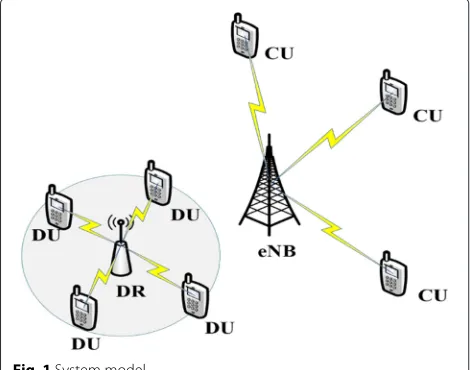
As shown in Fig. 1, we consider a single-cell MIMO uplink network with a base station (BS). The BS is assumed to be equipped withMcreceiving antennas and supporting data
traffic fromscellular users (CUs) simultaneously. Mean-while,lother users are selected to communicate with a DR which is equipped withMdreceive antennas as DUs. Each
user is equipped withNtransmit antennas. For simplicity, we consider the system where each user transmits only a single data stream.
Assume thatQCUandQDU represent the sets of CUs
and DUs, respectively. Denote the large-scale fading gain from useri∈QCUQDUto BS and DR asηci andηidand
the small-scale fading channel matrix from useri to BS and DR asHci andHdi, respectively. All fading coefficients are assumed to be i.i.d. circularly symmetric complex
Fig. 1System model
Gaussian random variables with zero mean and unit vari-ance, i.e., CN(0, 1). The signal at BS can be written as follows:
yc=
i∈QCU
PcηciUc†Hcivixi
+
k∈QDU
Pdηck
Uc†Hckvkxk+
Uc†zc,
(1)
and the signal at DR is given by the following:
yd=
i∈QCU
Pcηid
Ud
†
Hdivixi
+
i∈QDU
PdηdkUd
†
Hdkvkxk+
Ud
†
zd,
(2)
where Uc = uc1,uc2,· · ·,ucs ∈ CMc×s and Ud =
ud1,ud2,· · ·,udl
∈ CMd×l denote the post-processing matrices of BS and DR, with uci = udj = 1.vi ∈
CN×l denotes the precoding vector of user i. Pc andPd
denote the transmit power of CUs and DUs, respectively. xi denotes the data symbol of useriwithE[xi]= 1.zc
andzdare the additive white Gaussian noise (AWGN) at
BS and DR, respectively.
For convenience, it is assumed that the channels from all users are perfectly estimated at BS and DR. With perfect CSI, BS designs the post-precoding matrixUcand precod-ing vectors for all CUs and DUs usprecod-ing the “interference-free” interference alignment scheme proposed in [18]. To feed back the precoding vectors from BS to users, the pre-coding vector vi is quantized tov¯i withBi bits random
codebook,∀i∈QCUQDU. Following the theory of
ran-dom vector quantization [19], the relationship between the original precoding vectorviand the quantized
precod-ing vectorv¯ican be expressed as follows:
¯
vi=cos(θi)vi+sin(θi)vˆi, (3)
where θi = ∠(vi,v¯i) and sin(θi) is the magnitude of the
quantization error.vˆiis an unit norm vector isotropically
distributed in the null space ofvi.
Due to the quantization error, the interference that come from CUs cannot be eliminated completely with quantized precoding vectors. Therefore, the resulting residual interference power will degrade the through-put significantly. The achievable throughthrough-put of BS with limited feedback can be written as follows:
Rc =
i∈QCU
log2
⎛ ⎜ ⎝1+
Pcηci
uci†Hciv¯i
2
Iic,c+Iic,d+1
⎞ ⎟
where Ici,c = n∈Q
are the residual interference power from other CUs and DUs to the useri, respectively. Finally, the DR designs its post processing matrix Ud with the quantized precoding vectors to eliminate the interference from other DUs perfectly, while treating the interference from cellular links as noise [18], yielding the following:
udk
†
Hdiv¯i=0,∀i,k∈QDU,i=k. (5)
Hence, the throughput of D2D network is given by the following:
2accounts for the interference from CUs to DR.
3 Performance analysis
In the context of the quantized precoding vectors, the per-formance of cellular network and D2D network remains an open issue. In this section, we concentrate on the per-formance analysis for interference alignment with limited feedback in D2D uplink underlaying cellular networks.
As shown in last section, we consider the average rate of CUias follows:
E Rci=E
For the interference from CUnto CUi=n, substituting (3) into (7), we have the following:
Iic,c=
Moreover, since uci is of unit norm and independent of ¯
Hcn(:,t), thenuci†H¯cn(; ,t)2isβ(1,Mc−1)distributed.
The product ofHcn(:,t)2anduci†H¯cn(:,t)2is expo-nentially (1) distributed. Based on the fact that the sum ofNi.i.d. exponential (1) distribution random variables is
(N, 1)distributed, we can get thatei,n2is(N, 1)
dis-tributed, it is equal toχ2(2N)in distribution with variance
equal to 1/2.
distributed. Similarly, ∀i ∈
QCU,k ∈ QDU, we conclude that Pdηck ofs+lindependent random variables having exponential distributions with different parameters, whose probability density function (pdf ) is given by [23] the following:
Note that Gci = Iie,c+Iie,d is similar toAci except the absence of the termPcηci
uci†Hciv¯i
2
. Hence, the expec-tation of log2(G + 1) can be given by the following:
Now, we can get the average throughput of CU i as follow:
and the throughput of cellular network is
E Rc=
Next, we examine the performance of D2D network. As mentioned in last section, with the precoding vectors received from BS, DR can eliminate the interference from DUs perfectly. Hence, the performance of each DU is only degraded by the interference from CUs, which is treated as noise. Therefore, we obtain the average rate of DUkas follows:
is the interference from CUs to DUk. Especially, for the interference from CUito DUk, we have the following:
1)distributed random variable,
distributed. Similarly, the desired signal
power Pdηkd
2 is exponential
ofs+lindependent random variables having exponential distributions with different parameters, whose pdf is given by the following:
Therefore, we have the following:
Elog2Adk+1=
can be given by the following:
Now, we can obtain the average throughput of DUkas follows:
E
Rdk
=
t∈QCU,kν d t
ln 2
i∈QCU,k
−expνidei
−νd
i
νd k
j∈QCU,j=i
νd j −νid
,
(23)
and the throughput of D2D network is as follows:
ERd= k∈QDU
⎛ ⎝
t∈QCU,kν
d t
ln 2
i∈QCU,k
−expνdiei
−νd i
νd k
j∈QCU,j=i
νd
j −νid
⎞ ⎠.
(24)
For interference alignment with limited feedback, the performance of system degraded significantily due to the residual interference caused by the imperfect CSI. To optimize for the design, analysis, and deployment of the systems, the analytic expression of the average throughput of the D2D communication networks is a key factor and is very important. Howerver, as far as I konw, the perfor-mance analysis is still an open issue, so it is a basic work for the study of D2D communications.
4 Numerical results
In this section, we evaluate the analytic results of inter-ference alignment with limited feedback in a D2D uplink underlay cellular network. Without losing generality, we set N = 3, Mc = 5, Md = 4, s = 3, and l = 4.
We focus on a single cellular cell which contains an BS near its center, and a DR which is 0.5rm away from the BS, whereris the radius of the cellular cell. Thes CUs are distributed randomly in the cellular cell. The distance betweenlDUs and DR distribute randomly between 0.05r and 0.45r, and we configurerto be 300 m. The channel is assumed to obey a frequency flat block-fading channel model. We take the average of sum rate as the perfor-mance metric and evaluate the precision of our analytic results by means of Monte Carlo simulations (averaging over 1000 realizations) with random generated small-scale fading, which is generated so that the entries of the matri-ces are i.i.d. according toCN(0, 1). Moreover, we use the path loss model recommended by ITU-R as shown by the following:
η=40 log10α+30 log10f +49[ dB] , (25) whereαis the distance in km andf is the operating fre-quency in MHz which is set to be 2 GHz. Moreover, the noise power is set to be−113 dBm.
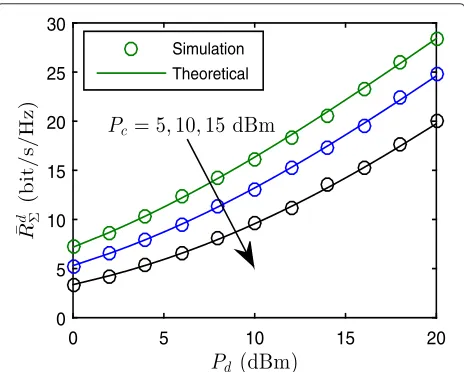
In Fig. 2, we plot both the empirical sum of average rate of cellular network (from simulation) and the analyt-ical results in (15), for the transmit power of DUsPd =
5, 10, 15 dBm with the number of feedback bitsBi=10 for
Fig. 2Theoretical and simulationR¯c
=E Rcwith different transmit
powers of DUs
each DUs and CUs. The derived analytical sum of average rate of D2D network in (24) and the simulation results are also plotted in Fig. 3. The numerical results show that the derived close-form expressions are sufficiently accurate in the sum of the average rate of CUs and DUs achieved by interference alignment with limited feedback in D2D uplink underlaying cellular networks. It is noted that, by comparing the Figs. 2 and 3, we can find that the sum rate of DUs is much larger than that of CUs. The per-formance gap is primarily attributed to the fact that DUs stand closer to DR than CUs on average, which leads to stronger desired signals and weaker interferences.
Fig. 3Theoretical and simulationR¯d
=E Rdwith different transmit
5 Conclusions
In this work, we comprehensively investigate the inter-ference alignment scheme with limited feedback for D2D underlaying cellular networks. We derive the average sum rate of cellular network and D2D network analytically. Thus, the exact performance can be obtained for a given path loss, transmit SNR, and feedback bits. The analysis results provide some basis for the design and optimization for D2D communication networks.
Competing interests
The authors declare that they have no competing interests.
Acknowledgements
This work was supported by NSFC(No. 61471056), the Fundamental Research Funds for the Central Universities, China (No. 15CX02048A, No. 15CX05025A), and the Shandong Provincial Natural Science Foundation, China
(No. ZR2015FL002), the Foundation for Outstanding Young Scientist in Shandong Province (No.2014BSE28044).
Author details
1School of Information and communication Engineering, Beijing University of Post and Telecommunications (BUPT), Xï Tu Cheng Road 10, 100876 Beijing, China.2School of Electronic Engineering, Beijing University of Post and Telecommunications (BUPT), Xï Tu Cheng Road 10, 100876 Beijing, China. 3Department of Disaster Prevention Instrument, Institute of Disaster Prevention, Xüeyuan Street, 101601 Sanhe, China.4College of Computer and Communication Engineering, China University of Petroleum (UPC), C ¨hangjiang xi Road 66, 266555 Qingdao, China.
Received: 7 December 2015 Accepted: 24 February 2016
References
1. WP Keizer, Fast low-sidelobe synthesis for large planar array antennas utilizing successive fast fourier transforms of the array factor. IEEE Trans. Antennas Propag.55(3), 715–722 (2007)
2. OG Vendik, DS Kozlov, Phased antenna array with a sidelobe cancellation for suppression of jamming. IEEE Antennas Wirel. Propag. Lett.11, 648–650 (2012)
3. N Xie, H Wang, X Lin, Adaptive frequency-domain equalization with narrowband interference suppression. Wirel. Pers. Commun.70(1), 267–281 (2013)
4. X Yang, P Yin, T Zeng, TK Sarkar, Applying auxiliary array to suppress mainlobe interference for ground-based radar. IEEE Antennas Wirel. Propag. Lett.12, 433–436 (2013)
5. D Gesbert, S Hanly, H Huang, SS Shitz, O Simeone, W Yu, Multi-cell MIMO cooperative networks: a new look at interference. IEEE J. Sel. Areas Commun.28(9), 1380–1408 (2010)
6. X Chang, J Huang, S Liu, G Xing, H Zhang, J Wang, L Huang, Y Zhuang, Accuracy-aware interference modeling and measurement in wireless sensor networks. IEEE Trans. Mob. Comput.15(2), 278–291 (2016). doi:10.1109/TMC.2015.2416182
7. VR Cadambe, SA Jafar, Interference alignment and degrees of freedom of t heK-user interference channel. IEEE Trans. Inf. Theory.54(8), 3425–3441 (2008) 8. Q Liang, Automatic target recognition using waveform diversity in radar
sensor networks. Pattern Recogn. Lett.29(3), 377–381 (2008) 9. Q Liang, inSensor and Ad Hoc Communications and Networks, 2006.
SECON’06. 2006 3rd Annual IEEE Communications Society On. Waveform design and diversity in radar sensor networks: theoretical analysis and application to automatic target recognition, vol. 2 (IEEE, Reston, Virginia, USA, 2006), pp. 684–689
10. Q Liang, X Cheng, SW Samn, New: network-enabled electronic warfare for target recognition. IEEE Trans. Aerosp. Electron. Syst.46(2), 558–568 (2010) 11. Q Liang, X Cheng, S Huang, D Chen, Opportunistic sensing in wireless
sensor networks: theory and application. IEEE Trans. Commun.63(8), 2002–2010 (2014)
12. S Singh, Q Liang, D Chen, L Sheng, Sense through wall human detection using UWB radar. EURASIP J. Wirel. Commun. Netw.2011(1), 1–11 (2011) 13. K Gomadam, VR Cadambe, S Jafar,et al, A distributed numerical approach
to interference alignment and applications to wireless interference networks. IEEE Trans. Inf. Theory.57(6), 3309–3322 (2011) 14. SA Jafar,Interference Alignment: A New Look at Signal Dimensions in a
Communication Network. (Now Publishers Inc, 2011) 15. I Santamaria, O Gonzalez, RW Heath Jr, SW Peters, inGlobal
Telecommunications Conference (GLOBECOM 2010), 2010 IEEE. Maximum sum-rate interference alignment algorithms for MIMO channels (IEEE, Miami, Florida, USA, 2010), pp. 1–6
16. U Niesen, Interference alignment in dense wireless networks. IEEE Trans. Inf. Theory.57(5), 2889–2901 (2011)
17. G Fodor, E Dahlman, G Mildh, S Parkvall, N Reider, G Miklós, Z Turányi, Design aspects of network assisted device-to-device communications. IEEE Commun. Mag.50(3), 170–177 (2012)
18. L Yang, W Zhang, S Jin, Interference alignment in device-to-device LAN underlaying cellular networks. IEEE Trans. Wirel. Commun.14(7), 3715–3723 (2015)
19. N Jindal, MIMO broadcast channels with finite-rate feedback. IEEE Trans. Inf. Theory.52(11), 5045–5060 (2006)
20. X Chen, C Yuen, Performance analysis and optimization for interference alignment over MIMO interference channels with limited feedback. IEEE Trans. Signal Process.62(7), 1785–1795 (2014)
21. H-H Lee, Y-C Ko, inVehicular Technology Conference (VTC Fall), 2012 IEEE. Interference alignment with random vector quantization for MIMO interference channels (IEEE, Quebec City, Canada, 2012), pp. 1–5 22. K Kiran Mukkavilli, A Sabharwal, E Erkip, B Aazhang, On beamforming with
finite rate feedback in multiple-antenna systems. IEEE Trans. Inf. Theory.
49(10), 2562–2579 (2003)
23. M Akkouchi, On the convolution of exponential distributions. J. Chungcheong Math. Soc.21(4), 501–510 (2008). Accessed 26 May 2015
Submit your manuscript to a
journal and benefi t from:
7Convenient online submission
7Rigorous peer review
7Immediate publication on acceptance
7Open access: articles freely available online
7High visibility within the fi eld
7Retaining the copyright to your article