Available online:
http://edupediapublications.org/journals/index.php/IJR/
P a g e | 687
Performance Analysis of Mimo-Wimax System Using
Space Time Block Codes
U. Kalyani & B.N. Srinivasa Rao
1
PG Scholar
,
Dept of ECE, Dadi Institute Of Engineering & Technology , Visakhapatnam,
AP, India.
2 Sr .
Assistant Professor, Dept of ECE, Dadi Institute Of Engineering & Technology ,
Visakhapatnam, AP, India.
ABSTRACT:Wireless access networks like WiMAX provide an excellent opportunity for operators to participate in the rapid growth opportunities that exist in emerging markets. The mobile Worldwide Interoperability for Microwave Access (WiMAX) is based on IEEE 802.16 standard and is used for wireless Metropolitan Area Network (MAN). The inclusion of Multiple Input Multiple Output (MIMO) in mobile WiMAX system provides a robust platform for space, time and frequency selective fading conditions and increases both data rate and system performance.The performance of mobile MIMO WiMAX system has been carried out using Space Time Block Code for different modulation schemes under different channel conditions like AWGN, Rayleigh channels etc. The result are encouraging because with respect to other services the WiMax getting better responses in term of WiMAX’s users and operators. The simulation of MIMO-mobile WiMAX model is done by using MATLAB
Keywords: OFDM, MIMO, STBC, Fading Channels, Wi Max
1. INTRODUCTION
Broadband wireless sits at the confluence of two of the most remarkable growth stories of the telecommunications industry in recent years. Both wireless and broadband have on their own enjoyed rapid mass-market adoption. Wireless mobile services grew from 11 million subscribers worldwide in 1990 to more than 2 billion in 2005 [1]. During the same period, the Internet grew from being a curious academic tool to having about a billion users. This staggering growth of the Internet is driving demand for higher-speed Internet-access services, leading to a parallel growth in broadband adoption. In less than a decade, broadband subscription worldwide has grown from virtually zero to over 200 million [2]. Will combining the convenience of wireless with the rich performance of broadband be the next frontier for growth in the industry? Can such a combination be technically and commercially viable? Can
Available online:
http://edupediapublications.org/journals/index.php/IJR/
P a g e | 688 Figure 1. Worldwide subscriber growth 1990–2006 for
mobile telephony, Internet usage, and broadband access [1, 2, 3]
Broadband access not only provides faster Web surfing and quicker file downloads but also enables several multimedia applications, such as real-time audio and video streaming, multimedia conferencing, and interactive gaming. Broadband connections are also being used for voice telephony using voice-over-Internet Protocol (VoIP) technology. More advanced broadband access systems, such as fiber-to-the-home (FTTH) and very high data rate digital subscriber loop (VDSL), enable such applications as entertainment-quality video, including high-definition TV (HDTV) and video on demand (VoD). As the broadband market continues to grow, several new applications are likely to emerge, and it is difficult to predict which ones will succeed in the future. So what is broadband wireless? Broadband wireless is about bringing the broadband experience to a wireless context, which offers users certain unique benefits and convenience. There are two fundamentally different types of broadband wireless services. The first type attempts to provide a set of services similar to that of the traditional fixed-line broadband but using wireless as the medium of transmission. This type, called fixed wireless broadband, can be thought of as a competitive alternative to DSL or cable modem. The second type of broadband wireless, called mobile broadband, offers the additional functionality of portability, nomadicity,1 and mobility.
Mobile broadband attempts to bring broadband applications to new user experience scenarios and hence can offer the end user a very different value proposition. WiMAX (worldwide interoperability for microwave access) technology, the subject of this book, is designed to accommodate both fixed and mobile broadband applications.
In this paper, we preset a MIMOOFDM system for various antenna configurations to fulfill the demand of WIMAX wireless technology.
2. IEEE 802.16-2009:
The IEEE 802.16 standard describes individual methods of operation, each of which fits a specific deployment objective. In the fused standard document, IEEE 802.16-2009, two modes are described: a mandatory Point-to-Multi-Point (PMP) and an optional Multihop Relay (MR). While both modes describe regular downlink communication, that is, from gateway or BS to mobile terminal, the MR mode utilizes intermediate RSs between a cell’s BS and the MT. This last is described in the amendment IEEE 802.16j. [8]
Fig 2. A schematic of a IEEE 802.16-2009 deployment, including a base station and different types of mobile terminals. [5]
In a PMP deployment, BSs provide a continuous coverage through a cellular configuration, with the BSs interconnected through a network management infrastructure that oversees the overall management of network operations. Through the BSs, Subscriber Stations (SSs) and Mobile Subscribers (MSs) connect to the network and, when applicable, to the Internet. In the standard, the general term SS describes user equipment capable of using different Radio Interface Technologies (RITs) operating under both, Line of Sight (LOS) and Non LOS (NLOS) circumstances. On the other hand, MSs are equipment sets whose connected mobility is supported in the NLOS network. Mobility is supported only under one IEEE 802.16 interface type, namely OFDMA, and does not require LOS with the BS for communication. More significantly, mobility support is enabled through employing handover mechanisms both within IEEE 802.16 networks and between IEEE 802.16 and other Radio Access Technologies (RAT).
3. WIMAX:
Available online:
http://edupediapublications.org/journals/index.php/IJR/
P a g e | 689 broadband wireless access [4][5]. WiMAX
equipment are certified for interoperability against a particular certification profile. The WiMAX Forum has thus far defined five fixed certification profiles and fourteen mobility certification profiles. To date, there are two fixed WiMAX profiles against which equipment have been certified. These are 3.5GHz systems operating over a 3.5MHz channel, using the fixed system profile based on the IEEE 802.16-2004 OFDM physical layer with a point-to-multipoint MAC. One of the profiles uses frequency division duplexing (FDD), and the other uses time division duplexing (TDD).
WiMAX is a wireless broadband solution that offers a rich set of features with a lot of flexibility in terms of deployment options and potential service offerings. Some of the more salient features that deserve highlighting are as follows:
OFDM-based physical layer: The WiMAX
physical layer (PHY) is based on orthogonal frequency division multiplexing, a scheme that offers good resistance to multipath, and allows WiMAX to operate in NLOS conditions. OFDM is now widely recognized as the method of choice for mitigating multipath for broadband wireless. Chapter 4 provides a detailed overview of OFDM.
Very high peak data rates: WiMAX is capable
of supporting very high peak data rates. In fact, the peak PHY data rate can be as high as 74Mbps when operating using a 20MHz2 wide spectrum. More typically, using a 10MHz spectrum operating using TDD scheme with a 3:1 downlink-to-uplink ratio, the peak PHY data rate is about 25Mbps and 6.7Mbps for the downlink and the uplink, respectively. These peak PHY data rates are achieved when using 64 QAM modulation with rate 5/6 error-correction coding. Under very good signal conditions, even higher peak rates may be achieved using multiple antennas and spatial multiplexing.
Scalable bandwidth and data rate support: WiMAX has a scalable physical-layer architecture that allows for the data rate to scale easily with available channel bandwidth. This scalability is supported in the OFDMA mode, where the FFT (fast fourier transform) size may be scaled based on the available channel bandwidth. For example, a WiMAX system may use 128-, 512-, or 1,048-bit FFTs based on whether the channel bandwidth is 1.25MHz, 5MHz, or 10MHz, respectively. This scaling may be done dynamically to support user roaming across different networks that may have different bandwidth allocations.
4. MIMO-WIMAX TRANSMITTER
AND RECEIVER:
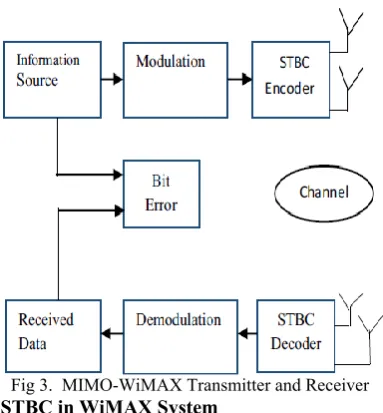
The MIMO-WiMAX Transmiter and Receiver system is shown in Figure 2. At transmitter side, the
information source generates the binary information to be transmitted. The binary information is converted to symbols for digital modulation. The modulated symbols are encoded by (Space time Block Code) STBC encoder and the reverse processes are carried out by different blocks at the receiver.
A. Transmitter
Transmitter consists of information source, modulator and STBC encoder.
a. Information Source
The Bernoulli binary generator block generates random binary numbers using a Bernoulli distribution. The Bernoulli distribution with parameter p produces zero with probability p and one with probability 1-p. The Bernoulli distribution has mean value 1-p and variance p (1-p). The probability of a zero parameter specifies p, and can be any real number between zero and one.
b. Symbol Modulation
The binary information generated by information source is coo groups of bits to form binary symbols. These symbols are modulated using digital modulation schemes such as BPSK QPSK, 16-QAM and 64-QAM.
c. STBC Encoder
This block is used for space time diversity coding which is used to reduce the effect of noise and increase the bandwidth by reducing the Bit Error Rate. Alamouti [13] STBC is one of most important technique to achieve diversity using MIMO systems, and secure mean of exchange information. It is usually design under certain assumption and consideration of having knowledge about response of channel i.e. perfect channel state information (CSI) at
1.Transmitter site only 2.Receiver site only 3.The both site.
The block then transmits the encoded symbol by a space time block code to spread each of the N-transmit antennas according to the type of coding technique used.
B. Receiver
Receiver mainly consists of STBC decoder and demodulator.
a. STBC Decoder
This block is used for space time diversity decoding which is used to decode encoded data. It is usually design under certain assumption and consideration of having knowledge about response of channel. b. Demodulation
Available online:
http://edupediapublications.org/journals/index.php/IJR/
P a g e | 690 Fig 3. MIMO-WiMAX Transmitter and Receiver
C. STBC in WiMAX System
Fat the transmitter the STBC Encoder takes the data from the guard band insertion block as shown in Fig 4 and transmits that data over two spaced antennas [19]. Different symbols are simultaneously transmitted over Recursive Systematic Convolutional Encoder (RSC): This type of encoder works on a bit by bit basis. For every input bit it generates a parity bit depending on the structure of the encoder and outputs the same input bit at the output known as the systematic bit. The encoder is implemented using Linear Feedback Shift Register (LFSR). [18] These registers are the main reason why we call it Recursive process. The output is feed back to the input and every new output is dependent on the previous input to the encoder. these antennas to reduce noise interference. The receiver after receiving the signal retrieves the bits using Maximum Likelihood decoding algorithm and passes the data to the guard band removal block. As shown in the Fig. 4.
Fig. 4.WiMAX Module with STBC.
5. RESULTS:
Fig 5. BER of MIMO-WiMAX System For Different Modulation Scheme under AWGN Channel
Fig 6. BER of MIMO-WiMAX System For Different Modulation Scheme under Rayleigh Channel
Available online:
http://edupediapublications.org/journals/index.php/IJR/
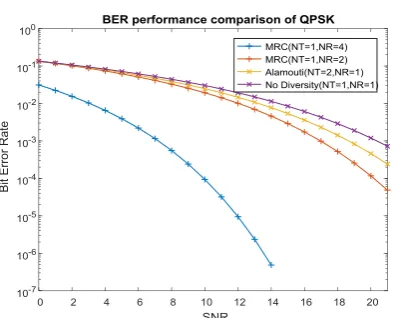
P a g e | 691 Fig 8. The BER performance comparison of QPSK with
MRC,Alamouti(2x1) & no diversity (1x1) in Rayleigh fading.
6. CONCLUSION:
Broadband Wireless Access (BWA) has emerged as a promising solution for providing last mile internet access technology to provide high speed internet access to the users in the residential as well as in the small and medium sized enterprise sectors. In this paper, the MIMO-mobile WiMAX system is simulated for different modulation schemes(QPSK,8-PSK,16-QAM,64-QAM,128QAM) with ½ code rate to analyse BER performance under AWGN, Rayleigh and Rician channels with the help of MATLAB. Simulation results have shown thatMIMO-mobile WiMAX system with different modulation schemes give better BER performance at different values of SNR under different channels. Lower modulation schemes give better BER performance as compared to higher modulation schemes. As SNR value increases, higher modulation schemes give better BER performance.
REFERENCES:
[1] IEEE Std 802.16TM-2004, “Part 16: Air interface for fixed broadband wireless access systems”, October 2004 [2] P.Samundiswary, Ravi Ranjan Prasad ,” Performance Analysis of MIMO-Mobile WiMAX System using Space Time Block Codes under Different Channels”, International Journal of Innovative Technology and Exploring Engineering (IJITEE) , Volume-2, January 2013 [3] Sunil Singh* and Ranjeet Prajapat” A Review WiMAX in Orthogonal Space Time Block Coding”, International Journal of Electrical, Electronics and Computer Engineering, November, 2014.
[4] IEEE Std 802.16a2003 (Amendment to IEEE Std 802.162001), “IEEE Standard for Local and etropolitan area networks Part 16: Air Interface for Fixed Broadband Wireless Access Systems Amendment 2: Medium Access Control Modifications and Additional Physical Layer Specifications for 211 GHz”, January 2003Mobile.
[5] WiMAX – Part I: A Technical Overview and
Performance Evaluation,
http://www.wimaxforum.org/technology/downloads/Mobil e_WiMAX_Part1_Overview_and_Performance.pdf , [6] G. J. Foschini and M. J. Gans, “On limits of wireless communications in a fading environment when using multiple antennas,” Wireless Personal Communications, vol. 6, no. 3, pp.311–335, 1998.
[7] K. Lee and D. Williams, “A space-time coded transmitter diversity technique for frequency selective fading channels,” Proceedings of IEEE Sensor Array and Multichannel Signal Processing Workshop, Cambridge, USA, pp.149–152, March 2000.
[8] S. Alamouti, “A Simple Transmit Diversity Technique for Wireless Communications,” IEEE Journal on Selected Areas in Communication, Vol. 16, pp. 1451–1458, Oct. 1998.
[9] Muhammad Sana Ullah, Mohammed Jashim Uddin, “ Performance Analysis of Wireless MIMO System by Using Alamouti’s Scheme and Maximum Ratio Combining Technique” , International Journal of Advanced Engineering Sciences and Technologies, Vol. 8, No. 1,pp. 019 – 024, 2011.
[10] E. Biglieri, R. Calderbank, T. Constantinides, A. Goldsmith, A. Paulraj, and H. V. Poor, “MIMO Wireless Communications”, Cambridge University Press, 2006. [11] Jeffrey G. Andrews, Arunabha Ghosh, Rias Muhamed “Fundamentals of WiMAX Understanding Broadband Wireless Networking”Copyright © 2007 Pearson Education, Inc.
[12] Yong Soo Cho, Jaekwon Kim, Won Young Yang, Chung G. Kang “ MIMO-OFDM WIRELESS COMMUNICATIONS WITH MATLAB” John Wiley & Sons (Asia) Pte Ltd, 2 Clementi Loop, # 02-01, Singapore 129809.
[13] P.Samundiswary, Ravi Ranjan Prasad ,” Performance Analysis of MIMO-Mobile WiMAX System using Space Time Block Codes under Different Channels”, International Journal of Innovative Technology and Exploring Engineering (IJITEE) , Volume-2, January 2013 .
[14] S. Alamouti, “A Simple Transmit Diversity Technique for Wireless Communications,” IEEE Journal on Selected Areas in Communication, Vol. 16, pp. 1451–1458, Oct. 1998.
[15] Vahid Tarokh, Member, IEEE, Hamid Jafarkhani, Member, IEEE, and A. Robert Calderbank, Fellow, IEEE,” Space–Time Block Coding for Wireless Communications: Performance Results”, IEEE JOURNAL ON SELECTED AREAS IN COMMUNICATIONS, VOL. 17, MARCH 1999.
AKNOWLEDGEMENT
This work is carried out for the partial fulfilment of M.Tech degree. For any kind of issues the author T. Kalyani holds the responsibility.
Available online:
http://edupediapublications.org/journals/index.php/IJR/
P a g e | 692 U. Kalyani received her B.Tech
degree in Electronics and Communication Engineering from JNT University Kakinada, India and pursing M.Tech from JNT University Kakinada, India. Her area of interest is Signals & Systems and Communications.
B.N. Srinivasa Rao received his B.Tech degree in
Electronics and
![Figure 1. Worldwide subscriber growth 1990–2006 for mobile telephony, Internet usage, and broadband access [1, 2, 3] Broadband access not only provides faster Web](https://thumb-us.123doks.com/thumbv2/123dok_us/1981980.1261920/2.595.327.506.89.269/figure-worldwide-subscriber-telephony-internet-broadband-broadband-provides.webp)