International Journal for Research in Applied Science & Engineering Technology (IJRASET)
ISSN: 2321-9653; IC Value: 45.98; SJ Impact Factor: 6.887 Volume 6 Issue XII, Dec 2018- Available at www.ijraset.com951
©IJRASET: All Rights are Reserved
An ANN Based Soft Starter for Starting and Speed
Control of a Three Phase Induction Motor
R. V. S. Ram Krishna
R.H. Sapat College of Engineering, Management Studies and Research, Nashik, India – 422 005
Abstract: An Artificial Neural Network (ANN) based speed control for a three phase induction motor is presented. The speed of the motor is controlled by using a thyristor voltage regulator with variable firing delay. The ANN used is a two layer feed forward type and is optimally trained to generate the firing delay for a desired speed torque combination. Also implemented in the presented model is a soft starter which gives the firing delay an appropriate time varying profile. The gradual increase in the motor supply voltage caused by the soft starter leads to a significant reduction in the motor starting torque and current pulsations as evident from the simulation results. The model is tested for several torque speed combinations and the performance of ANN controller as well as soft starting technique are found to be satisfactory.
Keywords: Induction Motor, Speed Control, Soft Starting, ANN
I. INTRODUCTION
Induction motors have widespread usage in industry as well as house-hold applications. One of the problems encountered with these motors is the high starting current and high starting torque [1]. The high starting current causes voltage dip affecting the operation of power system equipment connected to the motor bus along with overheating of the stator winding while excessive starting torque and the accompanying pulsations can damage the motor bearings and load couplings and cause belt slippages in case of belt connected loads [2].
As the torque and current of an induction motor directly depends on the supply voltage, it is desirable to control the voltage applied to the motor by a device known as the soft starter. A soft starter not only helps in reducing the starting torque and current by supplying a reduced voltage at the time of start but can also be used to save energy under light load conditions [3]. Soft starters are thyristor/IGBT based devices and when compared to conventional starters used for IM (such as Star/Delta) are cheaper and provide a smoother variation in the supply voltage [4].
The soft starter can also be used to control speed of the motor by using voltage control. The firing delay of the thyristors can be adjusted for a particular voltage corresponding to a given desired speed [5].
In this paper, an ANN fed soft starting scheme for starting and speed control of a three phase induction motor is presented. The ANN is optimally trained to generate the firing delay ( ) for a particular speed torque combination which is then input to the soft starter. The soft starter provides a time varying profile to this and limits the starting current and torque pulsations. The details of the circuit implemented in SIMULINK are discussed in subsequent sections.
II. SPEED CONTROL USING ANN
In the first part of the work, the speed control of the induction motor is implemented using an artificial neural network. Initially, the data required for training the network is obtained using a SIMULINK model shown in Fig. 1(a). The induction motor used is a 3 HP, 4 pole, 220 V, 50 Hz squirrel cage induction motor having stator resistance of 0.435 per phase, rotor resistance of 0.816 per phase and inertia J = 0.089 Kg-m2. A three phase, 220V voltage source is connected to a thyristor voltage regulator and the regulated voltage is used to excite the motor.
International Journal for Research in Applied Science & Engineering Technology (IJRASET)
ISSN: 2321-9653; IC Value: 45.98; SJ Impact Factor: 6.887 Volume 6 Issue XII, Dec 2018- Available at www.ijraset.com952
©IJRASET: All Rights are Reserved
Fig. 1(a). Simulink model used for generating training data
Fig. 1(b). Thyristor AC Voltage regulator
[image:2.612.126.485.76.266.2] [image:2.612.148.467.298.488.2] [image:2.612.137.484.540.713.2]International Journal for Research in Applied Science & Engineering Technology (IJRASET)
ISSN: 2321-9653; IC Value: 45.98; SJ Impact Factor: 6.887 Volume 6 Issue XII, Dec 2018- Available at www.ijraset.com953
©IJRASET: All Rights are Reserved
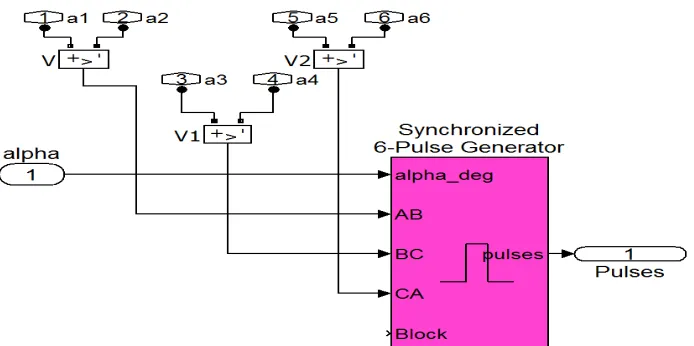
Fig. 1(d). Firing sequence for different phases
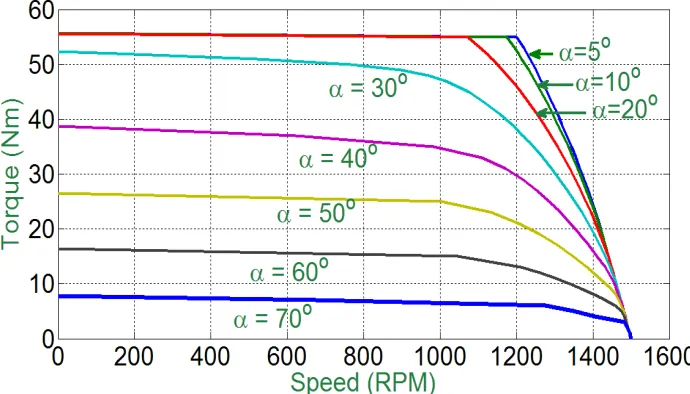
[image:3.612.161.467.88.279.2]The speed control of the induction motor is achieved by controlling the firing delay input to the synchronized pulse generator. By increasing , the output voltage of the regulator can be reduced and thus, the speed of the motor (directly proportional to the square of the applied input voltage) can be reduced. For a given firing angle, the applied torque is varied and the different speeds obtained are noted to generate and plot the training data as shown in Fig. 2. The data represents the T-N characteristic of an induction motor (in its stable operating region) for a given firing angle.
Fig. 2. Training Data consisting of torque, speed and values
[image:3.612.131.476.383.580.2]International Journal for Research in Applied Science & Engineering Technology (IJRASET)
ISSN: 2321-9653; IC Value: 45.98; SJ Impact Factor: 6.887 Volume 6 Issue XII, Dec 2018- Available at www.ijraset.com954
[image:4.612.149.471.78.369.2]©IJRASET: All Rights are Reserved
Fig. 3. Schematic of the Two Layer FF Neural Network used
[image:4.612.104.492.401.625.2]International Journal for Research in Applied Science & Engineering Technology (IJRASET)
ISSN: 2321-9653; IC Value: 45.98; SJ Impact Factor: 6.887 Volume 6 Issue XII, Dec 2018- Available at www.ijraset.com955
©IJRASET: All Rights are Reserved
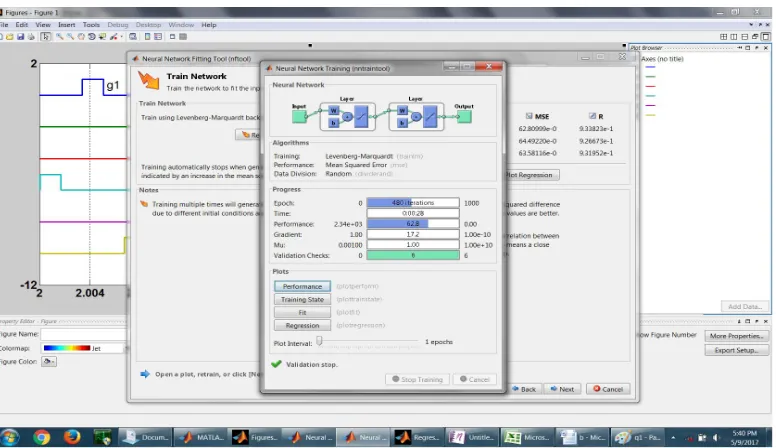
[image:5.612.137.460.75.257.2]Fig. 4(b). Training performance (Mean Squared Error)
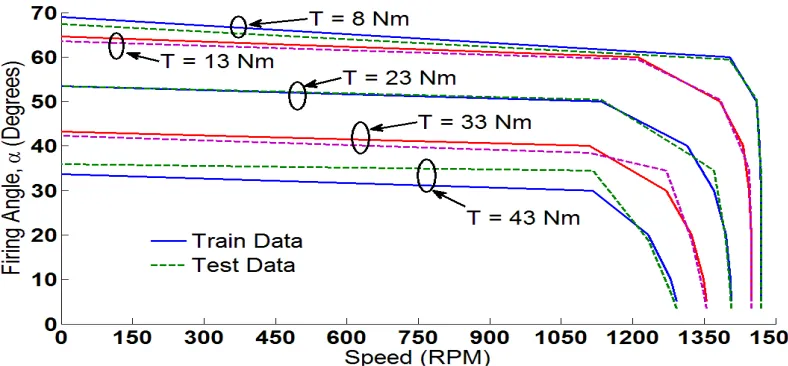
Fig. 5. Testing of the ANN for checking fitness
III. SOFT STARTING
In the second part of the work, a soft starter is designed to reduce starting torque and starting current pulsations. Basically, the soft starter smoothly varies the firing delay required for a given connected torque and a given speed requirement. is varied from an intial high value (optimally chosen to be 700) to the required value. The initial high value of reduces the initially applied voltage which reduces both the starting torque and the voltage. is gradually reduced to the required value. Through simulations, the input voltage obtained using a value of higher than 700 is found insufficent to start or accelerate the motor to the required speed (causing unstable operation). The variation in with respect to time can be mathematically given by equation (1) which is implemented in the soft starter shown in Fig. 6. …(1)
The soft starter accepts as inputs, the final value of , f (calculated using the ANN), the ramp-up time tR (time duration in which
[image:5.612.105.499.362.545.2]International Journal for Research in Applied Science & Engineering Technology (IJRASET)
ISSN: 2321-9653; IC Value: 45.98; SJ Impact Factor: 6.887 Volume 6 Issue XII, Dec 2018- Available at www.ijraset.com956
[image:6.612.88.529.87.264.2]©IJRASET: All Rights are Reserved
Fig. 6. Soft starting logic implemented in SIMULINK
IV. SIMULATION RESULTS AND DISCUSSION
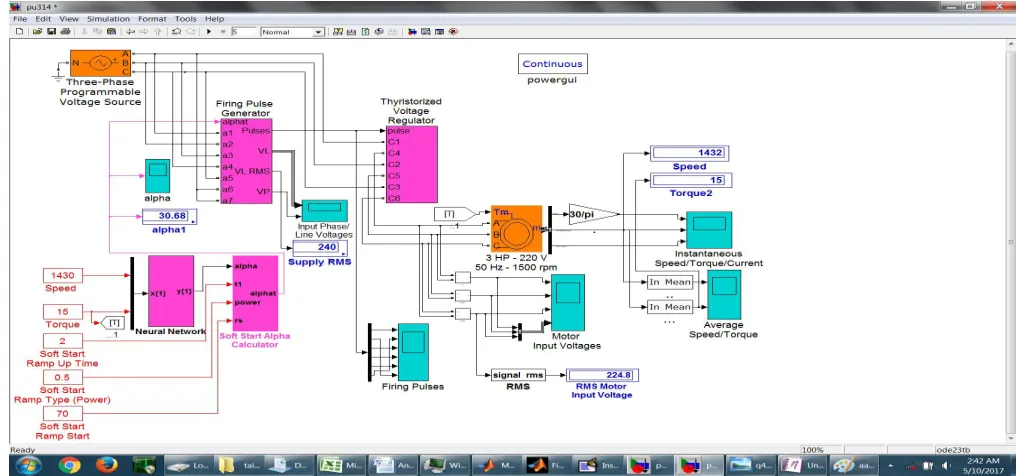
The complete model of the induction motor speed control and soft start is shown in Fig. 7. The induction motor is fed from the output of a three phase thyristor controlled voltage regulator. The optimally trained neural network block calculates the desired firing delay ‘ ’ for a given speed torque combination which is then given to the soft starter for generating the ramp to be input to the firing pulse generator. The variation in causes the voltage regulator to make a corresponding variation in the motor input voltage and thus controlling the torque, speed and current variations. Several measurement blocks are connected in the model for obtaining the voltage, current, speed and torque profiles.
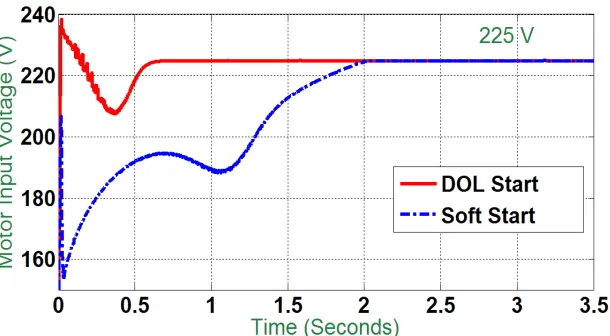
The model is simulated for different torque-speed combinations and the results are found to be satisfactory. As an sample case, the results obtained for the speed torque combination (N = 1430 RPM, T = 15 Nm) are shown in the following figures. A comparison is made between the two cases; with and without the use of soft starting (DOL starting). In case where soft starting is not used, the value of calculated by the ANN block is directly fed to the voltage regulator. For the given case, the value of estimated by ANN ois 30.680 and the ramp profile generated by the soft starter is shown in Fig. 8. A quadratic variation with time is chosen ( varying with t) by assigning p = 0.5 in the block. The corresponding variation in the regulator output voltage, or the motor input voltage is shown in Fig. 8(b).
[image:6.612.49.557.481.719.2]International Journal for Research in Applied Science & Engineering Technology (IJRASET)
ISSN: 2321-9653; IC Value: 45.98; SJ Impact Factor: 6.887 Volume 6 Issue XII, Dec 2018- Available at www.ijraset.com957
©IJRASET: All Rights are Reserved
Fig. 8(a). Firing delay profile – Soft Start
Fig. 8(b). Motor Input Voltage Profile – DOL Start and Soft Start Comparison
[image:7.612.156.451.85.260.2]It can be seen from the voltage profile that in case of DOL starting, the supply voltage is initially near 240V and after showing some dip (to 205V) reaches the final value of 225V (corresponding to = 30.680) in about 0.6 seconds. In case of soft starting, the voltage builds up from an initial value close to 160V to the final value of 225V in about 2 seconds. Again, a small dip is seen near 1.2 seconds. The variations in the motor speed are shown next in Fig. 9. From the speed characteristics, it is noted that a time delay of about 0.8 seconds is caused in reaching the final speed value (1432 RPM) due to soft starting when compared with DOL starting. This time delay can be acceptable in most practical applications.
[image:7.612.149.454.294.462.2] [image:7.612.148.442.580.721.2]International Journal for Research in Applied Science & Engineering Technology (IJRASET)
ISSN: 2321-9653; IC Value: 45.98; SJ Impact Factor: 6.887 Volume 6 Issue XII, Dec 2018- Available at www.ijraset.com958
©IJRASET: All Rights are Reserved
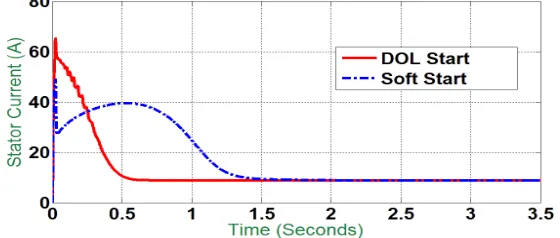
The beneficial effects of soft starting are most easily observable in case of torque and stator current variations shown in Fig. 10. A plot of the mean torque is presented in Fig. 10(a). The mean torque which is nearly 50 Nm in the intial starting period for about a quarter of a second in case of DOL starting reduces to less than 20 Nm during the same period in case of soft starting. The reduction in the magnitude of the initial torque pulsations is also easily noted from the instantaneous torque plot shown in Fig. 10(b). The motor torque in case of soft starting later increases for a short duration to about 35 Nm and finally stabilizes at the set value of 15 Nm. Again, as for the speed, a time delay of about 0.8 seconds is observed in the attainment of the steady value in case of soft starting when compared to DOL starting. The advantage of soft starting in reducing starting current pulsations are seen from Fig. 10(c) where the RMS values of the starting current for DOL start and soft start are compared.
Fig. 10(a). Average Torque – DOL Start and Soft Start Comparison
Fig. 10(b). Instantaneous Torque – DOL Start and Soft Start
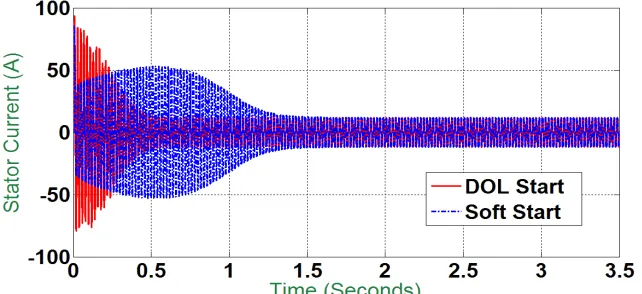
The starting value of the stator current is nearly 60A in case of DOL start which reduces to about 30A in case of soft start. The maximum RMS value of stator current in case of soft start is 40A near 0.5 seconds. The instantaneous currents are shown in Fig. 10(d). Thus, it is noted that with the use of soft starting technique, significant reduction in the starting torque and currenr pulsations can be achieved.
[image:8.612.154.453.192.332.2] [image:8.612.160.443.369.515.2] [image:8.612.163.443.601.720.2]International Journal for Research in Applied Science & Engineering Technology (IJRASET)
ISSN: 2321-9653; IC Value: 45.98; SJ Impact Factor: 6.887 Volume 6 Issue XII, Dec 2018- Available at www.ijraset.com959
©IJRASET: All Rights are Reserved
Fig. 10(d). Instantaneous Stator Current – DOL Start and Soft Start
V. CONCLUSION
In this paper, an ANN based speed control of a three phase induction motor is presented along with a soft starting technique. The ANN controller is trained using several speed, torque and firing angle combinations and genrates a firing delay suitable for a corresponding speed – torque combination, The soft starting is applied by using a thyristor voltage regulator whose firing delay is suitably time controlled. The motor input voltage is gradually increased to its final value thereby reducing the starting torque and current pulsations. The circuits are implemented in MATLAB / SIMULINK and the simulation results are found to be satisfactory..
REFERENCES
[1] C.C.Yeh and N.A.O Demerdash, “Fault-tolerant soft starter control of induction motors with reduced torque pulsations,” IEEE Transactions on Energy Conversion, Vol. 24, No. 4, pp. 848-859, 2009.
[2] M.G.Solveson, B.Mirafzal and N.A.O Demerdash, “Soft-started induction motor modeling and heating issues for different starting profiles using a flux-linkage ABC frame of reference,” IEEE Transactions on Industry Applications, Vol. 42, No. 4, pp. 973 – 982, 2006.
[3] A.Gastli and M.M.Ahmed, “ANN based soft-starting of Voltage Controlled-Fed IM drive system,” IEEE Transactions on Energy Conversion, Vol. 20, No. 3, pp. 497-503, 2005.
[4] A.Nied, J.D.Oliveira, R.F.Campos, R.P.Dias and L.C.S. Marques, “Soft starting of induction motor with torque control,” IEEE Transactions on Industry Applications, Vol. 46, No. 3, pp. 1002 – 1010, 2010.
[image:9.612.139.460.85.232.2]