N
S
Available online at: www.ijcncs.orgISSN 2308-9830
Design of Robust Speed Controller by Optimization Techniques
for DTC IM Drive
KMani indurupalli1, DR. K S R Anjaneyulu2, DR. B V Prashanth3
1
ASCEW, Gudur
2
JNTUCE, Anantapur
3
QISCET ,Ongole
E-mail: [email protected], [email protected], [email protected]
ABSTRACT
Direct Torque Control (DTC) of induction motor is preferred control strategy recently, due to its quick torque response, simplicity, less sensitivity against motor parameter variation. In general, PI speed controllers are widely used in industrial applications due to their simple structure. Due to the continuous variation of machine parameters, model uncertainties, nonlinear dynamics and system external disturbance, fixed gain PI controllers may becomes unable to provide the required control performance. Genetic Algorithm (GA) is used to tune the PI controller gains to ensure optimal performance. GA is more attractive for applications that involve non smooth or noisy signals. GA is used to minimize speed error and attains optimal values of the PI controller gains. The efficient and effective speed controllers can be designed by using adaptive control techniques. In which the conventional PI controller is replaced by structures based on Sliding Mode Control (SMC) strategy. SMC is known for its capability to cope with bounded disturbance as well as model imprecision which makes it ideal for the robust nonlinear control of IM drives.
Keywords: Sliding mode control, PI control, Induction Motor, GA, Artificial Intelligence
1 INTRODUCTION
In general, the conventional PI controller (CPIC) is one of the most common approaches for speed control in industrial electrical drives because of its simplicity and the clear relationship existing between its parameters and the system response specifications [1]. GA is proposed for both online and offline tuning procedure. The advantage of tuning with GA is the ability of choosing controller gains which optimize drive performance based on Multi-objective criterion without tripping in a local minima solution [2]. Sliding mode controller design provides a systematic approach to the problem of maintaining stability and satisfactory performance in presence of modeling imperfections. The sliding mode control is especially appropriate for the tracking control of motors, robot manipulators whose mechanical load change over a wide range.
2 DTC OF INDUCTION MOTOR
2.1 Direct Torque Control
In direct torque control (DTC), it is possible to control directly the stator flux and the torque by selecting the appropriate inverter switching state. Its main features are as follows [7]:
Direct torque control and direct stator flux control.
Indirect control of stator currents and voltages.
Approximately sinusoidal stator fluxes and stator currents
2.2 DTC Strategy
is composed of Flux comparator, Torque comparator, Inverter optimum switching table, Electro-magnetic torque and stator flux-linkage estimator and Voltage source inverter.
2.3 Torque Control
The electromagnetic torque given by equation (2.1) is a sinusoidal function of γ, the angle between
Ψ
andΨ
as shown in Fig. 2.5 Since the rotor flux changes slowly, the rapid variation of stator flux space vector will produce a variation in the developed torque because of the variation of the angle γ between the two vectors:=
∙ Ψ
………. (2.1)Fig. 1. Stator flux and rotor flux space vectors
∆
= ∙
[(Ψ + ∆Ψ ) ∙ Ψ ]
…….. (2.2)
Therefore the variation of the stator flux space vector due to the application of the stator voltage
vectors
V
has to be selected to obtain stronger rotation speed ofω
.The electromagnetic torque is given by
= ∙
∙ (Ψ i
− Ψ i )
……(2.3)2.4 Stator Flux-Linkage SPV estimation
For the instantaneous correction of the flux and torque errors an appropriate voltage vector needs to be applied to the voltage source inverter and this voltage vector is obtained from the switching vector look up table. The optimum switching look-up table
requires the knowledge of the position of the stator flux-linkage space vector position (SPV), since it must be known in which sector is the stator flux-linkage space vector. The stator flux angle (
∝
) can be determined by using the estimated values of the direct and quadrature axis stator flux-linkages in the stationary reference frame (Ψ
,Ψ
), thus∝ = ∠
Ψ
= tan
ΨΨ ……. (2.4) ‘
∝
’ is used to determine the sector number inwhich the flux linkage space vector lies as shown in Figure 1.
2.5 Stator Flux-linkage Estimation
The stator flux linkage can be obtained by integrating monitored terminal voltages reduced by the ohmic losses, as shown by the following equation.
Ψ = ∫
…... (2.5)
Ψ
= ∫
−
…... (2.6)
Ψ
= ∫
−
.….. (2.7)
Ψ = Ψ
+ Ψ
…… (2.8)
3 DESIGN OF PI CONTROLLER THROUGH GA
3.1 Implementation PI speed controller by GA
In GA method to tune the PI gains in the previously mentioned speed control loop, the fitness function used to evaluate the individuals of each generation can be chosen to be the integral time of absolute error (ITAE):
ITAE=
∫
׀
( )
׀
other one is the Ki value. Chromosome vector = [Kp
Ki ].
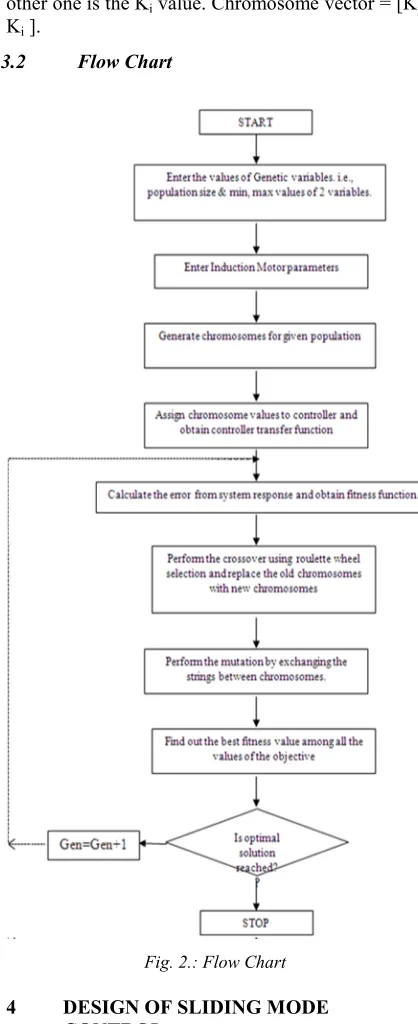
3.2 Flow Chart
Fig. 2.: Flow Chart
4 DESIGN OF SLIDING MODE CONTROL
In control theory sliding mode control, is a form of variable structure control (VSC). It is a nonlinear control method that alters the dynamics of a nonlinear system by application of a high-frequency switching control. The multiple control structures are designed so that trajectories always move toward a switching condition, and hence the ultimate trajectory will not exist entirely within one control structure.
Instead, the ultimate trajectory will slide along the boundaries of the control structures. The motion of the system as it slides along these boundaries is called a sliding mode. It is computationally simple compared to adaptive controllers with parameter estimation. Induction motor with sliding mode control performs well in the servo applications, where the actuator has to follow complex trajectories. Sometimes sliding mode control has a demerit of chattering of the control variable and some of the system states.
The strengths of SMC include:
Low sensitivity to plant parameter uncertainty
Greatly reduced-order modeling of plant dynamics
Finite-time convergence (due to discontinuous control law)
SMC is considered as an effective and robust control strategy. It is mainly a Variable Structure Control (VSC) with high frequency discontinuous control action which switches between several functions depending on the system states. This forces the states of the system to slide on a predefined hyper surface. The plant states are mapped into a control surface using different continuous functions and the discontinuous control action switches between these several functions according to plant state value at each instant to achieve the desired trajectory. SMC is known for its capability to cope with bounded disturbance as well as model imprecision which makes it ideal for the robust nonlinear control of induction motor drives [8], [9]. To design a sliding mode speed controller for the induction motor DTC drive, consider the mechanical equation:
ώ
ω + T
LJ
B
T
P
P
... (4.1)Where ω is the rotor speed in electrical rad/Sec, rearranging to get:
ώ +
ω
L eB
P
P
T
T
J
J
J
... (4.2)ώ
B
ω
P
T
LP
T
eJ
J
J
... (4.3)
ώ
a
ω
bT
e+
cT
L,
,
B
P
P
a
b
c
J
J
J
... (4.5)
Considering ∆a and ∆b as bounded uncertainties introduced by system parameters J and B, can be
rewritten as:
ώ = (a + Δ )ω ( + Δb)
a
b
T
e
cT
L.. (4.6)
Defining the state variable of the speed error as:
*
( )
ω( ) ω ( )
e t
t
t
... (4.7)
( )
é( )
d
e t
t
dt
... (4.8)*
é( )
t
ω ( ) 0
t
(a + Δ )ω ( + Δb)
a
b
T
e
cT
L* *
(a + Δ )ω ( + Δb)
a
b
T
ecT
La
ω
a
ω
* *
(ω ω ) Δ ω + Δ ω
eΔ
e La
a
a
bT
bT
cT
*
Δ
Δ
( )
[
eb
ea
ω
a
ω
c
L]
ae t
b T
T
T
b
b
b
b
*
Δ
Δ
( )
[
a
ω
b
ec
L ea
ω ]
ae t
b
T
T
T
b
b
b
b
( )
[
e( )]
ae t
b T
d t
... (4.9)
Where
T
eT
ea
ω ,
*b
Δ
Δ
( )
ω
e La
b
c
d t
T
T
b
b
b
... (4.10)
Defining a switching surface s(t) from the nominal values of system parameters a and b
0
( )
( )
(
) (τ) τ
t
s t
e t
a bk e
d
. .. (4.11)Such that the error dynamics at the sliding surface s(t ) =
s t
( )
= 0 will be forced to exponentially decay to zero, then the error dynamics can be described by:e
(t ) = (a + bk ) e(t ) ... (4.12)
Where k is a linear negative feedback gain
Assumption:
(a+bk) should be +ve,
(
)
0
(
)
0
0
a bk
B
Pk
J
J
B
Pk
J
pk
B
B
k
P
Then the sliding surface is
0
( )
( )
(
) (τ) τ
0
t
s t
e t
a bk e
d
…(4.13)
Variable structure speed controller
( ) β sgn( )
ke t
s
... (4.14)SMC:
ώ = aώ
bT
e
cT
L ... (4.15)* * *
ώ
ω
e L
bT
a
cT
... (4.16)
*
1
* *[ώ
ω
]
e L
T
a
cT
b
... (4.17) * *1
[(
ke
βsgn( )) (ώ
s
a
ω
cT
L)]
b
. (4.18)
* *
[
βsgn( ) ώ
ω
L)]
J
B
P
ke
s
T
b
J
J
... (4.19) 0( ) (
)
(τ) τ
ts
e t
a bk
e
d
... (4.20) 0
= ( ) (
)
(τ) τ
tB
Pk
e t
e
d
J
… (4.21)
disturbance [5], [6]. Therefore the speed control law defined in will guarantee the existence of the switching surface s(t) in and when the error function e(t) reaches the sliding surface, the system dynamics will be governed by which is always stable [10]. Moreover, the control system will be insensitive to the uncertainties ∆a , ∆b and the load disturbance TL.
5 RESULTS
5.1 GA based PI controller Simulation
5.1.1 Results with No-load
In this section, motor gives the results correspo-nding their rated speed with No-load. When the reference speed= 155 rad/sec (1480 rpm), with No-load.
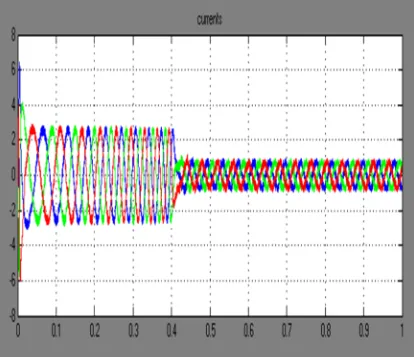
In this case, the motor gives the results when the reference speed is 155 rad/sec with No-load. The Stator currents of the motor corresponding are shown in Figure 3. The Torque response of the motor corresponding is shown in Figure 4. Rotor speed response with reference is shown in Figure 5.
Fig. 3. Stator Currents
Fig. 4. Torque response
Fig. 5. Speed response
5.1.2 Results with load
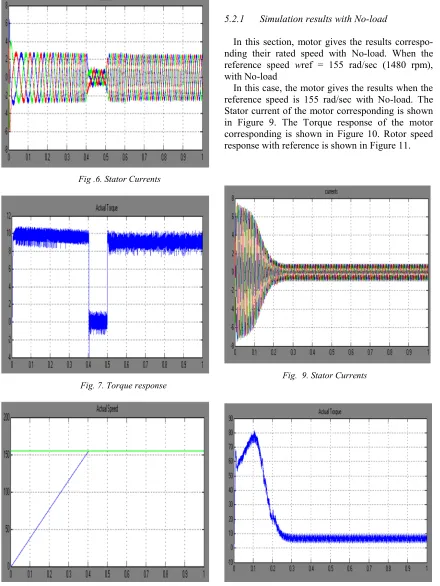
In this section, motor gives the results correspo-nding their rated speed with No-load. When the reference speed = 155 rad/sec (1480 rpm), with load TL= 9 N-m
Fig .6. Stator Currents
Fig. 7. Torque response
Fig. 8. Speed response
5.2 SMC based PI controller simulation
5.2.1 Simulation results with No-load
In this section, motor gives the results correspo-nding their rated speed with No-load. When the reference speed wref = 155 rad/sec (1480 rpm), with No-load
In this case, the motor gives the results when the reference speed is 155 rad/sec with No-load. The Stator current of the motor corresponding is shown in Figure 9. The Torque response of the motor corresponding is shown in Figure 10. Rotor speed response with reference is shown in Figure 11.
Fig. 9. Stator Currents
Fig. 11. Speed response
5.2.2 Simulation Results with load
In this section, motor gives the results correspo-nding their rated speed with No-load. When the reference speed wref = 155 rad/sec (1480 rpm), with load TL= 9 N-m
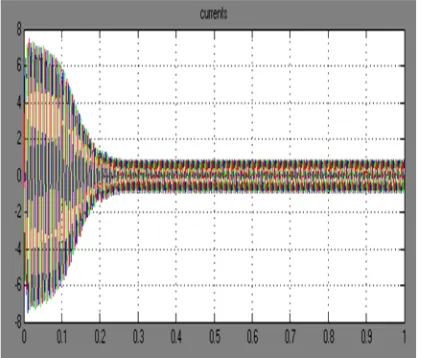
In this case, the motor gives the results when the reference speed is 155 rad/sec with load TL= 9 N-m is applied at t=0.5 sec. The Stator currents of the motor corresponding are shown in Figure 12. The Torque response of the motor corresponding is shown in Figure 13. Rotor speed response with reference is shown in Figure 14.
Fig. 12. Stator Currents
Fig. 13. Torque response
Fig. 14. Speed response
5.3 Comparison of ZN, GA and SMC based controller performance
Table 1: Comparison of ZN, GA and SMC
Response Specifications
Ziegler-Nichols method
Kp=0.612,
ki=122.4
GA
Kp=116.
7, ki=2.07
SMC
ITAE value at 155 rad/Sec TL= 9 N-m
t=0.5sec
4.872 4.416 2.12
Speed response settling time
0.49 0.42 0.32
Transient response
3% Speed over shoot
1% speed over shoot
6 CONCLUSIONS AND FUTURE SCOPE
In this paper, DTC is employed to a 3-Φ Induction motor and complete model has been designed in MATLAB-SIMULINK software. The simulation has been carried out for different operating conditions using conventional PI controller, genetic algorithm and sliding mode based controller performance. Sliding mode controller provides better response particularly when the operating conditions, such as change in speed and change in load torque when compare to Genetic PI Controller.
The further work for this paper can be extended in the following directions. Torque and flux Ripple Minimization with constant switching frequency controllers by replacing in the place of the hysteresis torque controller and hysteresis flux controller in the DTC drive. Ripple minimization of current, Torque, Flux can be taken as a suitable work to be extended. The DTC work can be extended with another optimization technique such as PSO. The DTC work can also be extended practical implementation by using DSP controller or FPGA controller.
7 REFERENCES
[1] A. Visioli, “Optimal tuning of PI controllers for integral and unstable processes”, IEE Proceedings – Control Theory and Applications, Vol.1. No.2, pp.180-184, 2001. [2] Astrom, K.J and T. Hagglund, PI Controllers:
Theory, Design, and Tuning. Instrument Society of America, 1995.
[3] F. Lin, W. Chou and P. Huang, “Adaptive sliding mode controller based on real time genetic algorithm for induction motor servo drive,” IEE Proc. Electr. Power Appl., Vol.150, No.1, Jan.2003, pp. 1-13.
[4] M. N. Uddin, T. S. Radwan, M. Rahman, “Performance of fuzzy-logic-based indirect vector control for induction motor drive,” IEEE Trans. Ind. Applicat., Vol.38, No. 5, Sept./Oct. 2002, pp. 1219-1225.
[5] F. Barrero, A. Gonzalez, A. Torralba, E. Galvan and L. G.Franquelo, “Speed control of Induction Motors uses a novel Fuzzy Sliding Mode structure,” IEEE Trans. Fuzzy Syst., Vol.10, No.3, June 2002, pp. 375-383.
[6] J. Lo and Y. Kuo, “Decoupled Fuzzy Sliding Mode Control,” IEEE Trans. Fuzzy Syst., Vol.6, No. 3, Aug. 1998, pp. 426-435.
[7] Y. Lai and J. Lin, “New hybrid Fuzzy controller for Direct Torque Control Induction
Motor drives,” IEEE Trans. Power Electron., Vol. 18, No. 5, Sept. 2003, pp. 1211-1219. [8] O. Barambones, A.J. Garrido, F.J. Maseda
and P. Alkorta, “An adaptive sliding mode control law for Induction Motor Using field oriented control theory,” Proc. IEEE International Conf. on Control Applications, 2006, pp. 1008-1013.
[9] P.Vas, Artificial-Intelligence-Based Electrical Machines and Drives-Application of Fuzzy, Neural, Fuzzy-Neural and Genetic Algorithm Based Techniques. New York: Oxford University Press, 1999.
[10]V. I. Utkin, “Sliding Mode control design principles and applications to electric drives,” IEEE Trans. Ind. Electron., Vol. 40, No. 1, Feb. 1993, pp. 23-36.
[11]W. S. Levine (Ed.), the control handbook, CRC Press, 1996.