Modern Journal of Language Teaching Methods ISSN: 2251-6204
Vol. 6, Issue 7, October 2016
Page 1
Modern Journal of Language Teaching Methods (MJLTM)
ISSN: 2251 - 6204
www.mjltm.com
Editor – in – Chief
Hamed Ghaemi, Assistant Professor in TEFL, Islamic Azad University (IAU)
Editorial Board:
1.
Abednia Arman, PhD in TEFL, Allameh Tabataba’i University, Tehran, Iran
2.
Afraz Shahram, PhD in TEFL, Islamic Azad University, Qeshm Branch, Iran
3.
Amiri Mehrdad, PhD in TEFL, Islamic Azad University, Science and research
Branch, Iran
4.
Azizi Masoud, PhD in Applied Linguistics, University of Tehran, Iran
5.
Basiroo Reza, PhD in TEFL, Islamic Azad University, Bushehr Branch, Iran
6.
Dlayedwa Ntombizodwa, Lecturer, University of the Western Cape, South Africa
7.
Doro Katalin, PhD in Applied Linguistics, Department of English Language
Teacher Education and Applied Linguistics, University of Szeged, Hungary
8.
Dutta Hemanga, Assistant Professor of Linguistics, The English and Foreign
Languages University (EFLU), India
9.
Elahi Shirvan Majid, PhD in TEFL, Ferdowsi University of Mashhad, Iran
10.
Fernández Miguel, PhD, Chicago State University, USA
11.
Ghaemi Hamide, PhD in Speech and Language Pathology, Mashhad University
of Medical Sciences, Iran
12.
Ghafournia Narjes, PhD in TEFL, Islamic Azad University, Neyshabur Branch,
Iran
13.
Grim Frédérique M. A., Associate Professor of French, Colorado State University,
USA
14.
Izadi Dariush, PhD in Applied Linguistics, Macquarie University, Sydney,
Australia
15.
Kargozari Hamid Reza, PhD in TEFL, Payame Noor University of Tehran, Iran
16.
Kaviani Amir, Assistant Professor at Zayed University, UAE
Modern Journal of Language Teaching Methods ISSN: 2251-6204
Vol. 6, Issue 7, October 2016
Page 2
17.
Kirkpatrick Robert, Assistant Professor of Applied Linguistics, Shinawatra
International University, Thailand
18.
Mehrani Mehdi, PhD in TEFL, University of Neyshabur, Neyshabur, Iran
19.
Morady Moghaddam Mostafa, PhD in TEFL, University of Tabriz, Iran
20.
Mouton Nelda, PhD in Education Management, North-West University
(NWU), South Africa
21.
Najafi Sarem Saeid, PhD Candidate in TEFL, Islamic Azad University, Science
and Research Branch, Tehran, Iran
22.
Naicker Suren, Department of Linguistics and Translation, University of South
Africa
23.
Ndhlovu Finex, PhD, Linguistics Programme, University of New England,
Australia
24.
Raddaoui Ali Hechemi, PhD, Associate Professor of Applied Linguistics,
University of Wyoming in Laramie, USA
25.
Rezaei Saeed, PhD in TEFL, Sharif University of Technology, Tehran, Iran
26.
Rolstad Kellie, PhD, Associate Professor of Education, University of Maryland,
USA
27.
Roohbakhshfar Hamid, PhD in TESOL, Islamic Azad University, Neyshabur
Branch, Iran
28.
Sanatifar Mohammad Saleh, PhD in Translation Studies, Tabaran Institute of
Higher Education, Mashhad, Iran.
29.
Shafiee Sajad, Department of English, Shahrekord Branch, Islamic Azad
University, Shahrekord, Iran
30.
Stobart Simon, PhD, Dean of Computing, Teesside University, UK
31.
Suszczynska Malgorzata, Senior Assistant Professor, University of Szeged,
Hungary
32.
Tabeifard Sayed Javad, PhD in ELT, University of Tehran, Kish International
Campus, Iran
33.
Weir George R. S., PhD in Philosophy of Psychology, University of Strathclyde,
Glasgow, UK
34.
Zabihi Reza, PhD in TEFL, University of Neyshabur, Neyshabur, Iran
35.
Zegarac Vladimir, PhD, University of Bedfordshire, UK
Modern Journal of Language Teaching Methods ISSN: 2251-6204
Vol. 6, Issue 7, October 2016
Page 3
Abstracting/Indexing
Index
Copernicus 2011
Modern Journal of Language Teaching Methods ISSN: 2251-6204
Vol. 6, Issue 7, October 2016
Page 4
Linguistics Abstract
EBSCO Publication
Lulu Publication
Modern Journal of Language Teaching Methods ISSN: 2251-6204
Vol. 6, Issue 7, October 2016
Page 5
Directory of Open Access Journals
ProQuest
Modern Language Association
Cabell's Directories
Modern Journal of Language Teaching Methods ISSN: 2251-6204
Vol. 6, Issue 7, October 2016
Page 6
COPE
Directory of Research Journal Indexing (DRJI)
Modern Journal of Language Teaching Methods ISSN: 2251-6204
Vol. 6, Issue 7, October 2016
Page 7
Indian Citation Index
International Society of Universal Research in Sciences
Ulrich's
Modern Journal of Language Teaching Methods ISSN: 2251-6204
Vol. 6, Issue 7, October 2016
Page 8
THE RELATIONSHIP AMONG SELF-EFFICACY,
CRITICAL THINKING AND PROFESSIONAL SUCCESS
OF IRANIAN EFL TEACHERS
Ahmad Mohseni
Islamic Azad University, South Tehran Branch [email protected]
Hadi Omrani
Islamic Azad University, South Tehran Branch [email protected]
ABSTRACT
THE PRESENT STUDY WAS AN ATTEMPT TO INVESTIGATE THE RELATIONSHIP AMONG SELF-EFFICACY, CRITICAL THINKING, AND PROFESSIONAL SUCCESS OF EFL TEACHERS IN THE IRANIAN CONTEXT. IN ADDITION TO THE EXISTING RELATIONSHIP AMONG THE THREE VARIABLES MENTIONED, THE STUDY WAS AN ATTEMPT TO MEASURE THE POWER SELF-EFFICACY AND CRITICAL THINKING AS PREDICTORS OF TEACHERS' PROFESSIONAL SUCCESS AMONG IRANIAN EFL TEACHERS. THIRTY EFL TEACHERS AS WELL AS 150 EFL LEARNERS IN SOME LANGUAGE INSTITUTES IN TEHRAN TOOK PART IN THE STUDY. THE PARTICIPANTS WERE BOTH MALE AND FEMALE STUDENTS AT THE UPPER-INTERMEDIATE LEVEL WITH THE AGE RANGE OF 18-35. THIRTY EFL TEACHERS WERE ASKED TO FILL OUT THE QUESTIONNAIRES OF TEACHER SENSE OF EFFICACY SCALE AND CORNELL CRITICAL THINKING TEST AND IN THE NEXT STEP OUT THE STUDENTS OF EACH TEACHER FIVE STUDENTS WERE RANDOMLY SELECTED TO FILL OUT THE TEACHERS’ PROFESSIONAL SUCCESS SURVEY. PEARSON CORRELATION WAS RUN TO PROBE ANY SIGNIFICANT RELATIONSHIP BETWEEN THE VARIABLES OF THE STUDY. A MULTIPLE REGRESSION THROUGH THE STEPWISE METHOD WAS ALSO RUN TO PREDICT TEACHERS’ SUCCESS BY USING THE SELF-EFFICACY AND CRITICAL THINKING. ANALYSIS OF VARIANCES (ANOVA) WAS EMPLOYED TO SEE IF THE RESULTS OF REGRESSION AT BOTH STEPS ENJOYED STATISTICAL SIGNIFICANCE. THE FINDINGS OF THE STUDY REVEALED SIGNIFICANTLY POSITIVE RELATIONSHIP AMONG SELF-EFFICACY, CRITICAL THINKING AND PROFESSIONAL SUCCESS OF IRANIAN EFL TEACHERS. ALSO, IT WAS FOUND THAT BOTH SELF-EFFICACY AND CRITICAL THINKING COULD RELATIVELY PREDICT EFL TEACHERS’ PROFESSIONAL SUCCESS. AS CRITICAL THINKING ALONE COULD PREDICT A HIGH PERCENTAGE OF TEACHERS’ SUCCESS, THE RESULTS OF DATA ANALYSIS REVEALED THAT CRITICAL THINKING WAS A BETTER PREDICTOR OF TEACHERS’ PROFESSIONAL SUCCESS. THE FINDINGS OF THE PRESENT STUDY COULD HAVE IMPLICATIONS FOR EFL TEACHERS AND LEARNERS IN THE IRANIAN CONTEXT.
KEYWORDS: SELF-EFFICACY, CRITICAL THINKING, PROFESSIONAL SUCCESS
Modern Journal of Language Teaching Methods ISSN: 2251-6204
Vol. 6, Issue 7, October 2016
Page 9
Introduction
As a key factor in successful adjustment and self-development, one's belief in self-efficacy is of paramount importance (Moafian & Ghanizadeh, 2011). Indeed, this can affect ''cognitive, motivational, affective and decisional processes, and cause individuals to think positively and hopefully or negatively and cynically, in self-enhancing or self-debilitating manners'' (ibid, p. 120). Self-efficacy (SE) beliefs can also influence the way barriers and changes in the environment are perceived; those with high sense of efficacy keep on trying and show resistance in case of hardships (Bandura, 2005).
Regarding teachers, this efficacy is reflected in the judgment of the teachers in their ability to bring about changes in the engagement level of the students and leading them to desired outcomes (Bandura, 1977) such as achievement (Ross, 1992), students' self-efficacy (Anderson et al., 1988), and motivation (Midgley et al.1989). From another point of view, Allinder (1994) sees higher levels of planning observed in such teachers. Efficacy beliefs also make teachers more risk taker to experience new methods to fulfill the requirements of the classroom (Stein & Wang, 1988). Ashton and Webb (1986) also contend that efficacious teachers are less critical when their students make errors. From another point of view, teachers’ SE has been strongly connected to their pedagogical success (Ghanizadeh & Moafian, 2011). Among the factors which correlate with self-efficacy, critical thinking seems a strong option (Moafian & Manafzadeh, 2011). Recently, the relationship between each of the aforementioned constructs (Self Efficacy and Critical Thinking) has been established (Birjandi & Bagherkazemi, 2010; Wong, 2005).
Although research on the three constructs (CT, SE, and Success) has contributed greatly to the literature; however, they have never been studied jointly in a single study. Thus, the present research makes an attempt to fill this gap and investigate the impact of the constructs of self-efficacy and critical thinking on the teachers' success. On the other hand, such factors and their relationships have not been investigated about the teachers dealing with teaching English in separate single study.
The main purpose of this study was investigating the relationship among self-efficacy, critical thinking and professional success of EFL teachers in the Iranian context. A minor purpose of the study, however, was investigating the impact of self-efficacy and critical thinking on the professional success of Iranian EFL teachers. In this regard the significant point to consider was to see if these two variables could predict EFL teachers` professional success. Among the self-perceived challenges that nonnative English speaking teachers face are the lack of teacher confidence, biased attitudes of students and other teachers because of their nonnative status, as well as English language needs (Samimy & Brutt-Griffler, 1999).Teachers' sense of efficacy can potentially influence both the kind of environment that they create as well as the various instructional practices introduced in the classroom (Bandura, 1997). Furthermore, teachers with a high sense of self-efficacy are confident that even the most difficult students can be reached if they exert extra effort; teachers with lower self-efficacy, on the other hand, feel asense of helplessness when it comes to dealing with difficult and unmotivated students (Gibson & Dembo, 1984). The literature widely documents the pervasive influence of self-efficacy beliefs and corroborates social cognitive theory that places these beliefs at the roots of human agency (Bandura, 2001).
Some of the ELT studies have sought to yield a broader conception of teacher success than one which only accords significance to professional qualities as language proficiency and managing skills. In an attempt to keep in line with developments in psychology and cognitive science, this upsurge in language education research has investigated the impact of language teachers’ various cognitive, affective and personality characteristics on their teaching practices and professional success. Among those investigated, one can refer to EFL teachers’ multiple intelligences (Pishghadam & Moafian, 2007), emotional intelligence (Hashemi, 2008), and self-efficacy (Moafian & Ghanizadeh, 2009). Following this line of research, another variable domain in which to investigate the concept of teacher success in foreign and second language teaching programs is L2 teachers’ critical thinking ability (Birjandi & Bagherkazemi, 2010).
Modern Journal of Language Teaching Methods ISSN: 2251-6204
Vol. 6, Issue 7, October 2016
Page 10
Statement of the Problem
Although a number of studies have investigated teacher efficacy in different subject matters, “little research has been conducted to explore the perceived efficacy of nonnative English speaking teachers in different ESL and EFL contexts” (Eslami & Fatahi, 2008, p.2). Because of the fast worldwide spread of the English language, the number of NNESTs has increased tremendously over the last decades. As nonnative English speaking teachers become a focus of research and pedagogical interest in applied linguistics, the issue of their professional success is gaining significance as the role of English teachers’ multiple intelligences in their teaching success has been recently researched and documented (Pishghadam & Moafian, 2007). Meanwhile, the relationship between the self-efficacy of the Iranian NNEST teachers and their professional success has been left almost intact. Although the relationship between Iranian EFL teachers’ critical thinking ability and their professional success has been well researched (Birjandi& Bagherkazemi, 2010), the role of EFL teachers teaching in the institutes, in this regard has not been well documented. Nor has the relationship among the three constructs of self-efficacy, critical thinking, and teachers' success been studied simultaneously. The predictive ability of the self-efficacy and critical thinking concerning EFL teachers’ success has not been well-established either. The main problem in the present study was to see self-efficacy belief and critical thinking have any impact on the professional success of EFL teachers in the Iranian context.
Research Questions
Considering the problem stated and the purpose of the study, the following questions were raised:
1. Is there any statistically significant relationship between self-efficacy and professional success among
EFL teachers in the Iranian context?
2. Is there any statistically significant relationship between critical thinking and professional success among EFL teachers in the Iranian context?
3. To what extent do the two variables of self-efficacy and critical thinking predict Iranian EFL teachers’
professional success?
Method
Participants
The nonnative English speaking teachers (NNESTs) taking part in the present study were 30 EFL teachers who were selected from among the male and female teachers of English teaching in Sokhan, Ayandeh, Gouyesh, and Tayebin , and Kiyan language institutes located in the eastern part of Tehran- the capital city of Iran. The reason behind such a selection was that the researcher had already taught in those institutes and this familiarity facilitated the process of conducting the present research. The EFL learners taking part in the present study were 150 EFL learners studying English in the aforementioned language institutes. The participants were both male and female students in intermediate, upper-intermediate and advanced level learners with the age range of 18-25. The reason for the selection of these participants lied in the fact that these learners had received enough training in English by different teachers and were likely to present the researcher with more trustable answers and data for the present research.
Instrumentations
To collect the data, the researcher used Teacher Sense of Efficacy Scale (Tschannen-Moran & Hoy, 2001), Successful Iranian EFL Teacher Questionnaire (SIETQ) (Moafian & Pishghadam, 2009), and Cornell Critical Thinking Test (Persian Version). The aforementioned instruments are introduced as follows.
Modern Journal of Language Teaching Methods ISSN: 2251-6204
Vol. 6, Issue 7, October 2016
Page 11
Teacher Sense of Efficacy Scale
Teacher Sense of Efficacy Scale (Tschannen-Moran & Hoy, 2001) which is available in two forms (the short with 12 items and the long one with 24 items). The scale in its two forms enjoys high reliability indices between .81 and .90 (Eslami & Fatahi, 2008). Because this instrument was developed at the Ohio State University, it is sometimes referred to as the Ohio State Teacher Efficacy Scale. The present researcher preferred to use the short form to absorb the cooperation of the teachers completing the questionnaire and present a more user-friendly data collection situation. This questionnaire is designed to help us gain a better understanding of the kinds of things that create difficulties for teachers in their school activities. The participants are asked to indicate their opinion about each of the 12 statements mentioned in the questionnaire through selecting from a nine-level likert scale including nothing (1) up to a great deal (9). The short form of the questionnaire used in the present study includes three areas of
efficacy in student engagement (items 2, 3, 4, 11), efficacy in instructional strategies (items 5, 9, 10, 12), and efficacy in classroom management (items 1, 6, 7, 8). The participants are ensured in the instruction section of the questionnaire that their answers would be confidential.
Teachers’ Professional Success Survey
Teachers’ professional success was estimated by their students through the Successful Iranian EFL Teacher Questionnaire (SIETQ) (Moafian & Pishghadam, 2009). Characteristics of successful EFL teachers’ questionnaire was designed by Moafian and Pishghadam (2009). The questionnaire consists of 47 items ranging from ‘strongly agree’ to ‘strongly disagree’. The results of reliability analysis showed that the total reliability of the questionnaire was very high (Cronbach’s alpha = 0.94). The results of factor analysis indicated that the questionnaire measures 12constructs, i.e., teaching accountability, interpersonal relationships, attention to all, examination, commitment, learning boosters, creating a sense of competence, teaching boosters, physical and emotional acceptance, empathy, class attendance, and dynamism.
Cornell Critical Thinking Test
Cornell Critical Thinking Test (Persian Version), which is available and has been frequently used in the researchers conducted in Iran. A standard copy of Cornell Critical Thinking Test Series available in Persian was used. The Questionnaire includes 52 items in 7 sections and should be answered in 50 minutes. The aim of the test is checking the critical thinking and cognitive ability of the learners. The Persian version of the questionnaire was prepared by Professor Houman, the late professor of Tehran University in 2005. The questionnaire has been frequently used in various researches in both educational sciences and TEFL domain. The reliability of the test has been frequently checked in different situations and the reported reliabilities have been between .61 and .80 (Houman, 2005). Also, Alivandi Vafa (2005) presented that Cornell Critical Thinking Questionnaire in Persian enjoyed high reliability of .82 percent based on Cronbach's alpha.
Procedure
At first 30 male and female teachers of teaching English conversation in different language institutes in Tehran city were asked to fill out the questionnaires of Teacher Sense of Efficacy Scale and Cornell Critical Thinking Test. In the next step from among the students of each teacher 5 students were randomly selected to fill out the Teachers’ Professional Success Survey. Both teachers and the students were briefed about the nature of the research and the specifications of the questionnaires. The data were
Modern Journal of Language Teaching Methods ISSN: 2251-6204
Vol. 6, Issue 7, October 2016
Page 12
collected and analyzed via SPSS software (version 22) and then reported and checked based on the research questions and research null hypotheses.
Results and Discussion
Descriptive Statistics Checking Normality
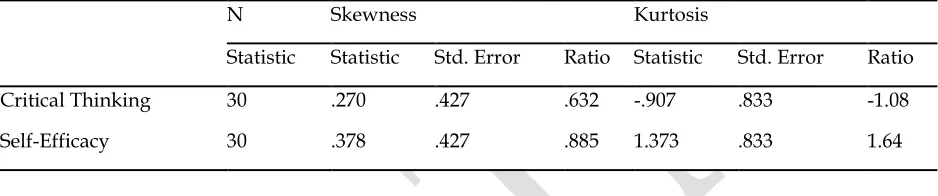
Since the data were analyzed using Pearson correlation, it should be verified that the data enjoyed normal distribution. As displayed in Table 1, the ratios of skewness and kurtosis over their standard errors were within the ranges of +/- 1.96.
Table 1
Testing Normality Assumption
N Skewness Kurtosis
Statistic Statistic Std. Error Ratio Statistic Std. Error Ratio
Critical Thinking 30 .270 .427 .632 -.907 .833 -1.08
Self-Efficacy 30 .378 .427 .885 1.373 .833 1.64
As the third question of the study required checking the predictive ability and value of variables of self-efficacy and critical thinking towards Iranian EFL teachers’ professional success, the present data were analyzed though multiple regression as well, that is why the data had to be verified to see if they enjoyed normal distribution. As displayed in Table 2, the Kolmogorov-Smirnov tests were non-significant (p > .05) for critical thinking, self-efficacy and teaching success; hence normality of the data was again confirmed.
Table 2
Tests of Normality for the Variables in an Account of Regression
Kolmogorov-Smirnov Shapiro-Wilk
Statistic df Sig. Statistic df Sig.
Critical Thinking .122 30 .200 .956 30 .240
Self-Efficacy .141 30 .134 .938 30 .081
Success .124 30 .200 .931 30 .052
Checking Reliability
The KR-21 reliability indices for the critical thinking, self-efficacy, and teachers’ success were respectively .89, .99, and .89. See Table 3 below for the indices of reliability of the instruments used in the study.
Modern Journal of Language Teaching Methods ISSN: 2251-6204
Vol. 6, Issue 7, October 2016
Page 13
Table 3
Reliability Statistics
N of Items (Total Score) Mean Variance KR-21
Critical Thinking 52 156 101.33 310.782 .89
Self-Efficacy 12 218 126.80 3271.821 .99
Success 47 235 137.07 2975.168 .89
Construct Validity
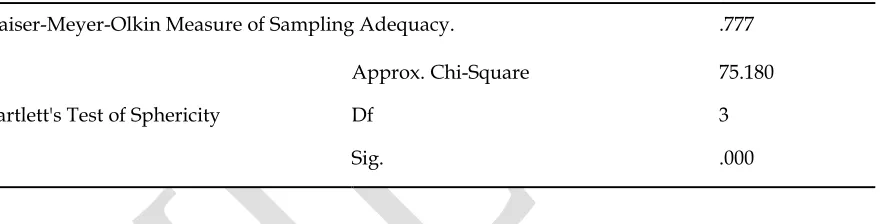
A factor analysis through the varimax rotation was run to probe the construct validity of the critical thinking, teachers’ success and self-efficacy. It should be mentioned that the assumption of sampling adequacy was met. As displayed in Table 4 the KMO index of .77 was higher than .50.
Table 4
KMO and Bartlett's Test
Kaiser-Meyer-Olkin Measure of Sampling Adequacy. .777
Bartlett's Test of Sphericity
Approx. Chi-Square 75.180
Df 3
Sig. .000
The Bartlett’s test was significant (χ2 (3) = 75.18, p = .000) indicating that the correlation matrix did not suffer from multicollinearity-too high or too low correlations among all variables. The SPSS extracted one factor which accounted for 89.76 percent of the total variance (Table 5).
Table 5
Total Variance Explained
Component
Initial Eigenvalues Extraction Sums of Squared Loadings
Total % of Variance Cumulative % Total % of Variance Cumulative %
1 2.693 89.762 89.762 2.693 89.762 89.762
2 .169 5.650 95.412
3 .138 4.588 100.000
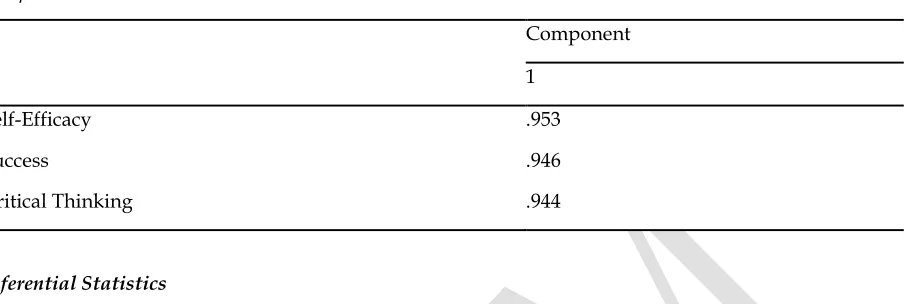
As displayed in Table 6, the critical thinking, teachers’ success and self-efficacy loaded on the extracted factor. These results further supported the results of the regression model as significant relationships between the variables.
Modern Journal of Language Teaching Methods ISSN: 2251-6204
Vol. 6, Issue 7, October 2016
Page 14
Table 6
Component Matrix
Component
1
Self-Efficacy .953
Success .946
Critical Thinking .944
Inferential Statistics
Research Question One: The first research question was an attempt to find if there was any statistically significant relationship between self-efficacy and professional success among EFL teachers in the Iranian context.
A Pearson correlation was run to probe any significant relationship between self-efficacy and professional success among EFL teachers in the Iranian context in order to probe the first research question. As displayed in Table 7 the self-efficacy (r (28) = .52, p = .003, representing a large effect size) had a significant relationships with Iranian EFL teachers’ self-efficacy and professional success. Thus, the first null-hypothesis as “there is no statistically significant relationship between self-efficacy and professional success among EFL teachers in the Iranian context”, was rejected.
Table 7
Pearson Correlations; Teachers’ Success with Self-Efficacy
Success
Self-Efficacy
Pearson Correlation .526**
Sig. (2-tailed) .003
N 30
**. Correlation is significant at the 0.01 level (2-tailed).
Research Question Two: The second research question wanted to find if there was any statistically significant relationship between critical thinking and professional success among EFL teachers in the Iranian context.
A Pearson correlation was run to probe any significant relationship between critical and professional success among EFL teachers in the Iranian context in order to probe the second research question. As displayed in Table 8 the self-efficacy (r (28) = .82, p = .000, representing a large effect size) had a significant relationships with Iranian EFL teachers’ critical thinking and professional success. Thus the second null-hypothesis as “there is no statistically significant relationship between critical thinking and professional success among EFL teachers in the Iranian context”, was rejected.
Modern Journal of Language Teaching Methods ISSN: 2251-6204
Vol. 6, Issue 7, October 2016
Page 15
Table 8
Pearson Correlations; Teachers’ Success with Critical Thinking
Success
Critical Thinking
Pearson Correlation .825**
Sig. (2-tailed) .003
N 30
**. Correlation is significant at the 0.01 level (2-tailed).
Research Question Three: The third research question of the study aimed at checking to what extent the two variables of self-efficacy and critical thinking could predict Iranian EFL teachers’ professional success.
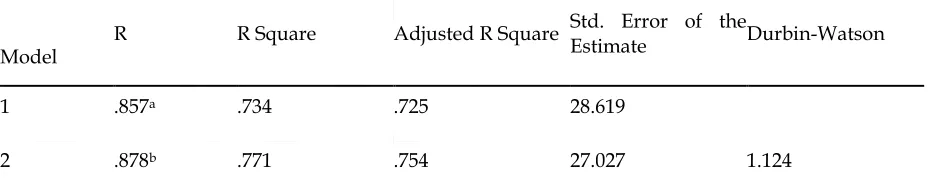
A multiple regression through the stepwise method was run to predict teachers’ success by using the self-efficacy and critical thinking. The teachers’ self-efficacy entered into the regression model on the first step to predict 73.4 percent of their success (R = .857, R2 = .734). The critical thinking entered into the regression model on the second step to increase the percentage of prediction to 77.1 percent (R = .878, R2 = .771).See Table 9 below for more details.
Table 9
Model Summaryc
Model R R Square Adjusted R Square
Std. Error of the
Estimate Durbin-Watson
1 .857a .734 .725 28.619
2 .878b .771 .754 27.027 1.124
a. Predictors: (Constant), SelfEfficacy
b. Predictors: (Constant), SelfEfficacy, CriticalT
c. Dependent Variable: Success
The negligible difference between the R-squared and Adjusted R-squared values (.771 - .754 = .017) indicated that the present results can safely be generalized to the population. The Durbin-Watson (DW) index was 1.12. As noted by Field (2013) DW indices between 1 and 3 are acceptable indicating that there are not any serial correlations between residuals (errors).The results of ANOVA tests of significance of the regression model (Table 10) indicated that the regression models enjoyed statistical significance at first (F (1, 28) = 77.34, p = .000) and second steps (F (2, 27) = 45.55, p = .000).
Modern Journal of Language Teaching Methods ISSN: 2251-6204
Vol. 6, Issue 7, October 2016
Page 16
Table 10
ANOVAaTest of Significance of Regression Model
Model Sum of Squares df Mean Square F Sig.
1
Regression 63346.547 1 63346.547 77.342 .000b
Residual 22933.320 28 819.047
Total 86279.867 29
2
Regression 66557.461 2 33278.730 45.559 .000c
Residual 19722.406 27 730.459
Total 86279.867 29
a. Dependent Variable: Success
b. Predictors: (Constant), Self-Efficacy
c. Predictors: (Constant), Self-Efficacy, Critical T.
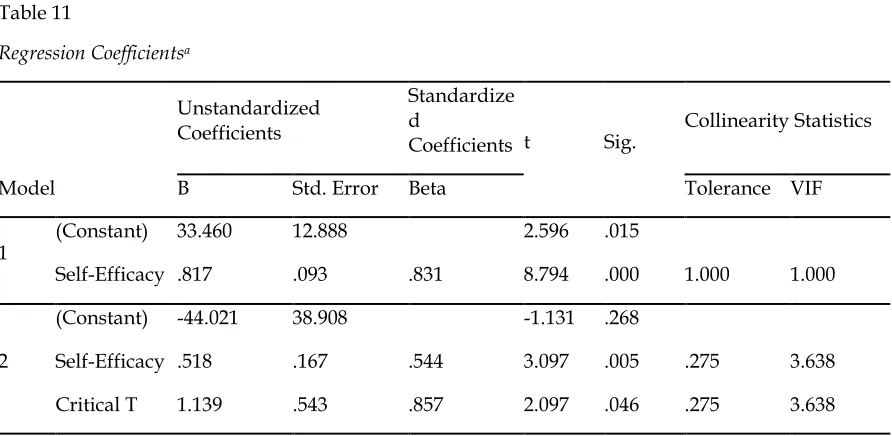
Table 11 displays the regression coefficients (b and beta values) which can be used to build the regression equation. For example, the regression equation for the first step is; Success = 33.460 + (self-efficacy*.817)
Table 11
Regression Coefficientsa
Model
Unstandardized Coefficients
Standardize d
Coefficients t Sig. Collinearity Statistics
B Std. Error Beta Tolerance VIF
1 (Constant) 33.460 12.888 2.596 .015
Self-Efficacy .817 .093 .831 8.794 .000 1.000 1.000
2
(Constant) -44.021 38.908 -1.131 .268
Self-Efficacy .518 .167 .544 3.097 .005 .275 3.638
Critical T 1.139 .543 .857 2.097 .046 .275 3.638
a. Dependent Variable: Success
The regression equation for the second step is; Success = -44.021 + (self-efficacy*.518) + (critical thinking * 1.139). The assumption of non-multicollinearity should be reported when running linear regression. The Value of Tolerance should not be lower than .10 and the value of VIF (Variance inflation rate) should not be higher than 10 to conclude that the assumption is met; as is the case in this study. As
Modern Journal of Language Teaching Methods ISSN: 2251-6204
Vol. 6, Issue 7, October 2016
Page 17
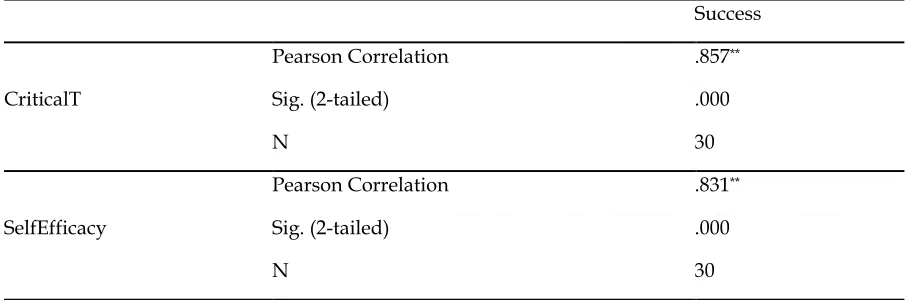
displayed in Table 12 the critical thinking (r (28) = .85, p = .000, representing a large effect size) and self-efficacy (r (28) = .83, p = .000, representing a large effect size) both had significant relationships with teachers’ success.
Table 12
Pearson Correlations; Teachers’ Success with Self-Efficacy and Critical Thinking
Success
CriticalT
Pearson Correlation .857**
Sig. (2-tailed) .000
N 30
SelfEfficacy
Pearson Correlation .831**
Sig. (2-tailed) .000
N 30
**. Correlation is significant at the 0.01 level (2-tailed).
Z-Transformation = .33, p = .370
The Z-transformation formula was used to compare the above mentioned R-values in order to probe which one had a higher contribution to teachers’ success. The results of Z-transformation (Z = .33, p = .370) indicated that critical thinking was a better predictor of teachers’ success when compared to self-efficacy.
Discussion
The findings of the present study revealed that firstly, there was a significant relationship between Iranian EFL teachers’ self-efficacy and professional success. Secondly, it was revealed that there was a significant relationship between Iranian EFL teachers’ critical thinking and professional success. Thirdly, it was revealed that both self-efficacy and critical thinking can relatively predict EFL teachers’ professional success. The results of data analysis also revealed that critical thinking was a better predictor of teachers’ professional success. Hence, critical thinking alone could predict a high percentage of teachers’ success.
The present findings are in line with the results of the previous research on the relationship between CT, self-efficacy, and EFL teachers’ professional success. Wilson, et al. (2004) found that Singapore teachers' personal and general efficacy affected their teaching behaviors. Cheung (2006) who worked on Hong Kong primary in-service teachers found that teachers’ self-efficacy beliefs vastly predicts their likely success in the classroom. Research reports in other settings also has proved the same: Liu, et al. (2007) in Taiwan, Wolters and Daugherty (2007) in America, Penrose, et al. (2007) in Victoria, Canada, Yan (2008) in Hong-Kong and Shanghai, Kotaman (2010) in Turky, and Fives and Loony (2009) in America, all have come to the this conclusion that teachers’ self-efficacy beliefs can highly predict their likely success in the second or foreign language classroom.
Modern Journal of Language Teaching Methods ISSN: 2251-6204
Vol. 6, Issue 7, October 2016
Page 18
Considering the impact of self-efficacy belief as a predicator of EFL teachers’ success, the findings of the present study confirms those of Chacón (2005) who studied the teachers' perceived efficacy among EFL teachers in middle schools in Venezuela.
Among the Iranian researchers, Karrabi (2005) found that English teachers' sense of self-efficacy was an effective factor in teaching grammar and experiencing in the profession. Abednia (2006) also found that EFL teachers' sense of efficacy can influence their success in what they do in the classroom environment. When self-efficacy of the EFL teachers becomes a significant factor in their profession they might find it an indispensable part of their job. As Eslami and Fatahi (2008) found, teachers' sense of self-efficacy highly correlated with their English proficiency and instructional strategies they use as nonnative EFL teachers. Izadinia’s (2008) study also confirmed the previous studies and asserted that EFL teachers’ efficacy and awareness of critical pedagogy in the EFL settings can promote their professional success.
Moafian and Ghanizadeh (2010, 2011) proved the high relationship among EFL teachers in terms of their critical thinking and self-efficacy. Akbari and Moradkhani’s (2010) study also revealed that Iranian English teachers’ self-efficacy could be a good predicator of their success. Of course their study showed that teachers’ experience made a difference among them in this regard. Vaezi and Fallah’s (2011) study, meanwhile, showed high self-efficacy reduces stress among Iranian EFL teachers. Another study by Ghanizadeh and Moafian (2011) revealed a high relationship between Iranian EFL teachers' sense of self-efficacy and their pedagogical success in language institutes. Karimvand (2011)’s study, however, found that Iranian EFL teachers' self-efficacy positively correlated with their teaching experience. It means that teachers’ experience affects their development of self-efficacy. Though it was not sought in the present study, such a concept could be further discussed and researched among Iranian EFL teachers.
Another significant factor which pertains to both findings of the study is the concept of critical thinking. The present study findings revealed that critical thing is a better predicator of EFL teachers’ professional success when compared to self-efficacy belief. This finding is in line with the results of some previous research as follows. The findings of the studies done by Radhakrishnan (2009) and Semeric (2010) also proved that critical thinking could both affect the EFL teachers’ success and be a reliable predicator of their professional success and their learners’ development.
The subsidiary findings of the study revealed that both of the main variables of the study highly correlated with each other and could significantly predict each other as well. This finding is also in line with a lot of research results which have mainly focused on the relationship between critical thinking and self-efficacy among ESL/EFL teachers (Alivandi Vafa, 2005; Jamshidian & Farahani, 2010; Mirzaie, 2008; Sheikhy Behdani, 2009).
Though the participants of the study were both females and males, the gender factor and its effect could be focused on in the present study. Karrabi’s (2005) study which focused on both male and female EFL teachers revealed that English teachers' sense of self-efficacy which played a significant role in better teaching grammar was higher in the male teachers, though some female teachers with high self-efficacy belief were among the successful teachers in this regard.
Unlike the studies reported, Bartlett (2005) found that the EFL teachers could enjoy high self-efficacy and critical thinking in case they were provided with teaching evaluation programs. Jamshidian and Farahani’s (2010) study also revealed that critical thinking ability of the experienced teachers in both genders were almost the same and of course a good predicator of professional success in the foreign language classroom. Confirming the previous findings Karimvand (2011) also found that Iranian EFL teachers' self-efficacy highly and positively correlated with their teaching experience for both genders. In a more recent study, Rahimi and Soryani (2014) who studied the relationship between EFL teachers’ critical thinking skills and vocabulary learning strategy instruction across gender in the Iranian context, came to know that that the negative relationship between male teachers’ inference skills and vocabulary learning instruction was stronger than that of female teachers.
Modern Journal of Language Teaching Methods ISSN: 2251-6204
Vol. 6, Issue 7, October 2016
Page 19
Based on the present study findings, both self-efficacy and critical thinking can help the improvement of EFL teachers’ success in their own profession. The reason might lie in the fact that teachers’ belief in what they do will provide them with the energy and spirit required to do their job more skillfully and find ways to be better teachers. As Bandura (2005) discusses, High self-efficacy beliefs can change the perspective of the teachers towards their own profession.
Critical thinking showed to be a highly critical factor in predicting EFL teachers’ success in the Iranian context. It seems that teachers with high critical thinking ability can perform better in the EFL classrooms based on their students’ views. Barjesteh and Vaseghi (2012) confirmed that critical thinking training for the EFL teachers could pave the way for their successful performance in the classroom. As critical thinking widens the scope of thinking and analyzing phenomenon around, and helps the teachers be more creative (Bessick, 2008), the teachers with high critical thinking are predicted to be more successful.
Implications
According to the results of the present study, some implications for teaching and learning English as a foreign language could be suggested. English teachers, material developers, policy makers in the ELT domain as well as the teacher trainers can be benefitted from the findings of the present study. As based on the present findings, both self-efficacy and critical thinking play significant roles in the teachers’ professionalism, it is suggested that EFL teachers should be checked for their level of self-efficacy and critical thinking as well as for their language proficiency.
Second, the would-be-teachers should be encouraged through the principles of critical thinking and how to enhance their self-efficacy. These will help them to have better performance in their classrooms. It is also suggested that working EFL teachers be exposed to principles of self-efficacy belief in the in-service training programs so as to get familiar with the ways through which they could improve their own abilities in this regard.
Conclusion
To sum up, the findings of the present research revealed a highly positive relationship among self-efficacy, critical thinking and professional success of Iranian EFL teachers. The findings also showed that both self-efficacy belief and critical thinking could be predictors of EFL teachers’ professional success. Meanwhile, the power of critical thinking was higher in this regard. This difference was not highly significant of course and based on the comparison which was made between the results of the present research and findings of previous ones reported in the literature. However as Nikoopour, et al. (2011) stress, critical thinking paves the way for analytical view towards EFL teaching and learning and that is why CT could be a reliable predictor of EFL teachers’’ professional success.
The findings of the study revealed significantly positive relationship among self-efficacy, critical thinking and professional success of Iranian EFL teachers. Also it was found that both self-efficacy and critical thinking could relatively predict EFL teachers’ professional success. As critical thinking alone could predict a high percentage of teachers’ success, the results of data analysis revealed that critical thinking was a better predictor of teachers’ professional success. Theoretically speaking, the present findings are in line with Bandura’s (2001 and 2005) studies indicating that self-efficacy could be a highly reliable predictor of learning within the domain of social cognitive theory. Also, in line with the impact of self-efficacy belief as a predicator of EFL teachers’ success, the findings of the present study confirm those of Chacón (2005), Coronado-Aliegro (2006), Eslami and Fatahi (2008), Izadinia (2008), Moafian and Ghanizadeh (2009), and Ghanizadeh and Moafian (2011) who revealed a high relationship between Iranian EFL teachers' sense of self-efficacy and their pedagogical success in language institutes.
Considering the significance of CT as the predictor of EFL teachers’ professional success, the present findings are in line with a lot of previousely reported research home and abroad ( Baleghizadeh &
Modern Journal of Language Teaching Methods ISSN: 2251-6204
Vol. 6, Issue 7, October 2016
Page 20
Shakouri,2015; Bessick, 2008; Dantas-Whitney, 2002; Fahim & Ahmadian, 2012; Ivie, 2001; Jamshidian & Farahani, 2010; Moafian & Ghanizadeh, 2010; Pishghadam, 2008; Radhakrishnan, 2009; Rahimi & Soryani, 2014; Semeric, 2010;Vaughn, 2008). CT proved to be a better predictor of professional success for the EFL teachers. The present study findings revealed that both female and male EFL teachers mostly rely on their critical thinking rather than their self-efficacy belief in becoming a successful EFL teacher. This is of course in line with Bartlett’s (2005) findings thermalizing that EFL teachers could enjoy high self-efficacy and critical thinking in case they are provided with related training. Jamshidian and Farahani’s (2010), Karimvand (2011) and in a more recent study, Rahimi and Soryani (2014) have also confirmed the same.
REFERENCES
Abednia, A. (2006). Developing a language teachers' sense of efficacy scale. (Unpublished MA thesis). Tarbiat-Modarres University, Tehran, Iran.
Akbari, R., & Moradkhani, S. (2010). Iranian English teachers’ self-efficacy: Do academic degree and experience make a difference? Pazhuhesh-e Zabanha-ye Khareji, 56(2), 25-47.
Alivandi Vafa, M. (2005). On investigating the relationship between critical thinking and Tabriz University students’ critical achievement. (Unpublished MA thesis). Az-Zahra University, Tehran, Iran.
Allinder, R. M. (1994). The relationship between efficacy and the instructional practices of special education teachers and consultants. Teacher Education and Special Education, 17(2),86-95.
Anderson, R., Greene, M., & Loewen, P. (1988). Relationships among teachers’ and students’ thinking skills, sense of efficacy, and student achievement. Alberta Journal of Educational Research, 34(2), 148-165.
Ashton, P. T., & Webb, R. B. (1986). Making a difference: Teachers’ sense of efficacy and student achievement.
New York: Longman.
Baleghizadeh, S., & Shakouri, M. (2015). Investigating the relationship between teaching styles and teacher self-
efficacy among some Iranian ESP university instructors. Innovations in Education and Teaching International,
2(1), 1-9.
Bandura, A. (1977). Self-efficacy: Toward a unifying theory of behavioral change. Psychological Review, 84(2), 191-215.
Bandura, A. (1997). Self-efficacy: The exercise of control. New York: W. H. Freeman and Company.
Bandura, A. (2001). Social cognitive theory: An agentic perspective. Annual Review Psychology, 52(1), 1-26.
Bandura, A. (2005). Adolescent development from an agentic perspective. In F, Pajares & T. Urdan (Eds.),
Self-efficacy beliefs ofadolescents (pp.1-43). Greenwich, CT: Information Age Publishing.
Barjesteh, H., & Vaseghi, R. (2012). Acculturation model for L2 acquisition: Review and evaluation.
Advances in Asian Social Science, 2(4), 579-584.
Bartlett, A. (2005). She seems nice: Teaching evaluations and gender trouble. Feminist Teacher, 15(3),
195-202.
Bessick, S. C. (2008). Improved critical thinking skills as a result of direct instruction and their relationship to academic achievement (Unpublished PhD Dissertation). US: Indiana University of Pennsylvania. US.
Birjandi, P., & Bagherkazemi, M. (2010). The relationship between Iranian EFL teachers’ critical thinking ability and their professional success. English Language Teaching, 3(2), 135-145.
Chacón, C. (2005). Teachers' perceived efficacy among English as a foreign language teachers in middle schools in Venezuela. Teaching and TeacherEducation, 21(2), 257-272.
Cheung, H. Y. (2006). The measurement of teacher efficacy: Hong Kong primary in-service teachers.
Journal of Education for Teaching, 32(4), 435-451.
Coronado-Aliegro, J. (2006). The effect of self-assessment on the self-efficacy of students studying Spanish as a foreign language. Unpublished PhD dissertation, University of Pittsburgh, Pittsburgh, Germany.
Dantas-Whitney, M. (2002). Critical reflection in the second language classroom through audiotaped journals. System, 30(2), 543-555.
Modern Journal of Language Teaching Methods ISSN: 2251-6204
Vol. 6, Issue 7, October 2016
Page 21
Eslami, Z. R., & Fatahi, A. (2008). Teachers' sense of self-efficacy, English proficiency, and instructional strategies: A study of nonnative EFL teachers in Iran. TESL-EJ, 11(4), 1-19.
Fahim, M., & Ahmadian, M. (2012). Critical thinking and Iranian EFL context. Journal of language teaching
and research, 3(4), 793-800.
Filed, A. (2013). Discovering statistics using IBM SPSS, statistics for statistics (4th ed.). London: SAGE Publications.
Fives, H., & Loony, L. (2009). College instructors' sense of teaching and collective efficacy. Teaching and Learning in Higher Education, 20(2), 182-191.
Ghanizadeh, A., & Moafian, F. (2011). The relationship between Iranian EFL teachers' sense of self-efficacy and their pedagogical success in language institutes. Asian EFL Journal, 13(2), 249-272.
Gibson, S., & Dembo, M. (1984). Teacher efficacy: A construct validation. Journal of Educational Psychology, 76(2), 569-582.
Hashemi, M. (2008). On the role of teachers’ emotional intelligence on their pedagogical success (Unpublished M.A. Thesis). Allame Tabataba’I University, Tehran, Iran. Haskvitz A. (2007). Eleven Traits of a Good Teacher.
Houman, H. (2005). Estenbate amari dar oloume raftari (Statistical analysis in behavioral sciences).Tehran: SAMT
Publications.
Hoy, W. K. (1996). The organizational climate of middle schools. Journal of Educational Administration, 34(1), 41-59.
Ivie, S. D. (2001). Metaphor: A model for teaching critical thinking. Contemporary Education, 72(1), 18-23.
Izadinia, M. (2008). A study on teacher efficacy and awareness of critical pedagogy in EFL (Unpublished MA
thesis). Al-Zahra University, Tehran, Iran.
Jamshidian, T., & Farahani, A. (2010). Relationship between level of critical thinking and nativeness, age and gender. Pazhuhesh-e Zabanha-ye Khareji, 55(2), 71-86.
Karimvand, P. (2011). The nexus between Iranian EFL teachers' self-efficacy, teaching experience and gender. English Language Teaching, 4(3), 171-183.
Karrabi, M. (2005). English teachers' sense of self-efficacy in teaching grammar and their personality types, gender, and experience in the profession (Unpublished MA thesis). University for Teacher Education, Tehran, Iran.
Kotaman, H. (2010). Turkish early childhood educators’ sense of teacher efficacy. Electronic Journal of Research in Educational Psychology, 8(2), 603-616.
Liu, C., Michael, B., & Lin, H. (2007). Taiwan elementary teachers’ views of science teaching self-efficacy and outcome expectations. International Journal of Science and Mathematics Education, 6(4), 19-35.
Midgley, C., Feldlaufer, H., & Eccles, J. (1989). Change in teacher efficacy and student self- and task-related beliefs in mathematics during the transition to junior high school. Journal of Educational Psychology, 81(2),247-258.
Mirzaie, Z. (2008). The relationship between critical thinking and lexical inferences of Iranian EFL learners
(Unpublished master's thesis). Islamic Azad University, Science and Research Campus, Tehran, Iran. Moafian, F., & Ghanizadeh, A. (2009). The relationship between Iranian EFL teachers’ emotional intelligence and
their self-efficacy in language institutes. System, 37(4), 708-718.
Moafian, F., & Pishghadam, R. (2009). Construct validation of a questionnaire on characteristic successful Iranian
EFL teachers. Pazhuhesh-e Zabanha-ye Kharej, 64(2), 27-36.
Moafian, F., & Ghanizadeh, A. (2010, February). Critical thinking and self-efficacy:Investigating the relationship
among EFL teachers (Paper presented at The Second Postgraduate Conference). University of Isfahan, Isfahan, Iran.
Moafian, F., & Ghanizadeh, A. (2011). A correlational analysis of EFL university students' critical thinking and self-efficacy. The Journal of Teaching Language Skills (JTLS), 3(1),119-149.
Modern Journal of Language Teaching Methods ISSN: 2251-6204
Vol. 6, Issue 7, October 2016
Page 22
Nikoopour, J., Amini Farsani, M., & Nasiri, M. (2011). On the relationship between critical thinking and language learning strategies among Iranian EFL learners. Journal of Technology & Education, 5(3), 195-200.
Norton, M. S. (1998). Teacher absenteeism: A growing dilemma in education. Contemporary Education,
69(2), 95-99.
Penrose, A., Perry, A., & Ball, I. (2007). Emotional intelligence and teacher self-efficacy: The contribution of teacher status and length of experience. Educational Research, 17(1), 107-125.
Pishghadam, R., & Moafian, F. (2007). The role of high school teachers’ multiple intelligences in their teaching success. Foreign Languages ResearchQuarterly, 42(1), 22-35.
Radhakrishnan, C. (2009). Critical thinking and practical strategies to promote it in classroom.
Rahimi, M., & Soryani, M. (2014). The relationship between EFL teachers’ critical thinking skills and vocabulary learning strategy instruction across gender. International Journal of Applied Linguistics and English Literature, 3(1), 107-114.
Samimy, K. & Brutt-Griffler, J. (1999). To be a native or nonnative speaker: Perceptions of nonnative speaking students in a graduate TESOL program. In G. Braine (Ed.), Non-native educators in English language teaching (pp. 127-144). Mahwah, NJ: Erlbaum.
Semeric, N. (2010). The relationship between self-leadership and critical thinking. African Journal of Business Management, 4(8), 1639-1643.
Sheikhy Behdani, R. (2009). The relationship between autonomy, critical thinking ability, and reading comprehension of the Iranian EFL learners. (Unpublished master's thesis). Islamic Azad University, Science and Research Campus, Tehran, Iran.
Stein, M. K., & Wang, M. C. (1988). Teacher development and school improvement: The process of teacher change. Teaching and Teacher Education, 4(4), 171-187.
Tschannen-Moran, M., & Hoy, W. A. (2001). Teacher efficacy: Capturing an elusive construct. Teaching and Teacher Education, 17(2), 783-805.
Vaezi, S., & Fallah, N. (2011).The relationship between self-efficacy and stress among Iranian EFL teachers. Journal of Language Teaching and Research. 5(2), 1168-1174.
Vaughn, L. (2008). The power of critical thinking: Effective reasoning about ordinary and extraordinary claims
(2nded.).Oxford: Oxford University Press.
Wilson, P., Tan, G., & Chin I. (2004). Singapore teachers' personal and general efficacy for teaching primary social studies. International Research in Geographical and Environmental Education, 13(3), 209-222. Wolters, C. A.,& Daugherty, S. G. (2007).Goal structures and teachers’ sense of efficacy: Their relation and association to teacher experience and academic level. Journal of Educational Psychology, 99(2),181-193. Wong, M. S. L. (2005). Language learning strategies and language self-efficacy: Investigating the relationship in Malaysia. ERLC Journal,36(4), 245-271.
Yan, H. (2008). Teacher efficacy: a comparative study of Hong-Kong and Shanghai primary in-service teachers. The
Australian Educational Researcher, 35(1), 103-123.
Modern Journal of Language Teaching Methods ISSN: 2251-6204
Vol. 6, Issue 7, October 2016
Page 23
THE IMPACT OF TEACHER-MADE GAMES VS.
CONVENTIONAL GAMES ON IRANIAN CHILDREN’S
LEARNING AND RETENTION OF ENGLISH VOCABULARY
Mahboub Mellati1
Department of English Language, Rasht Branch, Islamic Azad University, Rasht, Iran
Arash Saharkhiz Arabani2*
Department of English Language, Rasht Branch, Islamic Azad University, Rasht, Iran
Majid Pourmohammadi3
Department of English Language, Rasht Branch, Islamic Azad University, Rasht, Iran
ABSTRACT
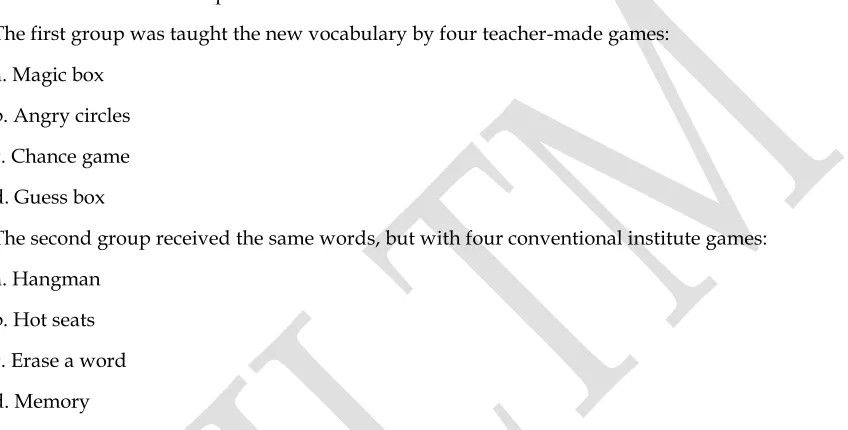
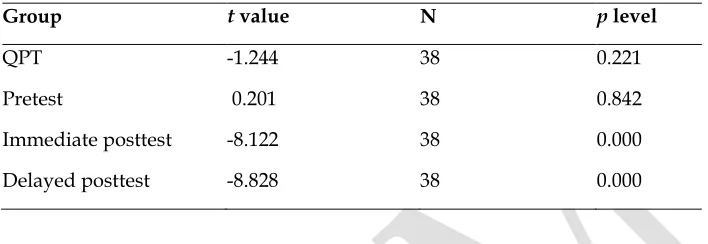
TEACHING ENGLISH THROUGH PLAYING GAMES IS POPULAR IN MANY INSTITUTES. TEACHERS USE DIFFERENT KINDS OF GAMES TO TEACH NEW VOCABULARY. THE PRESENT STUDY AIMS AT INVESTIGATING THE EFFECT OF USING TEACHER-MADE GAMES VS. CONVENTIONAL GAMES ON IRANIAN CHILDREN’S LEARNING AND RETENTION OF ENGLISH VOCABULARY. TO ENSURE THE HOMOGENEITY OF THE PARTICIPANTS QUICK PLACEMENT TEST WAS ADMINISTERED TO 60 LEARNERS. THEN 40 PARTICIPANTS WHOSE SCORES WERE BETWEEN ONE AND FIFTEEN WERE SELECTED AS THE PARTICIPANTS AND WERE RANDOMLY DIVIDED INTO TWO GROUPS. A VOCABULARY PRETEST WAS ADMINISTERED TO THE PARTICIPANTS BEFORE STARTING THE TREATMENT. DURING THE FOUR SESSIONS OF TREATMENT, TWENTY VOCABULARY ITEMS WERE INSTRUCTED TO THE TWO GROUPS. FOUR DIFFERENT TEACHER-MADE GAMES WERE CONSIDERED FOR THE EXPERIMENTAL GROUP, AND FOUR CONVENTIONAL GAMES WERE CONSIDERED FOR THE CONTROL GROUP. AFTERWARD, A VOCABULARY IMMEDIATE POSTTEST WAS ADMINISTERED. IN ORDER TO SEE THE POSSIBLE EFFECT OF TEACHER-MADE GAMES ON THE LEARNERS' ABILITY TO RECALL THE VOCABULARY ITEMS, A DELAYED POSTTEST WAS ALSO ADMINISTERED THREE WEEKS LATER, AND ALL THE COLLECTED DATA WERE ANALYZED THROUGH SPSS. THE RESULTS REVEALED THAT THE LEARNERS IN THE EXPERIMENTAL GROUP OUTPERFORMED THOSE IN THE CONTROL GROUP. HENCE, IT IS SUGGESTED THAT USING TEACHER-MADE GAMES CAN MORE EFFECTIVELY IMPROVE LEARNERS' ABILITY TO LEARN AND RECALL VOCABULARY.
KEY WORDS: EFL LEARNER, RETENTION, VOCABULARY, GAME
1. Introduction
Games have a crucial part in teaching unknown vocabulary. Based on Huyen and Nga (2003), they turn the learning atmosphere into a place full of fun together with competition, where students are eager to learn new things, and they will bring real-world context into the classroom.
1
[email protected]
2
* Corresponding author: [email protected]
3
Modern Journal of Language Teaching Methods ISSN: 2251-6204
Vol. 6, Issue 7, October 2016
Page 24
Games are made of sets of rules, and they can help teachers and students to apply them in the class, and no one crosses the border.
Language learning is a hard work, and it takes time since mind can acquire it slowly, so students should try many times to learn it. They may use different techniques to memorize it.
Although playing games can help students learn better, it is time-consuming, and it can be difficult for teachers to spend the class time for playing games, and at the same time control the classroom. Furthermore, most teachers are not familiar with this strategy for teaching; they may find it too challenging since they have to explain the rules of the games in English, which may not be understandable to EFL kids, and since teachers should pay attention to kids' personalities and cultures. Some of them are introverted students and hence reluctant to have a part in the games.
There are some famous vocabulary games such as Hangman, Role-play, Unscramble words, Board games. These kinds of games come from other countries, and they are not designed for the specific culture, so they bring some difficulties for both teachers and students, but teachers can reduce most of these problems by inventing new games.
2. Literature Review
Games have an old history which is divided into two basic periods: before and after the 19th century. Based on El-Shamy (2001), at first games were just some physical activities, which were related to a specific occasion such as religious rituals, celebrations and festivals. After the 19th century, the European people tried to modify some of their games’ rules to fit with American tastes, because they thought them as a waste of time. From that period, games started to be used for educational purposes. The first game that had this goal was Mansion of Happiness the goal of which was to teach the differences between the good and bad to children. From that time, games continued to change until the time they turned to being a tool for training.
According to Krashen (2004), by using a list of vocabulary items students can learn thousands of vocabulary items, but it might be a discouraging prospect for students who find this method tedious. While explicit learning can be boring for some students according to him, explicit learning is enjoyable for new learners because they can learn words through conversation or in a game, but the process of learning is very slow, and it makes the situation hard for some learners who are hesitant to expose their experience to a native speaker. But by using games in small groups inside a class they can talk with their peers so their knowledge can be nearly the same, and they can understand each other, a fact which gives them positive feelings to continue their study. Students can enjoy learning and problem solving through games, since they are word-learning wizards and they can remember how a problem can be solved and through this way, games challenge their mind. Since games questions start from easy to hard, it can specify students' knowledge. McGonigal (2011) had the same idea and pointed out that problem solving can be fun for students, because learning is situated and occurs through a process of hypothesizing and reflecting upon the stimulated word within the game.
During the teaching process a lot of words can be taught by the teacher and games can help students to transfer them from their short-term memory to long-term memory and recall them whenever they are needed. Curtiss (2005) had the same idea and stated that when teachers are using games to teach vocabulary, it is not important that how many words they want to transfer, because games can make learners' mind ready, motivate them and pave the way for their learning.
Aslanabadi and Rasouli (2013) conducted a study on the effect of games on the improvement of Iranian EFL vocabulary knowledge in kindergartens. The aim of their study was to find a way to help young EFL learners fix the novel vocabulary in their minds. The study was conducted at two kindergartens. They divided the students into the experimental and control group. The experimental group was given an
Modern Journal of Language Teaching Methods ISSN: 2251-6204
Vol. 6, Issue 7, October 2016
Page 25
online language teaching game and the control group was given a regular teaching. The result of their study revealed that games not only bring fun for learners in the class, but also they motivate learners and improve their confidence.
Kupeckova (2010) stated that there are various kinds of games such as recreational, pedagogical and therapeutic. Recreational games are just for fun and enjoyment, while therapeutic games diagnose or cure a problem in psychology. The pedagogical game is a kind of game that is used for an educational purpose, and the student can attend it and communicate with others.
Using games in the class is a trend to change the teacher-dominated class into a student-centered one or bring a situation in which both can participate in. Jones (2004) stated that games are very important. Therefore, language learners should not pay attention to the drills and memorization of language rule. They must involve a student in the process of learning and minimize the interference of the teacher. Allen (2004) stated that whenever students are active learners, they will automatically learn the language because they feel they are a part of what is going on. The teacher-centered class has problems since they think learners are passive, and they should pour knowledge into their mind. He also mentioned that games challenge students’ past and new information. They cause students to make a mistake, to learn, but they should not be corrected by the teacher, because they can be bored with being corrected by the teacher several times.
Based on Bell (2009), by using games teachers can create a different context in which students can communicate, exchange information and express their own opinions. Many scholars agree that learning will happen as a result of learners' interest and motivation, and if it doesn’t target their needs, it will not be successful. Haynes & Zacarian (2010) for example, highlighted the importance of creating enjoyment in class and believed that an entertaining situation can prevent the obligation feeling.
According to Foreman (2003), using games in the class is an excellent idea for students to practice new vocabulary since they have time to practice them without the risk of failure, there is the element of an information gap between teammates, and it can engage every one of the students, and they are responsible for the point. In a game, two humans’ skills can combine together, which are physical and mental powers. Playing games can teach them how to consider alternatives. It makes the class a different place in which learning is the central point. Students can share their information about vocabulary through communication.
Vocabulary games are special because they challenge students and make them work together so they can memorize them faster. Tuan (2012) overemphasized game's power and stated that it can facilitate meaningful learning, because there is not any sense of fear and humiliation so students are free to make different sentences by using new vocabulary. Ersoz (2005) believed that knowing how to teach a new word is not the key to successful learning. He emphasized that the best lesson may fail since students can learn things when they think them as a useful tool for their real life. Therefore, it is worth looking for ways to teach better and use games, which bring fun to the class environment. Orlick (2006) had the same point of view and stated that a teacher can attract students by providing activities that are communicative, pleasant, safe and non-threatening as well as meaningful and challenging. These kinds of games lead to students’ self-confidence, learning satisfaction and communication among learners.
Games have a long history in school and they started by using paper cards to teach vocabulary, which could make the students eager to learn. Games are often difficult to be used in a formal situation like the class, but as Nielsen (2006) stated, students can learn and remember new words faster through games. Kids’ teachers are more eager to use a game for teaching vocabulary and there is an old connection between vocabulary learning and games, to some extent; it is derived from communication approaches to language teaching and learning. Peterson (2010) stated that there is a common point about games and language learning in the sense that both try to make a situation where students learn and memorize the
Modern Journal of Language Teaching Methods ISSN: 2251-6204
Vol. 6, Issue 7, October 2016
Page 26
new lesson. He pointed out that one of these games can be role-play games, which make learners use the language for meaningful communication with others.
According to Pound (2005), games create a situation which has been called heads-on, minds-on, which allow students to focus on games and learn new words. Serious games allow them to think about a solution to answer a vocabulary question and also let them feel the tension of crises, which can challenge all their skills. It is a way to strengthening the awareness.
Pavicic (2008) stated that EFL learners need to discuss things which they are learning, they can recycle vocabulary that they just learned, and also they can transfer their knowledge. Playing games have a crucial role in learning and recycling a word. A teacher should be aware of these values and give them time to consult about the games' answer with each other.
According to Bradley, Rystedt and Lindstrm (2010), there are a lot of reasons that a teacher should use vocabulary games. First of all, they are fun; they help a teacher to motivate students and turn them from
passive students to active ones.Second, it can help them to participate willingly, build relationships and
feel equal. It can also help teachers to create a friendly and positive atmosphere where the chair arrangement can differ from game to game, and this causes a different class. Third, the reason which people want to learn a second language is to use it in real life, communicate with others and transfer their knowledge. Games are good tools for these goals since, a teacher can create different situations, and students can practice words in a different context. Fourth, students need to be emotionally involved. A game can bring strong emotions, like happiness, excitement, amusement and suspense, which allow them to feel positive about their learning situation. Fifth, games are good for introverted students and those with low confidence, and it can show itself when they play in small groups, because they can have a chance to speak in front of a few people rather than the whole class. It is sometimes easier to forget anxiety when playing a game, because the atmosphere is not that much serious, and grammar is not important. Sixth, the school system is too boring for young learners, and it is always based on teachers, but games bring variety and make the students feel these differences. Teachers need to think about games and their benefits for students, and they must preplan for them.
Iran Dolati and Mikaili (2011), for instance, examined the effects of games on facilitating students’ vocabulary learning. The purpose of their study was to gain information about the role of games in the area of vocabulary learning among students. The participants of their study were 70 female students in the age of 12 to 13 years old, who were selected from one of the Iranian primary schools in Iran. By analyzing the pretest and posttest, they found that applying games has a significant role in teaching vocabulary to language learners. They also found that games can motivate and engage learners especially the introverted and passive ones in the whole learning process.
Muhanna (2012) stated that from time to time games do craft setbacks for both the teachers and learners since they will not be effective unless the teacher clarifies the task engaging the games. According to Vossoughi and Zargar (2009), games not only encourage learners to participate in class activity, but also help them in vocabulary development. Karpicke (2009) pointed out that games can help students mind to work properly and hard in order to answer the games’ question.
A teacher should keep in mind that learning is a broad area and teaching every word by pictures is impossible, because some words are abstract, like freedom, which cannot be felt or shown by pictures. It is true that teachers can use pictures to teach better, but still they may have some problems with abstract words, so they can use different kinds of games like role play to reach their goal.
Teachers must consider when to use games, which of them are useful and how to use them appropriately in order to meet both students’ needs and lesson objectives. Unfortunately, some teachers may neglect their usefulness, but as Wright, Betteridge, and Buckby (2005) stated games should be seen as meaningful practice of language, which can be exploited as follow-ups of the present teaching material in order to
Modern Journal of Language Teaching Methods ISSN: 2251-6204
Vol. 6, Issue 7, October 2016
Page 27
practice and reinforce the required skills, knowledge. Also, for revising and recycling already acquired skills and knowledge, it can act as a tool for discovering students’ weaknesses in their language proficiency. Ge (2012) stated that choosing and using an educational game is very hard for teachers. They should keep in their mind that some issues like the number of students, proficiency, cultural context, timing, and learning topic