A Hybrid Method for Solving Optimal Control
Problems
Mohammad Keyanpour, Ali Mahmoudi
Abstract—This paper presents a numerical technique for solving optimal control problems. Control variables are se-ries constructed by Legendre polynomials. In this technique state variables are computed in terms of control variables by implementing Decomposition Method. Performance index is transformed by replacing new control and state variables. The system dynamics and the performance index are converted into some algebraic equations. Then the optimal control problem is reduced to constrained classical optimization problem. To show the efficiency of the purposed technique results and comparisons are given at the end of this paper. Also optimal state trajectory and optimal control policy graphs are included.
Index Terms—Legendre polynomials, Decomposition method, Optimal control problems, Optimization.
I. INTRODUCTION
A
T the large number of problems arising in analysis, mechanics, geometry, and so forth, it is necessary to determine the maximal and minimal of a certain functional. Because of the important role of this subject in science and engineering, considerable attentions has been received on this kind of problems. It is well known that generally optimal control problems are difficult to solve. Particularly, their analytical solutions are in many cases out of the question. To overcome this difficulty numerical methods are purposed for solving many of these real world problems. Numerical methods for solving optimal control problems dated back nearly six decades. From that time to the present, the complexity of methods and corresponding complexity and variety of applications has increased tremendously making optimal control a discipline that is relevant to many branches of engineering. There are various numerical approaches for solving optimal control problems (for instance see [1], [2], [3]) In recent years, considerable attentions have been given to the use of spectral methods for solving nonlinear problems. The approach, known as the spectral method [4] is based on converting the differential equations into an integral equation through integration. The state and/or control involved in the equation are approximated by finite terms of orthogonal series and using an operational matrix of integration to eliminate the integral operations. At the beginning in [5] A numerical technique for solving nonlinear optimal control problems is introduced. The state and control variables are expanded in the Chebyshev series, and an algorithm is provided for approximating the system dynamics, bound-ary conditions, and performance index. Application of thisManuscript received April, 2010; revised May 9, 2012.
Mohammad Keyanpour is with the Department of Applied Mathematics, University of Guilan, Rasht, Iran.
e-mail: ([email protected]).
Ali Mahmoudi from Department of Applied Mathematics, Faculty of Mathematical Science, University of Guilan, Rasht, Iran.
e-mail: ([email protected]).
method results in the transformation of differential and inte-gral expressions into systems of algebraic or transcendental expressions in the Chebyshev coefficients. In [6] for directly solving a generic optimal control problem with state and control constraints Chebyshev pseudospectral method are implemented, This method employs N’th degree Lagrange polynomial approximations for the state and control variables with the values of these variables at the Chebyshev-Gauss-Lobatto points as the expansion coefficients. This process yields a Nonlinear Programming Problem (NLP) with the state and control values at the CGL points as unknown NLP parameters.
In [7] an alternative computational method presented for solving the controlled Duffing oscillator. The approach is a spectral method in which we approximate the control and state variables by Chebyshev series. An explicit formula for the Chebyshev polynomials in terms of arbitrary order of their derivatives is used to convert the system dynamics into an algebraic equation.
In [8] the usage of orthogonal polynomials for obtaining an analytical approximate solution to optimal control problems with a weighed quadratic cost function is proposed. The method consists of using the orthogonal polynomials for the expansion of the state variables and the control signal. And in [9] wavelet functions are utilized instead of orthogonal polynomials.
In the present paper normalized Legendre polynomials are used for constructing control variables, but state variables obtained in different manner, here we compute state variables employing Decomposition Method, afterwards control and state variables are replaced in objective function, considering control and state constraints, former optimal control problem converted into classical optimization problem. Optimizing obtained performance index, parameters which give us state trajectory and control policy, could be calculated.
The paper is organized as follows: In Section 2, Decom-position Method and Legendre orthogonal polynomials are reviewed. In Section 3, the problem is formulated. Section 4, purposed method is presented and in Section 5, convergency of the method is discussed, finally in section 6 Numerical examples are expressed.
A. Preliminaries
B. Legendre polynomials
The definition of orthogonal polynomials {φj(t)} and some of their features are presented below:
∫ b
a
w(t)φi(t)φj(t)dt= {
δi i=j 0 i̸=j
In whichW(t)is the weight function.
The expansion of an arbitrary function f(t) on the closed
IAENG International Journal of Applied Mathematics, 42:2, IJAM_42_2_02
interval [0, tf] is as follows:
f(t) = N ∑
i=0
Ciφi(t)
In which:
Ci= 1
δi ∫ tf
0
tkf(t)φi(t)dt
An important property of orthogonal polynomials presented
in [10] is ∫
φ(t) =kφ(t)
And ∫
tf
0
P PT dt=γ
where
P(t) = [P0, P1, . . . , Pn] T
γ=diag[γ0, γ1, . . . , γn]
γi= ∫ tf
0
Pi2(t) dt
In the linear space of all polynomials, with the inner product
⟨x, y⟩= ∫ 1
−1
x(t)y(t)dt
consider the infinite sequence x0, x1, x2, . . . where x(t) =
tn. When the orthogonalization theorem is applied to this sequence it yields another sequence of polynomials
y0, y1, y2, . . .first encountered by the French mathematician A. M. Legendre(1752-1833) in his work on potential theory. The first few polynomials are easily calculated by the Gram-Schmidt process.
y0(t) = 1
y1(t) =t
y2(t) = 1 2 (
3t2−1) .
.
.
The polynomials in the corresponding orthonormal sequence are given by
P0(t) = √
1 2
P1(t) = √
3 2t
P2(t) = 1 2
√ 5 2(3t
2−1)
P3(t) = 1 2
√ 7 2(5t
3−3t)
.
.
.
given by Pn = yn/∥yn∥ are called normalized Legendre polynomials. Legendre polynomials are categorized as the Ja-cobi orthogonal polynomials whose interval of orthogonality is[−1,1].
C. Decomposition Method
In what follows Adomian’s Decomposition Method for solving Initial Value Problems (IVP-s) is briefly introduced. For more details see [11] and [12]. Consider the following ODE modelling a dynamical system via independent variable
t,F(x(t)) =g(t)withx(0) =a;
Here F represents a general nonlinear ordinary differential operator involves both linear and nonlinear parts, in which linear part is decomposed as L+R, so that L is easily invertible andRremainder of the linear operator. For conve-nience,Lmay be taken as the highest order derivative whose inverse does not involve difficult integrations that results when complicated Green’s functions are involved. Thus the above equation may be written as
Lx+Rx+N x=g(t)
where N u representing the nonlinear terms. Solving for above equation forLu, we have
Lx=g−Rx−N x
Since L is invertible, an equivalent form of the above equation is
L−1Lx=L−1g−L−1Rx−L−1N x
If this corresponds to an IVP, the integral operator L−1 may be regarded as definite integration from0 tos. Former equation yields
x=a+L−1g−L−1Rx−L−1N x (1) The nonlinear termN u is now approximated by ∑∞k=0Ak whereAk are special polynomials to be further elaborated. Thus we have the identity
N x(t) =
∞
∑
i=0
Ai(A0, A1, . . . , Ai)
Moreover,xis decomposed as∑∞k=0xkwithx0identified asa+L−1g(considering our purpose, we getL−1as one fold integration) accordingly, the above equation can be written as
∞
∑
k=0
xk=x0−L−1R
∞
∑
k=0
xk−L−1
∞
∑
k=0
Ak
Consequently, we may readily derive the following set of equations
x1=−L−1Rx0−L−1A0
x2=−L−1Rx1−L−1A1
. (2)
.
IAENG International Journal of Applied Mathematics, 42:2, IJAM_42_2_02
.
xk+1=−L−1Rxk−L−1Ak
Note that the polynomialsAk are generated for each nonlin-ear termN usuch thatA0 depends only onx0;A1 depends only on x0 andx1 ; A2 depends onx0, x1 andx2, and so forth, i.e. Adomian’s polynomials are A0(x0) , A1(x0, x1) ,A2(x0, x1, x2),. . .so the components xk are computable for allk≥0, and thus one computesx=∑∞k=0xk. It is well known that the series ∑∞k=0Ak are generalized Taylor series forf(x0); i.e. ∑∞k=0xk is a functional Taylor series about the functionx0, and that the terms in the series approach zero with 1/(mk)! (see [13]), where mis highest order of differentiation in the linear differential operator. Since the series converges and does so very rapidly. k term partial sum Sk =
∑k−1
i=0 xk may serve as a prac-tical solution for a rather small k and we naturally have limk→∞Sk =x. It is important to emphasize thatAk are readily computable for complicated nonlinearities of the form
f(x,x,˙ x, . . .¨ ) or f(g(x)). Since the solutions are analytic (and verifiable by substitution), we can have insights into how the solution evolves. Let ˆg = L−1g. Taylor series expansion ofgˆwith respect to τ= 0is
ˆ
g(τ) = ˆg(t0) +
dˆg dττ+
dˆg2 dτ2
τ2 2! +. . .
Thus the first series term is modified as x0 =a+ ˆg(t0) The other series terms (see (2)) are
xk+1=
dgˆk
dτk τk
k! −L
−1Rx
k−L−1Ak , k= 1,2, . . .
Then the solution (valid over the ith interval) is obtained as summation ofxk for k= 0,1,2, . . .. Herea=x(t0).
II. PROBLEM STATEMENT
We deal with the optimal control problem in which the optimal solution satisfies ordinary differential equation on the fixed time interval I:= [t0, tf] together with initial and final conditions while optimizes (i.e. maximize or minimize) performance index. in other word we want to find control function to optimize
J = ∫ tf
t0
f0(t, x(t), u(t))dt (3) subject to:
˙
x=f(t, x(t), u(t)) (4) and
x(0) =x0, Gx(tf) =x1 (5) Where x(t) = [x1, x2, x3, . . . , xn]
T
∈ Hn and u(t) = [u1, u2, u3, . . . , uk]
T
∈Hkare respectively, state and control vectors .x0∈Hn, x1∈Hlare given vectors, andGisl×n
matrix. f0:Hm+n+1 →H is supposed to be a continuous function.
The aim of control theory is to find a control u such that performance index (3) gets it’s optimum value.
III. METHOD OF THE SOLUTION
Since Legendre polynomials are defined on the time inter-val [−1,1], it is necessary to transform the time variable t
in the optimal control problem from the time interval[0, tf] -for simplicity and without losing generality we gett0= 0-into the the time interval[−1,1]. This transformation can be achieved by
τ =2t
tf −
1 (6)
formula (6) transforms the optimal control problem (3)-(5) into the problem of minimizing
J =tf 2
∫ 1
−1
f0(t, x(t), u(t))dτ (7)
Subject to:
dx dτ =
tf
2f(τ, x(τ), u(τ)) (8)
x(−1) = x0, Gx(1) = x1 (9)
WhereGis a non zerol×n matrix.
Let us approximate control function by normalized Legendre polynomials:
u(τ) = k ∑
i=0
ciPi(τ) (10)
WherePi(τ)i= 1,2,3. . .is normalized Legendre polyno-mials and ci ∈ ℜ, i = 1,2,3. . . are coefficients must be obtained as solutions of transformed optimization problem. Replacing (10) into (8), and supposing that coefficients
c0, c1, . . . , ckare constant, the following system of Ordinary Differential Equation (ODE) is acquired;
dx dτ =
tf
2f(τ, x(τ), k ∑
i=0
ciPi(τ))
subject to
x(−1) =x0
(11)
In the followind IVP (11), is solved using Decomposi-tion method introduced in previous secDecomposi-tion, as a result state variable x is obtained as a function in terms of
c0, c1, c2, . . . , ck, τ indeed one can write;
x=ψ(c0, c1, c2, . . . , ck, τ)
What remains is replacing x, and u by
ψ(c0, c1, c2, . . . , ck, τ) and ∑k
i=0ciPi(τ) respectively, through (7);
J = tf 2
∫ 1
−1
F(c0, c1, c2, . . . , ck, τ))dτ (12)
After integration, (12) can be rewritten in the following format:
IAENG International Journal of Applied Mathematics, 42:2, IJAM_42_2_02
J =φ(c0, c1, c2, . . . , ck, τ)
Considering boundary condition (9), one can see that optimal control problem (3),(4),(5) is converted into classical optimization problem;
min c0, c1, c2,..., ck
φ(c0, c1, c2, . . . , ck )
Subject to:
Gψ(c0, c1, c2, . . . , ck, 1) =x1
This optimization problem can be solved using conventional optimization Toolboxes, here in this study it is solved by MAPLE optimization Toolbox. Algorithm 1. illustrates present method strategy for solving optimal control problems;
Algorithm 1 .
Step 1 : Transform optimal control problem from the time interval[0, tf]into the time interval[−1,1].
Step 2 : Approximate control function using Legendre polynomials.
Step 3 : Use Decomposition method in order to obtain state in terms of control parameters.
Step 4 : Replace approximated control and obtained state into objective function and construct optimization problem. Step 5 : Solve optimization problem using optimization Toolbox.
IV. CONVERGENCY OF THE METHOD Consider the following functional equation:
x−N x=g (13)
whereN is a nonlinear operator from Hilbert space H into
H,g is a given function in H. ADM gives the solution of the problem as follows:
x=
∞
∑
i=0
xi
andN xis replaced by series;
N x=
∞
∑
i=0
Ai
where An for n = 1,2, . . . are polynomials in terms of
x0, x1, ..., xn is called Adomian polynomials. The method consist of the following scheme:
{
x0=g
xn+1=An(x0, x1, . . . , xn)
(14) The Adomian technique is equivalent to determining the sequence
Sn=x0+x1+. . .+xn
by using the iterative scheme
S0= 0
Sn=N(x0+Sn)
Associated with the functional equation
S=N(x0+S)
Theorem 1: Let N be an operator from a Hilbert space
H into H and x be the exact solution of (13), ∑∞i=0xi which is obtained by (14), converges to x if there exists 0≤γ <1, such that ∥xk+1∥ ≤γ ∥xk∥ k∈N∪ {0}. proof:see [14] .
Definition 1:
γi=
∥yi+1∥
∥yi∥ , ∥yi∥ ̸= 0
0, ∥yi∥= 0
Corollary 1:In Theorem 1., ∑∞i=0xi converges to exact solution x, when 0 ≤ γi < 1 , i = 1,2,3, ... i.e. limn→∞Sn =x.
When controlu inserted through (13), we have x−N x =
g(u) instead, reconstructing (14), one can rewrite corollary 1. as;
lim
n→∞Sn(u) =x(u)
Definition 2:Pair(x, u)is called an admissible pair, if and only if(x, u) satisfies (4), (5).
In the present paper admissible pair that optimizes performance index (3) will be shown by(x∗, u∗)in which
x∗=x(u∗).
Note that for the special pair (x∗, u∗) corollary 1. implies limn→∞Sn(u∗) =x∗.
Let us define the following sets: Definition 3:
(i)
ξk :={(x, uk)|uk= k ∑
i=0
citi},
(ii)
ξn:={(Sn(u), u)|Sn(u) = n ∑
i=0
xi(u)},
(iii)
ξkn:={(Sn(uk), uk)|uk = k ∑
i=0
citi, Sn(uk) = n ∑
i=0
xi(uk)},
Whereubelongs to an admissible pair,xis the solution of
x−N x=g(u),n, k∈ ℵ,ci ∈ ℜ, i= 1,2, . . . Notation 1:
(i) infuJ(x(u), u) :=J(x(¯u),u¯), (ii) J(x(¯uk),u¯k) :=αk,
(iii) J(Sn(¯uk),u¯k) :=αnk,
Lemma 1:Forn∈ ℵthe following relationship exists:
αn1 ≥αn2 ≥ · · · ≥αnk ≥ · · · ≥αn =J(Sn(u∗), u∗)
specially,
α1≥α2≥ · · · ≥αk≥ · · · ≥ J(x(u∗), u∗)
holds.
Proof: Considering the definition of ξnk one can easily verify that;
ξ1n⊆ξ n
2 ⊆,· · ·,⊆ξ n k · · · ⊆ξ
n
.
IAENG International Journal of Applied Mathematics, 42:2, IJAM_42_2_02
which proves the lemma.
Lemma 2:The following equation hold:
limk→∞|u¯k−u∗|= 0.
Proof: Since polynomials are dense in C(I), in which
C(I) is set of continuous functions on I, and considering continuity of f andf0 it is easy to verify the proof. Lemma 3:Now we can show that:
lim
k→∞J(x(¯uk),u¯k) =J(x(u
∗), u∗)
Proof:From lemma 1. we know that the sequence{αn}n is non increasing and bounded from below, thus it converges, suppose thatlimn→∞αn=αb we haveαb≥ J(x(u∗), u∗). ifα > Jb (x(u∗), u∗)then there existα′ andε′ >0such that:
|α′−J(x(u∗), u∗)|= ε′,
b
α > α′ > J(x(u∗), u∗), (15)
Because of continuity ofJ andxfor eachε >0there exist aδ >0 such that|u−u∗|< δ which implies;
|J(x(u), u)−J(x(u∗), u∗)|< ε
Getting ε = ε′ and using lemma 2. for each δ > 0 there exists aubsuch that:
|bu−u∗|< δ
And immediately
|J(x(bu),bu)−J(x(u∗), u∗)|< ε
Which implies
|J(x(bu),ub)−J(x(u∗), u∗)|<|α′−J(x(u∗), u∗)|
This contradicts with (15), Thus lemma 3. is proved. Theorem 4:Now, we can show
limk→∞limn→∞J(Sn(¯uk),u¯k) =J(x∗, u∗)
Proof: Continuity ofJ and corollary 1. give
limk→∞limn→∞J(Sn(¯uk),u¯k) =limk→∞J(x(¯uk),u¯k)
And lemma 3. proves the theorem.
V. COMPUTATIONAL RESULTS
To show the efficiency and practical application of pur-posed method described in the previous section, we present two numerical examples. First example is a well known linear system with quadratic performance index and we just have an initial condition, The second example is nonlinear system with quadratic performance index, in which we have initial and final conditions. We compare numerical estimation which obtained by present method and answers obtained by other methods. All of calculations is checked by Maple, also obtained optimization problems are solved by Maple
optimization Toolbox. Figures of optimal state and optimal control are presented.
Example 1. Find the optimal controlu(t)that minimizes
J = ∫ 1
0
x2+u2dt
subject to:
˙
x=u
The initial condition is:
x(0) = 1
Wherexis a state function anduis control function. This problem is solved for the following control approxima-tions:
u0= √
1 2c0
u1= √
1 2c0
+ √
3 2c1t
u2= √
1 2c0
+ √
3 2c1t+
√ 5 8c2(3t
2−1)
u3= √
1 2c0
+ √
3 2c1t+
√ 5 8c2(3t
2− 1) +
√ 7 8c3(5t
3− 3t)
And finally
u4= 4 ∑
k=0
ckPk(t)
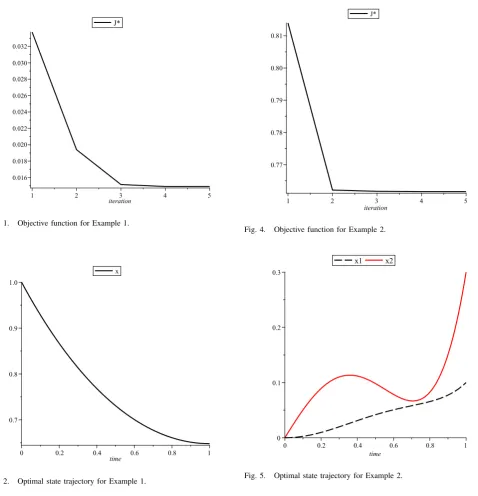
Corresponding objective functions are shown in Fig 1. Exact objective value is given in [15] with 7 decimal precision is: J∗ = 0.7615941. Optimal state trajectory and optimal control history are illustrated in Fig 2 and Fig 3.
Example 2. Find the suitable control for the nonlinear optimal control problem.
M inJ(x, u) = ∫ 1
0
x1(t) 2
+x2(t) 2
dt
˙
x1(t) = x2(t)
˙
x2(t) = 10x1(t)3+u
x1(0) = 0, x1(1) = 0.1
x2(0) = 0, x2(1) = 0.3
This problem solved for u0, . . . , u4, as presented in Example 1. and objective values are shown in Fig 4. This problem is solved in [16] withJ∗= 0.0135, the result given in [17] for the problem is J∗ = 0.024, in Table I these results are compared with present method.
The state trajectory and control history are shown in Fig 5 and Fig 6 respectively.
One can see from Fig 1 and Fig 4 that both for Example 1. and Example 2. objective value converges to optimal control so fast, results are accurate, and very little computations are needed to be done. Also relative error for Example 1. and Example 2. i.e. |Jk+1∗ −Jk∗|, is presented in Table II, as one can see we obtain these accurate results with very little computation efforts.
IAENG International Journal of Applied Mathematics, 42:2, IJAM_42_2_02
TABLE I
COMPARING RESULTS FOREXAMPLE2.
implemented methods J* present method 0.0149
method of [16] 0.0135
Rubio’s Method 0.024
TABLE II
COMPUTATION ERRORS FOREXAMPLE1.ANDEXAMPLE2.
k Example 1 Example 2
0 5.07×10⁻² 1.44×10⁻² 1 1.68×10⁻⁴ 4.26×10⁻³ 2 6.72×10⁻⁸ 2.41×10⁻⁴ 3 1.00×10⁻⁹ 1.00×10⁻⁸
VI. CONCLUSION
Legendre polynomials combined with ADM are used to solve optimal control problems. this polynomials are orthog-onal in closed interval [−1,1], so optimal control problem transformed in order to take advantage of their orthogonality. Then ADM is implemented to solve obtained ODE. Many authors utilized ADM to deal with ODE and they got wonderful results, It is also important that the ADM does not require the discretization of the variables. It is not affected by computation round errors and one is not faced with necessity of large computer memory and time. In numerical examples solved in this paper, solutions are obtained just by calculating 3 or 4 terms with low memory consumption and low effort with rational precise. ADM is powerful method for solving nonlinear differential equations so it make present method a good tool dealing with nonlinear optimal control problems.
ACKNOWLEDGMENT
The authors would like to thank from anonymous reviewer of the journal of Numerical Algorithms for his (her) helpful comments.
REFERENCES
[1] A.V. Kamyad, M. Keyanpour , M.H. Farahi, ”A new approach for solving of optimal nonlinear control problems,”Applied Mathematics and Computation, vol.187, pp.14611471, 2007.
[2] M.keyanpour, M.H.Farahi, ”wing drag minimization—,”Applied math-ematics and computation, vol. 186, pp.685-692,2007.
[3] M. Gachpazan, A. H. Borzabadi, A. V. Kamyad, ”A measure-theoretical approach for solving discrete optimal control problems ,” Applied Mathematics and Computation,vol.173, pp.736752,2006 .
[4] A. Alipanah, M. Razzaghi, M. Dehgan, ”Nonclassical pseudospectral method for the solution of brachistochrone problem,Chaos, Solutons and Fractals, vol. 34, pp. 1622-1628,2007.
[5] J. Vlassenbroeck and R. Van Dooren, ”A Chebyshev technique for solving nonlinear optimal control problems,” IEEE Transactions on Automatic Control, vol.33, no.4, pp. 333-340, Apr. 1988.
[6] F. Fahroo and I. M.Ross, ”Direct trajectory optimization by a Chebyshev pseudospectral method ,”American Control Conference, 2000. Proceed-ings of the 2000, vol.6, pp.3860-3864, 2000.
[7] M. L-kady and M. E. Elbarbary, ” A Chebyshev expansion method for solving nonlinear optimal control problems,”Applied Mathematics and Computation, vol. 129, pp.171-182, 2002.
[8] B. Tousi, M. A. Tavallaei, S. K. Yadavar Nikravesh, ”Analytical Solu-tion to Optimal Control by Orthogonal Polynomial Expansion,”World Congress on Engineering and Computer Science 2007,October 24-26, 2007, San Francisco, USA.
[9] I. Sadek, T. Abualrub, M. Abukhaled, A computational method for solving optimal control of a system of parallel beams using Legendre wavelets, Mathematical and Computer Modelling, vol.45, pp.11253-1264, 2007.
[10] P. Nevai Orthogonal polynomials: theory and practice, : Kluwer Academic/Cambridge University press,Norwell, MA,1990.
[11] A. M. Wazwaz and S. M.El-Sayed ,”A new modification of the Ado-mian decomposition method for linear and nonlinear operators,Applied Mathematics and Computation,vol.122, pp.393 - 405,2001 .
[12] J. Biazar, E. Babolian, R. Islam,” Solution of the system of ordinary differential equations by Adomian decomposition method,” Applied Mathematics and Computation, vol.147, pp.713719.2004.
[13] G. Adomian, ” Solving frontier problems of physics: The decomposi-tion method,”Kluwer Academic, Dordrecht, The Netherlands,1994. [14] M. M. Hosseini and H. Nasabzadeh,”On the convergence of
Ado-mian decomposition method,”Applied Mathematics and Computation, vol.182 ,pp. 536543, 2006.
[15] D. N. Burghes and A. Graham, ”Introduction to control theory, including optimal control,” E.Horwood, Halsted Press, New Yourk, 1980 .
[16] K. P. Badakhshan and A. V. Kamyad,”Numerical solution of nonlinear optimal control problems using nonlinear programming ,” Applied Mathematics and Computation,vol.187, pp. 15111519,2007.
[17] J. E. Rubio, ”control and optimization the linear treatment of nonlinear problems,”Manchester University Press, 1985.
IAENG International Journal of Applied Mathematics, 42:2, IJAM_42_2_02
Fig. 1. Objective function for Example 1.
Fig. 2. Optimal state trajectory for Example 1.
Fig. 3. Optimal control policy for Example 1.
[image:7.595.66.270.310.520.2]Fig. 4. Objective function for Example 2.
Fig. 5. Optimal state trajectory for Example 2.
Fig. 6. Optimal control policy for Example 2.
![TABLE II[12] J. Biazar, E. Babolian, R. Islam,” Solution of the system of ordinaryOMPUTATION ERRORS FOR EXAMPLE 1](https://thumb-us.123doks.com/thumbv2/123dok_us/385863.536101/6.595.107.233.73.145/table-biazar-babolian-islam-solution-ordinaryomputation-errors-example.webp)