PUBLIC POLICY DEVELOPMENT AND
IMPLEMENTATION IN THE UNITED ARAB
EMIRATES
DBA
UNIVERSITY OF BRADFORD
2017
Public Policy Development and Implementation in the United Arab Emirates
A study of organizational learning during policy development and implementation
in the Abu Dhabi Police and
the United Arab Emirates Ministry of Interior
Doaa F. H. ALGHALBAN
Submitted for the degree of Doctor of Business Administration
Faculty of Management and Law University of Bradford
Abstract
Doaa F. H. Alghalban
Public policy development and implementation in the United Arab Emirates. A study of organizational learning during policy development and implementation in the Abu Dhabi Police and the United Arab Emirates Ministry of Interior.
Key Words: public policy, organizational learning, policy development, policy implementation, policy interdependences, policy governance, policy management, policy practices, policy groups, United Arab Emirates.
Abstract: This reflective analysis of the Emirati public policy process (PPP) cycle and implications of uneven application of new public management (NPM) paradigms in the UAE offers insight into the way that public administrations develop, learn, evolve, and cope with new challenges during the policy development process. The author also assesses the relationship between organizational learning and organizational practices, to generate practical knowledge and experience that is translated into recommendations that will benefit UAE government organizations, and indeed any public sector organization in the Gulf Region.
Inside action research was chosen to emphasize the author's dual role as both a researcher and a participant. As an advisor to both the Ministry of the Interior (MOI) of the UAE and the Abu Dhabi Police (ADP), the author helped both organisations improve their PPP experiences while researching the challenges, learning, and adaptations which occurred while policy was being developed within the MOI. The author generated data through reflective memos, informal interviews, and document analysis, and presents her findings in terms of both
ii
The author primarily found that new models were necessary to reflect the highly flexible and authority-oriented UAE PPP cycle. The author also explored how cultural understandings led to challenges with NPM and learning in the UAE public administration, hindering policy development. Finally, the author found that her own position, as a female expatriate in the Emirati government, allowed for some valuable reflection about experience of serving in a Global South public administration.
Table of Contents
Abstract ... i
Table of Contents ... iii
List of Figures ... vi
List of Tables ... vii
Glossary ... viii
Chapter 1: Introduction ... 1
1.1 The Study of Policy-Making ... 2
1.2 Research Aims and Questions ... 6
1.3 Methods ... 9
1.4 General Findings ... 10
1.5 Roadmap of Thesis ... 13
Chapter 2: UAE Background and Research Context ... 17
2.1 Research Context... 18
2.1.1 UAE Economy and New Public Management ... 20
2.1.2 UAE Federal Administration: The Case of the Ministry of the Interior . 24 2.1.3 UAE Emirate Administration: The Case of the ADP ... 27
2.2 Study Background and Relevant Chronology ... 30
Chapter 3: PPP and NPM: Challenging Approaches to Public Administration ... 39
3.1 General Conceptions of the Public Policy Process ... 40
3.1.1 The Policy Cycle ... 42
3.1.1.1 Stage 1: Agenda setting ... 44
3.1.1.2 Stage 2: Policy formulation ... 45
3.1.1.3 Stage 3: Public policy decision-making ... 47
3.1.1.4 Stage 4: Policy implementation ... 47
3.1.1.5 Stage 5: Policy evaluation ... 48
3.1.2 Policy Process Research ... 49
3.2 Public Policy and Politics ... 51
3.2.1 Interdependencies ... 54
3.2.1.1 Interdependence at the Organisational Level ... 55
3.2.1.2 Policy Interdependence ... 60
3.2.2 Public Sector Reform and PPP ... 62
3.3 New Public Management ... 64
3.3.1 Principles of New Public Management ... 65
3.3.2 NPM Related Models ... 68
3.3.3 Impact of New Public Management ... 70
3.3.4 Applying NPM in the Global South ... 72
3.3.5 Applying NPM in the UAE ... 76
Chapter 4: Relevant Organisational Learning Scholarship ... 80
4.1 Perspectives on Organisational Learning ... 80
4.2 Important Organisational Learning Concepts ... 85
iv
4.3 Organisational Learning in the Global South ... 93
Chapter 5: Theoretical Foundations for Reflective Methods ... 97
5.1 Critical Subjectivity and the Social Construction of Knowledge ... 97
5.2 Reflecting in and on Organisational Research ... 100
5.3 Action Research and PAR ... 106
5.4 Insider Action Research ... 111
5.4.1 Role of the Researcher ... 114
5.4.2 Limitations and Challenges in One’s Own Organisation ... 120
Chapter 6: Methods for Insider Action Research ... 125
6.1 Context of Study ... 125
6.2 Design of Study ... 128
6.2.1 Inside Action Research Cycles ... 129
6.2.2 Thesis Research Cycle: Zuber-Skerritt, Perry, and Mezirow ... 131
6.2.3 Inside Action Research Cycle and Organisational Learning ... 133
6.3 Data Collection Methods ... 135
6.3.1 Observation/Interviewing ... 136
6.3.2 Reflective Memos ... 138
6.3.3 Document Content Analysis ... 141
6.3.4 Data Analysis ... 145
6.3.4.1 Data Analysis of PPP and Organisational Reflection Data .... 146
6.3.4.2 Reflection as Inside Action Researcher ... 147
Chapter 7: Findings and Recommendations ... 150
7.1 Academic and Theoretical Findings ... 150
7.1.1 The PPP Cycle in the UAE... 151
7.1.2 New Public Management Theory and the UAE ... 160
7.1.3 Organisational Learning Theory Applied ... 166
7.1.4 Theoretical Reflections on the UAE ... 178
7.2 Empirical and Practical Findings ... 184
7.2.1 Practical Approaches to PPP ... 184
7.2.1.1 Flexibility in the Need Analysis Stage ... 185
7.2.1.2 Flexibility in the Drafting Stage ... 186
7.2.1.3 Flexibility in the PEC Assessment Stage ... 188
7.2.1.4 Flexibility in the Consultation Stage ... 189
7.2.1.5 Flexibility in the Approval for Implementation Stage ... 190
7.2.1.6 Language in PPP Documentation ... 191
7.2.1.7 Governance Framework (GF) Documentation Challenges ... 194
7.2.1.8 Standard Templates for Improved Communication ... 200
7.2.1.9 Bottom-Up Policy Development ... 204
7.2.1 Practical Approaches to Managing Interdependencies ... 208
7.2.3 NPM and the Challenge of External Support ... 211
7.2.4 Problems with Outsourcing Organisational Learning ... 215
7.2.5 Practical Lessons about the UAE ... 220
7.2.6 Reflections on Researcher Position ... 225
7.4 Summary of Recommendations ... 237
Chapter 8: Discussions ... 240
8.1 Discussion of Empirical Findings ... 240
8.2 Addressing Gaps in the Literature ... 247
Chapter 9: Conclusions and Future Research ... 253
9.1 General Research Contributions ... 254
9.1.1 Academic Contributions ... 254
9.1.2 Practical Contributions ... 258
9.2 Research Limitations ... 260
9.3 Future Research Opportunities ... 262
Bibliography ... 266
vi
List of Figures
Figure 1: Organisational structure between MOI and ADP 28
Figure 2: Policy cycle emerges from the problem-solving approach 43
List of Tables
Table 1: Hierarchy of Inside Action Research Cycles 130
Table 2: Pair of PPP Focused Inside Action Research Cycles at
the Emirate-Level (ADP) 131
Table 3: Pair of Organisational-Learning Focused Inside Action
Research Cycles at the Federal Level (MOI) 134
Table 4: Format for Data Collection and Reflective Memos 141
Table 5: Comparison of PPP Models 153
Table 6: Single-, Double-, and Triple-Loops of Learning in
MOI 2013-2015 172
Table 7: Summary of Theoretical Findings 233
Table 8: Summary of Practical and Empirical Findings 236
Table 9: Summary of Recommendations from Research 238
viii
Glossary
ADP - Abu Dhabi Police
EFQM - The EFQM excellence model is a non-prescriptive business excellence framework for organizational management, promoted by the European Foundation for Quality Management (EFQM)
EXPO 2020 - Universal Exposition to be hosted by Dubai (UAE), opening on October 20, 2020.
HH - His Highness Sheikh Saif Bin Zayed Al Nahayan, Deputy of Prime Minister, Minister of Interior and Commander of Abu Dhabi Police at the time of research.
IAR - Inside action research
MOI - Ministry of the Interior of the UAE
NPM - New public management
OL - Organisational learning
PAR - Participatory action research
PDF - policy development file, including feedback of stakeholders, plan for implementation, and requirements for change
PEC - Policy Evaluation Committee
PPP - Public policy process
RACI - Management tool with initials as follows ‘R’ for
‘responsible’, A for ‘accountable’, C for ‘consulting’, I for ‘informing’
SA - MOI/ADP Strategic advisors (internal)
SME - Subject matter expert (external consultant)
SOP - Standard operating procedure
T1 - template for studying the need for the policy
T2 - template for designing and proposing policy
Chapter 1: Introduction
With so much public attention paid to how governments provide services for their people, it is not surprising that many governments are deeply concerned with developing their public administration and improving their policy processes. Public policy is intended to improve public services, solve critical problems, enhance social stability, and improve quality of life for citizens. Efficient and innovative public policy enables the programmes of governments and politicians to succeed; therefore, most public organisations invest heavily in improving the public policy process (PPP) to speedily meet unexpected future demands from the public. Understanding how PPP is used to ensure quality policy is developed is extremely important to governments, necessitating academic research that is practical and evidence-based. In rapidly modernising countries like the United Arab Emirates (UAE), this PPP is ongoing and readily available for study, offering new opportunities for research.
The public has a tendency to ask how policy could be better, why citizens are not more involved, or why certain actions are taken at specific times. These and other questions are frequently asked by the public with no understanding of the challenges facing policy makers: people suggest alternative solutions that could never be proposed, since they are typically unaware of the complex nature of public policy formulation. For example, many people build their attitudes to public policy without considering the inevitable disputes between the interests of the groups involved, or without acknowledging politics and the nature of power
2
framing policy, or even recognising a direct and necessary influence on policy development (Hill 2013). Empirical, insider action research from within the policy-making apparatus of a country can shine a light on those inevitable disputes, making research into the dynamics of how policy is developed extremely valuable, especially when exploring under-studied, Global South case examples.
Furthermore, organisational learning (OL) reveals the challenging relationship between the policy and the evidence and practices which are equally influenced by the political/organisational context (Howlett et al. 2009). Understanding how policy is developed within certain contexts, and how OL allows for those policy cycles to occur, is a necessary part of improving PPP and moving closer to the goal of having policy results match plans and expectations.
1.1 The Study of Policy-Making
This thesis examines the practicalities and realities of the public policy process in the UAE context, and place this case example within the larger academic framework of PPP and New Public Management (NPM) studies. Specifically, the purpose is to identify informative lessons through two studies of policy making, first in the Emirate-level Abu Dhabi Police (ADP) and second in the federal Ministry of Interior (MOI). The focus was also expanded to understand any OL that took place within the PPP by studying the reactions, actions, behaviours, practices and decisions of those translating PPP lessons
from one level and organisational department. This author reflected throughout her research on how her findings could be used in empirical ways; these practical conclusions and recommendations are found through several chapters of this thesis.
Furthermore, the research sought to improve academic and practical understanding and knowledge about a variety of public policy-related topics within the context of the Global South. This research also sought to study the contextual and practical knowledge generated by OL and utilised in PPP by comparing, at its simplest, what was initially planned to what finally occurred. In this sense, academic theories can be applied to real life examples to derive useful insight and research. In terms of practice, the lessons learned for each stage of PPP can be used to directly provide guidance to other governmental organisations within the UAE.
This thesis has significant practical merit, as professionally-oriented research often does, by providing data and analysis specifically related to the topic of interest: in this case, PPP development and execution in the federal and Emirate-level public administration, and the uneven application of NPM principles in this setting. For example, the author outlines the PPP cycle as it exists in Emirati public administration, and discusses some of the practical challenges faced by the Emirati government in its uneven and problematic application of NPM principles. But the author strives to put these practical findings in a larger theoretical context, and expects that the findings and
4
discussion can be applied to a wider range of case studies, beyond the UAE. As Nutley, Davies, and Walter (2002) note, public policy and related practices are informed by evidence. Evidence-based policies and practices help researchers and analysts to improve the use of evidence by considering the daily progress of activities in specific contexts (Nutley et al. 2002). Evidence-based policies and practices can also be used to make recommendations to inform future practice; this thesis makes such a contribution. The present research aimed to interpret the organisational experience during the deployment of a PPP with reference to the relationship between the formulated process, current practices and the available evidence. For example, the author reflected on how different types of policy are developed or implemented and what the influence was on the process itself, by employing triple-loop learning (Dewey 1944; Blackler et al. 2001; Wang and Ahmed 2003; Tomblin 2010). This thesis puts into practice the notion of evidence-based practice and aimed to ground itself in the knowledge-based practice concept in order to translate people’s experience into valuable practices that may be adopted by other organisations (Glasby 2011).
There is always tension between policy makers and academics over the use of the evidence-based approach. Sometimes a policy’s outcome is already defined even before the policy is formulated, and policy development is mundane. Often, however, the policy process is dynamic, and academics such as Hill (2013) and Howlett, Ramesh, and Perl (2009) argue that, in order to
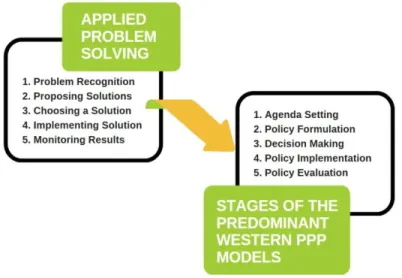
understand and analyse the policy process in practice, a policy should follow a rational or linear approach: identify problems, verify related evidence, formulate a policy, develop an implementation plan, and then deliver the policy. This PPP approach, referred to in this thesis as the ‘Western PPP model’, provides insight into how policy is made.
Exploring such issues provides a better understanding of policy formulation, with its accompanying negotiations of power and interest between the policy parties, and the process of making decisions with reference to an organisation’s capabilities and context. The process is not simple: it includes formulation, implementation and evaluation (Hogwood and Gunn 1984). Currently, it is considered iterative and continuous; it is likely to reflect the state of society and of politics (Roberts and King 1991). Making decisions is very complex and influenced by the type of policy in question, the available supporting evidence and the parties involved (Howlett et al. 2009). Moreover, it is not a linear process, but takes two approaches in turn: first it takes a descriptive approach which claims that a policy should be developed with reference to the current situation and its practices (analysis of need); second it takes a formative approach which outlines what ideally should happen, so as to enhance the quality of the policy (analysis of the policy) (Hill 2013).
The sociology of the organisation or political system contributes to the PPP, a point which is discussed thoroughly in this thesis. National culture permits the policy maker to interpret the actions performed in the organisational
6
context. This reminds all readers that policy development studies are a branch of social science research - the social subjectivities of daily life are relevant to experiences such as PPP. Research is influenced by politics, such as the power of the state, the laws, regulations, institutions or organisations; this power is habitually referred to in the context of restrictions on data or action (Howlett 1991; Howlett et al. 2009). Meanwhile, politics which affect data generation may be loosely used when policy studies take on the task of presenting the complexity and ambiguity of the clash between what policy should be and what is actually delivered. These issues maintain relevance throughout this work.
1.2 Research Aims and Questions
Before presenting research, it is advisable to clearly articulate the research aims, the expected contributions of the work, and the general questions which drive research (Shugert 1979; Rojon and Saunders 2015). This research aims to increase the existing knowledge (of theories and practices) with direct reference to the practical application of NPM and OL during the deployment of PPP within Ministry of the Interior (MOI) and Abu Dhabi Police Force (ADP) in the UAE. Although this research might be considered descriptive, it also aims to be objective, moving beyond description to explore, evaluate and interpret a number of theoretical ideas in ways that contribute to gaps in academic and practice-oriented literatures.
country is currently aiming to improve and develop its public sector services in response population growth, economic expansion, and increased international exposure. For example, the government is preparing to be ready for full automation before the Expo 2020. The context of this study is examined in much greater detail in Chapter 2. This research is expected to encourage productive dialogue between policy practitioners in the UAE and international academic researchers who study PPP, with a goal of more informed decision-making. The purpose is to reflect the nature of the deployment of PPP through contextualising the knowledge derived from bringing techniques, tools and practices to the formulation, implementation and evaluation of policy. This research examines the practices at each stage of PPP through data generated during inside action research. The fundamental concepts of PPP are similar all over the world, but their implementation are varied; this thesis demonstrates that Global South examples of PPP cycles can follow very different trajectories based on their socio-political circumstances.
As this thesis unfolds, the author explores a variety of theoretical concepts relating to PPP development and implementation, the utilisation of NPM in the Global South, and competing concepts of OL; an overarching research aim is to further add to academic knowledge of these topics in the unique case example of the UAE. Adding to the discourse surrounding application of NPM or OL principles in Global South will allow the author to make a valuable contribution to academic understandings of non-Western peoples and
8
practices.
The author has a number of objectives she accomplishes with this thesis, which serve as central themes guiding the work:
⚫ To explore the application of principles of PPP and NPM in the UAE and both the federal and Emirate-levels.
⚫ To evaluate the impact of Emirati cultural values on the implementation of NPM principles in a real-world command and control public administration.
⚫ To utilize OL theories to generate recommendations regarding interorganisational learning and interdependencies between federal-level and Emirate-level organisations.
⚫ To provide evidence-based insight into the development of PPP models and the application of NPM principles in the public sector of the UAE.
⚫ To provide recommendations and discuss issues of concern and practice as related to PPP or NPM, which will be of practical use to policy makers and government officials in the UAE and the Global South.
As a result of accomplishing these objectives, the author is able to draw conclusions relating to her overarching, reflective research questions that drive this thesis:
⚫ How do Western theories regarding PPP, NPM, and OL (drawn from many of the authors described in previous chapters, such as Birkland, Hill, Hood, Howlett, and others) apply to the specific Global South case of the UAE?
⚫ What lessons can be drawn from this UAE public administration research that can be applied to other Global South policy experiences? What practical recommendations can be made? Discussions of these objectives and questions are found throughout the reflective findings in Chapters 7 and 8.
1.3 Methods
This research study utilised an insider action research methodology (Coghlan and Brannick 2015); the author served as a Strategic Advisor in the ADP and MOI during the PPP from 2012 to 2015. In this role, she was able to hold the dual role of participant and researcher. By using a nested insider action research cycles, the author was able to explore ideas relating to public policy development, stakeholder involvement in policy planning, and OL. Utilising Zuber-Skerritt and Perry’s (2002) notion of core research cycles and thesis research cycles, this thesis research allowed the author/participant to simultaneously advise on public policy development in the UAE and reflect on the efficacy of PPP in action. Because the author was charged with applying lessons learned from Emirate-level PPP deployment to the federal-level, there was ample room to execute a pair of insider action research cycles. These first two core research cycles fell within the overarching thesis research project, which was based on Mezirow’s (1990, 1991, 1997, 2000) models of reflection and provided insight into the quality of action research in the UAE and the place of NPM in Middle Eastern public administration.
During research, it became possible to reconceptualise the study on a third level as a pair of action research cycles oriented toward studying OL. As will be described in the following Chapter 6, after a year of PPP planning and development at the federal level, it became clear near the end of 2013 that there would be significant setbacks to any PPP implementation, largely due to lack of
10
focus, understanding, and communication between stakeholders. As such, the author was able to use her position’s responsibilities to reflect on the challenges of the 2013 PPP and apply any lessons learned to the 2014 PPP planning and development process. This two-year process of OL was reflected upon and documented in the author’s second of two core research cycles.
Data collection was primarily focused on three main avenues: observation and informal interviewing; journaling and reflective memos; and document analysis. The author attended dozens of meetings, conducted over a hundred interviews and discussions, analyzed years of organisational policy documents, and reflected in extensive journals that demonstrated overarching themes over time.
1.4 General Findings
The methods described above were heavily dependent on the practice of reflection, and as such, much of the data generated is reflective and highly qualitative. Earlier iterations of this thesis’ findings were heavily data-driven, such that the author lost sight of the larger theoretical and empirical questions which had initially driven the research. However, reorganisation of findings through initiative periods of reflection, and a focus on the insider action research approach to data generation allowed the author to better conceptualise the larger-scale academic and practice findings that emerged from this doctoral research.
The author determined that findings and conclusions supported by her data could be categorised into theoretical findings, empirical findings, and methodological reflections; each class of findings draws from different steps and cycles in the various core and thesis insider action research projects that were concurrently reflected upon in this thesis. In addition, each category provides unique insight into the nature of public administration within the UAE, and translates those observations to a Global North audience.
Insider action research provides those already situated in organisations the opportunity to explore the experiences of social institutions and groups in real time. This allows for significant theoretical contributions derived from the unique positions and trust relationships that already exist for the researcher. The author’s core research cycles provided reflection on three major bodies of theoretical work: implications of PPP theory, applications of NPM models, and engagement with OL debates.
Theoretical findings on PPP focus on some of the conceptual challenges that delayed PPP efforts and hampered PPP success in the MOI. Approaches to flexibility and planning are discussed to build upon existing ideas of PPP stages, particularly in non-democratic contexts. The author then examines new public management (NPM) and engages in dialogue with Mansour (2017) and Salem (Salem and Jarrar 2012; Salem 2016), agreeing that decentralisation and outsourcing efforts in UAE public administration have not been entirely successful. Finally, the author refines her discussion of OL in the Emirati
12
government sector by focusing on theories of triple-loop learning (Wang and Ahmed 2003) and interorganisational learning (Tucker et al. 2007; Fortis et al. 2016).
One of the main goals of this thesis is to provide empirical discussions of PPP challenges and lessons learned; these commentaries will be beneficial for many Global South contexts, but will be most beneficial for researchers hoping to understand public administration in the UAE at both the federal and Emirate-levels. Many of the empirical findings of this thesis are centered around PPP documentation, challenges surrounding stakeholders’ involvement, and practical discussions of time and expectation management. These empirical findings allow the author to provide recommendations to PPP practitioners based on reflections generated during research. These recommendations can improve the standard practices of the Emirati public sector and beyond. These findings are of the utmost importance because they explore an under-researched subject (PPP and NPM in the Global South) and provide the foundation for practical recommendations which will help Emirati and other public administrators to better serve the public.
In addition, this research was conducted from a participatory position; once the author fully actualised theories regarding insider action research, she was able to operationalise her reflective data into clear research cycles that illuminated the most important findings that could be drawn from her data. As such, the author’s findings also include reflections on the use of insider action
research, essentially bringing to life the recommendation for thesis-level meta-analysis best articulated in the work of Zuber-Skerritt and Perry (2002). These methodological reflections also address the challenges and opportunities presented by conducting insider action research within a culture whose client-patron orientation directly affects public policy development in the Global South governmental organisation studied.
One of the major strengths of this thesis is the position of the author: by conducting inside action research in an advisory position within a Global South ministry during rapid deployment of new public management principles, the author expects to contribute a specific and valuable voice to academic discourse regarding NPM and other topics discussed. By adding the reflections and voices of a female Arab government official and her co-participants, the author will expand the overall understanding of how effectively Western academic theories (relating to PPP/NPM/OL) translate to Global South practice and experience. Thus, the author provides several reflections on Emirates’ public administration and OL, as well as reflections on her own experience as a researcher in a politically challenging position.
1.5 Roadmap of Thesis
After this roadmap, the thesis begins with an discussion of the United Arab Emirates and its rapid modernisation, with reference to federal and Emirati bureaucratic organisation and policy development processes. Chapter Two (UAE Background and Research Context) places the author’s organisations
14
within the context of public administration in Abu Dhabi and the UAE. This chapter will also explain the author’s role within the MOI and ADP, and situate her position within the PPP these organisations experienced from 2012 to 2015. After the introduction of the author’s research context, three chapters will provide the presentation and analysis of relevant literature necessary to share the findings of the insider action research conducted by the author. Chapter Three (PPP and NPM: Changing Approaches to Public Administration) focuses on the public policy process (PPP) and its relation to New Public Management (NPM). The role of government in the PPP in the Global South will be discussed, to place the author’s Emirati example within a larger global context. The problems translating modernising practices in Global South public administrations into NPM models will be explored, as will possible alternative models of policy development to apply to this Emirati example.
Because of the research expanded to explore OL after the initial PPP development period was not as successful as originally hoped within the MOI, Chapter Four (Relevant Organisational Learning Scholarship) provides a brief review of the salient points on OL. Again, the goal of this review is to place the author’s experiences in the UAE within a larger academic and geographic context. Attention is paid to different types of OL, as well as how OL has already been studied within the UAE and the Global South.
Chapter Five (Theoretical Foundations for Reflective Methods) provides the review of literature relevant to the methodology used in this research:
reflective insider action research relying on observation, reflective journaling, and content analysis. As an adviser to the MOI and ADP, the author had a specific role as participant and researcher, necessitating a flexible research methodology that was attuned to the challenges and opportunities the inside position afforded.
The chapter (6: Methodology) that then follows puts this literature review to work by explaining the methodology used in this thesis. As described above, Zuber-Skerritt and Perry’s (2002) notion of core research cycles and thesis research cycles was used to conceptualise the multiple levels of research that were conducted; insider action research was the methodology used to structure the research cycles and ensure high quality data was generated. Data collection methods and logistics are explored.
Chapter Seven (Findings and Recommendations) is comprised of the findings determined from the data generated over the course of the various cycles of insider action research. While data generation was extensive, the author has elected to focus on certain core themes in order to organise findings into groups of academic or practical significance. The author will begin by exploring her findings as related to public policy process development, new public management, and OL, all within the context of the Global South and the client-patron mindset of the UAE. The author then discusses findings which directly provide insight into the UAE itself, as related to public administration and policy development. Finally, the author discusses her findings based on
self-16
reflection, discussing challenges faced when conducting insider action research in the Global South.
Chapter Eight (Discussion) gives the author the opportunity to take a step back and reflect on her findings in a more generalised manner. During this chapter, she achieves two goals: to provide commentary on some of the empirical or practical findings drawn from her data, which contribute to the discourse about policy development in the UAE; and to address the gaps in literature which she had previously outlined, and then place her findings within those gaps.
The final chapter (9: Conclusions and Future Research) of this thesis briefly summarises the main theoretical and empirical conclusions which can be drawn from this research. This includes discussion of the relevance of this study to public policy process development in the UAE and the organisations researched. Chapter Nine also discusses limitations of the research project, and offers suggestions for future research which could build off of the data generated and analyzed here. It is the author’s expectation that the thesis will provide insight into the unique specificities of the UAE public sector while also contributing to general academic discourses and empirical practice to allow for the findings to be of interest to a wide range of scholars, practitioners, and readers.
Chapter 2: UAE Background and Research Context
A significant driver of this thesis research is the goal of presenting evidence and reflections gathered in practice within the government of the UAE. Many of the PPP, NPM, and OL theories which are explored in this thesis were developed in OECD countries and are most successfully applied to cases in West. There is significant merit in contributing to the growing body of literature which addresses the application of NPM or OL theories in the Global South. But, in order to present a thesis so situated within the public administration of the UAE during a pivotal period of rapid modernisation, it is necessary to explore the context of the study. This chapter provides the research background of the thesis, from the federal level to the Emirate-level, and then provides the reader with a clear chronology of the research study. This study description of 2012-2015 will illustrate to the reader the various research cycles and opportunities to examine topics related to PPP, NPM, and OL, so that the reader has a clear understanding of the scope of the research while progressing through the literature reviews in subsequent chapters.
This chapter is divided into two core sections. The first section (Research Background) focuses on the background context for this research: the UAE most broadly, Abu Dhabi Emirate more specifically, and the MOI and ADP most directly. The Emirates are a unique country in terms of their political organisation, requiring review so that the reader can understand the interdependencies inherent in the Emirati system. The reader also requires an
18
understanding of the relationships between organisations so that roles, including the author’s role, are clearer to those who are not insiders in the MOI/ADP. The second section (Study Background and Relevant Chronology) walks the reader through the chronology of this research study. Over the two years of research, the author continuously balanced a set of roles and requirements as both the ADP and MOI produced new policy initiatives and sought to learn from and improve PPP in the UAE.
2.1 Research Context
This study is set in the United Arab Emirates (UAE), which were established in 1971. It is an Arab, Muslim country, and Islamic values are deeply ingrained in Emirati corporate and governmental culture (Suliman 2006). The country is comprised of seven Emirates: Abu Dhabi is the capital and the others are Dubai, Sharjah, Ajman, Aum al-Quoin, Ras Al Khaimah and Al Fujairah. This federalised set of monarchies is ruled by a president. This Gulf Cooperation Council (GCC) member dominated by cosmopolitan urban centers fueled by petro-based wealth and rapidly expanding financial sectors. The founder of UAE, HH Shaikh Zayed bin Sultan Al Nahyan, aimed to unify the Emirates so that they could withstand internal and external threats and challenges – something the people of the UAE have embodied in their aspiration to develop their country.
cabinet of over thirty ministries, including the MOI. Thus, all public sector administration can fall into three categories, each with their own limitations: federal government, Emirate-level government, and municipal government. The UAE political system is that of a constitutional federation allowing interdependency between the Emirate-level organisations and local city governments to support a diverse economy and flexible options for municipal and Emirate-wide systems, bearing in mind that all levels government action must not contradict federal rules and regulations. This system permits competitive advantage to be sought between different Emirates.
The government of the Emirates, like many in the region, is based on the idea of client-patron relationships, a characteristic which cannot be ignored in studying the development of public policy in the UAE. As Mansour explains,
In the socio-political context of the UAE, characterised by a patron- client relationships on which political legitimacy is based and ethnic groups who behave softly like interest groups albeit in a different manner, the major concern of UAE government is that the privatisation policy should not disrupt the fabric of the well-woven patron-client ties by disrupting the provision of social services to citizens and their job security. (2017: 120)
The petro-economies are marked by neopatrimonialism, and this is reflected in the structure, composition, and staffing of several Emirati ministries. This worldview also explains why the Emirati government, like many in the region, clearly separates the rights of citizens and foreign workers and other expatriates (Vora 2010; Mansour 2016). Emirati citizens make up approximately 11-12% of the population of the UAE (GLMM Programme 2014); at the same time, foreign
20
workers and immigrants from the Indian/Pakistani subcontinent alone compose over 40% of the population living in the UAE (GLMM Programme 2014). The Emirati government provides public services to all people living in the UAE, but citizens are often given preferential treatment or economic advantage as a social subsidy, as a privilege of citizenship. Mansour (2017) argues that public sector development in the UAE has been paternalistic precisely because of this larger worldview.
As will be discussed later, the application of NPM principles in the UAE must be contextualised within the setting of the client-patron corporate monarchical system of the Emirates. This results in a different experience of public administration development, and “it should be emphasised from the outset that The UAE government avoids all policies that disturb the ruled-ruler relationship, especially massive policies of privatisation, because of its impact the provision of social and economic services provided for free to nationals as well as their as impact of on citizens’ employment” (Mansour 2017: 120). These constraints translate into serious limitations on how willing the monarchy is to support privatisation; instead, outsourcing and contracting-out marks the federal and Emirate-level public services.
2.1.1 UAE Economy and New Public Management
The UAE is considered by the World Economic Forum to be one of the fastest growing economies in the world. It has produced some remarkable
success stories of economic growth and business development, rising from the desert in the last fifty years into a series of shining metropoli. Its public services in the 21st century face the challenge of unpredictable increases in customer service demand, due to the predicted radical changes in technology, lifestyle and the environment.
Like many fast-growing economies in the Global South, determining how the UAE’s experience should be situated within a theoretical framework - as NPM as opposed to modernisation as a response to government restructuring and rapid economic growth - is a serious challenge. This thesis explores OL that occurred during development of PPPs within the MOI and ADP, processes which could be viewed both through the lens of the basic modernisation of public administration in a relatively young country and as a paradigm shift toward NPM. The UAE has adopted many of the principles of NPM, as they are discussed in Chapter Three, but the application of these principles has not been a smooth process.
Salem, in much of his work (Salem and Jarrar 2012; Salem 2016), argues that the UAE has moved, in the past decade, from a “silos” approach to a more “competitive approach.” This competitive approach, he argues, has increased government efficiency in the UAE, as promised by the models of NPM, but has led the Emirates’ public administration to retain many of the worst characteristics of the silo approach while failing to develop the trust or collaboration needed to make the competitive, outsourcing-oriented nature of decentralised NPM
22
successful. According to Salem and Jarrar’s (2012) surveys, Emirati public servants participate in the decentralisation of their roles and responsibilities, but still want to maintain pre-existing managerial hierarchies, leading to resentment and mistrust (2012: 3). Emirati public servants are now encouraged to compete, but still want to compete within the same top-down, client-patron, nepotistic and hierarchical system that has marked the UAE’s public administration since its conception. Salem and Jarrar conclude that “there is a need for developing locally grown systems to overcome existing cultural barriers in order to achieve a higher level of ‘social trust’ in the UAE public sector” (2012: 5); their recommendation is the use of technology and eGovernment to break down barriers to decentralisation and encourage competition that is outcome-oriented rather than reinforcing of traditional managerial hierarchies.
Mansour (2017) argues that the legitimacy given to the Emirati government by providing services to its citizens as their patron means that macro-level, federal services like education and healthcare are more likely to face foreign competition rather than privatisation. He also argues that many more local services, such as water and electric, telecommunications, and public transportation, were already handled privately, and thus not subject to NPM (Mansour 2017: 121-122). Thus, Mansour argues that at a macro-level, NPM development in UAE has not been entirely successful. In contrast, he argues that NPM has been more successful at the micro-level in relation to public and private economic culture. He argues that frameworks, TQM, e-Government, and
other tools of NPM have been successfully integrated into the the UAE’s public sector modernisation process (Mansour 2017: 126-130).
Mansour’s separation of NPM into macro- and micro-levels seems somewhat arbitrary, based more on findings than the actual structure of the UAE’s government. His binary, however, does draw attention to the separation of public policy implementation at the federal and Emirate-levels, an analysis with and differences between relevance to this thesis because the research operates within a federal organisation and a Emirate-level organisation. Mansour largely avoids the discussion of municipal government organisation, as will this thesis’s author, because of how specifically oriented each local government would be.
The separation of the UAE government into the federal, Emirate, and municipal levels creates advantages and challenges. Federal rules can be limiting to some Emirates and not others, and not all Emirates have equally sized economies. As such, PPP development and implementation is different at the federal and Emirate-level, and those differences will be reflected upon in this thesis though analysis of the MOI (federal ministry) and the ADP (Emirate-level police force). It should be noted that this thesis research does not delve into policy development at the municipal level, though certainly that is an area for other scholars to approach to further expand upon some of the findings of this work.
24
2.1.2 UAE Federal Administration: The Case of the Ministry of the Interior
The Emirates’ federal government is led by a president, who is elected from the Supreme Council (the seven rules of the seven Emirates) every five years. Though not required, the position of president is generally reserved for the ruling families, and has been held by the Emir of Abu Dhabi (the largest Emirate) for the entirety of the UAE’s history. Though not required, the vice-presidency has always been held by the Emir of Dubai, the second largest Emirate; the vice-president is also the Prime Minister, who leads the Council of Ministers. This council constitutes the federal executive, legislative, and judicial bodies. The Federal National Council supports the legislative decisions of the Council of Ministers, and the Federal Judiciary supports the judiciary needs of the Council; both bodies are by appointment at the royal families of the Emirates. The Ministry of the Interior (MOI) is one of these ministries.
Readers particularly interested in the public administration in the UAE at the federal level are advised to examine Simon Okoth’s (2015: 263-280) outstanding analysis of the structure of the Emirati federal government and the process of public policy and legislative development. His work gives a far clearer explanation of the logistics behind federal level ministries such as the MOI, but it possesses a level of detail unnecessary for this thesis. Still, the UAE’s unique federal structure is not intuitive to those outside of the Emirates, and Okoth’s work will illuminate the underlying structures which shape decision-making at the highest levels of the federal government. This thesis instead focuses on a
specific federal organisation, the MOI, and one of its Emirate-level subsidiaries, the ADP.
The MOI was established when the Emirates were unified in 1971 under Federal Law No. 1. The ministry was charged with overseeing a number of fields, most notably ensuring safety and security of the country’s citizens across a range of established sectors, including overseeing policing at various levels, controlling affairs of federal and local naturalisation and residency, ensuring traffic and road safety, and maintaining safety for the facilities and properties of the government and people. This includes providing services to all segments of society, from individuals to institutions. As a federal ministry, this task is spread over all seven Emirates. Hence, the MOI has focused on building an integrated business platform between the seven Emirates to ensure the provision of standardised quality services to the public; this is a large part of the responsibilities of the author in her role as a participant in the MOI.
The MOI is therefore somewhat different from similar ‘domestic/home affairs’ ministries in many other parts of the world, in that it encompasses five key sectors: the police force, nationality and residence, civil defence, road safety, prisons and rehabilitation. There are three additional support sectors included in the MOI ’s remit: support services (for finance, IT, HR, etc.), strategy and performance, and social/customer services. In sum, the MOI ’s organisational structure covers eight sectors and contains 48 general directorates and 243 departments. The estimated number of services provided
26
by the MOI totals above 350, about a quarter of all the services provided across the entire UAE government.
The MOI’s organisational structure reflects the ministry’s wide diversity, which aims to achieve a high level of coordination and integration in pursuing its strategic goals between the various public leaders in the seven Emirates of the federation. In addition, its organisational structure is supported by a joint federal framework of officials who meet regularly to coordinate work and follow up the general application of the federal strategy. Additionally, the MOI structure is flexible and capable of updating its approach to meet new requirements and directions as the government issues them.
The MOI has been able, over the past four decades, to perform its duties of law enforcement and the provision of security and safety within the variety of cultures, languages, religions, and different demographic patterns that make up Emirati society, without prejudice. The MOI maintains the country’s movement towards peaceful evolution and modernity, aiming to encourage investment and tourism. Recently, many governments of the world have faced security and safety challenges from the increased frequency of terrorist incidents; the Emirates have largely been able to avoid this trend, in no small part because of the efforts of MOI staff. The MOI has a vital part to play in securing the stability of the UAE and its economic, social and political interests. These issues are reflected in the clarity of its strategic directions and the priority given to ensuring public safety, security and service against the regional and international
challenges faced by the UAE.
2.1.3 UAE Emirate Administration: The Case of the ADP
The Abu Dhabi Emirate is the physically largest of the seven United Arab Emirates by a significant amount of territory; the city of Abu Dhabi is the second largest city after Dubai and hosts a population of just under three million inhabitants. The city is the home to the royal Emir, who also serves as the President of the UAE, making Abu Dhabi City the capital city of both the Emirate of Abu Dhabi and the country of the UAE. As a microcosm for the country, Abu Dhabi has experienced rapid economic growth, development, and construction. The Emirate-level Abu Dhabi government oversees the municipal (local) governments of Abu Dhabi, Al Ain, and various smaller cities, towns, and villages in the Western Region.
Abu Dhabi Executive Council (EC) is the local executive authority of the Emirate of Abu Dhabi. It assists the Emir in carrying out his duties and powers, through regular meetings to set the Emirate's general policy. In order to achieve general well-being of the Emirate, the EC works to: set development plans and supervise their execution; authorise projects, laws, and decrees before submitting them to the Emir; supervise work flow in departments and local entities; and coordinate the joint efforts of multiple bodies.
The Abu Dhabi Police Department (ADP) was established 60 years ago, before the Emirates united, and has operated as a public entity in the local government of Abu Dhabi since its inception. It is the UAE’s biggest police force,
28
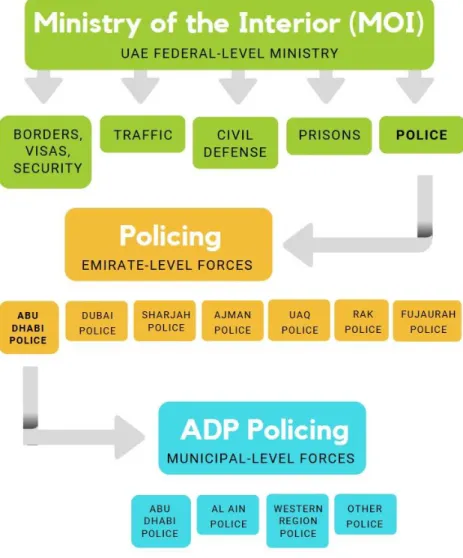
with a provision of service covering the whole of Abu Dhabi Emirate - 80% of the area of the federation. See Figure 1 for a representation of the three levels of UAE government; note, this thesis does not examine policy at the municipal-level.
Figure 1: Organisational structure between MOI and ADP
The ADP budget comes from Emirate-level government, and it operates under the Deputy Prime Minister of the UAE, who is also the country’s Minister
of the Interior. The ADP enforces the ministry’s regulations in alignment with its strategy and integrates with other police forces federally through an effective governance structure. Currently, the ADP provides over 130 services and has 36,000 employees in 42 departments. Thus, the ADP is the best pilot environment for projecting a holistic picture of the impact of a policy project deployed across the MOI.
The commander of the ADP is HH Shaikh Saif bin Zayed, who is at the same time the Minister of the Interior. Moreover, the employees of the ADP are also employed by the MOI, which is empowered to move them across to other Emirates if their services are needed. This relationship often means that ADP employees have interdependent relationships with people across multiple departments and even Emirates, because each ADP employee is also an MOI employee, meaning each has their own networks of collaboration and coordination. This means that many of the policies developed in the ADP are interdependent with policies from other MOI departments, especially in regards to implementation.
The scope of the ADP policies is limited to the safety, security, and policing functions of Abu Dhabi Emirate (Abu Dhabi Island, Al Ain and the Western Region). ADP policy complies with local laws and regulations and does not contradict federal systems. These policies general fall into one of three categories:
⚫ uni-functional policy: used at the operational level and owned by one department
30
⚫ cross-functional policy: involves several departments working together and may include external parties; such policies are considered strategic since their impact causes radical change
⚫ management policy: used for organising the organisation’s daily work through support services, (HR, accounting, quality control, etc.)
All three kinds of policy are developed by using the ADP’s PPP and deployed by ADP departments, and are of relevance to this thesis. A governance system of decision-making (approval, issue, budget, accountability, etc.) is applied within PPP, depending on the type of policy.
It is within this context, of both the UAE and more specifically the MOI/ADP, that this research sits - a study of PPP development and deployment within a heavily client-patron system in the midst of NPM expansion. The specific logistics of this research, particularly the chronology of the various PPP stages, are worth mapping before moving forward.
2.2 Study Background and Relevant Chronology
In Feb 2012, a major policing operation failed so significantly that two policemen in Abu Dhabi were seriously injured. As a result, the ADP saw a “policy window” (Okoth 2015: 265) and sought to develop two major cross-functional policies on the use of force and rules of pursuit. These two policies were initially drafted in April 2012, and then continuously viewed and reviewed for 3 months by different interested stakeholders, such as the MOI and the municipal police forces in Abu Dhabi Emirate that would be tasked with
implementation of the policies. Because this PPP was cross-functional (in that it affected police training, drug and crime prevention, station management, strategic initiatives, weapons and armory departments, etc.), many stakeholders were interested in the PPP itself even before the policy was approved by HH Sheikh Saif.
Separately, in July 2012, MOI Minister HH Sheikh Saif and Major-General Naser instructed each of the forty-five permanent committees to develop two federal policies related to their current challenges and functions in the coming year i.e. 2013. This decree was a massive undertaking for the Strategy Department to manage. Deploying new PPP in an organisation as massive as the MOI is very difficult, not because of any specific organisational characteristics, but because of the wider geographical coverage needed, which includes the seven Emirates’ budgets and systems, each further complicated by municipal bodies. Furthermore, the number of stakeholders involved is bigger and reaching a consensus is more challenging at the federal level. Therefore, the MOI decided to evaluate an Emirate-level PPP project as a test case, to determine what lessons could be learned from the Emirate-level and applied to the federal level.
Abu Dhabi is the physically largest of the seven Emirates, and has the largest operating budget; thus, the ADP was chosen as the most appropriate test case. The two 2012 ADP policies regarding use of force and rules of pursuit were chosen to serve as a sort of ‘pilot study’ for PPP deployment. The author,
32
therefore, was not only involved in the federal level PPP development at the decree of MOI, but was also responsible for evaluating and reflecting upon the Emirate-level ADP PPP implementation for use of force and rules of pursuit. This means that two core action research cycles were necessary - one in which the author researched the ADP PPP framework, and then a subsequent one in which those reflections informed the PPP development process at the MOI level.
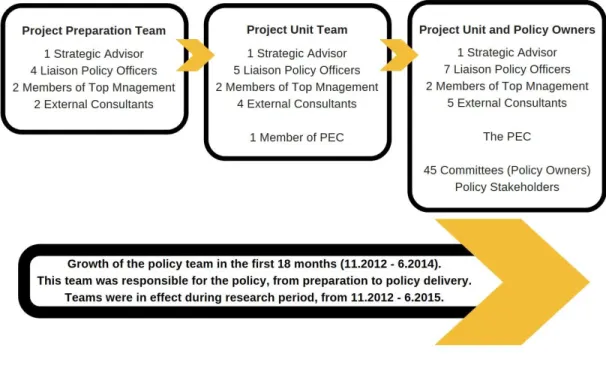
The remainder of 2012 was spent focusing on preparation and assessment of the federal-level PPP proposals. The author’s Strategic Department established a MOI Policy Section Team for the purposes of managing and maintaining effective deployment of PPP across the federal government during the PPP development process in 2013. The Strategic Department issued the strategic tender for establishing this PPP and allocated budgets. The department establish project teams in ADP and MOI, and a Policy Evaluation Committee (PEC) to provide feedback and responsiveness during the PPP development process The PECs also made decisions about the need for policy by assessing organisational capabilities and current problems. The Policy Section Team of the author’s Strategic Department also followed up and review proposals of on the ninety policies from the forty-five federal committees as they came in, and assessed their merit. At the end of 2012, the Strategic Department was also responsible for nominating an external consultation company that would provide the outsourced public policy consultation services needed by the MOI.
2013 was the first phase of the MOI strategic initiative planning. The MOI Policy Section Team ran the kickoff meeting, which defined the clear roles and expectations of and from all policy stakeholders. The first half of the year was then spent drafting new versions of PPP documentation which would guide the PPP process. This meant delivering PPP documents such as the assessment report of 2012 PPP model, producing the second version of T1 and T2, and issuing the PDF. The Strategy Department also developed the risk assessment criteria, prioritisation and study impact criteria, and authorisation matrix. This also meant working with external consultants to develop the governance framework (GF) documentation, a prolonged nine month process that required several drafts and collaboration with the stakeholders.
Concurrently, at the ADP, the author and her ADP Policy Section Team continued to deploy and reflect on the development of the use of force and rules of pursuit policies of 2012-2013. This included the development of new T1 and T2 documents, issuing new PDFs, writing governance and risk assessment criteria, developing study impact criteria, creating an authorisation matrix, and other parts of the pair of policies. The lessons learned from these experiences were then funneled into the development of MOI PPP proposals.
Starting in June of 2013, the MOI Policy Section Team drafted plans for the twenty-five highest priority policy suggestions from the ninety policy proposals which had been presented to the MOI Policy Section Team. The team required each committee responsible for these policies to fill out a second
34
version of their T1 and T2 documents for PEC approval. The MOI also improved longer-term planning by developing training materials, creating a three years plan for the policy implementation, and projecting a five-year roadmap for helping each policy unit to reach its full capacity as part of the overarching MOI policy push of 2013.
This included bringing in elements lessons learned from the PPP development in the ADP (because the author was a member of both Policy Section Teams). The MOI Policy Section Team conducted forty sessions of on-the-job training as part of the development and implementation of the first twelve policies. The MOI Policy Section Team also prepared for engagement between policy owners and SMEs to improve policy drafts (essentially plan SMEs contributions). Within the ADP, the author and her ADP policy section team continued to follow up on and reflect upon the implementation of the use of force and rules of pursuit policies.
However, it was clear at the end of 2013 that developing each of the twenty-five policies had not been achieved as planned. This because each policy was more complex than expected, and PPP development had not been properly oriented toward executing these policies. Twenty-two of the twenty-five proposals passed PEC approval (see Appendix 2); three were rejected by the PEC and were closed. By end of 2013, twelve policies had moved through stages 1, 2, and 3 of PPP (studying policy need and drafting policies, including approval from the PEC head) and ten policies were not yet ready for PEC
approval. By this point it had become clear that, in many cases, policy teams were more focused on creating a PPP than actually supporting committees to develop executable policy. The author and her MOI Policy Section Team made a series of recommendations to the consultants and committees regarding PPP development, based both on the lessons learned from the ADP policy deployments and the observations made during the first largely unsuccessful year of MOI policy development in 2012-2013. These recommendations are further discussed in Chapter Seven of this thesis.
This second phase of the MOI policy development and planning (the efforts in 2014 to shepherd the twenty-two PPP initiatives to readiness for implementation) also meant that the author was able to create a second pair of action research cycles, this time to study OL, by researching the 2013 MOI-level PPP development process and then adjusting her research to observe the 2014 MOI-level PPP development process to see how the organizational leadership had learned and created an environment conducive to learning. These multiple, concurrent cycles of insider action research are more clearly articulated and developed in Chapter Six of this thesis.
In 2014, the author continued to serve in her role as an adviser both on the Emirate-level ADP policy development, implementation, and reflection project and on the federal-level MOI PPP development policies, which were now limited to twenty-two proposals. The outsourced consultants’ contracts were renewed for 2014 as support services for developed policies only. The UAE
36
leadership’s plan for 2014 was to finish developing the best policy drafts, so it was important to identify all related stakeholders and manage the contributions of all Strategic Advisers (SAs) as related to each developing policy.
This created some problems with the external consultants, who proposed an unsatisfactory approach to working with the twenty-two policy initiatives that were moving at various paces of development. In early 2014, the external consultants suggested breaking the second round of PPP project planning into two streams. The first stream, provided support by one team of consultants, would move the twelve policies which had already received PEC approval into stages 4 and 5 of the PPP process (consultation and approval for implementation). The second stream, which would also be supported by its own team of consultants, would focus on developing the remaining 10 policies through stages 1 and 2 (studying policy need and drafting policies) for PEC approval. The external consultancy removed all of the consultants who had worked in 2013 to support the committees in proposing the first twelve policies, and instead proposed bringing in completely new staff to support both streams of policy development.
The author and her MOI Policy Section Team rejected this proposal, finding it problematic for a variety of reasons, most important of which is that there would be no continuity of knowledge or experience gained from the first year of MOI PPP planning if the consulting contract did not include the same personnelle. In addition, there were concerns about maintaining quality
throughout the overall MOI PPP planning initiative if different consulting teams were supporting different groups of policies. Finally, it had become clear during the 2013 MOI PPP development efforts that many of the new policy initiatives informed each other and shared stakeholders; having two different teams of consultants supporting some policy owners and not others could have led to failures in communication and wasted time.
The author and her Strategy Department countered the external consultants’ proposal by requiring that two of the previous consultants who had worked on the twelve successful PPP initiatives return in 2014. In addition, the two consultant teams who would be supporting each set of committees in their respective streams would be required to actively develop approaches for sharing knowledge and promoting learning within the MOI; both teams would be required to liaison with the MOI to ensure this OL was occurring. Consultants were required to develop documents which captured changes or new ideas at each stage of PPP to ensure that everyone in both streams was aware of progress being made in PPP development. Thus, easily accessible documents were also required of the consultants in both streams, so all interconnected stakeholders could share knowledge.
Chapters Seven and Eight contain a more detailed discussion of these challenges faced in outsourcing to external consultants within the context of NPM in the UAE and how those challenges were faced within the context of OL. Generally, the author and her Strategy Department oversaw the efforts of the