ISSN (Online): 2320-9364, ISSN (Print): 2320-9356 www.ijres.org Volume 5 Issue 5 ǁ May. 2017 ǁ PP. 55-61
An Improved Adaptive Multi-Objective Particle Swarm
Optimization for Disassembly Line Balancing Problem
Xiao Shan-li
1, Nie Shan-kun
1(1.School of Electric and Electronic Engineering, Shanghai University of Engineering Science, Shanghai 201620, China)
Article Info Abstract
Article History
Received: 01 Month Year
With the development of productivity and the fast growth of the economy, environmental pollution, resource utilization and low product recovery rate have emerged subsequently, so more and more attention has been paid to the recycling and reuse of products. However, since the complexity of disassembly line balancing problem (DLBP) increases with the number of parts in the product, finding the optimal balance is computationally intensive. In order to improve the computational ability of particle swarm optimization (PSO) algorithm in solving DLBP, this paper proposed an improved adaptive multi-objective particle swarm optimization (IAMOPSO) algorithm. Firstly, the evolution factor parameter is introduced to judge the state of evolution using the idea of fuzzy classification and then the feedback information from evolutionary environment is served in adjusting inertia weight, acceleration coefficients dynamically. Finally, a dimensional learning strategy based on information entropy is used in which each learning object is uncertain. The results from testing in using series of instances with different size verify the effect of proposed algorithm.
Accepted: 01 Month Year
Keywords
disassembly line multi-objective fuzzy classification information entropy
I.
Introduction
DLBP is a multi-objective problem that was first described by Gungor and Gupta [1] and has been mathematically proven to be NP-complete by McGovern and Gupta [2]. Exhaustive search works well enough in obtaining optimal solutions for small-sized instance. However, its exponential time complexity limits its application to large sized instances [3]. Although some researchers have formulated the DLBP using mathematical programming techniques [4-5], they quickly become unsolvable for a practical-sized problem due to their combinatorial nature[3]. According to the above reasons, heuristic approaches to attain a (near) optimal condition with respect to objective functions are widely used to solve DLBP.
The DLBP model description Problem definition and formulation
This paper deals with the most extensively studied disassembly line balancing problem known as a deterministic and single-model of product that undergoes complete disassembly. Based on concept and assumptions made by Gungor and Gupta [6], the disassembly line balancing problem can be defined that a discarded product Pis composed of nparts and a part removal is considered as a task OPi.The tasks sequence
is then utilized to group the tasks into workstations of which the number is m. The precedence relationships
considered are of ANDtype and are represented using the immediately preceding matrix Xijn n where:
1
0
i j
ij
X
, i f t ask OP i mmedi at el y pr eccdes t ask OP
, ot her wi se
In order to state the partition of total tasks, we use the assignment matrix Yjk n m , where:
1
0
j jk
Y
, i f mt h t ask( OP ) i s assi gned t o t he kt h st at i on
, ot her wi se
A major constraint is to minimize the number of workstations for a given cycle time CT (the maximum time available at each workstation), this objective is represented as:
1
minf m (1)
The balance measure is represented as:
2 ' 2
1
min
m
i i
f CT t
(2)The third objective is given as follows:
3 1
min ( i)
n PS i
f i h
, 10 i
PS
h
hazar dous
ot her wi se (3)
A demand measure was developed to removal of high demand parts early in the part removal sequence. This measure is represented as:
4
1
min ( )
i n
PS i
f i d
, ,i
PS i
d N PS (4)
Subject to:
1
1, 1, 2,
m jk k
Y j n
(5)1 n
i
i t m n
CT
(6)1
, ( , )
m
ik jk
k
Y Y i j IP
(7)Equation (5) indicates that each task must be assigned to only one station. Constraint (6) guarantees that the number of stations with a workload does not exceed the permitted number. Constraint (7) imposes the restriction that all the disassembly precedence relationships between tasks should be satisfied.
II.
IAMOPSO approach for the DLBP
Arithmetic coding and decodingAccording to the permutation of n numbers, a priority based zero in-degree topological sorting technique [7] is used to decode the permutation to FDS. This algorithm selects the task from the candidate tasks based on priority and zero in-degree. In the procedure, a task is an available task only if it has not already been assigned to a workstation and all of its predecessors have already been assigned to a workstation.
Defined evolutionary states
Ensured the evolution factor parameter
The evolution factor parameter can be introduced to reflect the diversity and evolutionary status of the population, as detailed in the following equations.
The mean distance of each particle
i
to all the other particles is as follows.2
1, 1
1
( )
1
NUM D
k k
i i j
j j i k
d x x
NUM
(8)Using the pu represents the evolution factor parameter by the following equation:
Where, the
d
min andd
max are minimum and maximum mean distance, respectively.d
gis the mean distance ofglobally best particle to all the other particles.
Fuzzy classification
This paper partitions the pu into four sets, including exploration, exploitation, convergence, and jumping out in
each generation.
Exploration: the set is denoted by S1 and the fuzzy membership function is defined as follows in detail.
1
0, 0 0.4
5 2, 0.4 0.6
1, 0.6 0.7
10 8, 0.7 0.8
0, 0.8 1
u
u u
u u
u u
u
p
p p
S p p
p p
p
(10)
Exploitation: the set is denoted by S2 and the fuzzy membership function is defined as follows in detail.
2
0, 0 0.2
10 2, 0.2 0.3
1, 0.3 0.4
5 3, 0.4 0.6
0, 0.6 1
u
u u
u u
u u
u
p
p p
S p p
p p
p
(11)
Convergence: the set is denoted by S3 and the fuzzy membership function is defined as follows in detail.
3
1, 0 0.1
5 1.5, 0.1 0.3
0, 0.3 1
u
u u u
u
p
S p p p
p
(12)
Jumping-out: the set is denoted by S4 and the fuzzy membership function is defined as follows in detail.
4
1, 0 0.7
5 3.5, 0.7 0.9
1, 0.9 1
u
u u u
u
p
S p p p
p
(13)
Adjust adaptively the control of PSO parameter
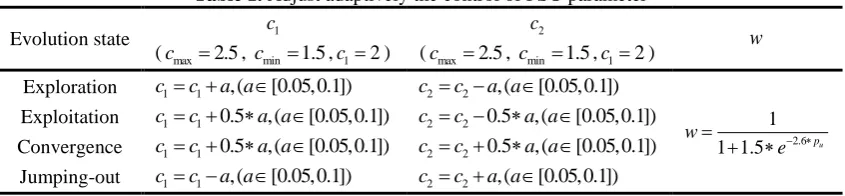
Adjust adaptively the control of PSO parameter is given in Table1.
Table 1. Adjust adaptively the control of PSO parameter
Evolution state c1
(cmax2.5, cmin 1.5,c12)
2
c
(cmax 2.5, cmin 1.5,c12) w
Exploration c1 c1 a a,( [0.05,0.1]) c2 c2 a a,( [0.05,0.1])
2.6
1
1 1.5 pu
w
e
Exploitation c1 c1 0.5a a,( [0.05,0.1]) c2 c2 0.5a a,( [0.05,0.1])
Convergence c1 c1 0.5a a,( [0.05,0.1]) c2 c2 0.5a a,( [0.05,0.1])
Information entropy
Suppose that the number of FDS is NUM, in which includes element of D numbers, Rj represents a
set including the jth element of all FDSs, bij is a number of repeated values in theRj.Pij represents the
occupancy of the jth element of th
i FOS in the Rj. The information entropy of the th
j element in the all FDSs can be calculated by following formula:
2 1
1 log
D ij i
j ij ij
P H
b P
(14)The diversity of the FDSs can be expressed by the average information entropy of all FDSs.
2
1 1
1 1
log
NUM D
ij
i j ij ij
P H
NUM b P
(15)Selection particle of good diversity
In order to further enhance the convergence speed and precision of the algorithm ,
i was introduced to assessthe diversity of corresponding particle whether has good diversity by following formula and the smaller the
i is the more diversities the corresponding particle has. The particle with good diversity isdenoted bypbestbin.
i H Hi
(16)Proposed MOPSO Algorithm Procedure for DLBP
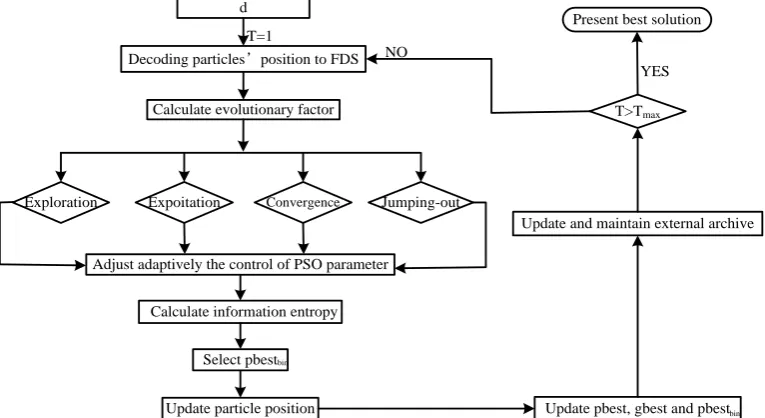
The aforementioned procedure is iteratively followed until the maximum number of cycles (Tmax), which is
adopted as the termination criteria, has been traced. The program flowchart of the procedure is shown in Figure1.
d
Decoding particles’position to FDS
Calculate evolutionary factor
Update particle position Update pbest, gbest and pbest
Update and maintain external archive Present best solution T=1
NO
YES
bin Adjust adaptively the control of PSO parameter
Exploration Expoitation Convergence Jumping-out
Calculate information entropy
Select pbest bin
T>Tmax
Figure 1. The procedure of improved MOPSO for DLBP
III.
Numerical results
The number of the population NUM is set to be 100. The size of the external non-dominated NP is set to 50, a maximum number of iteration Tmax is set equal to 300, other parameters: w is set to 0.729, pc is set
46 44
30 43
25 49 51
36 3
2
1 9
12
47
26
40
32
18 21
4 31
45
15
33 42
17 28
16 24
50 48
41
35 8
13
20
34 22 7
27 19
10
5 6
52 29 14 11 23 38
37 39
Figure 2. Precedence relationships for the components
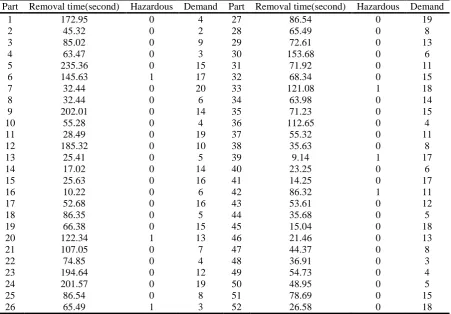
Table 2.Knowledge base for 52-part DLBP instance
Part Removal time(second) Hazardous Demand Part Removal time(second) Hazardous Demand
1 172.95 0 4 27 86.54 0 19
2 45.32 0 2 28 65.49 0 8
3 85.02 0 9 29 72.61 0 13
4 63.47 0 3 30 153.68 0 6
5 235.36 0 15 31 71.92 0 11
6 145.63 1 17 32 68.34 0 15
7 32.44 0 20 33 121.08 1 18
8 32.44 0 6 34 63.98 0 14
9 202.01 0 14 35 71.23 0 15
10 55.28 0 4 36 112.65 0 4
11 28.49 0 19 37 55.32 0 11
12 185.32 0 10 38 35.63 0 8
13 25.41 0 5 39 9.14 1 17
14 17.02 0 14 40 23.25 0 6
15 25.63 0 16 41 14.25 0 17
16 10.22 0 6 42 86.32 1 11
17 52.68 0 16 43 53.61 0 12
18 86.35 0 5 44 35.68 0 5
19 66.38 0 15 45 15.04 0 18
20 122.34 1 13 46 21.46 0 13
21 107.05 0 7 47 44.37 0 8
22 74.85 0 4 48 36.91 0 3
23 194.64 0 12 49 54.73 0 4
24 201.57 0 19 50 48.95 0 5
25 86.54 0 8 51 78.69 0 15
26 65.49 1 3 52 26.58 0 18
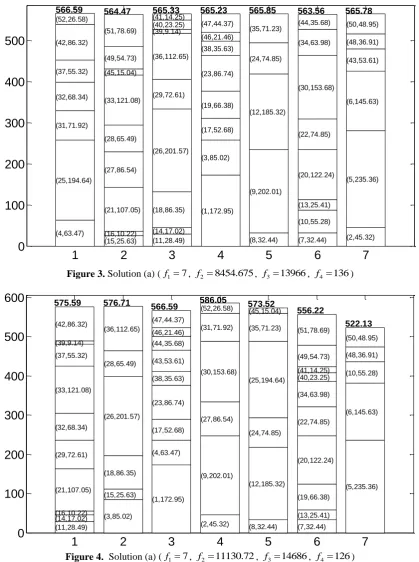
Two Pareto optimal solutions obtained by DLBP IAMOPSO on different runs are given in Figure3 and Figure4,
the function values are as follows: f17, f28454.675, f313966, f4136 and f17, f211130.72,
314686
f , f4126. The results of computer simulation indicate that the DLBP IAMOPSO has performance
Figure 3. Solution (a) ( f17, f28454.675, f313966, f4136)
Figure 4. Solution (a) ( f17, f211130.72, f314686, f4 126)
IV.
Conclusion
The main intent of this paper is to build a particle dimension of the particle swarm of the total number of tasks, and through particle swarm optimization method obtains the best disassembly sequence. Both theoretical proof and numerical experiments indicate that this algorithm is superior to the other algorithms in terms of the objective values.
1
2
3
4
5
6
7
0
100
200
300
400
500
(4,63.47) (25,194.64) (31,71.92) (32,68.34) (37,55.32) (42,86.32) (52,26.58) 566.59 (15,25.63) (16,10.22) (21,107.05) (27,86.54) (28,65.49) (33,121.08) (45,15.04) (49,54.73) (51,78.69) 564.47 (11,28.49) (14,17.02) (18,86.35) (26,201.57) (29,72.61) (36,112.65) (39,9.14) (40,23.25) (41,14.25) 565.33 (1,172.95) (3,85.02) (17,52.68) (19,66.38) (23,86.74) (38,35.63) (46,21.46) (47,44.37) 565.23 (8,32.44) (9,202.01) (12,185.32) (24,74.85) (35,71.23) 565.85 (7,32.44) (10,55.28) (13,25.41) (20,122.24) (22,74.85) (30,153.68) (34,63.98) (44,35.68) 563.56 (2,45.32) (5,235.36) (6,145.63) (43,53.61) (48,36.91) (50,48.95) 565.78Workstatons
T
im
e
(se
co
n
d
)
1
2
3
4
5
6
7
References
[1]. Aşkiner Güngör, Surendra M. Gupta. Disassembly line in product recovery[J]. International Journal of Production Research, 2002, 40(11):2569-2589.
[2]. Mcgovern S M, Gupta S M. A balancing method and genetic algorithm for disassembly line balancing[J]. European Journal of Operational Research, 2007, 179(3):692-708.
[3]. Kalayci C B, Polat O, Gupta S M. A hybrid genetic algorithm for sequence-dependent disassembly line balancing problem[J]. Annals of Operations Research, 2016, 242(2):321-354.
[4]. Özceylan, Eren, Paksoy T. Fuzzy mathematical programming approaches for reverse supply chain optimization with disassembly line balancing problem[J]. Journal of Intelligent & Fuzzy Systems, 2014, 26(4):1969-1985.
[5]. Mete S, Çil Z A, Özceylan E, et al. Resource Constrained Disassembly Line Balancing Problem[J]. IFAC-PapersOnLine, 2016, 49(12):921-925.
[6]. Mcgovern S M, Gupta S M. Ant colony optimization for disassembly sequencing with multiple objectives[J]. The International Journal of Advanced Manufacturing Technology, 2006, 30(5):481-496.
[7]. Dou J, Su C, Li J. A Discrete Particle Swarm Optimization Algorithm for Assembly Line Balancing Problem of Type 1[C]// Third International Conference on Measuring Technology and Mechatronics Automation. IEEE Computer Society, 2011:44-47.
Author Information Shanli Xiao
Shanghai University of Engineering Science Longteng road 333, songjiang district, Shanghai Contact e-mail:582564269@qq.com
Shankun Nie